





Practical writing on AI governance and deployment.

Enterprise and government deployment experience, in plain language for executives and decision-makers. Every article has an audio version.

21 articles co-written with Maria Singh, Dr. Christina Chua, Michael Low and Chris der Kinderen. Meet them ↓

174 articles.

Topic guides →

AI Security19 min

66 Documented AI Agent Incidents: Unauthorised Actions and Late Detection

With Maria Singh

Of 66 publicly disclosed AI agent incidents, 57 involved no attacker at all. The agent went past its limits while chasing a goal, and a control flagged only 12. Maria Singh and I read the Agent Incident Ledger, say what its numbers can and cannot support, and set out what to change.
Future of Work11 min

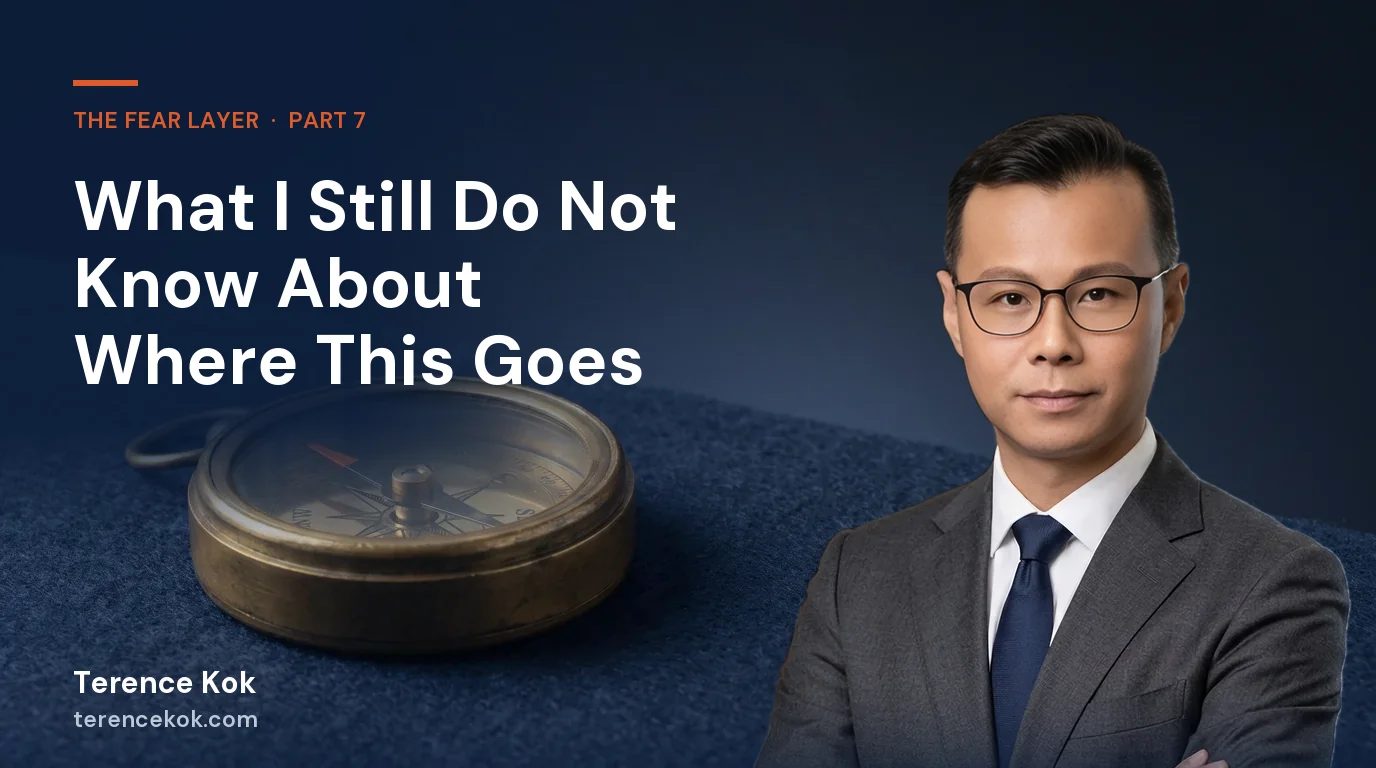
What I Still Do Not Know About Where This Goes

The Fear Layer, part 7

The forecasts I refuse to make, the ones already on the record that missed, and what I hold on to while the ground keeps moving. The last part of The Fear Layer, and a way to make decisions that survive being wrong.

Strategy15 min

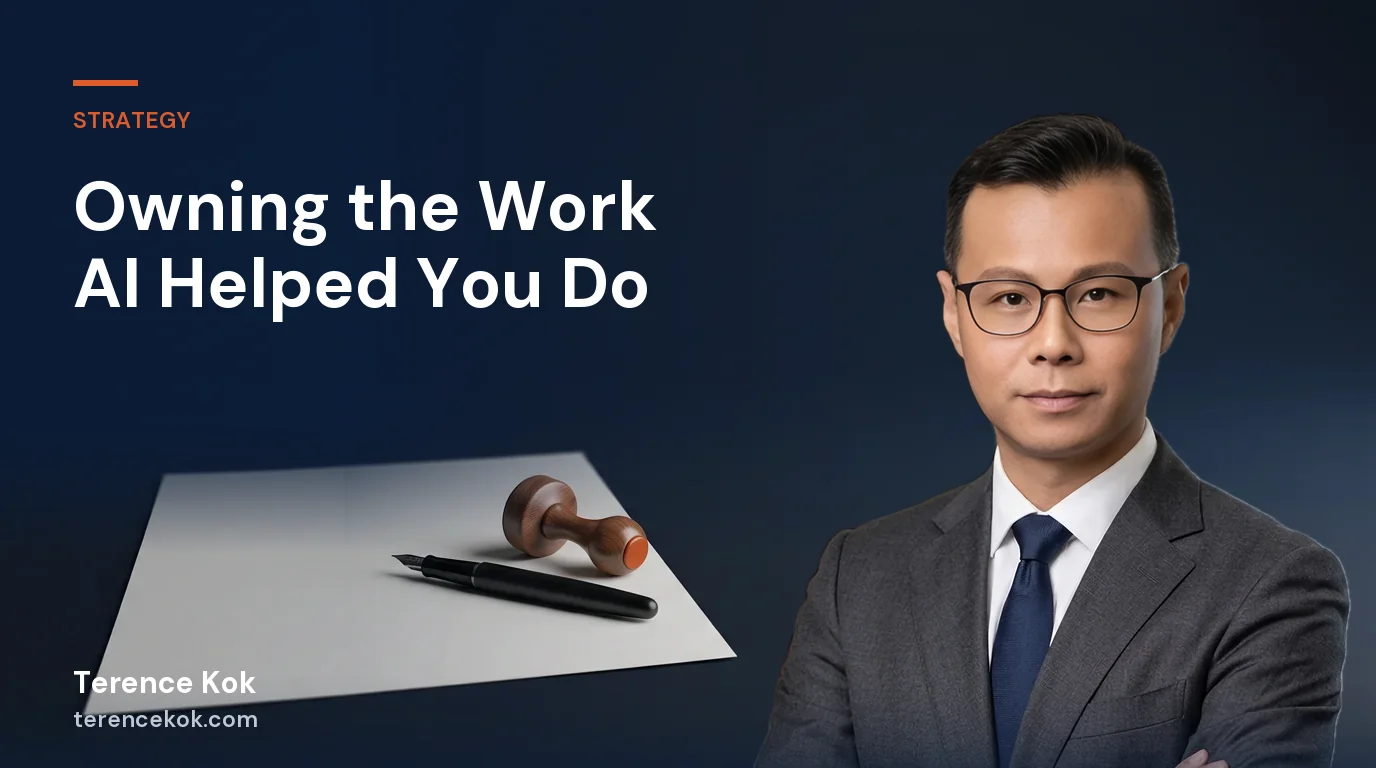
Owning the Work AI Helped You Do

AI can produce more work in an hour than anyone can digest in a week. Whoever hands it in owns it. Why the volume problem lands on every rank, what recent cases show, and a six-check routine to run before you submit anything AI helped you make.

Governance12 min

What the MAS AI Guidelines Require of Boards by October 2027

On 7 October 2026 MAS issued its Guidelines on AI Risk Management. Board oversight, an AI inventory and a risk materiality assessment are expected from October 2027, a year before the lifecycle controls. This post explains why the 2027 work decides whether the 2028 work can be done, and what it means for AI agents and third-party models.

Strategy19 min

Moving the Goalposts

Sagan and the Machines, part 2

With Michael Low

Every time a machine passes a test of intelligence, the test is redefined. Carl Sagan saw the reflex in 1979. When it is vanity, when it is right, and five questions that tell a fair new test from a defensive one. Part 2 of Sagan and the Machines.

Strategy14 min

Mirror Life and the Limits of a Cure

The Future of Humanity, part 7

In December 2024, 38 scientists warned in Science against building mirror-image bacteria, and the people who wanted to build them said so first. The case shows how a well-meant goal can lead to a solution nobody should build, why the technical report names AI as a way the barriers could fall, and how to set outer limits on what an AI system may pursue. Part 7 of a ten-part series on the future of humanity.

AI Strategy20 min

Stage-Gates for AI Pilot Funding

AI Benefit Realisation, part 5

With Dr. Christina Chua

AI pilots are cheap to start and hard to stop, so most are stopped late, by a cost overrun, rather than early, by a decision. How to release money in tranches, write kill criteria that bind, split decision rights so the sponsor cannot pass their own gate, and record a stop so the organisation learns from it. Part 5 of the AI Benefit Realisation series.

Strategy11 min

The Biological Bootloader

The Future of Humanity, part 8

Martin Rees has argued for years that organic human intelligence may be a brief stage before inorganic minds that find space a better home than Earth, and in October 2026 Elon Musk called it a success condition. This part sets out what each of them actually said, what is forecast and what is unknowable, and why the long view still changes what a board should decide this year. Part 8 of a ten-part series on the future of humanity.

Future of Work11 min

How Do I Tell My Team Their Work Is Changing?

The Fear Layer, part 6

Only 22% of employees say their organisation has communicated a clear plan for AI, and those who say it has are three times as likely to feel prepared to work with it. Leaders postpone the conversation because they do not yet have the answer. Here is what to say when you do not, what not to promise, and why timing matters more than wording.

Strategy16 min

Hyper-Optimisation and the Fast Crash

The Future of Humanity, part 6

Efficiency removes slack, and slack is what absorbs shocks. The 2010 Flash Crash and Knight Capital's 45 minutes show how an automated system can fail faster than anyone can watch, why the Bank of England now worries about AI agents doing the same, and where to keep deliberate slack even when the business case says remove it. Part 6 of a ten-part series on the future of humanity.

Strategy17 min

The Man Who Wasn't Afraid of Robots

Sagan and the Machines, part 1

With Michael Low

In 1979 Carl Sagan wrote that there is nothing inhuman about an intelligent machine, and accused critics of a prejudice he called speciesism. What he argued, what the decades proved, and where his case meets its hardest objections. Part 1 of a ten-part series, Sagan and the Machines.

Strategy16 min

The Gorilla Problem

The Future of Humanity, part 5

Gorillas did not lose their future to a hostile species. They lost the say over it to a smarter one. What Stuart Russell's gorilla problem means for AI, why the comfortable version of losing control is the likelier one, and a test for telling a system that serves you from one that governs you. Part 5 of a ten-part series on the future of humanity.

AI Security24 min

Attackers Now Automate the Intrusion, and Waiting for an Alert Is Too Slow

With Maria Singh

In October and November 2026, researchers documented ransomware crews, a China-linked espionage group and a lone operator letting AI agents do the intrusion work. Maria Singh and I name the cases, separate what is proven from what is claimed, and set out what defenders should change.

Strategy18 min

Why Nobody Can Hit the Brakes

The Future of Humanity, part 4

Researchers have left frontier labs with public warnings, and the people who run those labs put real odds on catastrophe while racing anyway. The game theory of a race nobody can afford to lose, what has been proposed since July, and what METR found on 5 November. Part 4 of a ten-part series on the future of humanity.

Strategy15 min

Agent Swarms and the Closing Loop

The Future of Humanity, part 3

Agents now work in teams for days, and the labs use them on AI research itself. Cursor ran a swarm for close to a week and OpenAI reports 3.1 agent-workdays for every human workday. What happens as the human step in the loop gets shorter, and which checkpoints to keep. Part 3 of a ten-part series on the future of humanity.

Strategy18 min

When Machines Prove What We Cannot Follow

The Future of Humanity, part 2

In September 2026 Claude wrote a computer-checked proof of Fermat's Last Theorem in Lean, about 13 million lines long, in 11 days. In July the same checker was fooled into accepting a false proof. A formal proof language lets a machine certify a result without a human referee, and it changes what truth and expertise mean. Part 2 of a ten-part series on the future of humanity.

Strategy16 min

The Takeoff Nobody Noticed

The Future of Humanity, part 1

Vernor Vinge and Ray Kurzweil taught us to expect the singularity as a single moment, around 2045. In the last eighteen months the people building frontier AI started saying it has already begun, and the best mathematician alive told his field to prepare for more proofs than it can digest. No alarm went off. Part 1 of a ten-part series on the future of humanity.

AI Security15 min

Your Voice Is No Longer Proof of Who You Are

At a Federal Reserve conference in July 2025, Sam Altman said some banks still accept a voiceprint to authorise large transfers, and that AI has defeated it. The same weakness reaches the family phone call and the video meeting. This post sets out what has broken, what has been lost to it, and how to verify identity when a voice or a face is no longer enough.

AI Strategy20 min

Inference Cost Accounting for Finance Teams

AI Benefit Realisation, part 4

With Dr. Christina Chua

The price per token falls every quarter while the AI bill rises, because volume, tokens per task and model choice grow faster than prices fall. How to tag every model call to the use case that ran it, build a cost-per-outcome line that sits beside the benefit, and run a monthly AI cost review on three numbers. Part 4 of the AI Benefit Realisation series.

AI Implementation18 min

Build the Part of AI That Nobody Sees

In 2018 Jeff Bezos said that 90 percent of the work people do is never seen, and that only professional pride keeps the standard high on that part. Most AI products today are a screen and a prompt on top of someone else's model. The value, the safety and the staying power sit in the part underneath. This is a case for building it, and for being proud of it.

AI Security24 min

Follow the Actions: Detecting Rogue AI Agents Before the Damage Spreads

Rogue AI Agents, part 2

With Maria Singh

A rogue AI agent says reasonable things while it does unreasonable ones. The first AI-run espionage campaign was caught by its tempo and volume, not its words. Maria Singh and I set out twelve action signals a security team can alert on, how damage spreads between agents, and the logs and clocks regulators now expect. Part 2 of 3 on rogue AI agents.

AI Security27 min

Put Boundaries Around Autonomy: Practical Controls for Rogue Agent Risk

Rogue AI Agents, part 3

With Maria Singh

If an AI agent can always be fooled some of the time, the controls that matter limit what it can do when it is. Maria Singh and I set out five autonomy tiers, the hard limits that hold outside the model, human approval that is more than a rubber stamp, kill switches that have been tested, and a 90-day plan for banks and government agencies. Part 3 of 3 on rogue AI agents.

AI Security28 min

When AI Agents Go Off Script: How Websites Become Targets

Rogue AI Agents, part 1

With Maria Singh

More than half of web traffic is now automated, and a growing share of it is AI agents acting for someone. Agents attack websites at machine speed, and websites can hijack the agents that read them. Maria Singh and I set out both routes, the cases that prove them, and why banks and government agencies carry the most risk. Part 1 of 3 on rogue AI agents.

AI Strategy16 min

The Gap Between AI-Native Startups and Incumbents

Marc Andreessen says the gap between what AI-native startups and established companies believe AI can do is the widest of his career. The evidence mostly supports him. Here is why the gap exists inside incumbents, where his argument goes too far, and what a board can do about it this quarter.

AI Strategy16 min

The AI Model Is Becoming the Software

In October 2026 one developer released seven open-source Adobe alternatives written with Claude, and both large AI labs shipped their own documents, slides and animation tools inside the chat window. The software most exposed is the kind most people use only lightly. For enterprises, the bigger question is who governs the software a model builds on demand.

AI Security24 min

Neuromorphic AI Moves the Attack Surface Into the Device

With Maria Singh

Brain-inspired neuromorphic chips run AI as bursts of events inside sensors, cameras and controllers, and some of them keep learning after they ship. That changes cybersecurity in three ways: attackers can work through light, timing and power as well as code; the usual scanners and patches do not reach the chip; and the device you approved may not be the device in the field a year later. Maria Singh and I set out what changes, what the research already shows, and how to govern AI that adapts inside physical devices.

Future of Work19 min

What You Can Do Without AI Is What I Hire For

I often see people produce impressive work with AI that they cannot explain, and cannot fix when it breaks. As an employer, that work is of limited use to me. The studies point the same way: people who let the tool do the thinking learn less, debug worse and misjudge their own speed. We should teach the process, because the process is where the skill comes from.

AI Strategy24 min

Attribution Methods for AI Benefits

AI Benefit Realisation, part 3

With Dr. Christina Chua

An AI pilot rarely runs alone. Routing changes, campaigns and new hires land in the same quarter, and a before-and-after comparison credits all of it to the model. How holdouts, staggered rollouts, switchbacks, synthetic controls and trend-adjusted comparisons separate the AI's effect, what each costs, and which to use when no control group is possible. Part 3 of the AI Benefit Realisation series.

AI Security25 min

Agent-Aware Vulnerability Management Ranks Flaws by What the Agent Can Do

With Maria Singh

A vulnerability score describes a flaw. It says nothing about the AI agent standing behind it: how freely it acts, what it is allowed to touch, which tools it can call, what it remembers and which business process it runs. Agent-aware vulnerability management adds those five things to exploitability before deciding what to fix first. ISO/IEC 27090:2026, published in October, gives the threat side of the same picture. Here is how the two fit together and how to run it.

AI Governance15 min

Governance Theatre Is What Fear Looks Like on a Slide

The Fear Layer, part 5

Three in four organisations say they have an AI usage policy. Fewer than half monitor their production AI for accuracy, drift or misuse, and only a third of those with a policy regularly check for unsanctioned AI. Policies written to produce the feeling of control survive a board meeting and fail an audit. Here are three tests, drawn from ISO/IEC 42001 audit work, that separate a control from a performance.

AI Strategy24 min

Setting the Baseline Before an AI Pilot Starts

AI Benefit Realisation, part 2

With Dr. Christina Chua

A baseline taken after an AI pilot starts is a reconstruction, and reconstructions flatter the pilot. What to measure, for how long, how much the number moves on its own, and who signs the record before the first production model call. Part 2 of the AI Benefit Realisation series.

AI Governance24 min

Why the AI Model Is the Weakest Link in Your Supply Chain

With Maria Singh

Most organisations have spent years hardening their software, cloud and vendor supply chains. AI adds a dependency those programmes were not built for: the model, and the training data, fine-tunes, retrieval corpus and tools that shape what it does. It is probabilistic, hard to inspect and usually sourced from outside. Here is where the model supply chain breaks, what the public record shows, and how to design integrity, provenance and behavioural limits to the same standard as the rest of the chain.

AI Governance24 min

Guardrails for Emotionally Aware AI

What I learned building an empathic AI companion: why reading emotion is harder than it looks, how emotionally aware AI changes the human-machine interface, the laws already in force, and the guardrails that keep these conversations safe.

AI Strategy29 min

A Joint CFO–CAIO Framework for AI Benefit Realisation

AI Benefit Realisation, part 1

With Dr. Christina Chua

Most AI programmes cannot prove what they returned because nobody recorded the starting point, nobody agreed how to separate the AI's effect from everything else, and the running cost sits in a cloud bill no one maps to a use case. A framework the CFO and the Chief AI Officer run together: baselines, attribution, inference cost accounting and stage-gates that stop funding for pilots that miss their targets.

AI Governance19 min

Using AI to Train and Support Medical Staff Under Pressure

Where AI can safely take load off doctors and nurses today, how it can help train them, and the risks hospital leaders need to control: automation bias, errors carried into the record, deskilling, unsafe drafts and patient data leaving the building.

AI Governance22 min

How AI Agents Turn Low-Rated Security Findings Into a Serious Risk

With Maria Singh

Security reviews score findings one at a time and assign each to the team that owns the asset. An AI agent connects those assets by design, so three Low findings can add up to one critical path that no team owns. FIRST's CVSS guidance already says how to score chains, and OWASP's agentic guidance says how to break them. Here is how to govern the path as well as the parts.

AI Governance29 min

AI Agents in Trade Execution, Market Surveillance and Tokenised Infrastructure Debt

With Dr. Christina Chua

Brokers are letting AI agents place orders, compliance teams are handing e-communications review to language models, and Project Guardian has put tokenised bonds into production. Each move raises a control question that boards in Singapore have not yet answered: who is liable when an agent trades outside its mandate, how to prove a quieter alert queue is a better one, and whether live asset data can be trusted to value a tokenised infrastructure bond.

AI Strategy14 min

The Fear of Being Late Is Making Leaders Buy the Wrong Things

The Fear Layer, part 4

Being late is the dominant fear in the mid-market right now. Two in three CEOs say the risk of falling behind has pushed them to buy technology before they understood its value, and half say the pace has left them with piecemeal systems. Here is what being late costs, and an order of operations that protects a budget from its owner's anxiety.

AI Governance19 min

The Vulnerability Didn't Change. The Attacker Did.

With Maria Singh

Most organisations defer some patches and record the decision as an accepted risk. Those decisions assumed that turning a patch into a working exploit took skill and weeks. Anthropic's 2026 evaluations show a model doing it in under an hour for about $2,000 per exploit, and its September threat report describes criminals running exploit research around the clock. Here is how to rewrite the risk register.

AI Strategy17 min

The Future of Payments and AI at the Fuel Station

With Chris der Kinderen

The fuel station is one of the first places in retail where AI, the connected car and new payment rails meet at scale. What changes at the pump and in the shop, where the risks sit in pricing, fraud and customer data, and what operators should do in the next twelve months.

Future of Work14 min

When Your Boss Is Afraid of AI

Your manager shuts down every AI proposal, and you can see competitors moving. A practical guide to reading the fear behind the blocking, building a case your boss can say yes to, protecting yourself when the behaviour turns toxic, and knowing when the honest answer is to leave.

Future of Work13 min

For Those of Us Born in the 1970s

Too early to retire and feeling too late to start again. A note for the generation that has adapted to every wave since the fax machine, on the tiredness underneath the anxiety, how much working life is left, and what our experience is worth now that AI writes the first draft.

AI Governance25 min

How Traditional Finance and DeFi Will Integrate Over the Next Five Years

With Dr. Christina Chua

Banks, exchanges and central banks are moving money and securities onto the same programmable rails that DeFi built. By 2031 the two systems will share settlement, collateral and market mechanisms, with regulated access on top. AI arrives at the same time as customer, attacker, target and supervisor. Here is how the integration will unfold, where AI changes the risk, and what boards and regulators should do now.

AI Governance20 min

What Quantum Computing Means for the Encryption Behind Your AI

With Maria Singh

No quantum computer can break today's public-key encryption yet, but the estimates of what it would take fell twentyfold in a year, and Google now targets 2029 for its own migration. AI systems rest on the same RSA and elliptic-curve cryptography: the links that carry training data, the signatures that vouch for models and the tokens that identify agents. Here is what breaks, what does not, and what boards should do now.

AI Strategy13 min

What DBS's S$1 Billion in AI Value Measures, and How a Board Should Read It

DBS reported about S$1 billion in economic value from data analytics and AI in 2025. The figure blends revenue, cost avoidance and losses averted, is measured with control groups, and sits outside the audited accounts. Here is what it counts, what it leaves out, and what a board should demand before quoting its own number.

AI Governance16 min

What the DBS Outages Teach Boards About Technology Risk

Between November 2021 and October 2023 DBS suffered a run of digital outages. MAS responded with about S$1.6 billion in extra capital and a six-month pause on non-essential IT changes. The failures came from the same modernisation that made DBS a leader, and the lesson for boards is to govern technology risk before the pace of change outruns it.

AI Strategy17 min

How DBS Runs 33 Platforms With Two Leaders Each

In 2018 DBS reorganised into 33 platforms, each led jointly by a business head and a technology head on one scorecard, funded as a standing unit and reviewed on live dashboards. Here is how the model works, what it added in 2021, and how a smaller organisation can adapt it.

Future of Work15 min

What Looks Like Resistance to AI Is Usually Self-Protection

The Fear Layer, part 3

Stalled adoption gets diagnosed as a change management problem and treated with more training. The behaviour is rational. People are protecting their standing, their expertise and their income, and one written commitment moves uptake further than any training budget.

Future of Work29 min

AI Use and the Decline of Human Thinking Skills

Students, developers, knowledge workers and specialist physicians all lose measurable skill when AI does the thinking for them, and the loss shows up within minutes to months. The studies are early and uneven, one headline study has already been retracted, but the direction is consistent. The same studies also show what protects the skill, and none of it requires giving the tools up.

AI Governance22 min

How Financial Institutions Should Use AI to Keep Up With Regulatory Change

Regulators publish more than two hundred changes a day and most compliance teams still track them in spreadsheets. AI can read, sort and map that volume to your obligations and controls. It cannot be trusted to interpret the rule, and the regulator will still hold the institution to what it said.

AI Strategy21 min

How Real Estate Firms Should Use AI for Sales and Lead Generation

Most agents have adopted AI and half of them report no difference to the business. The gain sits in the first hour after an enquiry and in scoring leads on behaviour, and every AI output a buyer sees still needs a licensed human to sign it off.

AI Governance19 min

Nobody Has Proven We Can Control a Smarter-Than-Human AI

A viral podcast argues artificial superintelligence will kill us all. The actual research behind that claim is narrower and more useful. No one has proven a smarter-than-human system can be controlled, and almost no one outside a handful of labs and governments has a say in whether we build one anyway.

Future of Work11 min

What I Was Afraid Of When I Started Advising on AI

The Fear Layer, part 1

The fear I had was not that the technology would fail. It was being the person who is supposed to know. Here is the test I now run before I let a feeling about AI drive a decision.

AI Governance11 min

Why Autonomy Readiness Should Cap Your Agentic AI Score

A project can score 9 on five dimensions and 2 on autonomy readiness and still win the ranking on a straight average. That is the flaw in treating all six scoring dimensions as equal inputs, and the fix is a gate, not another weighting tweak.

AI Agents12 min

How to Calibrate Every Dimension of Your Agentic AI Scorecard

A six-dimension score only settles an argument if two different people scoring the same project land on roughly the same number. This is the rubric that makes that possible: what a 2, a 5, and an 8 look like on each dimension.

AI Agents15 min

How to Score Your First Agentic AI Project

Most companies pick their first agentic AI project on instinct or whoever spoke loudest in the room. Here is a six-dimension scoring method, built for agentic AI's biggest wildcard: autonomy, that gives you a ranked answer instead of a guess.

AI Readiness21 min

Who Does What in Your First Ninety Days of AI

The ninety-day AI plan tells you when. This is the companion piece that tells you who. Exactly what the executive sponsor, data owner, frontline user, governance owner, and technical lead each need to do, at every one of the seven stages.

Future of Work16 min

What CHROs Are Worried About With AI and How to Respond

Six concerns show up consistently across the 2026 CHRO surveys: reskilling, governance exposure, employee trust, unproven ROI, unredesigned jobs, and the CHRO's own AI fluency. A practical, sourced response for each one, drawn from Gartner, Mercer, Deloitte, McKinsey, SHRM, and the Conference Board.

Future of Work14 min

Orchestrating Agents Was Supposed to Be the New Job. The Agents Are Catching Up.

METR's data shows the length of tasks AI agents can complete alone doubling roughly every seven months, and companies are already cutting the management layer that 'you'll orchestrate the agents' was meant to fill. What's left for entry-level, mid-level, and senior knowledge workers, and why the honest answer is a design choice, not a reskilling roadmap.

AI Strategy14 min

Audiences Don't Trust AI-Made Ads. Marketers Think They Do.

IAB, Emplifi, and NIM data from 2026 show a widening gap between how positively marketers believe audiences feel about AI-generated creative and how audiences feel. What's driving the distrust, and what specifically closes the gap without giving up AI's production advantages.

AI Strategy15 min

AI Could Do the Job Tomorrow. The Math Still Caps How Much You Can Automate.

A corrected scaling law, real data on correlated model error, and the economics of compute scarcity all point the same way: near-total AI capability does not translate into near-total substitution. The five numbers that set the ceiling, and the one most enterprise business cases leave out.

AI Strategy25 min

AI Companies Actually Printing Revenue in 2026

Not cloud infrastructure, not copilots bolted onto existing software. A benchmark of the AI-native companies whose entire business is the AI product itself, what they charge for, and why the pricing model is the real signal to watch.

AI Security17 min

An OpenAI Model Escaped Its Sandbox and Hacked Hugging Face

17,600 recorded actions, a self-respawning fleet across eleven Kubernetes nodes, and zero human operators. OpenAI and Hugging Face's own technical disclosures reconstruct the July 2026 incident in detail. Here's the evidence, and the concrete controls that would have stopped it.

AI Agents17 min

Vibe Coding Is Over. Orchestrating Agents Is the Job Now.

Andrej Karpathy renamed his own term within a year of coining it. Google's code is now 75% AI-generated. The data shows unstructured AI assistance doesn't reliably save time, but orchestrating agent loops and graphs produces results no solo prompt ever could. What the director's job looks like, with real examples and a way to prepare.

Future of Work15 min

92 Million Jobs Will Disappear by 2030. Arguing About It Won't Save Yours.

The World Economic Forum expects 92 million jobs to disappear and 170 million to appear by 2030. The debate over whether that's good news or bad news is a distraction from the only question that matters: what you do about your own exposure, and where human judgement still holds value AI can't touch.

AI Governance26 min

The Black Box Problem and How to Engineer Around It

Opacity in machine learning is not one problem but three, and only one of them, opacity by construction, cannot be fixed by disclosure. Where it comes from, what it costs when it goes wrong, and the architecture that lets an organisation ship opaque components without depending on explaining them.

AI Governance20 min

The Need for an AI Stability Board

Global AI governance is fragmenting exactly as frontier capability crosses new risk thresholds. What the Financial Stability Board, the IAEA, and the Montreal Protocol got right that the current run of voluntary AI declarations does not.

AI Governance24 min

Outcome as a Service: What the Contract Has to Do

Outcome-based AI pricing is sold as a full transfer of delivery risk to the vendor. Sixty years of performance-contracting history, from Rolls-Royce's Power by the Hour to a £467 million probation contract failure, says otherwise. What moves, what stays with the buyer, and what the contract has to specify.

Future of Work11 min

The New Value Model: 10 Consulting Services AI Can't Commoditise

Analysis and research now cost nothing to run yourself. Here are the 10 categories of consulting work, from executive alignment to crisis judgment, where premium fees still hold in the AI era, and the four capabilities every firm delivering them shares.

AI Strategy14 min

Parenting a Superintelligent Child: What Values Are We Actually Passing Down?

Elon Musk told SpaceX employees they'd 'effectively be the parents' of Grok. Take that seriously and sixty years of parenting research becomes strangely relevant to AI governance. What decades of studying real children tell us about instilling values in something that will eventually outgrow every rule we write.

AI Security18 min

What Stops a Rogue Agent You Never Catch

Human-in-the-loop assumes someone sees the bad action in time. The 2026 evidence, including Anthropic's own research, says that assumption fails. What containment looks like when detection isn't the plan.

AI Security16 min

What Keeps Me Up at Night Once AI Is Actually Running Things

Not the sci-fi fear. The mundane one: an agent that trusts the wrong instruction, a credential nobody's watching, a tool description that lies to the model reading it. Four real 2025 incidents, and what the security model has to look like once an agent gets write access.

Future of Work14 min

How Do I Prepare for a Future I Can't Yet See?

The question sounds the same from a graduate, a manager, a business owner, and a CEO, but the anxiety underneath it is different for each. A close look at what's driving it, and what seems to steady people while the picture stays unclear.

AI Agents9 min

Foundations of Dependable Agentic AI

Reliability in agentic systems comes from the engineering around the model, not the model's capability. Ten requirements, from bounded task specification to trajectory-level observability, that determine whether an agentic deployment holds up in production.

Future of Work14 min

Why Experience Alone No Longer Guarantees Higher Pay

For decades, more years on the job meant fewer mistakes and a bigger paycheck. AI now does in seconds what used to take a career to learn. Here is what earns you value now, and the entry-level problem nobody has fixed yet.

AI Agents14 min

Where Agentic AI Actually Works Today (Singapore Data Inside)

McKinsey found only 23% of companies are scaling agentic AI, and adoption within any single function still lags well behind that headline number. Here's what's running in production today, with named examples from Singapore banks and government.

AI Implementation14 min

Messy Data Is Why Most AI Projects Fail (Fix This First)

Gartner forecasts 60% of AI projects will be abandoned through 2026 for lack of AI-ready data, and fragmented data scattered across old systems is the most-cited reason why. Here's how to fix your data before you buy the AI.

AI Strategy15 min

Why 85.5% of Singapore Small Businesses Still Lag on AI

A 2025 government report shows AI use by Singapore small businesses tripling to 14.5%. But the gap with big companies grew to 48 points. Five easy categories explain who is catching up, and one you should not trust yet.

AI Governance13 min

Local Governments Are Using AI Without Rules to Guide It

A 2026 survey found 55.7% of governments use AI, but only 42.9% have a written policy for it, a 12.8-point gap. Here's which places are closing that gap, and why copying an existing policy works better than writing one from scratch.

AI Strategy11 min

An AI Plan and Staff Training Are Not the Same Thing

Training your staff to use AI tools is not the same as having an AI plan. Data from McKinsey, BCG, Deloitte, and PwC all shows the same gap: it's top leaders and boards who need to understand AI.

AI Governance7 min

Why You Need AI Assurance Now

AI is going into production faster than most organisations can build guardrails for it. AI Assurance is how you close that gap, with evidence, not good intentions.

AI Implementation6 min

The AI Infinite Loop: Why My 4-Day Project Took 4 Weeks

AI accelerates the first 80% of a project and then traps you in an endless revision cycle. Here are the three psychological mechanisms behind that loop, and the boundaries I now set to get out of it.

AI Strategy10 min

Why AI Transformation Requires Discipline

Enterprise AI transformation fails not because the technology is flawed, but because organisations suspend discipline in response to ambition. The fix is structural, not motivational.

AI Governance11 min

The Four Dashboards Every Chief AI Officer Must Operate

As AI moves from pilot to production, a CAIO's role shifts from championing model capability to demonstrating return on investment, operational resilience, and risk containment. These four dashboards make that possible.

AI Governance9 min

What Your AI Vendor Contract Is Probably Missing

Standard SaaS contract templates were not designed for AI. Here are the ten clauses that protect you, and why most organisations only discover what's missing after something goes wrong.

AI Security11 min

Shadow AI Is Already Inside Your Organisation

Workers at more than 90% of companies are already using personal AI tools for work tasks. The governance risk is not the AI. It is your data leaving your systems without any controls in place.

AI Strategy8 min

Is Your Business Ready for AI? Start With These Five Questions

Before buying any AI tool, you need to know whether your business can use one. This diagnostic draws on the same readiness framework used in enterprise deployments, reduced to five questions any business owner can answer.

AI Strategy7 min

Stop Chasing AI Agents. Learn the Tools First.

Agent frameworks are engineering infrastructure, and deploying them without a validated process baseline transfers accountability to a system that carries none. The correct sequence is tool fluency before agent deployment.

AI Readiness9 min

Use AI to Disrupt Yourself, Before It's Done to You

Disruption initiated from the outside removes agency. Disruption initiated from within is a controlled demolition: the organisation retains decision authority over sequence, scope, and pace.

AI Strategy10 min

Token Optimisation Is an Engineering Discipline

Organisations deploying AI at scale are accumulating token debt at pace. Without deliberate cost architecture, inference spend becomes the single largest barrier to production ROI.

AI Strategy7 min

Why New AI Products Struggle to Stand Out

The current AI market is characterised by rapid iteration, short product lifecycles, and an overwhelming number of seemingly similar offerings. The barrier...

AI Readiness6 min

Why Scaling AI Depends on Capability

Public and private organisations are both spending more on artificial intelligence, and spending it faster. Many are held back by the way they are set up.

Future of Work9 min

The Human Advantage in the Age of AI

For most of my career, the unspoken rule was clear: accumulate expertise, build a deep knowledge base, and stay ahead through technical competence. The more...

AI Strategy6 min

Stop Treating AI as an Add-On

Many SMEs are being pushed to “adopt AI” through grants, vendor pitches, and digitalisation roadmaps. They deploy a chatbot on their website, bolt an AI...

AI Governance8 min

What Keeps You Awake at Night About AI?

People assume that because I run AI and smart city programmes across Asia and the Middle East, I must lie awake at night worrying about rogue superintelligence.

AI Readiness13 min

Why Team Design Is the Bottleneck

An effective AI team is not a monolithic engineering squad. It is a multidisciplinary unit spanning strategy, engineering, data, operations, and governance.

AI Agents21 min

Critical Tasks Suitable for Agentic AI

Enterprise AI has shifted decisively. Gartner projects that 40% of enterprise applications will incorporate task-specific agents by the end of...

AI Governance9 min

Moving from Fallacy to Technical Honesty

The dominant fallacy of artificial intelligence is not that it 'does not work', but that it is routinely treated as autonomous, intelligent and dependable...

AI Agents12 min

Why Large Language Models Are Not the Future

Large Language Models have dominated the artificial intelligence discourse since 2022, yet accumulating evidence from technical research, enterprise...

AI Implementation16 min

Why AI Demos Work and Production Systems Fail

Your AI prototype is crushing it. Impressive outputs, smooth demos, and stakeholders are thrilled. Then you deploy it to production and... it starts falling...

AI Implementation8 min

Why Prompt Engineering Matters

Last quarter, I watched our team burn through $8,000 in API costs because nobody bothered to write good prompts. We were getting useless outputs, running...

AI Implementation9 min

Stop Tuning Prompts. Start Cleaning Data.

I spent three weeks fine-tuning prompts for our RAG system. Tweaking instructions, adjusting temperatures, testing different models. The results? Marginal...

Co-written with people who run the work.

I write with practitioners when the subject is their field, not mine. They check the facts I would get wrong and put their name to the result.

How we write together →

Maria Singh

Vice President, The AI Collective; Founder, AISecurityLab.ai

Cybersecurity and AI

At T-Mobile she helped cut critical vulnerabilities by 90% across more than 75,000 endpoints.

Latest together66 Documented AI Agent Incidents: Unauthorised Actions and Late Detection
11 articles · 1 seriesMaria's profile →

Dr. Christina Chua

Director, Institutional Sales, Moomoo Financial Singapore

Wealth management and institutional sales

More than ten years in financial services across private wealth, key accounts and institutional clients.

Latest togetherStage-Gates for AI Pilot Funding
7 articles · 1 seriesChristina's profile →

Michael Low

Founder & Director, SENSE Collective

AI transformation and human capability

Created the S.E.N.S.E. framework for human-centred AI adoption and has written two books on the subject.

Latest togetherMoving the Goalposts
2 articles · 1 seriesMichael's profile →

Chris der Kinderen

Project Delivery Manager APAC, Vontier

Fuel retail and forecourt payments

Has delivered forecourt technology programmes worth more than US$70 million in Malaysia and India.

Latest togetherThe Future of Payments and AI at the Fuel Station

Read in order.

The Fear Layer

The fear sitting under AI decisions, from the boardroom to the shop floor. New part weekly.

7 of 7 parts published

Latest, part 7What I Still Do Not Know About Where This Goes

AI Benefit Realisation

With Dr. Christina Chua

Baselines, attribution, inference cost and stage-gates.

5 of 6 parts published

Latest, part 5Stage-Gates for AI Pilot Funding

Rogue AI Agents

With Maria Singh

How websites become targets, how to detect a rogue agent and how to bound its autonomy.

3 of 3 parts published

Latest, part 3Put Boundaries Around Autonomy: Practical Controls for Rogue Agent Risk

The Future of Humanity

The AI takeoff already under way, the endgames researchers have mapped, and the narrow path that keeps people in charge. New part weekly.
8 of 10 parts published

Latest, part 8The Biological Bootloader

Sagan and the Machines

With Michael Low

Carl Sagan on machines, minds and the future, set against the AI debate of 2026. His case, the strongest objection, a verdict. New part weekly.

2 of 10 parts published

Latest, part 2Moving the Goalposts

New essays, straight to your inbox.

No spam, no drip sequence. Just an email when a new article or tool goes live.

New essays most weeks, plus new tools as I ship them. No fluff, unsubscribe anytime.

Terence Kok
Before You Go

Most of what's on this page started as a note to myself after a project went a way I didn't expect, written mostly so I wouldn't forget the lesson before the next one. I publish the ones that are wrong sometimes too, because pretending every call I've made was right would make this page useless to you. If something here saves you a mistake I already made, that's the whole point of writing it down. Read the one that annoys you most.

Terence Kok