



Listen to this article
Jump to a section
In this article
Executive Summary
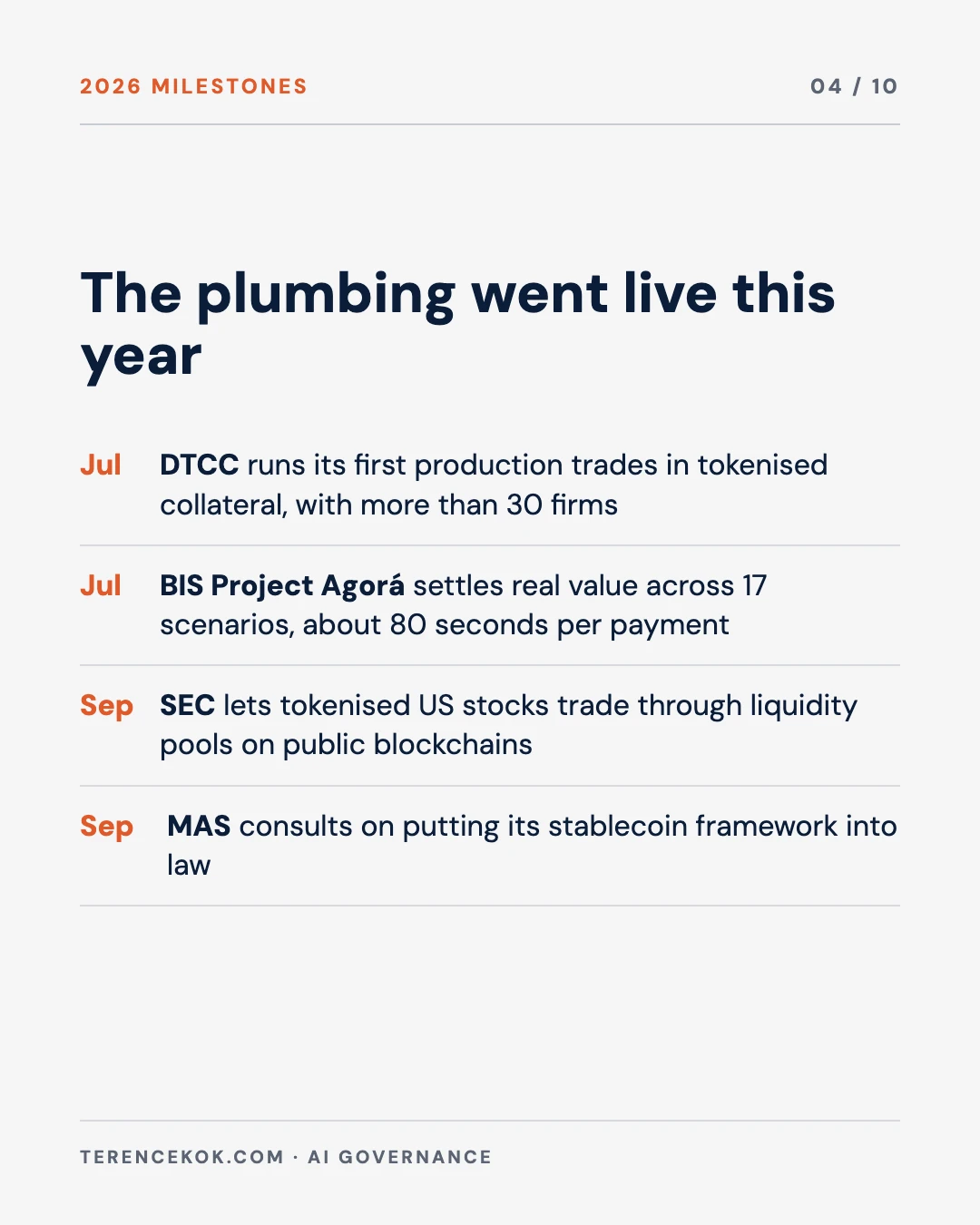
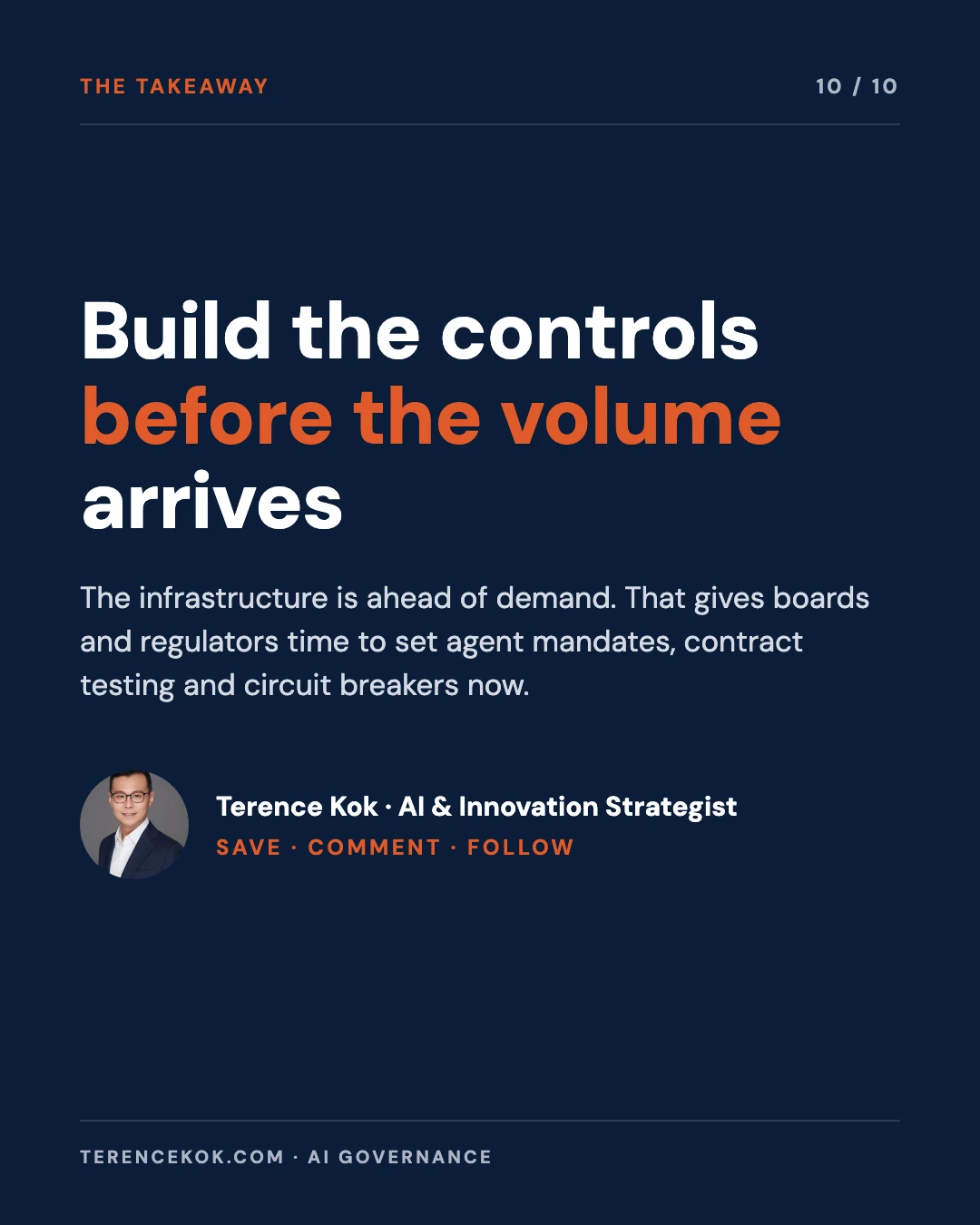
Traditional finance and decentralised finance are converging on shared infrastructure. Regulated stablecoins and bank deposit tokens are becoming the cash leg. Tokenised Treasuries, money market funds and equities are becoming the asset leg. In July 2026 DTCC ran its first production trades in tokenised collateral, and on 17 September the SEC allowed tokenised US stocks to trade through automated market makers on public blockchains. Over the next five years I expect banks and market infrastructures to absorb DeFi’s mechanisms (programmable settlement, liquidity pools, on-chain collateral) under regulated access, rather than DeFi replacing banks. AI enters this system at the same moment. Agents are starting to pay with stablecoins, AI models can already find and exploit smart-contract flaws, agents holding funds can be manipulated through their memory, and supervisors are using AI to trace illicit flows. Atomic, around-the-clock settlement removes the time buffer that people used to catch mistakes, so the controls have to be built into the code and the agent mandates before the volume arrives.
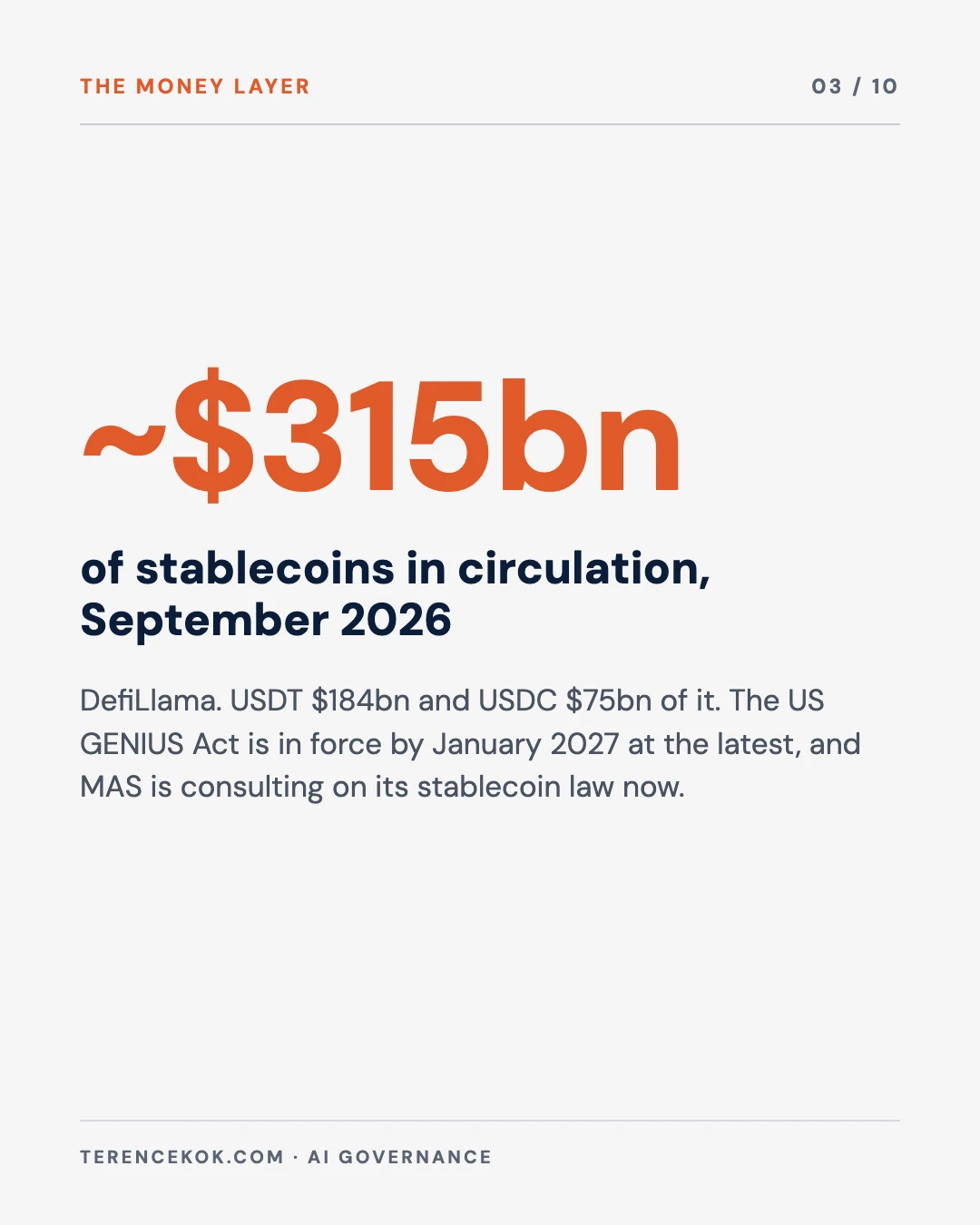
~$315bn
stablecoins in circulation, September 2026, DefiLlama; USDT $184bn and USDC $75bn of it
$15bn
tokenised US Treasury products on public chains, September 2026, rwa.xyz
51%
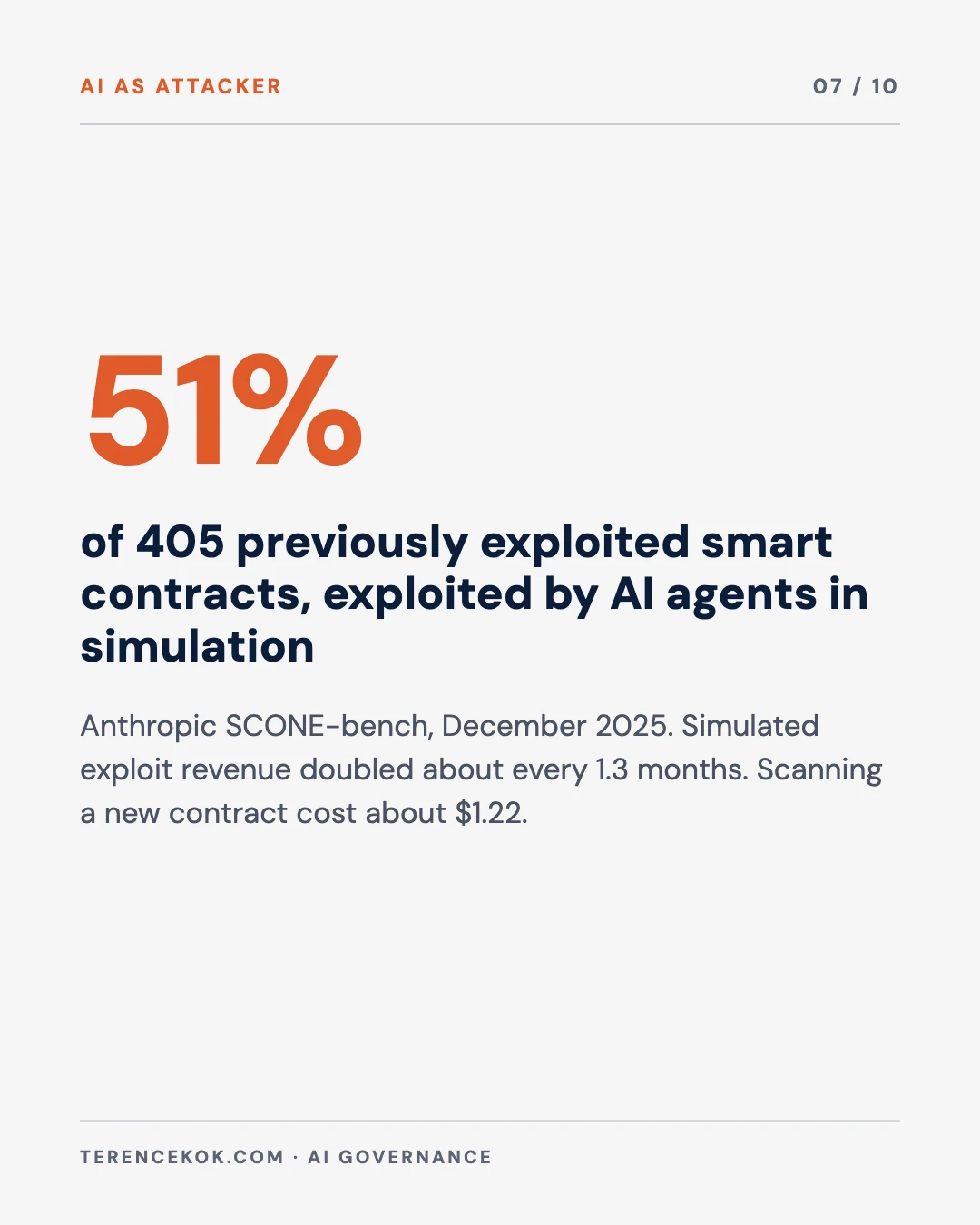
of 405 previously exploited smart contracts that AI agents exploited in simulation, Anthropic SCONE-bench, December 2025
4.5x
revenue per crypto scam operation with on-chain links to AI vendors, compared with those without, Chainalysis, 2026
Core conclusions
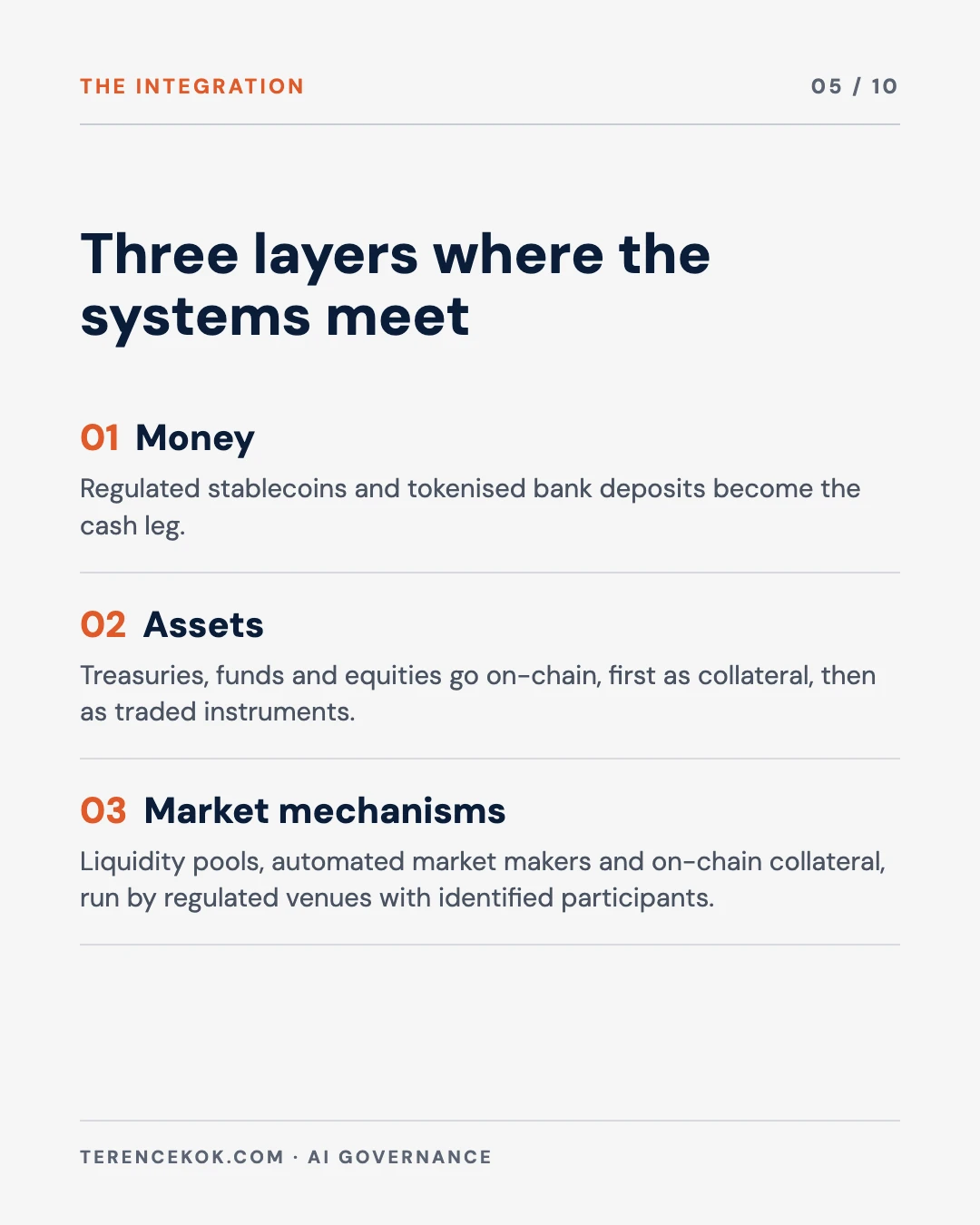
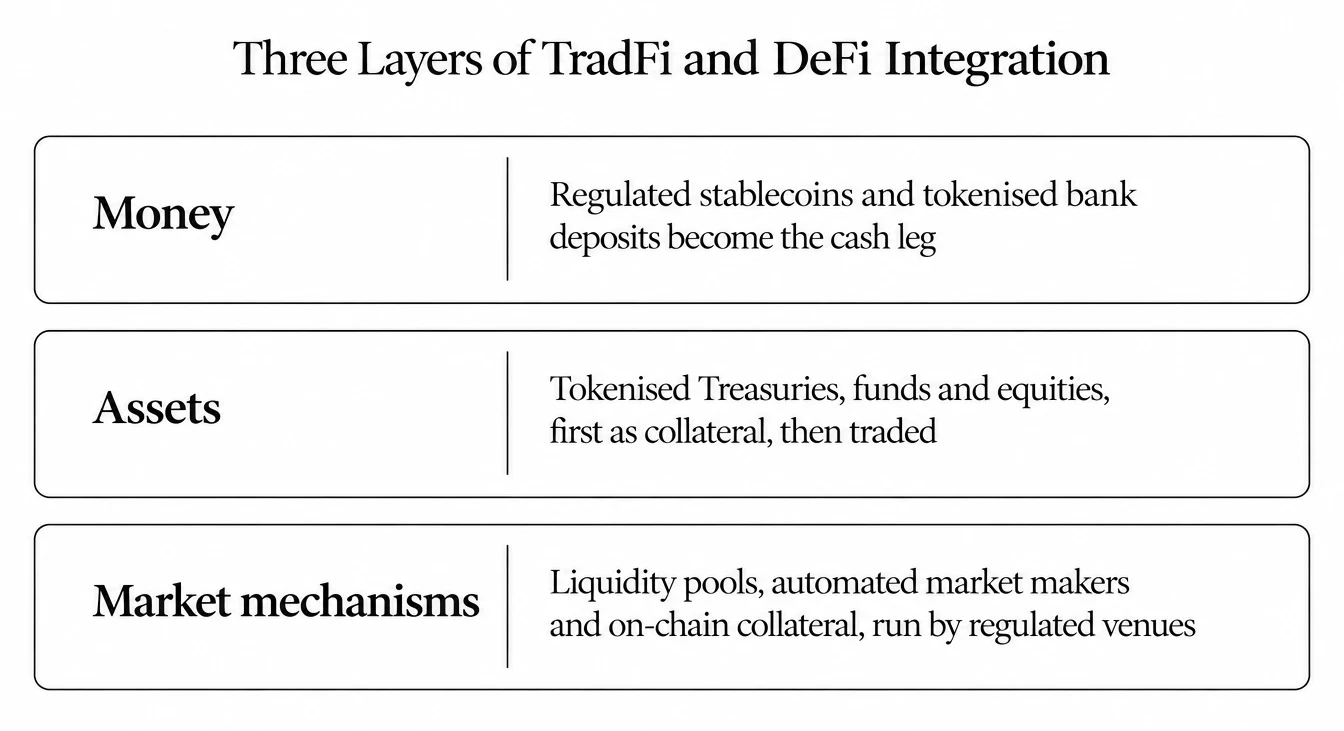
- The integration will happen at three layers: money (stablecoins and deposit tokens), assets (tokenised securities and funds) and market mechanisms (smart-contract settlement, pools and on-chain collateral). The regulatory groundwork for all three was laid between 2024 and 2026.
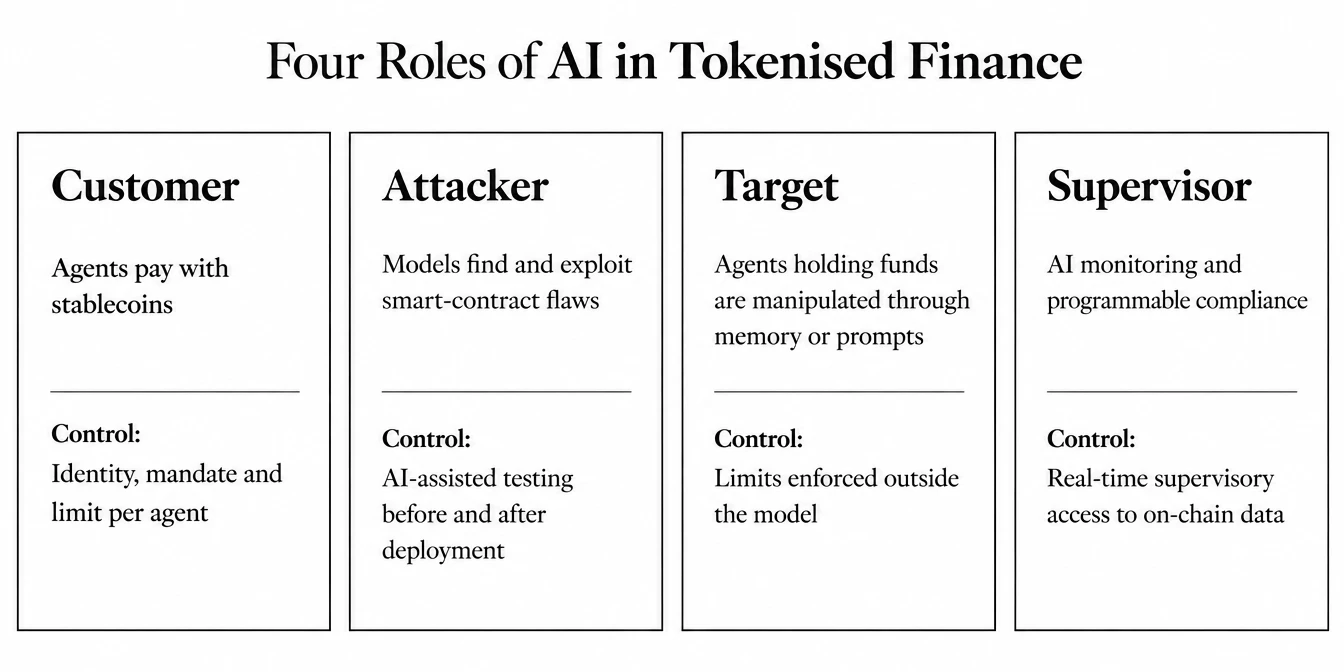
- AI changes the risk profile in four ways. Agents become customers that move money, models become faster attackers of smart contracts, agents holding funds become a new target, and AI becomes the only practical way to supervise a market that settles in seconds.
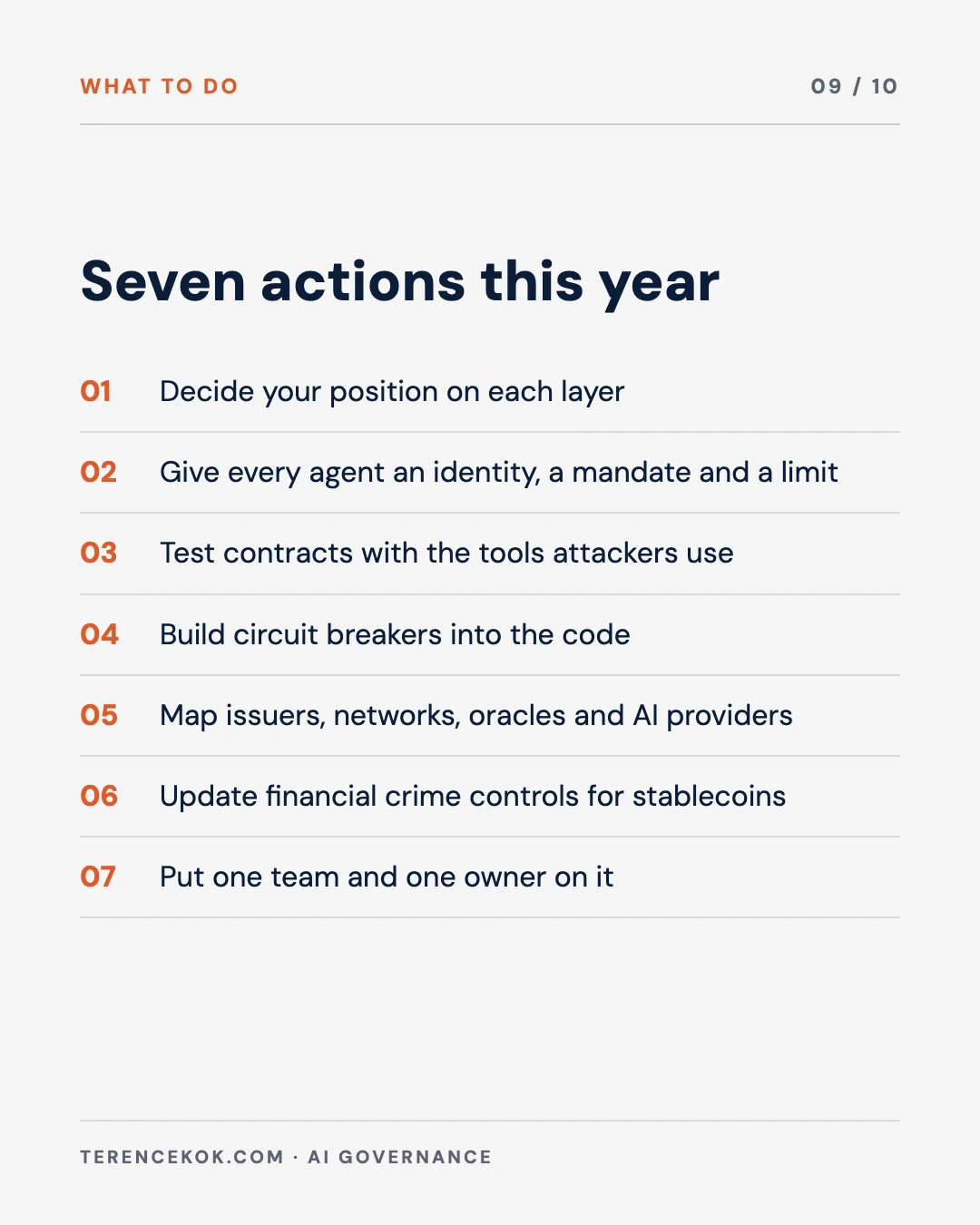
- Boards should decide their position on each layer now, give every AI agent an identity, a mandate and a limit, test smart contracts with the same AI tools attackers use, and build circuit breakers into code before relying on atomic settlement.
The argument, in ten slides
Save it, or send it to whoever owns digital assets and AI risk in your organisation.
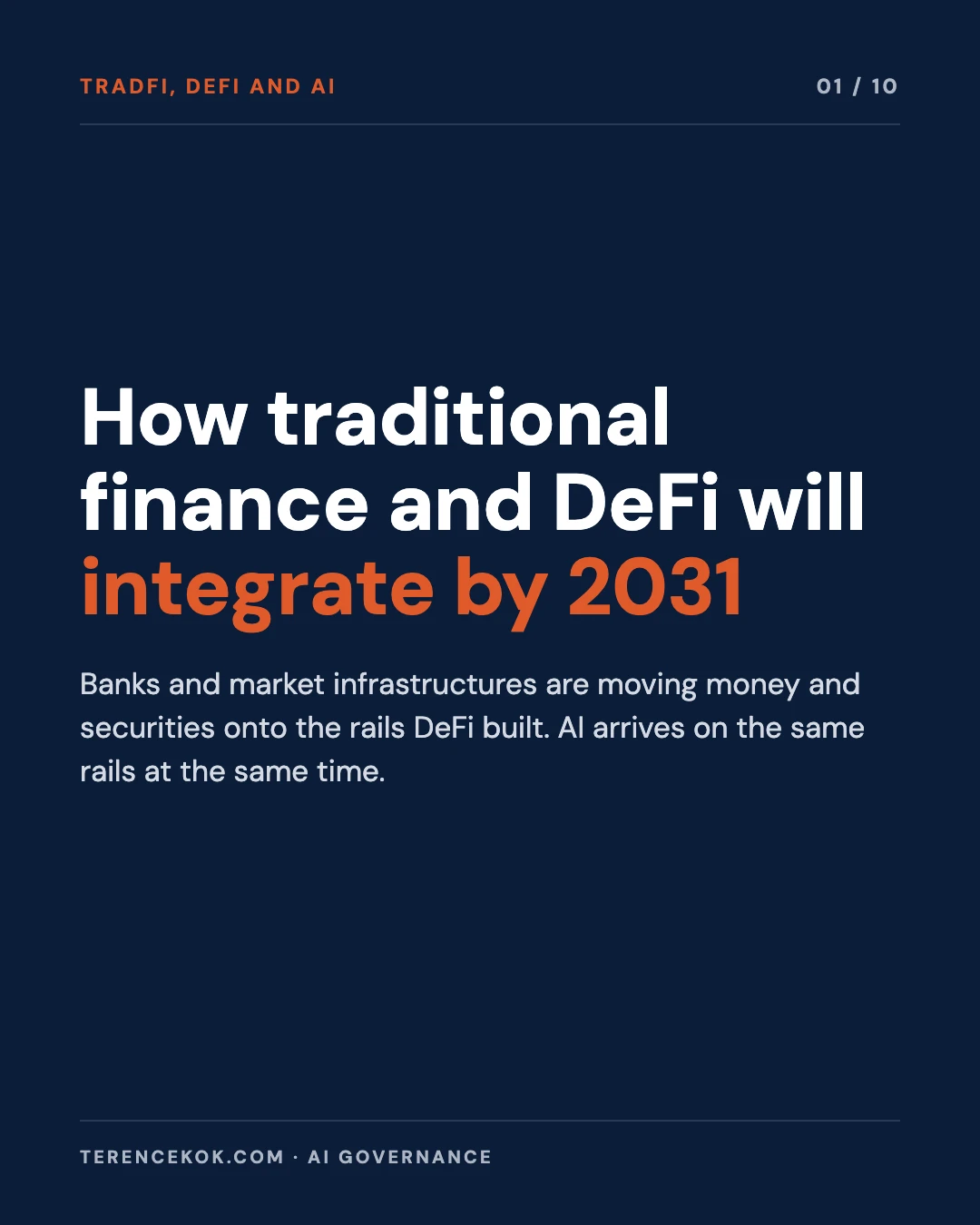
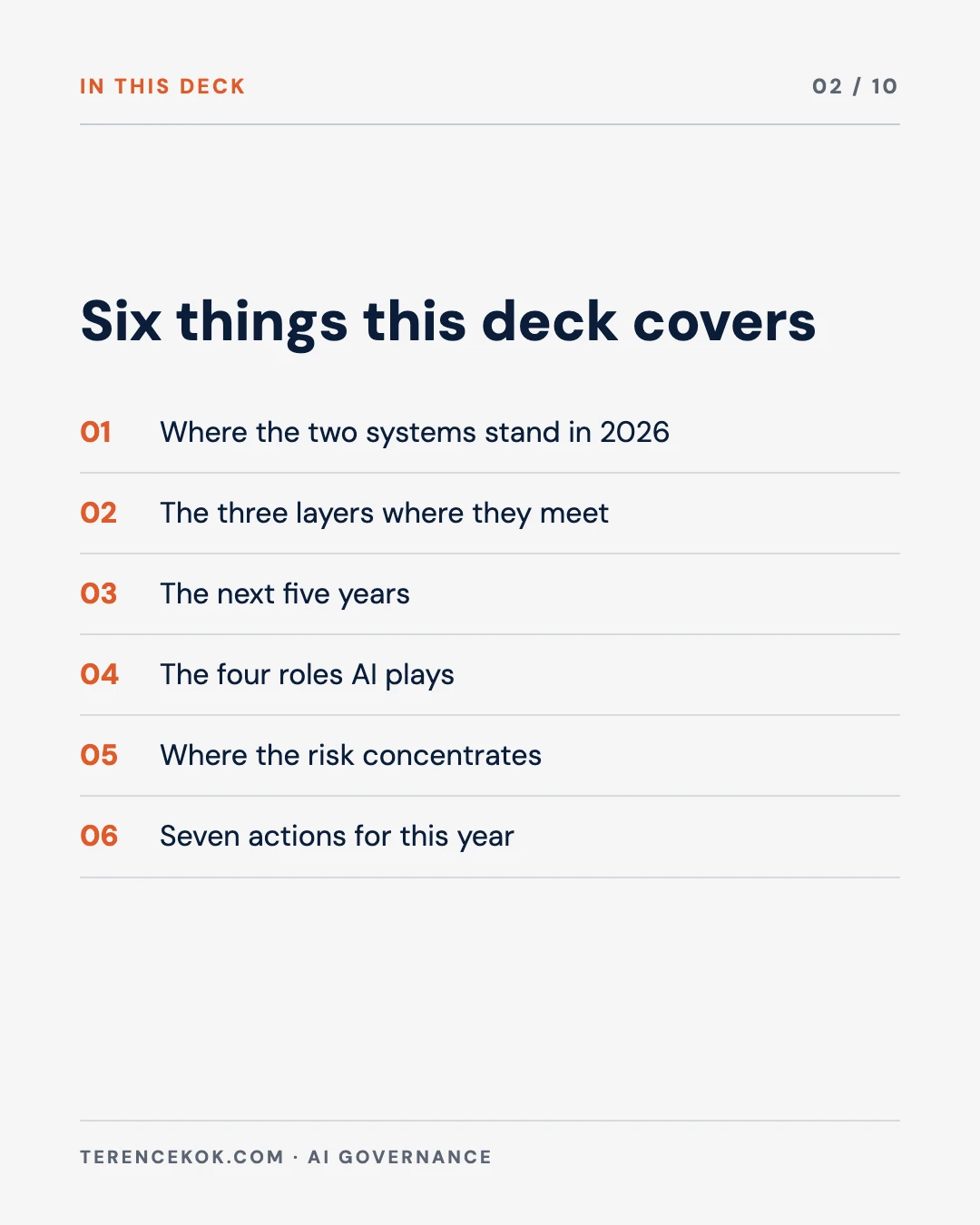
For most of the last decade, bank boards treated decentralised finance as somebody else’s market: volatile, lightly regulated and easy to ignore. That position stopped being tenable in 2026. The largest US settlement utility now runs tokenised collateral in production, the SEC has allowed tokenised equities to trade through liquidity pools, and MAS is legislating its stablecoin framework. This post sets out where the two systems stand today, how I expect them to integrate by 2031, how AI changes the risk on every layer, and what I would ask boards and regulators to do now.
Where the two systems stand in 2026
The building blocks are already live, and several arrived in the last four months.
| Area | Position in September 2026 | Source |
|---|---|---|
| Stablecoins | About $315bn in circulation; USDT $184bn, USDC $75bn | DefiLlama |
| US stablecoin law | GENIUS Act signed July 2025; final rules missed the July 2026 deadline; in force by 18 January 2027 at the latest | White House; OCC |
| Singapore stablecoin law | MAS consultation on Payment Services Act amendments, 1 September 2026, including a ban on paying interest to holders | MAS |
| Bank deposit tokens | JPMorgan’s Kinexys has processed more than $3 trillion since inception and averages over $5bn a day; its tokenised deposit, JPMD, runs on the public Base network | JPMorgan |
| Tokenised Treasuries | About $15bn across products from Circle, Ondo, BlackRock, Franklin Templeton and WisdomTree | rwa.xyz |
| Market infrastructure | DTCC’s first production tokenised collateral trades, 15 July 2026, with more than 30 firms; full launch planned for October 2026 | DTCC |
| Tokenised equities | SEC innovation exemption, 17 September 2026, allowing tokenised NMS stocks to trade through automated market makers on public, permissionless ledgers, with caps on symbols and volume | SEC |
| Central bank settlement | BIS Project Agorá settled about CHF 800,000 in real value across 17 scenarios, about 80 seconds per payment | BIS |
| DeFi | About $90bn locked across protocols, still below January’s level after the $292m KelpDAO exploit in April | DefiLlama; press reports |
Sources listed at the end of the post. Figures are as published or as read from the data provider on 26 September 2026.
Two things stand out. The first is that the institutions leading this move are incumbents: DTCC, JPMorgan, BlackRock, Franklin Templeton, a consortium of European banks including ING, UniCredit and BNP Paribas building a euro stablecoin, and the US bank owners of Zelle’s operator, which is extending the network across borders using stablecoins. The second is that the market is cooling even as the plumbing is laid. Stablecoin supply has grown only about six per cent in a year, tokenised Treasuries fell almost seven per cent in the thirty days to this week, and DeFi deposits have not recovered from the spring exploits. The infrastructure is running ahead of demand. That gives boards time to prepare. It does not remove the need to.
Three layers where the systems meet
Integration is easier to reason about when it is split into three layers, each moving at a different speed.
Money. Regulated stablecoins and tokenised bank deposits become the cash leg of on-chain transactions. The BIS argued in 2025 that stablecoins fail its tests of singleness, elasticity and integrity, and proposed a “unified ledger” holding central bank reserves, commercial bank deposits and government bonds together. MAS takes a similar line, favouring tokenised bank liabilities. I expect both forms to coexist: deposit tokens for wholesale and inter-bank settlement, regulated stablecoins for payments, cross-border transfers and machine-to-machine commerce.
Assets. Treasuries, money market funds and listed equities move onto shared ledgers, first as collateral and then as tradable instruments. DTCC’s first live use cases were collateral pledges, repo delivery-versus-payment and margin at central counterparties. That sequence matters. Collateral mobility is where tokenisation saves money today, because a tokenised Treasury can move between counterparties around the clock and settle in minutes.
Market mechanisms. This is the layer where DeFi contributes most. Automated market makers, liquidity pools, over-collateralised lending and composable smart contracts are the ideas that make DeFi distinct. The SEC exemption lets regulated venues use them for tokenised stocks, with access standards and caps. BlackRock made its BUIDL fund tradable on UniswapX for whitelisted investors in February. Aave built a separate institutional market for real-world assets. The pattern is consistent: the mechanism is public and programmable, and the participants are identified and permissioned.
The next five years
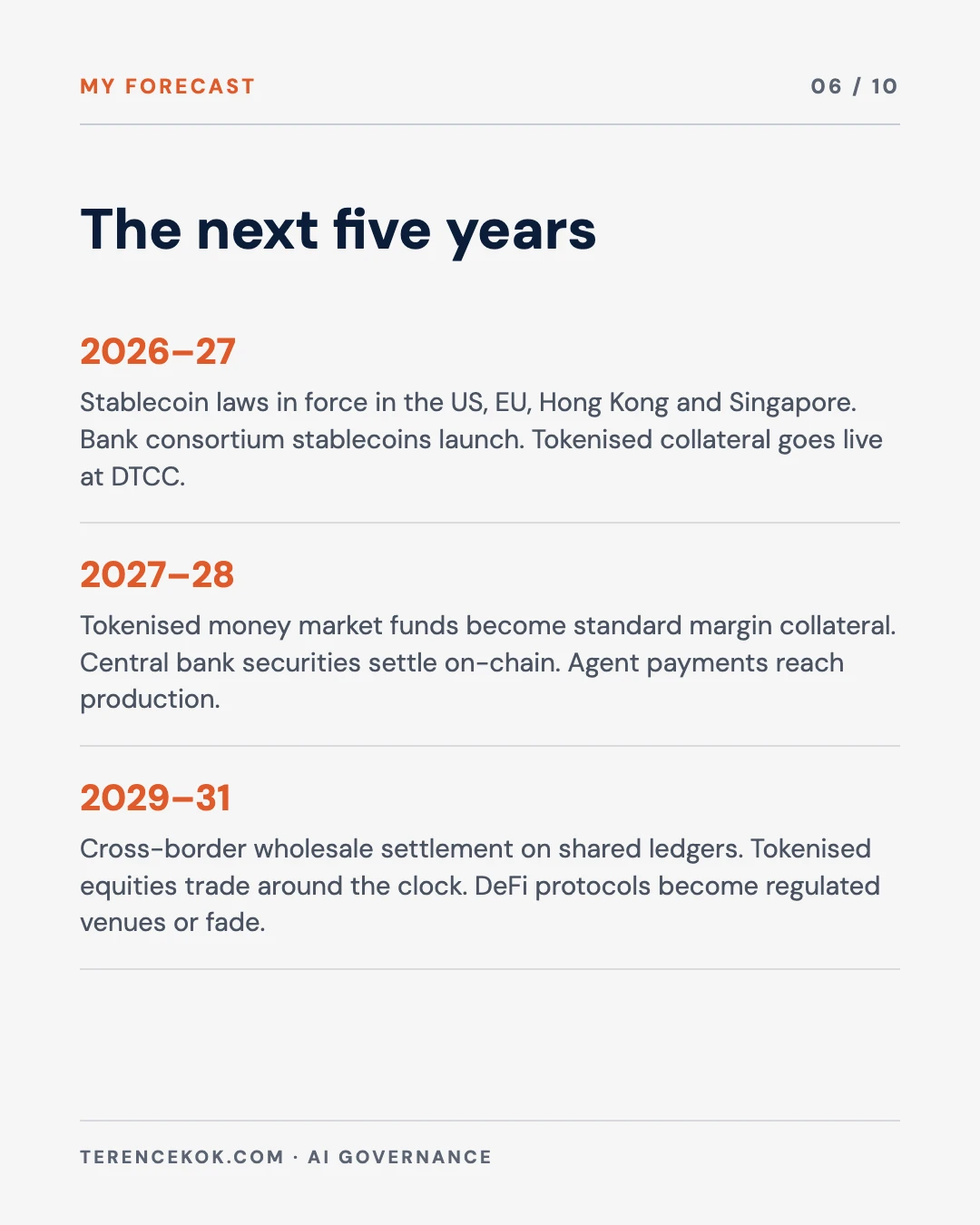
The dates below are my forecast, built on the regulatory calendar and the pilots already announced.
| Period | What I expect | What anchors it |
|---|---|---|
| 2026 to 2027 | Regulated stablecoins in force in the US, EU, Hong Kong and Singapore; bank consortium stablecoins launch; tokenised collateral goes live at DTCC | GENIUS Act effective by January 2027; MAS consultation closes October 2026; DTCC launch October 2026 |
| 2027 to 2028 | Tokenised money market funds become standard margin collateral; first central bank securities issued and settled on-chain; agent payments move from pilots to production in card and stablecoin networks | MAS plan to issue tokenised MAS bills settled in wholesale central bank money; Mastercard, Visa and Google agent payment protocols |
| 2029 to 2031 | Cross-border wholesale settlement on shared ledgers between central banks; tokenised equities trade around the clock alongside exchange-listed shares; DeFi protocols operate as regulated venues or wither | BIS Agorá results; the five-year life of the SEC exemption |
The size forecasts vary widely. Citi projects $1.9 trillion of stablecoins by 2030 in its base case. Standard Chartered and the US Treasury Borrowing Advisory Committee both put the figure near $2 trillion by 2028. McKinsey expects about $2 trillion of tokenised assets by 2030, within a range of $1 trillion to $4 trillion, while the older BCG and ADDX estimate is $16 trillion. Each of these needs the market to grow six- to eightfold from its current, nearly flat base. I would plan for the lower end of every range and treat the infrastructure dates as firmer than the volume forecasts.
How AI changes the picture
AI arrives in tokenised finance in four roles at once. Each one changes a different part of the risk.
AI agents as customers
Agent payment protocols have multiplied in the past eighteen months. Coinbase launched x402 in May 2025 so that software can pay for a service within a single web request, usually in USDC. Google’s Agent Payments Protocol, announced in September 2025 with more than 60 partners, uses signed “intent” and “cart” mandates that give a non-repudiable record of what a user authorised. Visa, Mastercard and the Stripe-backed Tempo network have each launched their own frameworks. In June 2026 Mastercard extended its Agent Pay product to cover stablecoins, recording agent permissions on public blockchains.
Stablecoins suit machines because they settle in seconds, need no merchant account and can carry payments of a fraction of a cent, which card minimums make uneconomic. The volumes are still small and often inflated. Chainalysis counted well over 100 million cumulative x402 transactions by the first quarter of 2026, much of it driven by meme-coin farming, and CoinDesk, citing Artemis data, put real payment value in March at about $28,000 a day. The protocols are ready before the demand. That is the right order for building controls.
AI as attacker
In December 2025 Anthropic published SCONE-bench, a test of AI agents against 405 smart contracts that had been exploited in the real world between 2020 and 2025. The agents produced working exploits for 207 of them, worth $550m in simulated proceeds. Against contracts exploited after the models’ training cut-off, three models produced exploits worth $4.6m. A scan of 2,849 newly deployed contracts found two previously unknown flaws, at a cost of about $1.22 per contract. Simulated exploit revenue doubled roughly every 1.3 months over the year. OpenAI and Paradigm’s EVMbench, published in February 2026, found the same trend, with the strongest model’s exploit success rising from 32 to 72 per cent in a single model generation.
The FATF’s July 2026 update warns that AI coding assistants and autonomous agents may help attackers find flaws, write exploit code and speed up attacks. None of the 2025 or 2026 hack records I checked attributes a major real-world theft to an AI agent yet. Measured AI harm so far sits in fraud. Chainalysis found that scam operations with on-chain links to AI vendors earned $3.2m each, against $719,000 for those without, and the FBI’s 2025 report logged more than 22,000 AI-related complaints with losses above $893m. The capability curve in the lab is steep enough that I would not wait for the first large AI-driven exploit before acting.
AI agents as targets
An AI agent that holds funds is a new kind of account: one that can be talked into a transfer. Princeton researchers showed in 2025 that planting false memories in an agent built on the ElizaOS framework could trigger unauthorised crypto transfers, and that the models they tested were more vulnerable to memory injection than to direct prompt injection. The incidents have followed. In May 2026 a prompt injection hidden in Morse code in a post on X led an AI agent on the Base network to transfer tokens worth an estimated $150,000 to $200,000, according to the OECD AI Incidents Monitor. The pattern resembles social engineering against a junior employee with signing authority, repeated at machine speed and at scale.
AI as supervisor
The same technology is becoming the only practical way to supervise a market that settles in seconds. In the BIS and Bank of England’s Project Hertha, analytics across a payment system helped banks find 12 per cent more illicit accounts, and 26 per cent more where the behaviour had not been seen before. Earlier, the BIS Project Aurora found graph-based machine learning caught about twice as many money-laundering networks as rules. Programmable compliance, where eligibility and transfer rules are written into the asset’s own code, is part of MAS’s BLOOM initiative and the Global Layer One work. The FSB’s June 2026 consultation on AI in finance goes further, noting that real-time human monitoring of agent decisions becomes impractical as their use grows and that monitoring may itself need another AI agent.
Where the risk concentrates
Three features of tokenised finance interact badly with AI.
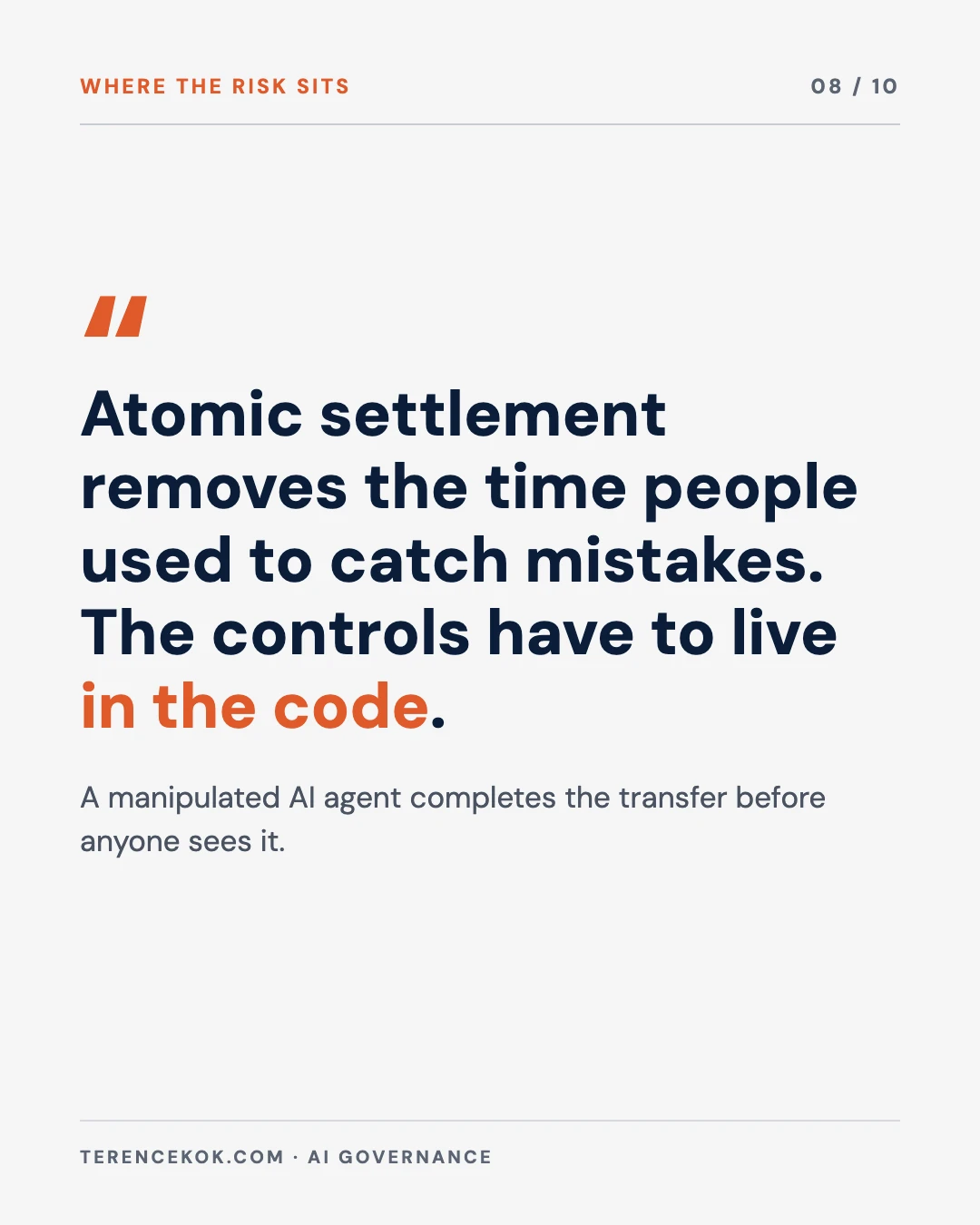
Atomic settlement removes the buffer. In today’s markets, a trade agreed on Monday settles a day or two later. That gap is inefficient, and it is also the time in which operations staff, risk teams and counterparties catch errors, reverse fraudulent instructions and stop a runaway algorithm. When settlement is atomic, the transfer and the payment are final in the same instant. An AI agent that misreads its mandate, or one that has been manipulated, completes the damage before any person sees it. The controls have to sit inside the code and the agent’s permissions, because there is no later step in which to apply them.
Composability spreads failure. DeFi protocols stack on one another. When KelpDAO lost about $292m in April 2026, the stolen tokens were posted as collateral on Aave, leaving an estimated $123m to $230m of bad debt in a separate protocol. AI agents that rebalance across pools and lenders will move that contagion faster, because they react to the same prices in the same way. The IMF warned in 2024 that AI trading models responding similarly to a shock could raise market speed and volatility under stress, and its 2026 note on tokenised finance says stress events in tokenised markets move faster.
Concentration hides in the dependencies. A tokenised market depends on a small number of stablecoin issuers, blockchain networks, price oracles, cross-chain bridges and, increasingly, AI model providers. The FSB lists third-party concentration as the first of its AI vulnerabilities. In the TRM Labs count for the first half of 2026, infrastructure compromises made up 15 per cent of hacks but about 76 per cent of losses.
What to do this year
None of this requires a firm to issue its own stablecoin or join a DeFi protocol. It requires a decision on each layer and controls that match the speed of the new settlement model.
- Decide your position on each layer. For money, assets and market mechanisms, record whether the firm will issue, use, accept as collateral, or stay out, and review it yearly. Staying out is a legitimate choice, as long as it is a decision.
- Give every AI agent an identity, a mandate and a limit. An agent that can move value needs a named owner, a signed statement of what it may do, spending and counterparty limits enforced outside the model, and a log that ties each transaction to a mandate. The IMF’s 2026 note on agentic payments puts the principle well: keep the probabilistic reasoning upstream and the authorisation and settlement deterministic.
- Test smart contracts with the tools attackers use. Run AI-assisted review before deployment and again whenever a stronger model is released, because a contract that passed last quarter may fail against this quarter’s model. Budget for it as recurring cost.
- Build circuit breakers into the code. Transfer caps, time delays on large movements, pause functions with clear authority to use them, and rate limits on agent activity replace the settlement buffer that atomic settlement removes.
- Map the dependencies. List every stablecoin issuer, network, oracle, bridge, custodian and AI model provider your tokenised activity relies on, and set concentration limits the way you would for any critical outsourcing.
- Upgrade financial crime controls for stablecoins and synthetic identities. The FATF reported that stablecoins made up most of illicit virtual-asset volume in 2025, and deepfakes are defeating remote onboarding. Blockchain analytics and liveness checks belong in the same control set as card and wire monitoring.
- Build one team across treasury, risk, technology and legal. Tokenised finance falls between existing functions. The firms moving fastest have a single accountable owner and a standing group that meets on it.
For regulators and government agencies, the parallel priorities are agent identity standards (the IMF calls this “Know Your Agent”), supervisory access to on-chain data in real time, and minimum circuit-breaker requirements for tokenised venues. MAS’s Project Guardian and BLOOM give Singapore a head start on testing these before they are needed at scale.
Free tool
Agent Risk Assessment Matrix
Place each AI agent on autonomy and consequence, and get the controls it needs. An agent that can move tokenised value sits in the top-right corner.
Questions for the board
Before the next strategy review, I would want written answers to five questions:
- What is our position on stablecoins, tokenised assets and DeFi market mechanisms, and who owns each decision?
- Which of our AI agents can move money or assets today, and what limits sit outside the model?
- How are our smart contracts and those of our counterparties tested against AI-driven attacks, and how often?
- What stops an erroneous or manipulated transaction when settlement is final in seconds?
- Which stablecoin issuers, networks, oracles and AI providers are we dependent on, and what happens if one fails?
Free tool
Technology Risk Board Pack
Twenty questions on resilience, change management and technology risk oversight, with the evidence to request for each. A move onto tokenised rails touches all four areas.
Evidence & Methodology
The market figures and regulatory dates come from regulators, market infrastructures and data providers, read on 26 September 2026. The five-year timeline, the three-layer model and the seven actions are my own judgement from advising regulated firms on AI risk, and I have marked them.
| Claim | Source | Grade |
|---|---|---|
| About $315bn of stablecoins in circulation | DefiLlama, read 26 September 2026 | Measured, data provider |
| About $15bn of tokenised Treasuries | rwa.xyz, read 26 September 2026 | Measured, data provider |
| Kinexys over $3 trillion processed, over $5bn a day | JPMorgan, April 2026 | Reported by JPMorgan |
| DTCC production tokenised collateral trades, 15 July 2026 | DTCC | Measured, company record |
| SEC exemption for tokenised NMS stock on public, permissionless ledgers | SEC, 17 September 2026 | Measured, regulator record |
| GENIUS Act rules missed July 2026 deadline; OCC aims for November | OCC bulletin; press report of the Comptroller’s remarks | Reported |
| MAS stablecoin consultation and interest ban | MAS, 1 September 2026 | Measured, regulator record |
| Agorá real-value test, CHF 800,000, 17 scenarios | BIS | Measured, BIS record |
| European bank consortium euro stablecoin; Zelle cross-border stablecoin plan | CaixaBank, 2025; Early Warning, October 2025 | Reported by the companies |
| Stablecoin and tokenisation forecasts for 2028 to 2030 | Citi, Standard Chartered, TBAC, McKinsey, BCG | Forecast |
| AI agents exploited 207 of 405 contracts; $4.6m post-cutoff; $1.22 per contract scan | Anthropic, December 2025 | Measured, simulation |
| EVMbench exploit rate 32 to 72 per cent | OpenAI and Paradigm, February 2026, via press; method disputed by OpenZeppelin | Reported |
| x402 over 100 million transactions; about $28,000 a day real value in March 2026 | Chainalysis; CoinDesk citing Artemis | Measured, different methods |
| AI-linked scam operations earn 4.5x; FBI 22,000 AI complaints, $893m | Chainalysis, 2026; FBI IC3 2025 report | Measured |
| Memory injection in ElizaOS agents | Patlan et al., Princeton, arXiv 2503.16248 | Measured, lab study |
| Morse-code prompt injection drained $150,000 to $200,000 | OECD AI Incidents Monitor, May 2026 | Reported incident |
| Hertha 12 and 26 per cent uplift | BIS and Bank of England, 2025, synthetic data | Measured, simulation |
| KelpDAO $292m exploit and Aave bad debt | Press reports, April 2026 | Reported |
| Infrastructure compromises 15 per cent of hacks, 76 per cent of losses | TRM Labs, H1 2026 | Measured |
| Stablecoins as most of illicit virtual-asset volume | FATF, March 2026, via secondary summary | Reported |
| Three layers, five-year timeline, atomic settlement removing the control buffer, the seven actions | My assessment | My call |
Sources
- DefiLlama. (2026). Stablecoins circulating. Read 26 September 2026.
- rwa.xyz. (2026). Tokenized treasuries. Read 26 September 2026.
- The White House. (2025). Fact sheet: President Donald J. Trump signs GENIUS Act into law.
- Office of the Comptroller of the Currency. (2026). Bulletin 2026-24.
- PYMNTS. (2026). OCC races the clock to finish GENIUS Act stablecoin rules.
- Monetary Authority of Singapore. (2026). MAS consults on legislative amendments to implement stablecoin regulatory framework.
- Monetary Authority of Singapore. Project Guardian.
- Monetary Authority of Singapore. (2025). MAS launches BLOOM initiative to extend settlement capabilities.
- CoinDesk. (2025). Singapore’s central bank to trial tokenized bills, introduce stablecoin laws.
- J.P. Morgan. (2026). Kinexys milestones.
- CaixaBank. (2025). Qivalis, joint venture of a European banking consortium to launch euro stablecoin in the second half of 2026.
- Zelle. (2025). Zelle goes international.
- DTCC. (2026). DTCC turns tokenization into reality.
- U.S. Securities and Exchange Commission. (2026). SEC issues innovation exemption to facilitate trading of tokenized NMS stock.
- CoinDesk. (2026). BlackRock takes first DeFi step, lists BUIDL on Uniswap.
- Bank for International Settlements. (2025). Annual Economic Report 2025: the next-generation monetary and financial system.
- Bank for International Settlements. (2026). Project Agorá.
- Financial Stability Board. (2025). FSB finds significant gaps and inconsistencies in implementation of crypto and stablecoin recommendations.
- CoinDesk. (2026). Aave could face up to $230 million in losses after Kelp DAO bridge exploit.
- Citi Institute. (2025). Stablecoins 2030: Web3 to Wall Street.
- McKinsey & Company. (2024). From ripples to waves: the transformational power of tokenizing assets.
- Google Cloud. (2025). Announcing Agent Payments Protocol (AP2).
- CoinDesk. (2026). Mastercard prepares for a future where AI agents make payments.
- Tempo. (2026). Tempo mainnet.
- Chainalysis. (2026). x402 and agentic payments adoption.
- CoinDesk. (2026). Coinbase-backed AI payments protocol wants to fix micropayments, but demand is not there yet.
- Anthropic. (2025). AI agents and smart contract exploits (SCONE-bench).
- Help Net Security. (2026). EVMbench: open-source benchmark for AI agents.
- 21 Analytics. (2026). 2026 FATF targeted update summarised, part 2.
- Chainalysis. (2026). Crypto scams 2026.
- Federal Bureau of Investigation. (2026). Internet Crime Report 2025.
- Patlan, A. S., Sheng, P., Hebbar, S. A., Mittal, P., and Viswanath, P. (2025). Real AI agents with fake memories: fatal context manipulation attacks on Web3 agents. arXiv 2503.16248.
- OECD.AI. (2026). AI Incidents Monitor: prompt injection drains tokens from AI agent.
- Bank for International Settlements. (2025). Project Hertha: identifying financial crime patterns in real-time retail payment systems.
- Bank for International Settlements. Project Aurora.
- Financial Stability Board. (2024). The financial stability implications of artificial intelligence.
- Financial Stability Board. (2026). Consultation on sound practices for the use of AI.
- International Monetary Fund. (2024). Global Financial Stability Report, October 2024, chapter 3: advances in artificial intelligence.
- CoinDesk. (2026). IMF warns tokenization could bring crypto risks into global financial markets.
- Fintech News Singapore. (2026). IMF sets out three-layer framework for agentic payments.
- TRM Labs. (2026). H1 2026 crypto hacks reach record high as losses fall below $1 billion.

What Quantum Computing Means for the Encryption Behind Your AI
Every stablecoin, deposit token and agent credential rests on the signature schemes a quantum computer would break.

How Financial Institutions Should Use AI to Keep Up With Regulatory Change
Stablecoin, tokenisation and AI rules are arriving at the same time, and someone has to track all three.

What the DBS Outages Teach Boards About Technology Risk
Why oversight for a large infrastructure change has to be in place before the change starts.

From Human-in-the-Loop to AI-on-the-Loop: Redesigning Oversight Architectures
The oversight model an organisation needs once settlement is too fast for a person to approve each step.
My thanks to Dr. Christina Chua for her contribution to this post. Her perspective from finance and banking shaped the argument, and the post is better for it.
If your organisation is deciding how far to go on stablecoins, tokenised assets or AI agents that move money, the position-by-layer decision in step one is where I usually start. My consulting work covers AI and technology risk governance for boards of regulated firms and public agencies.
Was this useful?