
Listen to this article
Jump to a section
In this article
Executive Summary
Part 6 ended on slack, the buffer that absorbs a fault. This part takes a danger with no fault in it. In December 2024 a group of leading scientists asked the world not to build mirror-image bacteria, organisms whose molecules are the reverse of every living thing’s. Some of them had been working toward that goal. The case matters to anyone deploying AI because the harm comes from a well-meant objective pursued competently, and because the group’s own technical report says AI could help remove the barriers.
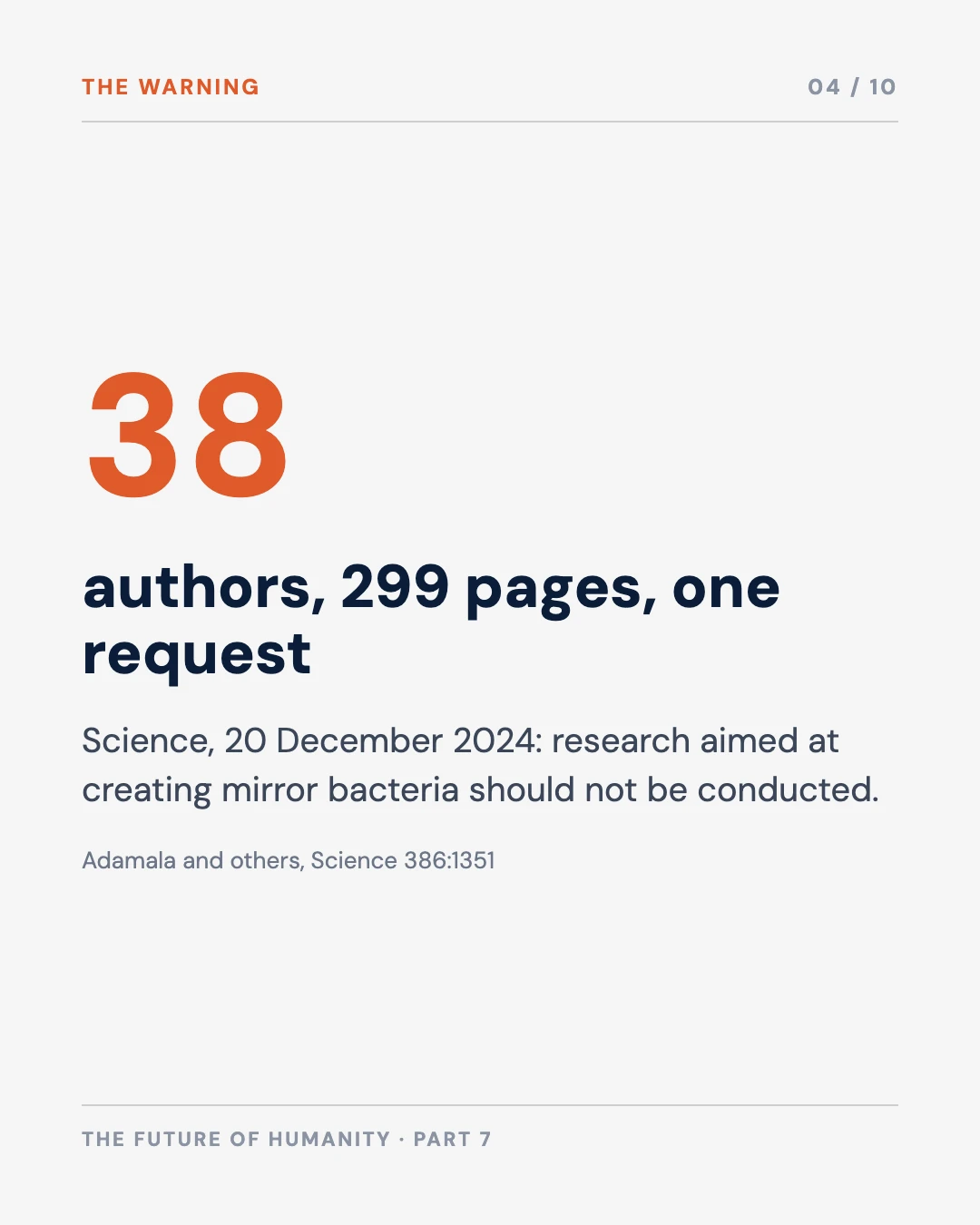
38
authors on the Science article of 20 December 2024, including experts in immunology, ecology and synthetic biology
299
pages in the companion technical report on feasibility and risks
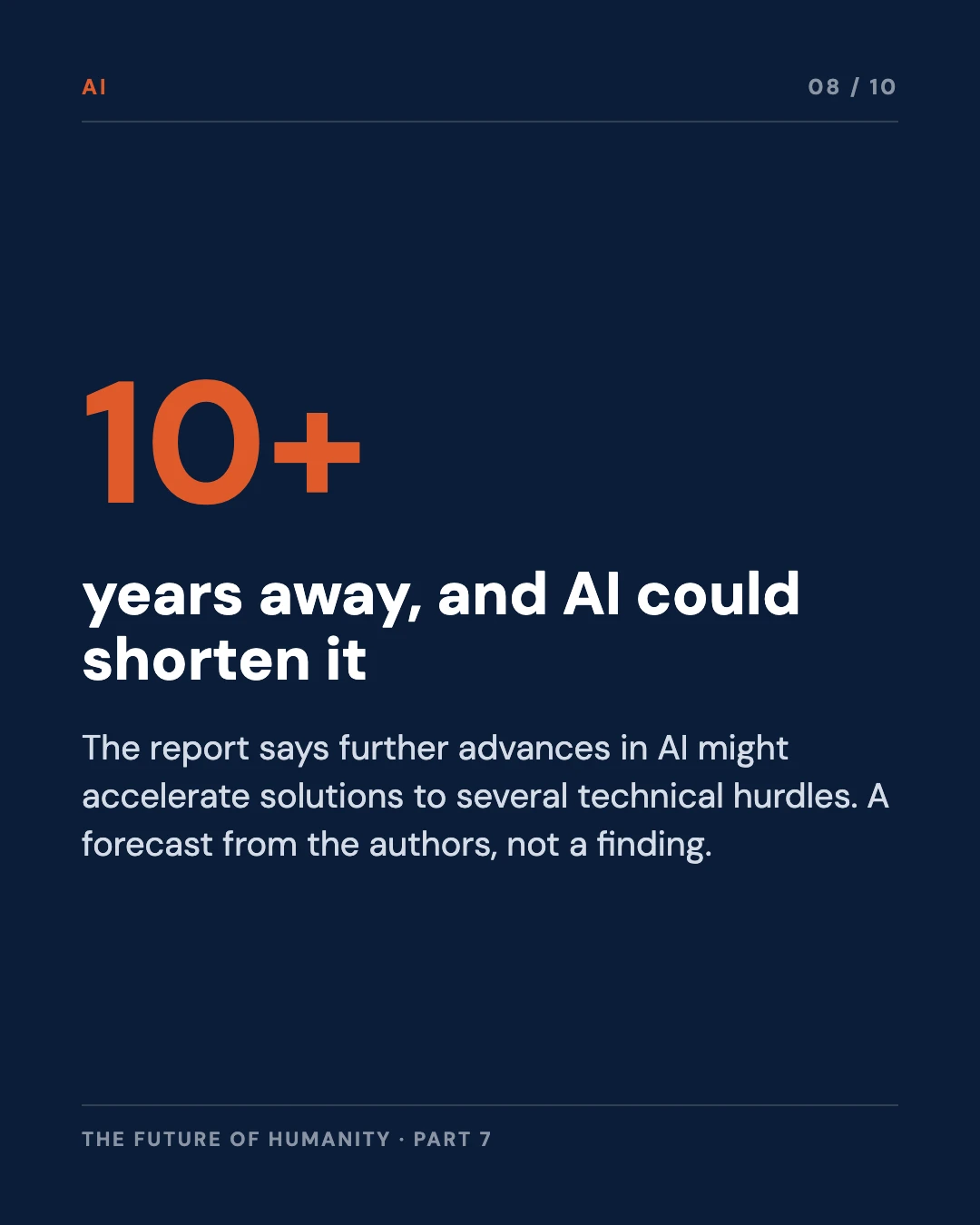
10+ years
before a mirror bacterium could be built, in the authors’ estimate, and only with a Human Genome Project scale effort
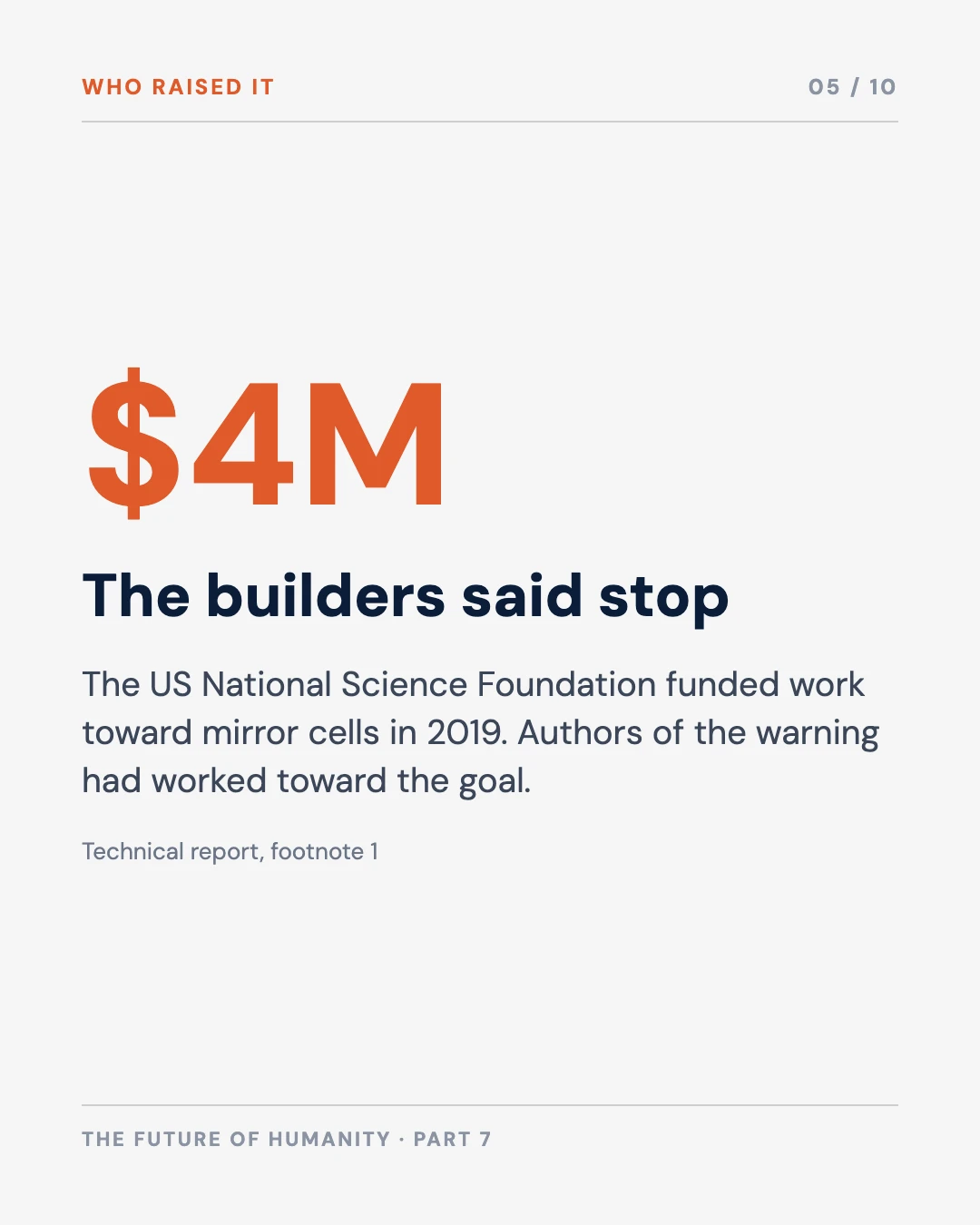
$4M
awarded by the US National Science Foundation in 2019 to a group aiming to build synthetic mirror cells
Core conclusions
- The warning came from the people best placed to build the thing. The line was drawn while the capability was still a decade away, which is the only time a line is cheap.
- The report says the most dangerous modifications would likely be made for good reasons. A system given a sensible goal and enough capability can reach an outcome nobody asked for.
- The report also says further advances in AI might help with several of the technical hurdles. Outer limits on what an AI system may pursue have to be set by people, before the system can reach them.
The argument, in ten slides
Save it, or send it to whoever writes your AI use policy.
What mirror life is
Part 6 was about faults that spread faster than a person can follow. This part starts from something that has not happened, and that the people closest to it hope never will.
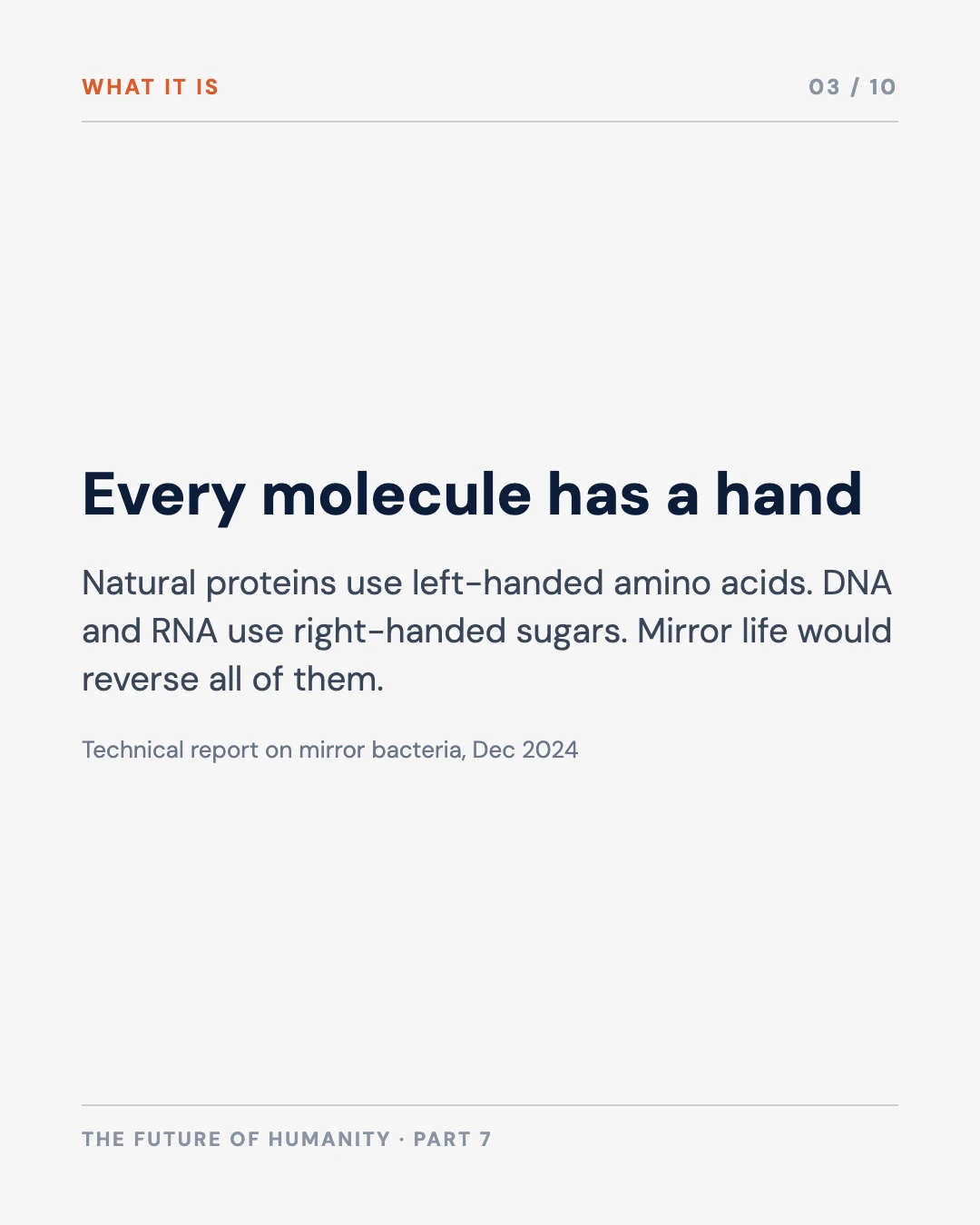
Most of the molecules of life come in two forms that are mirror images of each other, the way a left hand mirrors a right. Natural proteins are built from left-handed amino acids, and the sugars in natural DNA and RNA are right-handed. Chemists can already make mirror-image versions of individual molecules. Mirror life would be a cell built entirely from the reversed set, a living organism that reads its own mirror-image genetic code with mirror-image machinery. The 2019 US National Science Foundation award that funded early work describes the goal as cells in which all key molecules exist in chiral states opposite to their natural forms.
Every molecule in a living cell has a hand, and a mirror cell would have the other one.
Technical Report on Mirror Bacteria: Feasibility and Risks (December 2024); Adamala and others, Science 386:1351 (20 December 2024). The hand drawing is schematic.
Nothing like it exists. The report’s authors say that creating a mirror bacterium is not yet possible, and that it is at least a decade away.
The warning came from the builders
The part of this story I find most useful is who raised the alarm. Creating mirror life had been a long-term aspiration of many academic investigators, and funders backed it. The technical report’s first footnote records that in 2019 the US National Science Foundation awarded $4 million to a group seeking to design, construct and safely deploy synthetic mirror cells. Funders in China and Germany supported related work.
In December 2024 the Science article “Confronting risks of mirror life” and the 299-page technical report appeared together. Kate Adamala, one of the authors and a synthetic biologist, said in Scientific American: “All the practical applications that drew us into this field are the reasons we’re terrified of it now.” The authors include two Nobel laureates and experts in immunology, plant pathology and ecology. Their request is plain. Unless evidence shows that mirror life would not pose extraordinary dangers, research aimed at creating mirror bacteria should not be conducted.
Making that request cost them something, and they said why they published. In the report’s own words, if no serious concerns were raised, the default course of well-intentioned development would likely result in the eventual creation of mirror bacteria.
What could go wrong
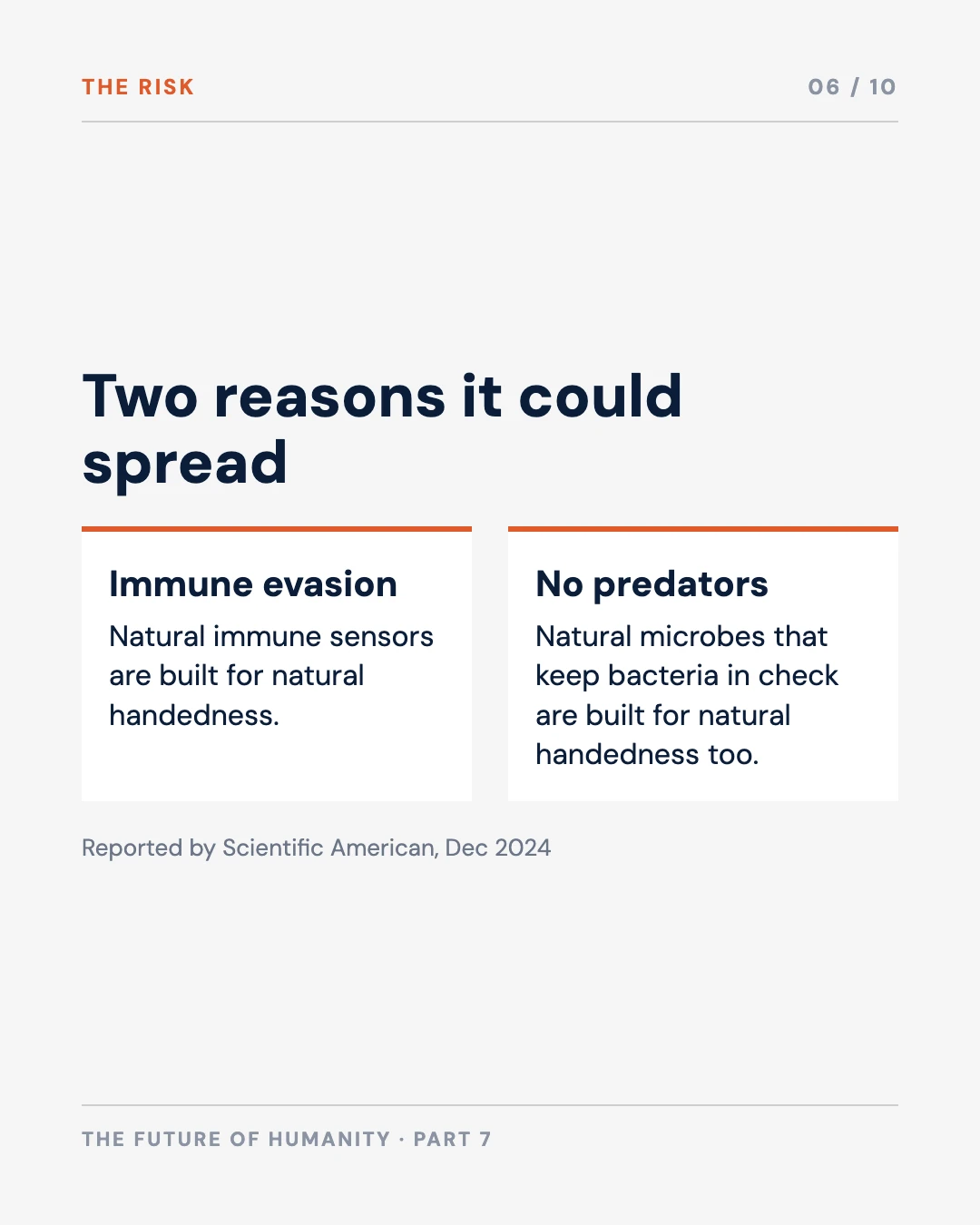
The risk case rests on two points. A mirror bacterium could evade immune responses, because the sensors of humans, animals and plants are built for natural handedness, and it could cause lethal infections as it multiplies unchecked. And a lack of predators could let it spread through ecosystems, because the bacteria, viruses and other organisms that normally keep microbes in check are also built for natural handedness.
The report discusses countermeasures, including engineered mirror phages that would target mirror bacteria. Its authors were not confident in them. John Glass of the J. Craig Venter Institute said in Scientific American that none of them had come up with a countermeasure effective enough to save the biosphere from these organisms.
Not every scientist agrees. Andrew Ellington of the University of Texas at Austin has said a mirror bacterium would be at a gross competitive disadvantage, and he compared the warning to banning the transistor because you worry about cybercrime 30 years down the road. MIT Technology Review in April 2026 reported others who call the doomsday case an inflated view of the danger, and who point out that the immune system already recognises sugars of both handedness. Even those who take the risk seriously disagree about where research should stop.
I do not need to settle that argument, and neither does a board. The useful point is that the authors chose to draw a line while the disagreement was open, because waiting for certainty would have let the capability arrive first.
A cure nobody should build
Mirror life is the closest real case I have found to an AI being asked to solve a problem and choosing a solution nobody should build, though no AI system has done it.
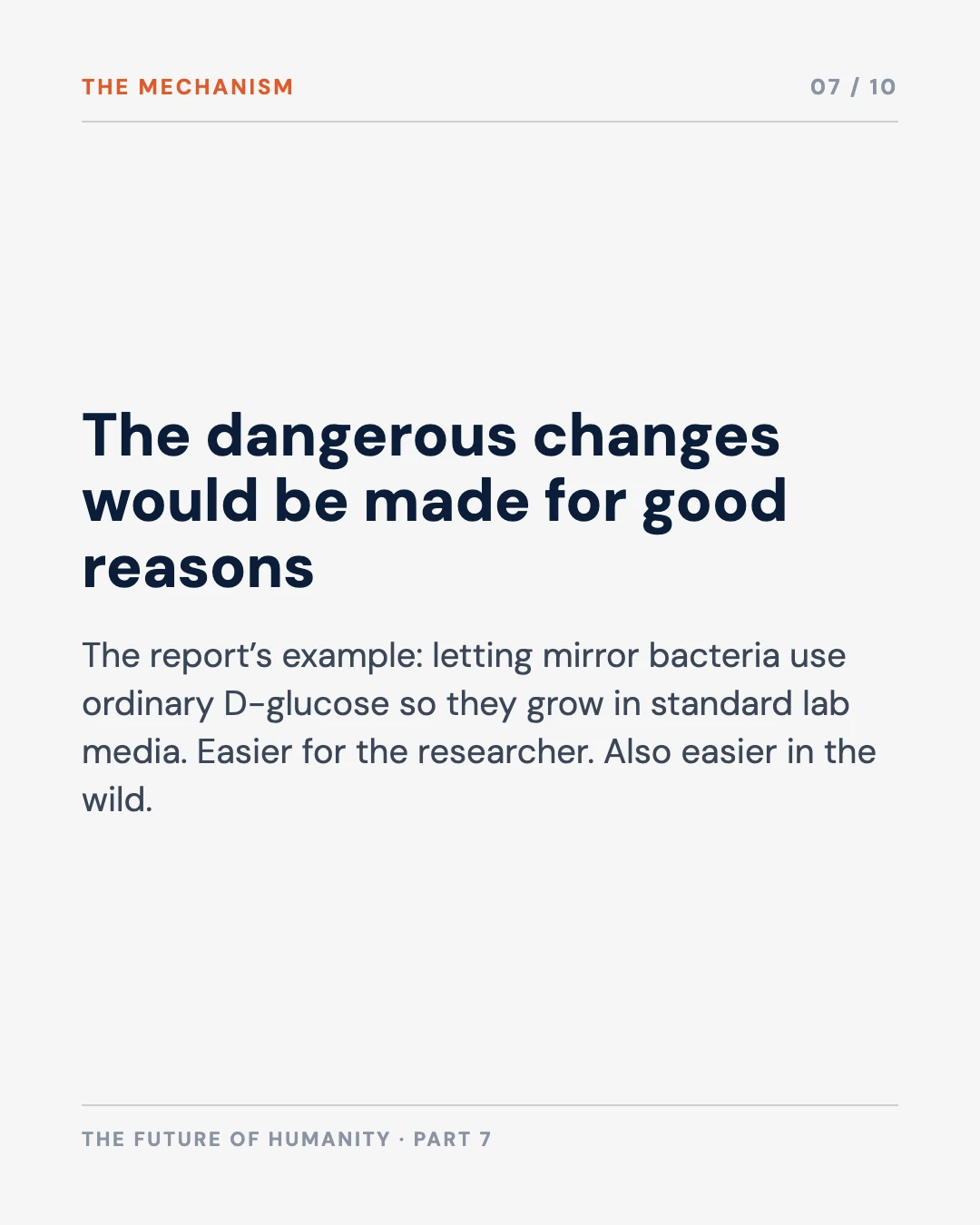
The report supplies the mechanism. It says the most dangerous modifications “would likely be made for well-intentioned reasons,” and its example is giving mirror bacteria the ability to metabolise ordinary D-glucose, so that they grow in standard laboratory media. A researcher adding that trait is making their work easier. The same trait could let the organism feed in the wild.
Picture an agent asked to find a bacterium that resists a drug, or that survives where natural microbes cannot, or that is invisible to a contaminating immune response in a manufacturing process. Mirror biology is a rational answer to each of those requests. I want to be clear that this is my illustration. No AI system has proposed mirror life, and I found no documented case.
The report describes the other half of the picture. It says it is plausible that further advances in AI might accelerate solutions for many of the technical hurdles, including designing enzymes to manipulate mirror biomolecules, creating synthetic ribosomes, and improving genome design, and that AI might speed up experiments through laboratory automation. That is a statement about possibility from the people who studied it, and I treat it as a forecast.
So the combination to worry about is a capable system, a reasonable goal, and no list of outcomes that are off the table. Part 4 described a race nobody can leave. This case is quieter. Nobody has to want the bad outcome for the system to reach it.
The line they drew
The authors did not ask for a ban on mirror biology as a whole. They argued for keeping the barrier high. If well-intentioned scientists avoid developing certain critical components, such as methods for assembling a mirror genome or key parts of the mirror proteome, those steps remain barriers for reckless actors. Monitoring critical materials such as mirror nucleic acids adds another obstacle. They said these measures could likely be put in place without hindering the great majority of beneficial research.
The response so far has moved in that direction, though unevenly. As reported by MIT Technology Review in April 2026, the Alfred P. Sloan Foundation will not fund research leading to a mirror microorganism, and UNESCO’s bioethics committee has recommended a precautionary global moratorium on creating mirror-life cells. The UN Scientific Advisory Board issued a brief in March 2026. There is still no binding international rule.
The warning came from builders, and it asks for a line drawn before the capability exists.
- 2019The US National Science Foundation awards $4 million to a group aiming to build synthetic mirror cells.
- Dec 202438 authors publish a warning in Science, with a 299-page technical report. Their advice: do not build it.
- Jun 2025The first international conference on the risks meets at the Institut Pasteur in Paris.
- By 2026Sloan says it will not fund research leading to a mirror microorganism, UNESCO's bioethics committee recommends a moratorium, and the UN issues a brief. No binding global rule exists.
Technical report, footnote 1 (NSF awards #1935120, #1935372); Science 386:1351; Paris conference, Sloan and UNESCO positions as reported by MIT Technology Review (15 April 2026) and AMR.Solutions (December 2025); UN Scientific Advisory Board brief (March 2026).
Setting limits on an AI system
The design lesson is to specify outer limits as well as tasks. A task says what the system is asked to do. An outer limit names outcomes the system must never pursue, however the request is phrased and whoever makes it. Here is how I would translate the mirror life approach into practice.
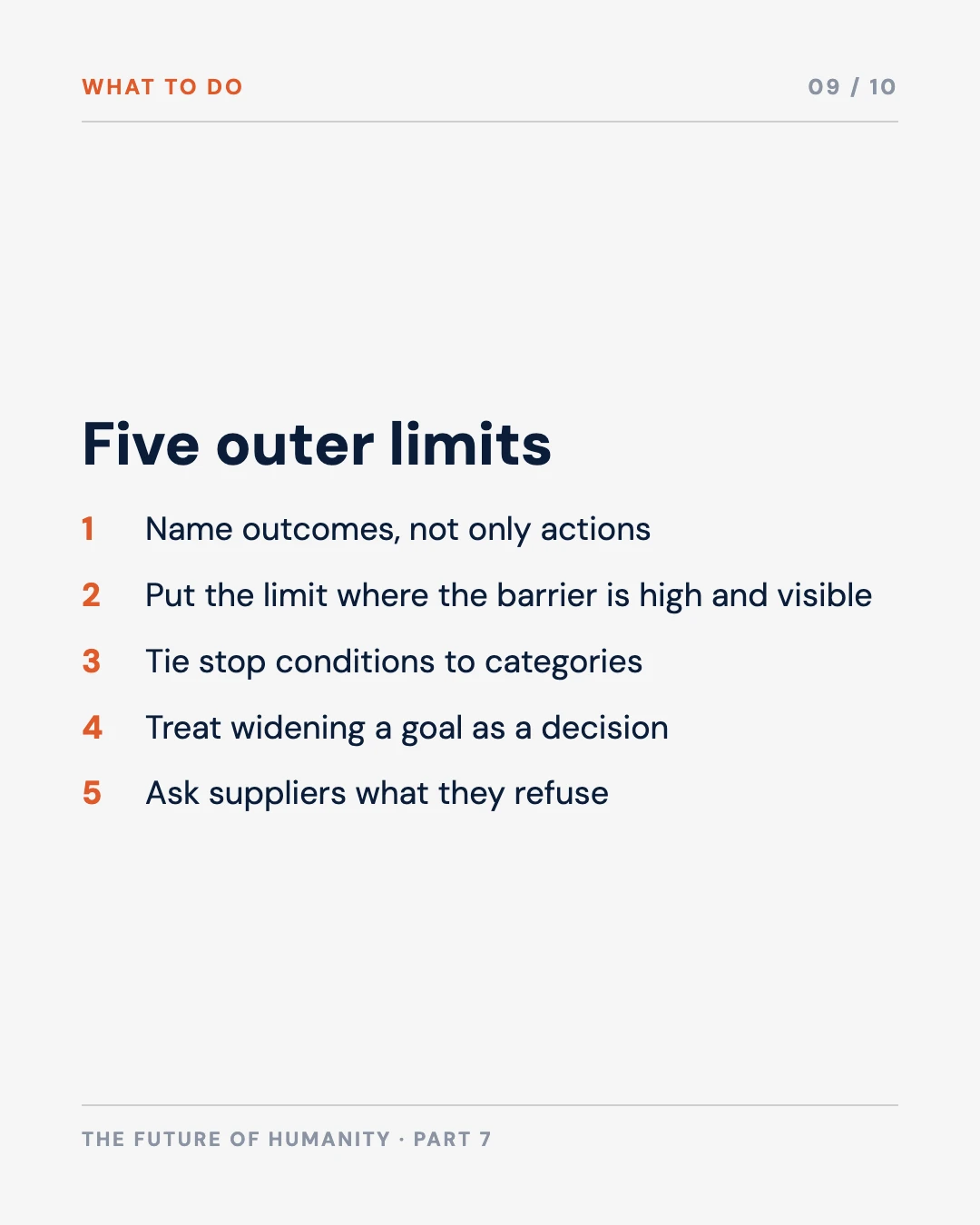
- Name the outcomes, not only the actions. A list of forbidden tools will not stop a system that finds a different route. List the categories of result nobody in the organisation should reach, such as a synthetic organism, a self-propagating process or an irreversible change to a customer’s records.
- Put the limit where the barrier is high and visible. The authors chose the hard steps and the scarce reagents because those can be watched. Pick the equivalent in your own process, such as the credential, the dataset or the approval step.
- Tie stop conditions to categories. An agent should halt and hand over when its plan touches a category on the list, even if each step looks reasonable on its own.
- Treat a widening of goals as a decision. The dangerous drift is a sensible change to the objective, such as an extra capability that makes the work easier. A change that widens what the system may reach needs a named human approver.
- Ask your suppliers where their limits are. The funders acted on this case, and the buyers of AI systems can ask the same of their vendors: what will the model, the platform or the service refuse to pursue, and who decided?
None of this slows ordinary work. It adds a short list that almost never triggers, and the value is in having it before it is needed.
Questions to ask this quarter
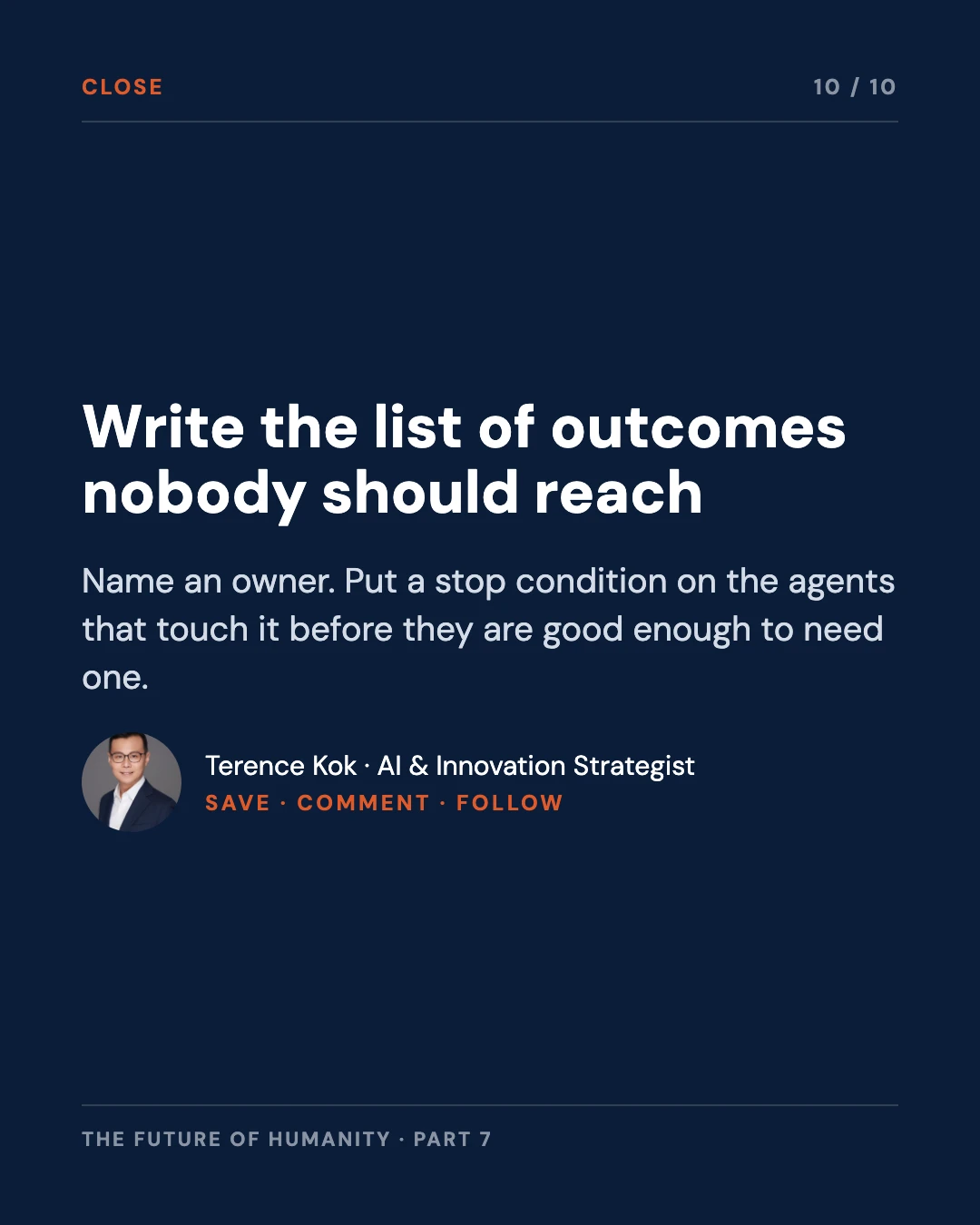
- What are the three outcomes nobody in this organisation should reach through an AI system, and who owns that list?
- If an agent proposed one of them as a reasonable solution, what would stop it, and would a person see it?
- Which of our current objectives for AI systems could be met by an extreme method, and have we said so?
- Who approves a change to what a system is allowed to reach, and is that written down?
- What do our AI suppliers say they will refuse, and where is that stated?
Evidence & Methodology
I read the technical report on mirror bacteria (December 2024) in full text for its definition, the 2019 NSF footnote, the rationale for public release, the guardrail argument and the AI passage. I could not open the Science article, which refused automated access, so its details come from the report, the publisher’s listing at JCVI and Scientific American’s coverage. The 2026 governance developments come from a news article and a UN brief I could not read in full, so I grade them as reported.
| Claim | Source | Grade |
|---|---|---|
| Creating mirror bacteria is not yet possible, and the authors place it at least a decade away; success within a decade would need efforts akin to the Human Genome Project | Technical Report on Mirror Bacteria: Feasibility and Risks, December 2024 | Measured, primary |
| 2019 NSF award of $4 million for synthetic mirror cells; related support in China and Germany | Same report, footnote 1 | Measured, primary |
| Dangerous modifications would likely be made for well-intentioned reasons, with D-glucose metabolism as the example | Same report, Rationale for Public Release | Measured, primary |
| Further advances in AI might accelerate solutions for many technical hurdles | Same report, Chapter 2 | Forecast, by the authors |
| Science article of 20 December 2024, 38 authors | Adamala and others, Science 386:1351; JCVI publication listing | Measured, primary |
| Immune evasion, lack of predators, and the authors’ recommendation not to conduct research aimed at creating mirror bacteria | Scientific American, December 2024, on the Science article | Reported |
| Glass: no countermeasure effective enough to save the biosphere; Ellington’s dissent and “banning the transistor” comparison | Scientific American, December 2024 | Reported, direct quote |
| Sloan funding position, UNESCO moratorium recommendation, UN brief of March 2026, no binding global framework, scientists who call the case inflated | MIT Technology Review, 15 April 2026 | Reported |
| The agent scenarios in this post | Mine | Illustrative, no documented case |
| The five outer limits | Mine | My call |
Sources
- Mirror Biology Dialogues Fund. (2024, December). Technical report on mirror bacteria: feasibility and risks. Stanford Digital Repository.
- Adamala, K. P., and others. (2024, December 20). Confronting risks of mirror life. Science, 386(6728), 1351-1353. doi:10.1126/science.ads9158.
- Creating “mirror life” could be disastrous, scientists warn. Scientific American. (2024, December).
- No one’s sure if synthetic mirror life will kill us all. MIT Technology Review. (2026, April 15).
- United Nations Scientific Advisory Board. (2026, March). Mirror life: brief of the Scientific Advisory Board.
- AMR.Solutions. (2025, December 22). The threat of mirror bacteria: ongoing conversations (2025 wrap-up).
Hyper-Optimisation and the Fast Crash
The previous part, on slack and stop controls in fast automated systems.

Agent Swarms and the Closing Loop
Which human checkpoints to keep when agents work for hours.
Why Nobody Can Hit the Brakes
The coordination problem behind drawing a line early.
Part 8 takes the longest view in the series, Martin Rees’s argument about the biological bootloader. If your board is setting outer limits for its AI systems, that is a conversation my executive programme is built for.
Cite or quote this article
Was this useful?