



Listen to this article
Jump to a section
In this article
Executive Summary
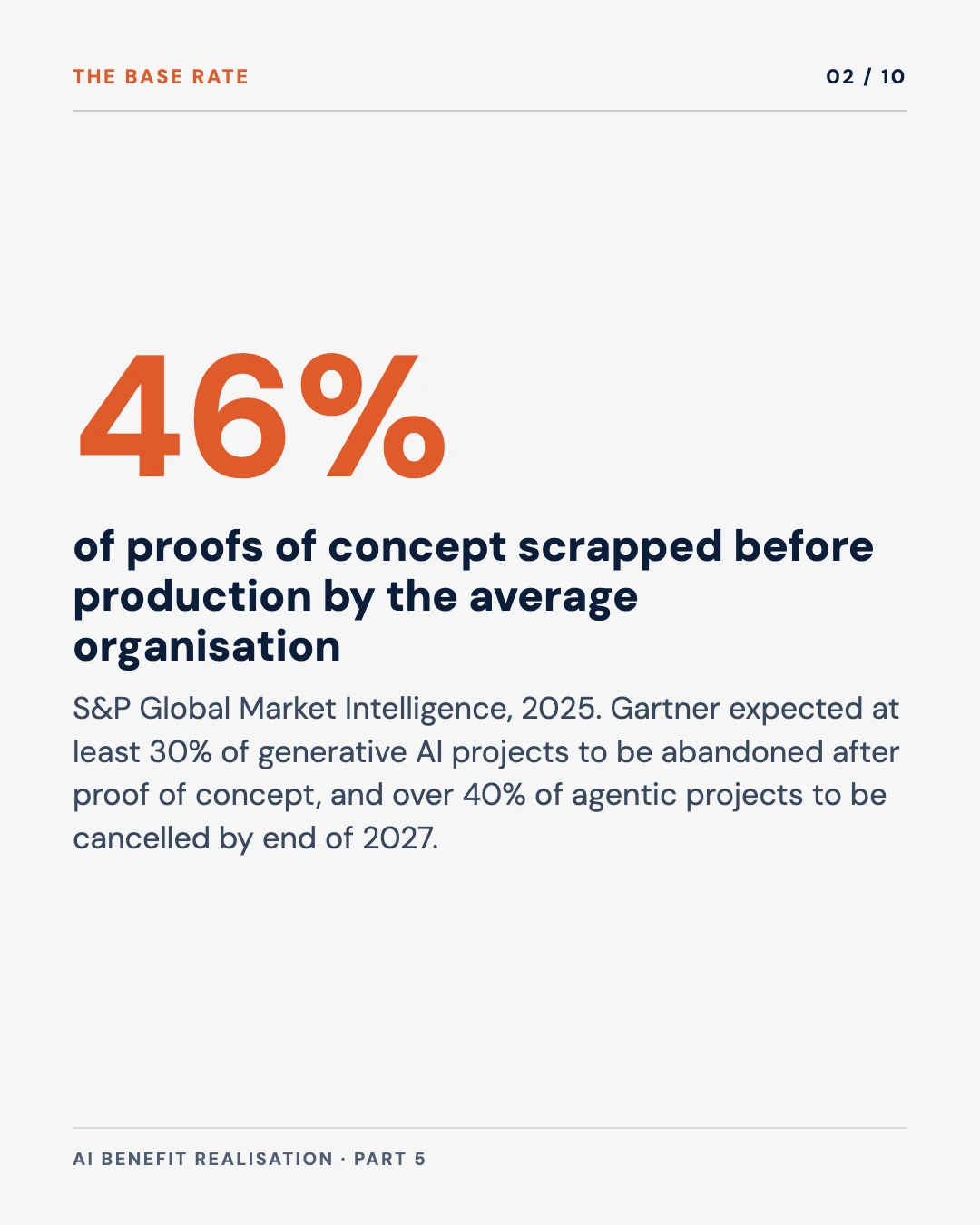
Most AI pilots that fail are stopped in the end. Gartner expected at least 30 per cent of generative AI projects to be abandoned after proof of concept, and S&P Global’s survey found the average organisation scrapping 46 per cent of its proofs of concept before production. The question is when, and who decides. Research on escalating commitment, which goes back to the 1970s, shows that people keep funding a failing project because they have already put money and credit into it. A stage-gate moves the stop decision to a fixed date, early, and takes it away from the person who built the pilot. This part sets out how to run the gates. Release money in tranches that match what each gate needs to learn. Write kill criteria with a threshold, a measure, a date and an owner, and sign them before the first model call. Give the Chief AI Officer the job of presenting the evidence, the CFO the job of signing the decision, and an independent reviewer the job of checking that the measurement followed the charter. When a pilot stops, record the decision in the same register as the benefit and keep what the organisation paid to learn.
30%
of generative AI projects Gartner expected to be abandoned after proof of concept by the end of 2025
46%
of proofs of concept scrapped before production by the average organisation, S&P Global Market Intelligence, 2025
40%+
of agentic AI projects Gartner expects to be cancelled by the end of 2027, citing cost, unclear value and weak risk controls
8.8x
more spent when the stop comes at month twelve than at the first gate, in our worked example (S$528,000 against S$60,000)
Core conclusions
- Fund each stage with its own tranche, sized to answer the question that stage exists for. A pilot that fails at the first gate should cost a small fraction of one that fails after scaling.
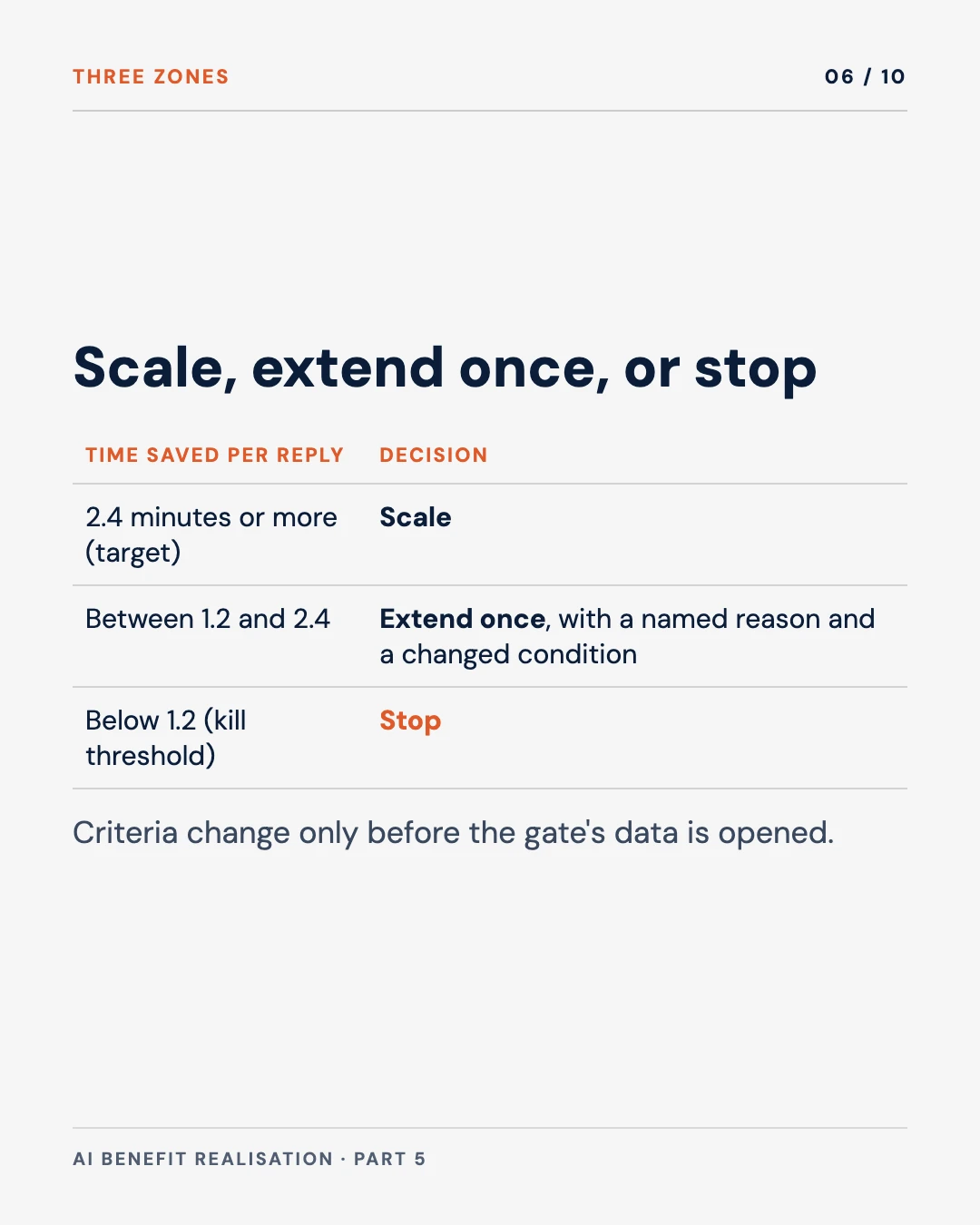
- Write each kill criterion as a threshold, a measure, a date and an owner, and allow one extension, with a named reason and a changed condition. Criteria change only before the gate’s data is opened.
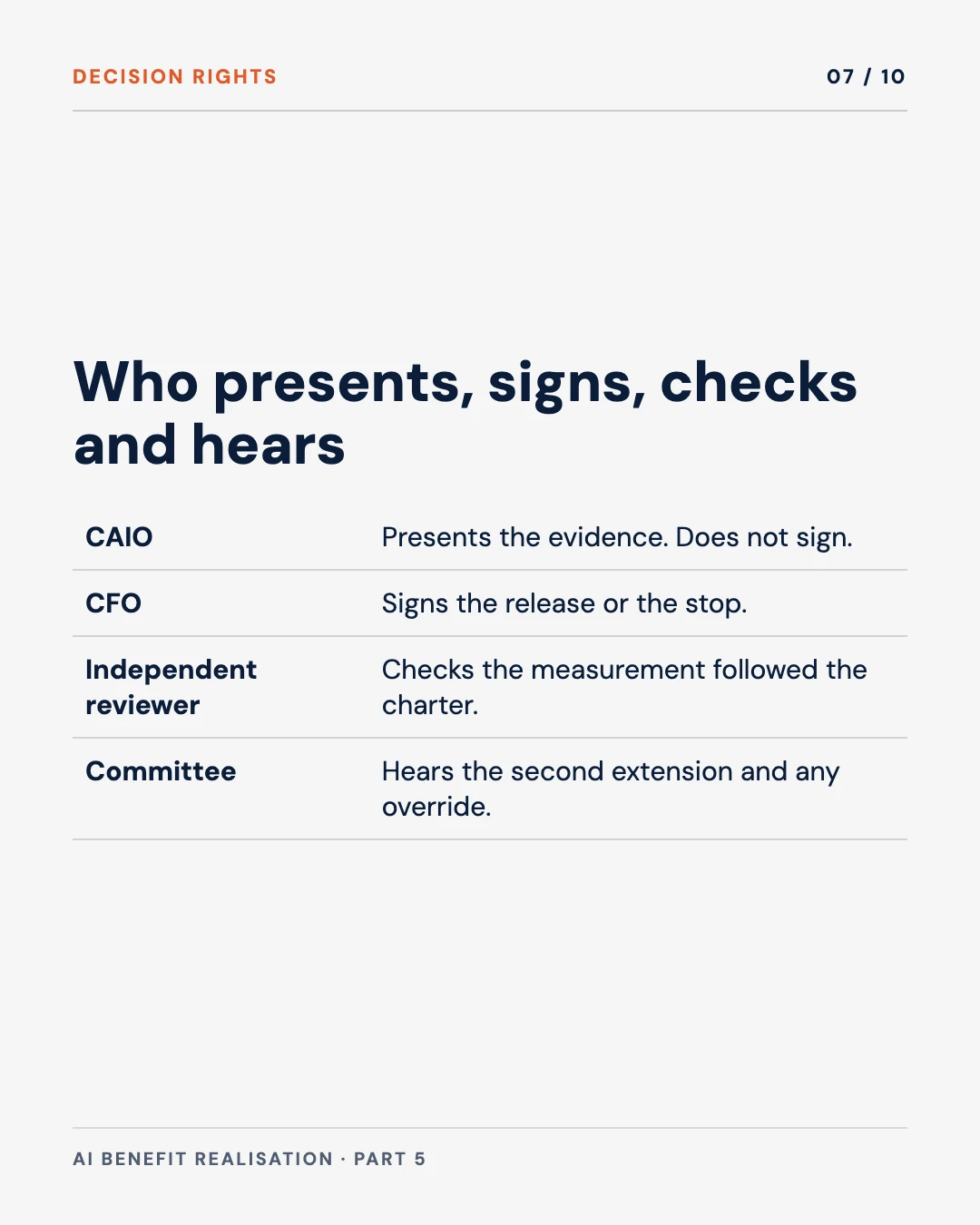
- Separate the roles. The Chief AI Officer presents, the CFO signs, an independent reviewer checks the measurement, and the investment committee hears the second extension.
The argument, in ten slides
Save it, or send it to the committee that approves your next AI pilot.

This is the fifth part of the series Christina and I are writing on AI benefit realisation. Part 1 proposed four gates and four kill criteria. Parts 2, 3 and 4 built the evidence a gate needs: the baseline, the attribution method and the cost per outcome. This part is about the meeting where that evidence is used. How much money is released at each gate, how a kill criterion is written so that it binds, who may say what, and what happens in the week after a stop. Christina’s view from the finance side shaped the tranche sizes and the sign-off rules.
Why pilots are hard to stop
Gartner’s July 2024 release predicted that at least 30 per cent of generative AI projects would be abandoned after proof of concept by the end of 2025, citing poor data quality, inadequate risk controls, escalating costs and unclear business value. In June 2025 it predicted that more than 40 per cent of agentic AI projects would be cancelled by the end of 2027. S&P Global Market Intelligence’s survey of more than 1,000 respondents in North America and Europe found the share of companies abandoning most of their AI initiatives before production up from 17 per cent to 42 per cent in a year, with the average organisation scrapping 46 per cent of its proofs of concept.
Read together, these say that stopping is common. Nothing in them says it is done well. A project stopped after a cost overrun has already spent the money the gate would have saved.
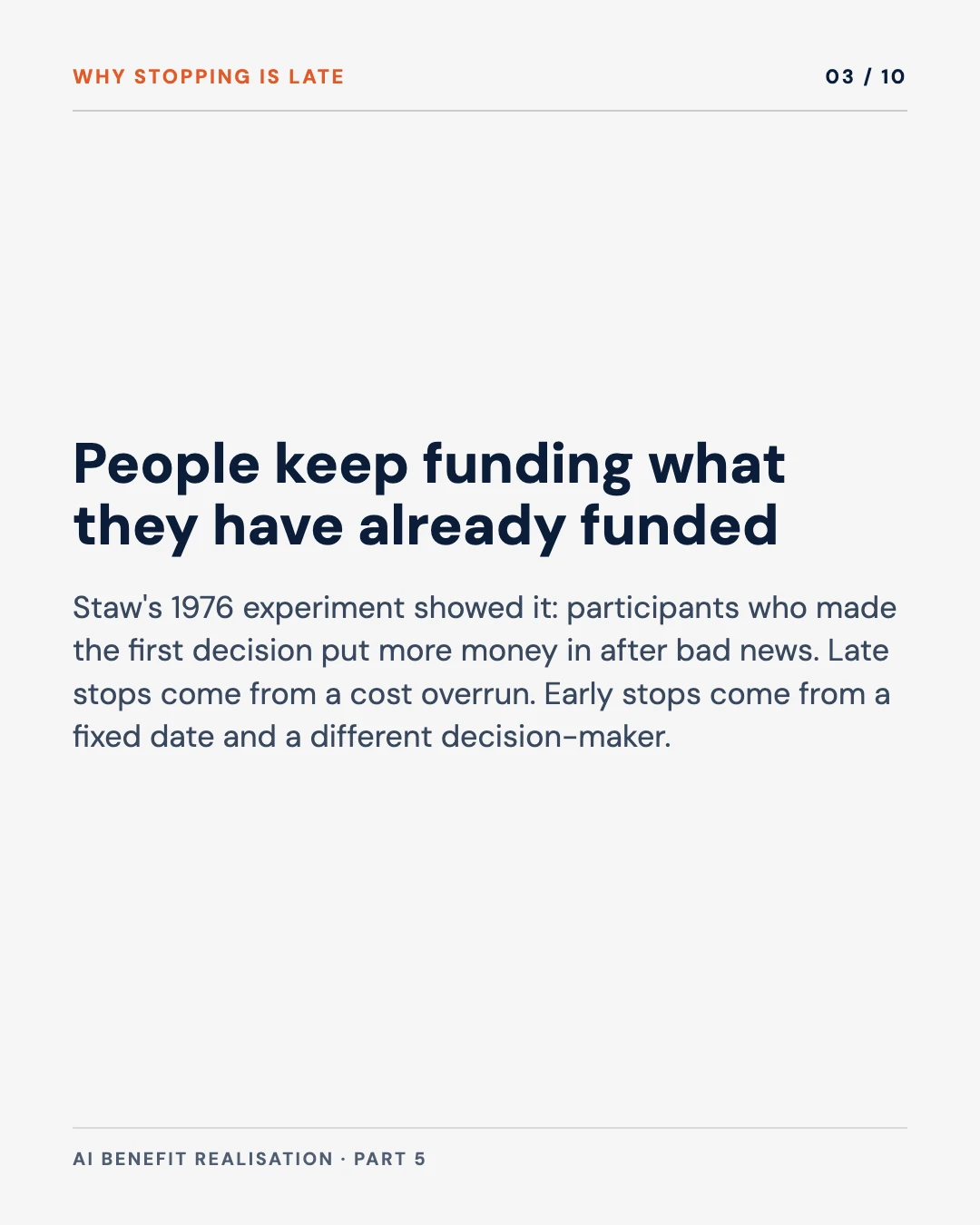
The reason is old and well studied. In 1976 Barry Staw ran an experiment in which participants who had made an investment decision, and were then told it had gone badly, put more money into the same course of action than participants who had not made the first decision. He called it escalating commitment. Mark Keil and Ramiro Montealegre later examined more than 40 cases of escalating information technology projects over eight years, and found that troubled projects were turned around when someone with authority stepped back and re-examined the commitment. AI pilots carry the same pressures in a milder form. They start cheaply, a demonstration is persuasive, the sponsor has told the board it will work, and each extension looks small on its own.
A stage-gate answers this with structure. The date of the review is fixed in advance, the criteria are written before there is anything to defend, and the decision sits with people who did not build the pilot.
Release money in tranches
A stage-gate funds a stage, and the size of the tranche should match the question the stage exists to answer. Our proposal is three tranches, using the contact-centre drafting assistant from parts 3 and 4.
| Tranche | Released at | What it buys | Question it answers | Amount (S$) |
|---|---|---|---|---|
| Pilot | Gate 0 | Ten weeks of build and a comparison-group run | Does the effect reach the target, measured the way we agreed? | 60,000 |
| Scale | Gate 1 | Integration, roll-out to all teams, review staffing | Does the unit margin hold at full volume? | 240,000 |
| Run | Gate 2 | Twelve months of operation at S$19,000 a month, from part 4 | Is realised benefit matching the forecast? | 228,000 |
Illustrative worked example built for this post. The run tranche is the S$19,000 monthly cost from part 4 over twelve months.
What the same answer costs at each gate
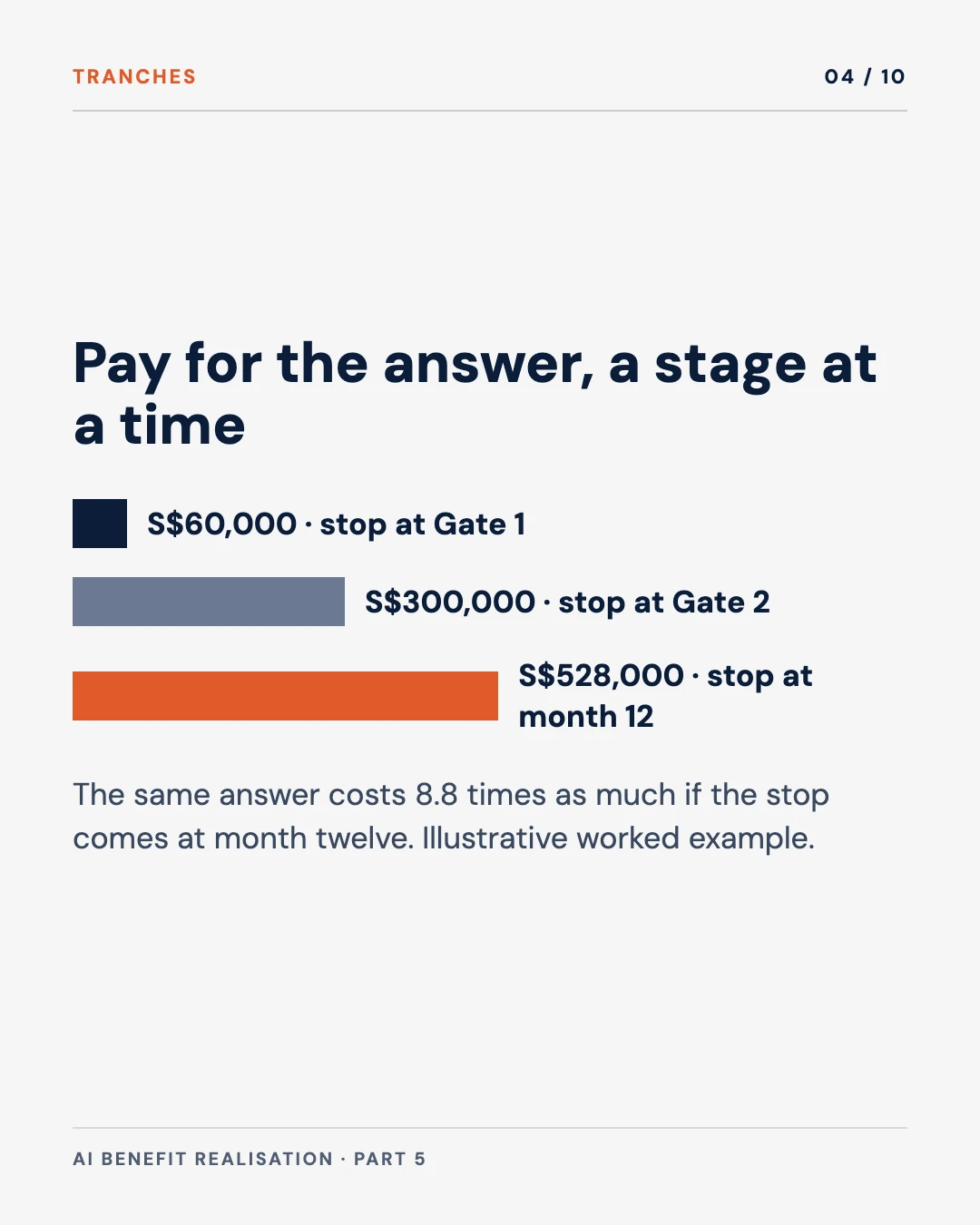
8.8x
the spend when the stop comes at month twelve rather than at the first gate
Illustrative worked example built for this post. Pilot tranche S$60,000, scale tranche S$240,000, then twelve months of running at S$19,000 a month (S$228,000). Spend is cumulative.
The cumulative figure at each gate is the cost of finding out. A pilot that is stopped at Gate 1 has cost S$60,000. The same use case allowed to drift into scale and stopped at month twelve has cost S$528,000, which is 8.8 times as much, for the same answer. Part 1 noted that most AI pilot spending lands in the profit and loss account in the year it is incurred, so each tranche is budgeted and reviewed as operating spend, and finance can see the money leave.
Two rules keep the tranches honest. A tranche cannot be spent on the next stage. If the pilot team starts building the scale integration before Gate 1, the gate has been bypassed, and the cost sits in the pilot’s line. And an unspent balance at a stop is returned to the portfolio, not carried to another use case, so that a stop produces visible savings.
Writing kill criteria that bind
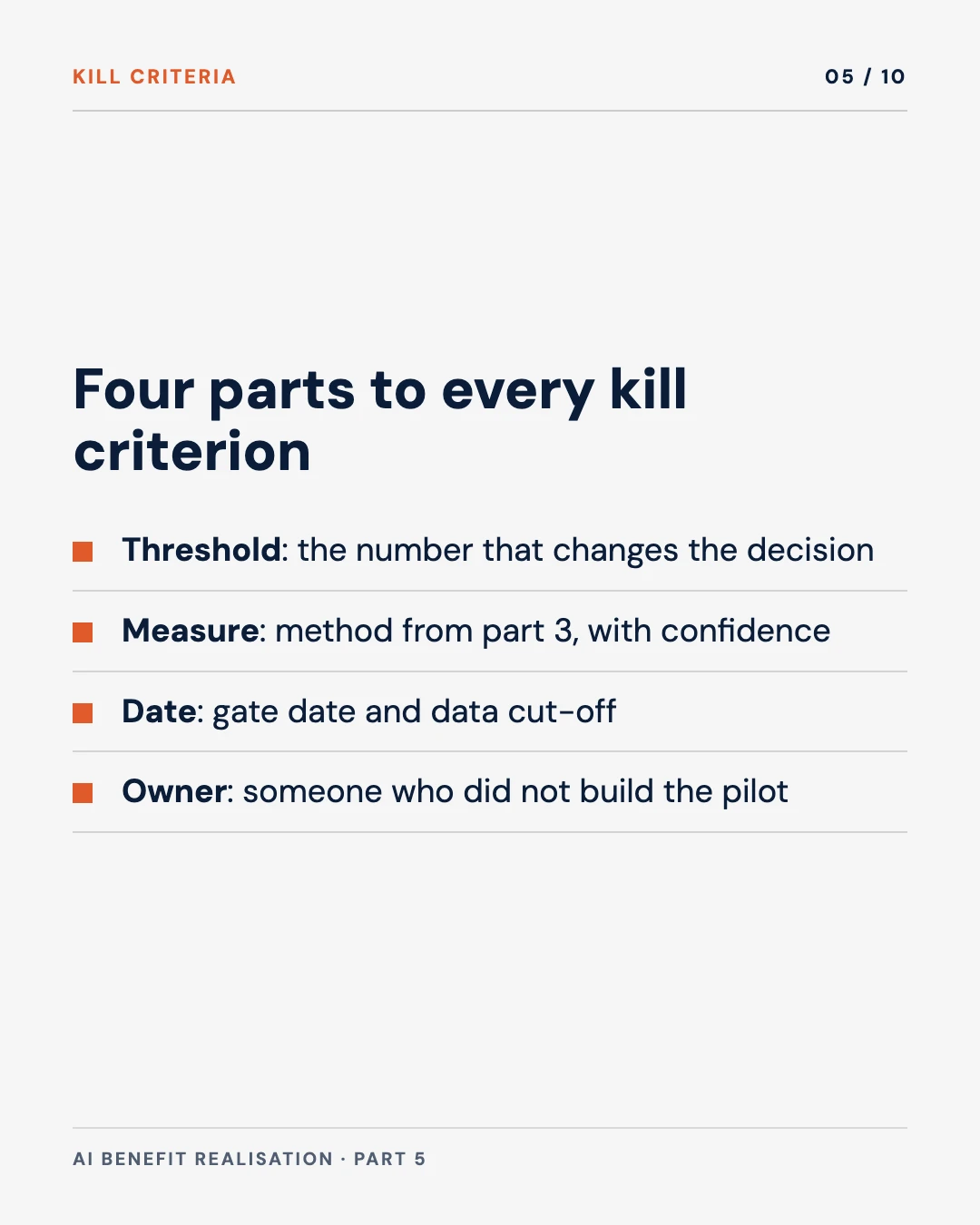
Part 1 listed four kill criteria. A criterion only binds if it is specific enough that two people looking at the same result would reach the same decision. We write each one with four parts.
- A threshold. The number at which the decision changes.
- A measure. How the number is produced, by which attribution method from part 3, with what confidence.
- A date. The calendar date of the gate, and the date after which results are no longer admitted.
- An owner. The person who produces the number, who is not the person who built the pilot.
Here is the pilot charter for the drafting assistant.
| Criterion | Threshold | Measure and owner | Decision if breached |
|---|---|---|---|
| Time saved per reply | Below 1.2 minutes (target 2.4) | Comparison-group difference at 90% confidence, finance analyst | Stop |
| Unit margin | Cost per reply sent above benefit per reply at projected volume | Part 4’s cost line against part 3’s benefit, finance | Stop |
| Quality guardrail | Reopened-case rate more than one percentage point above the comparison group | Case-system data, quality team | Stop unless fixed inside the extension |
| Measurement | Comparison group not running by week four | Pilot charter check, independent reviewer | Stop |
Illustrative charter for the worked example. The 2.4-minute target and the S$0.70 a minute rate come from part 4; the thresholds are our proposal.
The first row creates three zones, which is what makes the extension rule workable.
At or above 2.4 minutes, the pilot has met its target and goes forward. Below 1.2 minutes, it stops. At S$0.70 a minute, 1.2 minutes is S$0.84 per reply, comfortably above the S$0.48 cost, so a result in between does not lose money. It does leave the use case short of what the board was told, and the right response is a bounded extension. The pilot team can say what would change and by when. The gate can say what result earns the scale tranche.
The extension rule
Extensions are where gates fail, so we limit them. A pilot may be extended once, for at most half the original pilot period, and only if the extension names a reason that can be checked and a condition that has changed. “The results are promising” is neither. “The comparison group had 400 cases against the 1,200 the power calculation needed, and the new sample will reach 1,200 by week fourteen” is both. The kill threshold does not move during an extension. A second extension goes to the investment committee, which hears the case in writing.
Changing a criterion
Criteria can be amended, and some should be, when the team learns something that no one could have known at Gate 0. The rule is about timing. An amendment is accepted before the gate’s data is opened, with a recorded reason and the signatures of the CFO and the Chief AI Officer. After the data is open, the criteria are fixed. Clinical trials follow the same discipline by registering the primary outcome before the results exist, because an outcome chosen afterwards tends to be the one that looks best.
The pre-mortem
One short exercise at Gate 0 improves the criteria. Gary Klein’s project pre-mortem, described in Harvard Business Review in 2007, asks the team to assume that the project has failed and to write down believable reasons why. We run it with the pilot team, finance and the independent reviewer in the same room, for thirty minutes. Each reason that could be measured early becomes a candidate kill criterion or a guardrail. In our experience the commonest reason is that the comparison group quietly stopped being comparable, which is why the fourth row of the charter exists.
Who decides
A gate fails when the same person builds the pilot, reports the result and approves the next tranche. The roles should be separate.
| Role | Holds | Does not hold |
|---|---|---|
| Chief AI Officer or use-case owner | Presents the evidence and proposes the decision | The signature that releases or stops money |
| CFO | Signs the release or the stop; owns the criteria once Gate 0 is signed | The right to change criteria after the data is open |
| Independent reviewer | Checks that the measurement followed the charter; may call a gate early if a threshold is breached | A vote on the decision |
| Investment committee | The second extension and any override of a stop | Routine gate decisions |
Our proposed split. The independent reviewer can be internal audit, a portfolio office or a Chief AI Officer from another business unit.
An override of a stop is allowed, because there are good reasons for one, such as a strategic bet the committee chooses to keep funding. It is recorded as an override, with the committee’s reasons and the amount at stake, so that the cost of the judgement can be reviewed at the next gate. The UK government’s Gateway reviews rest on the same separation, with a review team from outside the project reporting to its senior responsible owner. What AI programmes can borrow is the independence, without the formal machinery.
The gate review pack is one page: the charter criteria, the results against each, the method and confidence, the unit margin, spend against tranche, open risks, the recommendation and a line for any dissent. Anyone on the panel can attach a dissent, and dissents are kept.
The stop decision
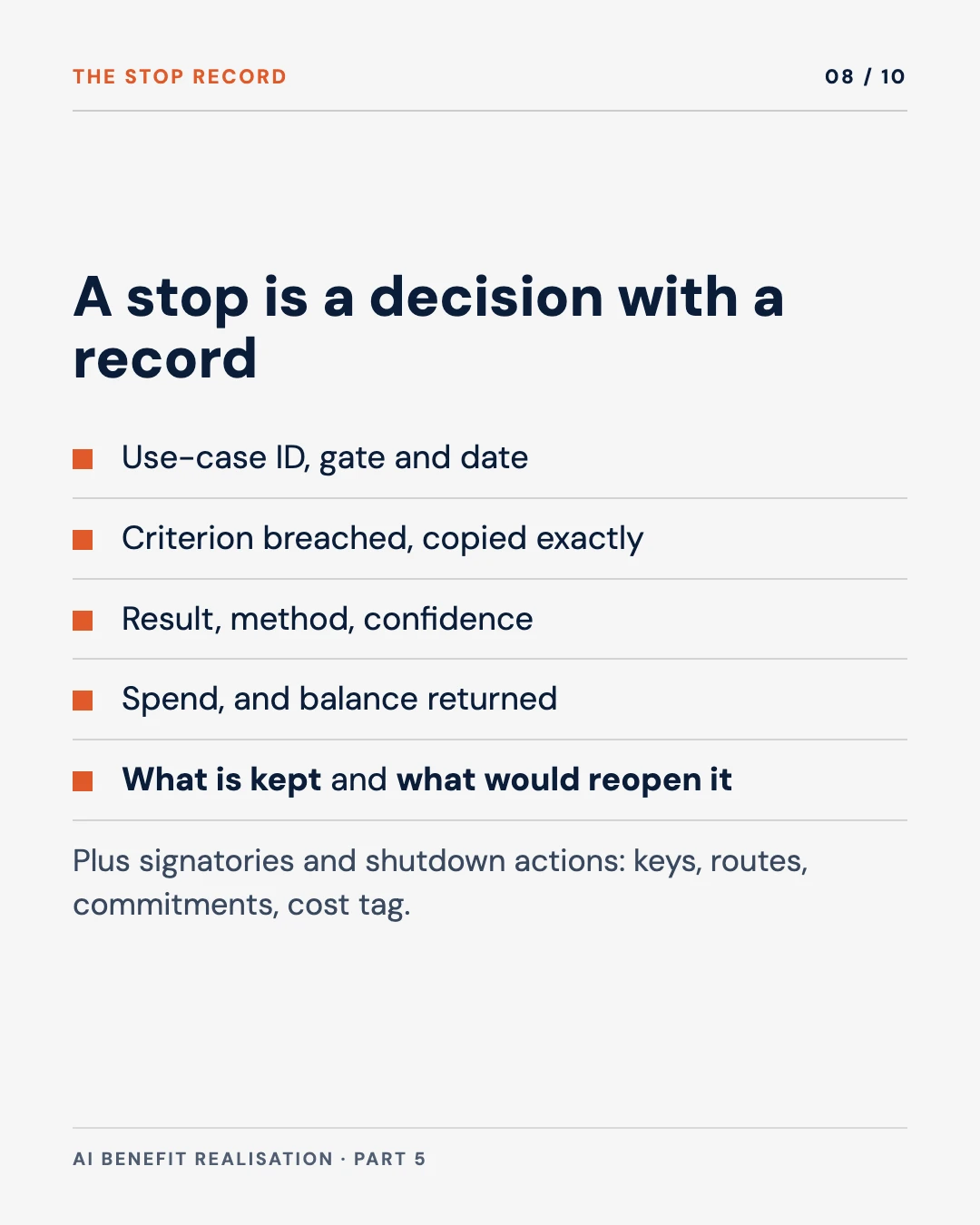
A stop is a decision with a record, and it should look the same every time.
| Field | What it holds |
|---|---|
| Use-case ID | The ID from the benefits register, the same one used on the cost tags |
| Gate and date | Which gate, and the date the data was opened |
| Criterion breached | The wording from the charter, copied exactly |
| Result | The measured value, the method and the confidence |
| Decision and signatories | Stop, with the CFO’s signature and the independent reviewer’s note |
| Spend | Spent against the tranche, and the balance returned |
| What is kept | The evaluation set, data pipelines, integrations and lessons that other use cases can reuse |
| Shutdown actions | Keys revoked, gateway routes closed, unused commitments released, cost tag retired |
| Revisit condition | What would have to change for the idea to return, and the earliest date |
Our proposed template. The shutdown row ties back to the unused-commitment line in part 4’s cost review.
The two rows that organisations skip are what is kept and the revisit condition. A pilot that fails often leaves a clean evaluation set, a tidied knowledge base or a working integration, and the stop is where those are claimed for the next use case. A revisit condition lets the idea come back when a model improves, a price falls or a dataset arrives, without the team arguing it all over again from scratch. Treat the stop as the pilot’s result, and report it that way. A pilot stopped at Gate 1 on a clean measurement has done its job, because it bought the answer for S$60,000.
Shutdown is also a security and cost matter. A pilot whose credentials, service accounts or model routes stay live after the decision is a small version of the unowned agent problem, and its cost line carries on in the bill.
Are the gates being used
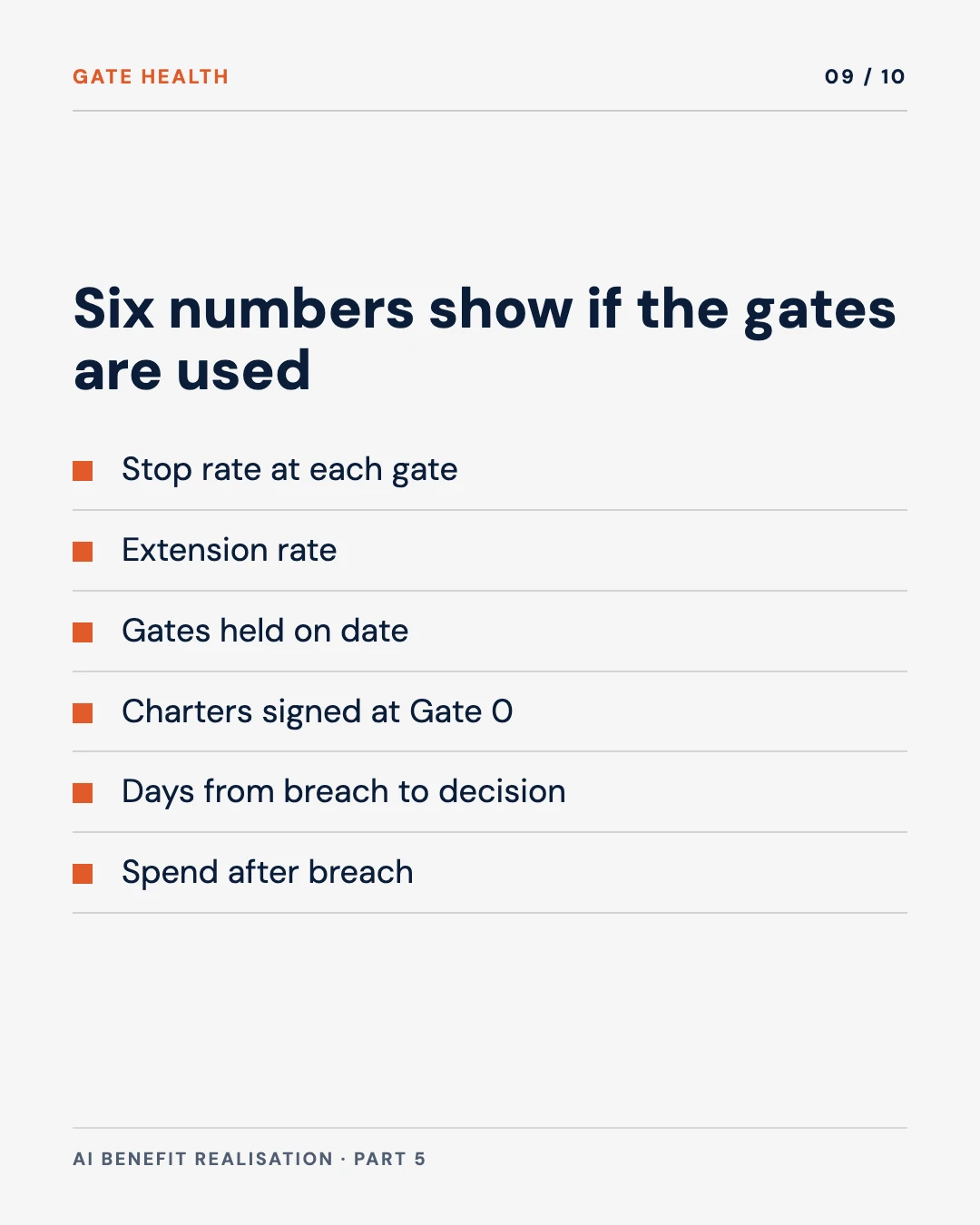
A set of gates that no pilot ever fails is a sign they are not working. Six numbers give the investment committee a view of their health, and finance can compute all of them from the register.
Six of ten stop at some gate, and the early stops cost least
Illustrative portfolio built for this post, not a published stop rate. Each filled square is a pilot still funded after the gate.
- Stop rate at each gate. In the worked portfolio above, six of ten pilots stop at some gate.
- Extension rate. The share of Gate 1 reviews that end in an extension. A high rate suggests thresholds are being set too tightly, or too loosely, to decide anything.
- Gates held on date. The share of gates that took place within a week of the date in the charter.
- Charters signed at Gate 0. This should be every pilot. A pilot without signed kill criteria should not receive its first tranche.
- Days from breach to decision. The time between a kill threshold being crossed and the stop being signed.
- Spend after breach. The money spent on a use case after a threshold was crossed and before the decision. This is the cost of a gate that did not work.
Our proposed measures. The thresholds a committee sets for each depend on the portfolio and are not given here.
What to do before the next pilot
- Size the tranches. Name the question each stage answers, and release only what that stage needs. Return unspent balances to the portfolio.
- Write the charter. Four to six kill criteria, each with a threshold, a measure, a date and an owner. No first tranche without signatures.
- Run a pre-mortem. Thirty minutes at Gate 0 with the pilot team, finance and the independent reviewer.
- Fix the roles. Name the presenter, the signatory and the independent reviewer before the pilot starts, and put the extension rule in the charter.
- Use the stop template. Every stop gets the nine fields, including what is kept and what would reopen the idea.
- Report the six numbers to the investment committee each quarter, beside the part 4 cost review.
Questions to ask at the gate
- Were these criteria signed before the first model call, and has any changed since?
- Who produced the number, and did they build the pilot?
- If we extend, what has changed that we can check, and when will we know?
- What does it cost to find out at this gate, compared with the next one?
- If we stop today, what do we keep, and what would reopen the idea?
Free tool
AI Use Case Prioritisation Matrix
Score up to five use cases on six dimensions and see which earn a first tranche, and what autonomy clearance each one’s governance supports.
Part 6 closes the series with reporting to the board: realised benefit against forecast, net of run cost, with the confidence of each figure stated. The series page lists what is planned.
Evidence & Methodology
Survey results and forecasts come from the publishers’ own releases or from news reports of them, read in November 2026, except where noted. The worked example, the tranche sizes, the criteria and the thresholds are our own proposal, and the figures in them are illustrative.
| Claim | Source | Grade |
|---|---|---|
| At least 30% of generative AI projects to be abandoned after proof of concept by end of 2025 | Gartner press release, July 2024 | Forecast, analyst estimate |
| More than 40% of agentic AI projects to be cancelled by end of 2027 | Gartner press release, June 2025 | Forecast, analyst estimate |
| Share of companies abandoning most AI initiatives rose from 17% to 42%; average 46% of proofs of concept scrapped; more than 1,000 respondents in North America and Europe | S&P Global Market Intelligence, March 2025, read through CIO Dive’s report | Measured, survey |
| Participants who had made an investment decision put more into the same course after bad news | Staw, 1976, Organizational Behavior and Human Performance | Measured, experiment |
| More than 40 cases of escalating IT projects examined over eight years; de-escalation follows a re-examination of the commitment | Keil and Montealegre, MIT Sloan Management Review, 2000 | Reported, case research |
| Pre-mortem: assume the project failed and write believable reasons | Klein, Harvard Business Review, September 2007 | Reported, practitioner method |
| Tranches of S$60,000, S$240,000 and S$228,000; S$528,000 against S$60,000; the ten-pilot funnel; the charter thresholds | Illustrative example built for this post | Illustrative |
| One extension of at most half the pilot period; amendments before the data is opened; the six gate-health numbers | Our practice and judgement | My call |
Sources
- Gartner. (2024). Gartner predicts 30% of generative AI projects will be abandoned after proof of concept by end of 2025. Press release.
- Gartner. (2025). Gartner predicts over 40% of agentic AI projects will be canceled by end of 2027. Press release.
- CIO Dive. (2025). AI project failure rates are on the rise: report. Reporting S&P Global Market Intelligence’s survey, 14 March 2025.
- Staw, B.M. (1976). Knee-deep in the big muddy: a study of escalating commitment to a chosen course of action. Organizational Behavior and Human Performance, 16(1), 27-44.
- Keil, M. and Montealegre, R. (2000). Cutting your losses: extricating your organization when a big project goes awry. MIT Sloan Management Review, 41(3).
- Klein, G. (2007). Performing a project premortem. Harvard Business Review, September 2007.
- Cooper, R.G. (1990). Stage-gate systems: a new tool for managing new products. Business Horizons, 33(3), 44-54.
Inference Cost Accounting for Finance Teams
The cost per outcome and monthly review that feed the gate.

A Joint CFO–CAIO Framework for AI Benefit Realisation
The four gates and four kill criteria this part puts to work.

Attribution Methods for AI Benefits
The method that produces the number a kill criterion tests.

Setting the Baseline Before an AI Pilot Starts
The baseline every threshold in the charter is measured against.
My thanks to Dr. Christina Chua for co-writing this post and the series. Her view of how finance releases and withholds money shaped the tranche sizes, the sign-off rules and the stop record. Christina is Director, Institutional Sales at Moomoo Financial Singapore. The post does not discuss Moomoo, and the views in it are not Moomoo’s.
If your organisation has pilots running with no written criteria for stopping them, setting up the gates is a short piece of work I often start with. My consulting work covers AI governance and investment oversight for boards, finance leaders and public agencies.
Cite or quote this article
Was this useful?