
Listen to this article
Jump to a section
In this article
Executive Summary
A significant share of AI spending starts as anxiety rather than analysis. The request arrives written as strategy, and the step that produces a strategy, a stated problem, was never taken. Three questions separate the two, and the answer that works costs nobody their standing.
Core conclusions
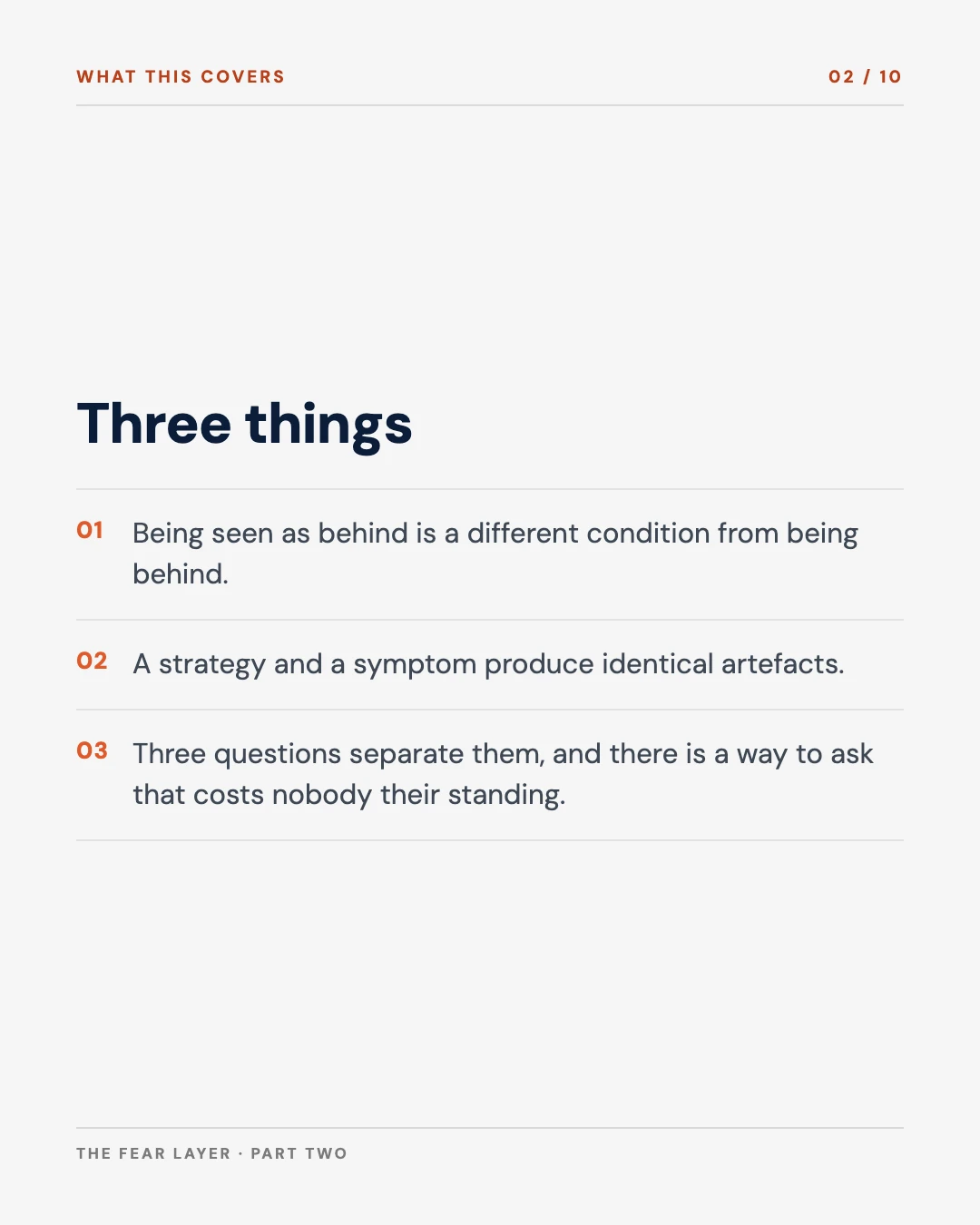
- Fear of being seen as behind is a different condition from being behind. One is about standing, the other about capability, and they are rarely separated in the room.
- A strategy and a symptom produce identical board packs. The only reliable difference sits upstream, in whether a problem was ever named.
- Refusing the mandate and complying with it both fail. Accept it and make the diagnosis the first deliverable.
The argument, in ten slides
Save it, or send it to whoever will be asked to write the strategy.
Where the mandate comes from
Trace one of these backwards and it usually ends in a room the board never mentions.
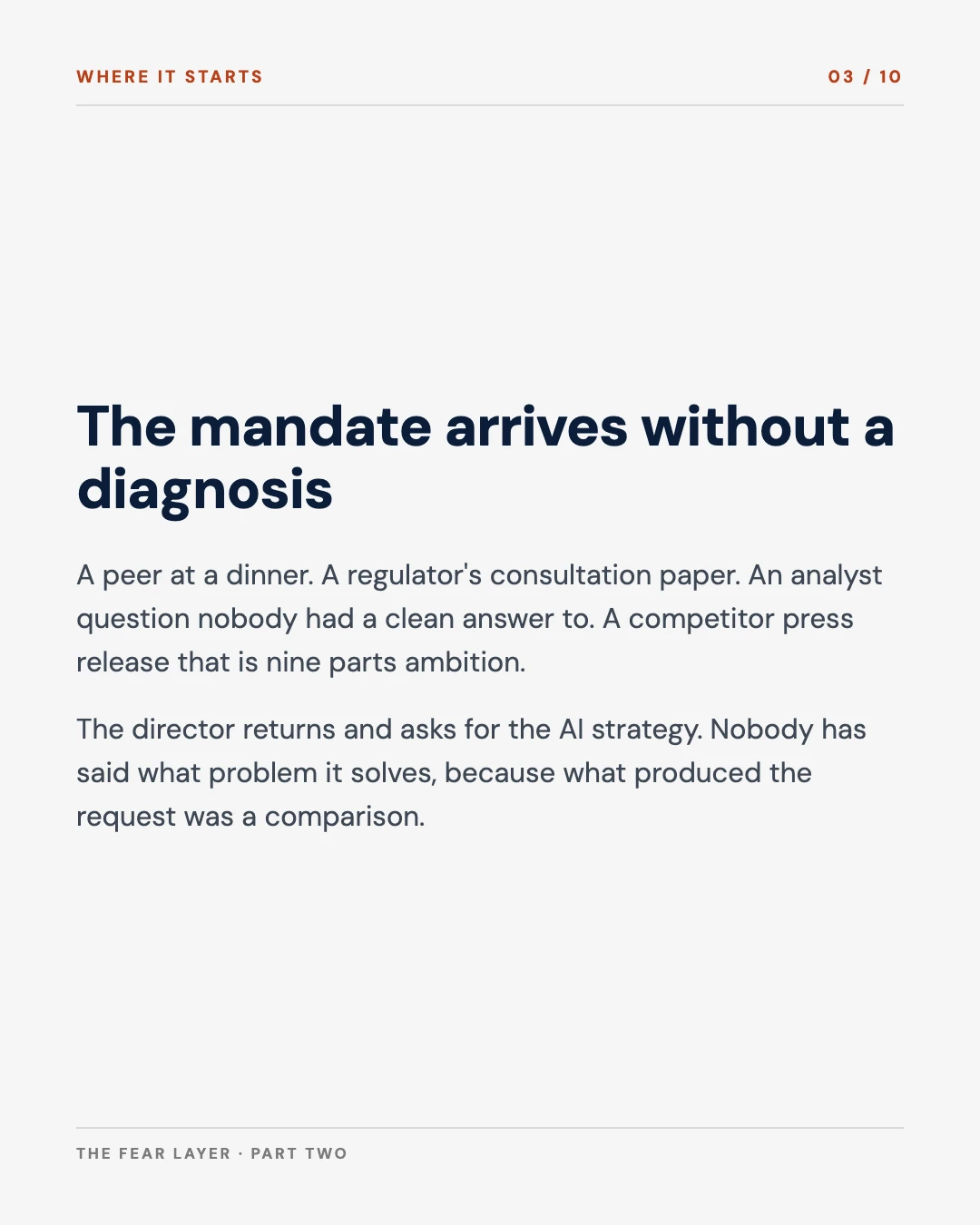
A director hears a peer at a dinner describe what their organisation has deployed. A regulator publishes a consultation paper. An analyst asks a question on a results call that nobody had a clean answer to. A competitor issues a press release that is nine parts ambition and one part deployment. The director returns and asks for the organisation’s AI strategy by the next meeting.
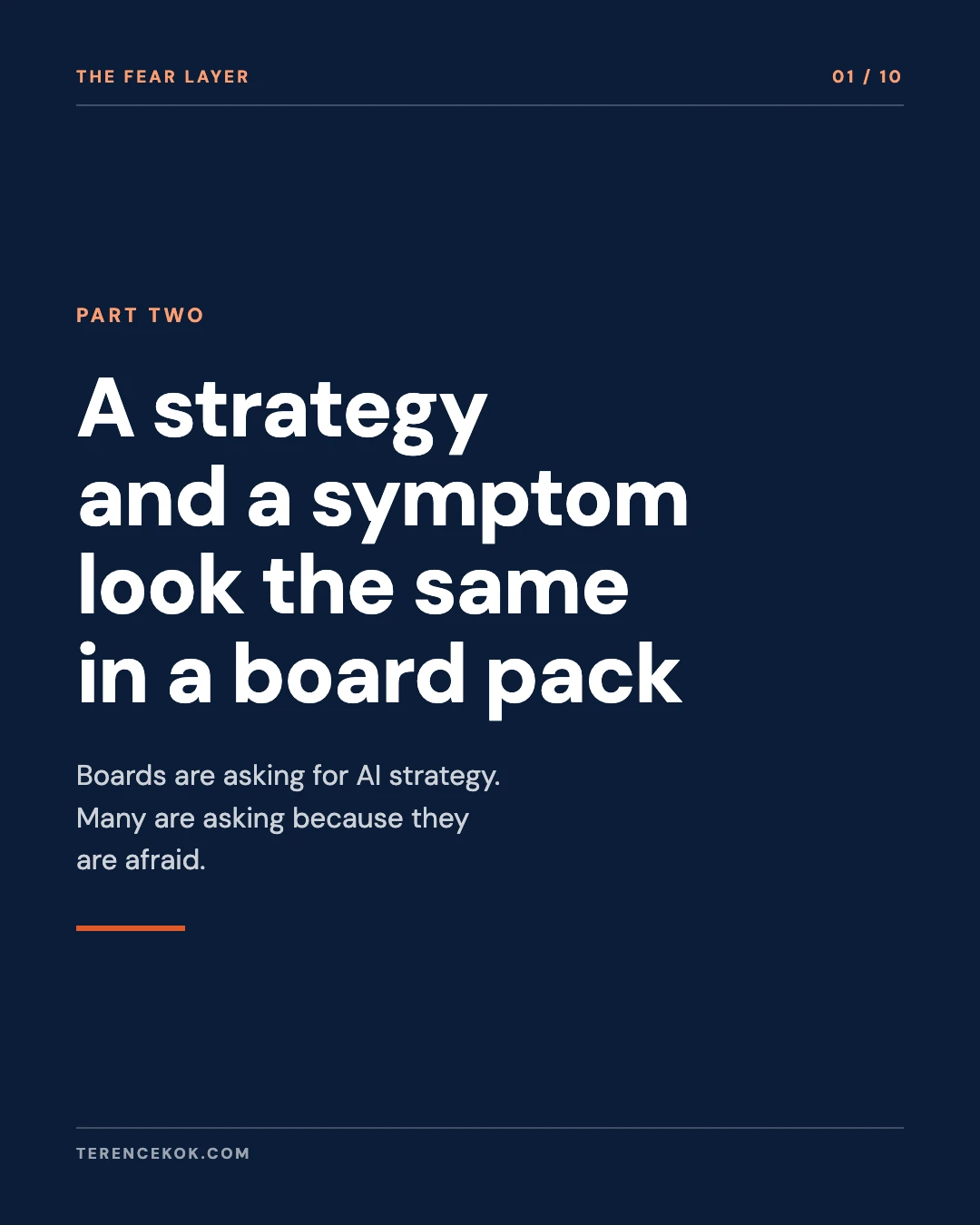
The request itself is legitimate. What is missing is the step in between. Nobody has said what problem the strategy exists to solve, because the thing that produced the request was not a problem. It was a comparison.
This is where the useful distinction lives. Being seen as behind and being behind are different conditions. The first is about standing, and it is felt by a specific person who has to sit in a specific room again in three months. The second is about capability, and it can be measured. They call for completely different responses, and in my experience they are almost never separated before the budget is approved.
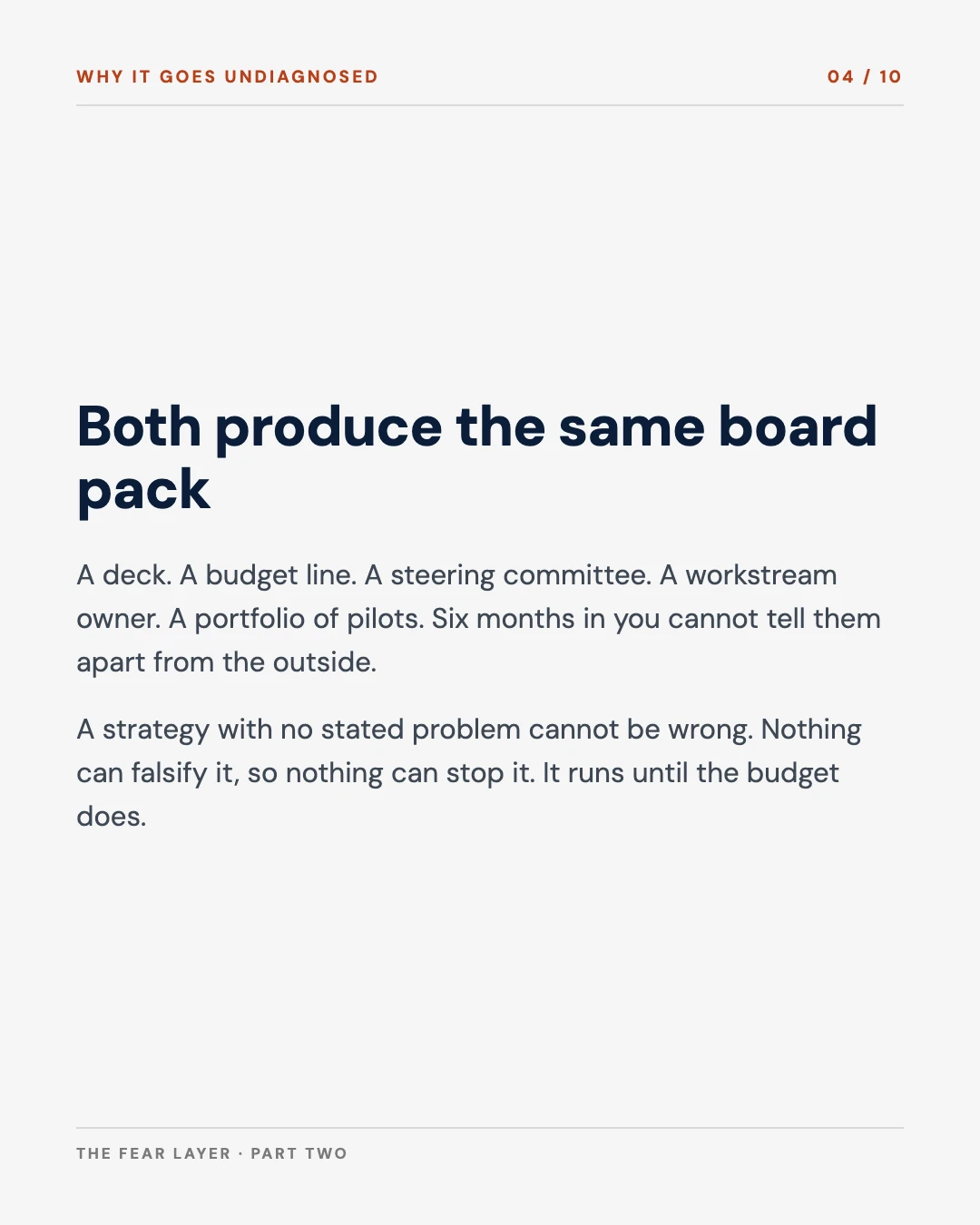
A strategy and a symptom produce identical board packs
Six months in, you cannot tell them apart from the outside.
Both produce a deck. Both produce a budget line, a steering committee, a named workstream owner and a portfolio of pilots. Both generate a monthly update that reads like progress. This is precisely why the condition goes undiagnosed for so long: the artefacts of a strategy and the artefacts of an anxiety are the same artefacts.
The difference is upstream and it is a single thing. A strategy exists to resolve a stated problem. Without one, the document cannot be wrong, which sounds like an advantage and is the entire difficulty. Nothing can falsify it, so nothing can stop it. It runs until the budget does.
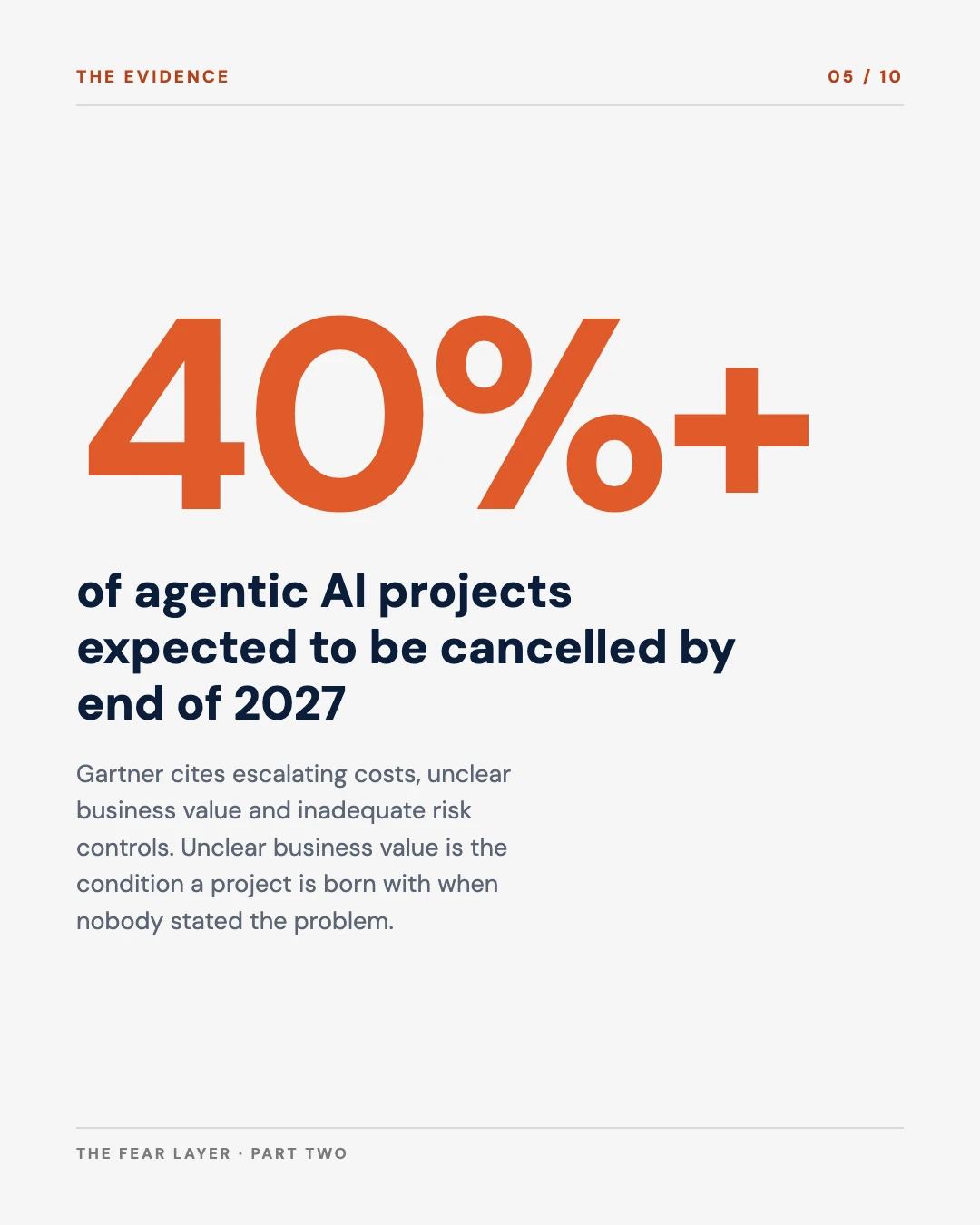
Gartner expects more than 40% of agentic AI projects to be cancelled by the end of 2027, citing escalating costs, unclear business value and inadequate risk controls. Unclear business value is the condition a project is born with when nobody was required to state the problem at the start. It does not develop later. It was there at approval, unexamined, because the request that produced the project came from somewhere else entirely.
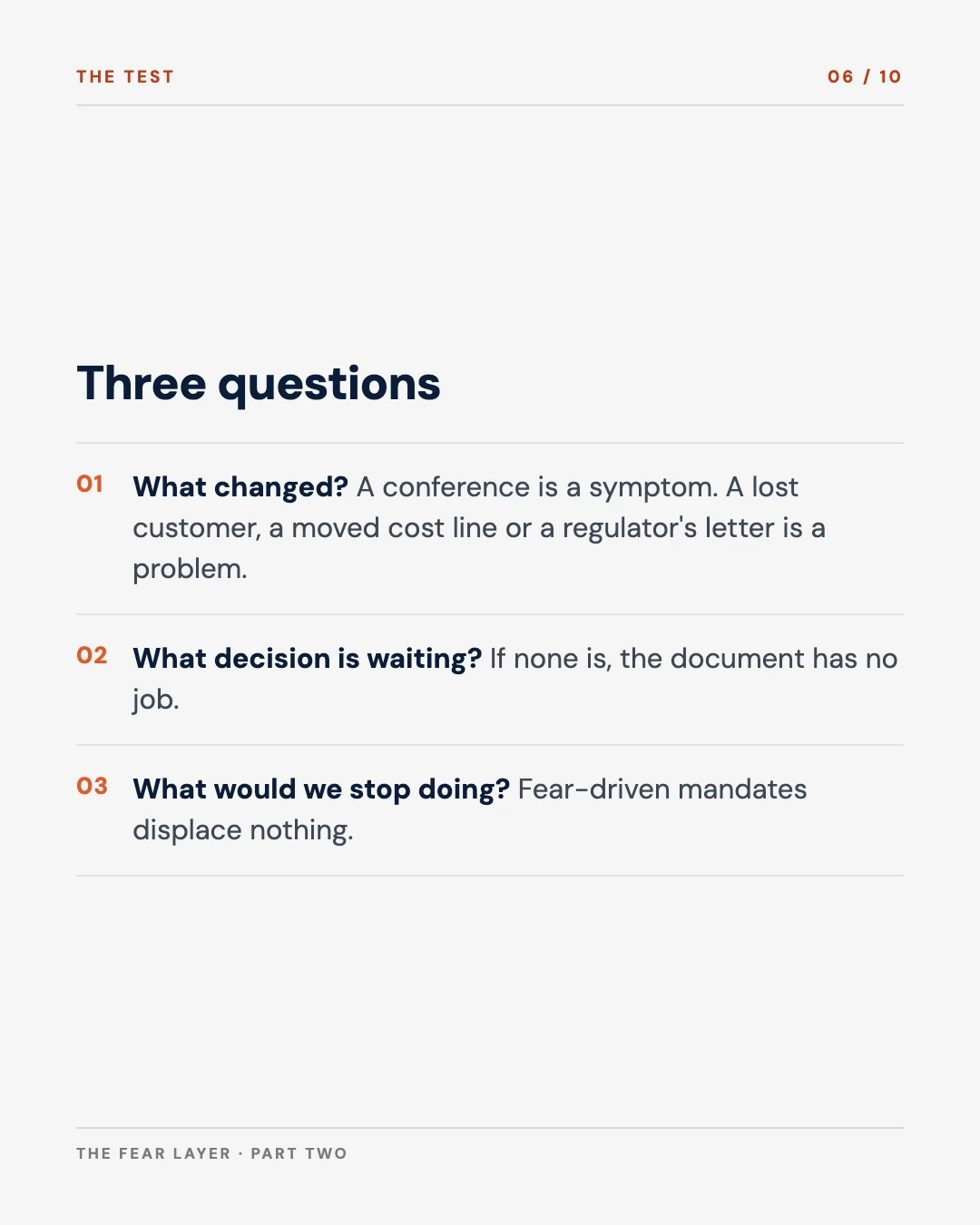
Three questions that tell you which one you have
These are the same shape as the questions in part one of this series, pointed at an organisation rather than at yourself.
What changed? Ask what specific event produced this request now rather than last quarter. If the honest answer is a conference, an article or a competitor’s announcement, you are holding a symptom. If it is a customer you lost, a cost line that moved, a regulator who wrote to you, or a capability a competitor demonstrably has that you have quantified, you are holding a problem, and a strategy is the correct instrument for it.
What decision is waiting on this? A strategy is an instrument for making a decision. Name the decision. Whether to build or buy. Whether to commit a capability budget across three years. Whether the operating model changes. If no decision is waiting, the document has no job, and it will be read once by the people who wrote it.
What would we stop doing? Mandates that come from fear are purely additive. They add a workstream, a committee and a budget line, and they displace nothing, because displacement requires somebody to have decided what matters less. A real strategy carries an opportunity cost and can tell you what it is. If the answer to this question is nothing, you have not been given a strategy. You have been given a wish with a governance wrapper.
Free tool
Board AI Oversight Checklist
What a board should be able to see, ask and evidence about an AI programme, in a form you can take into the next meeting.
How to answer without embarrassing the person who asked
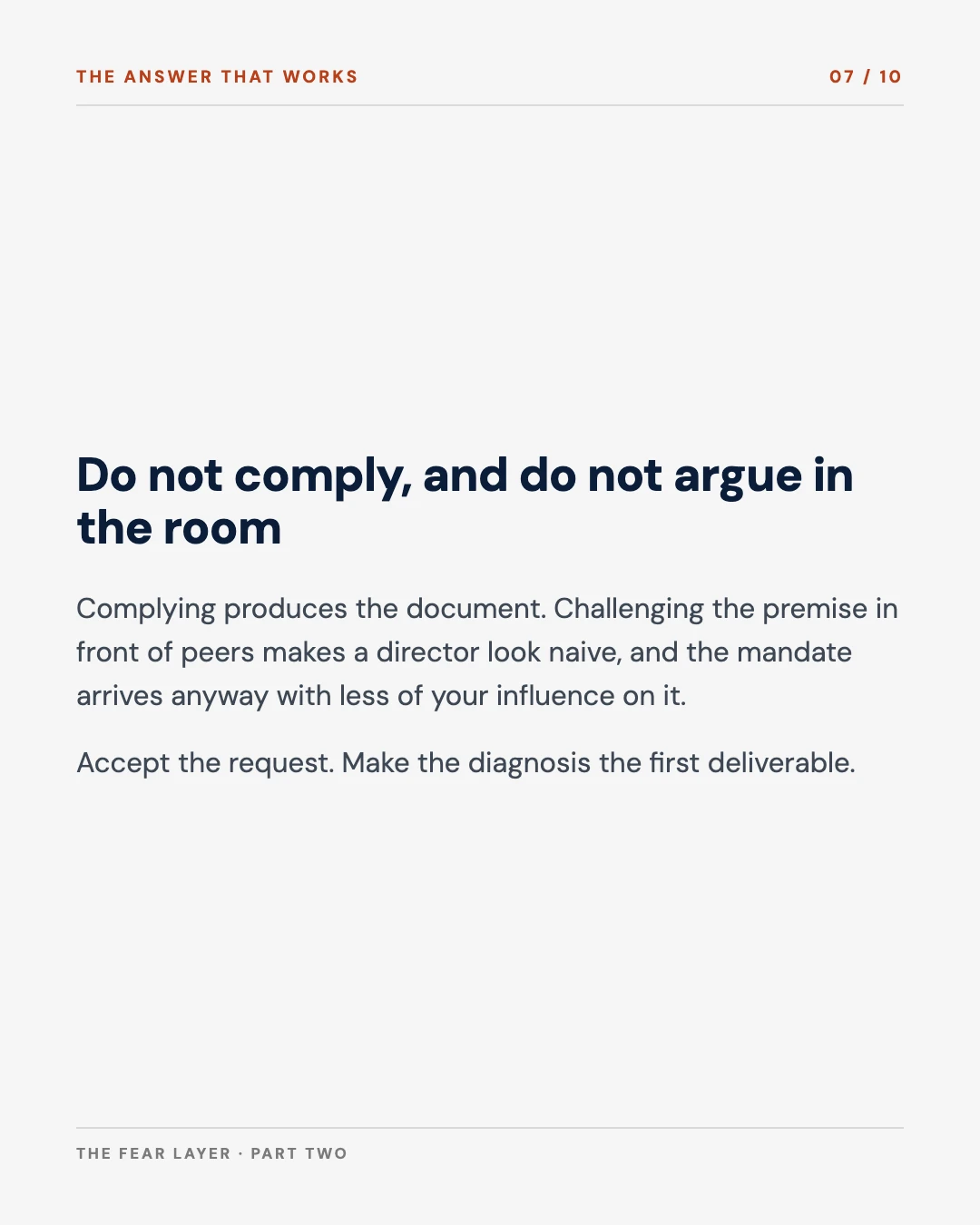
The instinct is to comply immediately or to challenge the premise. Both fail, for different reasons.
Complying produces the document. You will spend a quarter on a strategy with no problem behind it, and the organisation will spend two years on what the document authorised.
Challenging the premise in the room is worse. A director who is asked in front of peers why they want an AI strategy will hear the question as an accusation of naivety, and they will be right that it looked like one. You will win the exchange and lose the relationship, and the mandate will arrive anyway, with less of your influence attached to it.
What works is to accept the request, because it is legitimate, and to make the diagnosis the first deliverable.
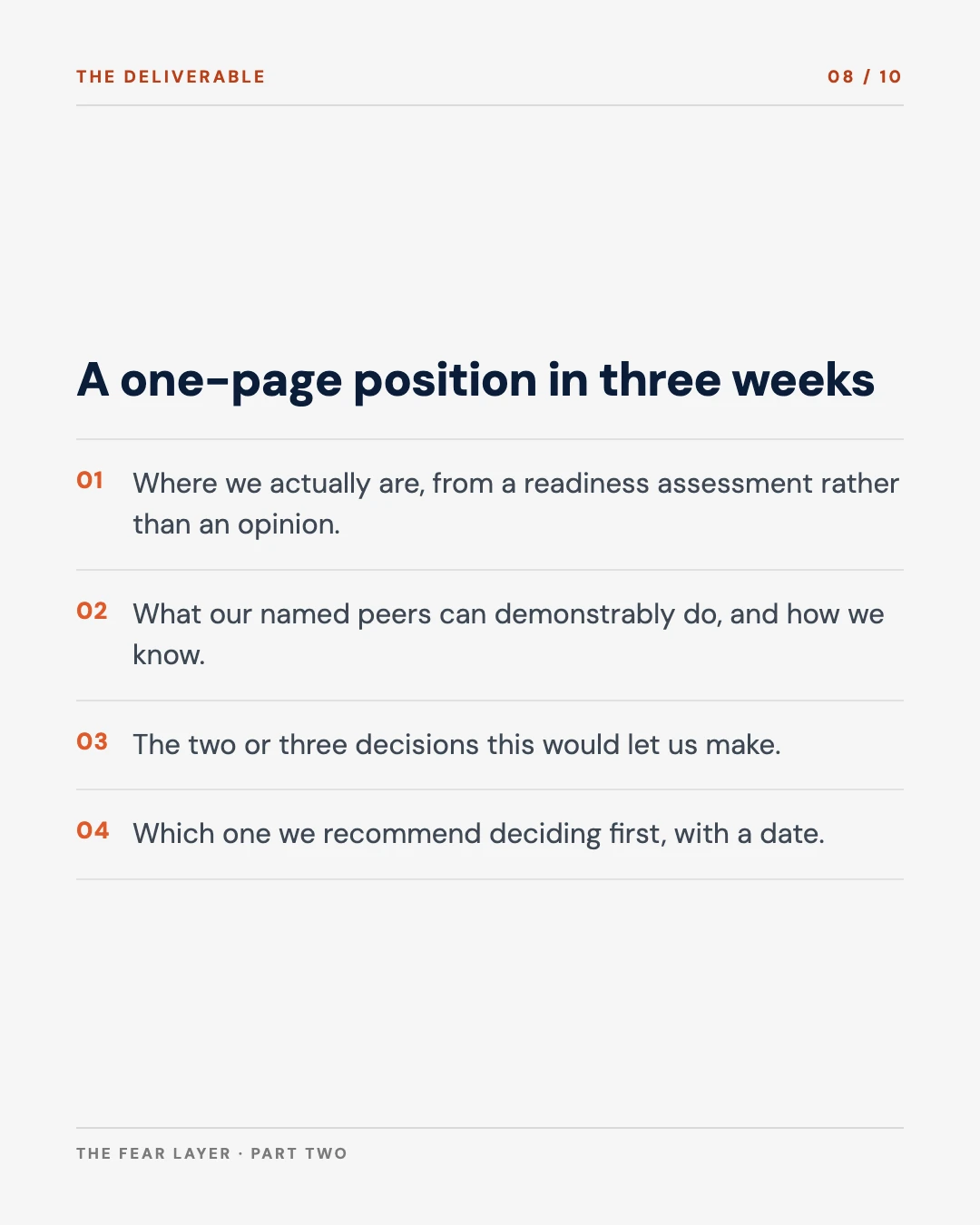
In practice that is a one-page position, inside two to three weeks, with four parts. Where we are, taken from a readiness assessment. What our named peers can demonstrably do, and how we know that. The two or three decisions this capability would let us make. And which one we recommend deciding first, with a date.
That page does the political work as well as the analytical work. It hands the director something to say to whoever unsettled them, which is usually the real requirement behind the request. It converts an anxious ask into a governed one with nobody losing standing. And a one-page position in three weeks tests your organisation far more honestly than a strategy document in three months, because the organisations that cannot produce the page are telling you something important about why the strategy would have failed.
What anxiety spending looks like a year later
The pattern is consistent enough to recognise on sight.
Tools bought before problems were named, now renewing on autopilot. A pilot portfolio that nobody will retire, because retiring one means saying out loud that it did not work. Headcount hired for a capability with no accountable owner, gradually absorbed into whatever work was nearest. An advisory engagement that produced a strategy nobody in the organisation had the mandate to implement.
The financial cost of that is recoverable. Budgets recover. The second-order cost is slower to repair, because the organisation has now learned that AI announcements do not mean anything. The next mandate arrives into a workforce that has already decided how seriously to take it, and the people whose cooperation the whole thing depends on have started protecting themselves. That is the subject of the next part of this series, and it is the most expensive consequence in the list.
Free tool
AI Use Case Prioritisation Matrix
Score candidate use cases on value and feasibility, so the portfolio has a stated reason for its order.
The version of the board’s fear that deserves a serious answer
None of this argues that boards should stop worrying about AI. Some of what they are feeling is the most accurate signal in the building.
Strip the standing anxiety away and there is often a real claim sitting underneath it. Are we structurally unable to adopt this, even once we decide to? That is a readiness question. It is answerable across dimensions you can measure, it produces a number a board can act on, and if the answer is poor then the board is right to be alarmed and right to spend.
Notice that this version passes all three tests from part one. It makes a specific claim rather than expressing a mood. Evidence would change it, since a readiness assessment can come back better than feared. And competent people who are free to disagree will still tell you it matters. That is what a fear looks like when it has been converted into something a governed organisation can use.
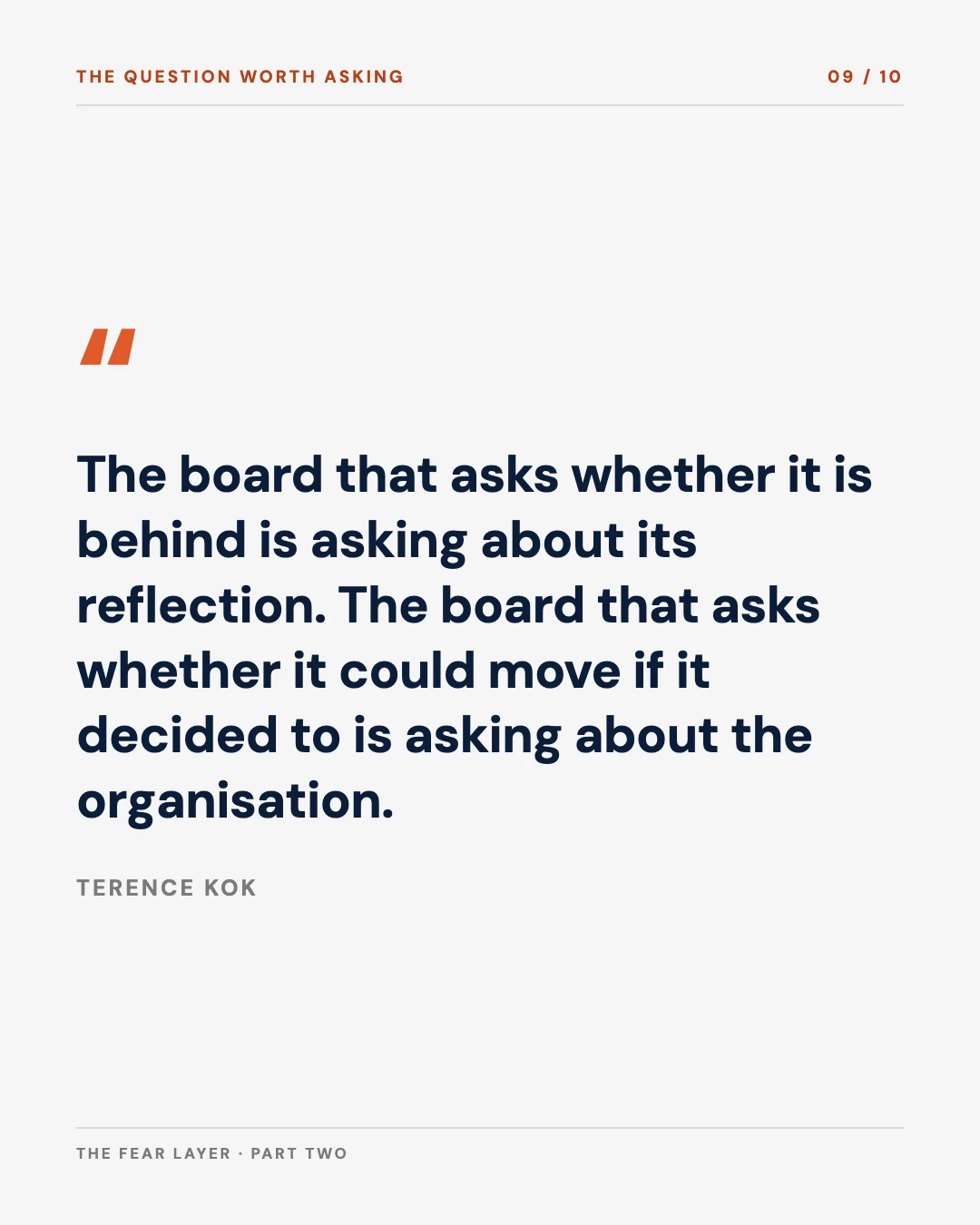
The board that asks whether it is behind is asking about its reflection. The board that asks whether it could move if it decided to is asking about the organisation. The second question is harder to ask and it is the only one with a useful answer.
Where to start this quarter
If you sit on the board, write one sentence naming the problem before the next mandate goes out. If you cannot write the sentence, you are about to ask for a symptom to be dressed as a strategy, and everyone downstream will comply.
If you are receiving the mandate, do not argue with it. Ask the three questions privately, then come back inside three weeks with the one-page position. You will either surface a real problem worth building on or you will have shown, without confrontation, that there was not one.
Either way, name the decision that is waiting. Almost everything else in an AI programme is downstream of that, including whether the fear that started it was worth acting on.
Evidence & Methodology
Only one claim in this piece rests on outside data. The rest is a pattern from my own advisory conversations, not a survey. Here is which is which.
| Claim | Source | Grade |
|---|---|---|
| 40%+ of agentic AI projects will be cancelled by end of 2027 | Gartner press release, June 2025 | Forecast |
| Fear of being seen as behind and being behind are almost never separated before the budget is approved | My own pattern across board and advisory conversations | My call |
| Three questions, what changed, what decision is waiting, what would we stop doing, separate a real strategy from a symptom | My own framework, tested in my own client work, not externally validated | My framework |
Sources
- Gartner. (2025, June 25). Gartner predicts over 40% of agentic AI projects will be canceled by end of 2027 [Press release].

What I Was Afraid Of When I Started Advising on AI
The three questions in their original form, applied to your own fear before you turn them on anyone else.

The Avenger Tower Fallacy: Why Your AI Strategy Is Failing Before It Starts
The structural version of this argument, on strategies built impressively on foundations nobody checked.

Why Your AI Budget Could be Backwards
How AI budgets get allocated in the wrong proportions, and what the correct shape looks like.

Why Your Choice of First AI Use Case Will Make or Break the Programme
Choosing the first use case on evidence.
This is part two of The Fear Layer. Part three looks at what happens when the fear reaches the people who have to use the thing. If a mandate has landed on your desk without a problem attached to it, that is a conversation my consulting work starts with regularly.
Was this useful?