
Listen to this article
Jump to a section
In this article
Executive Summary
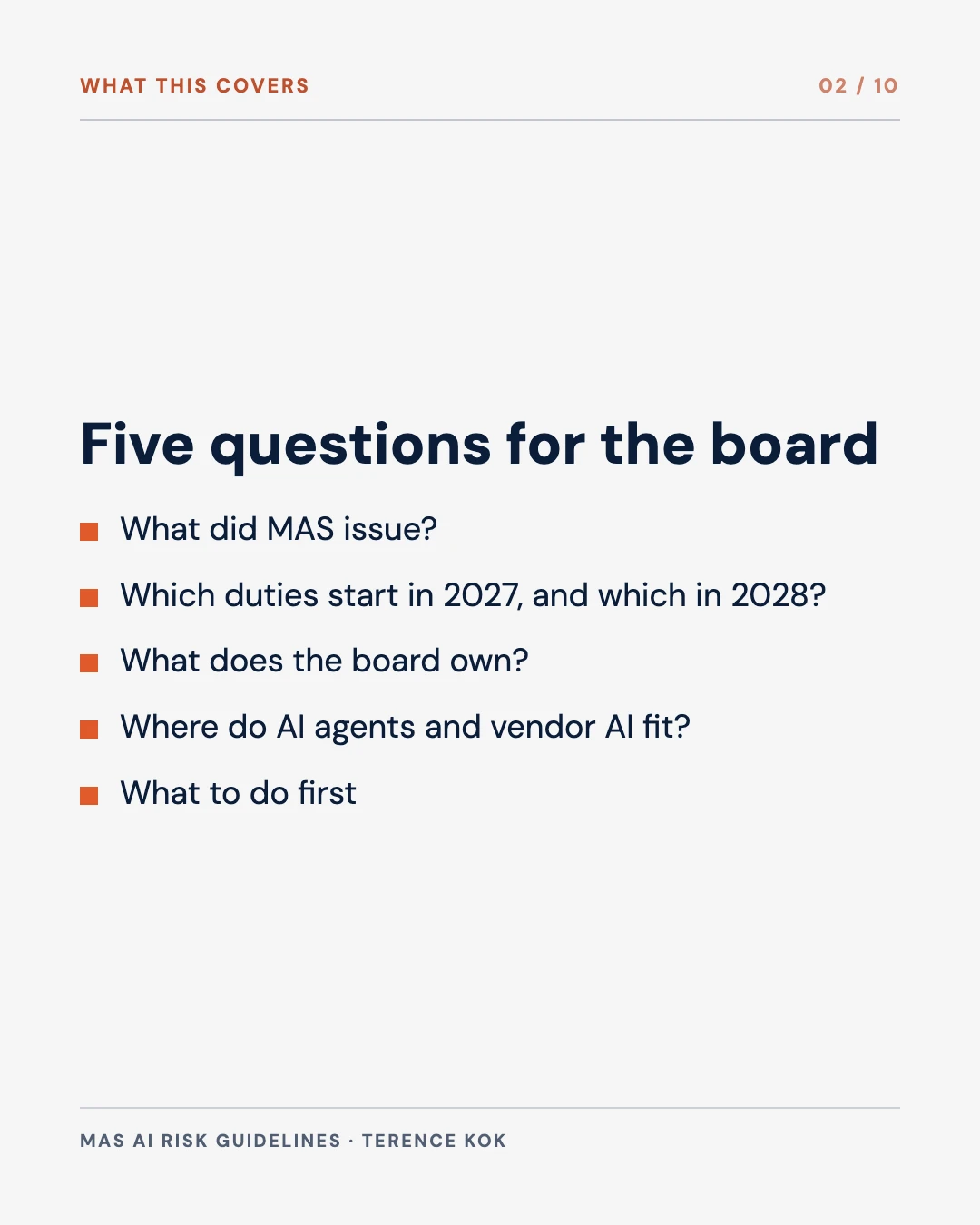
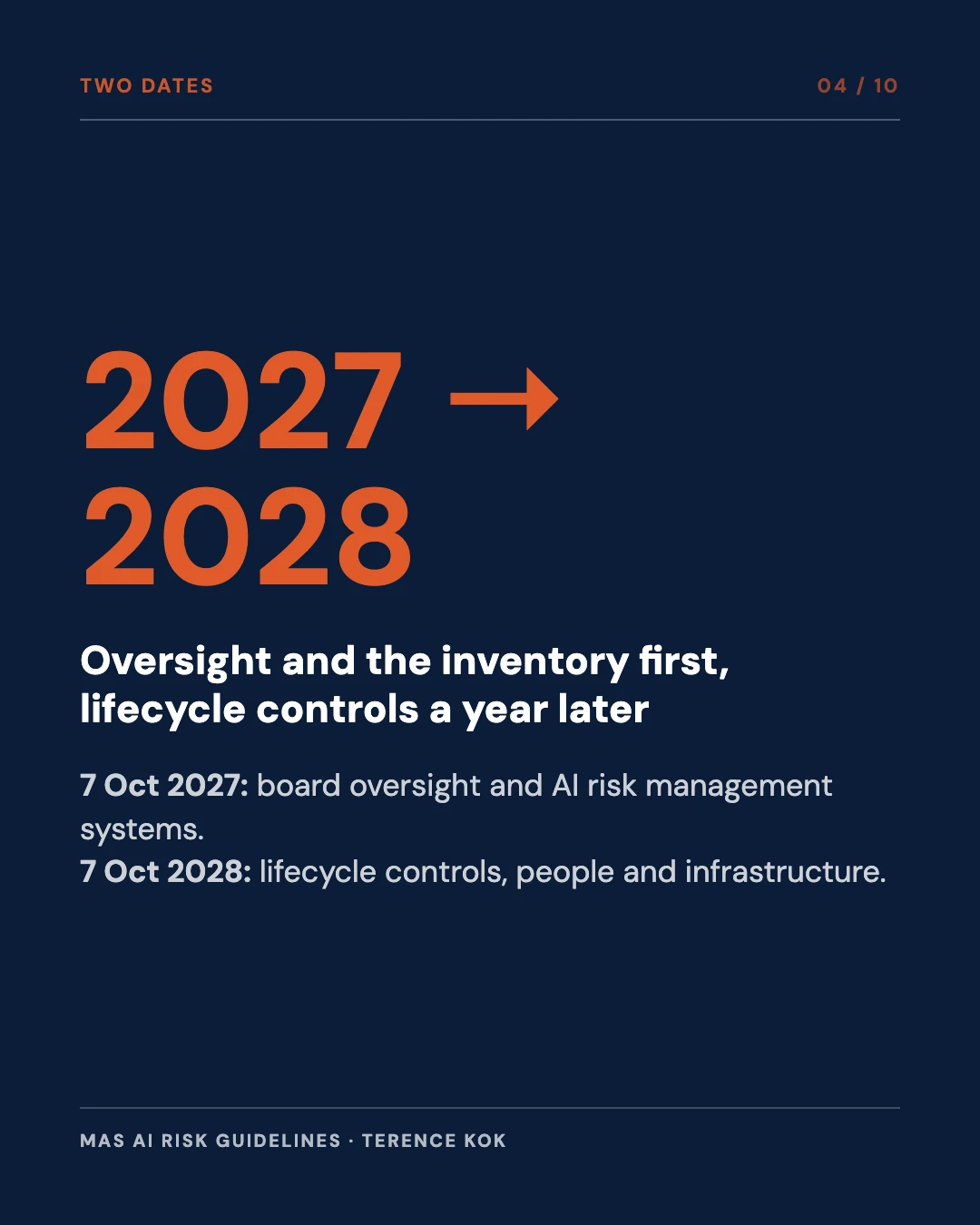
On 7 October 2026 the Monetary Authority of Singapore issued its Guidelines on Artificial Intelligence Risk Management, after a consultation that opened in November 2025. They apply to all financial institutions and to all AI, including generative AI and AI agents. The Guidelines take effect on 7 October 2027. Oversight by the board and senior management, and the risk management systems that include an AI inventory and a risk materiality assessment, can be met from that date. Controls across the AI lifecycle, and the people and infrastructure to run them, follow by 7 October 2028. The order matters. Lifecycle controls are applied in proportion to materiality, and materiality can only be assessed for AI the institution has found. The inventory is therefore the first real piece of work, and it belongs in 2027.
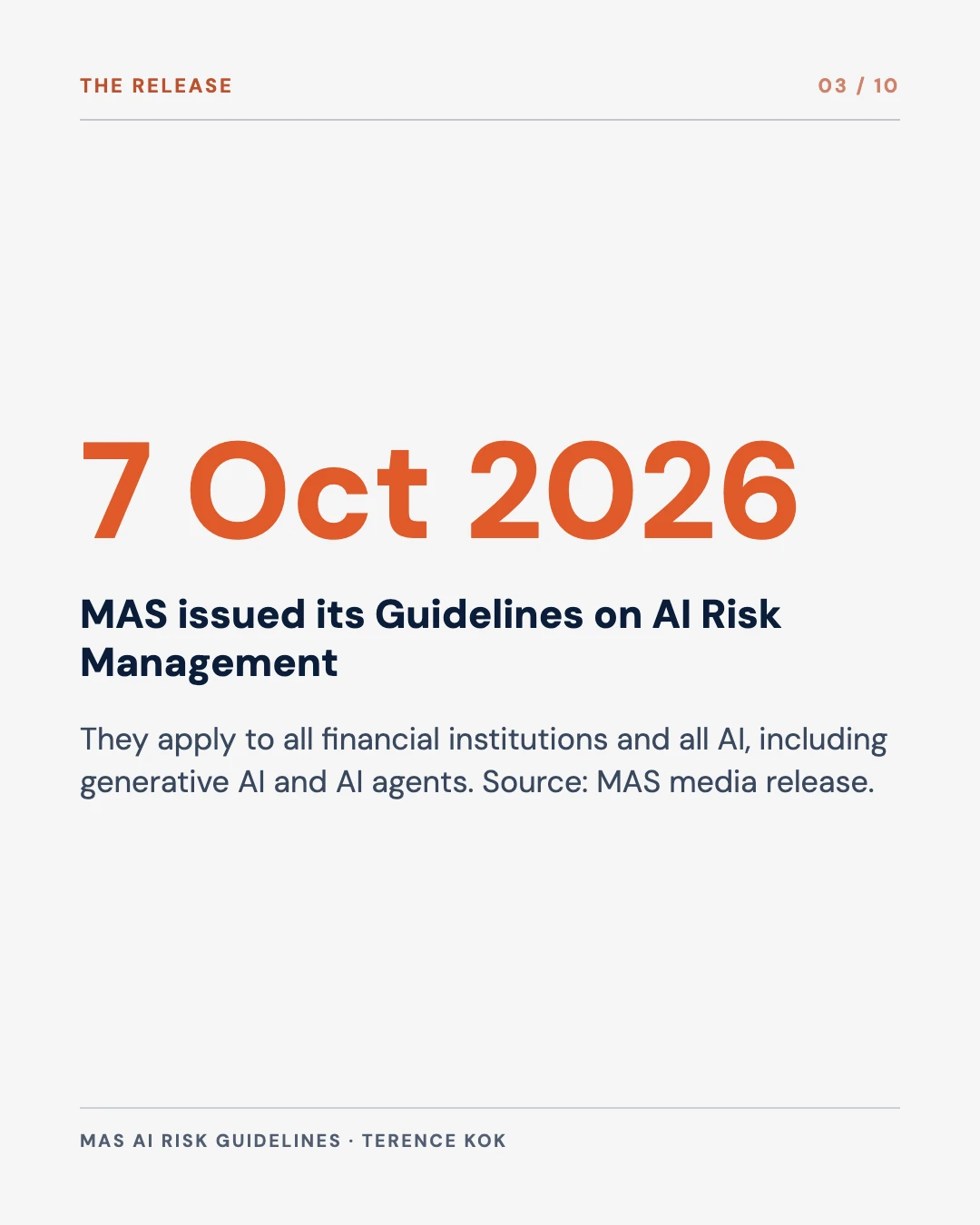
7 Oct 2026
MAS issued the final Guidelines on AI Risk Management
7 Oct 2027
Guidelines take effect; board oversight, inventory and materiality assessment expected from this date
7 Oct 2028
lifecycle controls and the capability and capacity expectations to be met by this date
2027
year MAS intends to consult the sector on what further guidance on agentic AI would be useful
Core conclusions
- The board owns AI risk oversight from October 2027. It can use an existing committee, but it needs a named owner, a risk appetite and an inventory to oversee.
- An AI agent is AI under the Guidelines. It belongs in the inventory with the same standing as a model, and its materiality should reflect that it acts.
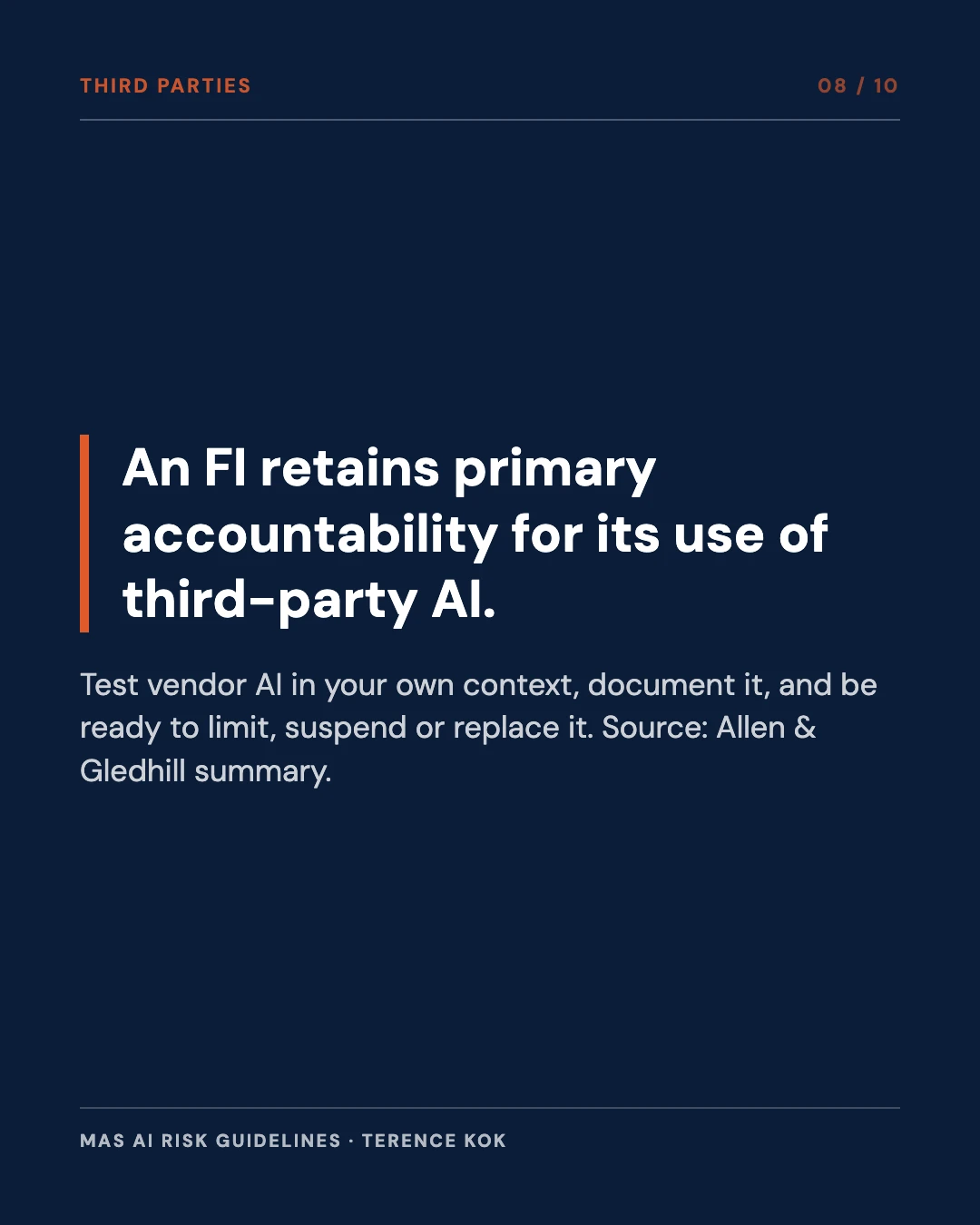
- An institution remains accountable for third-party AI. A vendor’s model inside a vendor’s product still has to be listed, assessed and tested in the institution’s own context.
The argument, in ten slides
Save it, or send it to the board secretary and the head of risk.
What MAS issued
On 7 October 2026 MAS published its Guidelines on Artificial Intelligence Risk Management for financial institutions. They follow a consultation paper from November 2025. MAS describes them as high-level expectations that every financial institution should meet, applied in proportion to the size of its business and the risk its AI creates. They cover generative AI and newer developments such as AI agents.
Two phrases from the release carry the weight. The first is accountability. MAS says institutions remain accountable for the AI used in the services they deliver, and that includes AI supplied by a third party. The second is proportionality. An institution whose AI could not materially harm itself, its customers or other parties if it failed may use basic policies and procedures. A bank that runs credit decisions or customer-facing agents will not be able to.
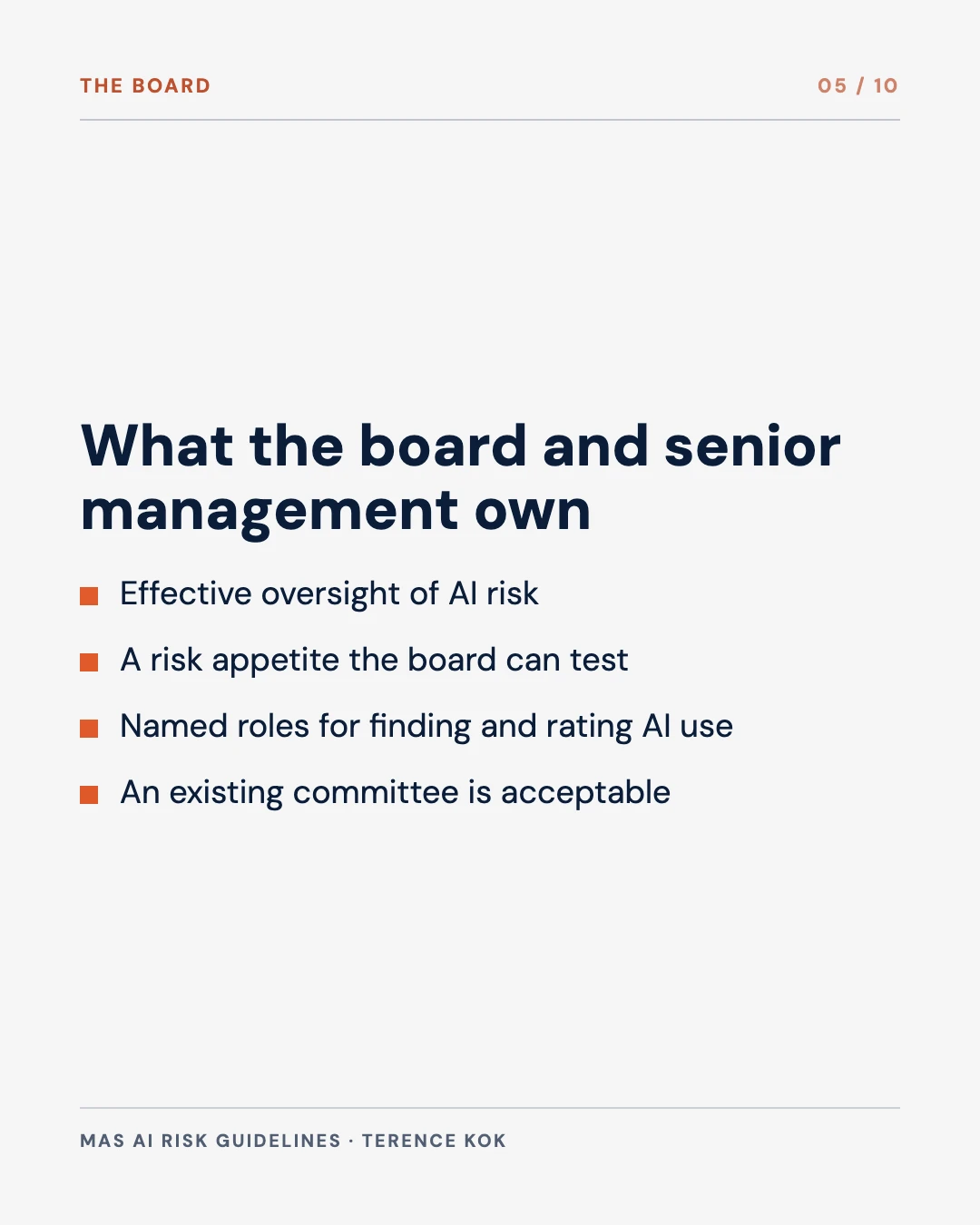
MAS does not require a new AI committee. Existing governance structures are acceptable if they give adequate oversight and cross-functional coordination.
Two dates, two kinds of work
The Guidelines have four areas of expectation. Oversight by the board and senior management, and the risk management systems, policies and procedures, can be met from 7 October 2027. Controls across the AI lifecycle, and the capability and capacity to run them, are to be met by 7 October 2028. Law firm summaries number the sections differently, so check the official text before citing a section number.
The 2027 inventory sets the size of the 2028 controls.
From 7 October 2027 the institution should show who oversees AI, what AI it runs and how material each use is.
Schematic. Phases follow the MAS release of 7 October 2026 and law firm summaries; section numbering differs between sources, so areas are named.
The 2027 work is the foundation. It asks an institution to set frameworks, policies and procedures for AI, to identify its AI use across the business, to keep an inventory at an appropriate level of detail, to assess the risk materiality of each use, and to give named people clear roles for doing so. The 2028 work covers data management, human oversight, selection and testing, cybersecurity, monitoring and change management, with contingency plans for use cases rated high risk.
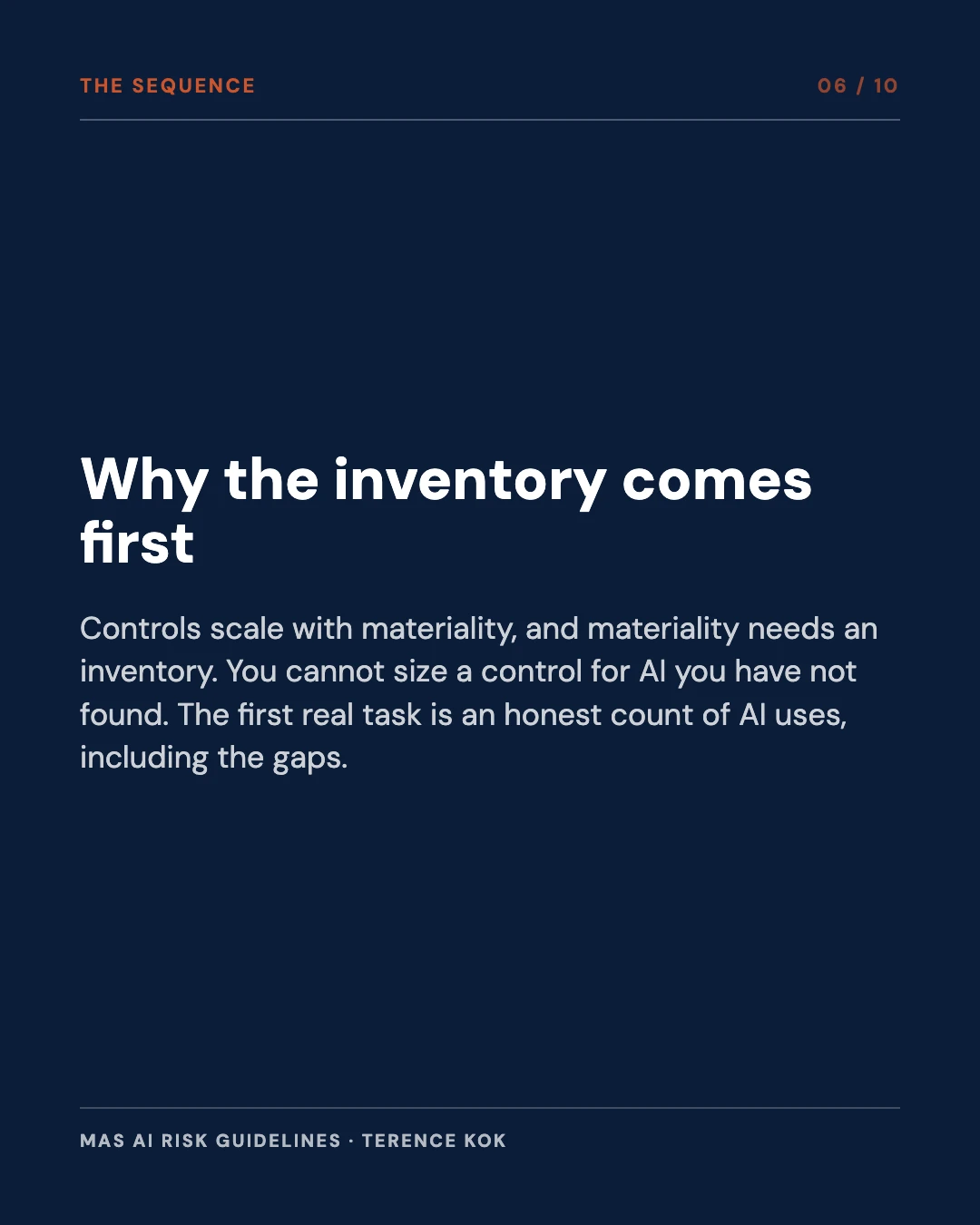
I read the sequence as an instruction on order. A control is meant to be proportionate to materiality, so it cannot be designed before the materiality is known. A year looks generous. It is the time an institution needs to find out how much AI it actually runs.
What the board owns
The board and senior management are asked to provide effective oversight of AI risk. In practice that means three things I would expect a supervisor to look for.
First, a risk appetite for AI that the board has approved, written in terms it can test. Second, roles and responsibilities that name who identifies AI use, who keeps the inventory and who assesses materiality. Third, a view on whether AI use conflicts with regulatory requirements or supervisory expectations, and consistent standards across the institution.
I want to be careful about the next point, because it is my inference and not MAS’s wording. A board that cannot say how many AI uses its institution has will struggle to show effective oversight of them. The inventory is the document that lets a board answer that question.
Why the inventory comes first
The Guidelines ask for an accurate inventory at an appropriate level of detail. They do not prescribe the fields, and I would not invent a template and call it the standard. The sensible reading is that each entry should be detailed enough to support a materiality assessment and the controls that follow.
Three problems usually show up when an institution starts.
AI sits outside the project list. Much of it arrives inside products the institution already buys: a customer service platform with a language model, a fraud tool with a scoring model, an office suite with an assistant. None of these was approved as an AI project. All of them are AI use.
Shadow use is common. Staff use public tools for drafting, summarising and analysis. An inventory built only from the project portfolio will miss it, so it needs a second route, such as procurement records, network data and a short staff declaration.
Materiality needs a method. The Guidelines ask for a risk materiality assessment methodology based on the nature of the business and the risks of the systems and models used. I would write the method down in plain terms and apply it the same way to every entry, so that two assessors would reach the same rating.
AI agents and third-party models
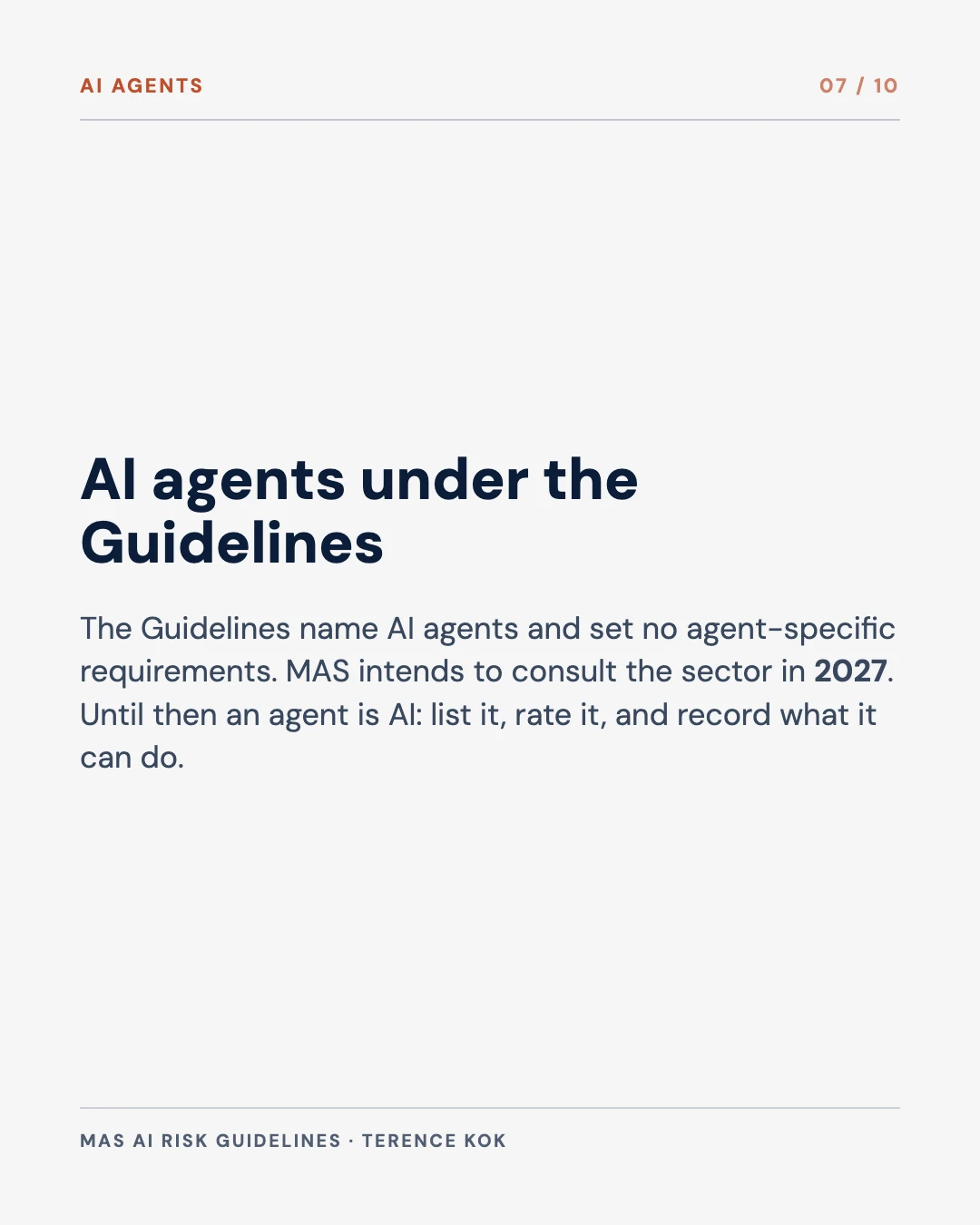
The Guidelines cover AI agents within scope, and they set no agent-specific rules. MAS has said it intends to consult the sector in 2027 on what additional agentic guidance would be useful. An institution should not wait for that. Under the current text an agent is AI, so it needs an inventory entry and a materiality assessment like anything else.
What should differ is how the assessment treats action. A model that drafts text for a person to review and an agent that moves money, sends messages or changes records carry different risk, because the second acts without a person checking each step. The entry for an agent should record what it can do, what it can reach and who can stop it. This is my recommendation. The Guidelines do not require those fields.
On third parties, the text is clear. An institution retains primary accountability for its use of third-party AI. It should test that AI in its own context, including with its own data, and document the testing. Contracts should give a risk-appropriate level of visibility into how the AI is introduced and updated. If the residual risk falls outside appetite, MAS expects the institution to consider limiting or suspending the service, or replacing the provider. A vendor’s assurance helps. It does not transfer the accountability.
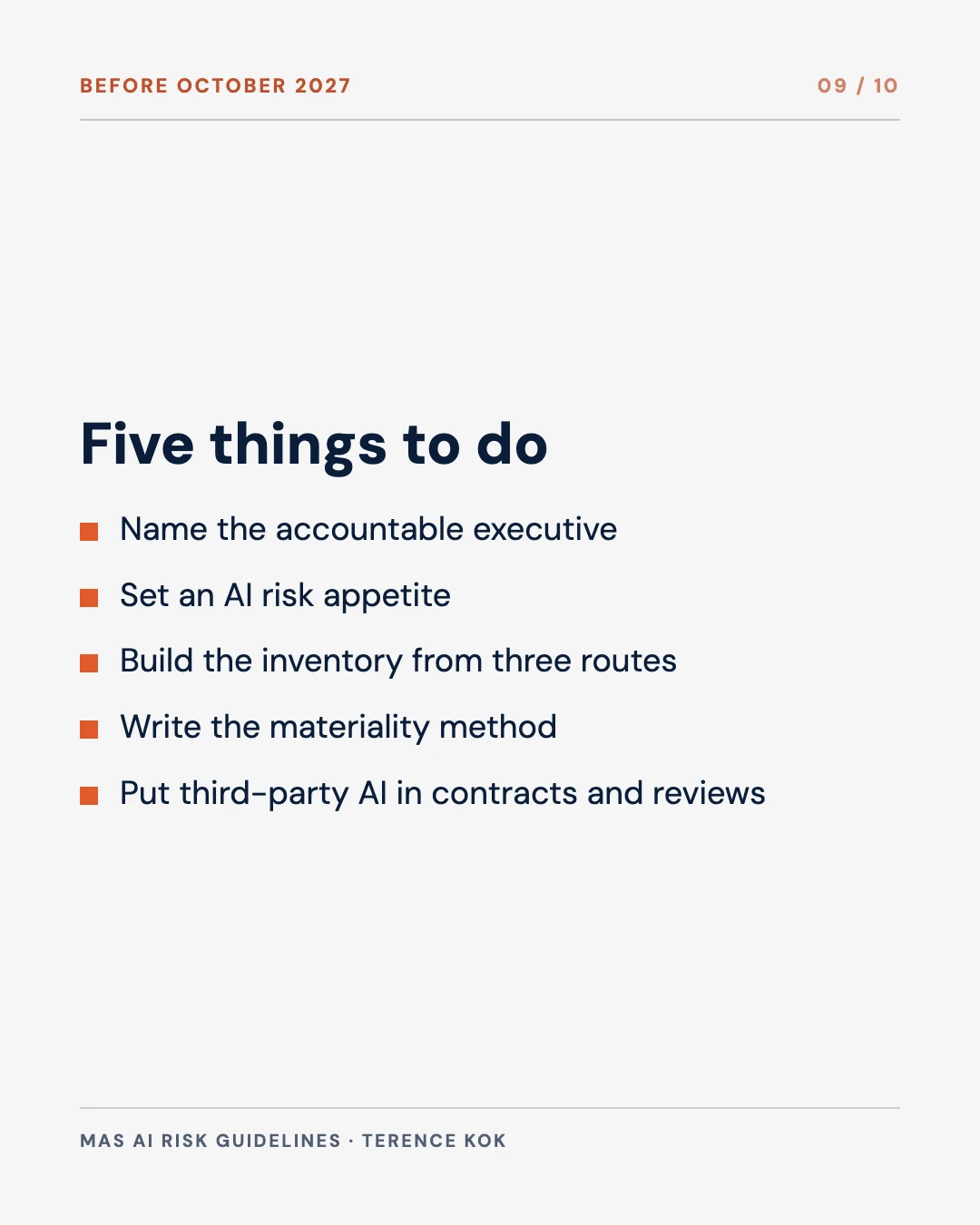
Five things to do before October 2027
| Action | What it produces | Owner |
|---|---|---|
| Name an accountable executive and say where AI risk sits in the existing governance structure | A written mandate the board has approved | Board and CEO |
| Set an AI risk appetite the board can test | A short statement with measures the board will see | Board risk committee |
| Build the inventory from three routes: projects, procurement and staff declaration | A list of AI uses, including agents and vendor-embedded AI | Chief risk officer |
| Write the materiality method and apply it to every entry | A rating for each use, with the reasons recorded | Risk and technology |
| Add third-party AI to contracts and reviews | Visibility into model changes and a record of testing in the institution’s own context | Procurement and legal |
The actions are my synthesis of the Guidelines’ 2027 expectations. The Guidelines set expectations, not this checklist.
If I had to put the first ninety days on one line, it would be to get the first honest count of AI uses to the board, with its gaps stated. A count that is known to be incomplete is more useful than a tidy one that is not, and it gives the 2028 work something to attach to.
I should say plainly what this post does not claim. It does not say what a supervisor will do when it finds a gap, because MAS has not said, and I have not seen any enforcement guidance on the Guidelines. It does not claim the dates are hard deadlines. The law firm summaries describe them as dates by which an institution may meet the expectations, and the wording is worth confirming in the official text.
Evidence & Methodology
The facts about the Guidelines come from MAS’s own release and two law firm summaries. The 2028 section numbering differs between sources, so I describe the areas by name. The recommendations are mine.
| Claim | Source | Grade |
|---|---|---|
| MAS issued the Guidelines on AI Risk Management on 7 October 2026, after a November 2025 consultation | MAS media release, 7 October 2026 | Measured, primary source |
| The Guidelines take effect 7 October 2027, with oversight and risk management systems from that date and lifecycle controls and capability by 7 October 2028 | MAS release; Allen & Gledhill; Baker McKenzie (section numbering differs) | Reported, dates consistent |
| Boards and senior management should provide effective oversight; existing governance structures may be used | MAS release | Measured, primary source |
| FIs should identify AI use, keep an inventory at an appropriate level of detail and assess risk materiality | MAS release; Allen & Gledhill | Measured, fields not specified |
| An FI remains accountable for third-party AI and should test it in its own context | MAS release; Allen & Gledhill | Measured |
| The Guidelines cover AI agents; MAS intends to consult on further agentic guidance in 2027 | MAS release; Baker McKenzie; Allen & Gledhill | Reported |
| Materiality must come before lifecycle controls, so the inventory is the first real task | Follows from controls being proportionate to materiality | My call |
| The agent inventory entry should record actions, reach and who can stop it | My own recommendation | My call |
| Five actions before October 2027 | My own synthesis | My framework |
Sources
- Monetary Authority of Singapore. (2026, October 7). MAS sets out supervisory expectations on responsible AI adoption by financial institutions. Media release.
- Monetary Authority of Singapore. (2026, October). Guidelines on Artificial Intelligence Risk Management for Financial Institutions.
- Allen & Gledhill. (2026, October). MAS publishes AI risk management guidelines setting out supervisory expectations on responsible AI adoption.
- Baker McKenzie. (2026, October). Singapore: MAS issues Guidelines on Artificial Intelligence Risk Management.
- OpenGov Asia. (2026, October 7). Singapore: MAS sets out AI governance expectations for financial institutions. Not retrieved directly; cited as a secondary report.

Practical Controls for Rogue AI Agent Risk
Tiers, approval and kill switches for the agents an inventory will find.

The AI Model Supply Chain
Where the models inside your vendors come from and who answers for them.

Build the Part of AI That Nobody Sees
Why the invisible controls decide whether a system can be trusted.
If your board needs a first count of AI use and a materiality method before October 2027, that is work my executive programme can help you run.
Cite or quote this article
Was this useful?