

Listen to this article
Jump to a section
In this article
Executive Summary
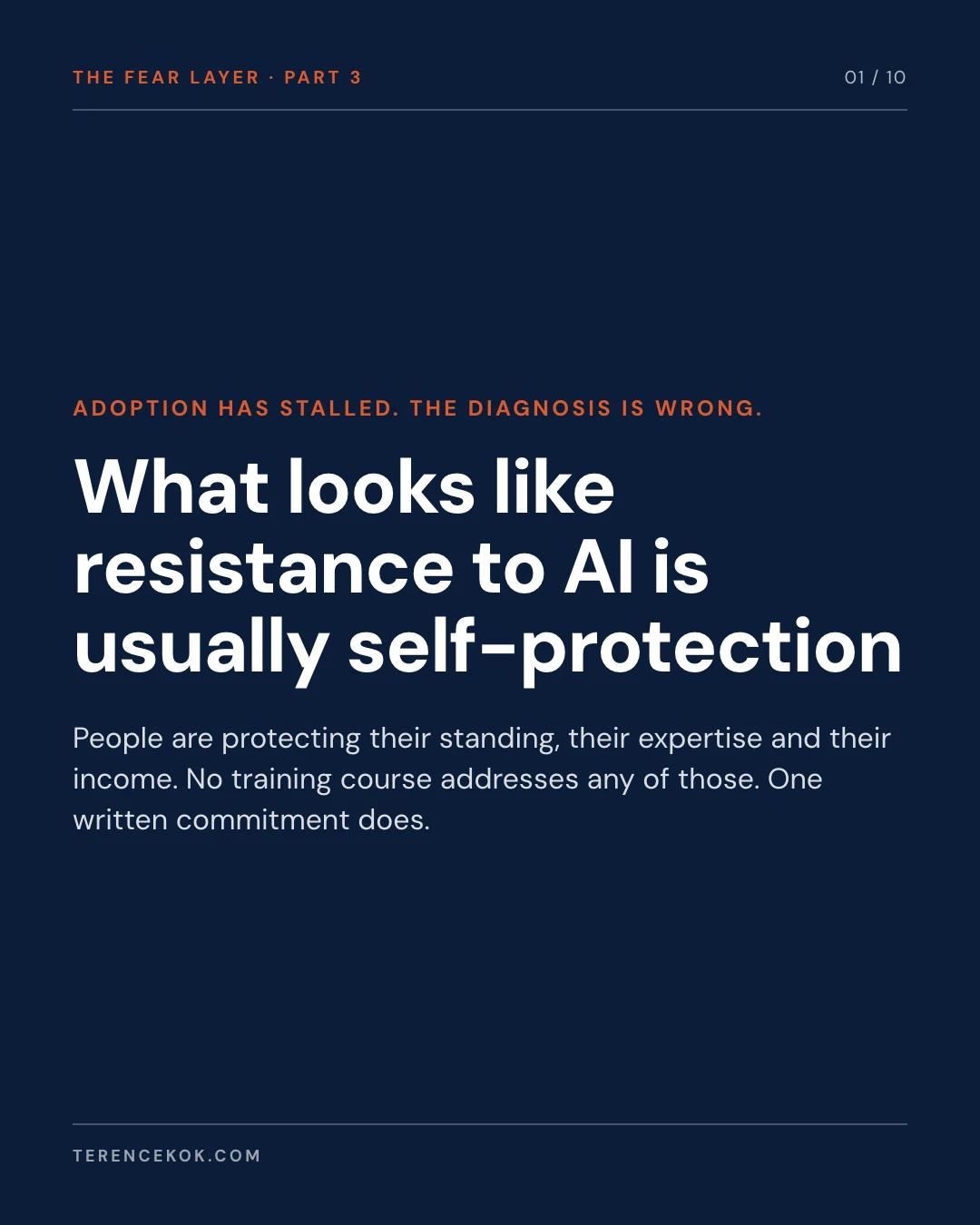
When AI uptake stalls, the diagnosis arrives before anyone has watched the behaviour. It gets called resistance, treated as a change management problem, and answered with more training. The behaviour is rational. People are protecting their standing, their expertise and their income, and no course addresses any of those. One written commitment does.
Core conclusions
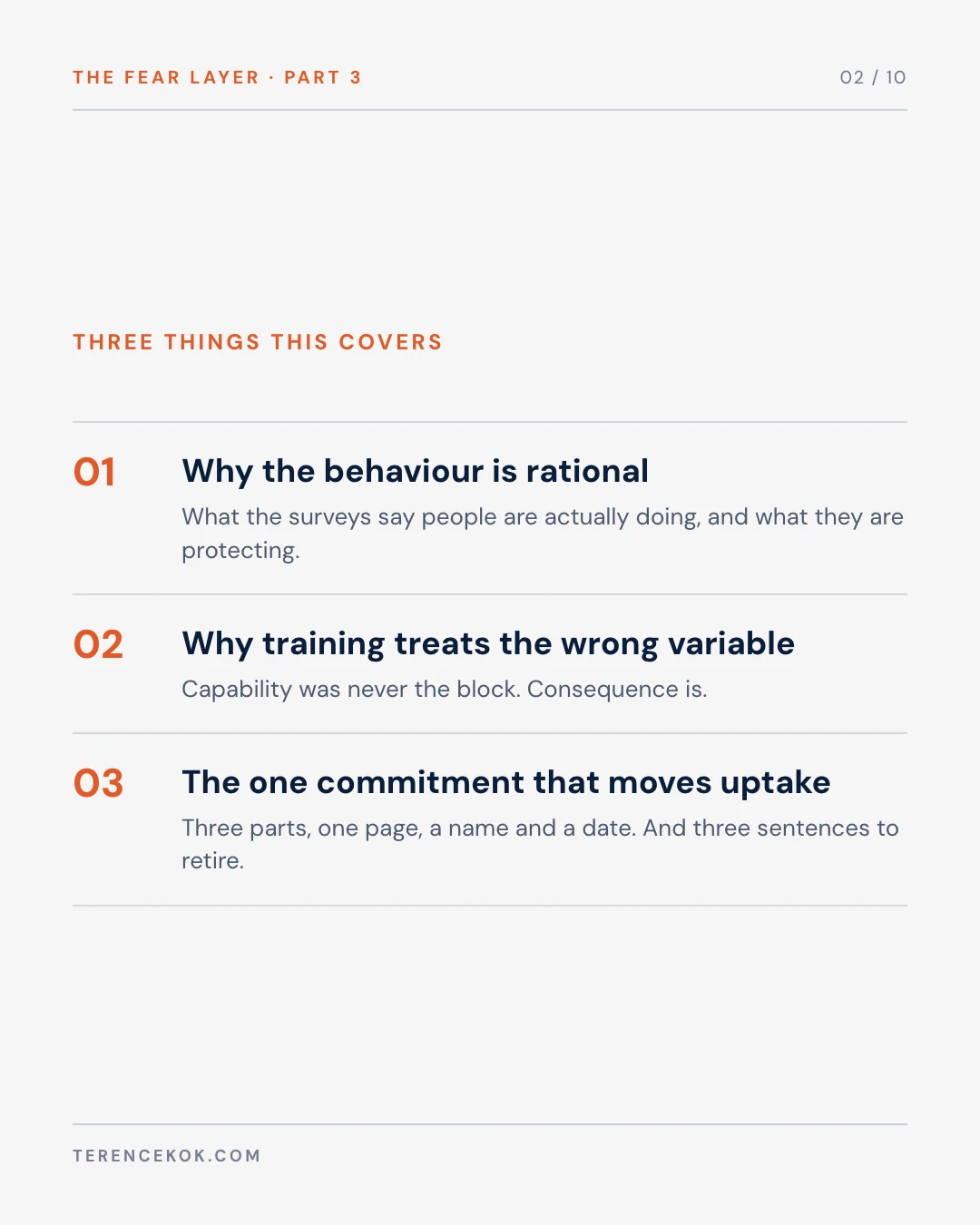
- About half of the people using AI at work are reluctant to admit it. Hiding a tool is a decision about consequences, and no amount of capability building changes a decision about consequences.
- Training treats the wrong variable. The block sits in the unanswered question of what happens to the time the tool saves and to the people whose expertise it touches.
- A dated, written statement of what happens to freed capacity, who decides, and how long the answer holds moves uptake further than any training budget I have seen deployed.
The argument, in ten slides
Save it, or send it to whoever is about to commission another round of training.
The diagnosis arrives before anyone has watched the behaviour
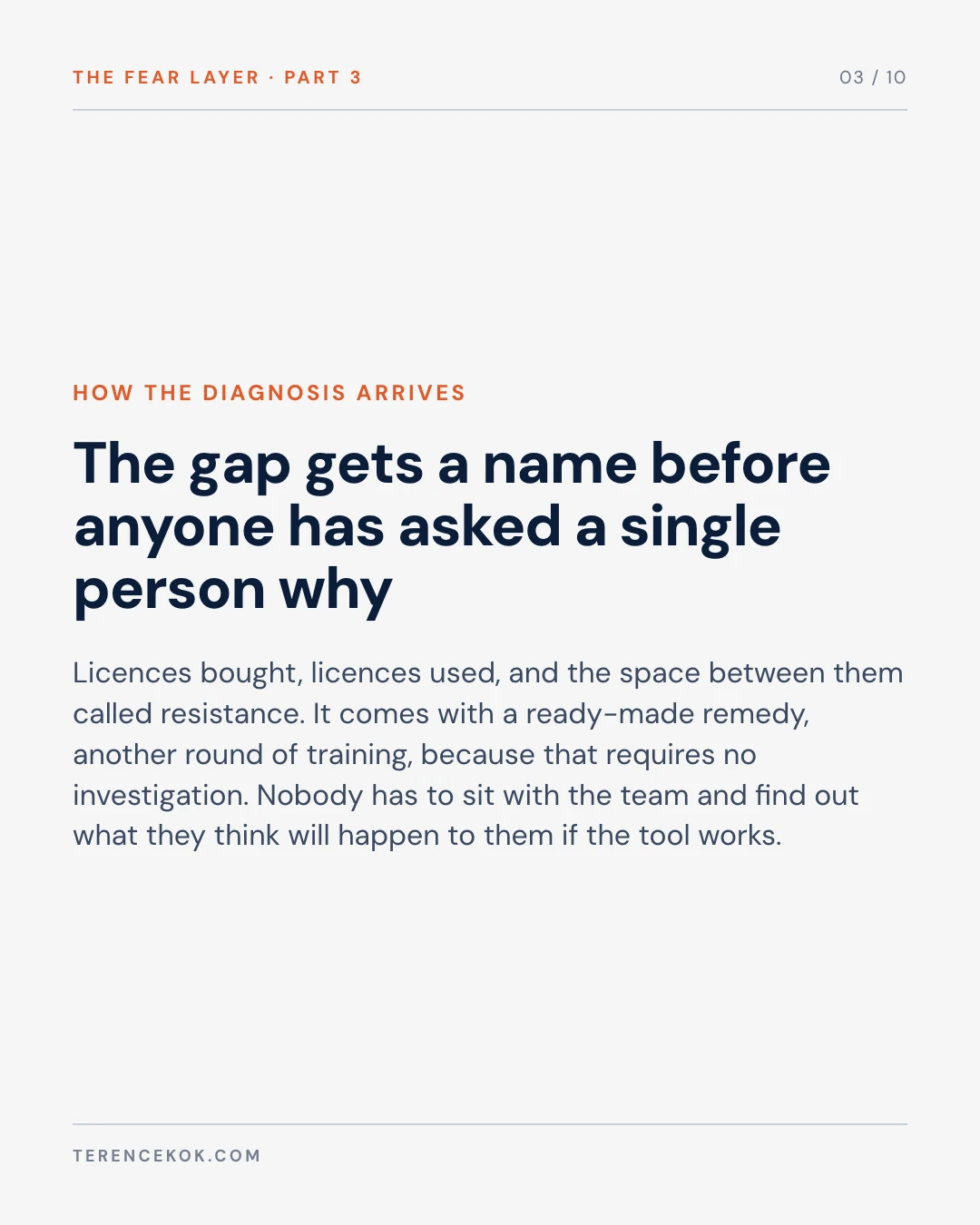
Six months after the tools go live, the dashboard shows licences bought and licences used, and the gap between the two has a name before anyone has asked a single person why.
The name is resistance. It comes with a ready-made explanation, which is that people are uncomfortable with change, and a ready-made remedy, which is a change management workstream and another round of training. Both arrive so quickly because they require no investigation. Nobody has to sit with the team that is not using the tool and find out what they think will happen to them if they do.
I have seen the same programme diagnosed this way in organisations that had nothing else in common. The dashboard looked the same, the word was the same, and the remedy was the same. When a diagnosis is that portable, it is usually describing the person making it rather than the people it is about.
The behaviour is rational
Look at what people do and the picture changes.
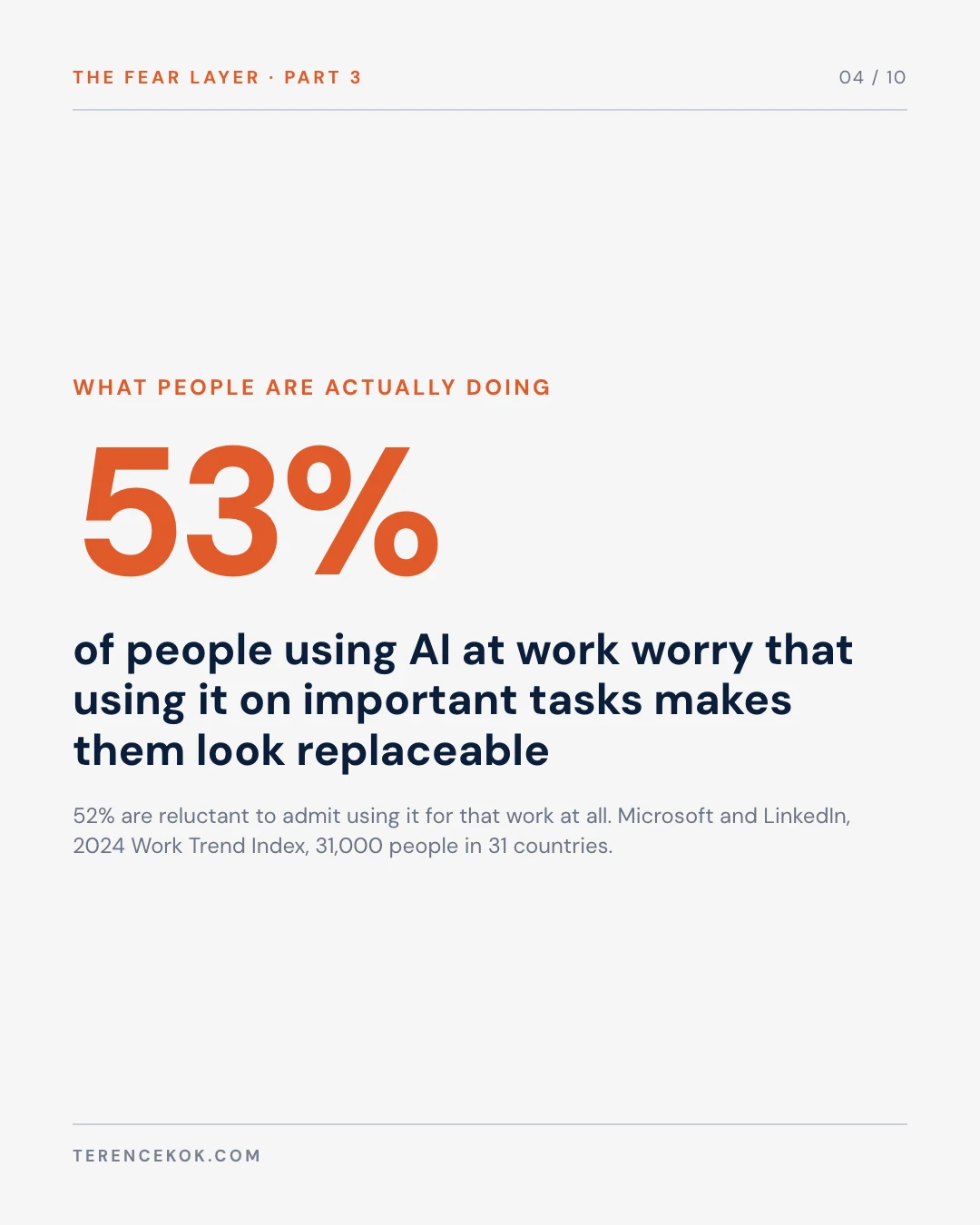
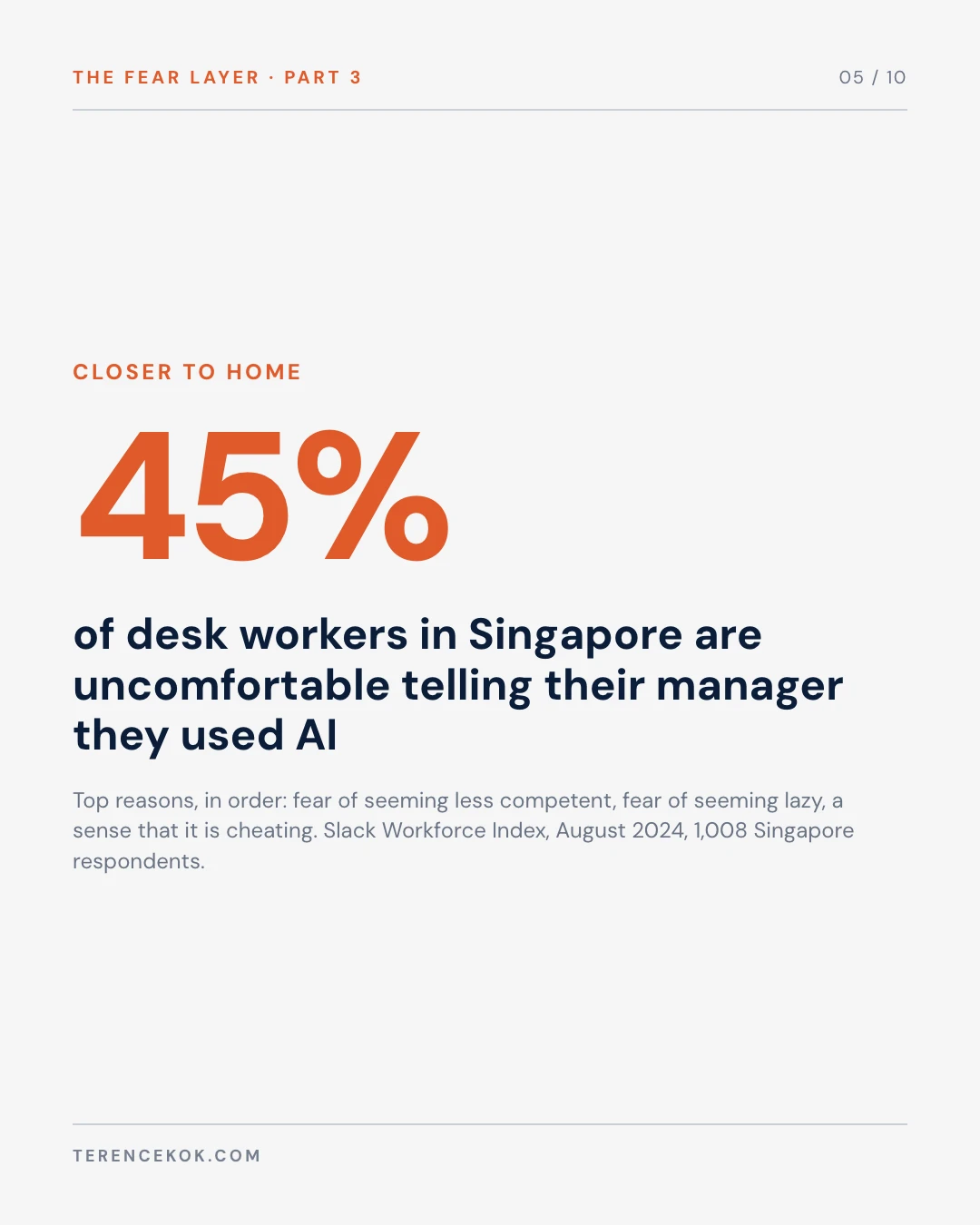
In the 2024 Microsoft and LinkedIn Work Trend Index, 53% of people who use AI at work said they worry that using it on their most important tasks makes them look replaceable, and 52% said they are reluctant to admit using it for that work at all. Slack’s Workforce Index, fielded in the same year, found 48% of desk workers globally uncomfortable telling their manager they had used AI for ordinary tasks. In Singapore the figure was 45%, and the reasons given, in order, were fear of being seen as less competent, fear of being seen as lazy, and a sense that using it was cheating.
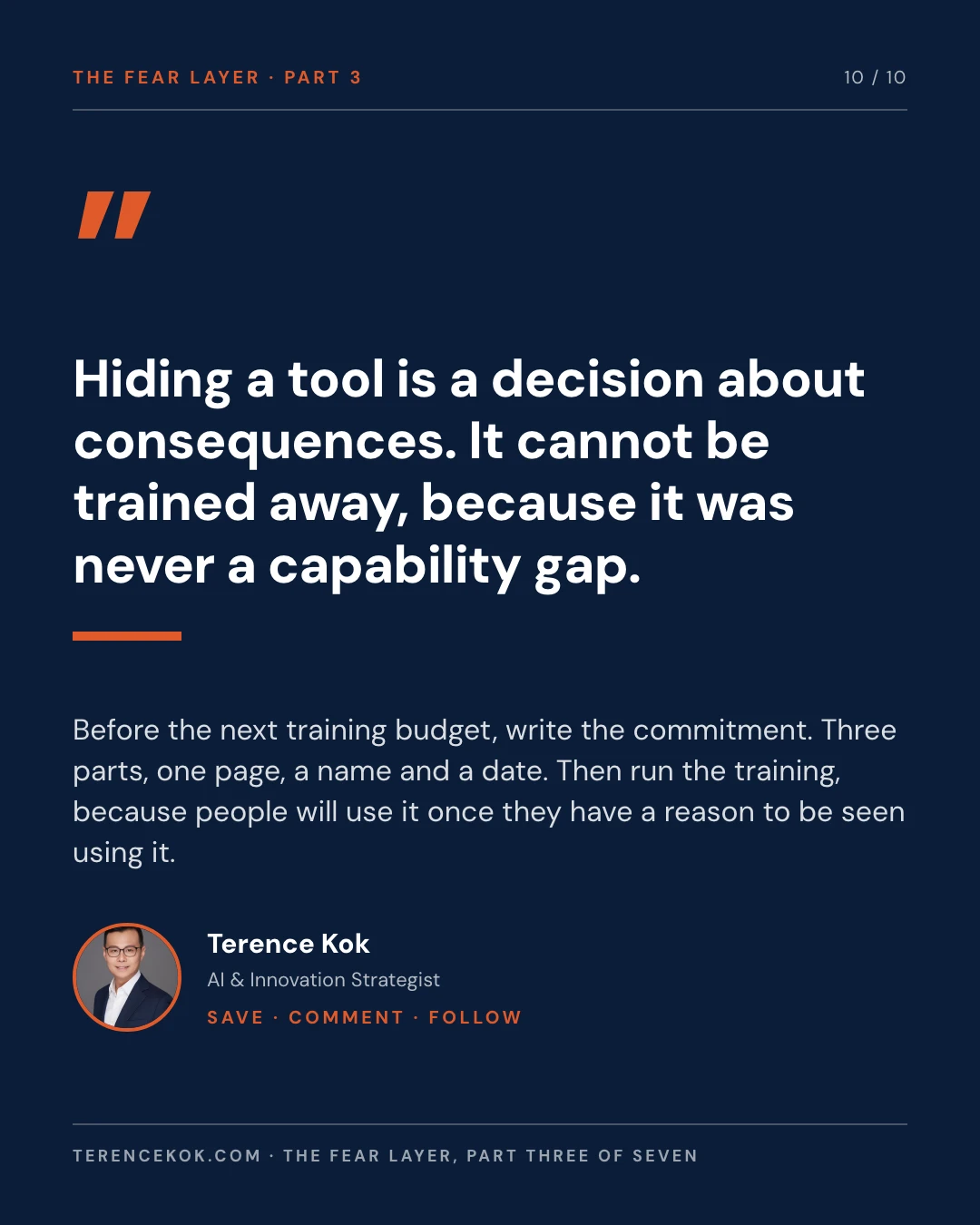
None of those are descriptions of people who cannot learn a tool. They are descriptions of people who have learned it, thought about what it reveals, and decided the safest course is to keep it out of sight. Hiding a tool is a decision about consequences. It cannot be trained away, because it was never a capability gap.
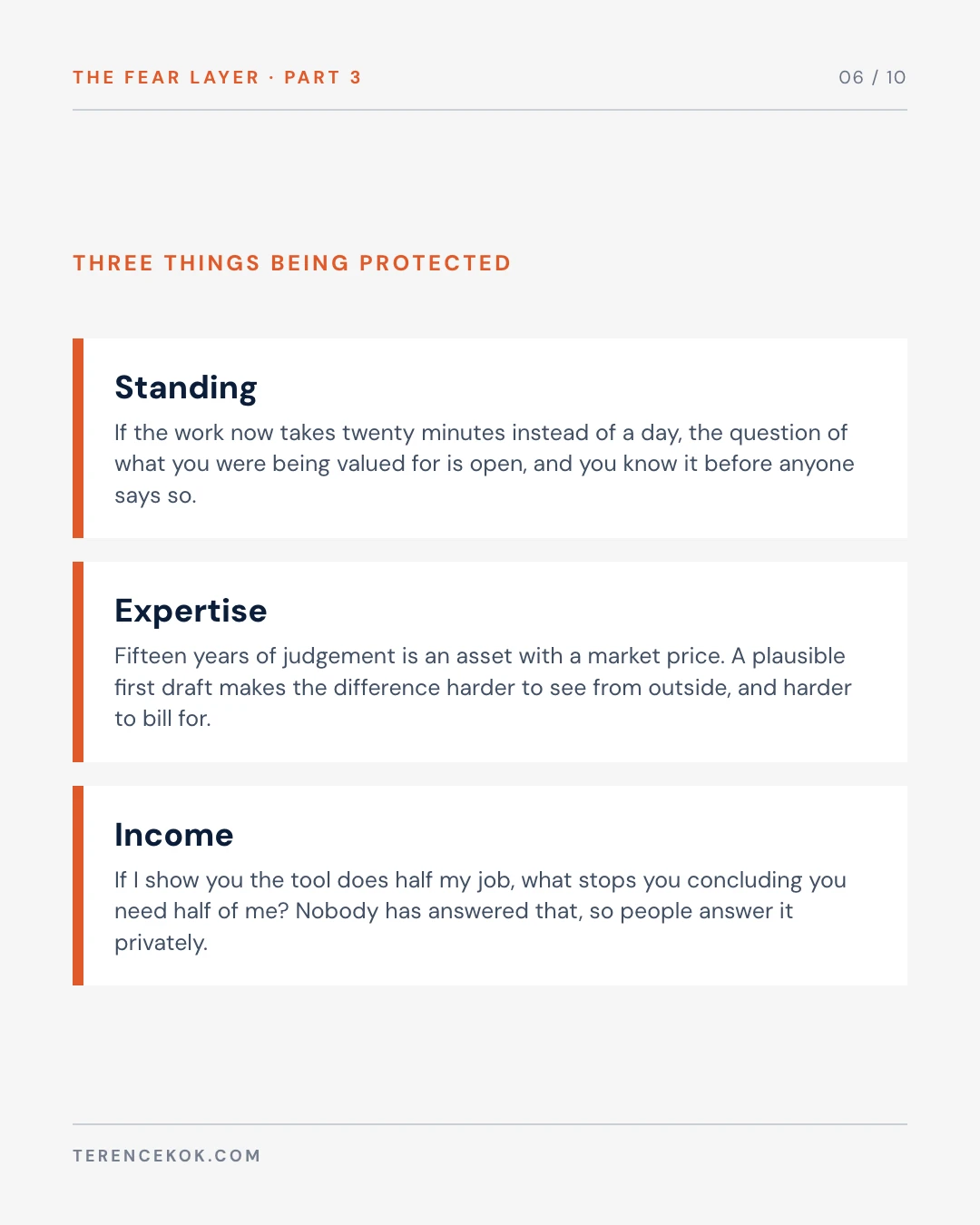
What is being protected is specific, and leaders tend to collapse it into one thing.
Standing. The people who are good at the work are known for being good at the work. If it now takes twenty minutes instead of a day, the question of what they were being valued for is open, and they know it before anyone says so.
Expertise. Fifteen years of judgement in a domain is an asset with a market price. A tool that produces a plausible first draft of that judgement does not make the expertise worthless, but it does make the difference harder to see from the outside, and harder to bill for. People notice that before their managers do.
Income. This is the one everybody thinks about and nobody says in the room. If I show you that the tool does half my job, what stops you from concluding you need half of me? Nobody has answered that, so people are answering it for themselves, and their answer is to keep the demonstration private.
That last one is the tell. When the people who have adopted fastest are the ones most careful to hide it, the programme does not have a skills problem. It has a consequences problem, and the adoption figure is measuring how well people have understood the consequences.
Free tool
Enterprise AI Value & Adoption Dashboard
Track adoption against realised value, so the gap between the two is visible before it gets named.
Training treats the wrong variable
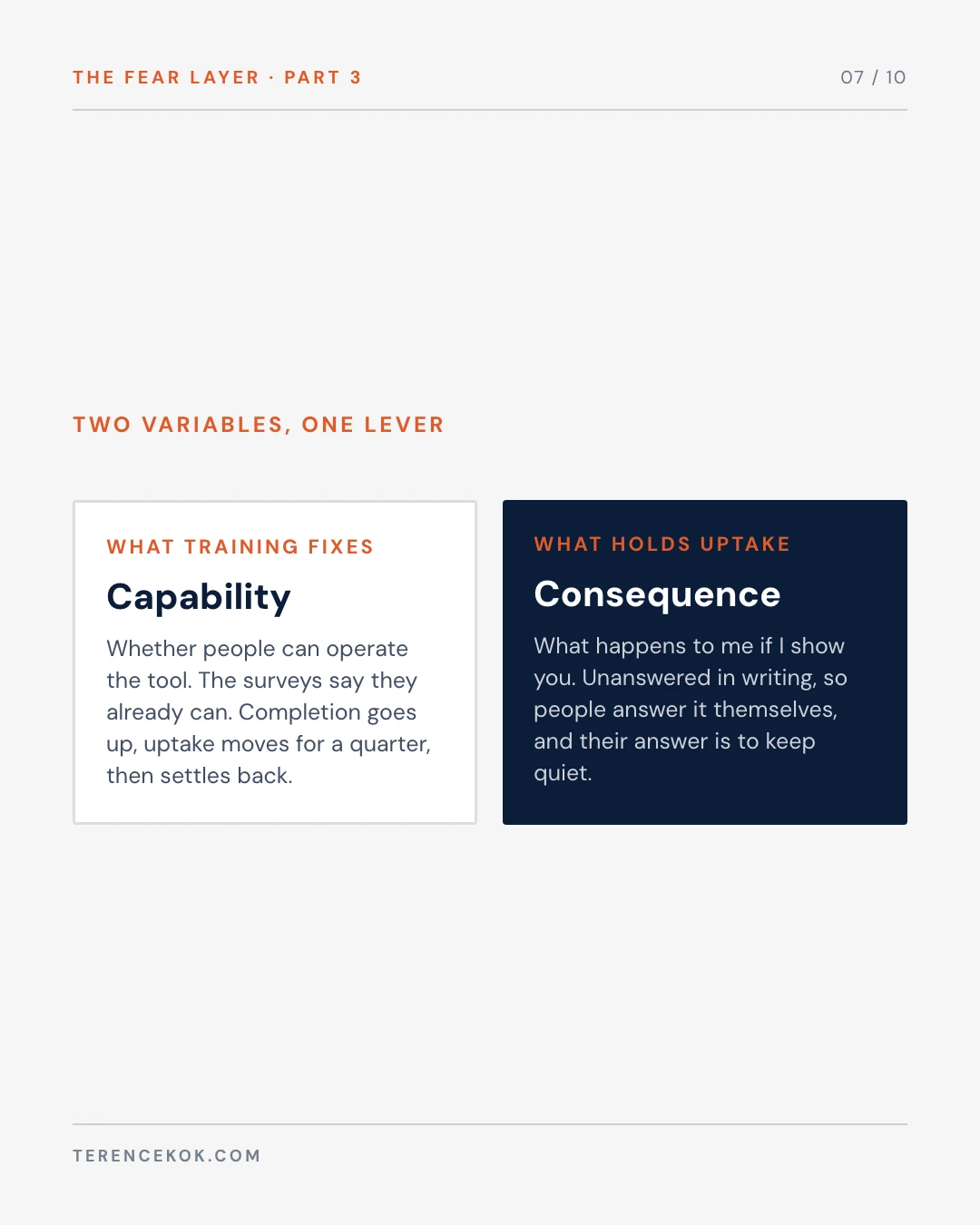
Training is what a leadership team reaches for because it is the lever it controls. It has a budget line, a vendor and a completion rate. It also addresses exactly one thing, which is whether people can operate the tool, and that is the one thing the evidence says they already can.
I am not arguing against training. The Slack data for Singapore found that 63% of workers had spent under five hours in total learning to use AI, and that is thin. The point is what the training is expected to fix. It can raise capability. It cannot answer the question that is keeping capability hidden, which is what happens to me if I show you.
The pattern that follows is predictable. Completion rates go up, the adoption figure moves for a quarter, and then it settles back, because the people who completed the course have the same question they had before and now also have a certificate. The next diagnosis is that the training was not good enough, and the cycle repeats with a different vendor. I have watched organisations go round that loop three times without anyone proposing that the variable might be something other than skill. Each round also teaches the workforce that leadership does not understand what is happening, and that lesson outlasts the course content.
The one commitment that moves uptake
What moves the figure is a written answer to the question people are asking privately.
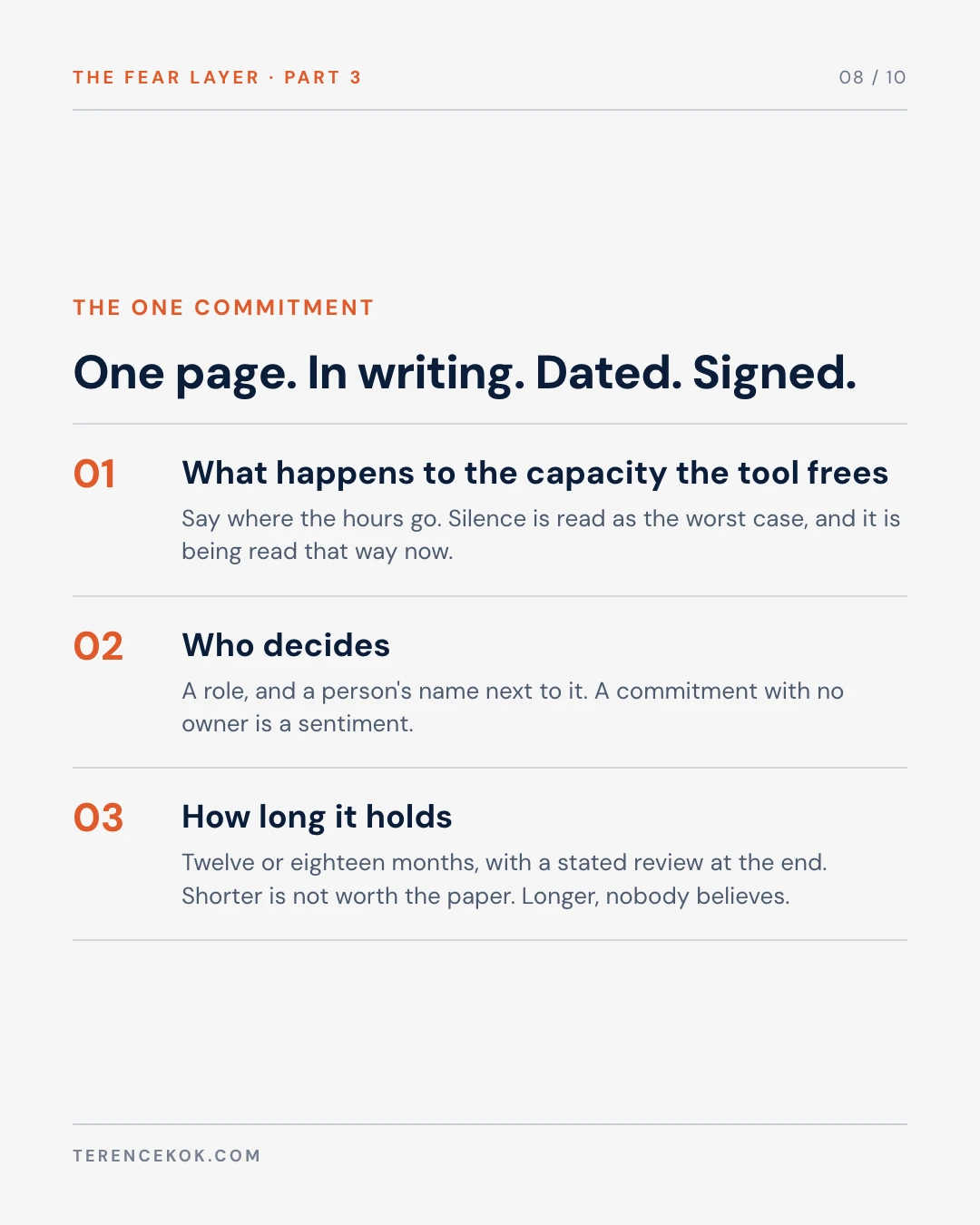
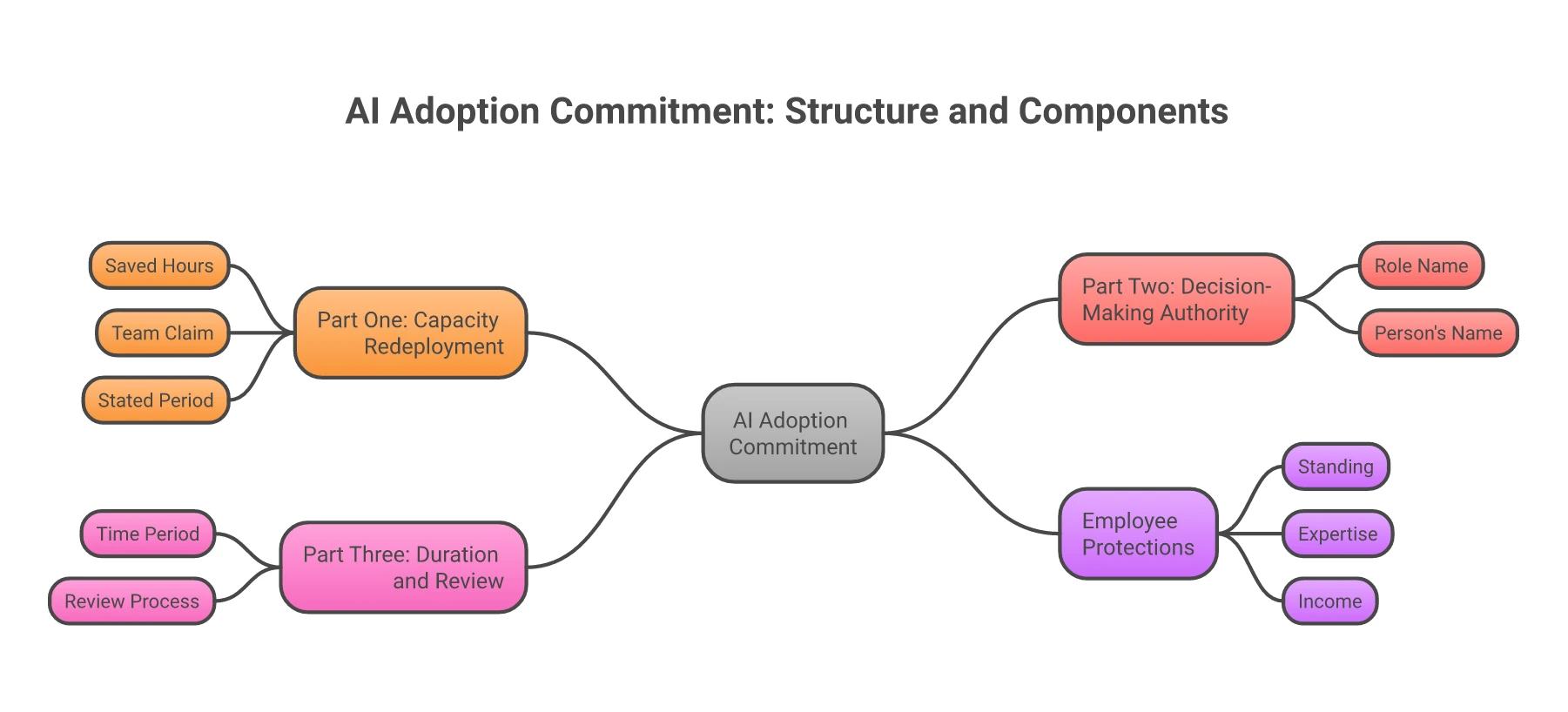
The answer has three parts. All three have to be in writing, dated, and signed by someone whose signature carries weight.
What happens to the capacity the tool frees. Say where the hours go. If the answer is that the team that generates the saving keeps first claim on it for a stated period, to redirect into work that was previously unfunded, say that. If the answer is that some of it will fund headcount reduction, say that too, because people already assume it and a stated version is less corrosive than the one they have constructed. What cannot be done is leaving it unsaid, because silence is read as the worst case, and it is being read that way now.
Who decides. Name the role that makes the call on redeployment, and put a person’s name next to it. A commitment with no owner is a sentiment. People have been given sentiments before.
How long it holds. A commitment without a date can be withdrawn without anyone having lied. Set a period, twelve or eighteen months, and say what review happens at the end. Shorter and it is not worth the paper. Longer and nobody will believe it, because nobody in the room can see that far either.
This is a commitment about consequences, and it is the only kind that addresses what is being protected. It does not need to be generous to work. It needs to be specific enough that a rational person can stop guessing. In my experience the organisations that publish something like this see uptake move within a quarter, and the ones that spend the same quarter on a second training vendor do not.
It is also cheaper than the training it replaces. The resistance to it comes from a different place: signing it means the leadership team has to have decided the answer, and many have not, because deciding is uncomfortable. The workforce has noticed that too.
Free tool
Human-AI Interaction & Decision Quality Dashboard
Measure how people and AI divide the work, so the redeployment commitment is written against evidence.
Three sentences to stop saying in town halls
Each of these is said with good intent, and each makes the hiding worse. They are worth removing from the script before the commitment goes out, because the commitment will be read against whatever was said last.
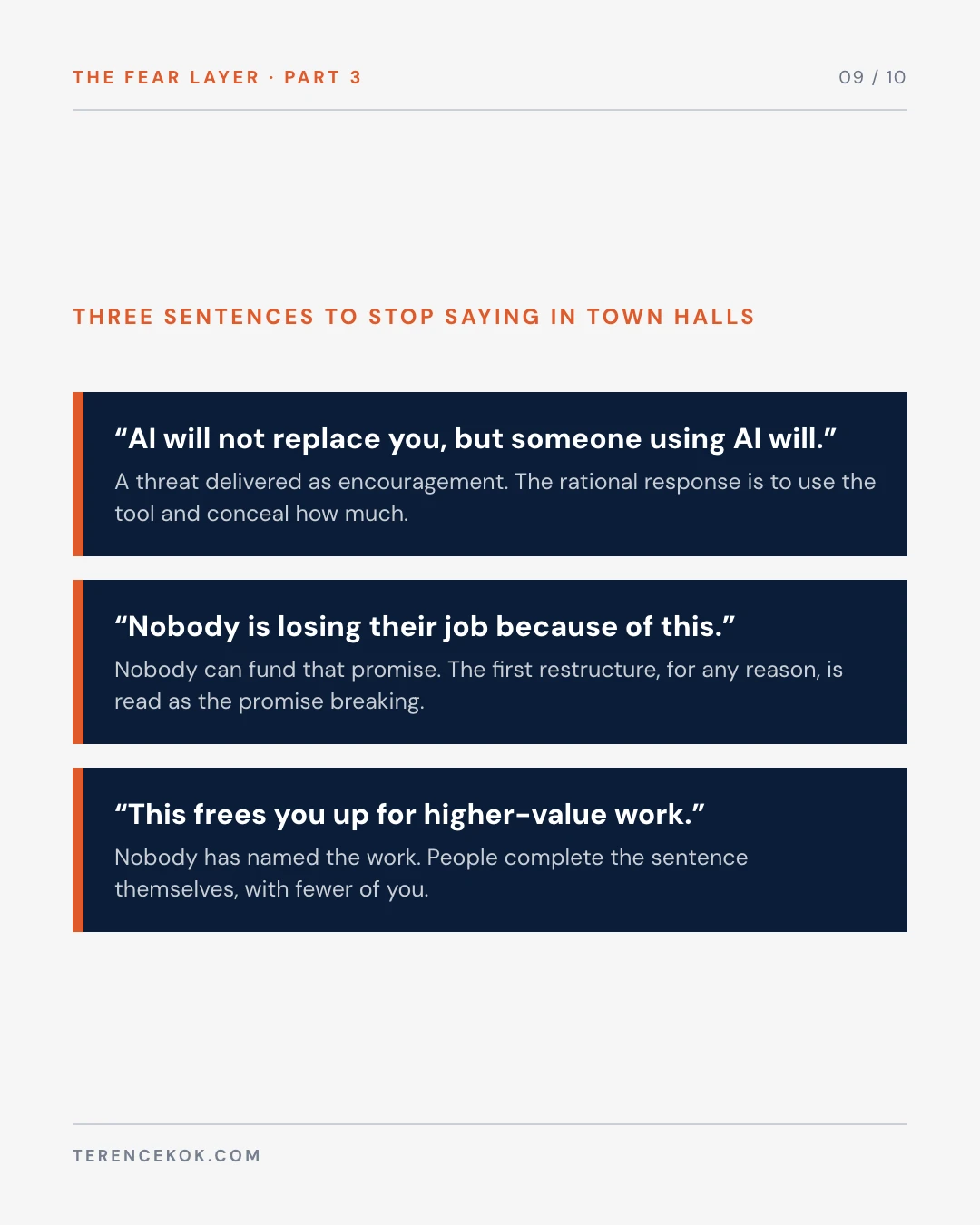
“AI will not replace you, but someone using AI will.” This is a threat delivered as encouragement, and everyone in the room hears the threat. It tells people that their standing now depends on a tool, and that anyone not visibly using it is on notice. The rational response is to use the tool and conceal how much, which is precisely the behaviour the sentence was supposed to cure.
“Nobody is losing their job because of this.” No leadership team can fund that promise, and the workforce knows it. The first restructure for any reason, related or not, will be read as the promise breaking, and every later statement about AI will be discounted. A dated commitment about freed capacity is believable. An unconditional guarantee spends credibility the programme will need later.
“This frees you up for higher-value work.” Nobody has named the higher-value work. Until someone does, the sentence has an unspoken second half, which is that it frees up the organisation for fewer of you. People complete it themselves, and the version they arrive at is the one the leadership team least intended. If the work exists, name it in the commitment. If it does not exist yet, say who is finding it.
Notice what all three share. Each one talks about the technology when the listener is thinking about the consequences. The commitment works because it is the first thing they have heard that talks about the consequences directly.
What self-protection looks like when it lifts
The signals are quieter than a dashboard, and they arrive first.
People start telling their managers what the tool cannot do, which they would never volunteer while hiding that they used it at all. Somebody in a team meeting says the draft came from a model and asks for a second pair of eyes, and nobody flinches. The experienced people begin to describe what they add on top of the output, which is the conversation about expertise that could not happen while expertise felt under threat.
The adoption figure moves later, and by then it is measuring something real. The behaviour changes when the consequences are answered, and the number follows the behaviour.
Where to start this quarter
If you are about to commission another round of training, hold it for two weeks and use the time to draft the commitment instead. Three parts, one page, a name and a date. Then run the training, because people will use it once they have a reason to be seen using it.
If you are a manager watching a team that has stopped, ask one person what they think will happen to them if the tool works. Ask it privately and do not argue with the answer. You will learn more in that conversation than the dashboard has told you in six months.
If you sit on the leadership team, decide the answer to the capacity question before anyone asks you in public. It is going to be asked. It is being asked now, of everyone except you, and the answer people have settled on in your absence is the one that is holding the programme where it is.
Evidence & Methodology
The survey figures are measured and cited below. Everything about what leaders should do about them is my own pattern from advisory work, not a study. Here is which is which.
| Claim | Source | Grade |
|---|---|---|
| 53% of people using AI at work worry it makes them look replaceable; 52% are reluctant to admit using it for their most important tasks | Microsoft and LinkedIn, 2024 Work Trend Index, survey of 31,000 people across 31 countries | Measured |
| 48% of desk workers globally are uncomfortable admitting AI use to their manager; 45% in Singapore, with fear of seeming less competent the top reason | Slack Workforce Index, fielded August 2024, 17,372 desk workers, 1,008 in Singapore | Measured |
| 63% of workers in Singapore have spent under five hours in total learning to use AI | Same Slack Workforce Index release | Measured |
| Organisations that publish a written commitment on freed capacity see uptake move within a quarter, and repeat training rounds do not | My own pattern across advisory engagements, not a controlled comparison | My call |
| The three-part commitment, capacity, owner, duration, is the intervention that addresses what people are protecting | My own framework, drawn from my client work, not externally validated | My framework |
Sources
- Microsoft & LinkedIn. (2024, May 8). AI at Work Is Here. Now Comes the Hard Part. 2024 Work Trend Index Annual Report, Microsoft WorkLab.
- Slack. (2024, November 12). The Fall 2024 Workforce Index shows executives and employees investing in AI, but uncertainty holding back adoption.
- Salesforce. (2024, December 13). Half of workers in Singapore feel uncomfortable admitting AI usage at work, says new Slack Workforce Index [Press release].

Boards Are Asking for AI Strategy. Many Are Asking Because They Are Afraid.
Where the mandate comes from, and why a workforce that has watched one anxiety programme fail reads the next one differently.

When AI Success Threatens to Take the Credit: A Hidden Barrier to Adoption
The earlier piece on what happens when a tool does the work someone was known for doing.

An AI Plan and Staff Training Are Not the Same Thing
The data on how much AI spending goes to training, and why the plan has to exist first.

What CHROs Are Worried About With AI and How to Respond
Employee trust erosion and the reskilling gap, from the survey data CHROs are reading.
This is part three of The Fear Layer. Part four looks at the fear of being late, and the procurement decisions it produces. If your adoption figure has stalled and the proposed remedy is another training round, that is a conversation my consulting work has had more than once.
Was this useful?