
Listen to this article
Jump to a section
In this article
Executive Summary
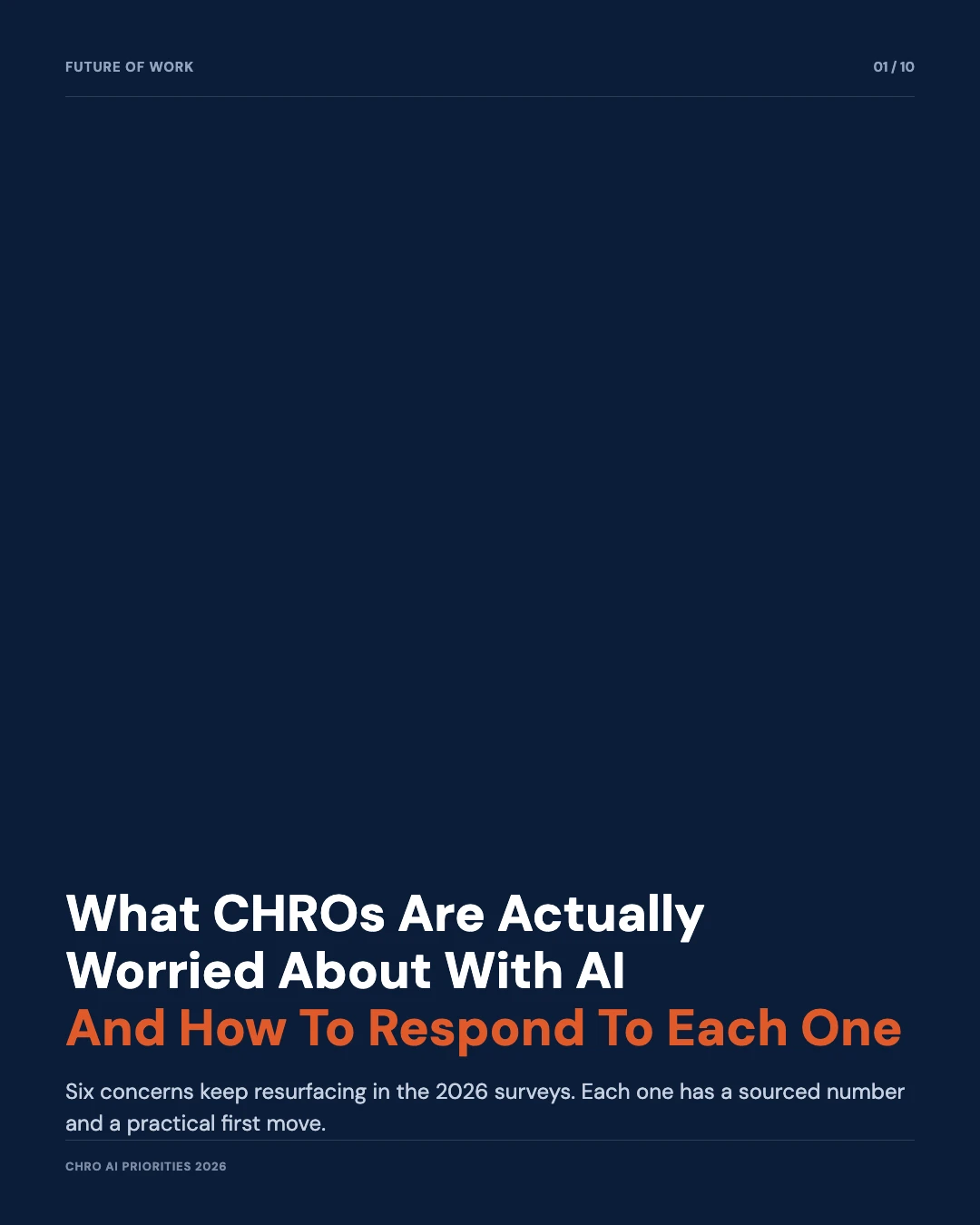
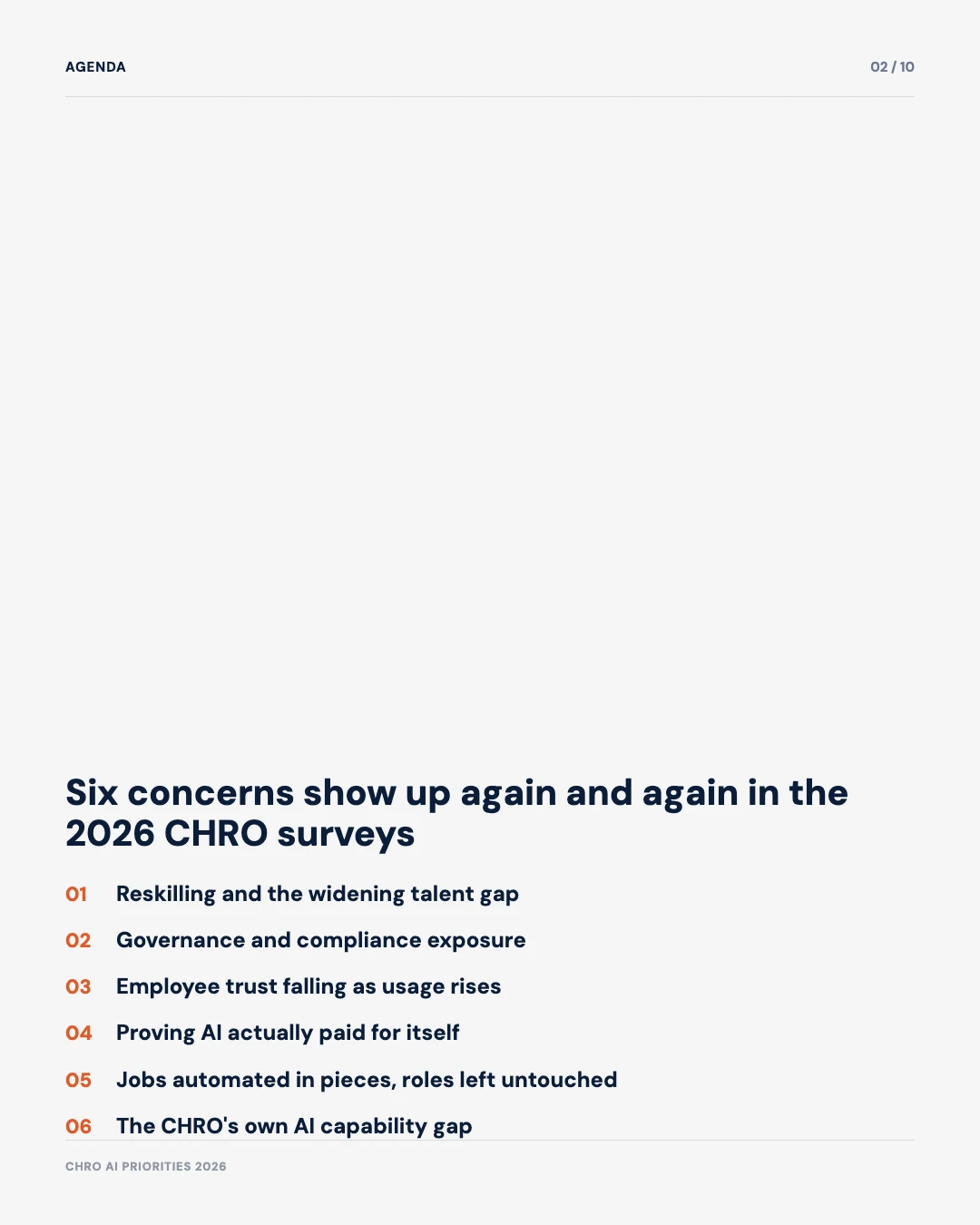
Ask a CHRO what worries them about AI in 2026 and the answer rarely stays on one topic for long. Across the year’s major surveys, the same six concerns keep resurfacing: closing the reskilling gap before roles change again, containing governance and legal exposure, holding onto employee trust as sentiment sours, proving AI paid for itself, redesigning jobs, and admitting that HR’s own AI fluency is thinner than the workforce it is meant to develop. None of these are abstract. Each has a specific, sourced number attached to it, and each has a practical first move that does not require solving AI as a whole before starting.
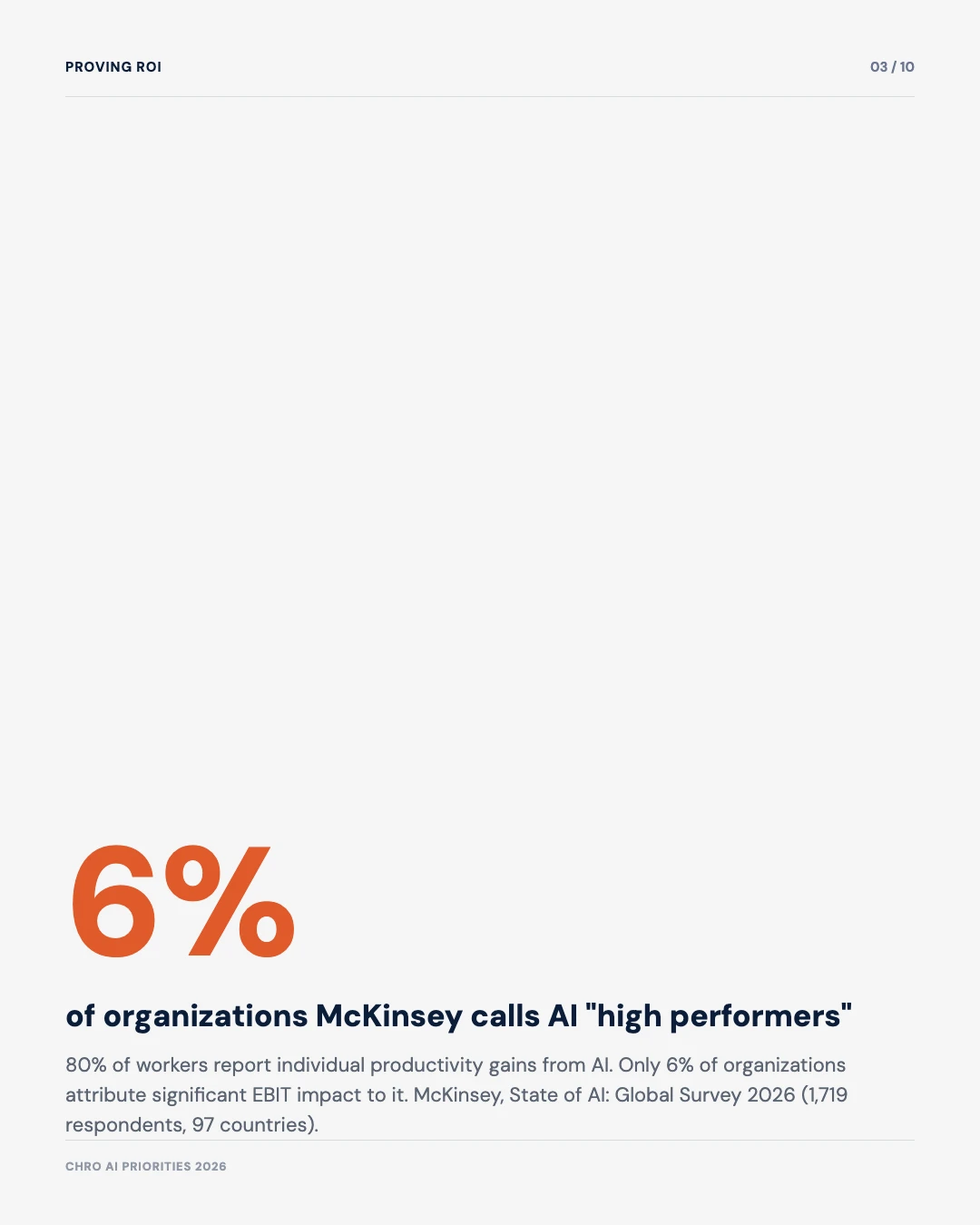
6%
of organizations McKinsey classifies as AI “high performers,” attributing significant EBIT impact to AI, State of AI: Global Survey 2026
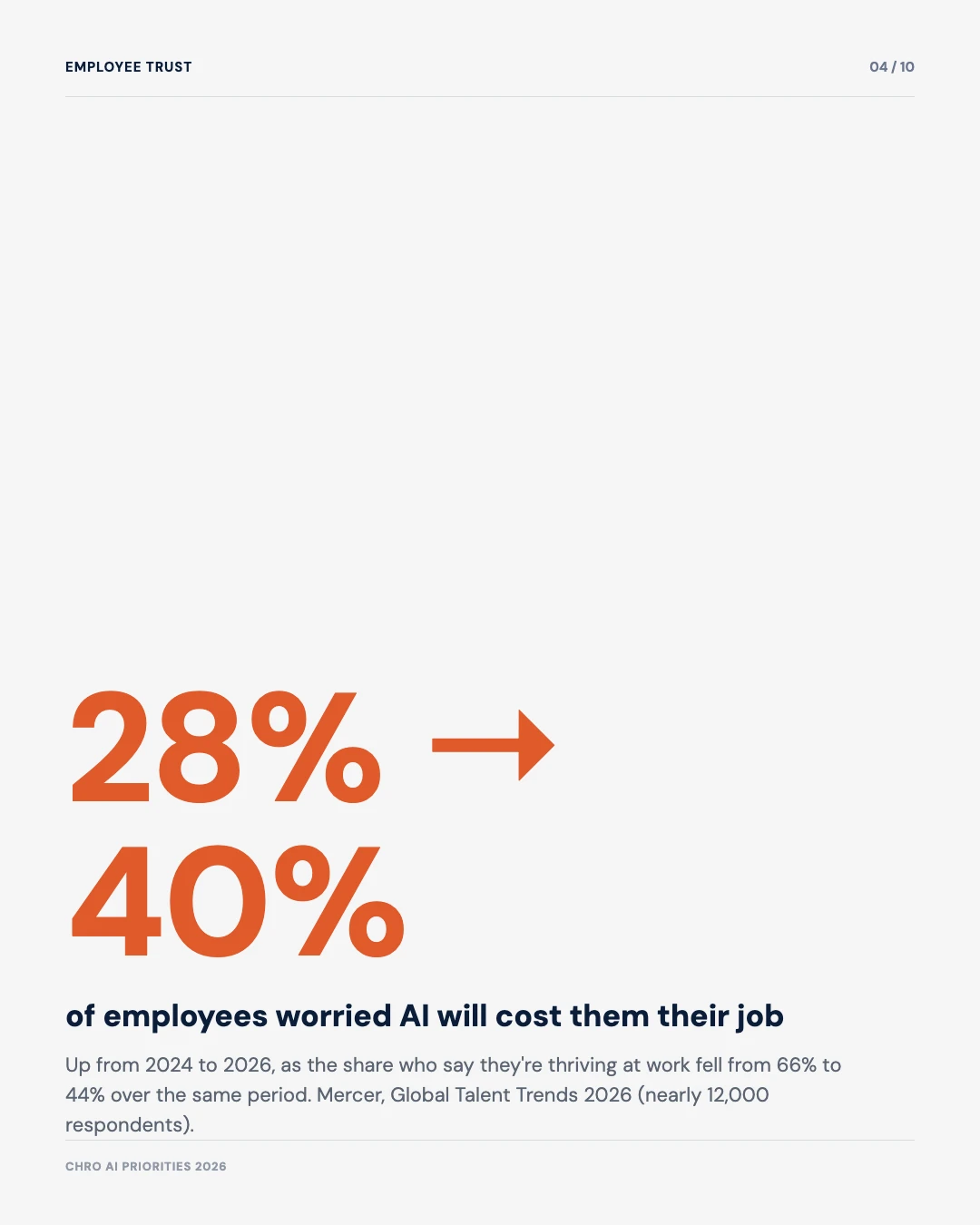
28% → 40%
of employees worried AI will cost them their job, 2024 versus 2026, Mercer Global Talent Trends 2026
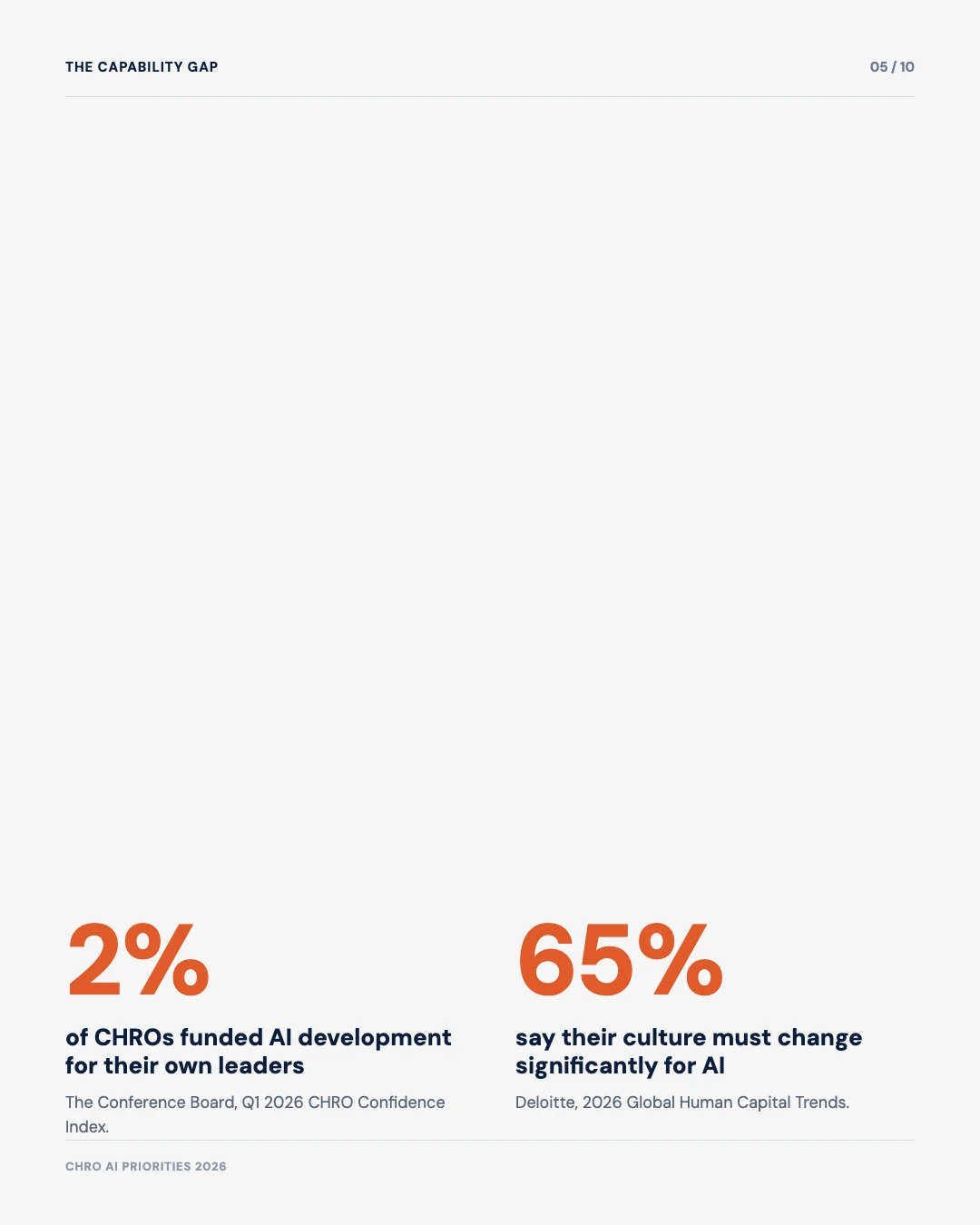
2%
of CHROs who invested specifically in AI and digital-capability development for their own leadership and managers, Conference Board Q1 2026
65%
of organizations that believe their culture needs to change significantly because of AI, Deloitte 2026 Global Human Capital Trends
Core conclusions
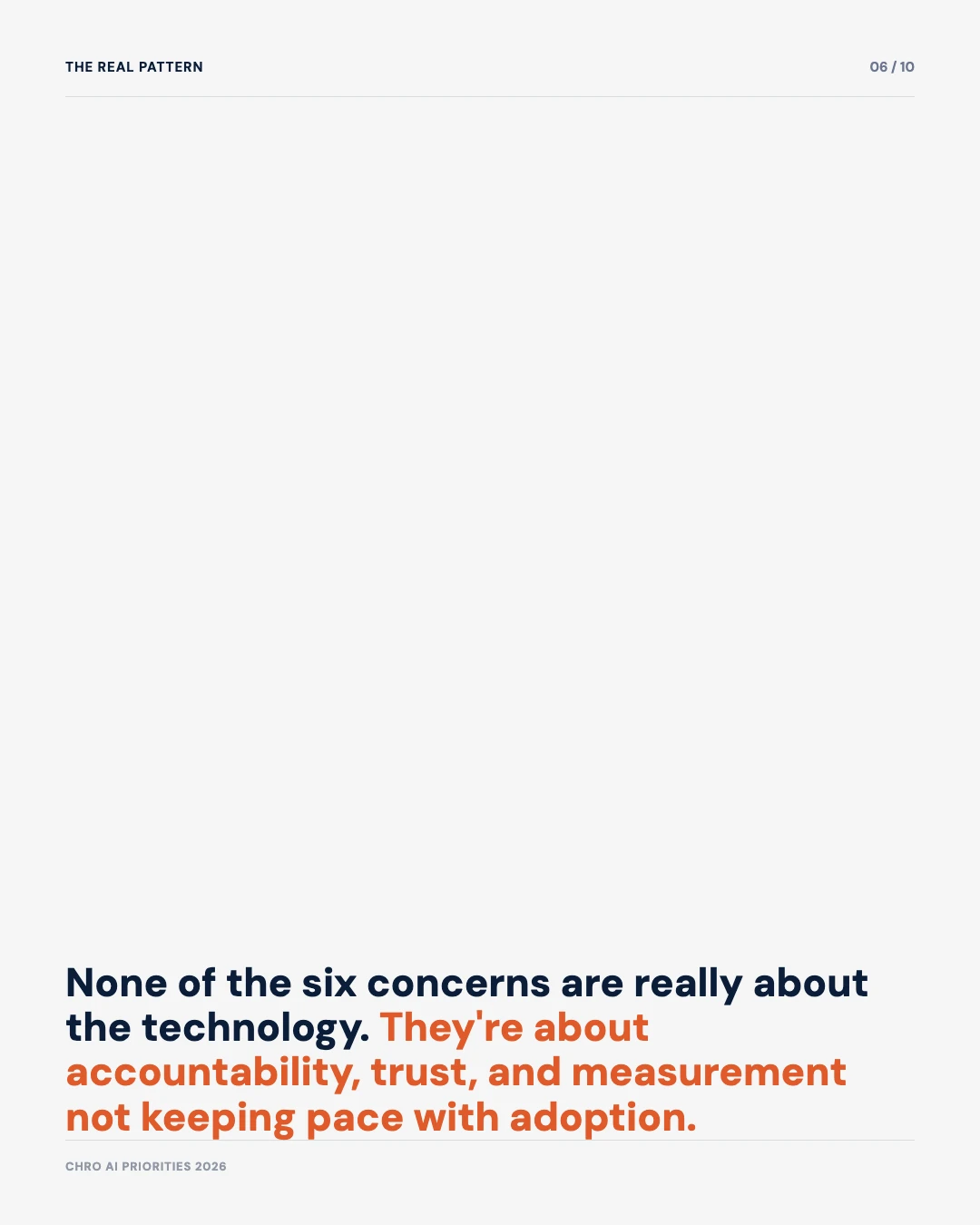
- Every one of the six concerns CHROs report traces back to the same gap: adoption is outrunning the accountability, trust, and measurement systems built to hold it.
- There is no single “AI strategy” fix. Governance, trust, ROI, and organizational redesign each need a named owner and a distinct practical response.
- The most under-invested layer is not the workforce. It is HR’s own leadership, the group with the smallest share of AI-specific development spend of any it is responsible for growing.
The six CHRO AI concerns, ten slides
Save it, share it, or send it to whoever owns the AI rollout you’re not sure is covering all six.
Reskilling keeps slipping despite being the top CHRO priority
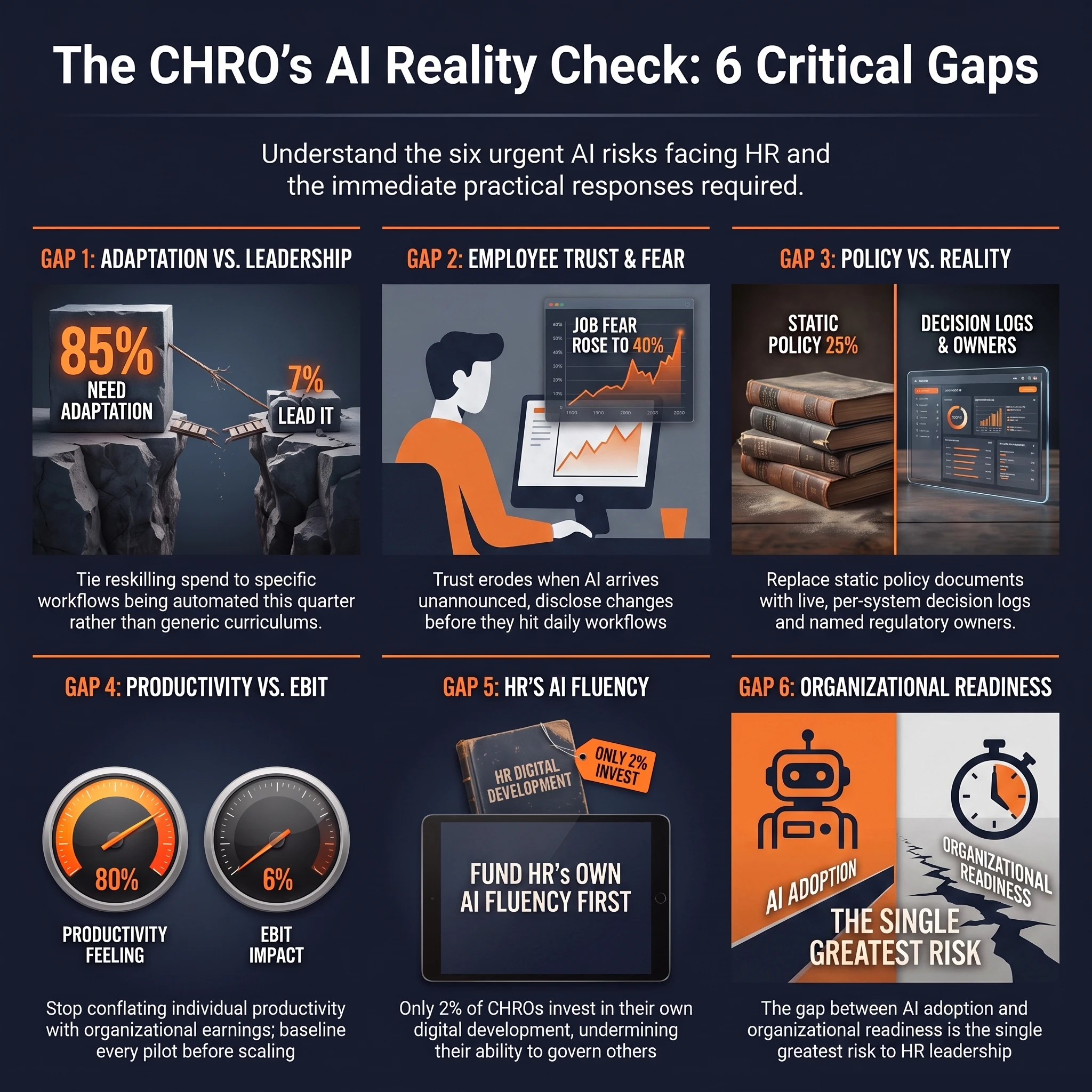
Gartner’s July 2025 survey of 222 CHROs put “shape work in the human-machine era” among the top three CHRO priorities for 2026, alongside harnessing AI inside HR itself and mobilizing leaders through continued uncertainty. Less than half of those CHROs, 47%, said their organization’s culture currently drives employee performance at all, before AI is even added to the picture. Deloitte’s 2026 Global Human Capital Trends survey of more than 9,000 business and HR leaders across 89 countries found the same strain from the workforce side: 85% say building the organization’s ability to adapt continuously is critical, but only 27% say their organization manages change well, and just 7% say they are leading in helping their people grow and adapt. Two-thirds, 65%, believe their culture needs to change significantly because of AI.
The pattern across both surveys is a plan that outruns its own execution. CHROs know reskilling matters and can name it as a priority; what is missing is a mechanism that connects the reskilling budget to the actual pace at which specific roles are changing.
Three practical moves close that gap faster than a general AI-literacy rollout:
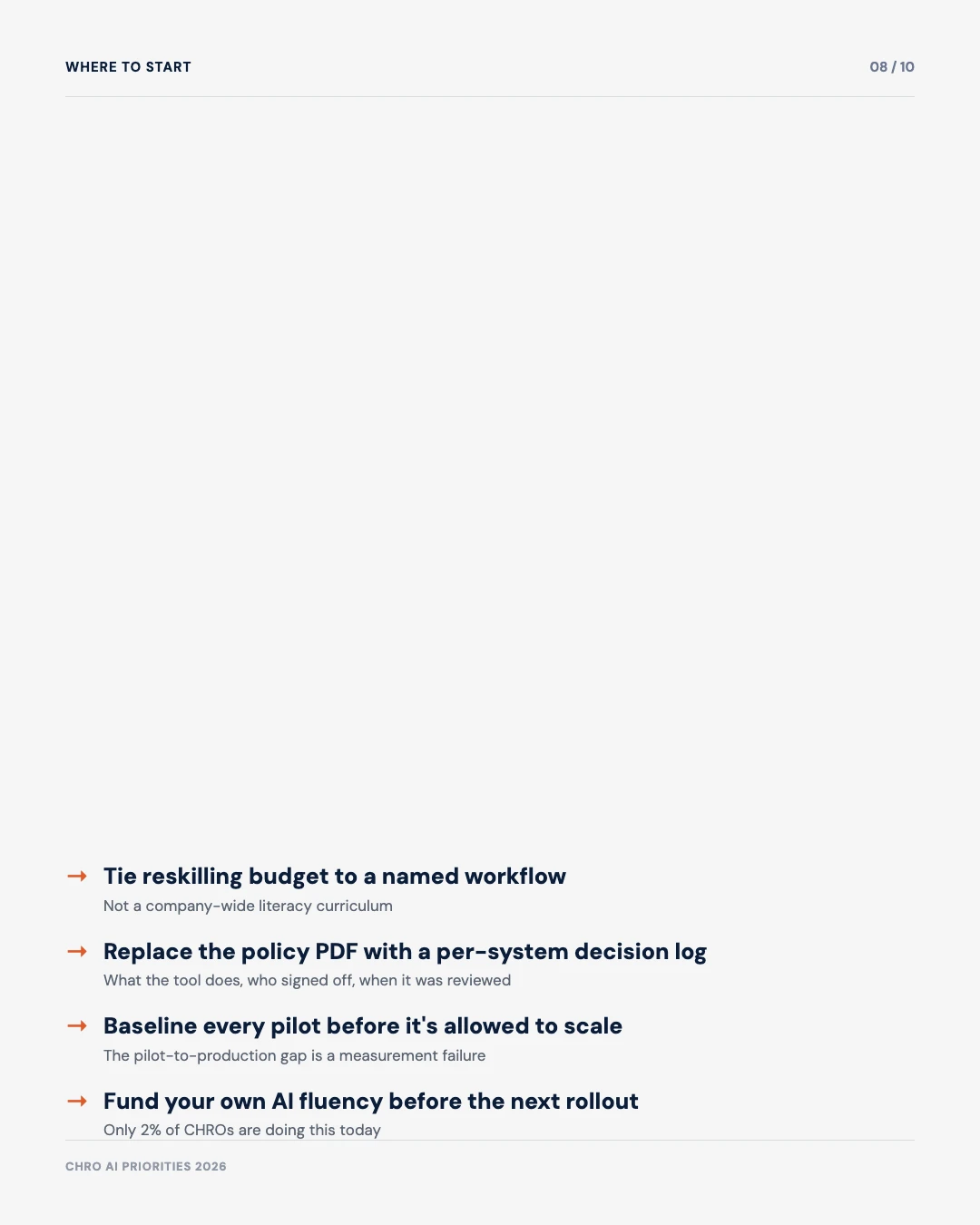
- Tie reskilling spend to named workflows being automated in the next two quarters, not to a company-wide curriculum. Deloitte found only 40% of leaders design AI deployments for both business and human outcomes together, including fairness, skills, and day-to-day experience, which means most reskilling budgets are currently disconnected from the automation roadmap they are supposed to prepare people for.
- Fund manager-level fluency before employee-wide literacy. The layer meant to translate strategy into daily practice is consistently the most starved, a pattern this post returns to below.
- Measure redeployment instead of completion. Track whether reskilled employees move into higher-value work within a defined window.
AI governance has become a compliance exposure most HR policies don’t cover
SHRM’s State of AI in HR 2026 research, drawing on more than 1,900 HR professionals, found that 49% of organizations have a policy in place to regulate employee AI use, but only 25% believe that policy is future-proof. In states and jurisdictions with specific workforce AI regulation already in force, 57% of HR professionals report they are not aware of the rules that apply to them, and among the smaller group who are aware, only 12% have taken concrete compliance steps. The exposure is not hypothetical: bias in AI-assisted hiring, unclear data handling, and outdated policy language are the risks SHRM’s own respondents flag most often.
The practical failure mode here is treating governance as a document:
- Replace the single policy document with a per-system decision log: what the tool does, what data it touches, who signed off, and when it was last reviewed. A quarter of organizations believing their policy is future-proof means three-quarters already know theirs is not.
- Assign a named owner for regulatory tracking in every jurisdiction of operation. More than half of HR professionals in regulated states not knowing the specific rules that apply to them is a staffing gap, not a legal-department gap.
- Build a pre-deployment checklist, covering bias testing, data handling, and a defined human review point, that a system has to clear before HR uses it operationally, instead of retrofitting compliance after adoption.
Free tool
AI Trust, Risk & Governance Dashboard
Score your organization’s AI governance maturity against the gaps this section describes: policy currency, jurisdictional coverage, and pre-deployment review.
Employee trust in AI is falling even as usage keeps rising
Mercer’s Global Talent Trends 2026 report, based on nearly 12,000 executives, HR leaders, investors, and employees surveyed in late 2025, found that employee concern about losing a job to AI rose from 28% in 2024 to 40% in 2026, while the share of employees who say they are thriving at work fell from 66% to 44% over the same period. Sixty-two percent of employees say leaders underestimate AI’s emotional impact on their work, but only 19% of HR leaders factor that impact into their AI implementation strategy at all. Glassdoor’s economic research team, reported by HR Executive, found employee review mentions of AI rose 240% between May 2025 and May 2026, and the sentiment attached to those mentions flipped over the same period from 81% positive in 2019 to just 43% positive and 53% negative or listed-as-a-con in 2026. Employees who mentioned AI negatively in a review were 3.7 times more likely to also mention burnout or job insecurity, and six times more likely to mention layoffs directly. Managers see the same anxiety from the other side: Beautiful.ai’s 2026 survey of 3,000 US managers found 70% believe their own employees fear AI will eventually cost them their job, up twelve points year over year.
Trust is not eroding because AI arrived. It is eroding because of how it arrived, mostly without warning, inside someone’s existing job:
- Put the emotional-impact question directly into every AI rollout plan as a line item with a named owner. Mercer’s 19% figure is the exact size of the gap between what leaders assume and what HR strategy accounts for.
- Tell people what is changing and why before they discover it through a workflow change. The reviews data shows trust erodes fastest when AI shows up unannounced inside someone’s day-to-day work.
- Track thriving and engagement scores segmented by exposure to AI-driven change, not just as a company-wide average, so a national-scale drop does not obscure which specific teams are absorbing the most disruption.
Most organizations still can’t show AI paid for itself
McKinsey’s State of AI: Global Survey 2026, with 1,719 respondents across 97 countries, found that 37% of organizations now attribute at least some EBIT impact to AI, roughly unchanged from a year earlier. But McKinsey classifies only 6% of respondents as AI “high performers,” meaning they attribute at least 5% of EBIT to AI and describe the impact as significant. Eighty percent report individual productivity gains from AI use, which means the gap between people feeling more productive and the organization being able to prove it in earnings terms is enormous. Deloitte’s separate State of AI in the Enterprise report, surveying 3,235 leaders across 24 countries, found 66% of organizations reporting productivity and efficiency gains, but scaling from pilot into production is consistently running behind what leaders expect.
The measurement problem, more than the technology problem, is what is keeping most CHROs and their CFO counterparts from being able to answer “did it work”:
- Measure organizational impact separately from individual productivity. McKinsey’s gap between 80% individual gains and 6% significant EBIT impact is exactly the distinction most internal dashboards currently collapse into one number.
- Concentrate proof-of-ROI efforts in the two or three functions where both McKinsey and Deloitte show consistent gains, such as service operations, supply chain, and software engineering.
- Require a documented before-and-after baseline for every pilot before it is allowed to scale. The pilot-to-production gap both firms track is largely a measurement failure, not a capability failure.
Free tool
AI ROI Calculator
Separate individual productivity gains from organizational EBIT impact for your own workforce AI investments, the exact distinction McKinsey’s data shows most dashboards conflate.
Jobs are being automated in pieces while almost nobody redesigns the whole role
Deloitte’s 2026 Global Human Capital Trends report frames three tipping points reshaping the workforce: human and machine working side by side giving way to human times machine, cost efficiency giving way to value creation, and static workforce plans giving way to dynamic orchestration. The report also found that 59% of organizations still take a tech-focused approach to AI deployment rather than a human-centric one, and that tech-focused organizations are 1.6 times more likely to fail to realize the AI returns they expected, compared with organizations that design around people as well as the technology. Only 40% of leaders design for both business and human outcomes together. And 60% of executives already use AI in their own decision-making, but only 5% say they manage that use well.
The common failure is automating individual tasks inside a role while leaving the role itself, its accountability, its reporting lines, its definition of success, untouched:
- Redesign one role end-to-end as a pilot, not just its tasks, before scaling the pattern org-wide. Most companies stop at task automation and never revisit what the role is for.
- Make the human-centric versus tech-focused choice an explicit line in the AI steering committee’s charter. The 1.6x gap in realized ROI between the two approaches is one of the largest effect sizes in Deloitte’s entire dataset.
- Put a named decision-owner and a defined review point on every AI-assisted executive decision process, closing the gap between the 60% of executives already using AI in decisions and the 5% who say they manage that use well.
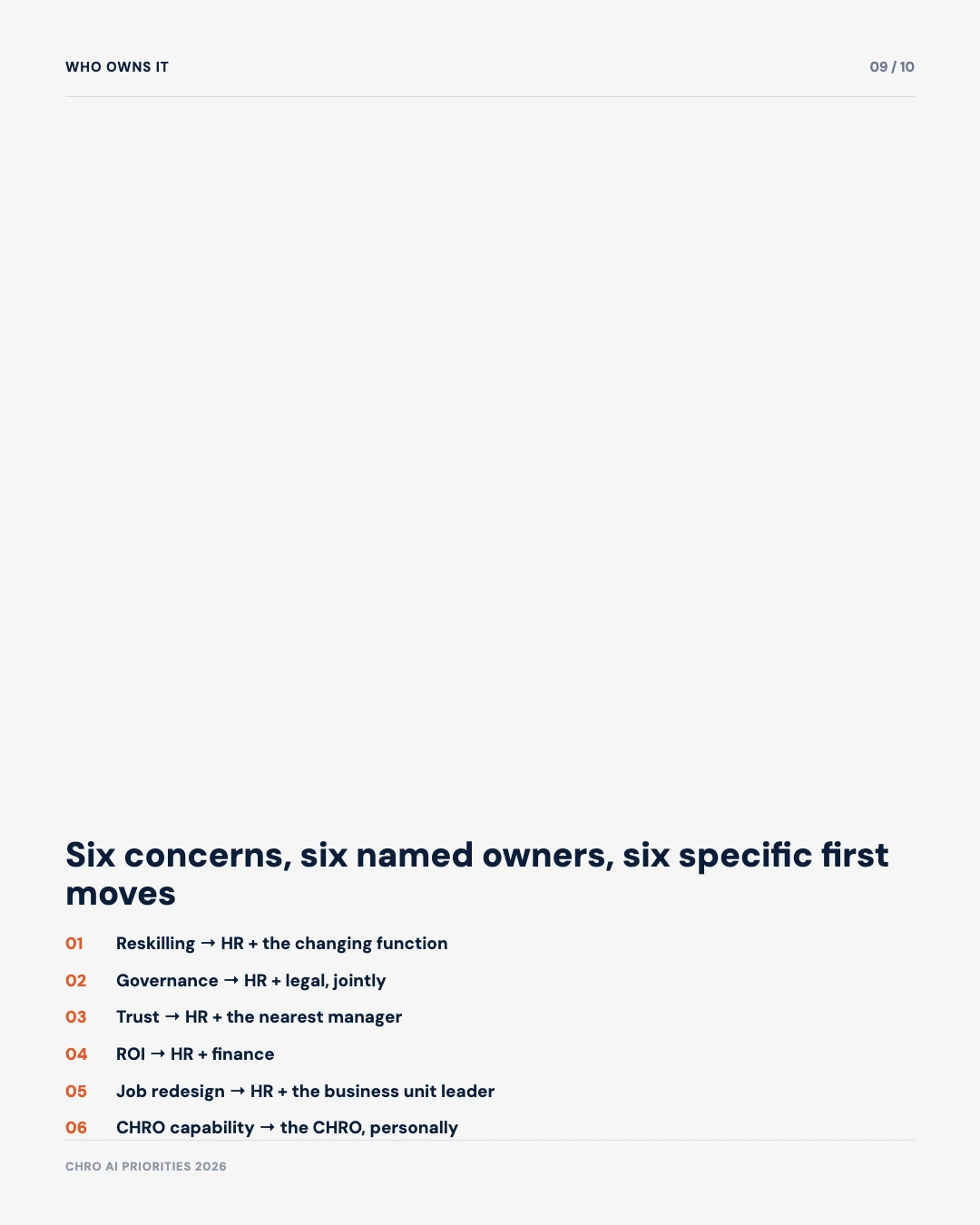
| Concern | Who owns the first move | Where to start |
|---|---|---|
| Reskilling gap | HR + the function whose workflow is changing | Tie budget to a named workflow being automated this quarter |
| Governance exposure | HR + legal, jointly, not sequentially | Build a per-system decision log before writing another policy PDF |
| Employee trust | HR + the manager closest to the change | Announce the change before the workflow does |
| Unproven ROI | HR + finance | Baseline every pilot before it’s allowed to scale |
| Unredesigned jobs | HR + the business unit leader | Redesign one role end-to-end as a pilot |
| CHRO’s own capability gap | The CHRO, personally | Fund your own AI fluency before the next org-wide rollout |
CHROs are the least AI-ready function in the room they’re supposed to be leading
The Conference Board’s CHRO Confidence Index reached 59 in the first quarter of 2026, its strongest reading since the series began in Q1 2023, and 36% of CHROs report having invested in AI or automation for HR operations. But only 2% invested specifically in AI and emerging digital-capability development for their own leadership and manager population, and within HR’s broader AI investment, just 20% went toward learning and coaching tools rather than operational automation. Gartner’s data shows the same disconnect from the other direction: leader and manager development has been CHROs’ top stated priority for two years running, and HR technology and AI strategy has climbed to the second-highest priority this year, yet the two are being funded almost entirely apart from each other.
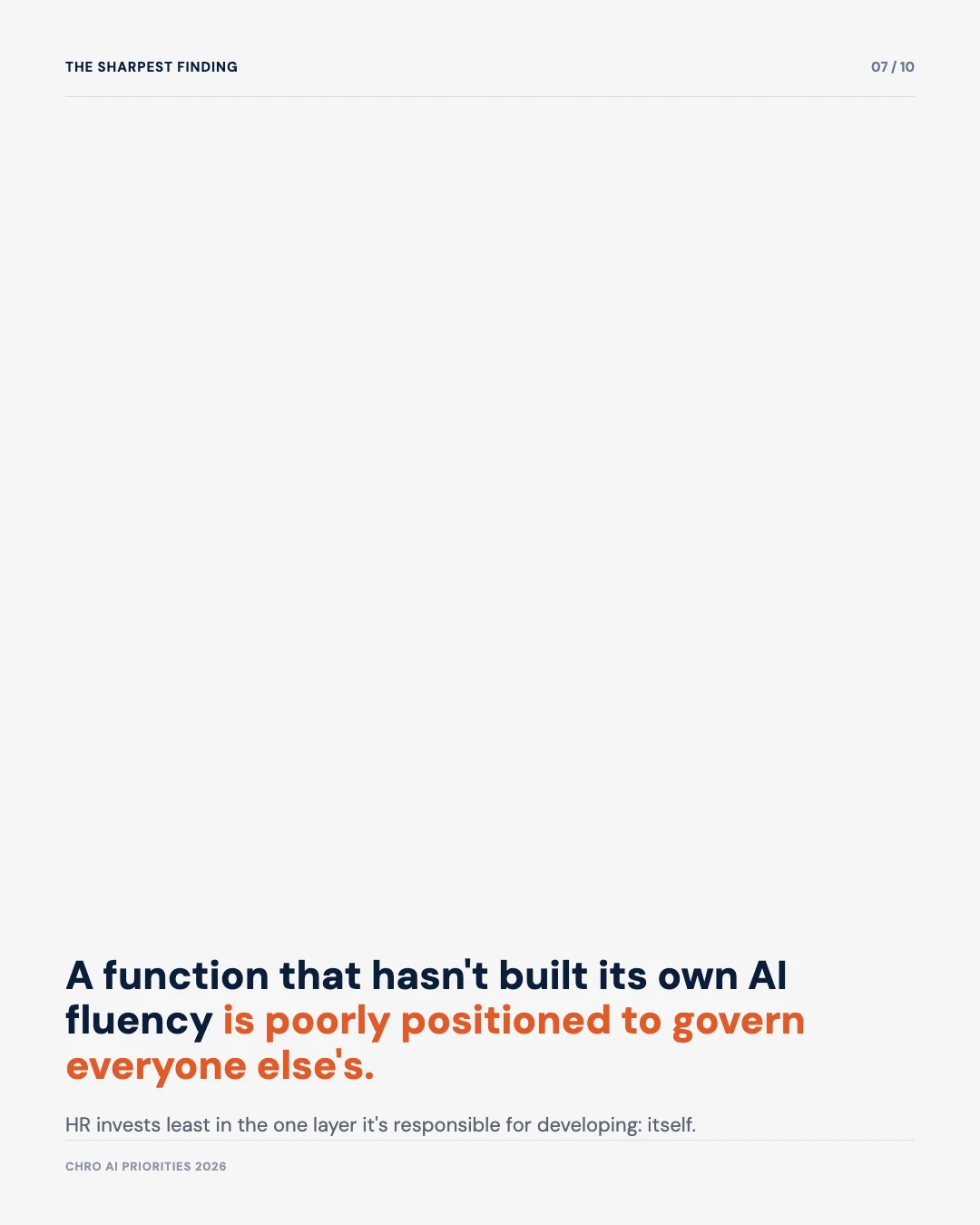
A function that has not built its own AI fluency is poorly positioned to govern everyone else’s, and the fix here is more personal than organizational:
- Treat CHRO and senior-HR AI fluency as a personal development requirement. The 2% figure shows almost nobody is doing this seriously yet, which makes doing it now a genuine point of difference.
- Merge the leadership-development budget and the AI-strategy budget into a single line item with a single accountable owner, since Gartner’s data shows they currently sit as priority one and priority two without being connected to each other.
- Get outside review of your own AI rollout decisions, from a peer network or an advisor without a stake in the vendor relationship, before scaling them. A function that is underconfident in its own AI readiness is the wrong function to grade its own governance unassisted.
None of these six concerns resolve independently. A CHRO who fixes governance without addressing trust will ship a compliant rollout that employees route around. One who proves ROI without redesigning the underlying role will find the gains don’t survive the next reorganization. The concerns rank by leverage as much as by urgency, and the leverage runs in one direction: the function asked to answer for all six of them is currently the one that has invested least in being ready to.
Evidence & Methodology
Every specific number below comes from a named, sourced survey. The single explanation connecting all six concerns is mine, not something any one survey states directly.
| Claim | Source | Grade |
|---|---|---|
| Only 6% of organisations are AI “high performers” with significant EBIT impact, despite 80% reporting individual productivity gains | McKinsey State of AI: Global Survey 2026, 1,719 respondents | Measured |
| Employee concern about losing a job to AI rose from 28% to 40% between 2024 and 2026 | Mercer Global Talent Trends 2026, nearly 12,000 surveyed | Measured |
| Only 2% of CHROs invested specifically in AI and digital-capability development for their own leadership | The Conference Board, Q1 2026 | Measured |
| All six CHRO concerns trace back to the same gap: adoption outrunning the accountability, trust, and measurement systems built to hold it | My own synthesis across the surveys cited in this piece | My read |
Sources
- HR Executive. (2025, October). 3 Top HR Priorities for 2026, According to Gartner’s Latest Survey, citing Gartner’s July 2025 survey of 222 CHROs.
- SHRM. (2026). The State of AI in HR 2026: 5 Critical Insights for CHROs.
- Mercer. (2026). Mercer’s Global Talent Trends 2026 Report.
- HR Executive. (2026). Employee Reviews Reveal the Workplace Side of AI’s Trust Problem, citing Glassdoor economic research team analysis.
- The Register. (2026, August 25). McKinsey Says Enterprise AI Is Finally “On the Road to ROI”, citing McKinsey’s State of AI: Global Survey 2026 (1,719 respondents, 97 countries).
- Deloitte. The State of AI in the Enterprise, 2026 AI Report.
- Deloitte. (2026). 2026 Global Human Capital Trends; additional figures via HR Executive, What Deloitte’s 2026 Trends Report Says Leaders Want Tech to Fix.
- The Conference Board. (2026). Survey: CHRO Confidence Hits New High, Q1 2026 CHRO Confidence Index.
- Beautiful.ai. (2026, April 22). AI’s Impact on the Workplace in 2026: 3rd Annual Survey of American Managers.
If your organization is trying to sequence these six problems instead of tackling them all at once, that prioritization work is exactly what my consulting work helps with.
Was this useful?