

Listen to this article
Jump to a section
In this article
Executive Summary
The public argument about AI and jobs has settled into two camps repeating the same two numbers at each other, and both numbers are correct at the same time. What neither camp does is the smaller, harder, useful work: mapping which of your own tasks are exposed, moving toward the next category before it has a name, and building the specific combination of skill the labour market has been paying for since long before generative AI existed.
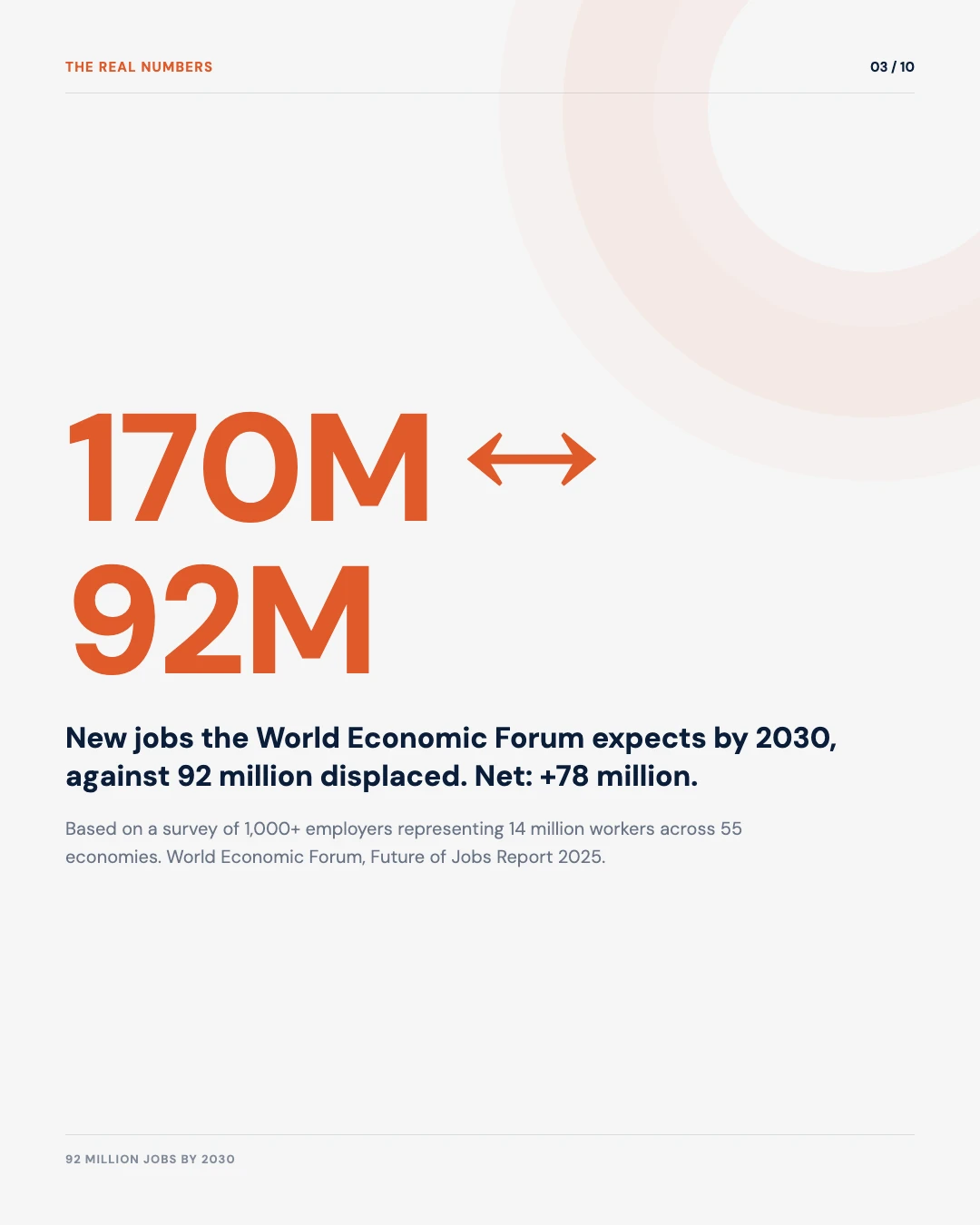
170M ↔ 92M
new jobs the World Economic Forum expects by 2030, against 92 million displaced, a net of +78 million
39%
of core job skills expected to change or become outdated by 2030, per the same WEF survey of 1,000+ employers
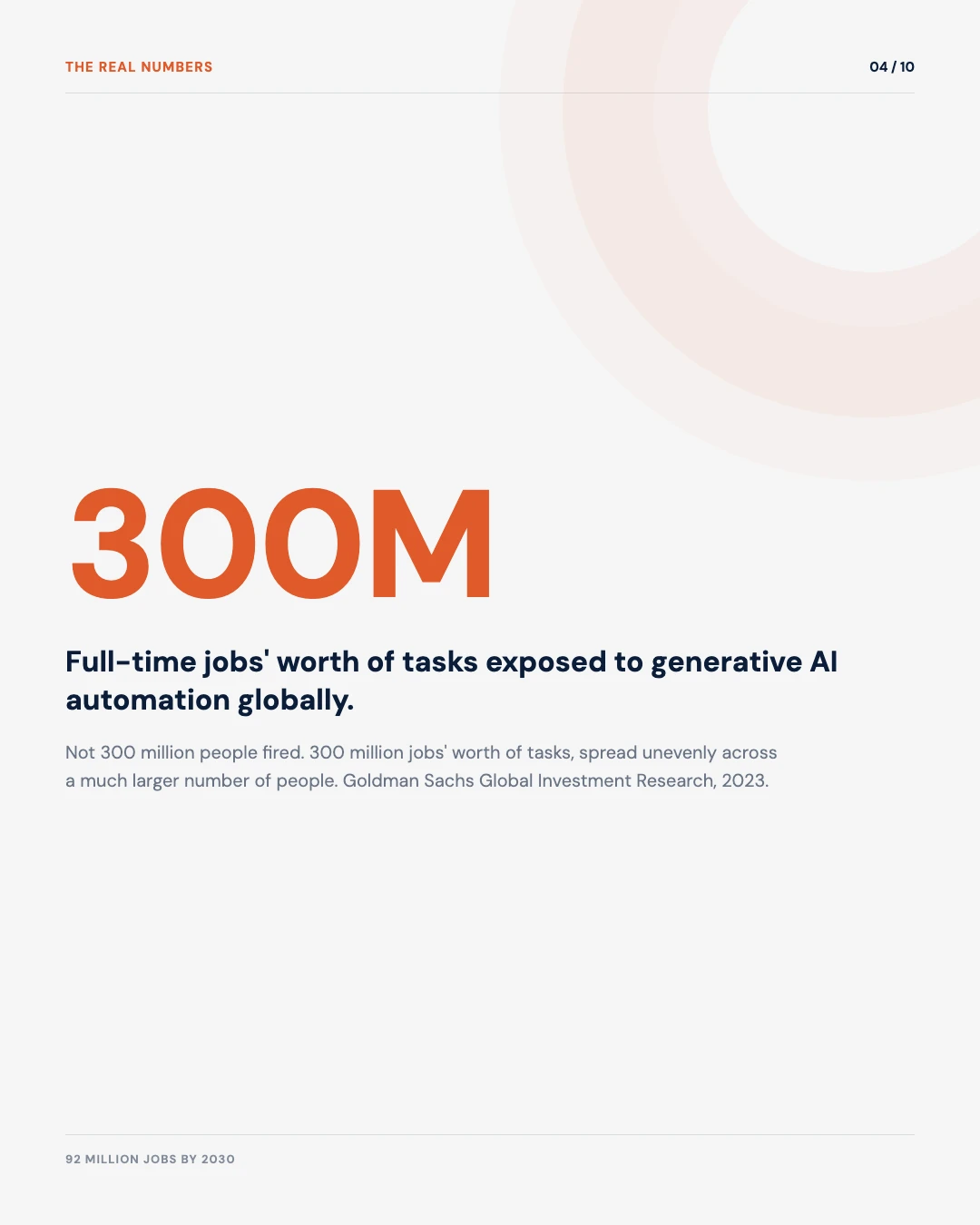
300M
full-time jobs’ worth of tasks Goldman Sachs estimated were exposed to generative AI automation globally, 2023
60%
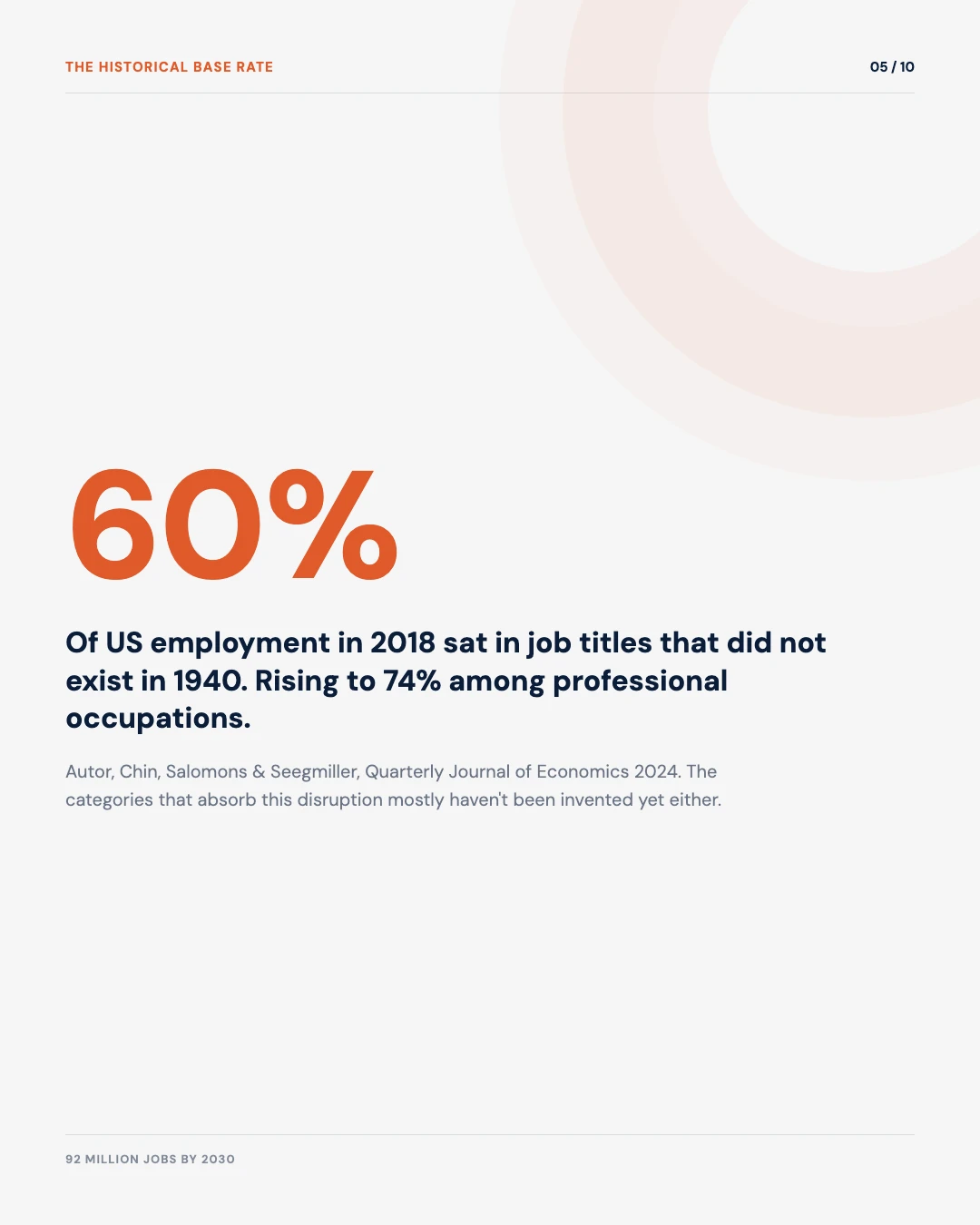
of US employment in 2018 sat in job titles that did not exist in 1940, Autor, Chin, Salomons & Seegmiller, QJE 2024
Core conclusions
- Net positive by 2030 is real in the WEF’s own numbers, but it’s an aggregate. It says nothing about whether the 92 million people being displaced are the same people who get hired into the 170 million new roles.
- History’s base rate favours new work over lost work, but Autor’s data is also a warning: most of the categories that will absorb this disruption haven’t been invented yet, which is not a reason to wait for one to be named.
- What survives displacement clusters around a specific, identifiable profile: judgement someone is accountable for, dexterity in unstructured physical settings, and trust built through repeated contact.
The real numbers, the historical base rate, and where humans still hold the line, ten slides
Save it, share it, or send it to whoever’s still arguing about whether AI is good or bad for jobs instead of auditing their own.
The debate is over; the math was never the point
Every few weeks a new estimate lands. One side reads it as proof AI is going to gut the labour market. The other reads the same report as proof there’s nothing to worry about. Both sides can point at the same source and both are technically right, because the World Economic Forum’s Future of Jobs Report 2025, a survey of more than 1,000 employers representing 14 million workers across 55 economies, expects 92 million existing roles to be displaced by 2030 and 170 million new ones to be created. Net, that’s +78 million jobs. WEF put that number in its own headline.
It is not an argument for calm, and it is not an argument for panic. It’s an argument that whether AI destroys jobs was never the useful question, because the honest answer, yes and no at the same time, has been true of every automation wave on record. The useful question is smaller and much less quotable: which specific tasks in your specific role are exposed, and what are you doing about the ones that are. That’s the only version of this question that’s yours to answer, and almost nobody arguing about it online is asking it in that form.
Jobs displaced and created by 2030
The net hides the churn. The 92 million leaving are mostly not the people hired into the 170 million new roles, and those roles need not open in the same country, industry or skill band.
39% of core skills expected to change or become outdated in the same window.
Source: World Economic Forum, Future of Jobs Report 2025, a survey of more than 1,000 employers representing 14 million workers across 55 economies. Both figures are employer forecasts.
What “plus 78 million” hides
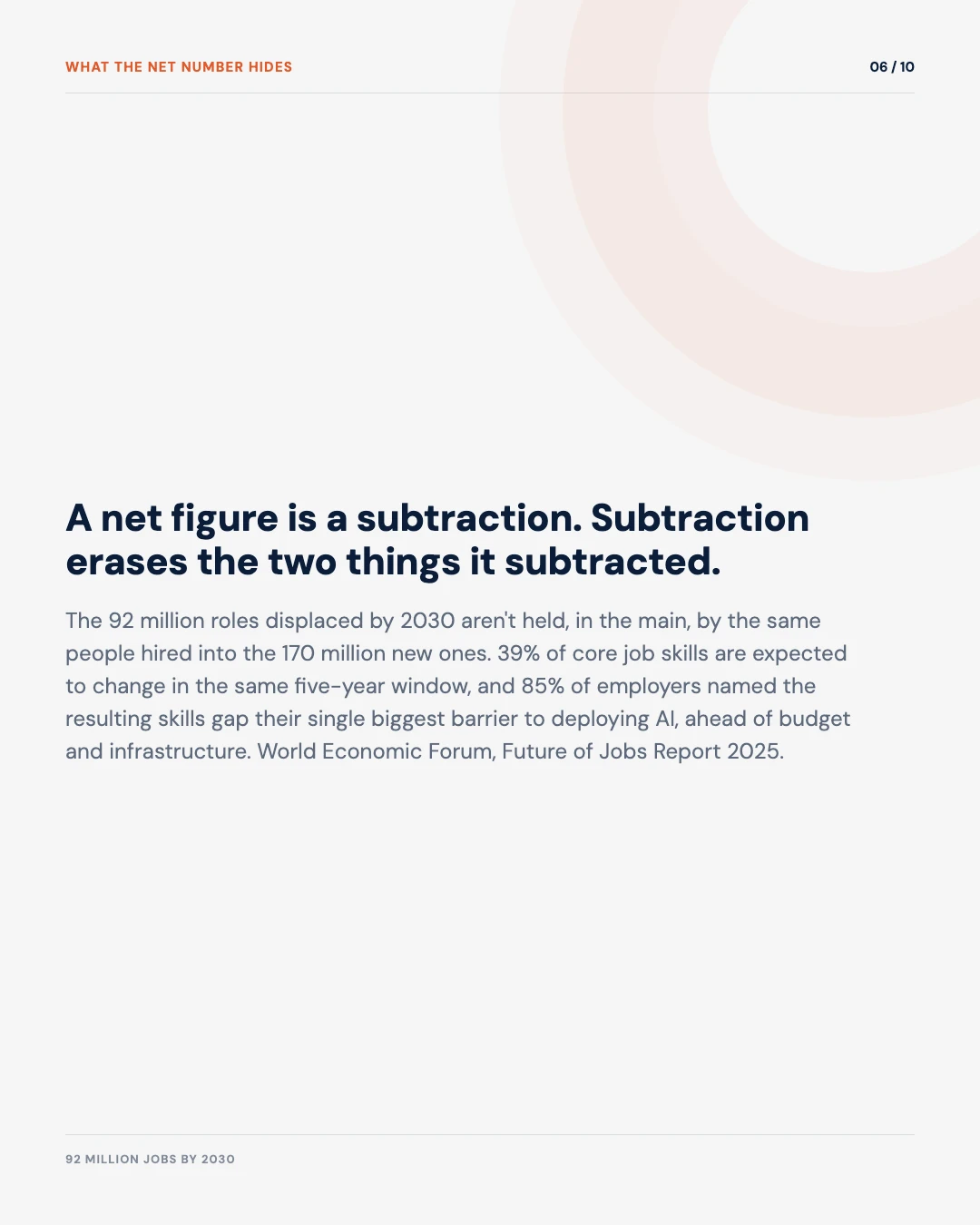
A net figure is a subtraction, and a subtraction erases the two things it subtracted. The 92 million roles WEF expects to disappear by 2030 aren’t held, in the main, by the same people who’ll be hired into the 170 million new ones, and the new roles aren’t guaranteed to open in the same country, industry, or skill band as the ones they’re replacing. The Future of Jobs Report puts a second number underneath the net figure that makes the churn concrete: 39% of the core skills workers use today are expected to change or become outdated within the same five-year window, and 85% of the employers surveyed named the resulting skills gap their single biggest barrier to deploying AI, ahead of budget and ahead of infrastructure.
Goldman Sachs’ 2023 estimate makes the exposure concrete at the level that matters: the task, not the job. Jan Hatzius and his team estimated that roughly two-thirds of current US and European jobs are exposed to some degree of AI automation, and that within those exposed jobs, AI could plausibly take on a quarter to as much as half of the workload, adding up to the equivalent of 300 million full-time jobs globally. Read that carefully. It is not 300 million people fired. It’s 300 million jobs’ worth of tasks that generative AI can plausibly absorb, spread unevenly across a much larger number of people, most of whom keep a job that simply looks different from the one they have now. Tasks versus jobs is the entire distinction, and almost none of the public argument operates at that resolution.
Free tool
AI Readiness Self-Assessment
Five questions, ten minutes. The organisational version of the task-level audit below, applied to a whole business instead of a single role.
The historical base rate is not a permission slip
The optimistic argument, stated at its strongest, is this: technology has never run out of new work to create, no matter how terminal each wave looked in the moment. Autor, Chin, Salomons and Seegmiller went back to 1940 US Census records and traced every job title through 2018. They found that roughly 60% of US employment in 2018 sat in job titles that did not exist in 1940, rising to 74% among professional occupations specifically. Nobody in 1940 could have named “cloud infrastructure engineer” or “UX researcher,” and those categories, invented well after the disruptions that made room for them, now employ tens of millions of people.
US employment in job titles that did not exist in 1940
Share of 2018 US employment in job titles absent from the 1940 census. Source: Autor, Chin, Salomons and Seegmiller, Quarterly Journal of Economics, 2024, using US census records.
That’s real, and it should discount some of the apocalyptic framing. It is not, on closer reading, the reassurance it sounds like, because the same finding says the categories that will absorb this disruption mostly don’t exist yet either. Waiting for someone else to announce what the new jobs will be, then applying, has never once worked as an individual strategy during any of the transitions Autor’s data covers. The people who ended up in the new categories were disproportionately the ones already building toward something adjacent before the category had a name. The base rate favours the economy as a whole. It does not favour any specific person who treats “history says it’ll work out” as a reason to do nothing differently this year.
What doing something about it looks like
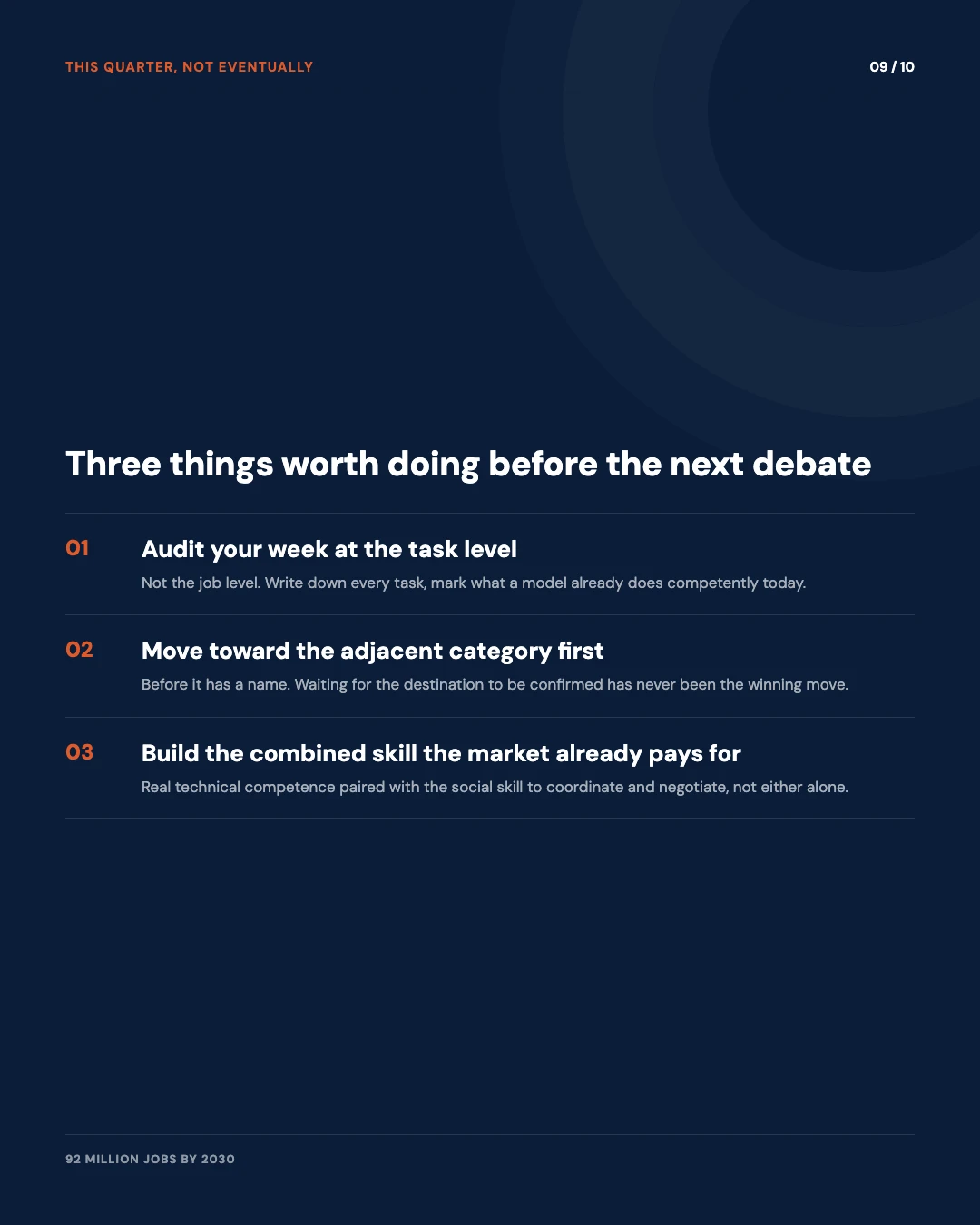
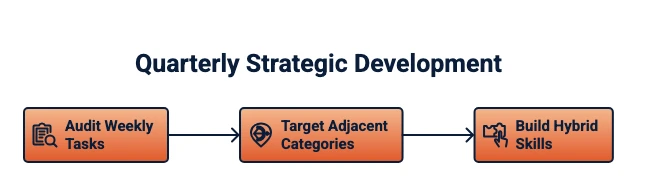
This is the part the debate itself has become a way to avoid. Three things are worth doing this quarter.
First, audit your own week at the task level, not the job level. A job title survives or doesn’t as a bundle of maybe fifteen to thirty actual tasks, and generative AI is exposed to some of them and not others, unevenly, the way Goldman Sachs’ quarter-to-half estimate implies. Write the list. Mark which tasks a model already does competently today. That list is the actual map of what to change, and almost nobody who complains about AI and jobs has written it down for their own role.
Second, move toward the adjacent category before it has a name, rather than waiting for someone to publish a list of “AI-proof jobs.” Autor’s data says the categories that absorb this disruption will look obvious in hindsight and are invisible right now. The people who end up in them are the ones already building skills one step over from where they currently sit.
Third, build the specific combination the labour market already pays for. David Deming’s research on social skills found that jobs requiring high levels of social interaction grew by nearly 12 percentage points as a share of the US labour force between 1980 and 2012, while math-intensive jobs with low social demands, including a lot of STEM roles, shrank by 3.3 points over the same period. The strongest growth of all went to jobs combining high math skill with high social skill. That combination has been paying off for four decades, well before generative AI existed, because it solves a coordination problem, not just an information problem, and coordination is not what generative AI removes.
Where human judgement still holds the line
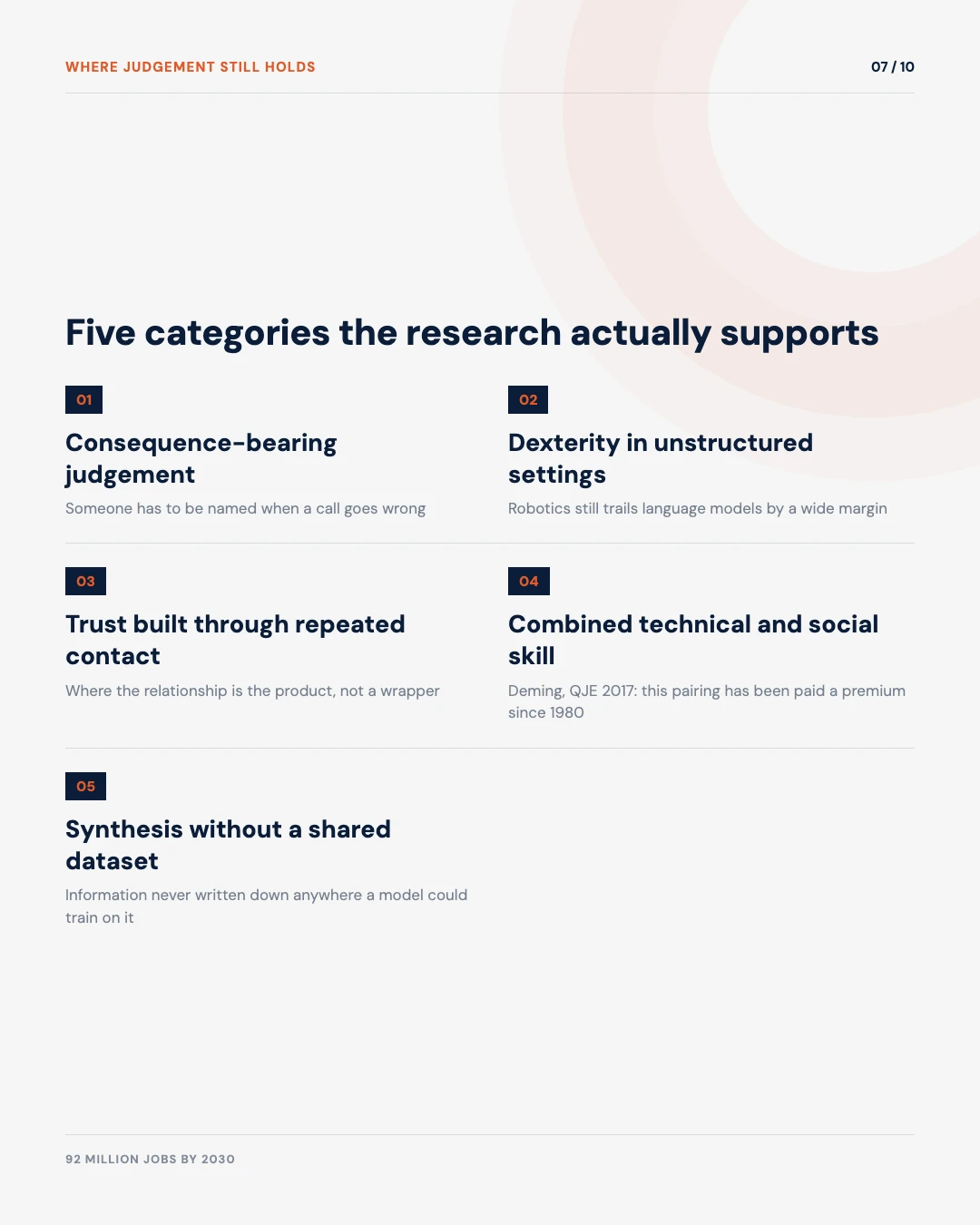
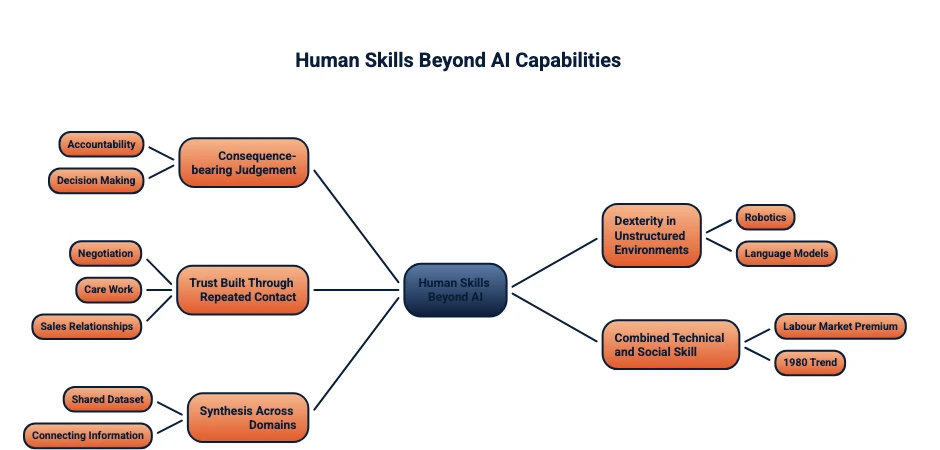
Strip the debate down to what the research supports, and a specific profile shows up.”
| Category | Why it holds up |
|---|---|
| Consequence-bearing judgement | Someone has to be named when a call goes wrong, in a courtroom, a boardroom, or a hospital ward, and a model cannot be that person |
| Dexterity in unstructured physical environments | Robotics remains far behind language models outside repetitive, controlled settings. Real houses, real bodies, real terrain don’t compress into a training set the way text does |
| Trust built through repeated contact | Negotiation, care work, and sales relationships where the relationship is the product, not a wrapper around one |
| Combined technical and social skill | Deming’s finding above: the labour market has paid a growing premium for exactly this pairing since 1980, independent of any AI wave |
| Synthesis across domains without a shared dataset | Connecting an obscure precedent, a client’s actual history, or how a specific regulator behaves, information that was never written down anywhere a model could train on it |
Every row above is testable against your own task list from the previous section. If a task depends on one of these five things, it’s the part of your role least worth worrying about right now.
Free tool
Human-AI Interaction & Decision Quality Dashboard
Row one in practice: benchmark how decision acceptance and accountability shift once AI enters a workflow, against McKinsey, BCG, Stanford HAI and MIT data.
What organisations should measure instead of headcount
If you lead an organisation rather than just a task list, the business case for AI usually starts and ends with headcount removed, and that framing is exactly what turns this into a fight instead of a plan. Every employee who reads a business case built that way correctly hears “you are the line item,” and then has no reason to help the rollout succeed. I built the Return on Employee framework for this reason specifically: it measures AI’s value through the increase in productive capacity per person instead of the headcount subtracted, which is the same net-versus-churn distinction from earlier in this piece, just applied at the organisational level instead of the individual one.
The actual choice
None of this requires believing AI-driven job loss isn’t real. It is real: the 92 million and the 300 million are both describing genuine disruption to real people, and no amount of optimism about the net number changes that for the specific person whose role gets cut. It also doesn’t require despair. Disruption on this scale has happened before, and the aggregate math has worked out before, three out of four professional jobs alive today didn’t exist within one working lifetime of the last comparable shift.
What it requires is the part the public conversation skips: the specific, unglamorous work of auditing your own exposure at the task level, moving toward the adjacent category before it has a name, and building the combination of skill the data already says gets paid. Arguing about whether the net number is good news or bad news changes nothing about your own position inside it. Neither does reading one more take on it. The list above does, and only if you work through it.
Evidence & Methodology
The historical numbers below are solid. The forward-looking ones are somebody’s best estimate, including the one at the bottom that’s mine.
| Claim | Source | Grade |
|---|---|---|
| WEF expects 92 million jobs displaced and 170 million created by 2030, a net of +78 million | World Economic Forum, Future of Jobs Report 2025, survey of 1,000+ employers | Forecast |
| Roughly 300 million full-time jobs’ worth of tasks are exposed to generative AI automation globally | Goldman Sachs, 2023 | Estimate |
| 60% of US employment in 2018 sat in job titles that did not exist in 1940, rising to 74% for professional occupations | Autor, Chin, Salomons & Seegmiller, QJE / NBER 2024, using actual census records | Measured |
| Human judgement still holds an advantage in five specific categories: consequence-bearing decisions, unstructured physical work, repeated-contact trust, combined technical-social skill, and cross-domain synthesis | My own synthesis of the research above | My framework |
Sources
- World Economic Forum. (2025, January). Future of Jobs Report 2025.
- World Economic Forum. (2025, January). Future of Jobs Report 2025: 78 million new job opportunities by 2030 but urgent upskilling needed. Press release.
- Briggs, J., & Kodnani, D. (2023, March 26). The potentially large effects of artificial intelligence on economic growth. Goldman Sachs Global Investment Research.
- Autor, D., Chin, C., Salomons, A., & Seegmiller, B. (2024). New frontiers: The origins and content of new work, 1940–2018. Quarterly Journal of Economics / NBER Working Paper 30389.
- Deming, D. J. (2017). The growing importance of social skills in the labor market. Quarterly Journal of Economics / NBER Working Paper 21473.
The AI Governance & ROI Executive Programme walks through exactly this shift at the organisational level, task-level exposure mapping and the Return on Employee framework, before the headcount conversation becomes the only one your team hears. Details are on the workshops page.
Was this useful?