
Listen to this article
Jump to a section
In this article
Executive Summary
Agentic AI is a big topic. But it only has six moving parts. Once you know the six parts, you can ask sharp questions in any meeting about it, even if you have never written a line of code. This guide explains each part in plain words, then tells you what to worry about as a leader, and what you can safely ignore.
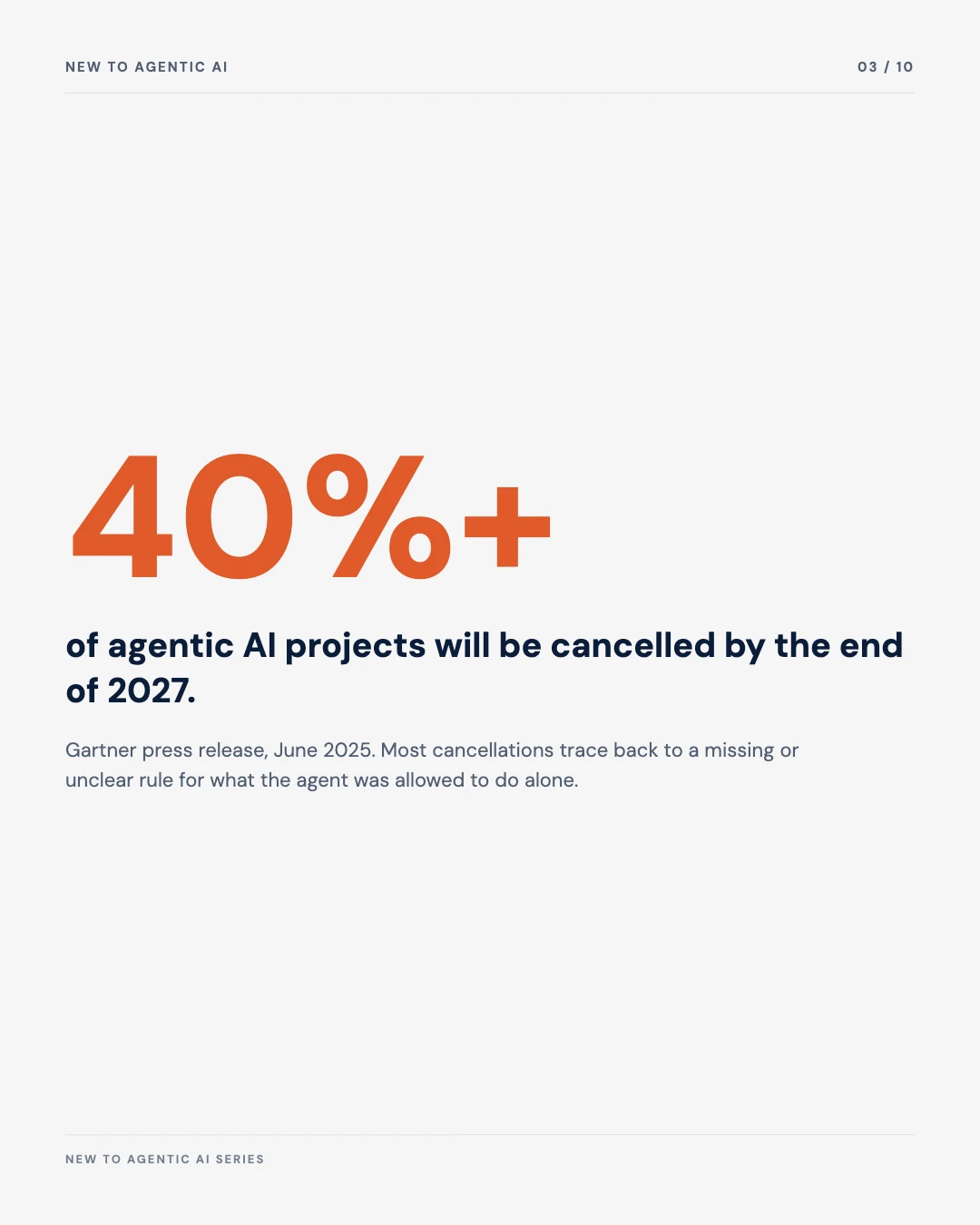
40%+
of agentic AI projects will be cancelled by end of 2027, Gartner press release, June 2025
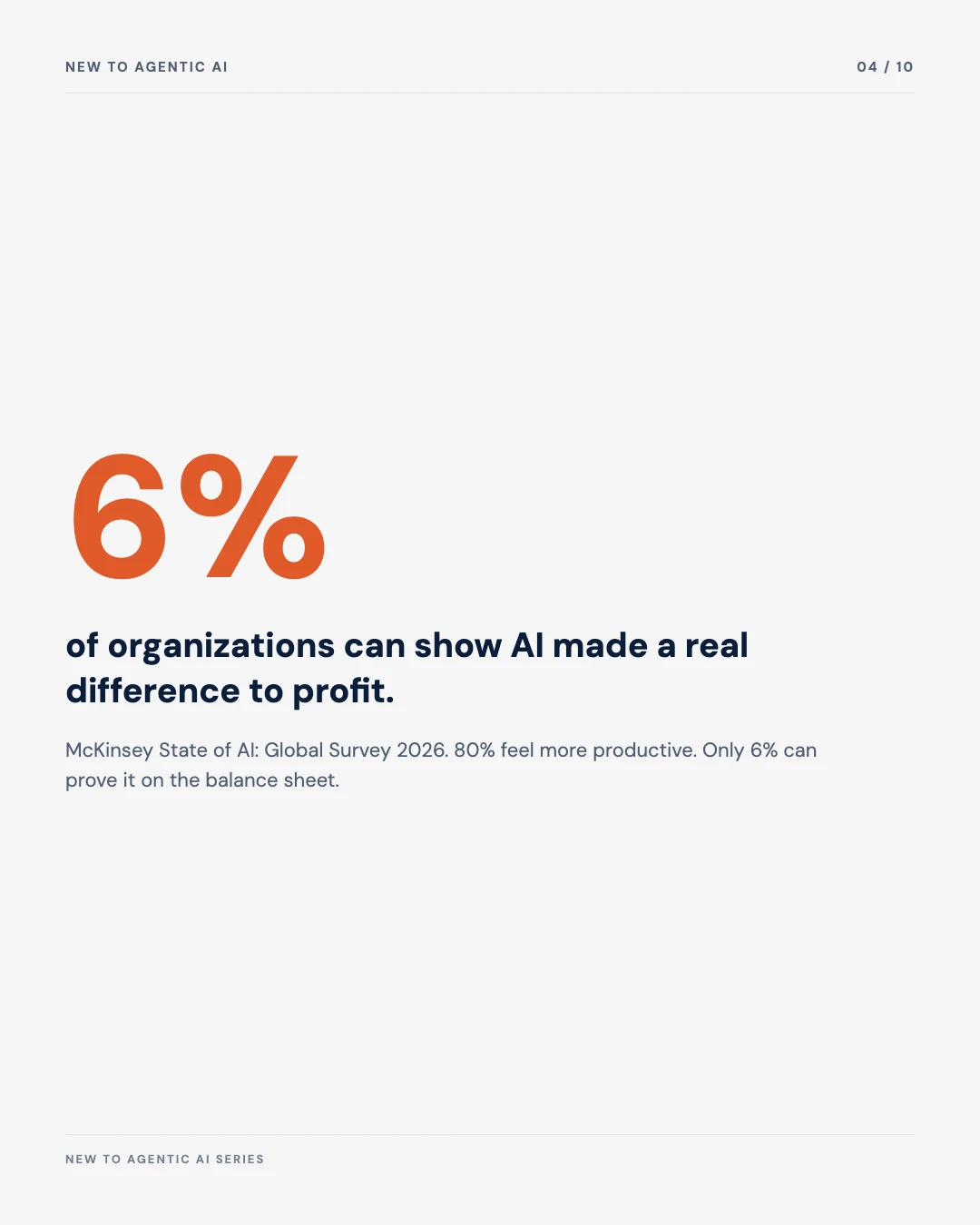
6%
of organizations McKinsey classifies as AI “high performers” with significant EBIT impact, State of AI: Global Survey 2026
17% → 60%+
of organizations that had deployed an AI agent versus planned to within two years, Gartner 2026 CIO Survey
Core conclusions
- An agent is not a smarter chatbot. A chatbot talks. An agent acts, on its own, across your real business systems.
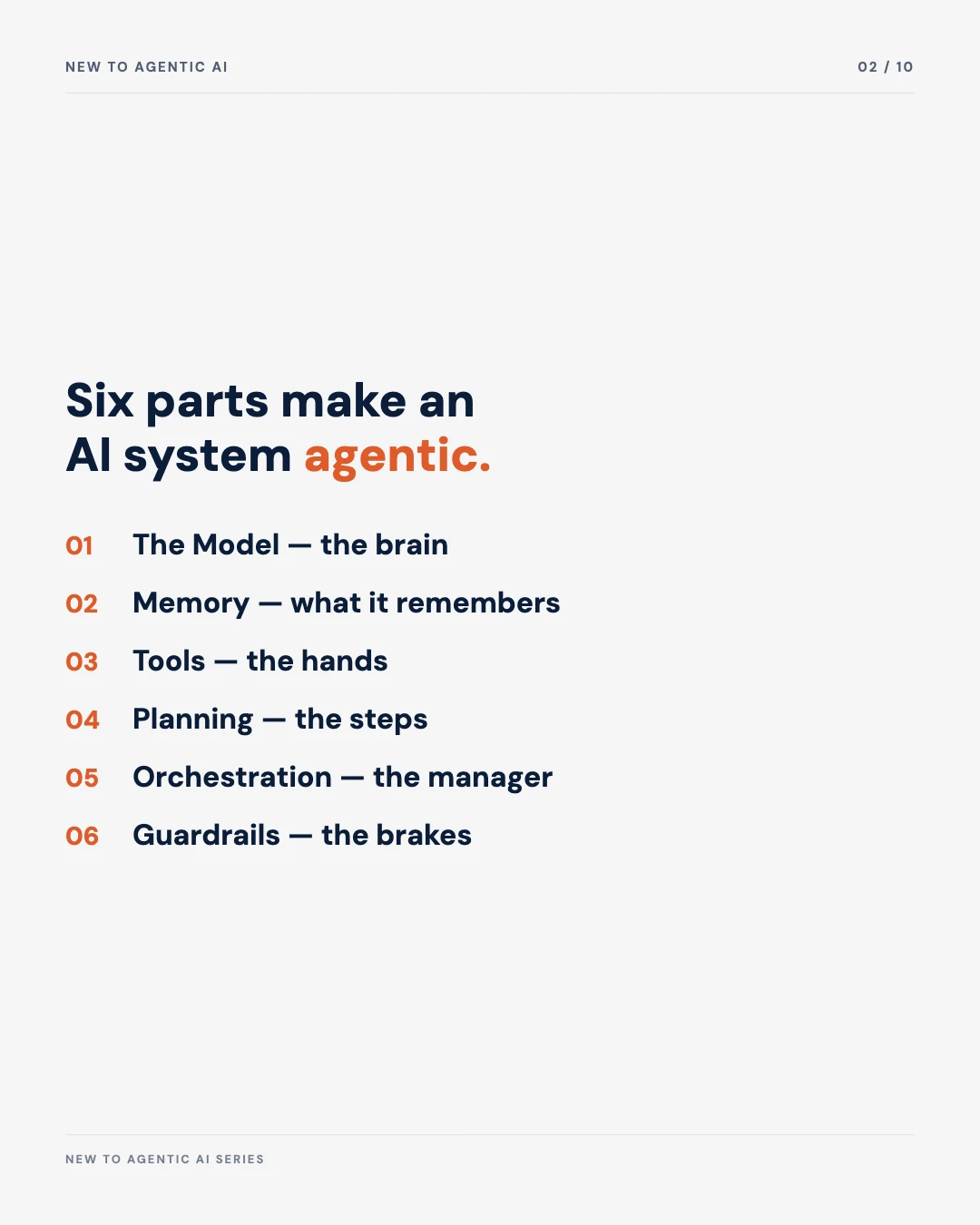
- Six parts make an AI “agentic”: the brain, the memory, the tools, the plan, the manager, and the brakes. Miss any one of these and the project usually stalls or fails.
- Your job as a leader is not to understand the code. It is to decide which of the six parts your company controls, and which one it is missing.
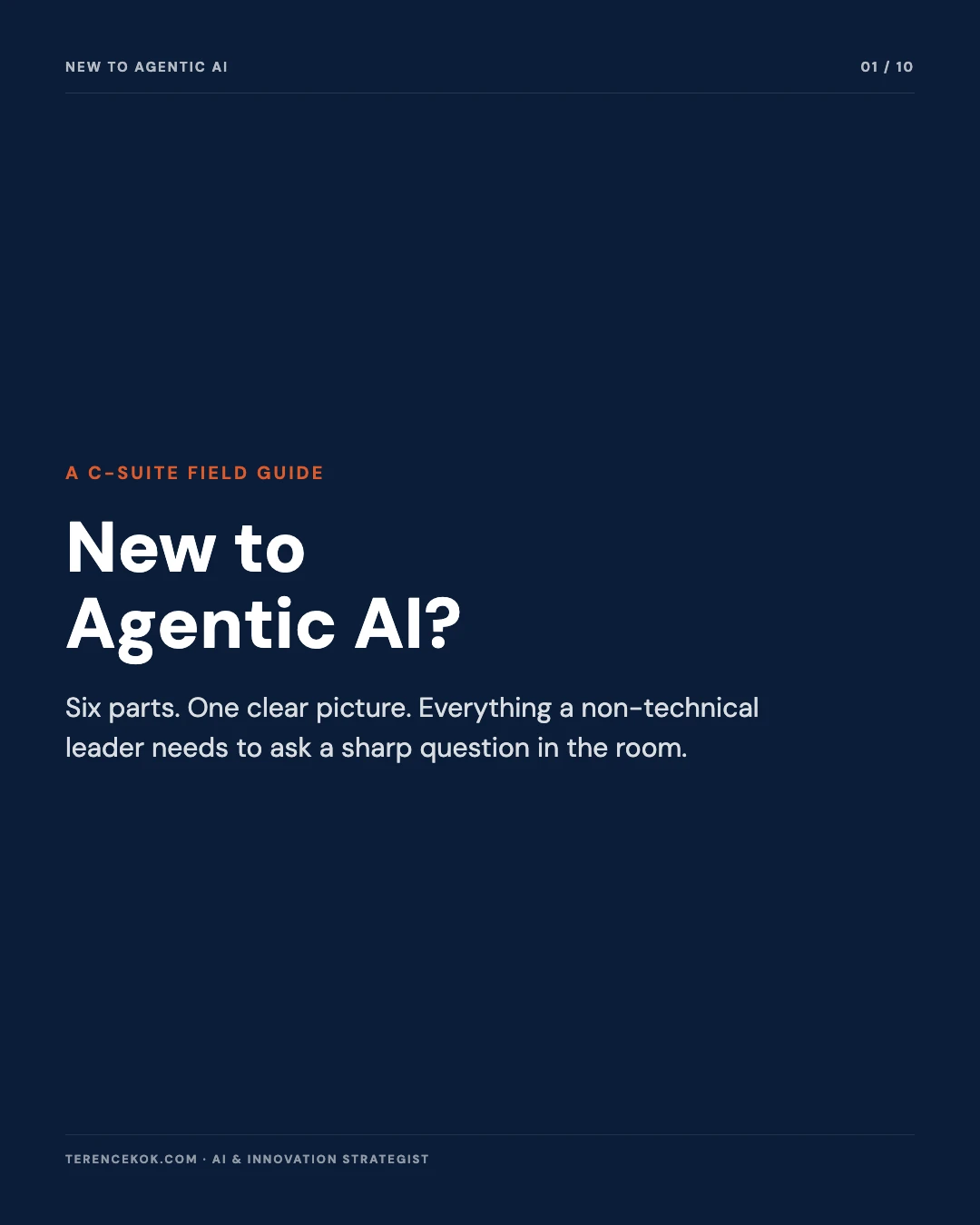
The six-part picture, ten slides
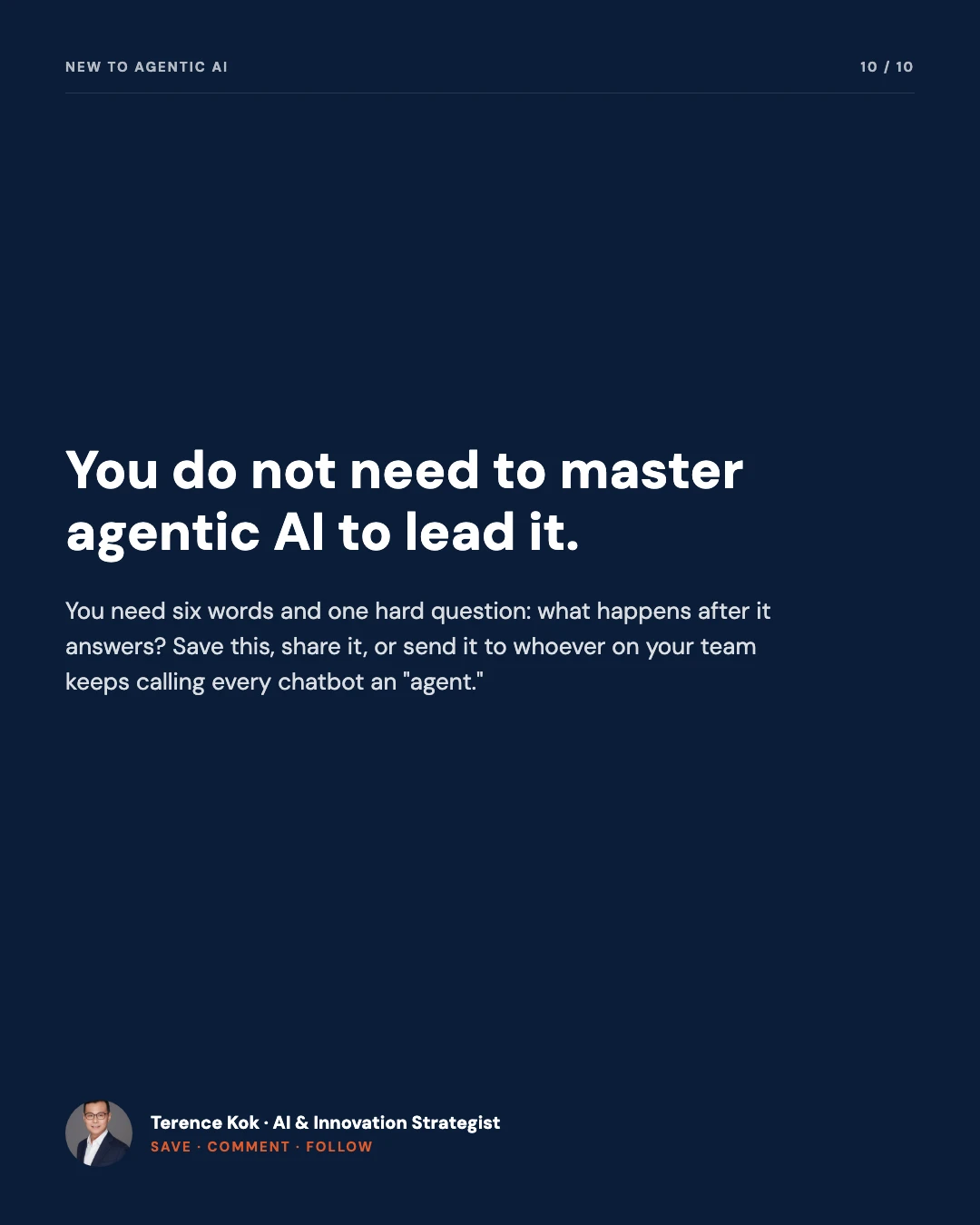
Save it, share it, or send it to whoever on your team keeps calling every chatbot an “agent.”
Why “agentic AI” sounds confusing
Every vendor now calls their product “agentic.” A chatbot with a new button. A workflow tool with a new label. A spreadsheet macro with a new name. This is not your fault, and it is not a sign that you are behind. It is a sign that a real, useful word got stretched to sell software.
The real meaning is simple. Agentic AI means an AI system that can plan a set of steps, take those steps on its own, check its own results, and adjust when something goes wrong. It does not just answer your question and stop. It keeps going until the goal is done, or until it hits a wall it cannot cross alone.
That is the whole definition. Everything else in this guide is just the six parts that make that definition possible.
The one-line test for real agentic AI
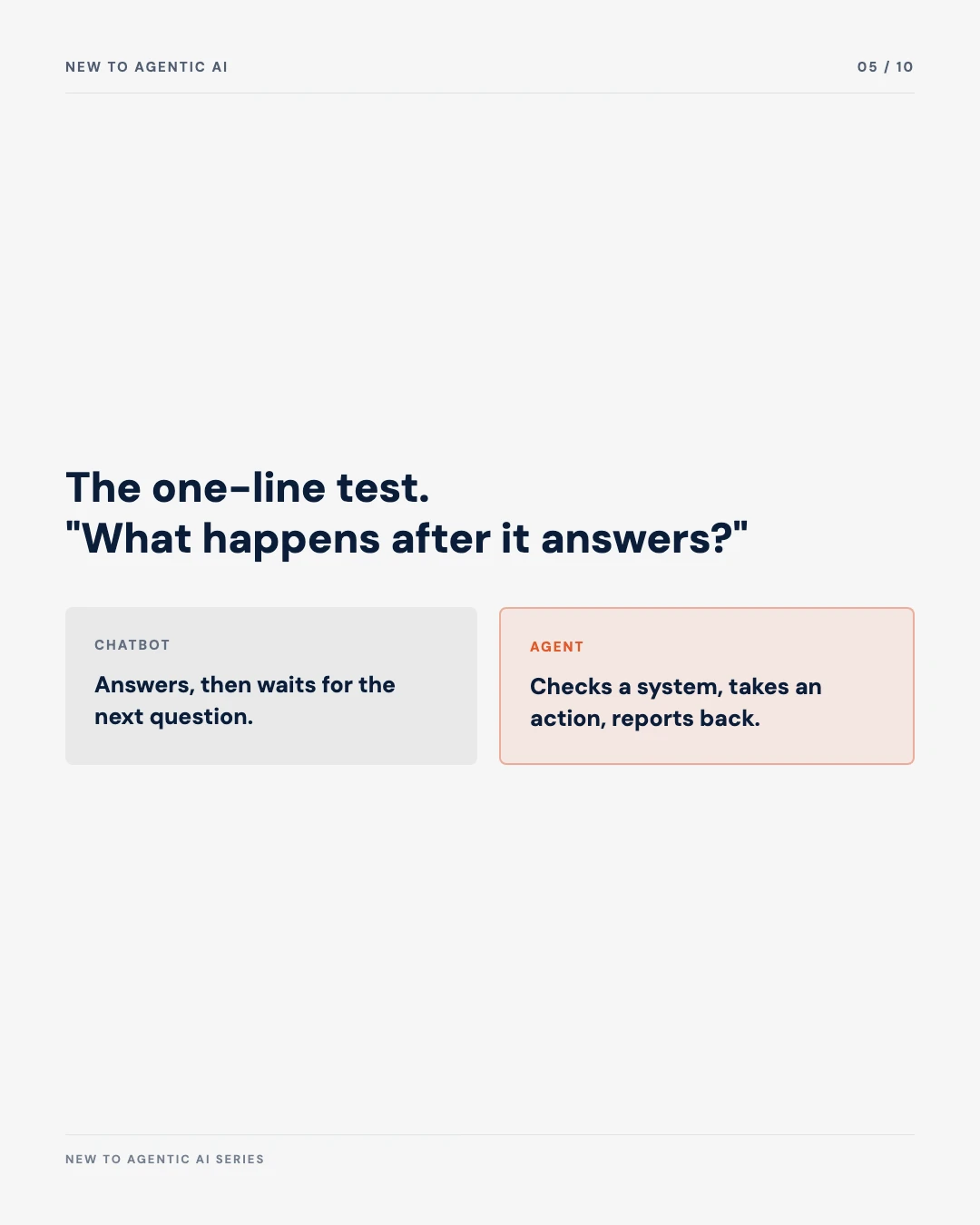
Before you read the six parts, here is a fast test you can use in any vendor pitch or internal proposal. Ask one question: “What happens after it answers?”
If the answer is “it waits for the next question,” you are looking at a chatbot. Useful, but not agentic. If the answer is “it checks a system, takes an action, and reports back,” you are looking at something agentic. This single question cuts through almost all of the marketing noise in this space.
| You ask | A chatbot does | An agent does |
|---|---|---|
| ”Draft a reply to this customer” | Writes the reply, then stops and waits | Writes the reply, checks the customer’s order history first, flags anything unusual |
| ”Is this invoice correct?” | Tells you what looks off, in words | Opens the purchase order, compares the numbers, flags the mismatch, drafts a note to finance |
| ”Plan next week’s shipments” | Suggests an approach in a paragraph | Checks stock levels, checks carrier capacity, builds the schedule, and asks you to approve it |
The six parts of every agentic AI system
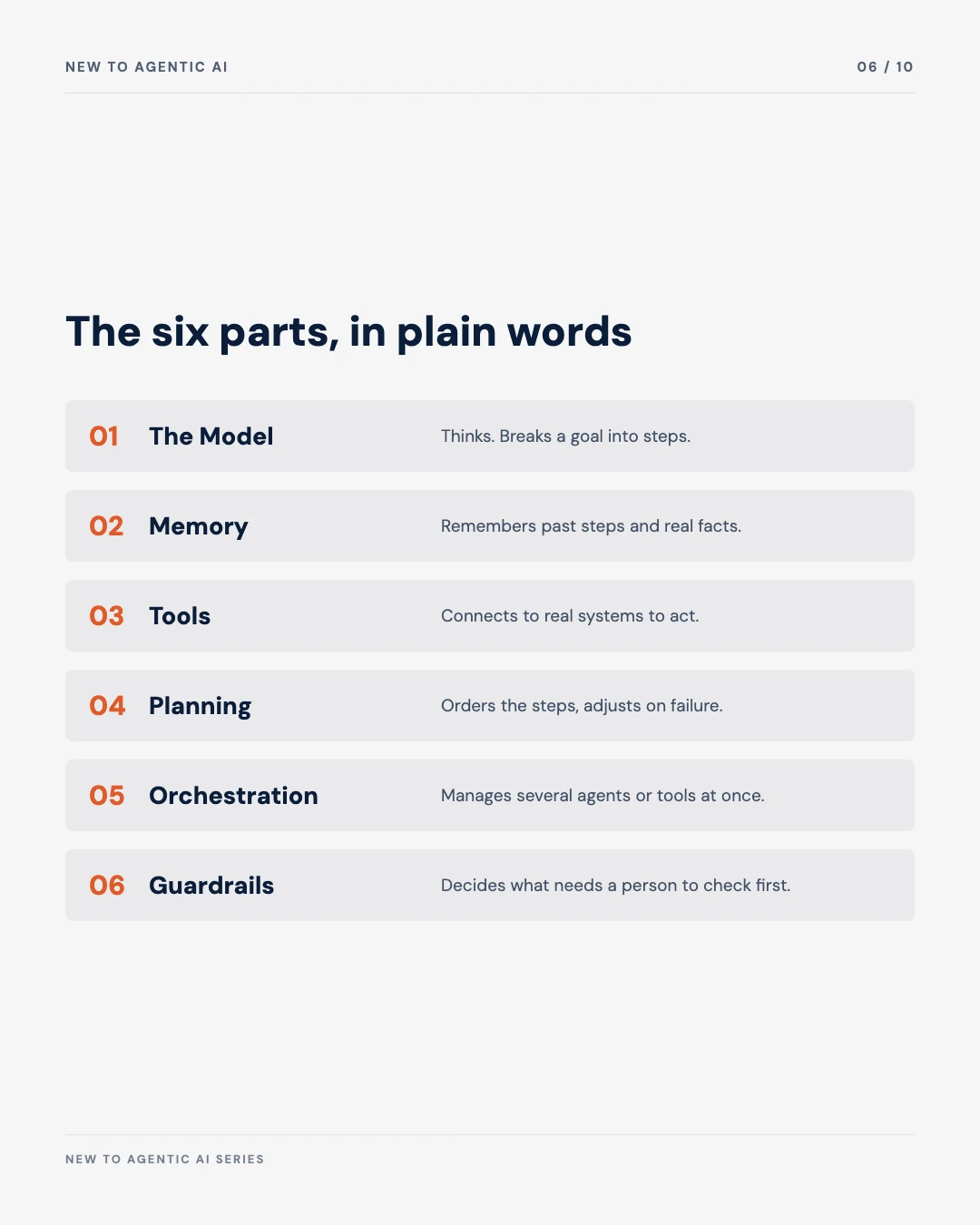
Strip away the marketing, and every agentic AI system, no matter which vendor sells it, is built from the same six parts. Learn these six, and you can ask a sharp question about any agent project your company is considering.

01 · The Brain
The Model
This is the part that thinks. It is a large language model, the same kind of technology behind ChatGPT or Claude. It reads your goal, breaks it into steps, and decides what to do next at each step. On its own, the model can only think and write. It cannot touch anything in your business. Everything else on this list exists to give the model a body to act with. Look up the full term in the AI glossary.

02 · The Memory
Memory
An agent needs to remember two things: what it already did in this task, and what your company knows. Short-term memory tracks the steps taken so far in one task, so the agent does not repeat itself or forget what it already checked. Long-term memory connects the agent to your real documents, prices, and policies, so it answers from facts instead of a guess. Without memory, an agent restarts from zero at every step, which is slow, expensive, and unreliable.

03 · The Hands
Tools
This is what turns thinking into action. A tool is a connection to a real system: your email, your database, your calendar, your finance software. Without tools, an agent can only talk about a task. With tools, it can do the task, sending the email, updating the record, booking the meeting. This is also where the risk sits. The more systems an agent can touch, the more damage one wrong step can cause, and the faster it can cause it.

04 · The Plan
Planning
This is the step that separates an agent from a simple tool. Given one goal, the agent breaks it into a sequence of smaller steps, in an order that makes sense. Check the invoice, then compare it to the order, then flag the mismatch, then draft the note. If one step fails or returns something unexpected, a good agent revises the plan instead of freezing or repeating the same failed step. A weak agent either gives up too early or repeats a broken step forever. Both are common failure modes worth watching for in a pilot.
05 · The Manager
Orchestration
Once a task needs more than one agent, or one agent using several tools in the right order, something has to manage the traffic. That is orchestration: the layer that decides which agent or tool runs next, passes results between steps, and stops the process cleanly when the goal is met. Small projects often skip this and get away with it. Once a company runs several agents across different teams, skipping this layer is exactly where things start to break in ways nobody planned for.

06 · The Brakes
Guardrails And Human Review
This is the part that decides what the agent is allowed to do on its own, and what needs a person to approve first. A clear rule, written on one page, not a long policy nobody reads. Send an internal draft on its own, fine. Send money, change a customer contract, or delete a record, stop and ask a person first. Every serious agentic AI failure you have read about in the news traces back to a missing or unclear version of this one part.
Most vendor pitches only talk about the first part, the model. That is the part that sounds impressive in a demo. The other five parts are where a real project either holds together or falls apart, and they rarely get mentioned until something goes wrong.
Free tool
AI Trust, Risk & Governance Dashboard
Score where your guardrails stand today, before you hand an agent access to a real system.
Why the brakes matter more than the brain
Most first-time buyers spend all their attention on part one, the model. Which one is smartest. Which one scores highest on which test. That attention is misplaced. Nearly every agent on the market today uses a model that is smart enough for a well-scoped first task. The part that decides whether your project succeeds is part six, the brakes.
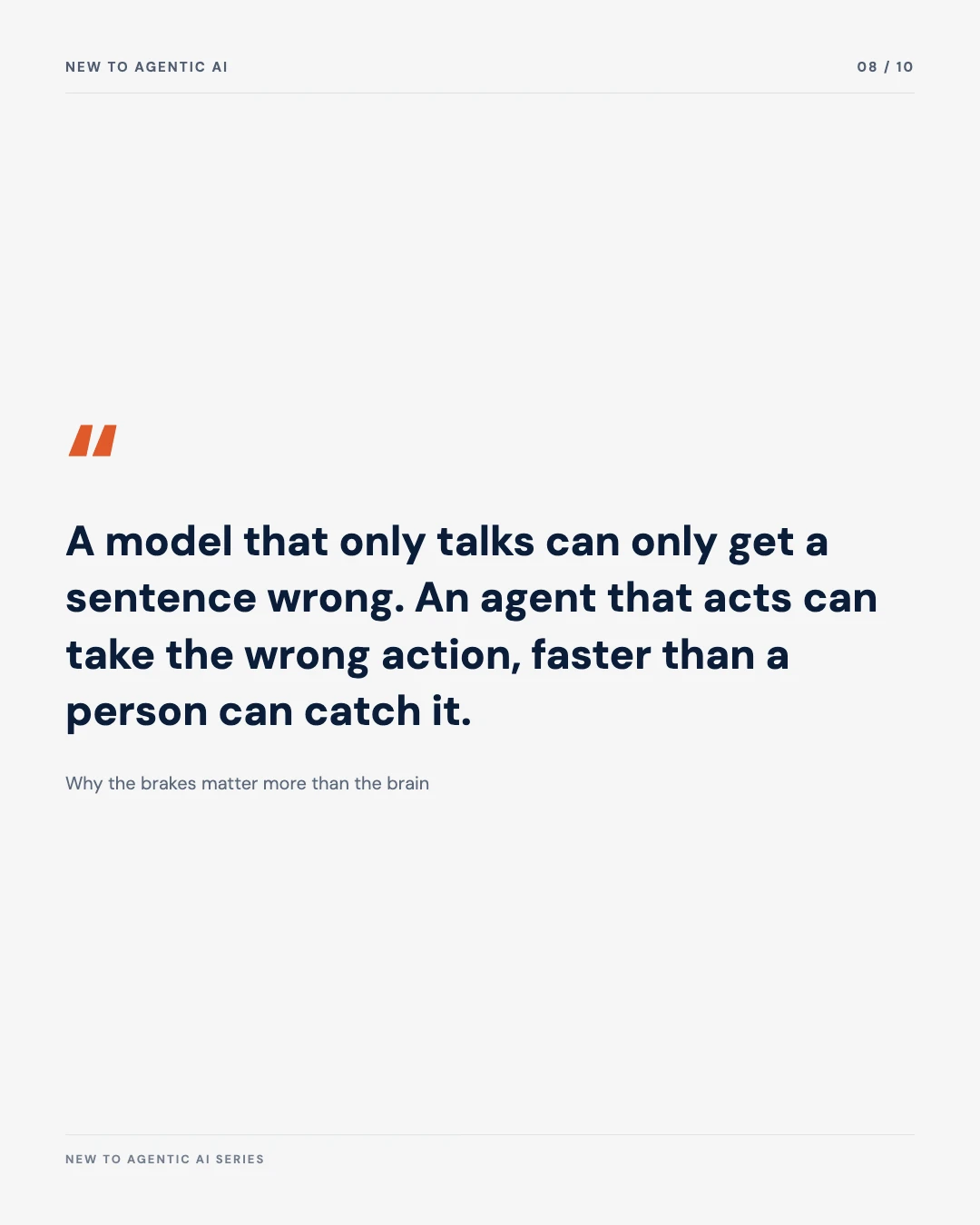
A model that only talks can only get a sentence wrong. An agent that acts can take the wrong action, in a real system, faster than a person can catch it and undo it. That gap between talking and acting is exactly why Gartner expects more than 40% of agentic AI projects to be cancelled by the end of 2027. Most of those cancellations will not be because the model was not smart enough. They will be because nobody built a clear brake before the agent was given the keys.
This is also why so many companies feel AI helps them personally, but cannot show it helped the company’s profits. McKinsey’s 2026 survey found 80% of organizations see individual productivity gains from AI, but only 6% can show a significant profit impact. A person using a chatbot carefully is not the same risk as an agent acting inside your systems without a clear brake. The gap between those two numbers is largely the gap between part one and part six.
The three levels of agentic AI, from safest to riskiest
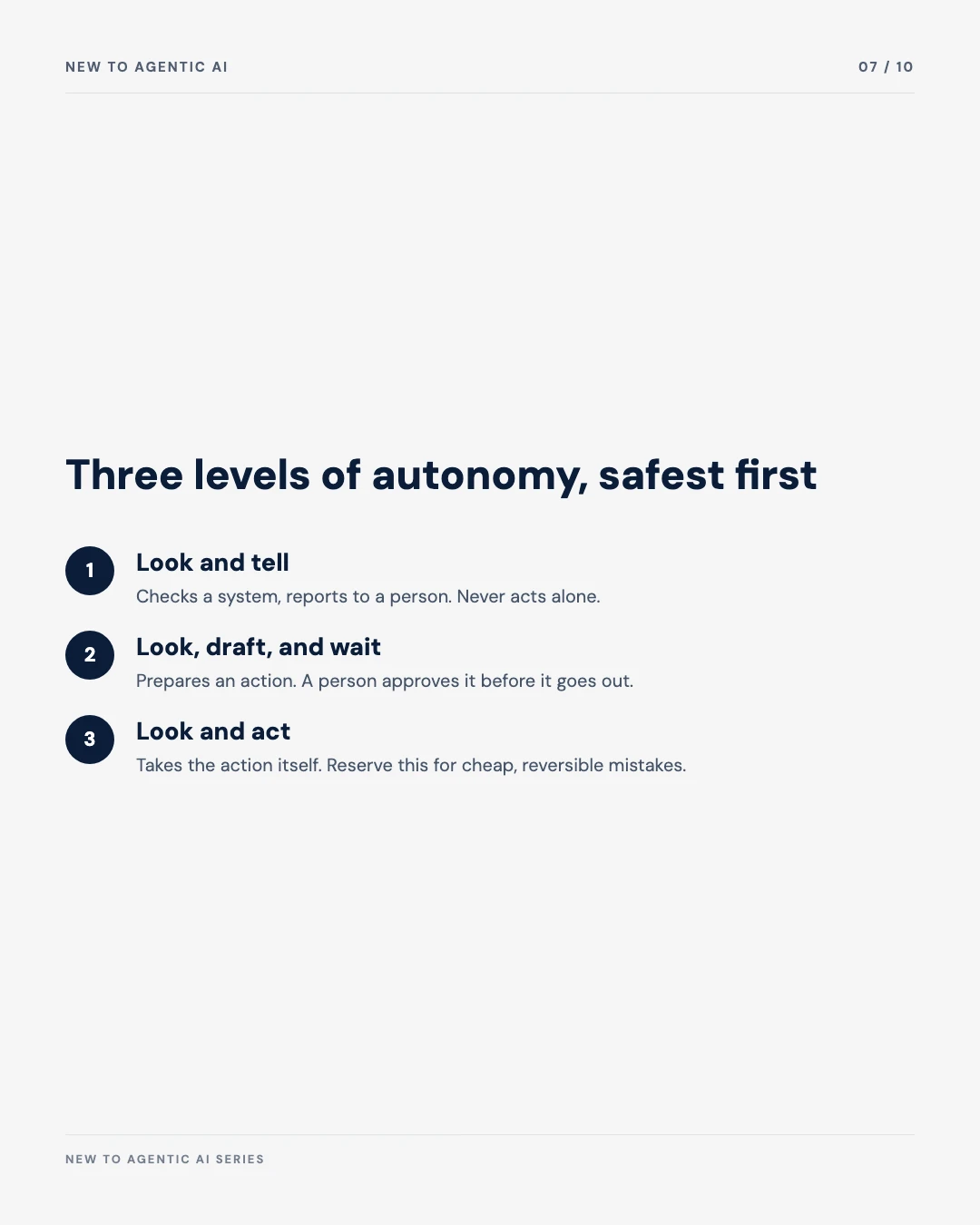
Not every agentic AI project carries the same risk. It helps to think in three levels, from the safest starting point to the one that needs the most caution.
- Look and tell. The agent checks a system and reports back to a person. It never takes an action on its own. This is the safest place to start, and the fastest to get approved.
- Look, draft, and wait. The agent checks a system and prepares an action, an email, an update, a report, but a person must approve it before it goes out. Most successful first projects live here.
- Look and act. The agent checks a system and takes the action itself, no person in the loop. This level should only be used for tasks where a mistake is cheap and easy to reverse, never for anything touching money, contracts, or customer-facing decisions, until the first two levels have proven themselves for months.
The mistake most companies make is starting at level three because it sounds more impressive in a board meeting. The companies that see a return start at level one, earn their way to level two, and only reach level three on a task that has already proven itself safe at the lower levels.
Free tool
AI Use Case Prioritisation Matrix
Score your first agent idea and see which of the three levels it belongs at.
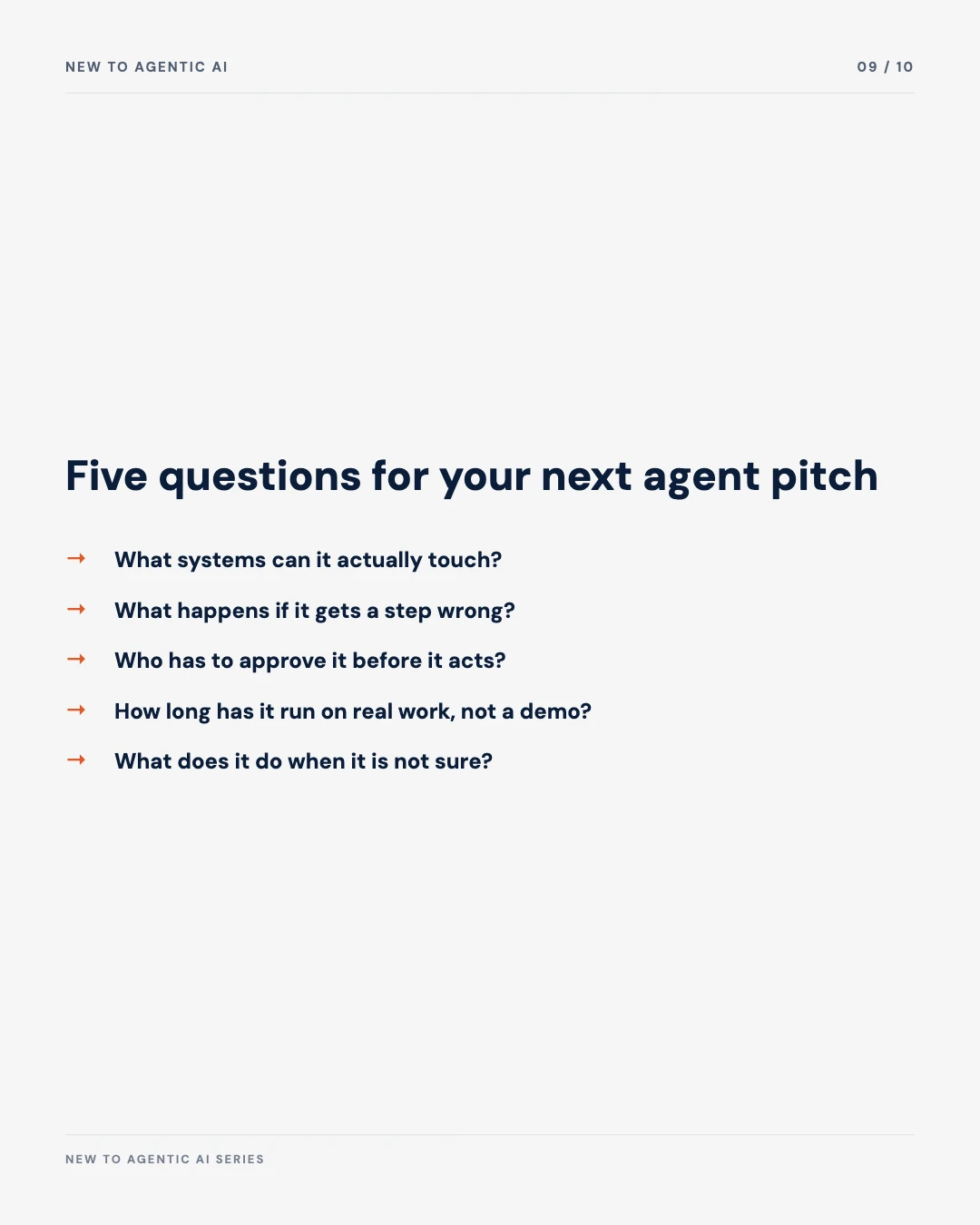
The five questions worth asking in your next agentic AI pitch
You do not need to understand the code behind any of this. You need to ask five questions, in this order, the next time someone brings you an agentic AI proposal.
| Ask this | Because it tells you |
|---|---|
| ”What systems can it actually touch?” | This is the real list of tools, and the real size of the risk, no matter how the pitch is worded |
| ”What happens if it gets a step wrong?” | This tells you whether there is a real plan for failure, or just hope |
| ”Who has to approve it before it acts?” | This tells you which of the three risk levels above you are being asked to approve |
| ”How long has this run on real work?” | A few days of testing is not proof. A few months on real tasks is |
| ”What does it do when it is not sure?” | A good agent stops and asks. A bad one guesses and keeps going |
If a vendor or an internal team cannot answer all five clearly, that is not a reason to say no automatically. It is a reason to slow down and ask again before you approve anything that touches a real system.
Where to go next on this site
This guide is short on purpose: six parts, one clear picture. Once you know what you need next, here is exactly where to find it.
Learn the words
New terms like agent, orchestration, and guardrails, explained in plain language.
Check your readiness
A quick quiz that scores where your company stands today.
Score your guardrails
See how your review points and policies stack up before you approve an agent project.
Go deeper on agentic AI
The full topic hub, with every post on agents, use cases, and risk in one place.
Train your team
A half-day programme for your leaders and managers.
Talk to me directly
Get a second opinion on your first agentic AI project before you commit.
Nine posts worth reading next
This guide covers the six parts of agentic AI and how to talk about it in a boardroom. It does not cover every detail. These nine posts go deeper into the pieces that matter most once you are deciding whether to build one.

New to AI? A Step-by-Step Guide to Starting Your Enterprise Transformation
This guide assumes you already understand the basics of AI. If "LLM" and "RAG" are still new words to you, start with this one first, then come back.

Which Critical Tasks Are Actually Suitable for Agentic AI
Goes deeper on the three risk levels in this guide. A clear test for which tasks belong at level one, two, or three before you commit any budget.

Eight Practical Types of AI Agents Emerging in Real Systems
Goes deeper on part three, tools, and part four, planning. Eight real patterns of what agents do in production.

The Foundations of Dependable Agentic AI
The deeper engineering version of the six parts in this guide, written for the technical lead on your five-person team.

The 2026 Shift: From AI Experimentation to Autonomous Systems
Why more companies are moving past level one, look and tell, into level two and three this year, and what that shift looks like.

Agentic AI: The Most Common Use Cases Being Deployed
A survey of the actual tasks companies are handing to agents right now, sorted by how common and how proven each one is.

How to Build Your First AI Agent at Work: A Simple, Step-by-Step Guide
The direct next step after this guide. A plain-language walk-through of building your first real agent, level one, the safe way.

Rogue Agents and Containment When Detection Fails
The deeper version of part six, the brakes. What to do when an agent has already gone off script, and detection alone is not enough.

From Human-in-the-Loop to AI-on-the-Loop: Redesigning Oversight
Goes deeper on the three risk levels from a different angle: how oversight itself needs to change shape as an agent earns more trust.
Evidence & Methodology
Two of the numbers below come from real surveys. One is a forecast. The six-part framework itself is mine, built from watching agent projects up close, not pulled from a textbook. Here is which is which.
| Claim | Source | Grade |
|---|---|---|
| 40%+ of agentic AI projects will be cancelled by end of 2027 | Gartner press release, June 2025 | Forecast |
| Only 6% of organizations show a significant profit impact from AI, despite 80% seeing personal productivity gains | McKinsey’s State of AI Global Survey 2026, 1,719 respondents | Measured |
| Organizations planning to deploy an AI agent within two years jumped from 17% to over 60% | Gartner’s 2026 CIO and Technology Executive Survey | Measured |
| The six parts, model, memory, tools, planning, orchestration, guardrails, are what decide whether an agent project holds together | My own framework, built from advisory work on agent projects | My framework |
Sources
- Gartner. (2025, June 25). Gartner predicts over 40% of agentic AI projects will be canceled by end of 2027 [Press release].
- Gartner. (2026). Hype Cycle for Agentic AI, 2026, citing the 2026 CIO and Technology Executive Survey.
- The Register. (2026, August 25). McKinsey Says Enterprise AI Is Finally “On the Road to ROI”, citing McKinsey’s State of AI: Global Survey 2026 (1,719 respondents, 97 countries).
Still not sure whether your first project should be level one, two, or three? That is exactly the conversation my consulting work begins with.
Was this useful?