

Listen to this article
Jump to a section
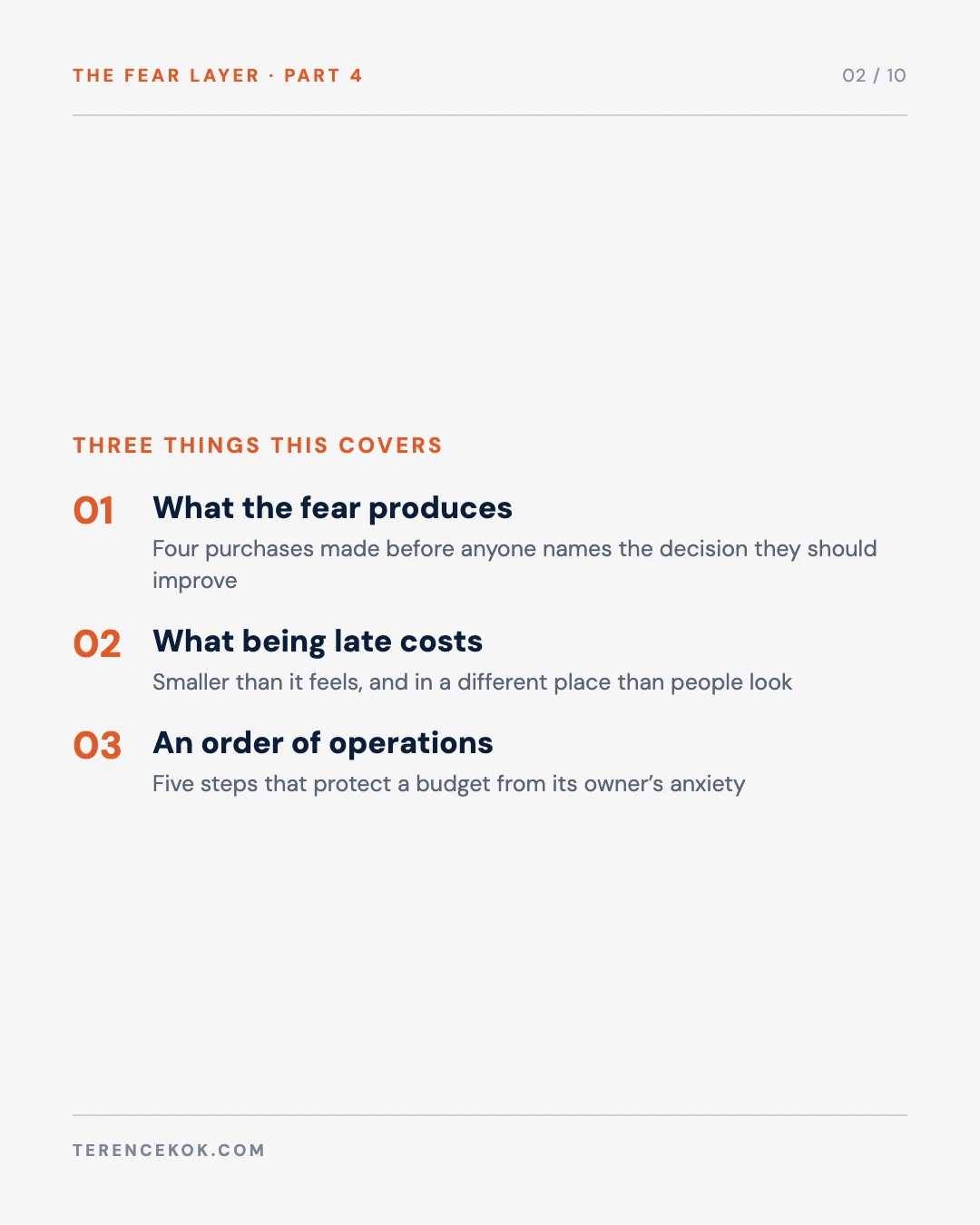
In this article
Executive Summary
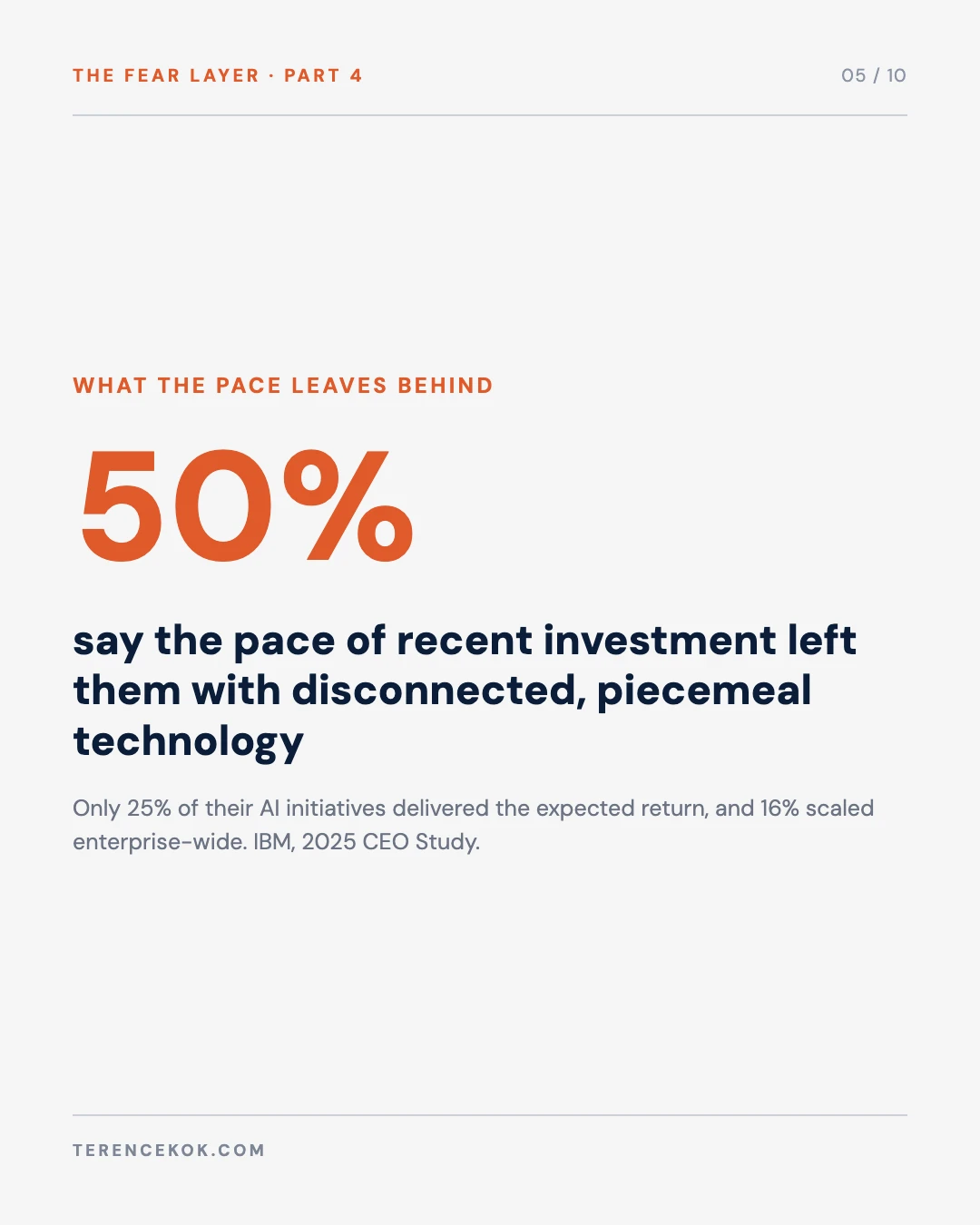
Being late is the dominant fear among mid-market leaders right now, and it has a deadline attached: a competitor’s announcement, a vendor’s quarter end, a board meeting next month. The fear produces purchases. In IBM’s 2025 survey of 2,000 CEOs, 64% said the risk of falling behind had driven them to invest in some technologies before they understood the value, and half said the pace of recent investment had left them with disconnected, piecemeal technology. Being late is real, but it costs far less than buying the wrong thing, and the parts of AI that cannot be bought quickly later are the parts anxiety skips.
Core conclusions
- Anxiety buys products. It skips the decision the product was meant to improve, which is the only thing that makes the spend measurable.
- A late buyer pays less for a more mature product and learns from the early buyers’ cancellations. What a late buyer cannot catch up on quickly is data, ownership and governance, and none of those come in a box.
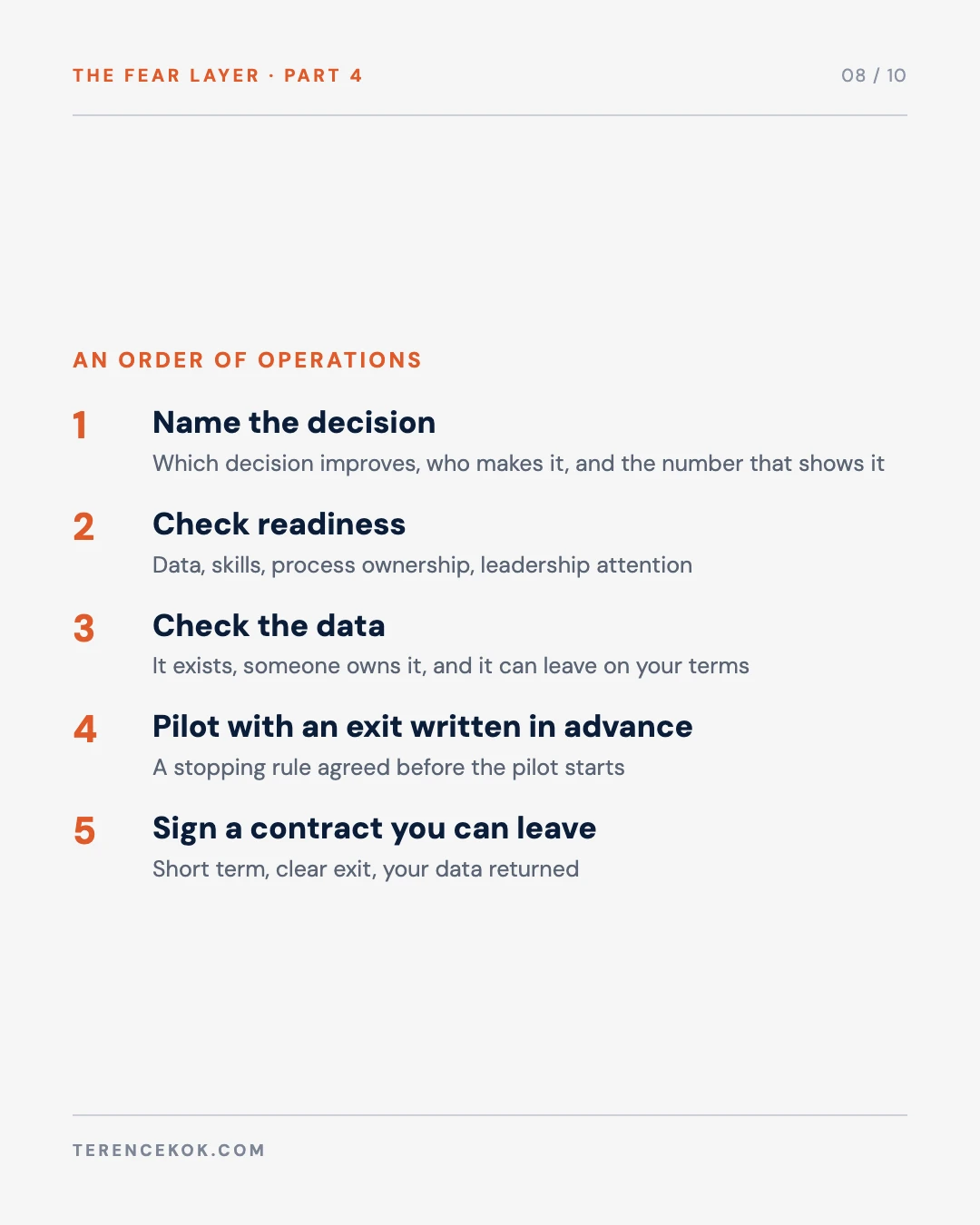
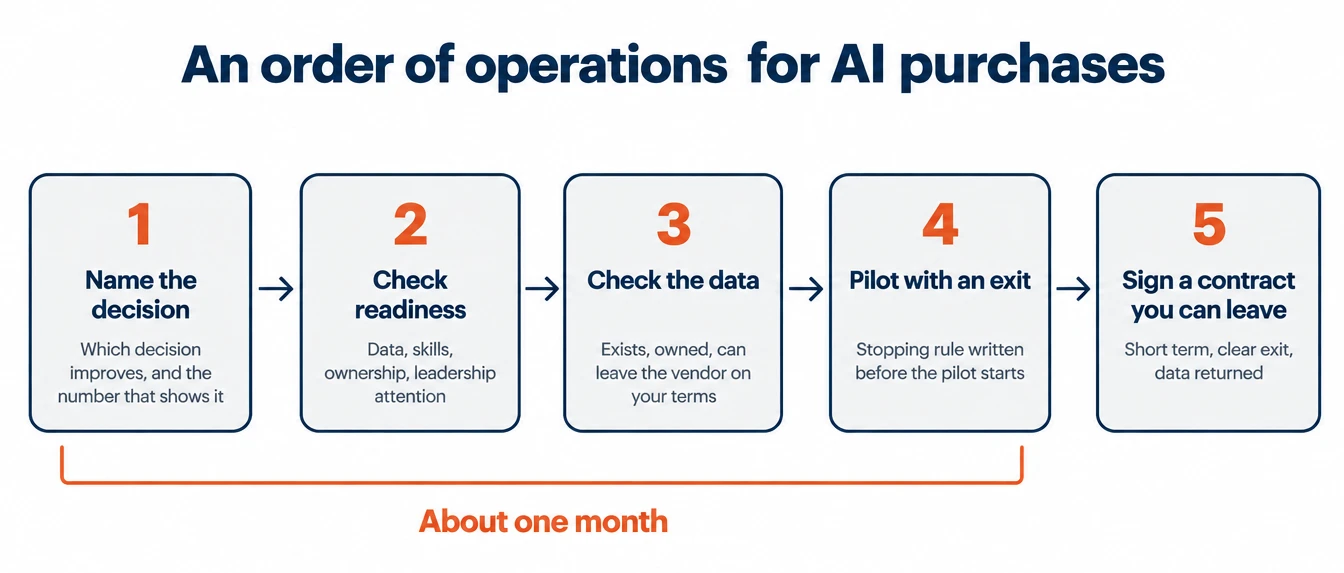
- Five steps in a fixed order protect a budget from its owner’s anxiety: name the decision, check readiness, check the data, run a pilot with an exit written in advance, then sign a contract you can leave.
The argument, in ten slides
Save it, or send it to whoever is holding a purchase order that has to be signed this week.
The fear arrives with a deadline attached
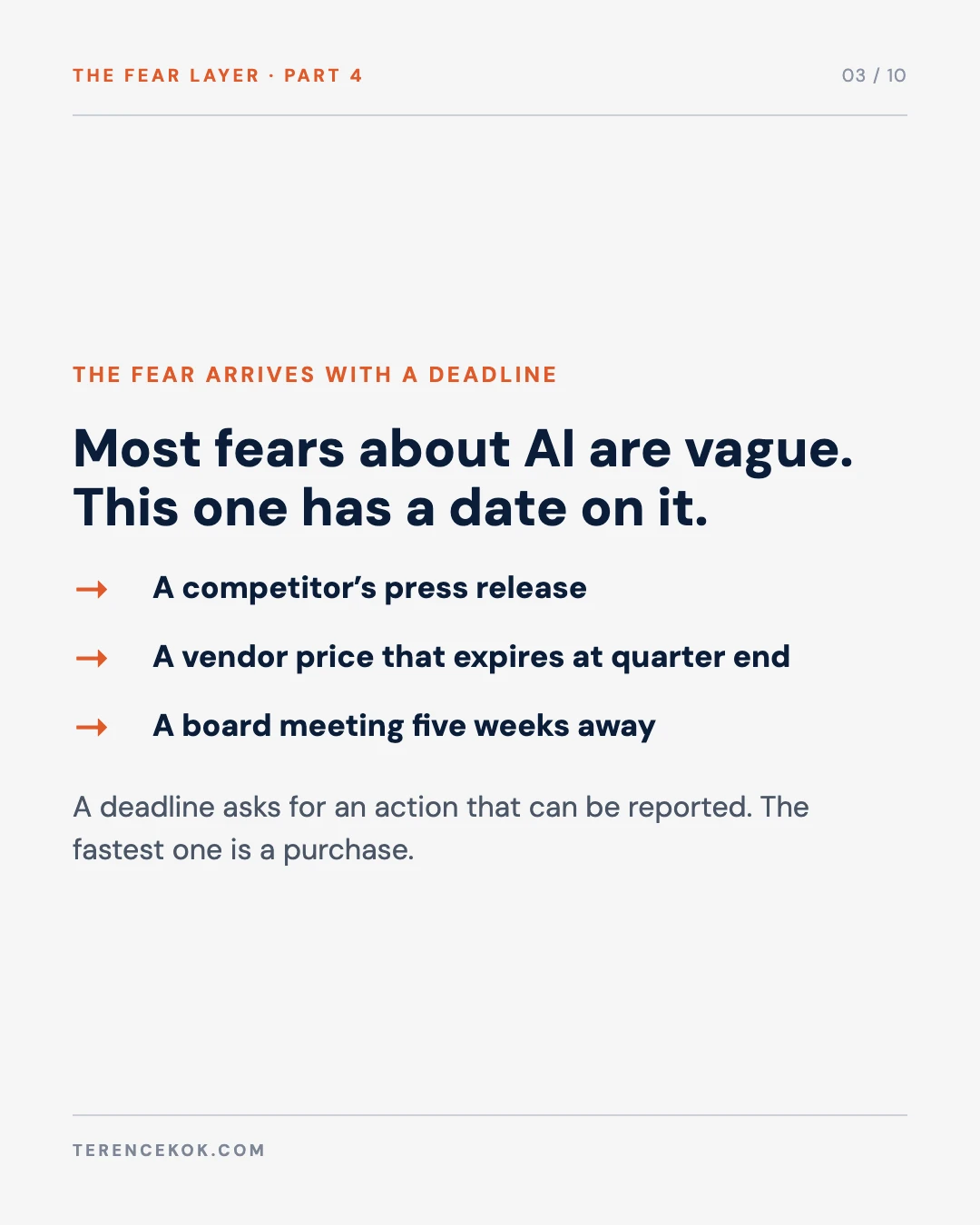
Most fears about AI are vague. This one has a date on it.
A competitor announces an AI programme in a press release. A vendor offers a price that expires at the end of its quarter. A board member forwards an article and asks, reasonably, what the company is doing about it, and the next board meeting is five weeks away. Each of these turns a general unease into a specific deadline, and a deadline asks for an action that can be reported. The action that can be reported fastest is a purchase.
In part two of this series I looked at mandates that arrive written as strategy and start as fear of being seen as behind. This part is about what happens next, when that fear reaches the budget. It is the fear I meet most often in the mid-market, and it is the easiest to act on, because a purchase order feels like progress on the day it is signed.
What the numbers say about buying early
The leaders making these purchases are aware of what they are doing.
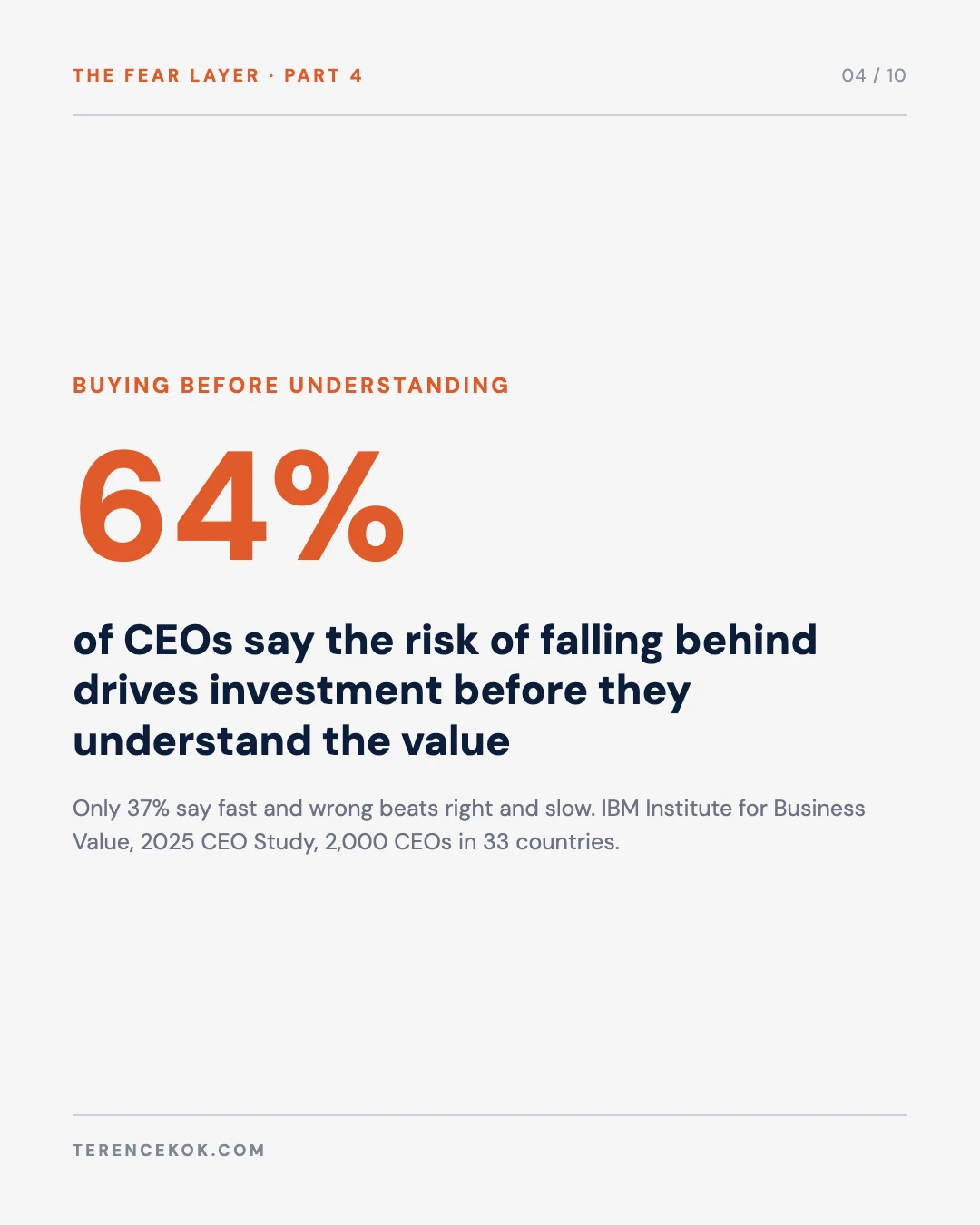
IBM’s 2025 CEO study surveyed 2,000 chief executives across 33 countries between February and April 2025. 64% said the risk of falling behind drives them to invest in some technologies before they have a clear understanding of the value those technologies bring. In the same survey only 37% said it is better to be fast and wrong than right and slow. Most of them believe in being right, and most of them are buying early anyway. That gap between belief and behaviour is the fear at work.
The same study shows what it produces. Half of the CEOs said the pace of recent investment has left their organisation with disconnected, piecemeal technology. Only 25% of their AI initiatives had delivered the return expected over the previous few years, and only 16% had scaled across the enterprise.
The market is helping the fear along. Gartner expects more than 40% of agentic AI projects to be cancelled by the end of 2027, for escalating costs, unclear business value or inadequate risk controls. It also estimates that only about 130 of the thousands of vendors selling agentic AI offer real agentic capability, with the rest relabelling chatbots, assistants and robotic process automation. A buyer in a hurry is the easiest customer for a relabelled product, because the hurry leaves no time to ask what changed apart from the name.
Free tool
AI Vendor Scorecard
Score a vendor on capability, data handling and exit terms before the quarter-end discount decides for you.
Four purchases anxiety makes
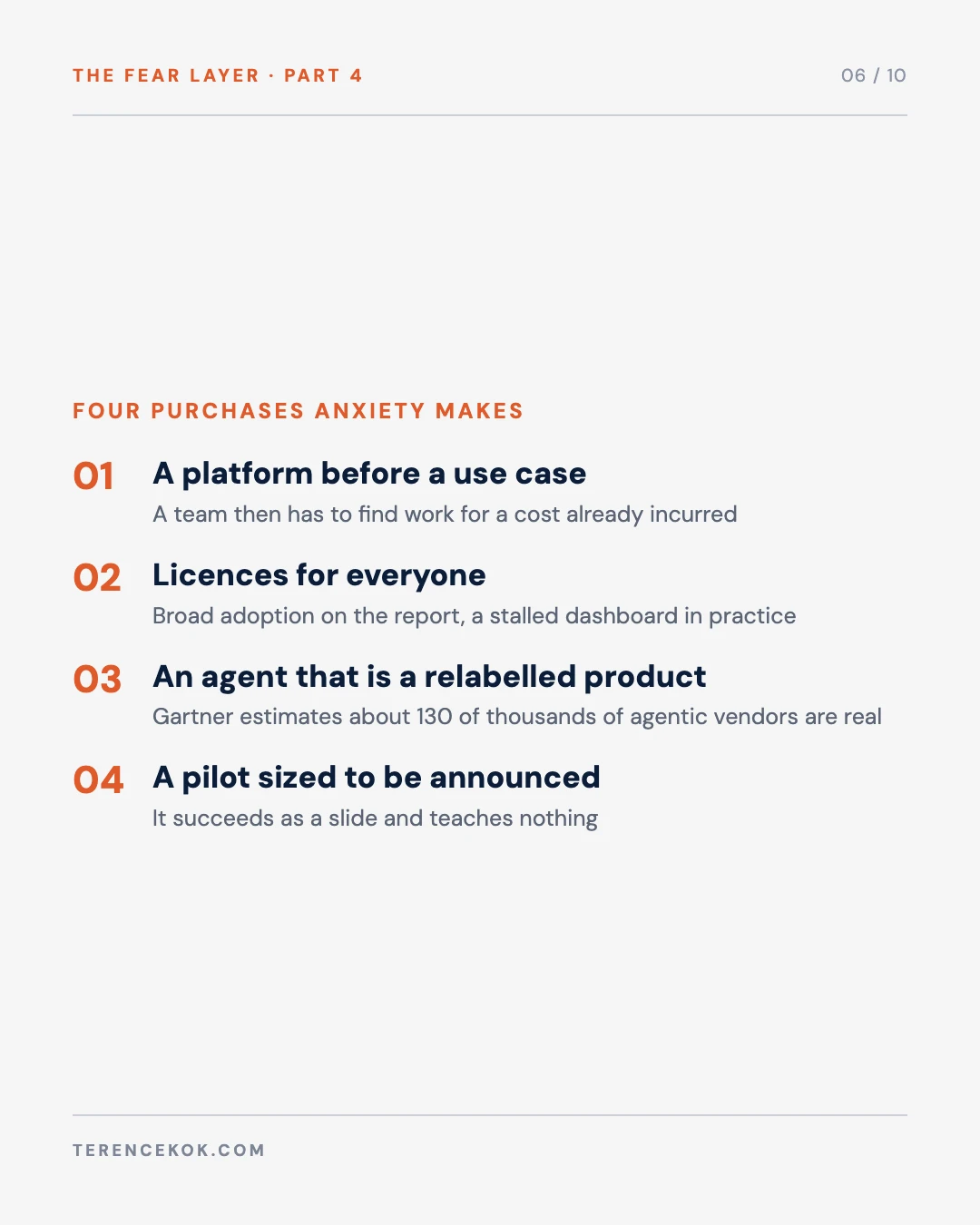
The purchases that come out of this fear look different on the invoice and share one feature. Each is bought before anyone has named the decision it is meant to improve.
A platform before a use case. An enterprise AI platform is bought on the reasoning that the use cases will follow once the capability exists. They rarely follow on their own. The platform then needs a team to find work for it, and the team’s first job is justifying a cost that has already been incurred.
Licences for everyone. A copilot for every seat looks like broad adoption and is easy to report. Without a named task for each group it becomes the stalled dashboard from part three, with a larger renewal attached.
An agent that is a relabelled product. The demonstration looks autonomous. The contract describes a workflow tool with a language model at the front. The buyer finds out in production, when the edge cases arrive and the agent hands them back to a person.
A pilot sized to be announced. The pilot is chosen because it will make a good slide by the next board meeting, rather than because it tests something the business needs to know. It succeeds as an announcement and teaches nothing, and the next purchase is made on the confidence it produced.
In my advisory work I see all four, often in the same organisation within the same year. None of them is irrational taken alone. Each is what a reasonable person does when the question being answered is “how do we show we are not behind” and the question that should be answered is “which decision should this make better, and how will we know”.
What being late costs
It is worth being precise about the thing being feared, because it is smaller than it feels.
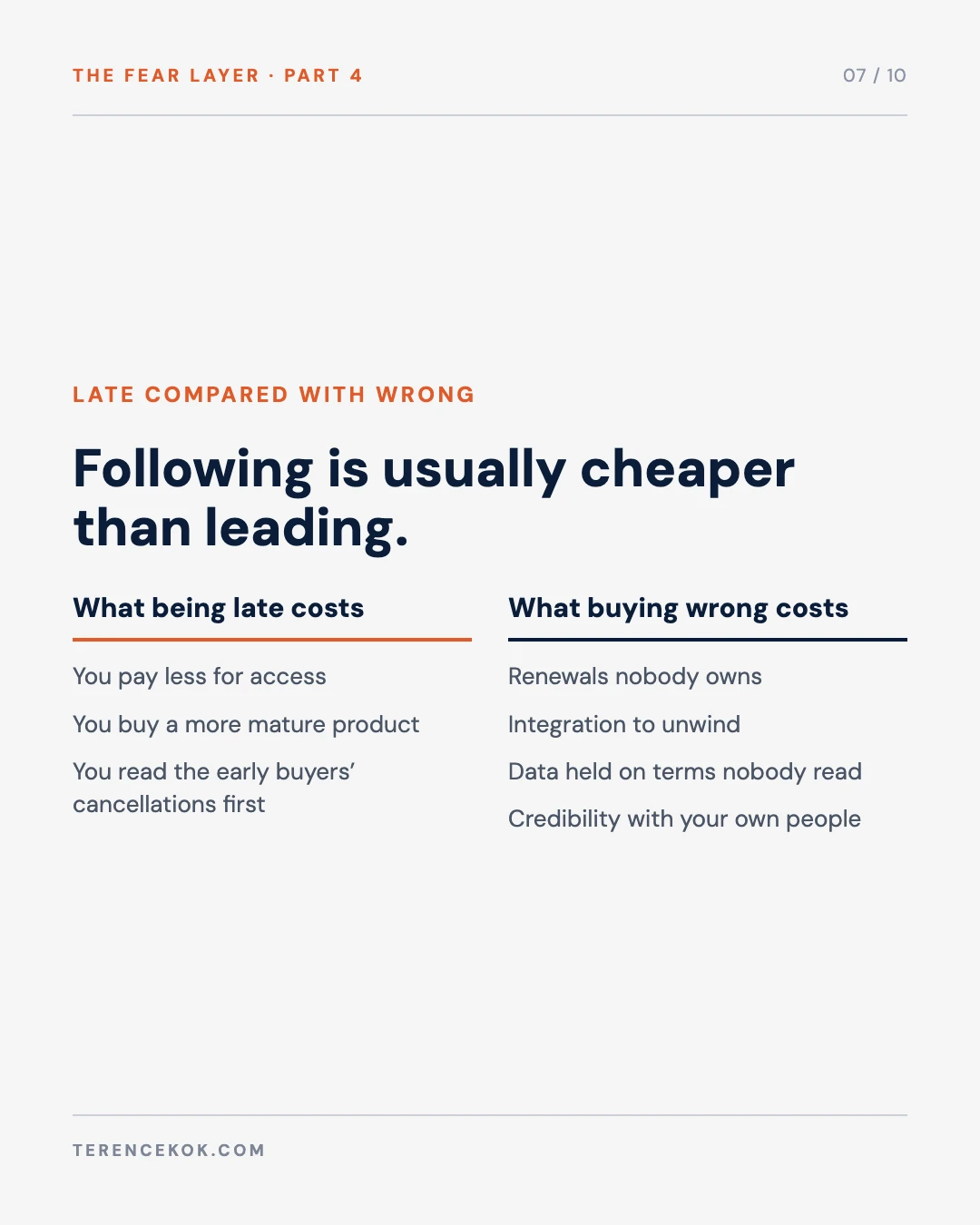
A late buyer pays less. Prices for model access have fallen steeply and repeatedly since 2023, and each new product generation arrives with the previous one’s features included. A late buyer also gets a more mature product, sold by a vendor that has survived its early customers’ complaints, and can read the early buyers’ cancellations before signing. On products alone, following is usually cheaper than leading.
Buying wrong costs more, and most of the cost does not appear on the invoice. There is the licence that renews because nobody owns the decision to cancel it. There is the integration work that has to be unwound before the next tool can go in. There is the data that now sits in a vendor’s environment on terms nobody read closely. The largest cost is credibility: a workforce that watched one anxious purchase fail will treat the next one as another announcement, and discount it accordingly.
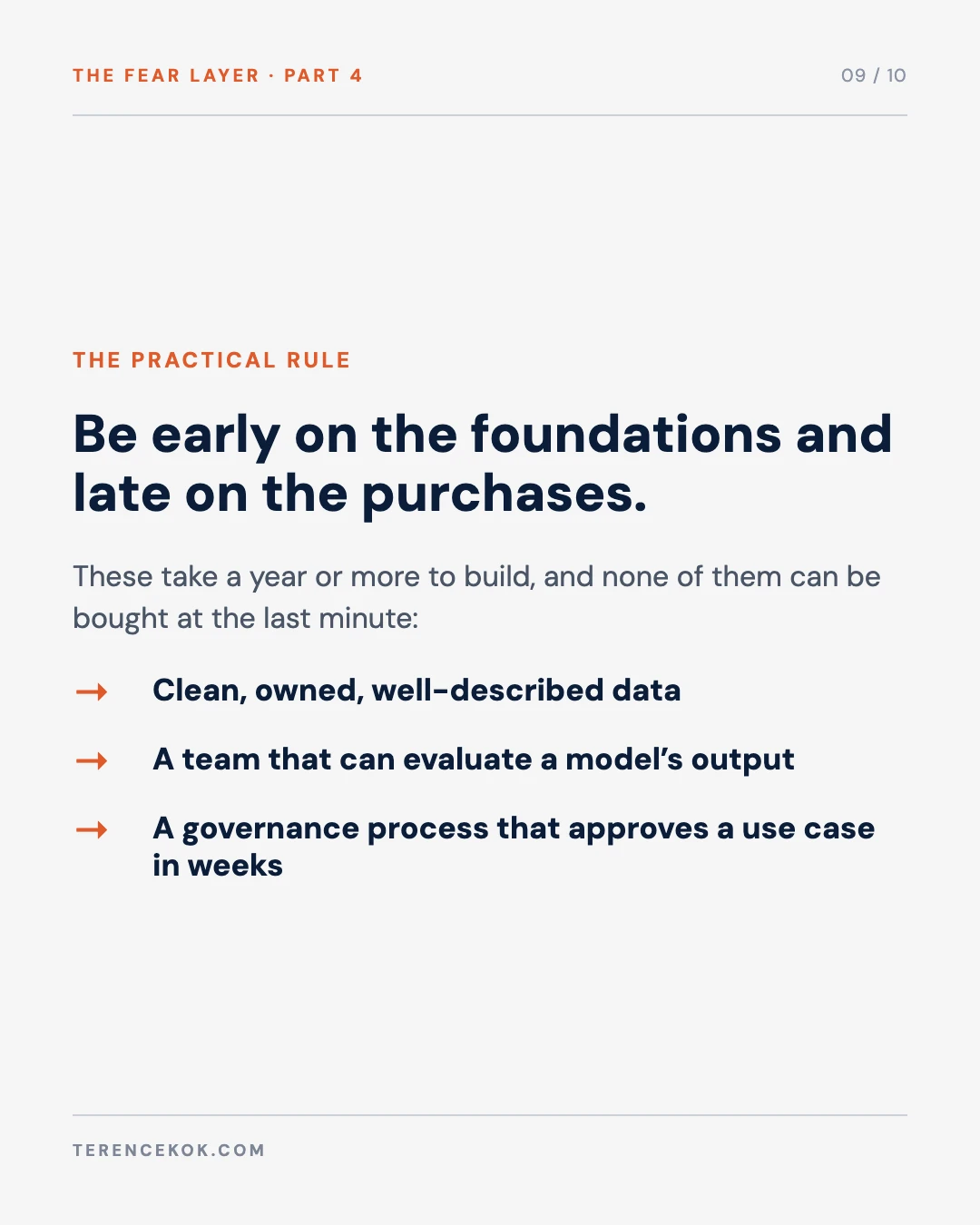
There is a real cost to being late, and it sits somewhere else. Clean, owned, well-described data takes a year or more to build. So does a team that knows how to evaluate a model’s output, and a governance process that can approve a use case in weeks. None of these can be bought at the last minute, and all of them are what separates the organisations whose AI spending pays back from the ones whose spending does not. Anxiety skips them, because they cannot be announced.
The practical rule follows from that. Be early on the foundations and late on the purchases.
An order of operations that protects the budget
The fear will not go away because someone has read an article about it. What helps is a sequence that a purchase has to pass through, agreed before the next deadline arrives, so that the anxious moment meets a process rather than a signature.
Name the decision. Write down the business decision the purchase should improve, who makes it today, and the number that shows whether it got better. If this cannot be written in three sentences, nothing is ready to buy.
Check readiness. Assess whether the organisation can absorb the change: data, skills, process ownership, leadership attention. An afternoon with a structured readiness assessment will stop most anxious purchases, because the gaps it finds are gaps a product cannot fill.
Check the data. Confirm that the data the tool needs exists, is owned by someone, and can leave the vendor’s environment on your terms. Most failed purchases I review failed here, well before the model was ever the problem.
Pilot with an exit written in advance. Define in writing, before the pilot starts, what result would make you stop. A pilot without a stopping rule never fails. It drifts until someone renews it.
Sign a contract you can leave. A short term, a clear exit, your data returned in a usable format, and no price protection that only works if you stay. The quarter-end discount is worth less than the right to walk away.
Each step is cheap. Together they add perhaps a month to a purchase. That month is the insurance on the budget, and it is the month anxiety is trying to skip.
Free tool
AI Readiness Assessment
Five dimensions, one afternoon. Run it before the purchase order, while the answer can still change what you buy.
Where to start this quarter
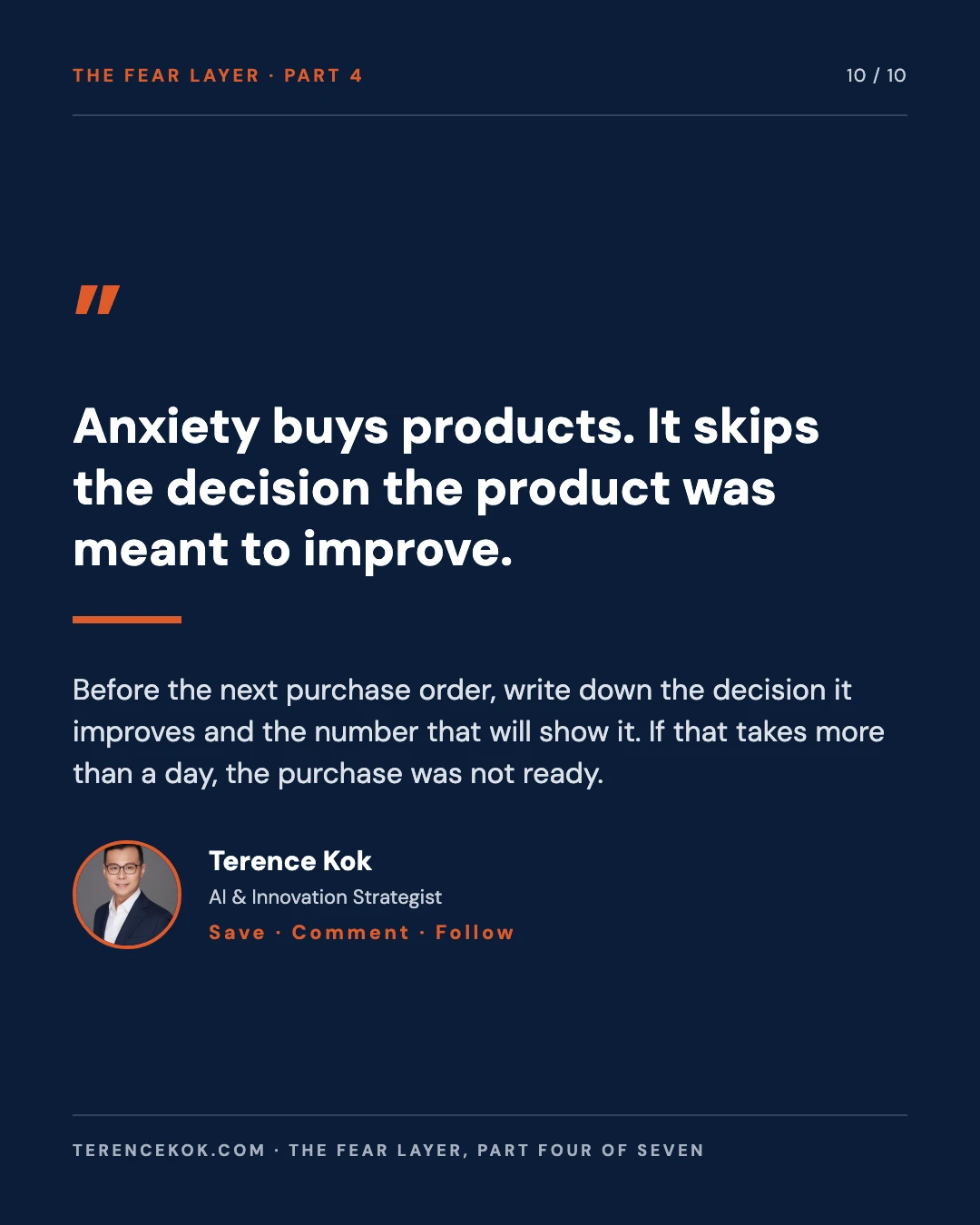
If there is a purchase waiting for signature this month, hold it until someone has written down the decision it improves and the number that will show it. If that takes more than a day, the purchase was not ready.
If you are the person whose board keeps asking what the company is doing about AI, give them the sequence instead of a product. A board that sees an order of operations with dates attached has been answered. A board that sees a licence count will ask again next quarter.
If you already own one of the four purchases, and most organisations do, find its renewal date and name an owner for the decision to renew it. Some of those tools will earn their place. The ones that do not will cost you another year if nobody is watching the date.
Evidence & Methodology
The CEO survey figures and Gartner’s forecast are cited below. The four purchases, the cost comparison and the five steps are my own pattern from advisory work. Here is which is which.
| Claim | Source | Grade |
|---|---|---|
| 64% of CEOs say the risk of falling behind drives investment in some technologies before they understand the value; 37% prefer fast and wrong to right and slow | IBM Institute for Business Value, 2025 CEO Study, 2,000 CEOs in 33 countries, February to April 2025 | Measured |
| 50% say the pace of recent investment left them with disconnected, piecemeal technology; 25% of AI initiatives delivered expected ROI; 16% scaled enterprise-wide | Same IBM study | Measured |
| More than 40% of agentic AI projects will be cancelled by the end of 2027 | Gartner, June 2025 | Forecast |
| Only about 130 of the thousands of agentic AI vendors offer real agentic capability | Gartner estimate, same release | Reported |
| Model access prices have fallen steeply since 2023, so late buyers usually pay less for products | General market observation; prices vary widely by vendor and model | My call |
| The four anxiety purchases, and the finding that most failed purchases fail on data before the model | My own pattern across advisory engagements, not a study | My call |
| The five-step order of operations | My own framework, not externally validated | My framework |
Sources
- IBM. (2025, May 6). IBM Study: CEOs Double Down on AI While Navigating Enterprise Hurdles [Press release]. IBM Institute for Business Value, 2025 CEO Study.
- Gartner. (2025, June 25). Gartner Predicts Over 40% of Agentic AI Projects Will Be Canceled by End of 2027 [Press release].

Boards Are Asking for AI Strategy. Many Are Asking Because They Are Afraid.
Where the mandate comes from, before it reaches the budget.

Why Your Choice of First AI Use Case Will Make or Break the Programme
How to choose the first use case so the purchase has something to be measured against.

What Your AI Vendor Contract Is Probably Missing
The exit, data-return and liability terms that the quarter-end discount usually trades away.

The Late Adopter's Playbook: Five Must-Do Steps for AI That Actually Grows
What a later start makes possible, and the steps that make it pay.
This is part four of The Fear Layer. Part five looks at governance theatre, the policies written to produce the feeling of control rather than control itself. If a purchase order is waiting on your desk and the deadline came from someone else’s announcement, that is a conversation my consulting work has had more than once.
Was this useful?