

Listen to this article
Jump to a section
In this article
Executive Summary
Most enterprises have adopted AI; almost none have matured into it. The gap is a wisdom problem, and speed without depth is a structural liability.
Core conclusions
- Adoption and maturity are different things: near-universal AI use hasn’t translated into organisations that can govern and sustain it in live operations.
- The “buy to learn, build to last” sequence holds up in practice: starting with off-the-shelf tools before custom development gets to sustainable ROI faster than building bespoke from day one.
- Diagnosing the real operational constraint, fixing the data foundation, and measuring outcomes.
The wisdom gap, in ten slides
Save it, share it, or send it to whoever is setting the pace on your AI programme.
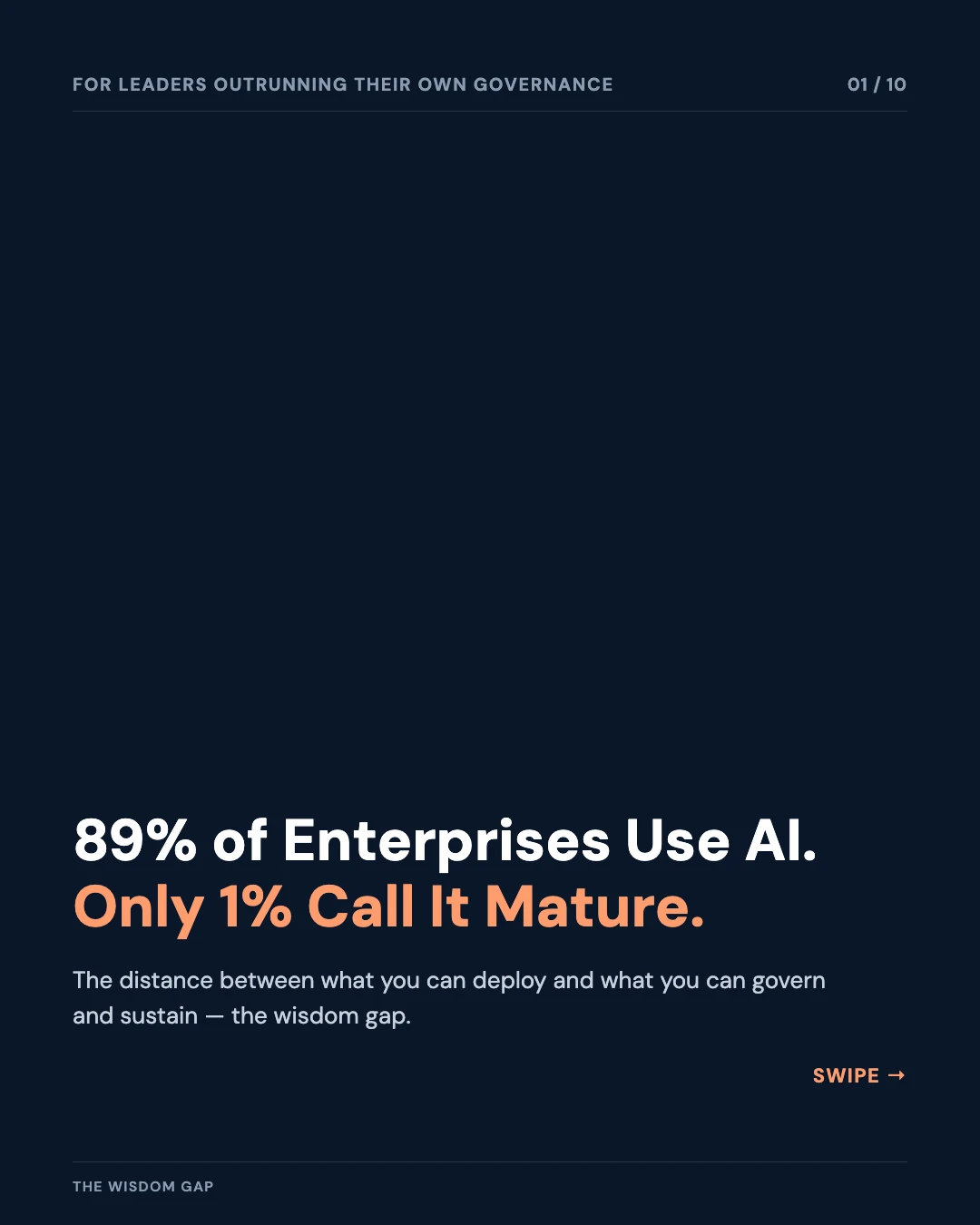
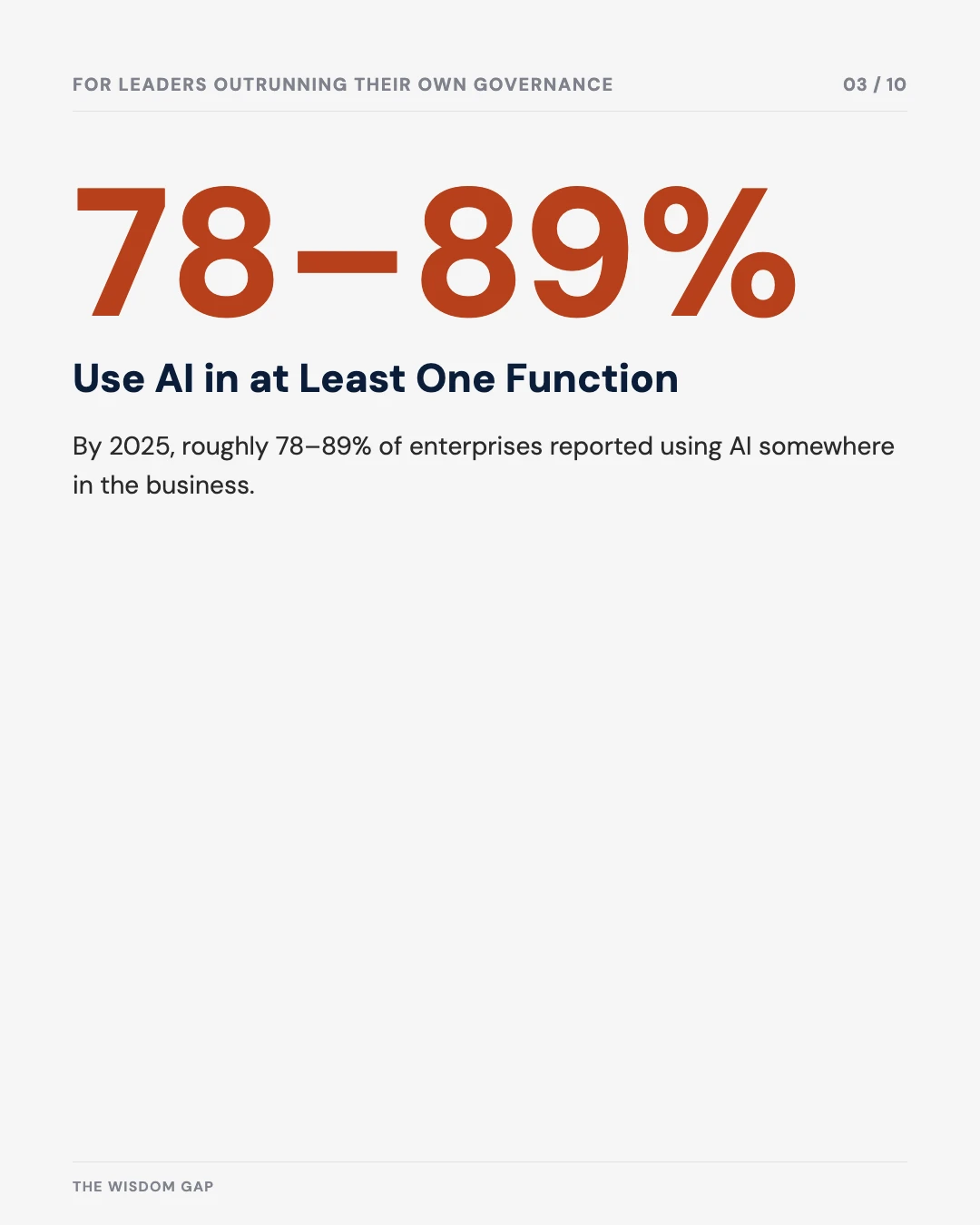
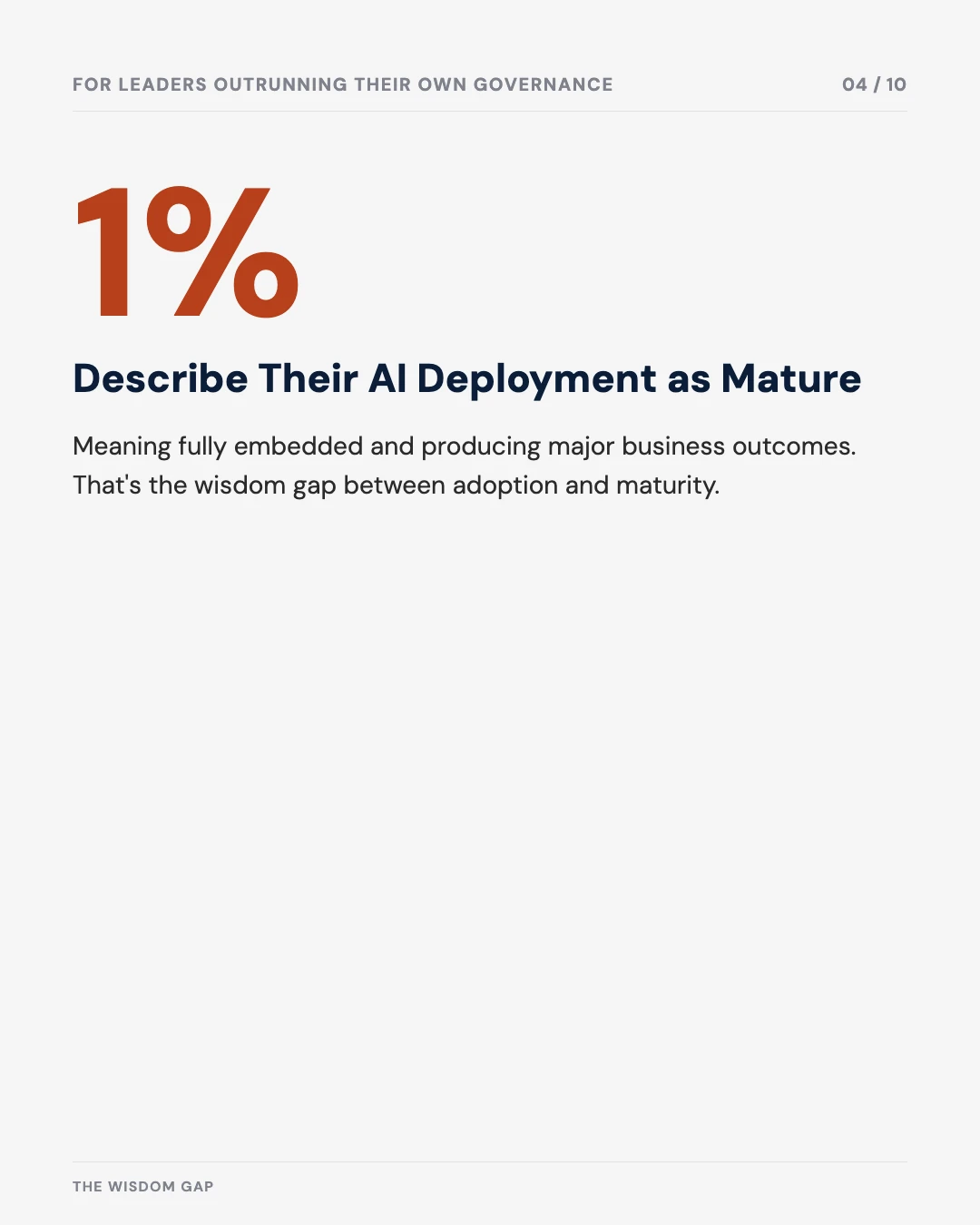
By 2025, roughly 78–89% of enterprises reported using AI in at least one business function. Yet only approximately 1% of those same organisations describe themselves as “mature” in AI deployment, meaning AI is fully embedded and producing major business outcomes.
That gap has a name: the wisdom gap. The distance between what organisations can technically deploy and what they understand, can govern, and can sustain in live operations.
The gap between adoption and maturity is not a technology problem. It is a wisdom problem.
The Speed Trap and the Knowledge Paradox
The field is moving fast. AI can compress years of innovation into months. Agents are shortening development cycles and automating tasks once considered highly skilled. They are raising expectations at a rate that outpaces human learning models. The instinct, understandably, is to run alongside this velocity: to implement, to launch, to demonstrate. But the organisations that have moved fastest have not necessarily moved furthest.
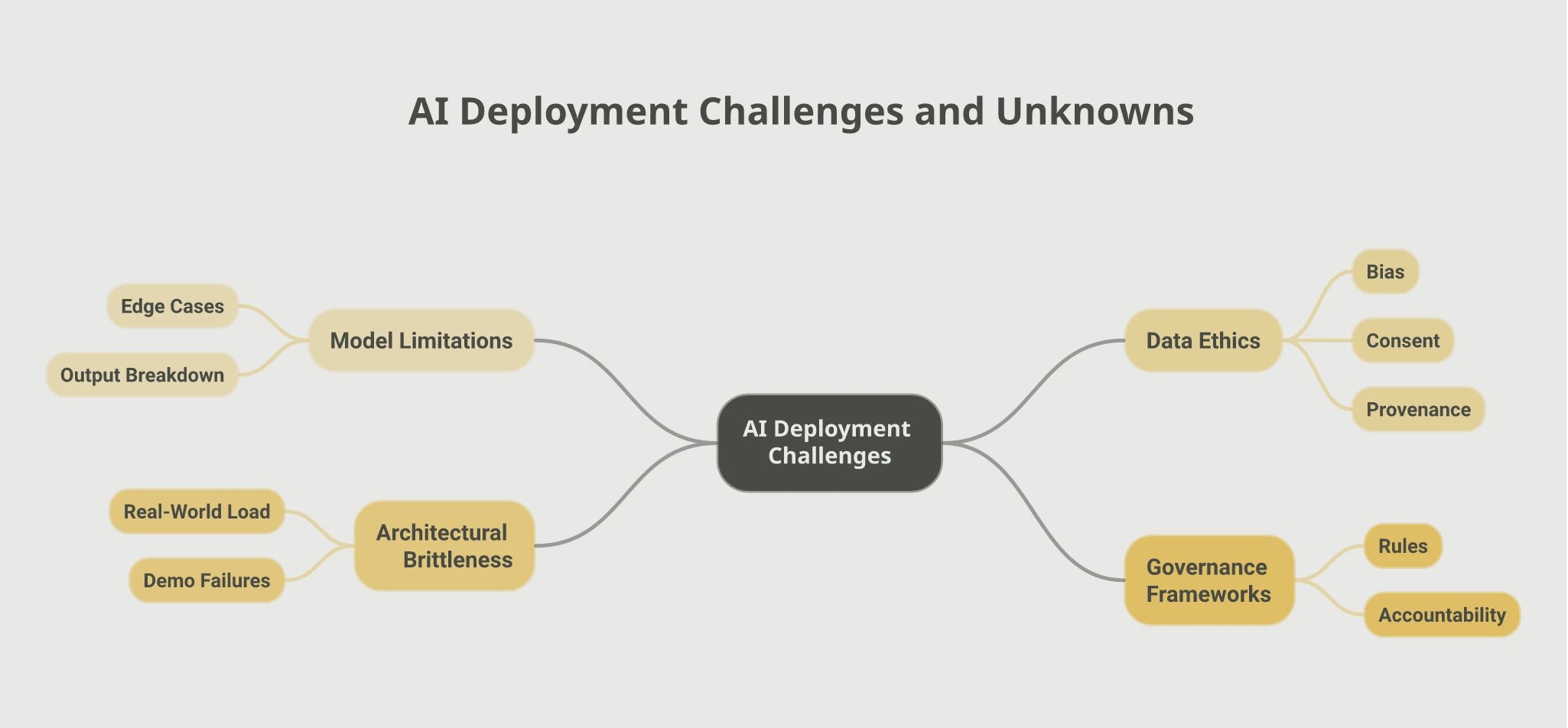
The more one learns, the more one becomes aware of what one does not yet know. For practitioners, this paradox is intensifying. Tools accelerate capability, but they also expose the depth of what remains to be understood: model limitations, data ethics, architectural brittleness under edge cases, and the governance frameworks required to sustain deployment.
This is precisely why speed without depth is a structural liability. AI can generate code or content instantly, but without understanding the fundamentals, practitioners risk producing outputs that create technical debt or operational risk. Reviewing and refactoring AI-generated work without adequate conceptual grounding increases cognitive overhead and pulls teams away from higher-order problem-solving. AI tools excel at pattern recognition and short-term problem optimisation. But they struggle to design for adaptability, maintainability, and long-term human experience, precisely the qualities required in high-stakes deployments.
The Case for Depth
The most valuable human expertise increasingly lies not in having the answers, but in asking better questions: identifying unknown unknowns, recognising hidden assumptions, and working in the white spaces that no AI model’s training data yet contains. An experienced practitioner not only identifies existing patterns but also their limitations and the associated areas yet to be explored. This meta-expertise, the ability to orchestrate AI tools, integrate information across different fields, and forge innovative connections beyond algorithms, is what elevates a basic system to a impactful one.
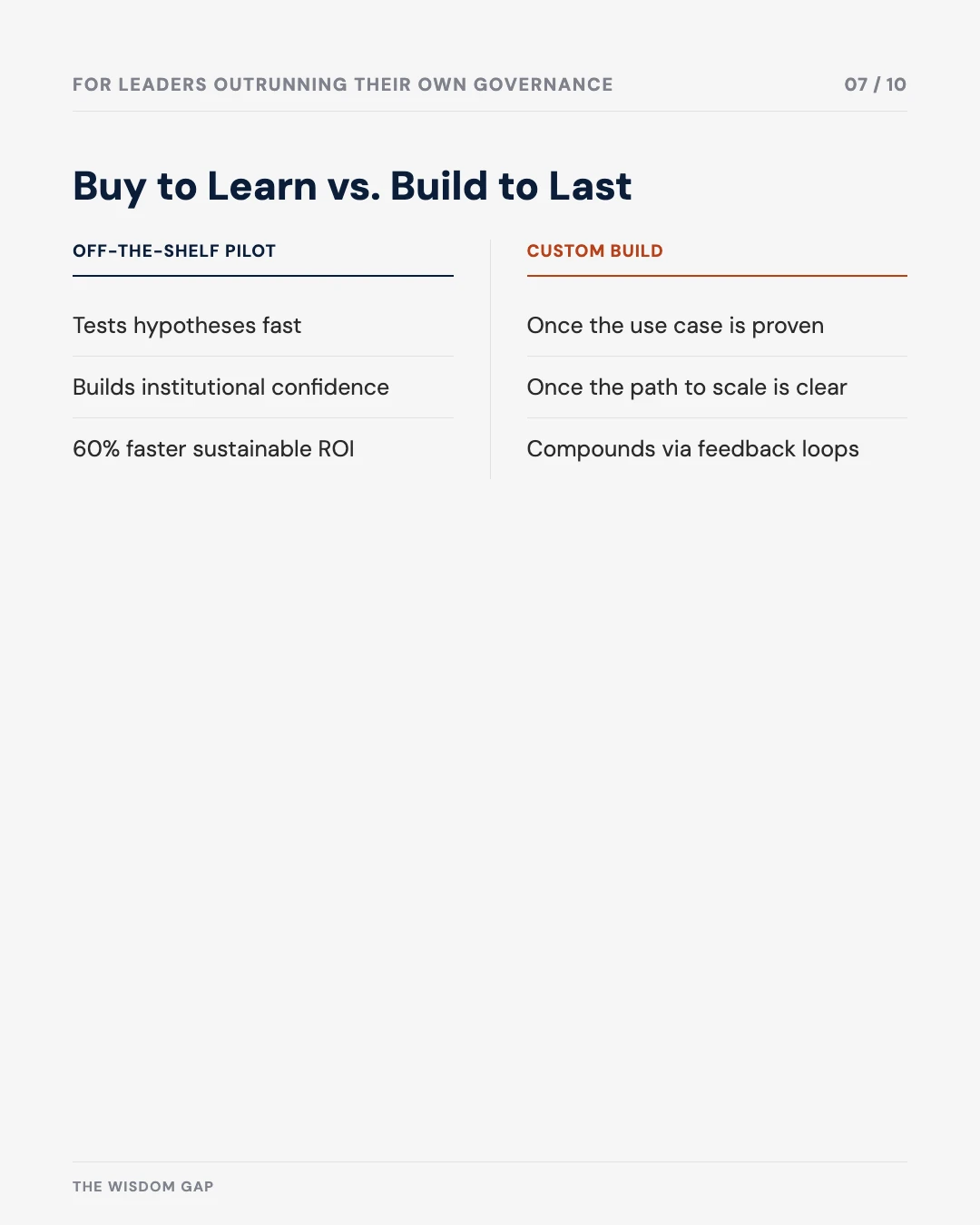
There is a valid role for quick wins. Early-stage pilots build institutional confidence, test hypotheses, and provide a clear path to value. In my own client work, organisations adopting a staged approach, beginning with off-the-shelf tools before moving to custom development, consistently reach sustainable AI ROI faster than those building bespoke from day one. Buy to learn. Build to last. However, the quick win should not be mistaken for the final objective. A pilot that solves the wrong problem, while technically impressive, fails to create value if it doesn’t address the real operational bottleneck.
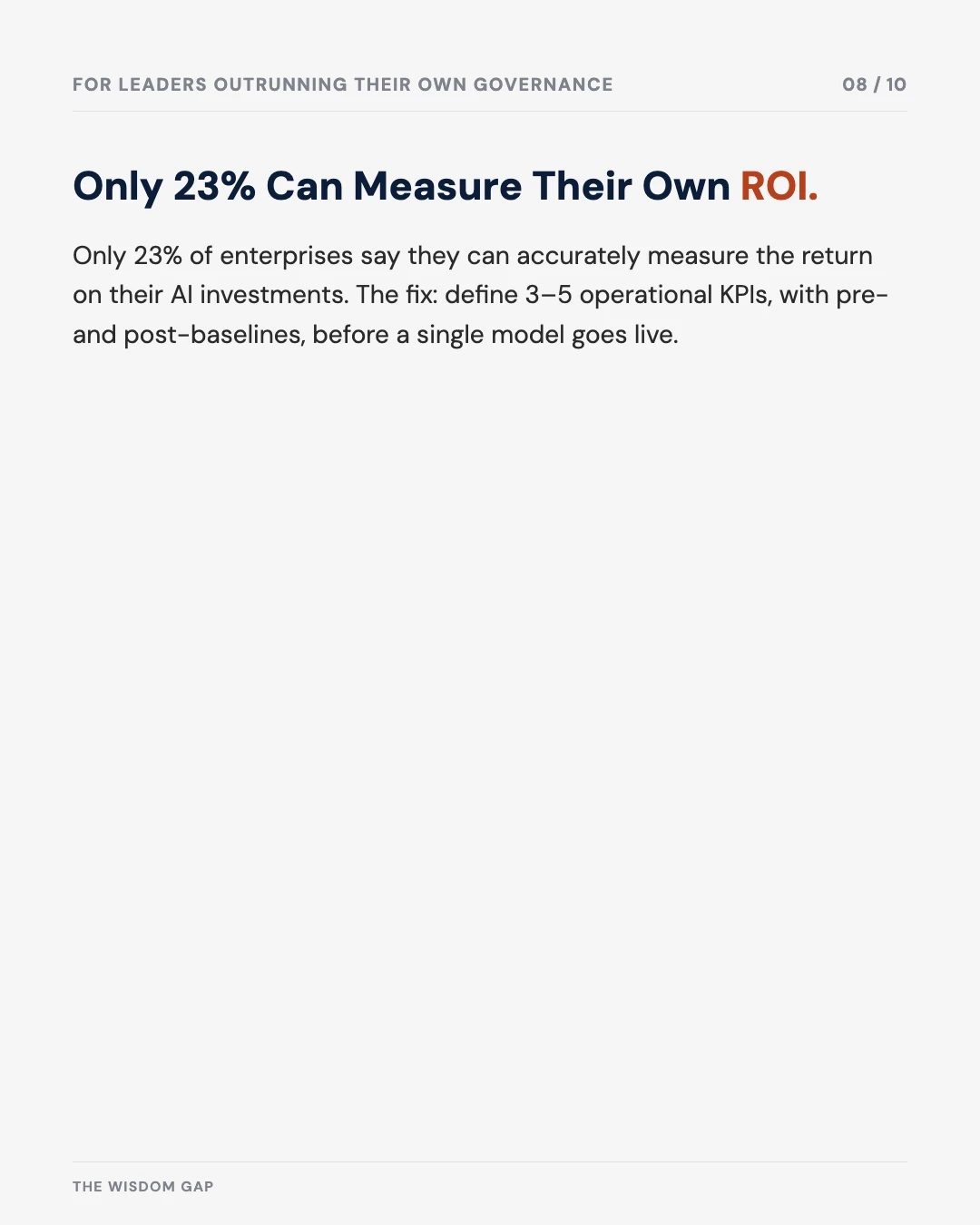
When the technology team works in isolation, concentrating on AI’s capabilities instead of business needs, it causes significant strategic misalignment, and that misalignment is compounded by a measurement gap: most enterprises still cannot say with confidence that they can accurately measure the return on their AI investments. Measurement discipline is exactly what the four dashboards a Chief AI Officer should be running are built to fix. Define 3–5 operational KPIs, with pre- and post-baselines, before a single model goes live.
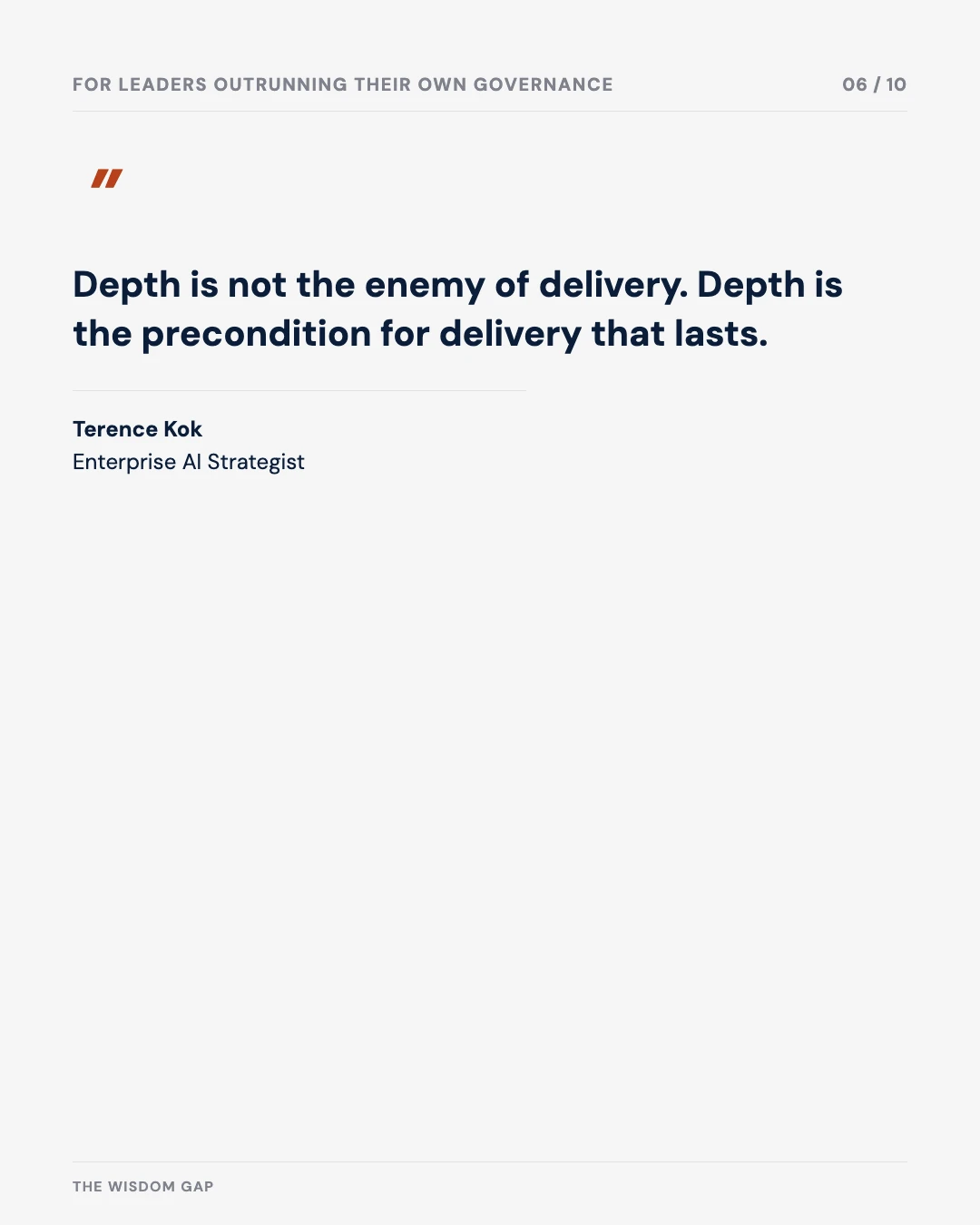
There is a false binary embedded in much of the AI conversation: move fast or fall behind. This framing is flawed. Depth is not the enemy of delivery. Depth is the precondition for delivery that lasts.
Depth is not the enemy of delivery. Depth is the precondition for delivery that lasts.
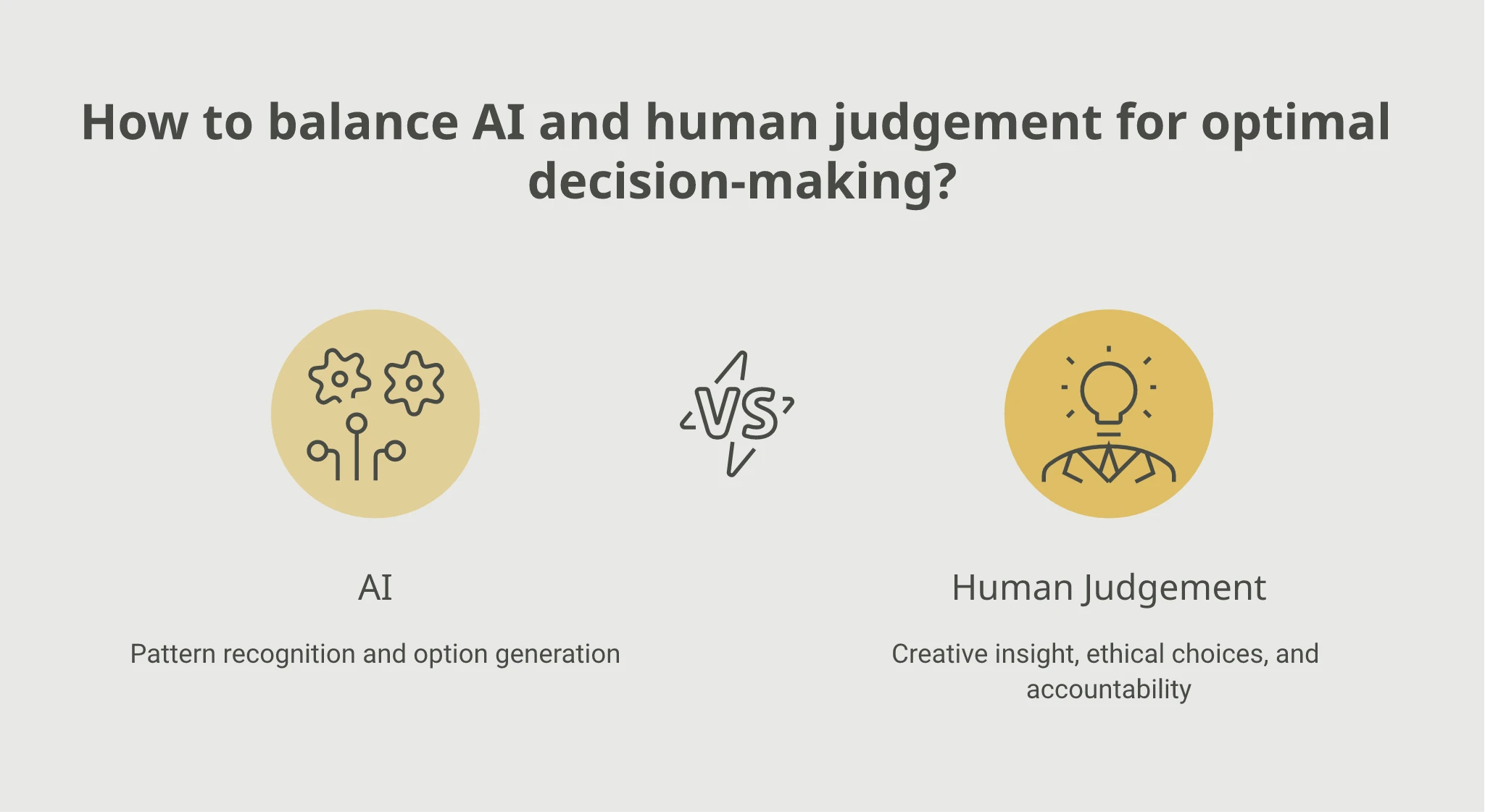
Organisations that succeed do not rely solely on AI nor cling rigidly to traditional methods. Success depends on carefully enhancing AI for pattern recognition and option generation while leaving creative insights, ethical choices, and accountability to human judgement. For smart city programmes and public infrastructure where decisions affect large populations and systems must operate over multi-year timescales, this balance is essential.
A Framework for Practitioners
For those operating at the intersection of AI, digital infrastructure, and public-sector delivery, the following principles reflect what the evidence consistently supports:
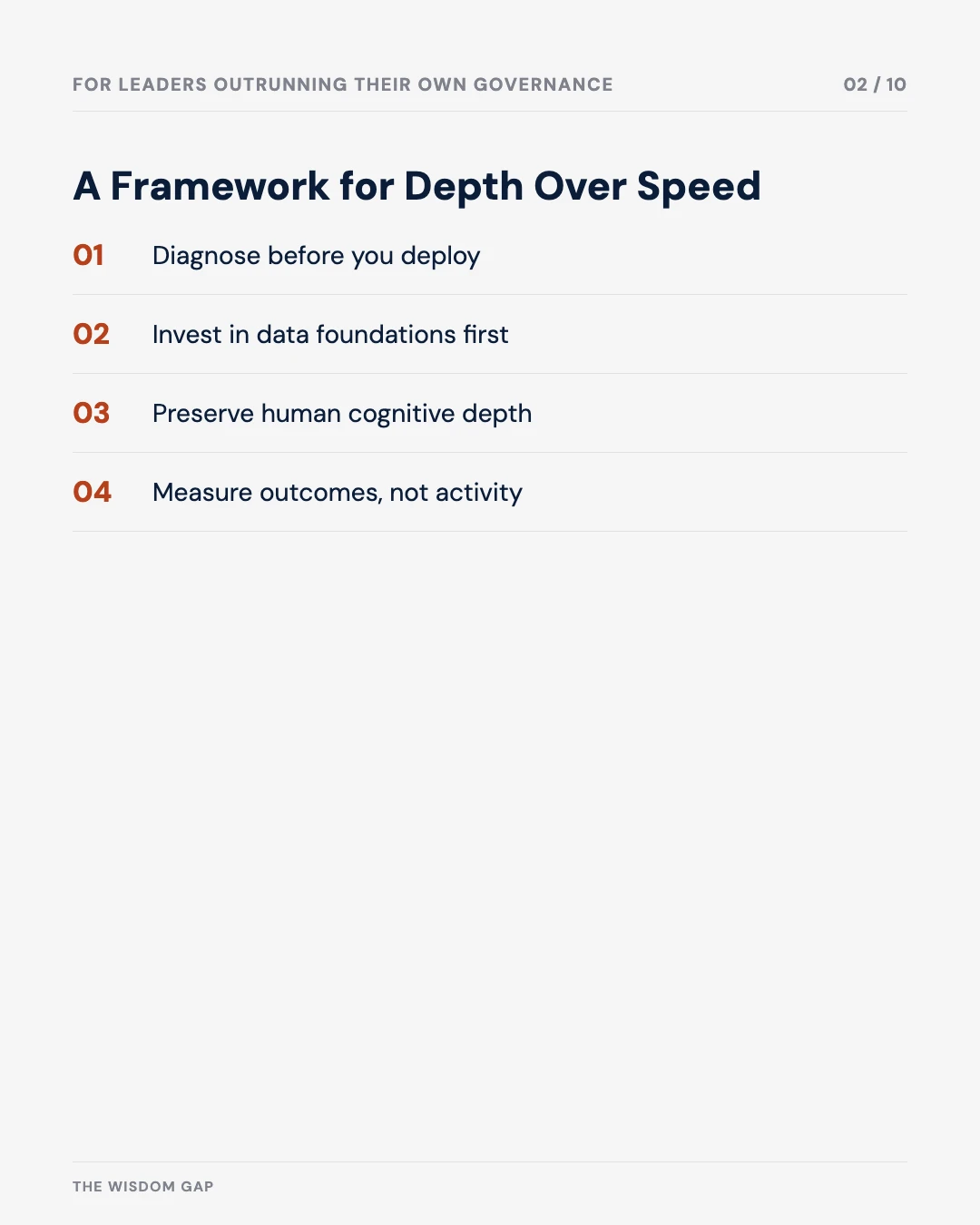
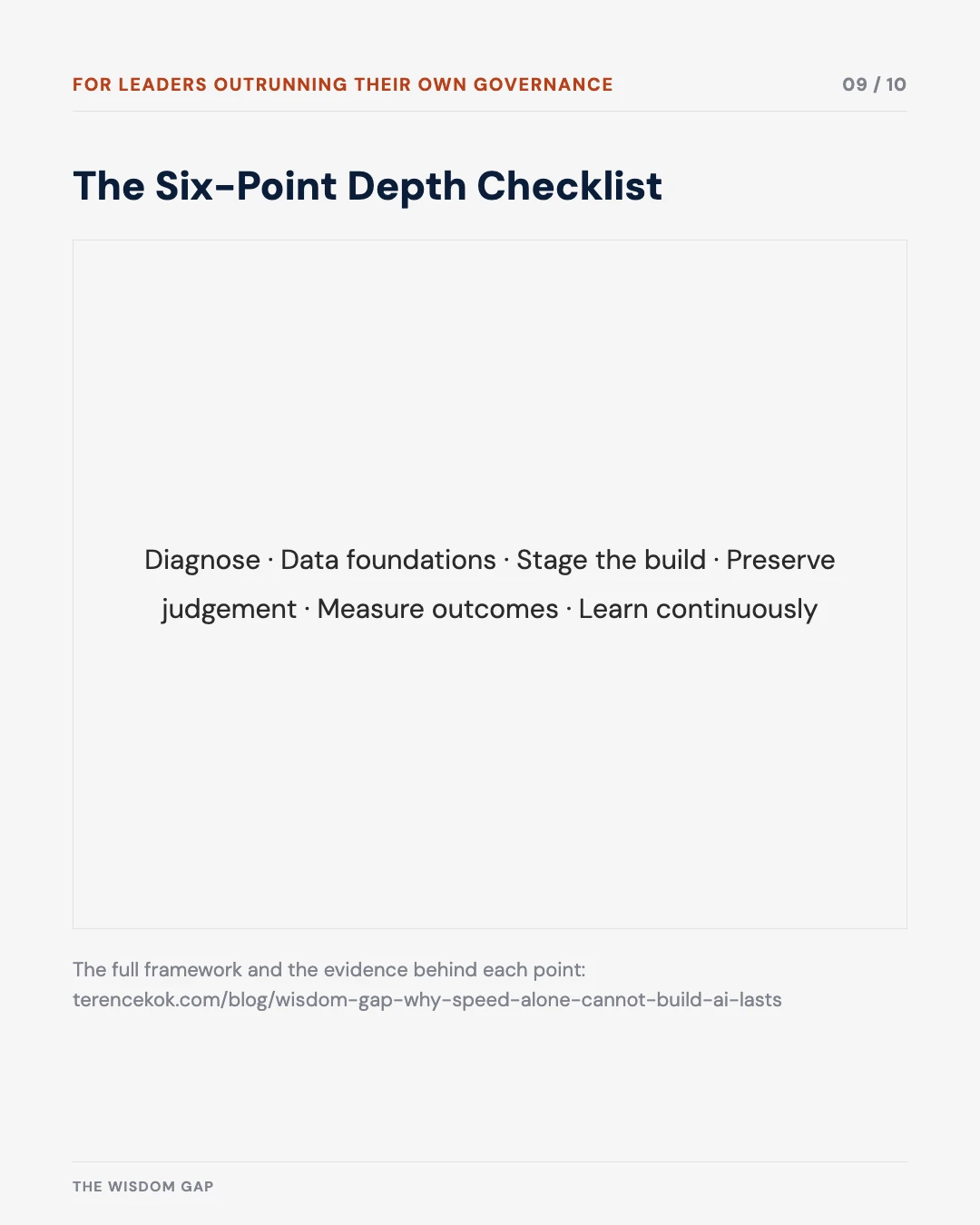
- Diagnose before you deploy. Understand the real operational constraint before selecting or building a solution. Run a constraint-mapping session with operations, finance, and risk present. Strategic misalignment is the leading cause of AI project failure.
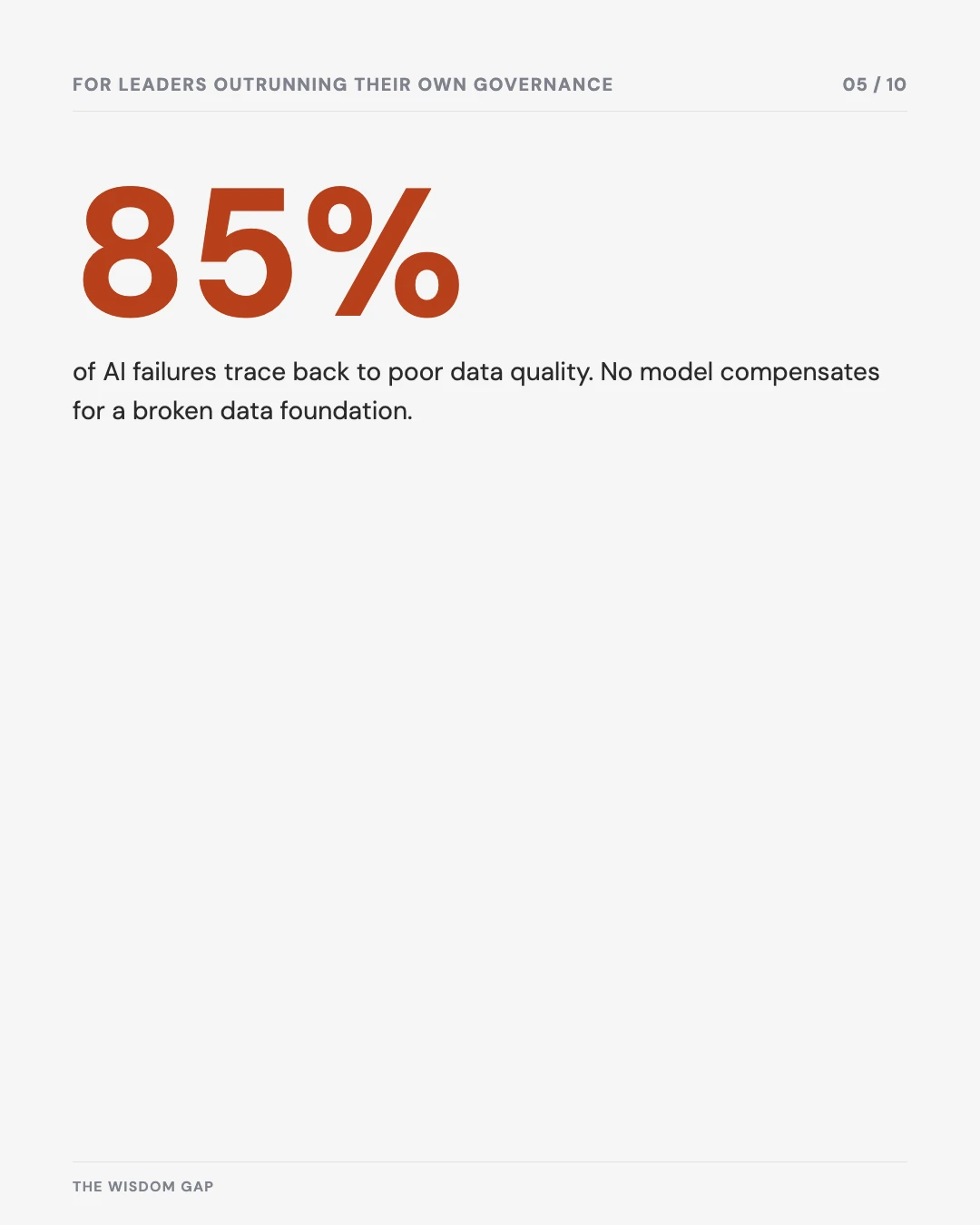
- Invest in data foundations before model sophistication. Most AI failures trace back to poor data quality, not model choice. No model compensates for a broken data foundation. I learned this one the expensive way: stop tuning prompts, start cleaning data. Prioritise data quality, lineage, and governance before scaling.
- Stage the build-versus-learn journey deliberately. Use commercial tools and off-the-shelf capabilities to learn the problem space. Build proprietary systems when the use case is proven and the path to scale is clear.
- Preserve and develop human cognitive depth. Audit where AI augmentation adds value versus where human judgement must remain sovereign. Establish governance frameworks that maintain clear accountability for AI-assisted decisions.
- Measure outcomes instead of activity. Fix a baseline, target, and verification method for each AI-enabled process before deployment. Track traceable ROI instead of demonstration metrics.
- Treat learning as a continuous operational requirement: a persistent practice embedded into delivery cycles rather than an annual training event or a pre-project workshop.
Wisdom as a Competitive Advantage
Artificial intelligence does not supply wisdom. It processes patterns, predicts outcomes, and accelerates execution. It does not replace human judgement, contextual understanding, ethical reasoning, or the accountability that comes with consequential decisions.
These are not trivial considerations. They determine whether a technically sound system achieves lasting operational impact or becomes just another entry in the growing catalogue of stalled pilots.
The organisations and practitioners that will deliver the most sustainable AI impact are those who understand that speed is a tactic, not a strategy. That a quick win which cannot be explained, governed, or scaled is a liability disguised as an achievement. That depth of understanding is not a luxury to be delayed until later; it is the foundation upon which everything else is built.
The goal is not to outrun the technology. The goal is to deploy it in ways that still work ten years from now.
Evidence & Methodology
Two of the numbers in this piece come from named McKinsey survey work. Two more are figures the industry repeats often enough that I used them, without a source I can point to independently. And the “buy to learn, build to last” sequencing is my own read from client work, not a controlled comparison.
| Claim | Source | Grade |
|---|---|---|
| 78 to 89% of enterprises use AI in at least one function, yet only ~1% call their deployment mature | McKinsey’s State of AI survey and Superagency in the Workplace research | Measured |
| 85% of AI failures trace back to poor data quality | Repeated industry figure, no source I can independently verify | Unverified |
| Only 23% of enterprises can accurately measure their own AI ROI | Repeated industry figure, no source I can independently verify | Unverified |
| Staging AI adoption, buying before building, reaches sustainable ROI faster | My own client work, not a controlled comparison | My call |
Sources
- McKinsey. (2025). The state of AI: Global survey.
- McKinsey. (2025). Superagency in the workplace: Empowering people to unlock AI’s full potential.
Free tool
AI Build vs. Buy vs. Partner
Seven questions to pressure-test the “buy to learn, build to last” sequencing this piece argues gets to sustainable ROI 60% faster.
Free tool
AI ROI Calculator
Model your own numbers against the measurement gap this piece describes, before you mistake a quick win for the final objective.
Was this useful?