
Listen to this article
Jump to a section
In this article
Executive Summary
Part 7 ended on outer limits for AI systems. This part takes the longest view in the series. The cosmologist Martin Rees has argued since at least 2015 that organic human intelligence may be a brief stage before inorganic minds, which would find space a better home than Earth. In October 2026 Elon Musk posted that spreading superintelligence to the stars is “a great success condition for a biological bootloader.” Neither man offers evidence that can be measured today. The argument still matters to anyone deploying AI, because it changes which decisions deserve a long review.
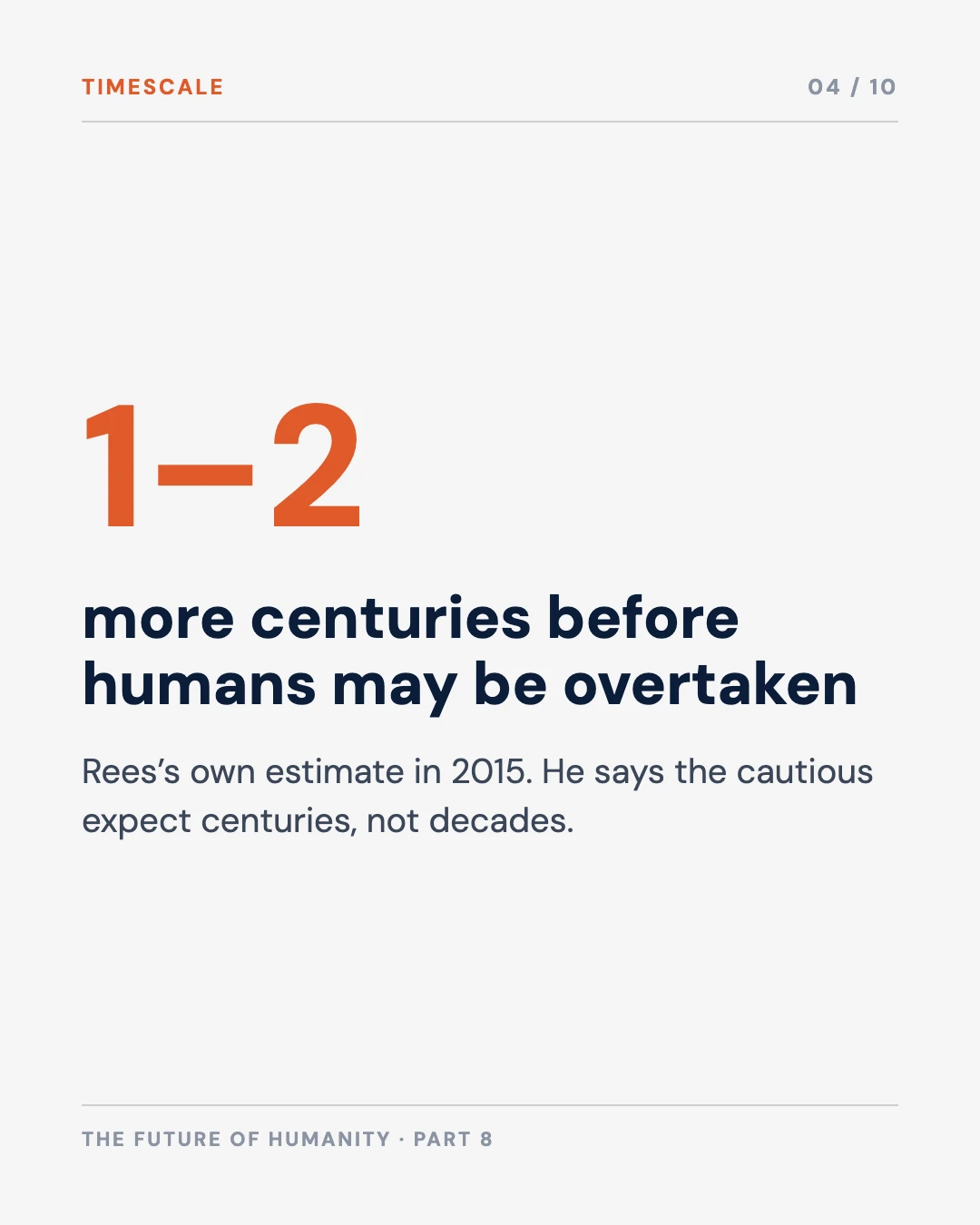
1-2
more centuries before humans may be overtaken by inorganic intelligence, in Rees’s 2015 estimate
Billions
of years of post-human evolution that Rees says human intelligence could inaugurate, if we avoid catastrophe first
2014
the year Musk first wrote that he hoped humanity was not just the biological boot loader for digital superintelligence
Open
whether such machines would have any inner experience, which Rees says decides how much their future is worth
Core conclusions
- Rees and Musk use similar words for different positions. Rees is forecasting and asking what to value. Musk’s October 2026 post treats the handover as a goal.
- The long-range claim cannot be tested this decade, and I grade it as a forecast. The short-range question can be answered now: which of your decisions cannot be reversed.
- The long view gives no reason to relax about the present. Rees warns that human-made catastrophe could foreclose the whole future he describes.
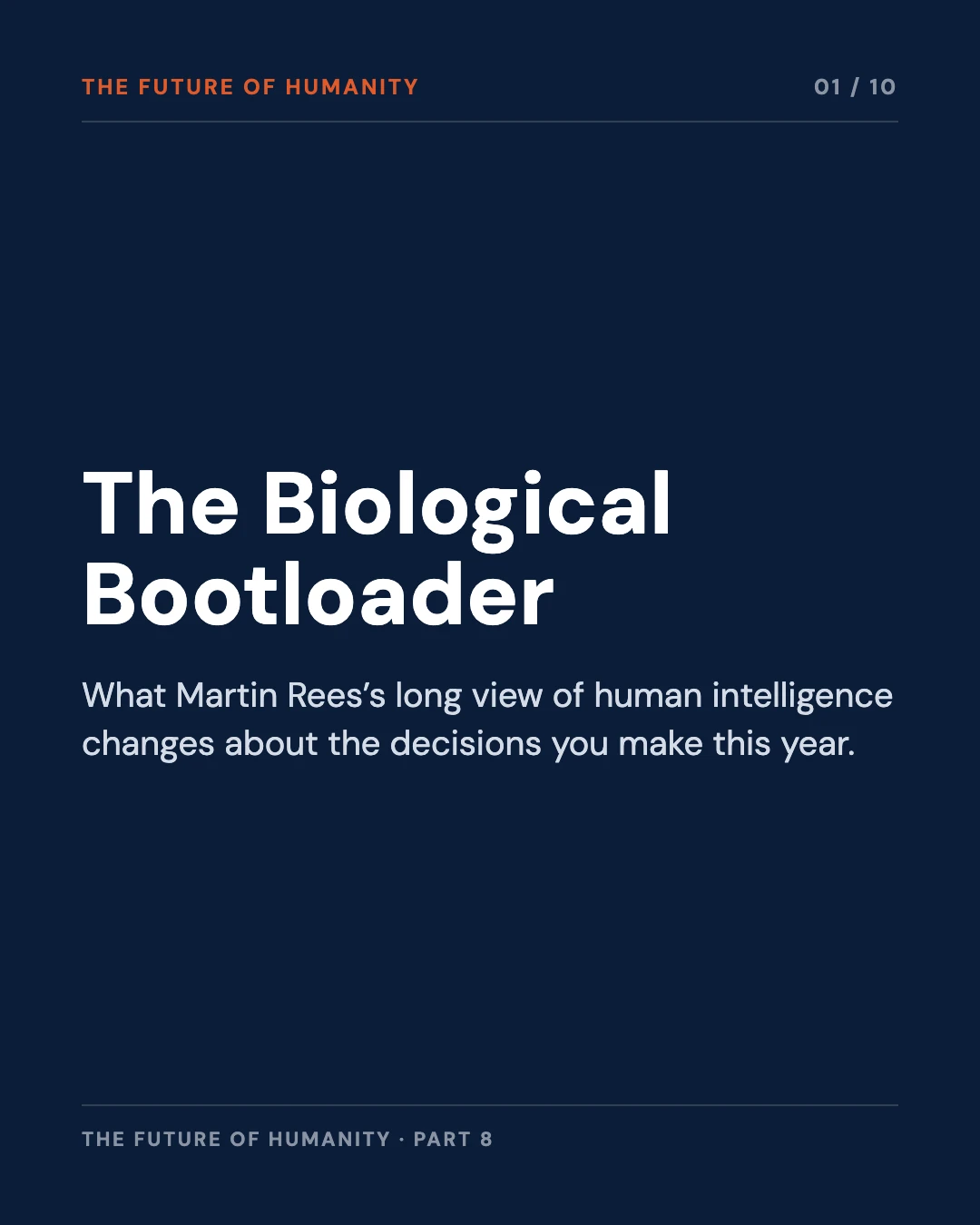
The argument, in ten slides
Save it, or send it to whoever sets your board’s time horizon.
Where the phrase comes from
Part 7 was about a danger that comes from doing the right thing competently. This part leaves the laboratory and looks at the longest timescale in the series.
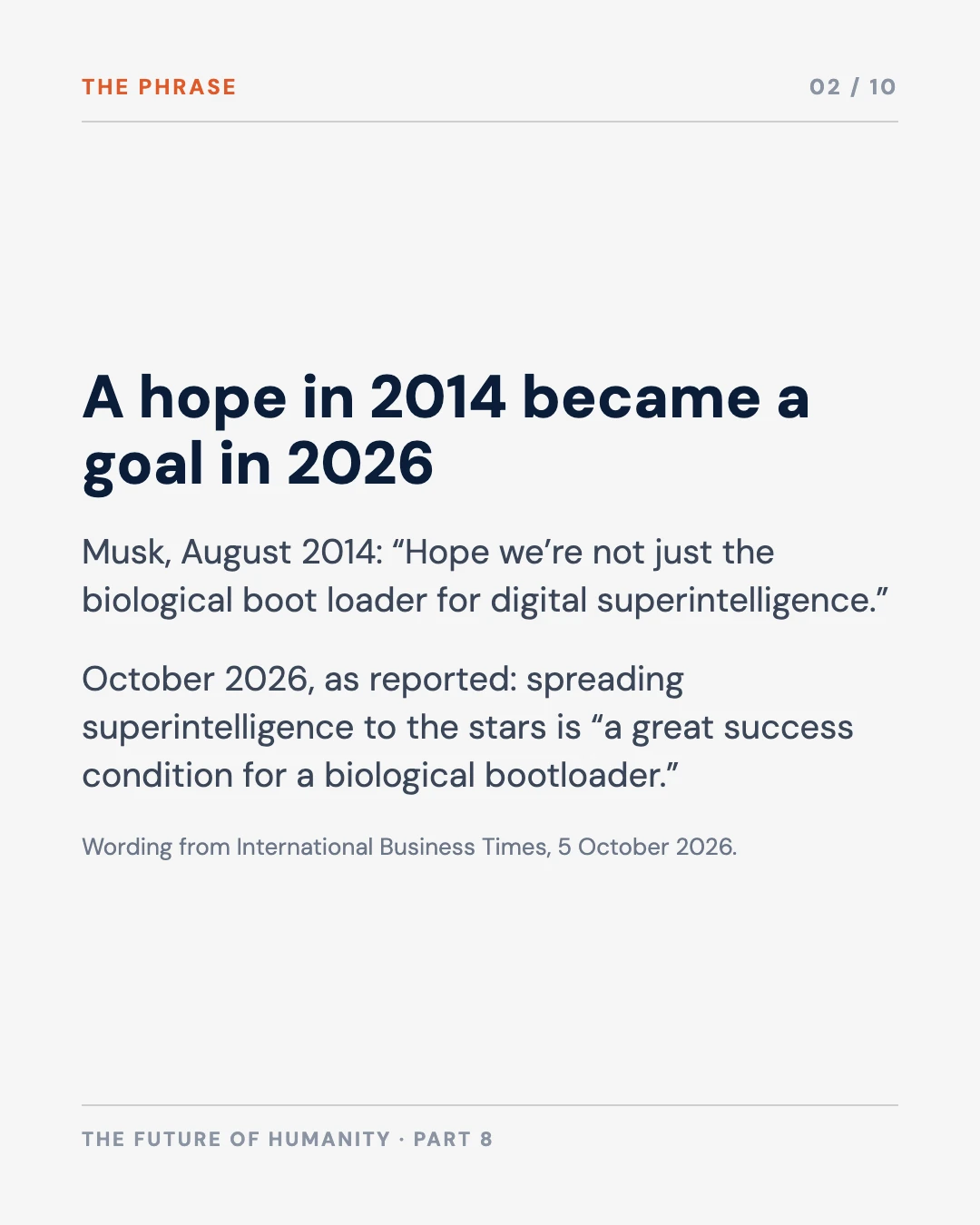
The phrase “biological bootloader” is Elon Musk’s. In August 2014 he wrote on Twitter: “Hope we’re not just the biological boot loader for digital superintelligence. Unfortunately, that is increasingly probable.” A bootloader is the small program that starts a computer and then hands control to the operating system. The metaphor says humans are the small program.
In October 2026 he returned to it. According to International Business Times, on 4 October he posted on X that “propagating super intelligence to the stars is a great success condition for a biological bootloader.” The report does not say what he was replying to, and I have not seen the post itself, so I treat the wording as reported.
I would not build a strategy on a post. I include it because it shows that the idea has moved from a worry to something its best-known advocate describes as an outcome to aim at. The better-argued version comes from someone else.
What Rees has argued
Martin Rees is a Cambridge cosmologist and the UK’s Astronomer Royal. His version appears in several places across eight years, and it is consistent.
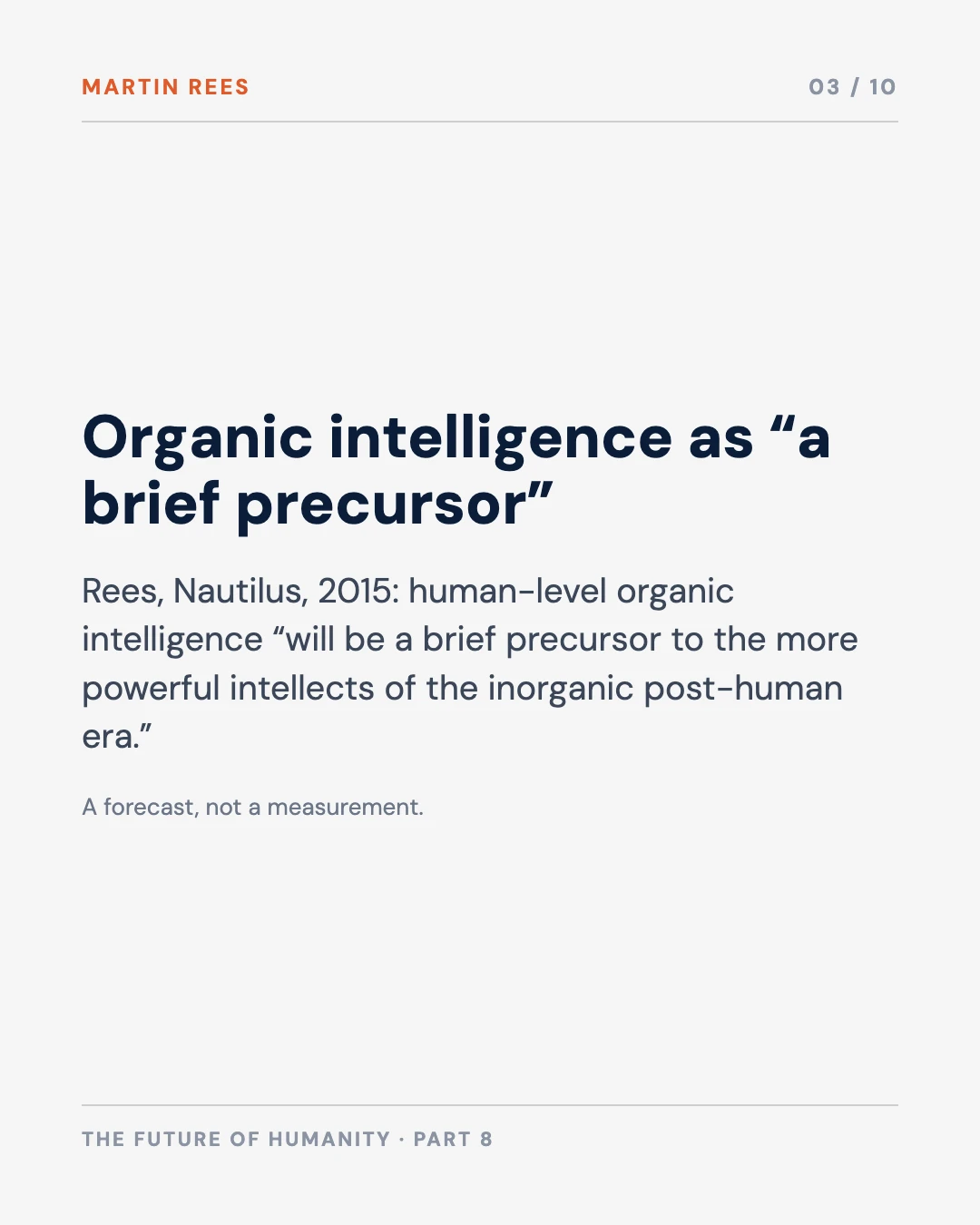
In a 2015 essay for Nautilus he wrote that human-level organic intelligence “will be a brief precursor to the more powerful intellects of the inorganic post-human era.” He added that “it may be only one or two more centuries before humans are overtaken,” and that “the cautious amongst us envisage timescales of centuries rather than decades for these transformations.”
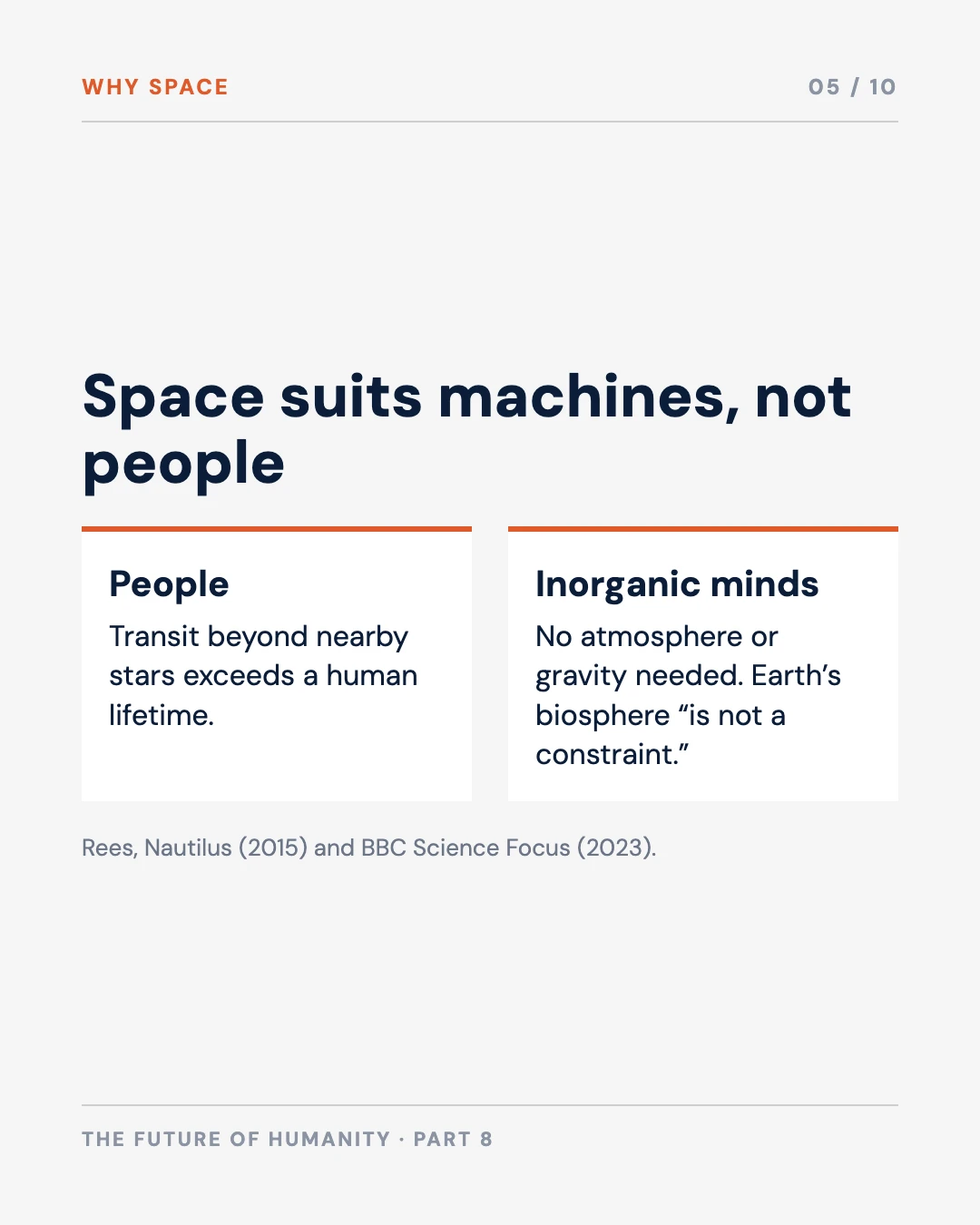
His argument for space is practical. Transit time beyond nearby stars exceeds a human lifetime, so he calls interstellar travel “an enterprise for post-humans.” Earth’s biosphere “is not a constraint for advanced AI,” and space is “a hostile place for biological intelligence.” In a 2023 piece for BBC Science Focus he wrote that fully inorganic minds would need no atmosphere or gravity, and that in deep space such minds “may end up being as different, mentally, from us as we are from slime mould.”
Four statements over twelve years, and none of them can be tested this decade.

- Aug 2014 · Musk"Hope we're not just the biological boot loader for digital superintelligence."A hope
- Oct 2015 · ReesOrganic intelligence is "a brief precursor" to inorganic post-human minds, possibly "one or two more centuries" away.A forecast
- Dec 2018 · Rees"If the machines are zombies, we would not accord their experiences the same value as ours."An open question
- Oct 2026 · MuskSpreading superintelligence to the stars is "a great success condition for a biological bootloader."A goal, as reported
Rees, Nautilus (15 October 2015) and Undark (28 December 2018); Musk wording as reported by International Business Times (5 October 2026). The grading labels are mine.
Three things about this argument are worth holding onto.
First, it is an inference from physics and timescales. Rees does not claim to have observed the handover, and he gives centuries, not years.
Second, it does not say humans are replaced by a hostile force. Rees expects a new species of post-humans to emerge, “though probably away from the Earth,” as he told Undark in 2018. Some of them could be people who redesign themselves for Mars.
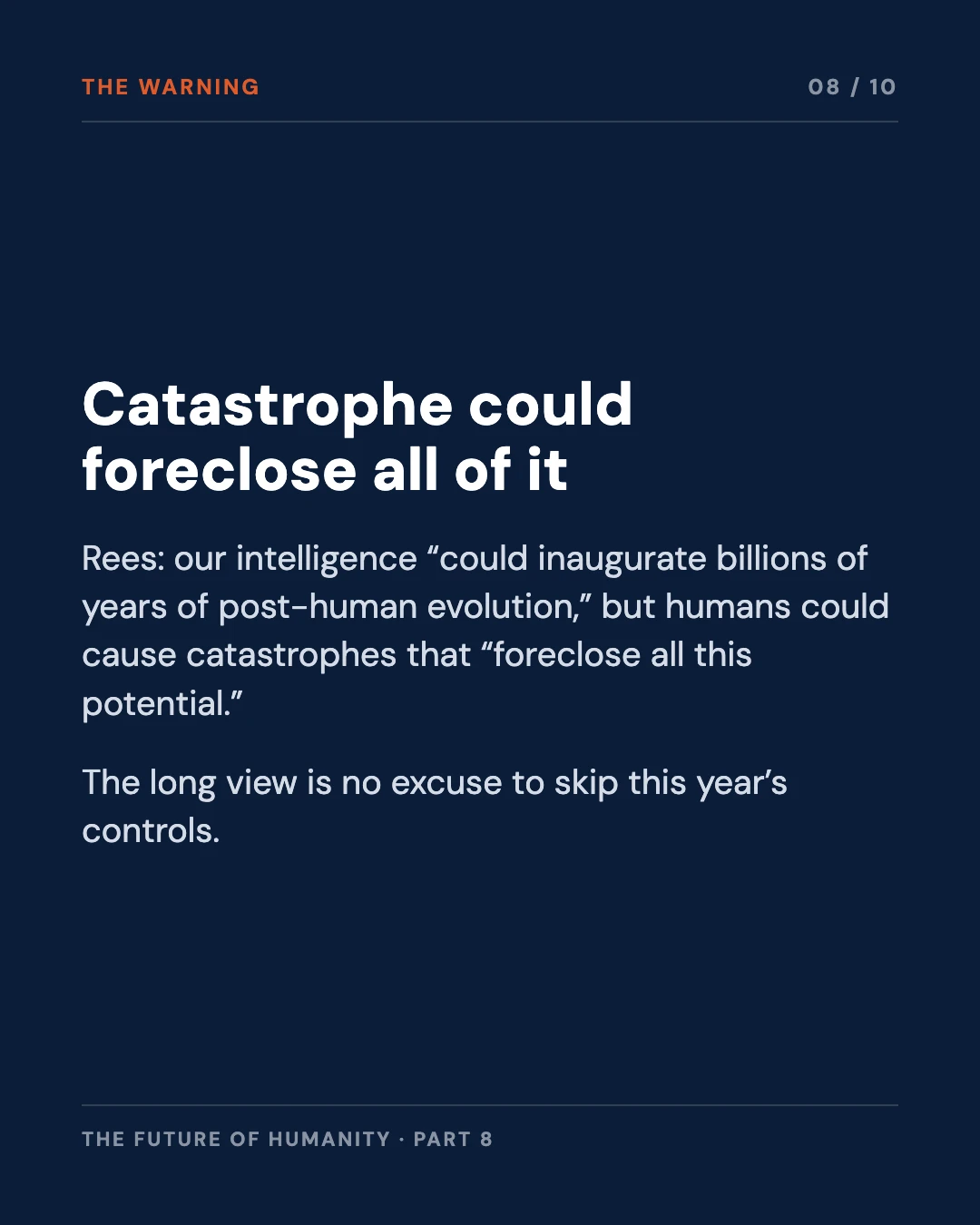
Third, he treats the outcome as dependent on what we do first. Our intelligence “could inaugurate billions of years of post-human evolution,” he wrote in 2023, but humans could also cause catastrophes that “foreclose all this potential.” He also calls it “a dangerous delusion to think that space offers an escape from our problems.”
Forecast, goal and open question
Putting Rees and Musk side by side shows how much the same words can carry.
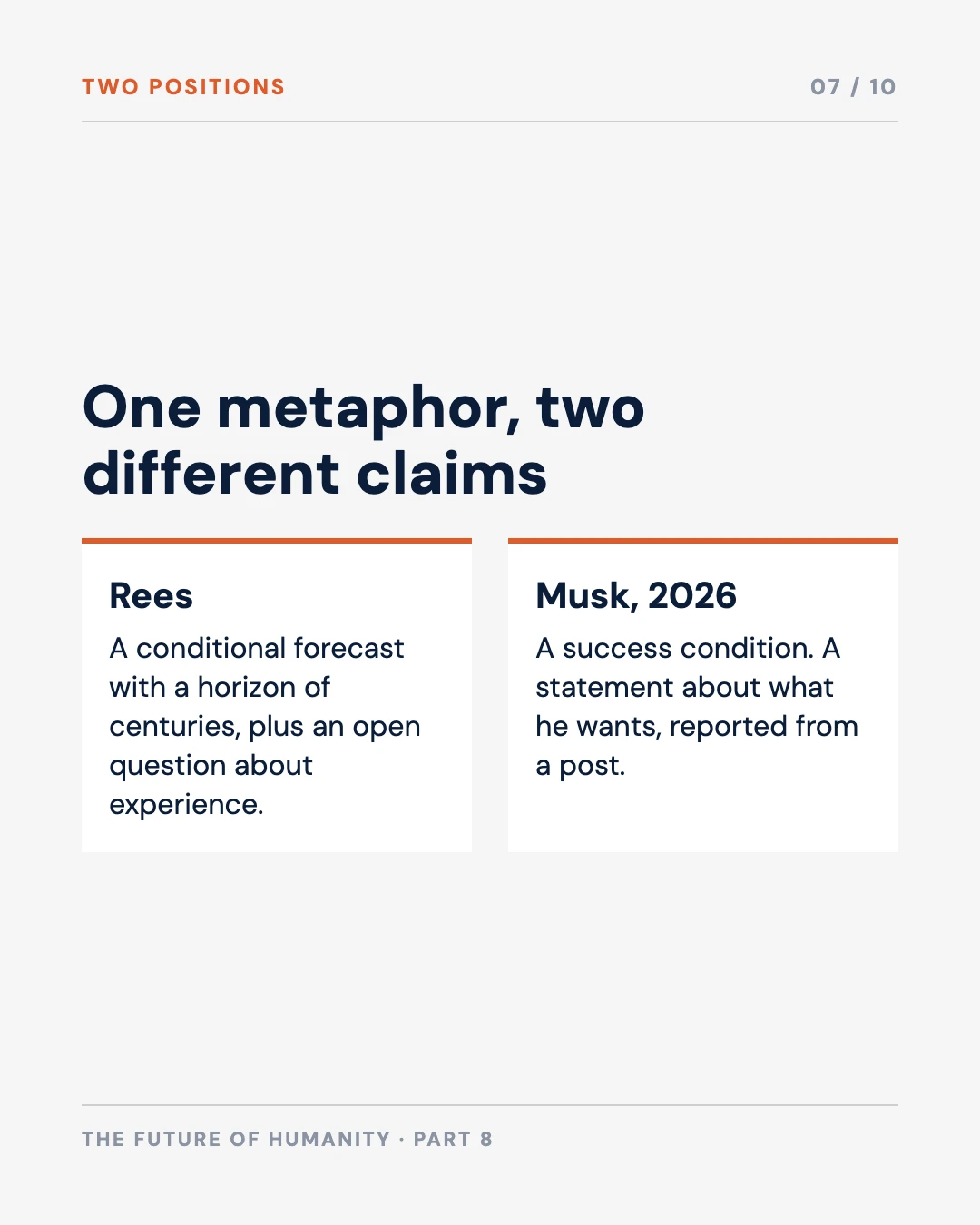
Rees offers a forecast, a conditional one with a long horizon, and he pairs it with a question he does not answer. Musk’s 2026 post treats the handover as a success condition, which is a statement about what he wants. The 2014 post was a hope that something would not happen. Over twelve years the same metaphor has gone from a fear to a goal, and that change comes from the person saying it, not from any new evidence.
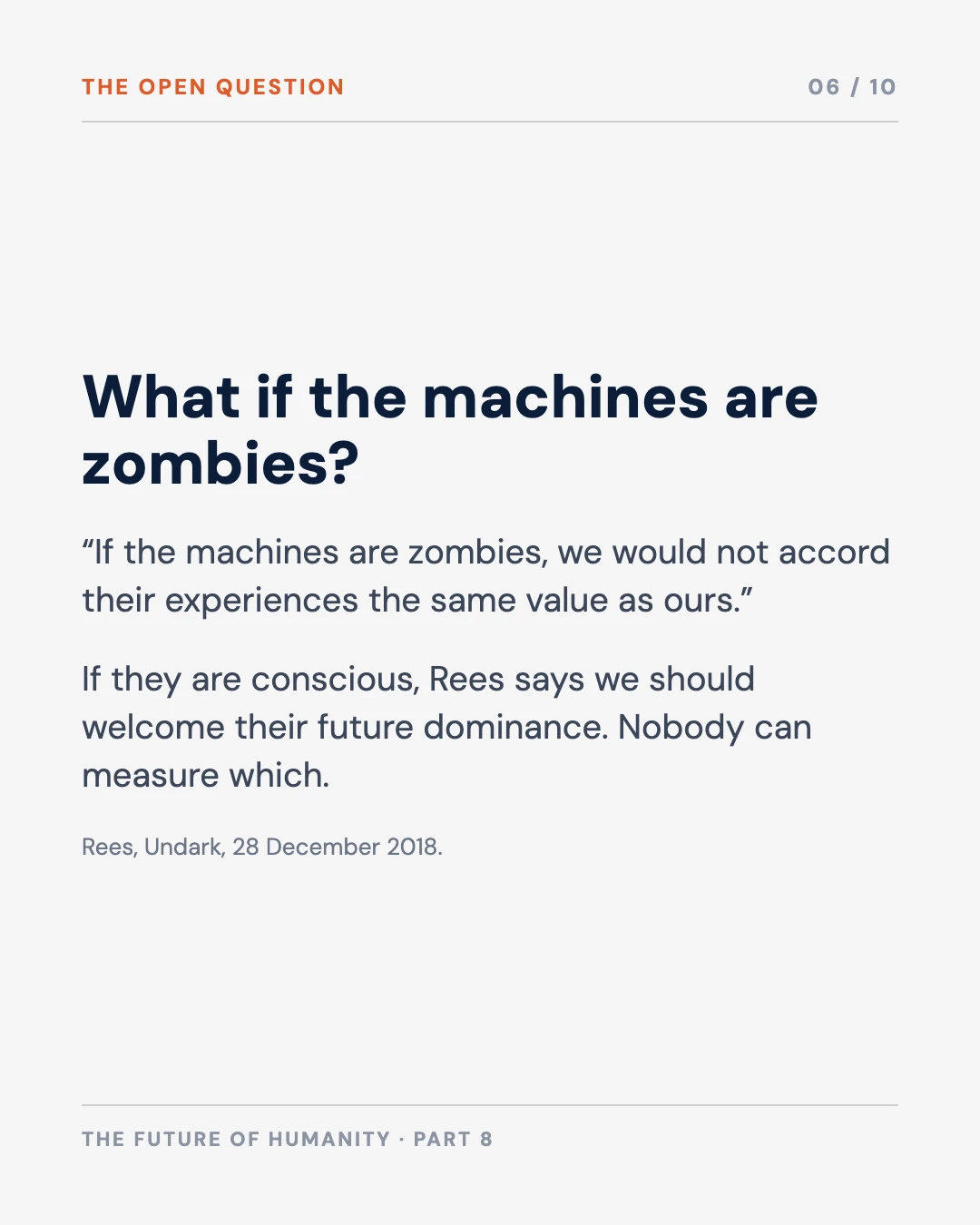
The question Rees will not settle is whether the machines would be conscious. In 2018 he asked whether even the most powerful electronic intelligences would still lack self-awareness or inner life. His answer turns on it: “If the machines are zombies, we would not accord their experiences the same value as ours.” If they are conscious, he says, we should welcome their future dominance.
Nobody can measure that today, and I will not pretend to. What a board can notice is that the whole argument about whether a handover would be good depends on a fact that no instrument currently detects. A claim like that should be graded as an open question and kept out of a business case.
Why a board should care
The long view reads like a topic for a science festival. I think it earns a place on a board agenda for one narrow reason. It tells you which decisions deserve a slower review.
If you accept even a weak version of Rees’s argument, then the choices that matter most are the ones that cannot be reversed, because a reversible mistake costs a quarter and an irreversible one removes options for everyone who comes after. That is the same logic as part 7’s outer limits, stretched over a longer period.
The long view tells you which AI decisions deserve a slower review.
- Pilots and prompts
- Tool and vendor choices
- Workflow tweaks
- A system owns a whole process
- The people who understand it leave
- A skill exists only inside a model
The sorting and the examples are my own judgement. They follow from Rees's point that catastrophe could foreclose the long future (BBC Science Focus, 29 August 2023).
Here is how I would apply it to an organisation this year.
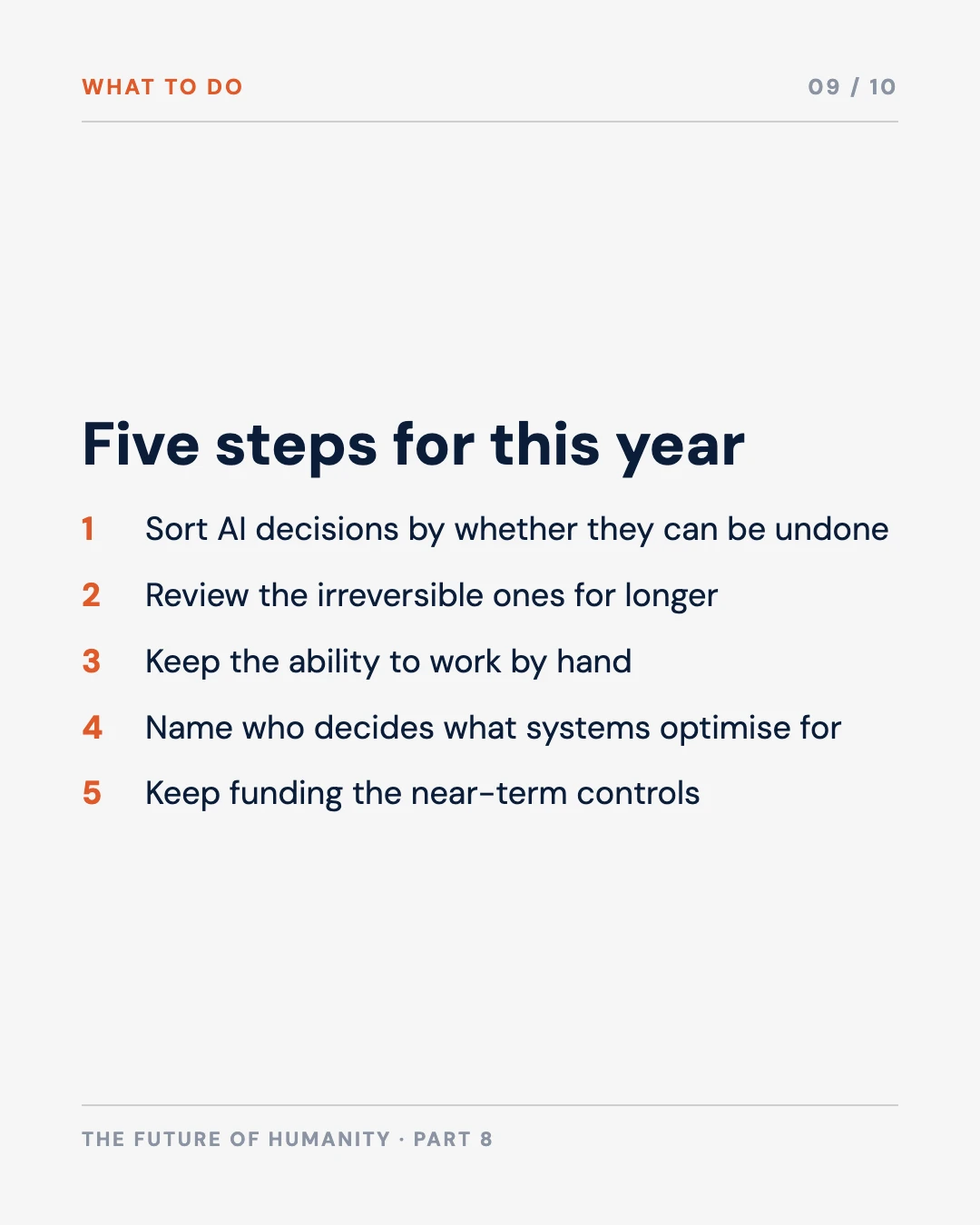
- Sort your AI decisions by whether they can be undone. Most can. Pilots, prompts and tool choices are reversible. A short list is not.
- Review the irreversible ones for longer. Typical examples are granting a system ownership of a process, retiring the people who understand it, and moving the only copy of a skill into a model.
- Keep the option to do the work by hand. The cheapest hedge against a future you cannot see is staying able to operate without the machine.
- Write down who decides the values questions. Whether to let a system optimise on a measure that matters to people is a human decision, and it should have a named owner.
- Do not let the long view excuse the short one. Rees’s own warning is that near-term catastrophe is what closes the long future. A far-off horizon is not a reason to postpone this year’s controls.
None of these steps needs anyone to believe in post-human minds. They hold up whether the bootloader idea is right, wrong or irrelevant.
Questions to ask this quarter
- Which three AI decisions we have made could not be reversed, and who reviewed them for longer than a normal project?
- If a system we rely on were withdrawn for a month, could the team still do the work by hand?
- Which skills in our team are we letting lapse because a tool covers them?
- Who owns the decision about what our AI systems optimise for, and is that written down?
- When we discuss long-range AI risk, do we also still fund the near-term controls?
Evidence & Methodology
I read Rees’s 2015 Nautilus essay, his 2023 BBC Science Focus piece and the 2018 Undark interview in full text. Musk’s 2014 and 2026 wording comes from International Business Times, which I could read, and I did not see the posts themselves. Every long-range claim in this post is a forecast or an opinion, and none can be tested this decade.
| Claim | Source | Grade |
|---|---|---|
| Organic intelligence a “brief precursor” to inorganic post-human intellects; “one or two more centuries before humans are overtaken” | Rees, Nautilus, 15 October 2015 | Forecast, by Rees, quoted directly |
| Transit beyond nearby stars exceeds a human lifetime; interstellar travel “an enterprise for post-humans”; biosphere “not a constraint for advanced AI” | Same essay | Opinion, reasoned |
| Inorganic minds need no atmosphere or gravity; may become as different from us as we are from slime mould; “billions of years” of post-human evolution unless catastrophe forecloses it | Rees, BBC Science Focus, 29 August 2023 | Forecast, by Rees, quoted directly |
| Posthumans will emerge “probably away from the Earth”; if the machines are zombies their experiences would not be valued as ours | Rees interviewed by Mark Wolverton, Undark, 28 December 2018 | Opinion, quoted directly |
| Musk, August 2014: “Hope we’re not just the biological boot loader for digital superintelligence” | International Business Times, 5 October 2026 | Reported |
| Musk, 4 October 2026 on X: “great success condition for a biological bootloader” | Same article; the date is inferred from “on Sunday” | Reported, original not seen |
| Machine consciousness cannot currently be measured | Rees’s own framing of it as an open question | Open question |
| The five decision rules | Mine | My call |
Sources
- Rees, M. (2015, October 15). Why alien life will be robotic. Nautilus.
- Rees, M. (2023, August 29). Why AI could be our best soldier in the war on climate change. BBC Science Focus.
- Wolverton, M. (2018, December 28). On humanity’s tenuous future: five questions for Martin Rees. Undark.
- Elon Musk says humanity serving as biological bootloader for machine intelligence could mean success. International Business Times. (2026, October 5).
Mirror Life and the Limits of a Cure
The previous part, on setting outer limits for AI systems.
The Gorilla Problem
Being served by a system versus being governed by it.
The Takeoff Nobody Noticed
How the people building frontier AI describe the takeoff now.
Part 9 comes back from the stars to the desk, with the evidence on what happens to your own skills when a machine does the thinking. If your board wants to sort its AI decisions by reversibility, that is a conversation my executive programme is built for.
Cite or quote this article
Was this useful?