
Listen to this article
Jump to a section
In this article
Executive Summary
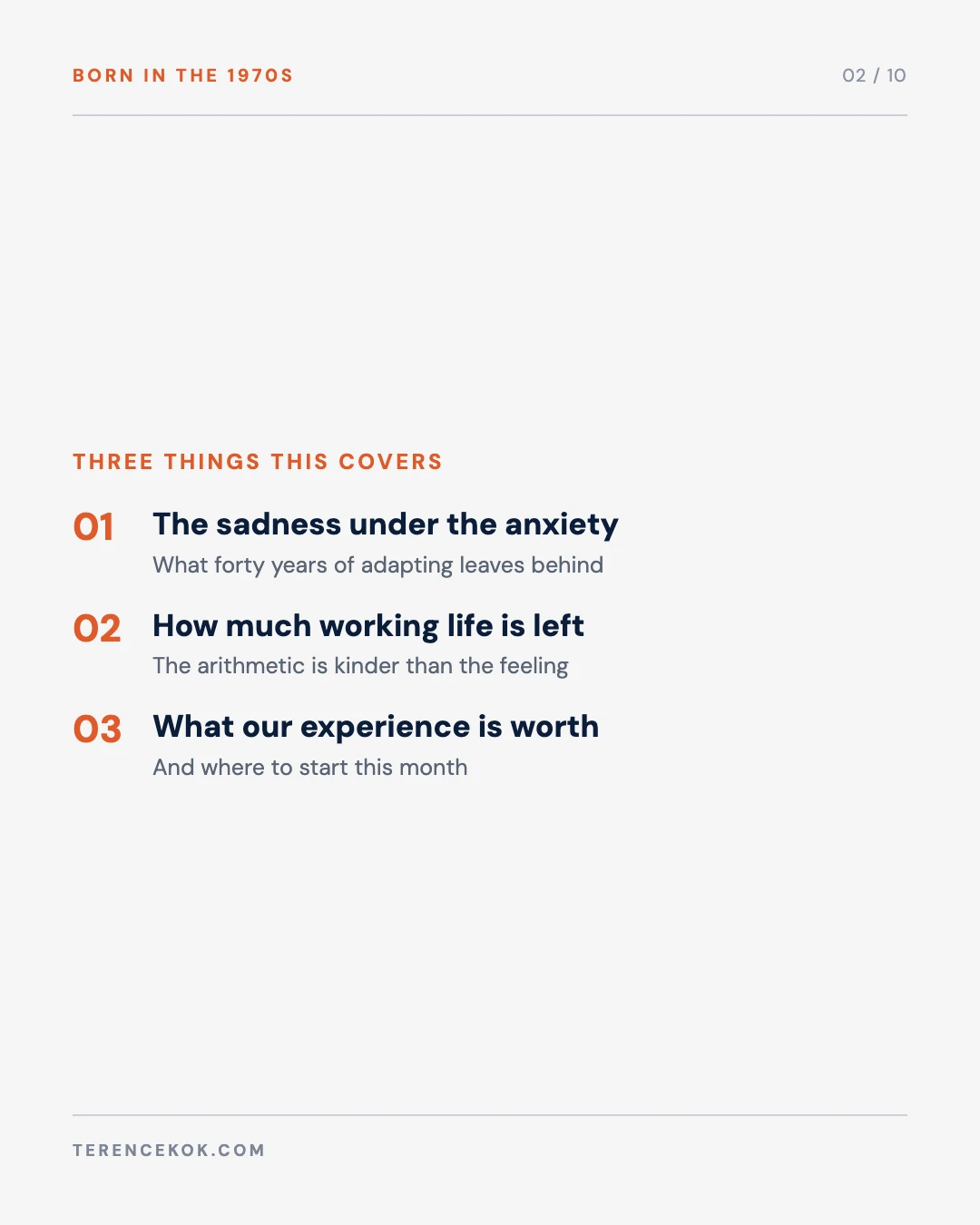
If you were born in the 1970s you are somewhere between 47 and 56. Too early to retire, and many of us feel too late to start again with AI. Underneath the anxiety there is often a quieter sadness, and it deserves a hearing before it gets a to-do list. The arithmetic is also kinder than the feeling: most of us have close to two decades of working life left, and the thing AI most needs from people is judgement we already have.
Core conclusions
- The sadness is a reasonable response to forty years of adapting. It points to grief nobody made time for and a nervous system that has not stood down since the 1990s.
- Under Singapore’s retirement and re-employment ages from July 2026, someone born in 1975 can work to 2044. That is roughly as long as the smartphone has existed.
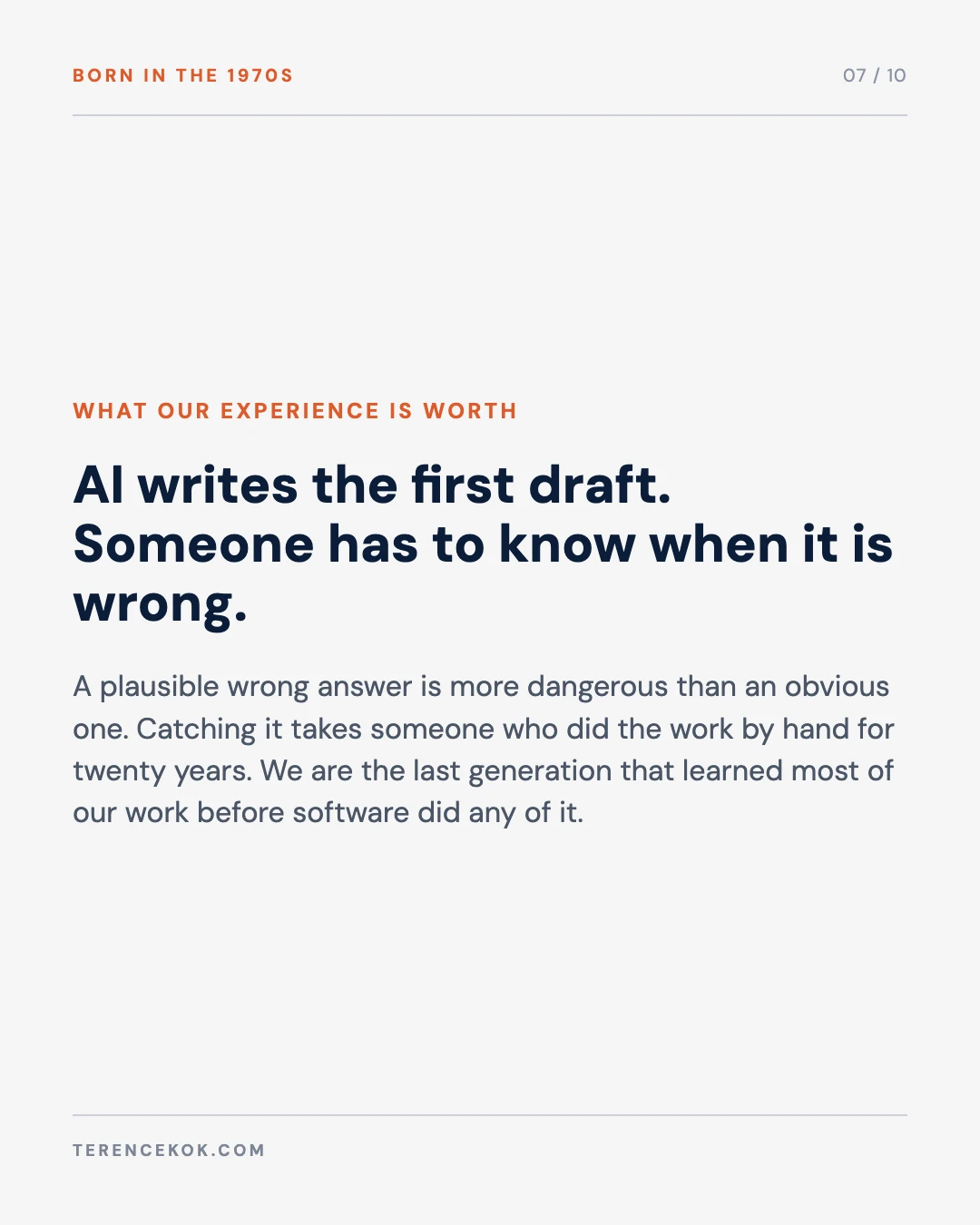
- AI produces the first draft. Knowing when the draft is wrong takes someone who did the work by hand, and our generation is the last one that did.
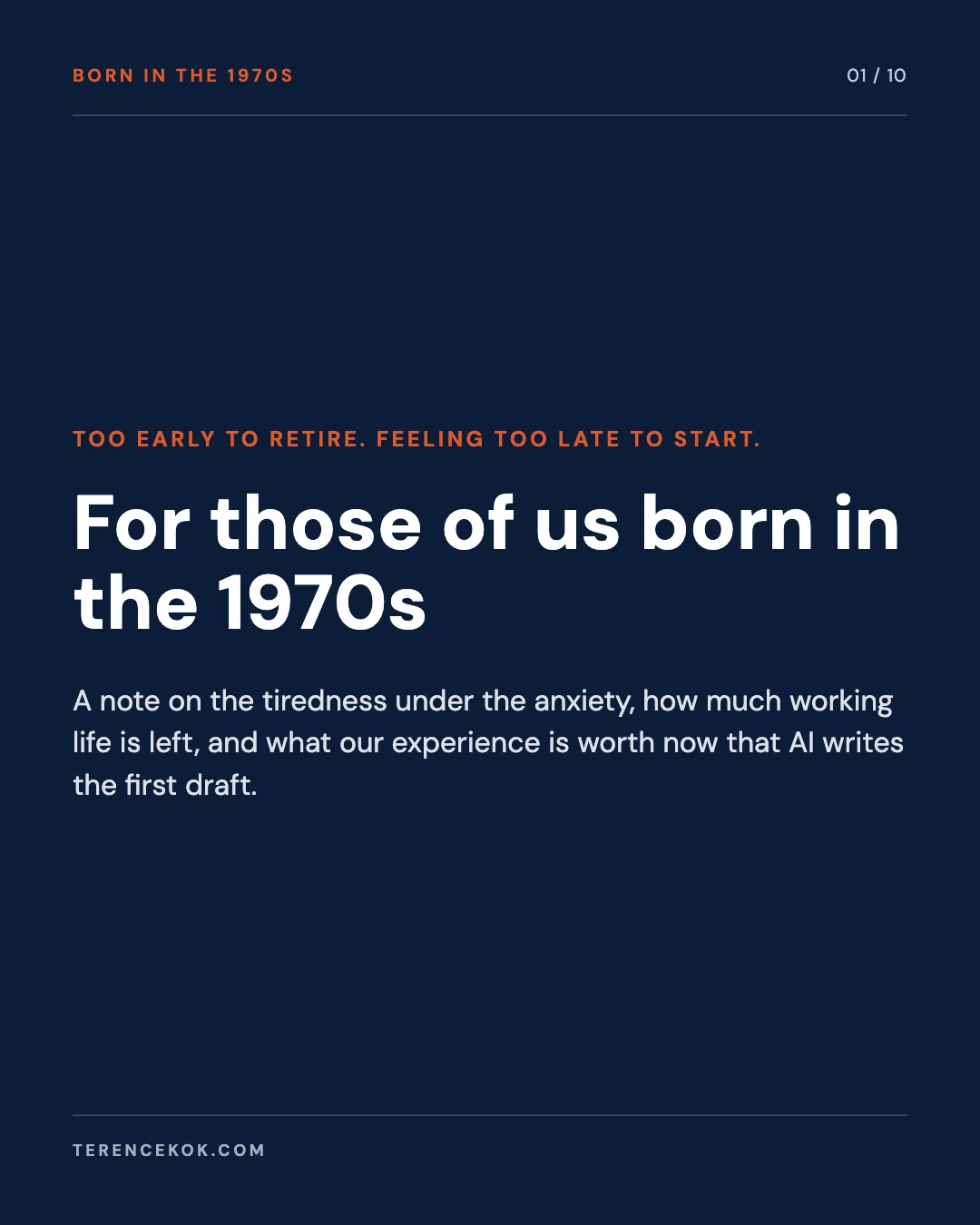
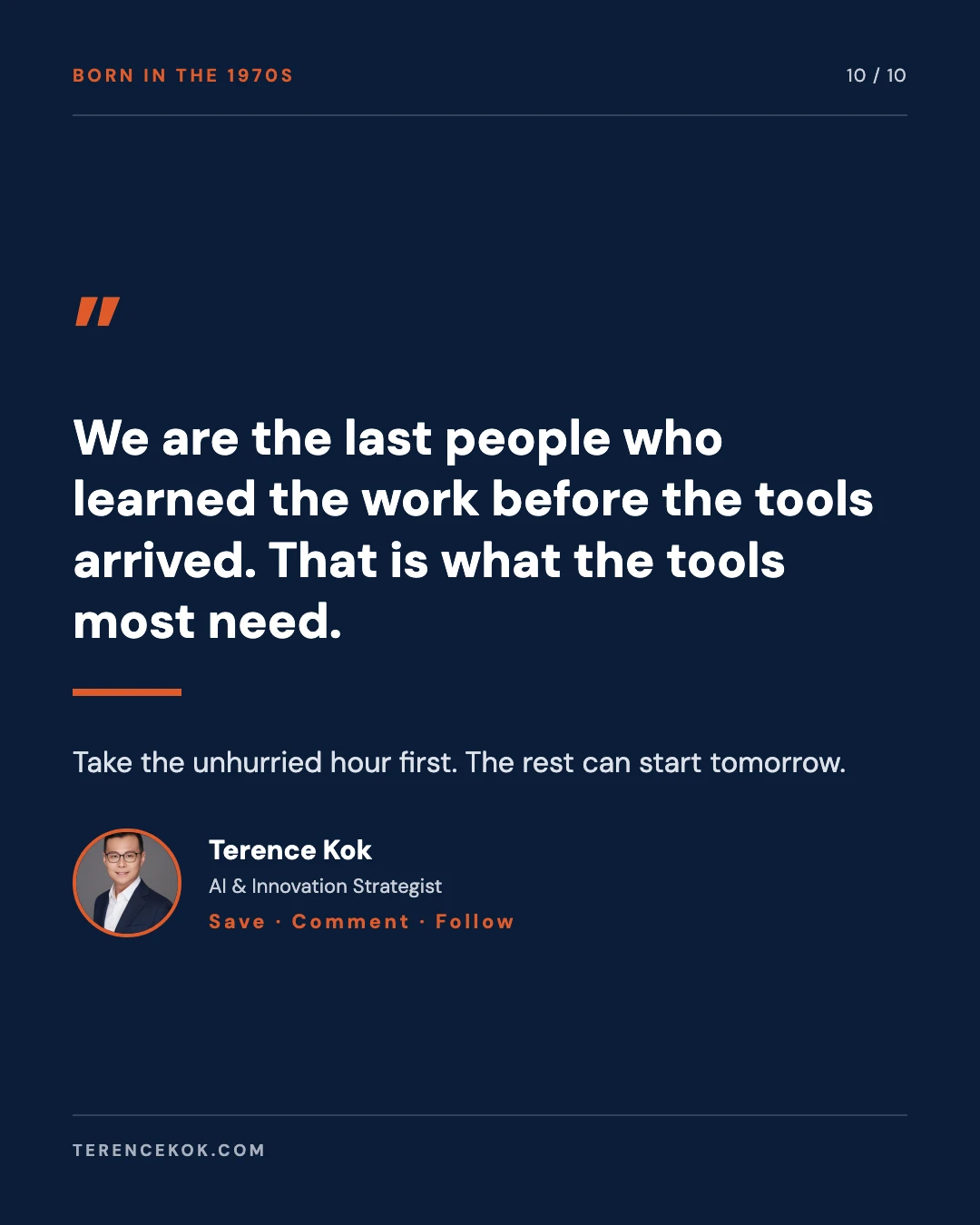
The note, in ten slides
Save it, or send it to someone your age who has gone quiet about all this.
What we have lived through
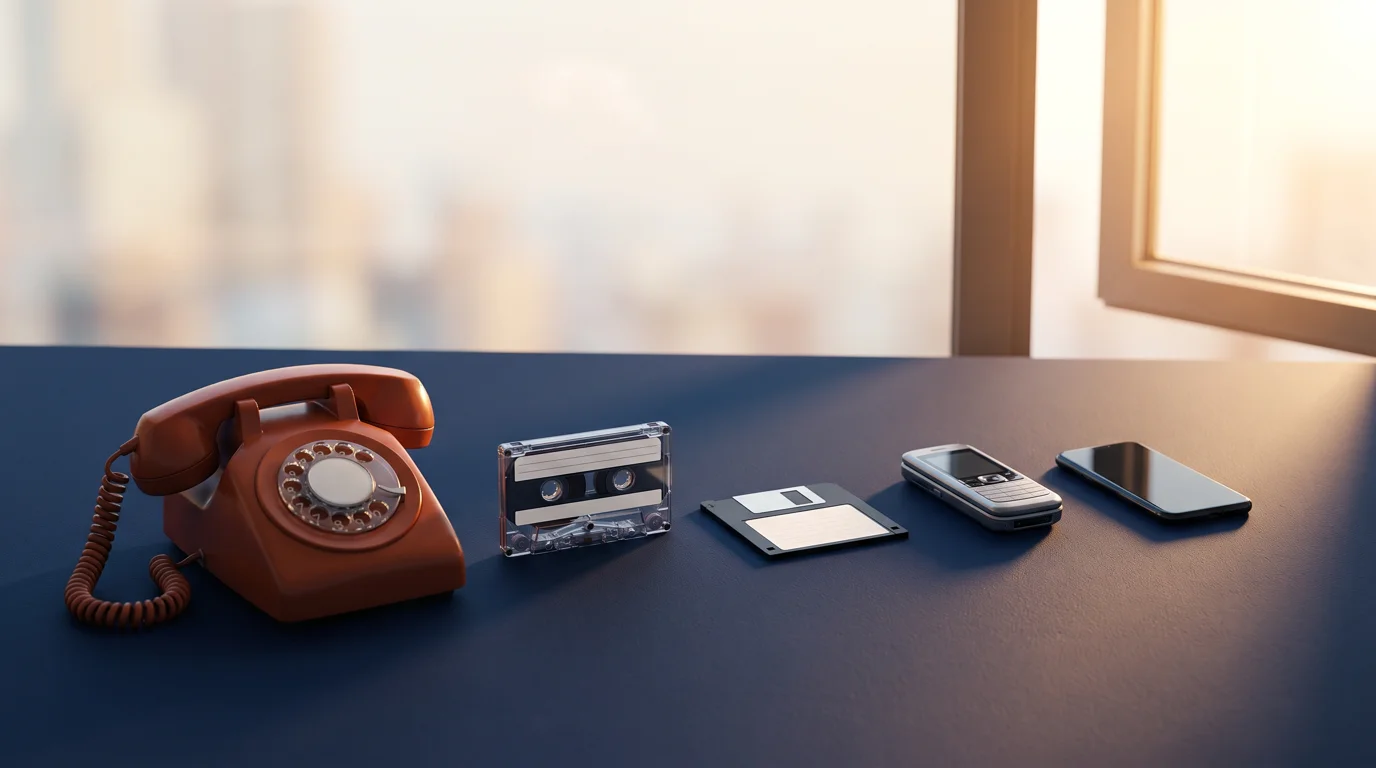
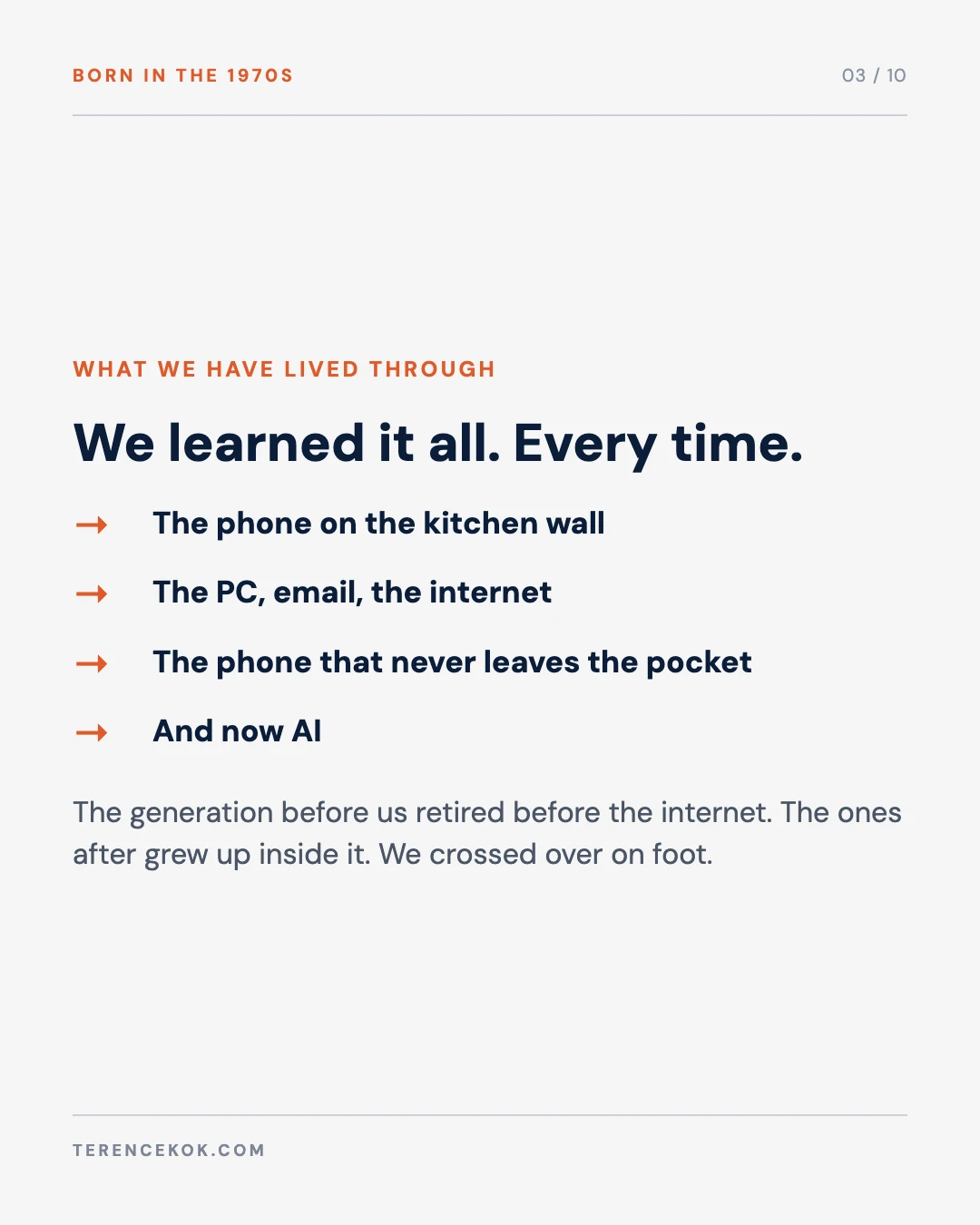
We remember a phone fixed to the kitchen wall, and a letter that took a week to arrive and a week to answer. Then came the personal computer, then email, then the internet, then a phone that never left the pocket, then the feeds, then remote work, and now AI. Each arrived with the same message: learn this, quickly, or be left behind.
We learned it. Every time. Most of us have rebuilt how we work four or five times over, and we did it while raising children, looking after ageing parents and carrying a mortgage. The generation before us mostly retired before the internet reshaped their jobs. The generations after us grew up inside it. We are the ones who crossed over on foot.
So when AI arrives with the same message, it lands on people who are already tired. The first reaction is anxiety, and that is familiar. The second reaction, the one fewer people talk about, is a kind of sadness.
The sadness under the anxiety
Anxiety for our generation has become something close to a default setting. It is the habit of scanning for the next change so it does not catch us unprepared. It was useful once, and it has been running for a long time.
The sadness underneath is different. It does not push us to act. It sits in the background, and when we notice it, we tend to treat it as a weakness to manage or a mood to push through, because there is always another thing to learn.
I think the sadness deserves more respect than that. In my experience it is often the most honest part of us. It is the part that has noticed how fast the years are going and how much has changed, and that speed and efficiency were never the same thing as a good life.
What the sadness is usually about
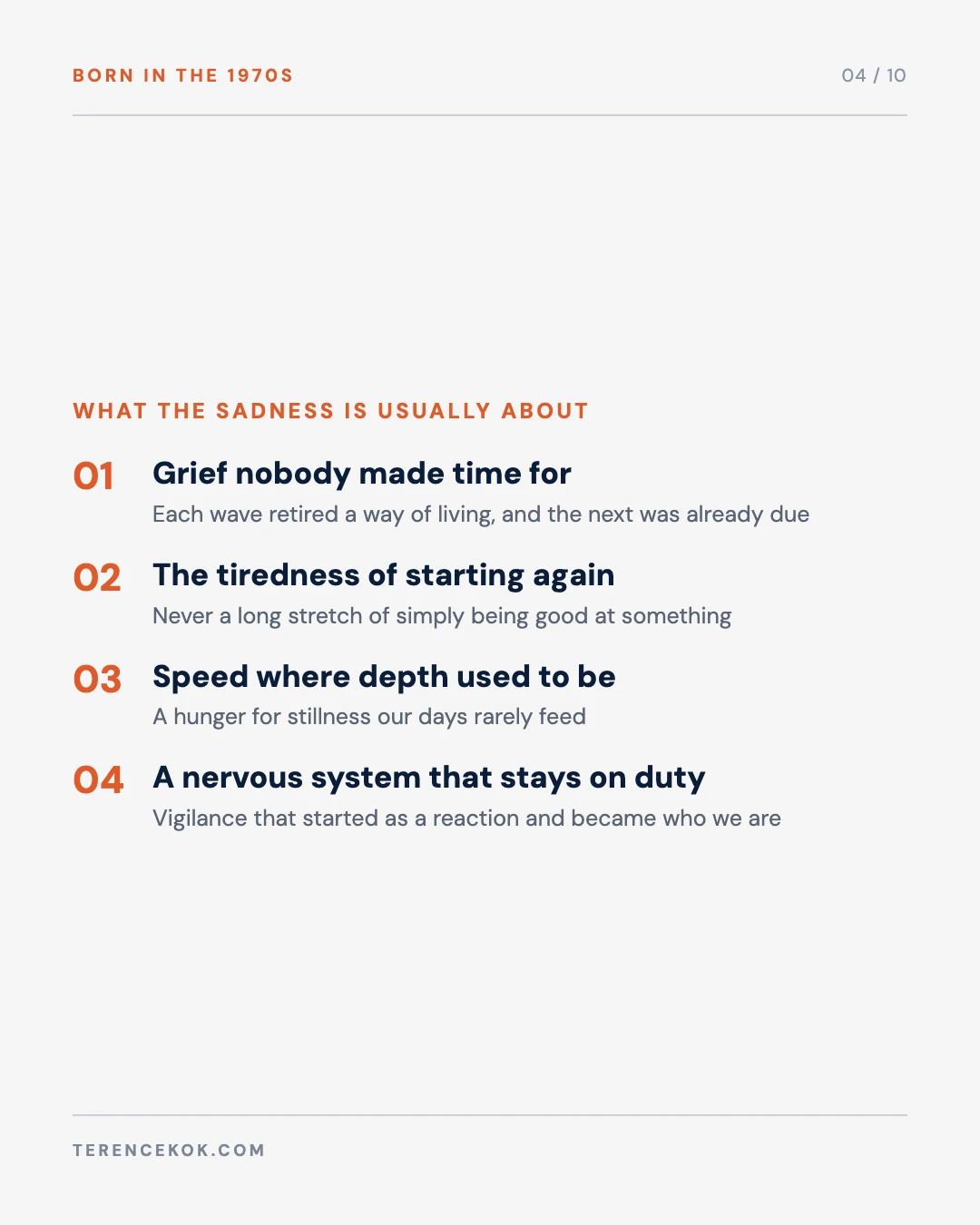
When people my age describe it to me, the same four things come up.
Grief nobody made time for. Each wave of change retired a way of living. The long phone call, the handwritten note, the office where people knew each other’s children, work that ended when you left the building. Those were real losses. We never mourned them because the next thing was already due, and the world rewarded competence over reflection.
The tiredness of starting again. When the ground rules of work reset every few years, there is never a long stretch of simply being good at something. We are always partway through learning the next thing. That kind of effort, sustained for decades, produces a weariness that a holiday does not fix.
Speed where depth used to be. Many of us remember a slower rhythm, where attention could settle on one thing for an afternoon. Much of modern work runs on notifications and urgency. The loss shows up as a hunger for stillness that our days rarely feed.
A nervous system that stays on duty. If you adopted vigilance early, as a way to get through unpredictable transitions, it eventually stops feeling like a reaction and starts feeling like who you are. The sadness is often the body’s quiet protest against being on guard for thirty years.
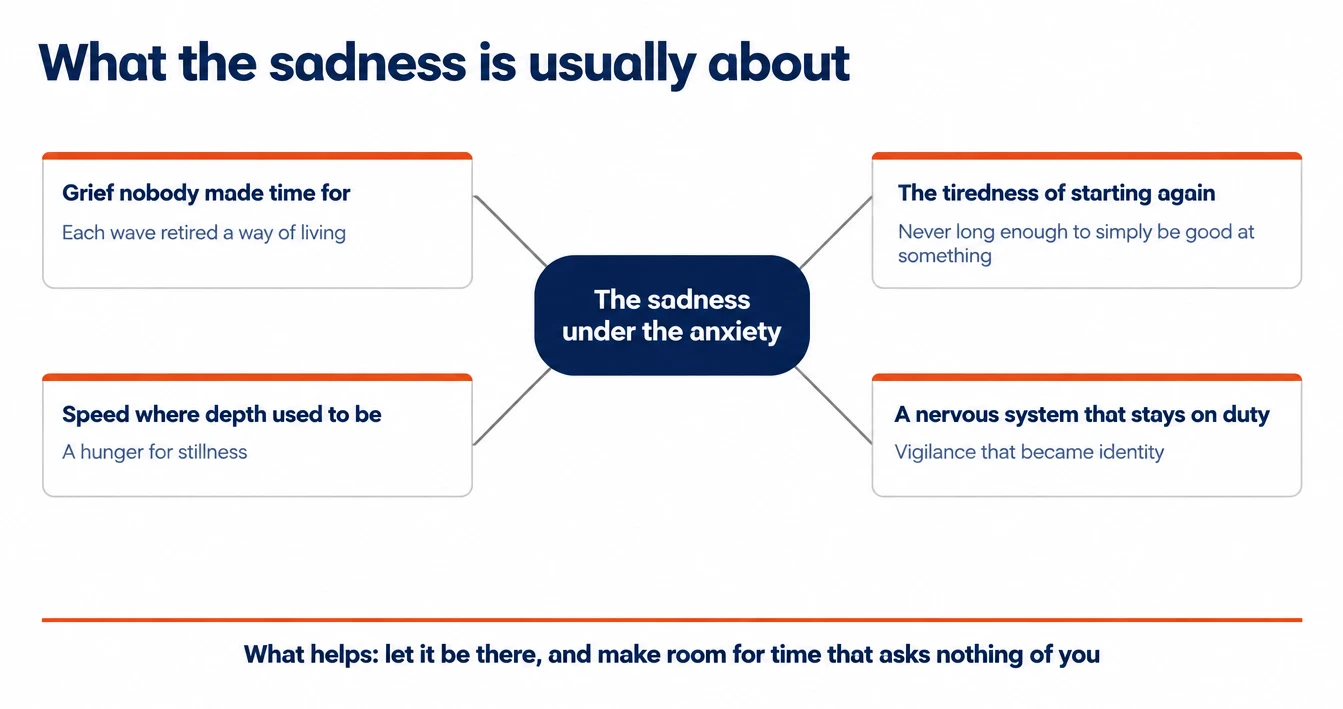
Trying to fix a feeling that has lived in the background this long usually feeds the anxiety. What helps is a different relationship with it: letting it be there without demanding that it be solved, and deliberately making room in the day for time that asks nothing of us. No optimising, no staying ahead, no preparing for the next cycle.
How much working life is left
The feeling says it is too late. The arithmetic says otherwise.
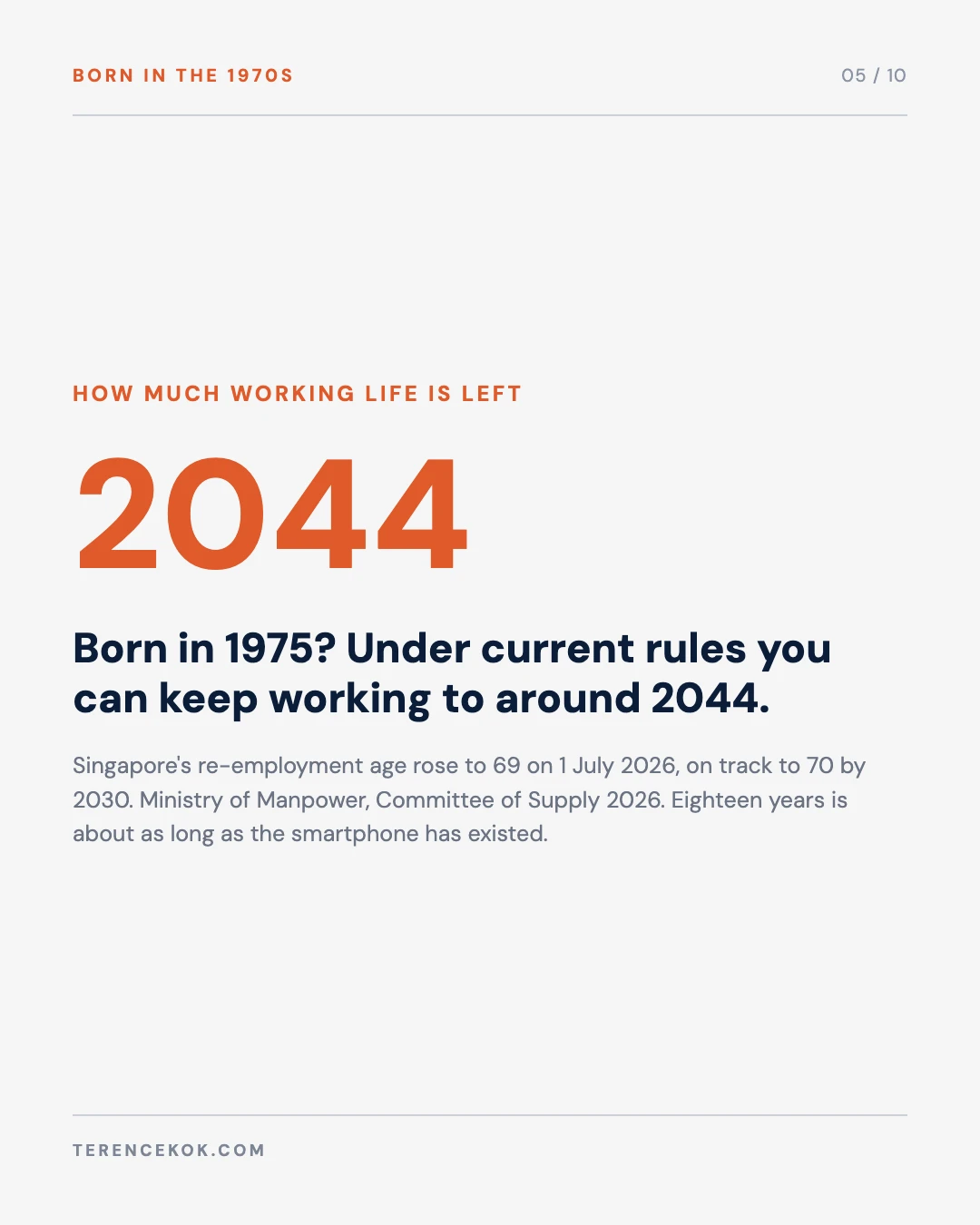
From 1 July 2026, Singapore’s retirement age is 64 and the re-employment age is 69, and the government has said it intends to reach 65 and 70 by 2030. Someone born in 1975 can therefore keep working to around 2044 under the rules already in force. That is roughly eighteen more years. The iPhone launched in 2007, nineteen years ago. We have about as much working life ahead as the smartphone has had in total.
That is enough time to learn something properly, use it for a decade and teach it to someone else. It is more time than most of the people now running AI teams have spent in their careers so far.
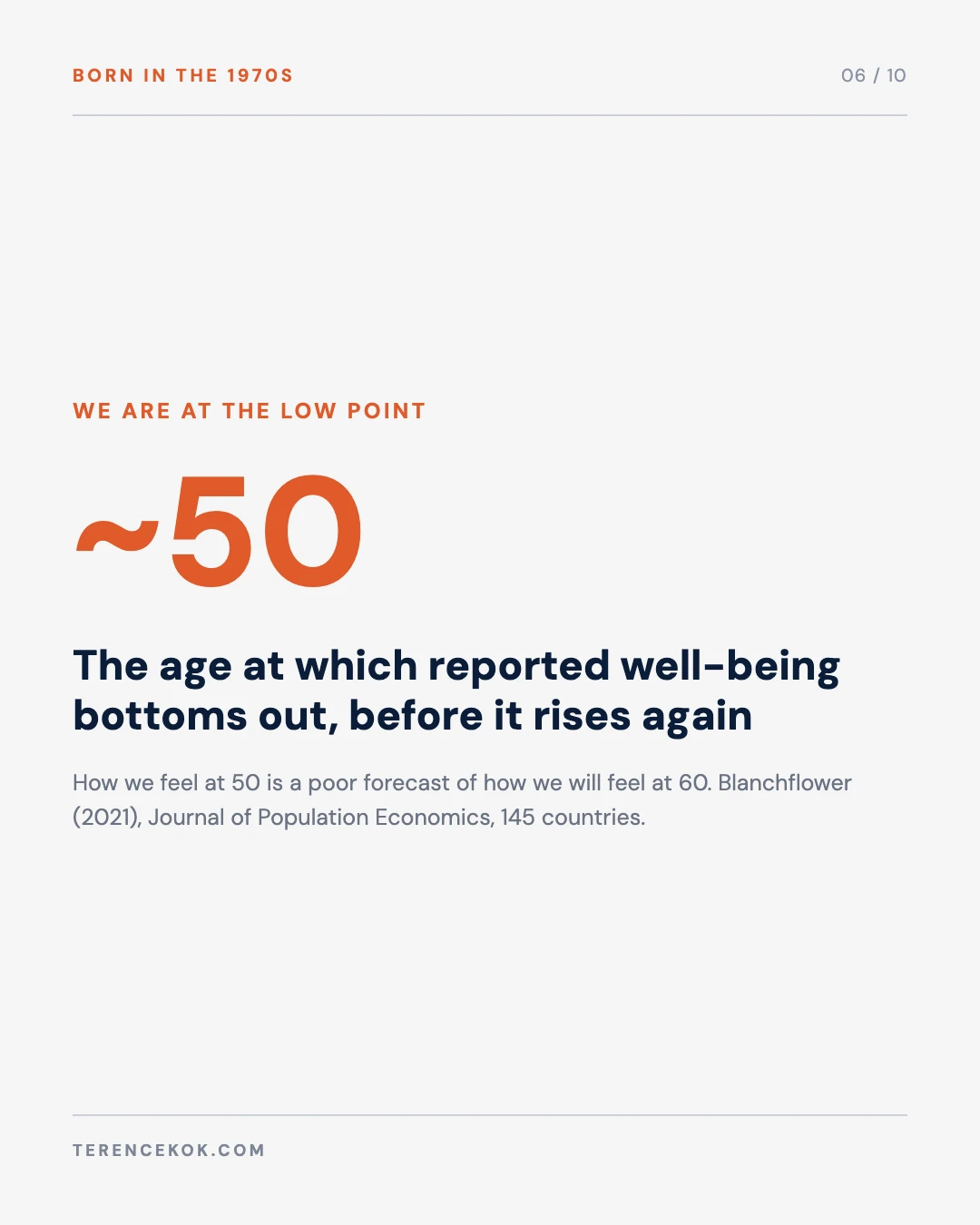
There is also a well-documented pattern in how people feel across a lifetime. David Blanchflower’s study of 145 countries found that reported well-being follows a U shape, with the low point around age 50, and then rises again. Our generation is sitting at the bottom of that curve right now. The research does not promise anything to any one of us, but it does suggest that how we feel at 50 is a poor forecast of how we will feel at 60.
What our experience is worth now
AI is very good at producing a plausible first draft. A board paper, a contract summary, a design option, a customer reply. What it cannot do is tell whether the draft is right, and a plausible wrong answer is more dangerous than an obvious one.
Catching those errors takes someone who has done the work without the tool. Someone who knows what a sound contract clause looks like because they have read a thousand of them, or who can smell a bad project estimate because they have lived through three that went wrong. In the organisations I work with, that person is usually over 45. The younger staff are faster with the tools. The older staff are the ones who notice when the tool is confidently wrong.
We are the last generation that learned most of our work before software did any of it. That can feel like being out of date. It is also the exact capability that makes AI safe to use, and it becomes scarcer every year as people who have only ever worked with the tools move up.
So the entry point for us is closer than it looks. It is to become the people who can use the tool on work we already understand, and say with authority when its answer should not be trusted.
Where to start this month
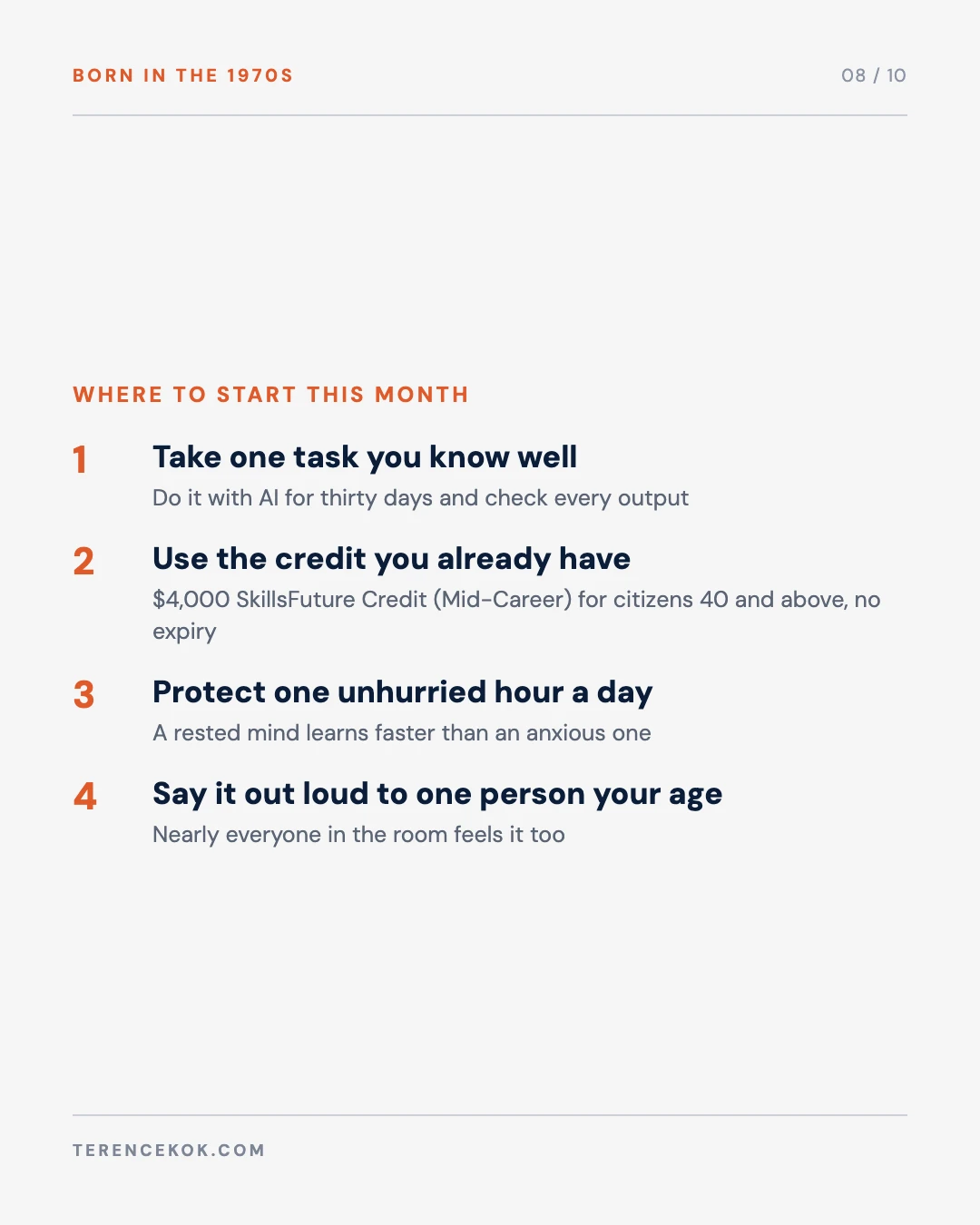
Take one task you already know well. Something you have done for years, like a monthly report, a proposal or a tender review. Do it with an AI tool for the next thirty days and check every output against what you would have done yourself. Keep a note of where it was wrong. By the end of the month you will know more about its limits than most people who use it daily.
Use the credit you already have. Since May 2024, every Singapore Citizen aged 40 and above has received a $4,000 SkillsFuture Credit (Mid-Career) top-up that does not expire. It is meant for substantial courses, such as diplomas and degrees, and many of us have not touched it. It was put there for our generation.
Protect one unhurried hour a day. A walk, a meal without a screen, an hour with a book. The point is that it requires nothing of you. It sounds small, and it is the part people skip first, but a rested mind learns faster than an anxious one.
Say it out loud to one person your age. Most of us assume we are the only one who feels this way. In my experience nearly everyone in the room does. One honest conversation with a peer takes away a surprising amount of the weight.
When it is more than tiredness
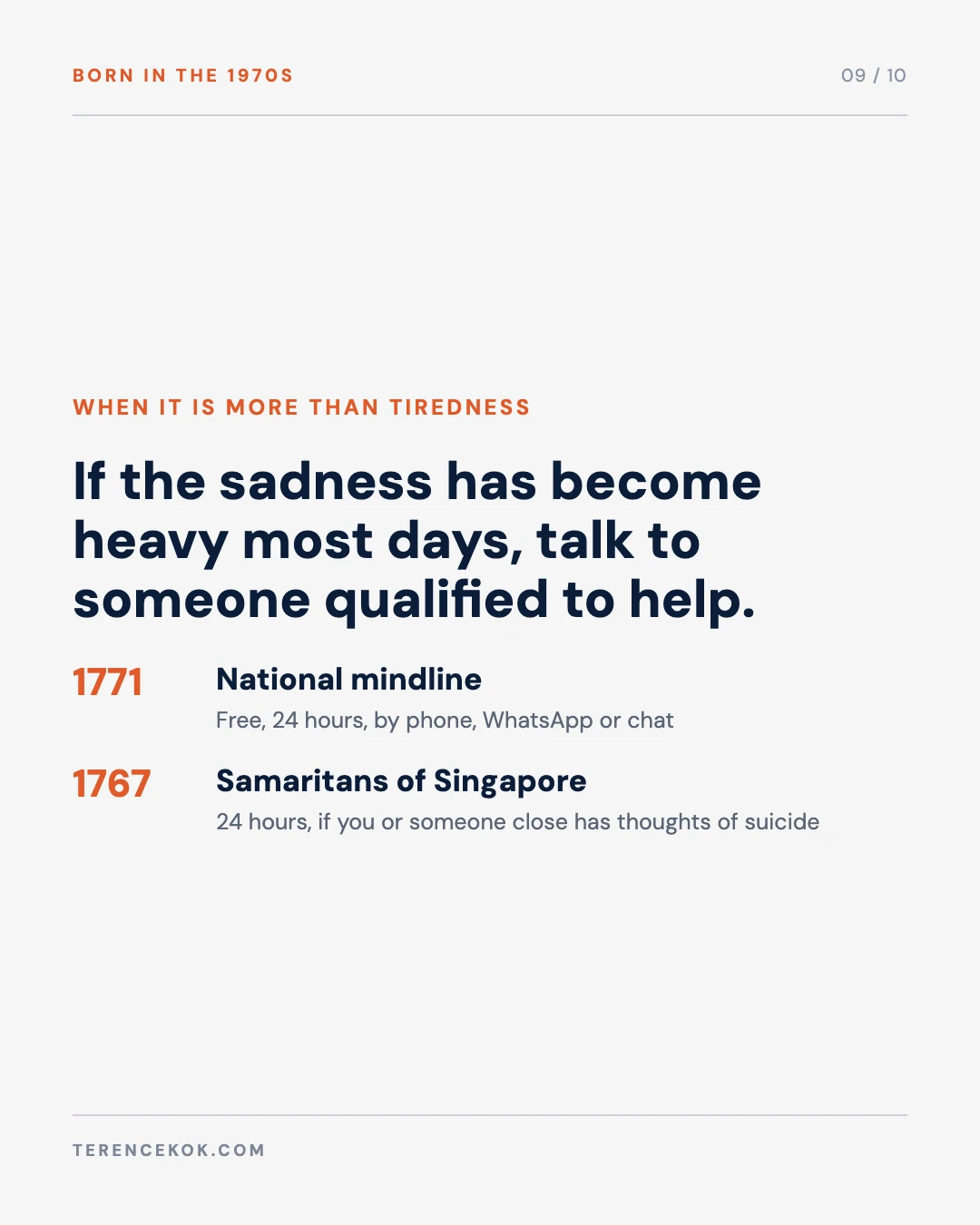
Some of what I have described is ordinary for people of our age. Some of it is more than that. If the sadness has become heavy most days, if sleep has changed or things you used to enjoy have lost their pull, please talk to someone qualified to help. In Singapore, the national mindline on 1771 offers free, round-the-clock support by phone, WhatsApp or chat. If you or someone close to you is having thoughts of suicide, Samaritans of Singapore answers at 1767, 24 hours a day.
Asking for that help is the same good judgement we have used everywhere else in our working lives.
Evidence & Methodology
The retirement ages, the SkillsFuture credit and the happiness research are published facts. What I say about what the sadness is about, and what experience is worth in AI work, comes from my own conversations and client work. Here is which is which.
| Claim | Source | Grade |
|---|---|---|
| Singapore’s retirement age rose to 64 and re-employment age to 69 on 1 July 2026, on track to 65 and 70 by 2030 | Ministry of Manpower, Committee of Supply 2026 | Measured |
| Every Singapore Citizen aged 40 and above received a $4,000 SkillsFuture Credit (Mid-Career) top-up from 1 May 2024, with no expiry | SkillsFuture Singapore, Level-Up Programme | Measured |
| Reported well-being is U-shaped across age, with the low point around 50 | Blanchflower (2021), Journal of Population Economics, 145 countries | Measured |
| Someone born in 1975 can work to around 2044 | My arithmetic from the re-employment age of 69 | Derived |
| The four sources of the sadness: unmourned losses, repeated restarting, loss of depth, sustained vigilance | My own pattern from conversations with people of my generation, not a clinical study | My call |
| People over 45 are usually the ones who catch AI’s confident errors | My own observation in client work, not a measured comparison | My call |
Sources
- Ministry of Manpower. (2026). Re-employment. Retirement age 64 and re-employment age 69 from 1 July 2026, announced at Committee of Supply 2026.
- SkillsFuture Singapore. (2024). SkillsFuture Level-Up Programme.
- Blanchflower, D. G. (2021). Is happiness U-shaped everywhere? Age and subjective well-being in 145 countries. Journal of Population Economics, 34(2).
- Ministry of Health. National mindline 1771. Samaritans of Singapore, 24-hour helpline 1767.

How Do I Prepare for a Future I Can't Yet See?
How the anxiety differs for a graduate, a manager and a chief executive, and what steadies people while the picture stays unclear.

What I Was Afraid Of When I Started Advising on AI
My own version of the fear, from the start of the series on the emotional side of AI decisions.

AI Use and the Decline of Human Thinking Skills
The research on what heavy AI use does to thinking, and why people who learned the work first have an edge.
Was this useful?