

Listen to this article
Jump to a section
In this article
Executive Summary
The seven-layer OSI model that has governed enterprise technology for fifty years stops at the Application Layer. Generative AI’s probabilistic reasoning needs a governed cognitive layer above it, what I call Layer 8, to translate that reasoning into governed, auditable action.
Core conclusions
- Deploying a cognitive layer is an organisational-guardrail decision, not a coding task. It rests on intent sorting, reasoning loops, and a mandatory guardrail check before any AI output reaches production systems.
- Layer 8 trades latency and cost predictability for reasoning quality, so leaders need to choose deliberately where it belongs: strategic decision support, not instantaneous transaction processing.
- When cognitive systems fail, there’s no broken line of code to point to; quality assurance shifts from engineering verification to statistical risk management.
The argument, in ten slides
Save it, share it, or send it to whoever’s about to greenlight the AI roadmap.
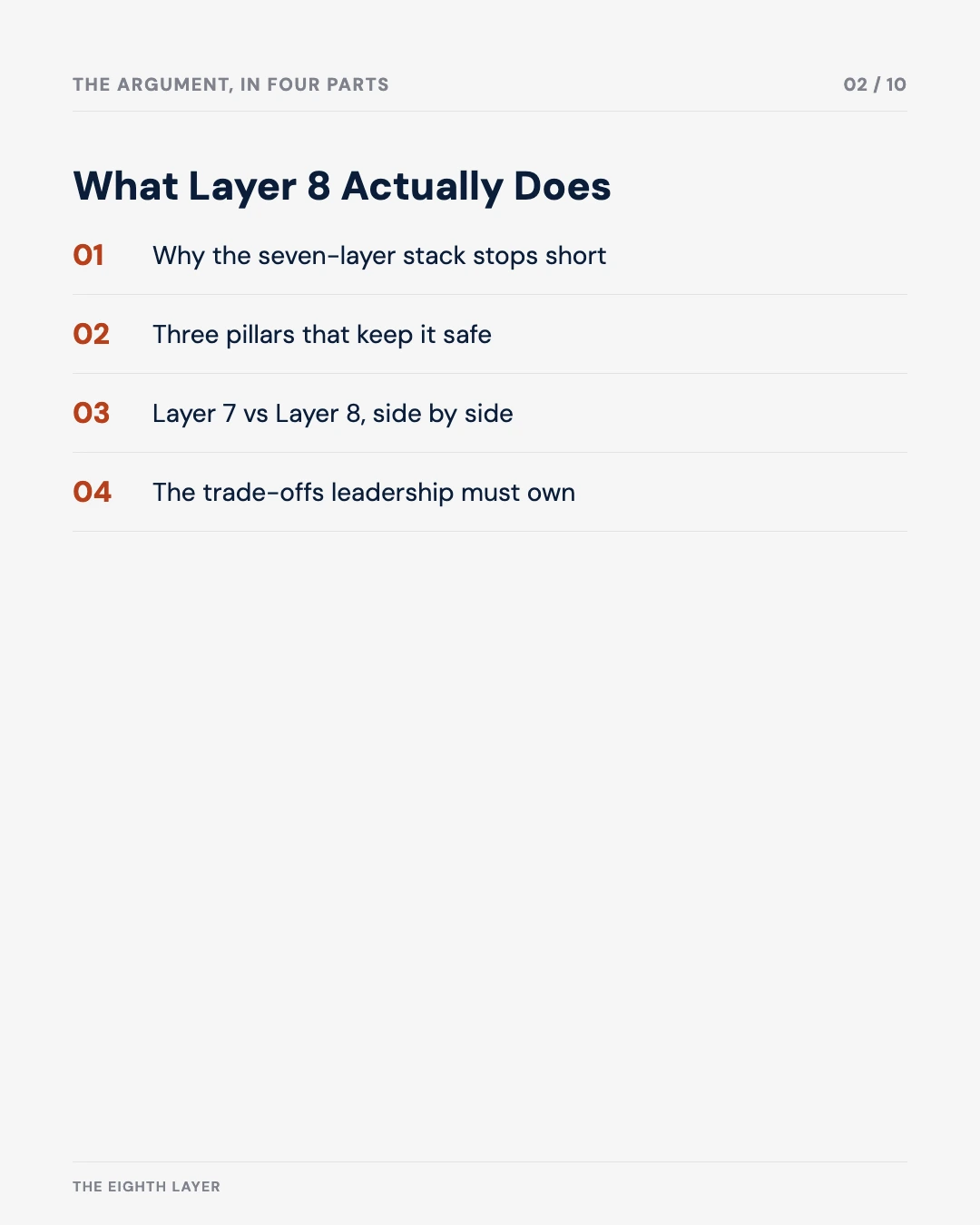
Enterprise technology is undergoing a structural shift from rigid, rule-based software to systems that can reason, adapt, and make context-based decisions. Historically, global digital infrastructure has been governed by a seven-layer framework known as the Open Systems Interconnection (OSI) model, which maps out everything from physical network cables to the applications on a desktop.
However, this traditional stack stops at the Application Layer (Layer 7). To successfully manage digital transformation today, corporate leadership must recognise an emerging tier: the Cognitive Layer (Layer 8). This layer acts as a translator and structural bridge, allowing businesses to integrate non-deterministic artificial intelligence safely into their legacy operational environments without risking core stability.
The Traditional Network Stack Has Seven Layers
To understand the necessity of a new layer, it is helpful to visualise how corporate technology has operated for decades. The internet and enterprise software rely on a universal seven-layer blueprint.
- Layers 1 to 6 (the foundation): These layers handle the digital plumbing. They ensure that data packets are formatted, addressed, secured, and routed correctly across physical wires and wireless networks.
- Layer 7 (the Application Layer): This is the visible interface: the web browser, the enterprise resource planning (ERP) system, or the mobile banking application that users interact with directly.
For fifty years, this seven-layer model sufficed because software was strictly deterministic. Systems operated like a vending machine: if a user entered a specific code, the software executed an identical, predictable sequence of calculations to deliver an identical result.
Layer 8 Is Cognitive Layer Programming
The rise of generative artificial intelligence and large language models (LLMs) has introduced a fundamentally different type of computing: probabilistic execution. Instead of reading rigid code line by line, these newer systems process semantics: meaning, intent, nuance, and human context.
Cognitive Layer Programming is the practice of building a dedicated, structured environment to manage this flexible reasoning process. Architects build Layer 8 to serve as an intelligent intermediary. It ingests unstructured human goals, reasons through the best path forward, and translates that intent into precise commands that traditional, predictable systems can safely execute.
The core operational shift:
- Traditional software (Layers 1–7): Input data + rigid rules → a single, completely predictable outcome.
- Cognitive programming (Layer 8): Input intent + contextual meaning → a dynamically generated path → a calculated, best-fit solution.
A Cognitive Layer Protects the Enterprise Architecturally
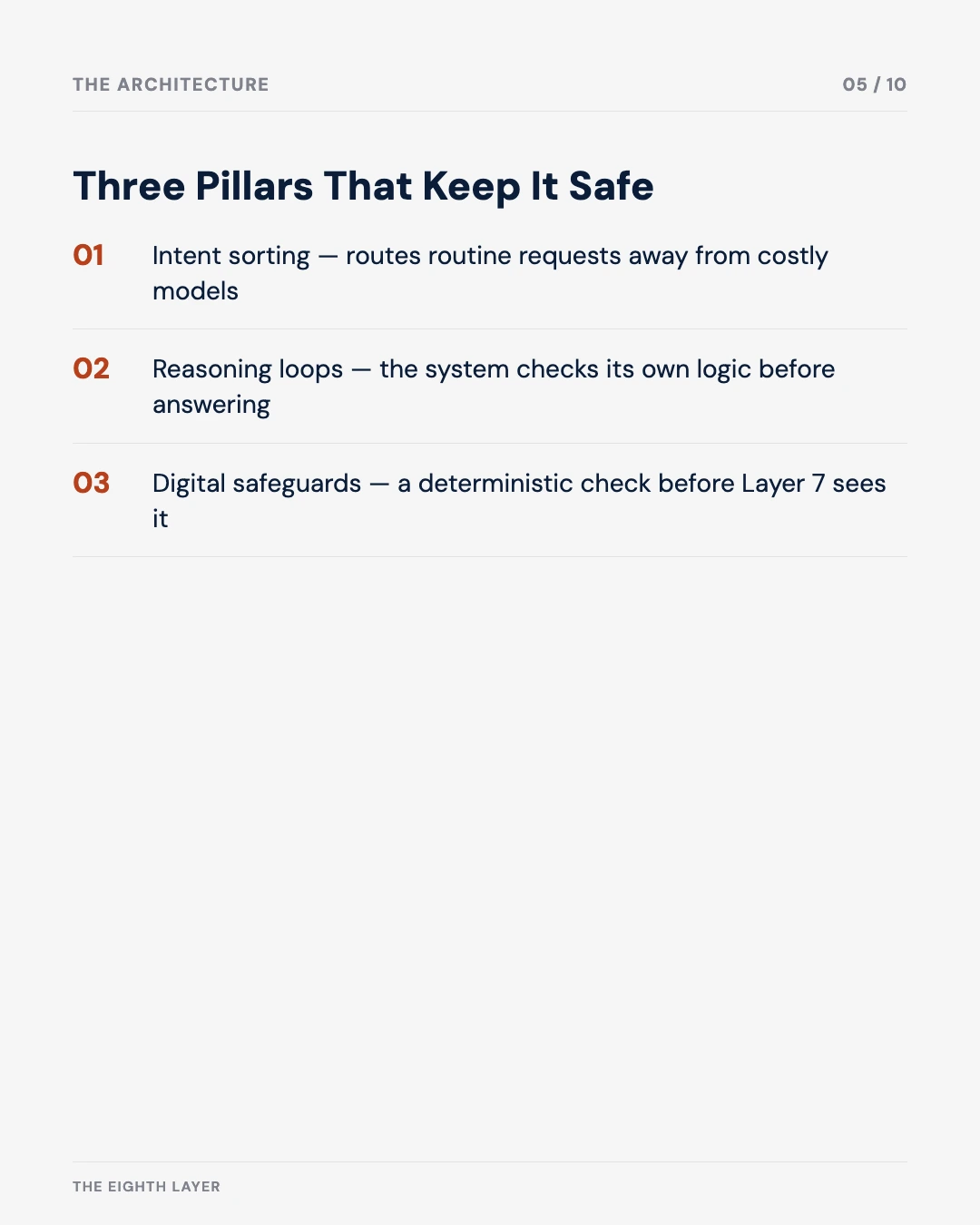
For cross-functional leadership teams, deploying a cognitive layer is not about writing code; it is about establishing organisational guardrails. A mature Layer 8 architecture relies on three distinct pillars to maintain operational safety:
- Intent sorting (semantic routing): When a user or system interacts with the platform, the cognitive layer evaluates the request to determine its complexity. Routine tasks are instantly routed away from expensive AI models and sent straight to traditional databases, saving significant processing time and operational costs.
- Reasoning loops: Instead of generating a single, unfiltered response, the layer allows the AI to self-correct. The system creates an internal loop: it outlines a plan, checks its own logic against corporate reference material, and refines the answer before presenting it.
- Digital safeguards (guardrails): This is the mandatory inspection point. Before any recommendation generated by the AI reaches the actual business systems (Layer 7), a final, deterministic piece of code checks the output against strict legal compliance, security baselines, and data privacy policies.
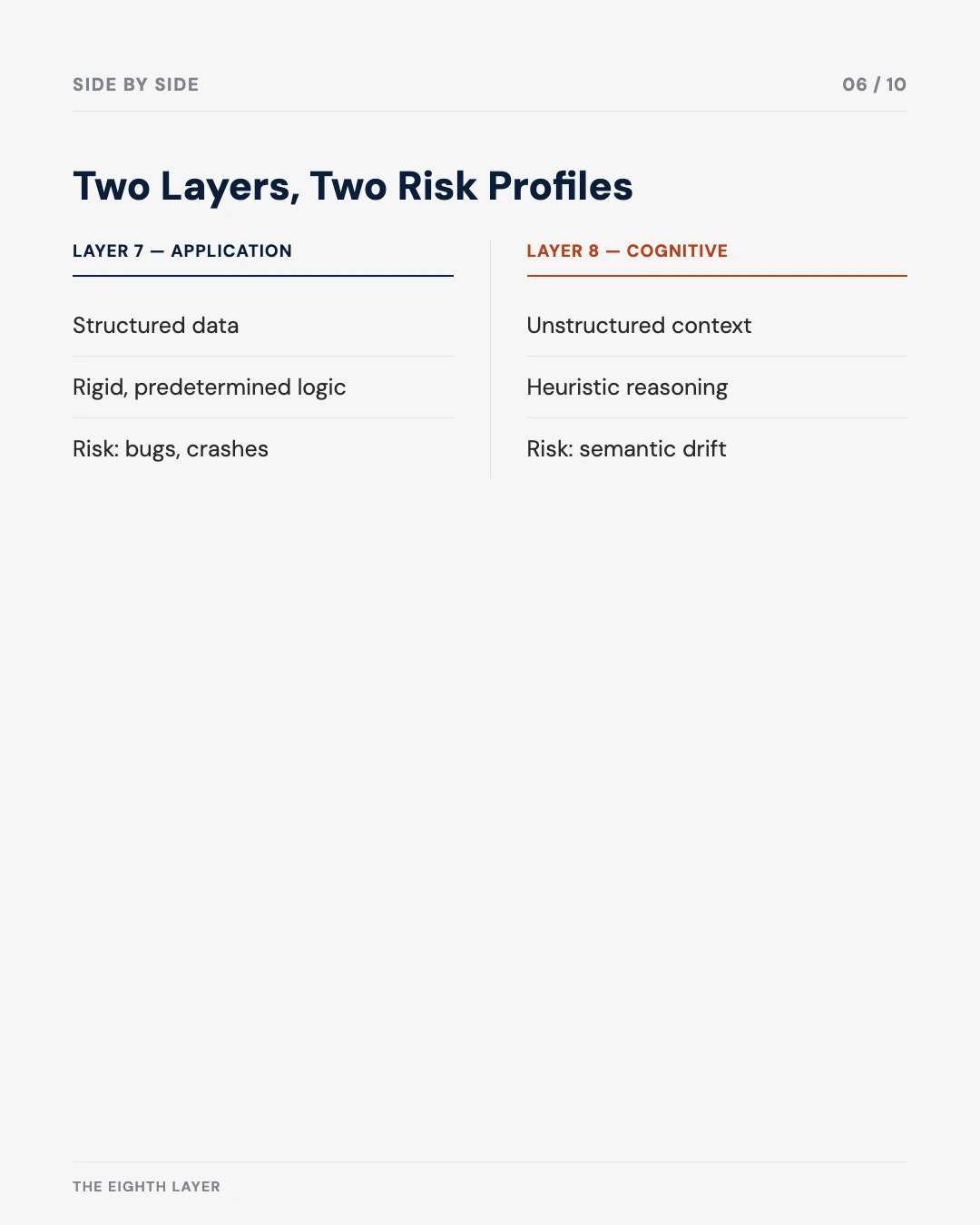
The Application Layer and the Cognitive Layer Serve Different Jobs
| Business Dimension | Layer 7: The Application Layer | Layer 8: The Cognitive Layer |
|---|---|---|
| What it processes | Structured data (spreadsheets, databases, exact text strings) | Unstructured context (natural conversation, audio, diverse documentation) |
| How it decides | Rigid logic (always follows a predetermined path) | Heuristic reasoning (evaluates possibilities based on probability) |
| System behaviour | Fixed and uniform across all instances | Adaptive and highly tailored to specific context |
| Primary risk vector | Software bugs, system crashes, data entry errors | Semantic drift, incorrect reasoning, data leakage |
| Business metric | System uptime, processing speed, mathematical precision | Accuracy of intent fulfilment, user alignment, compliance adherence |
Strategic Risks and Operational Trade-offs
Integrating a cognitive layer introduces distinct business tensions that executive leadership must evaluate:
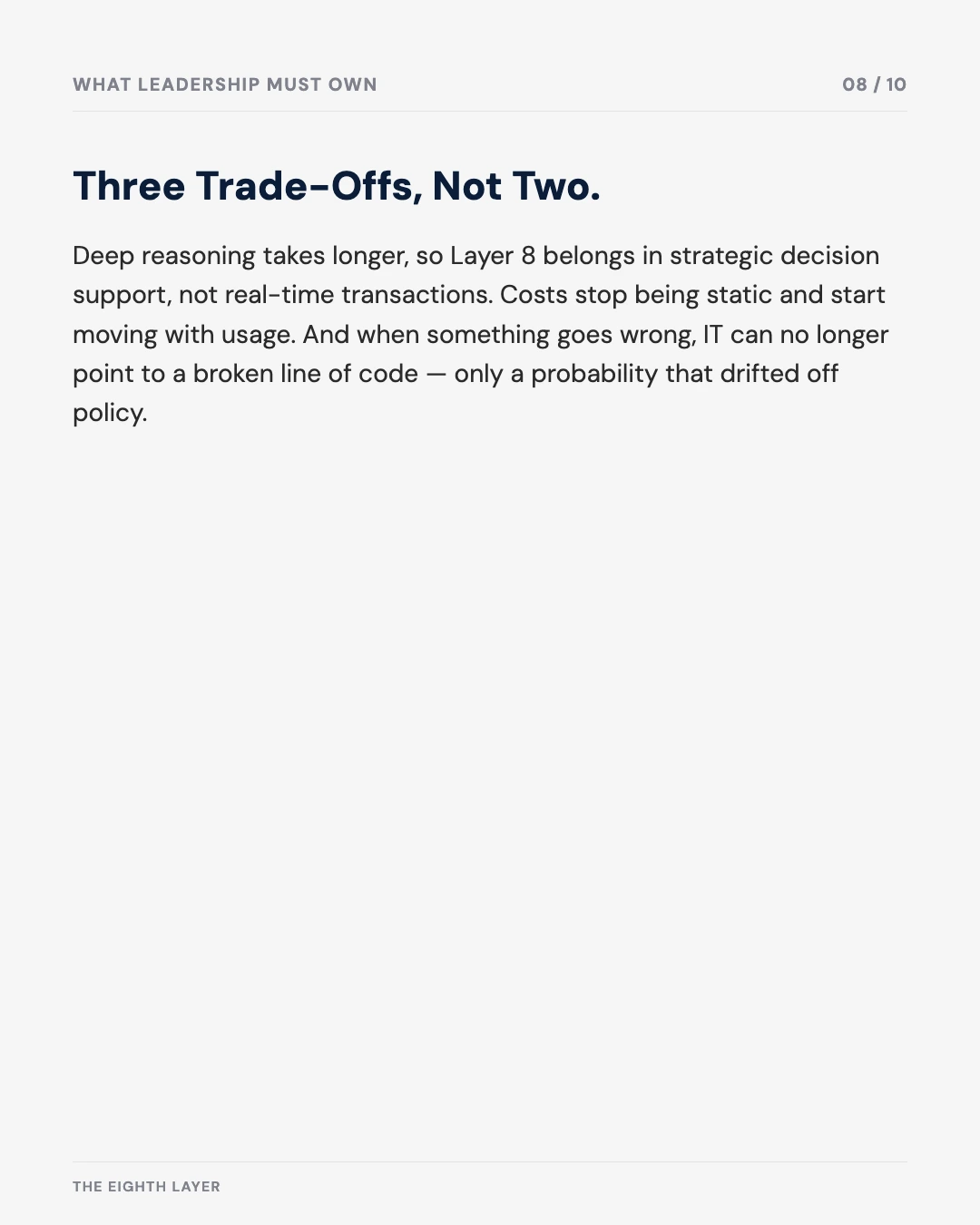
- Flexibility versus latency: Systems that engage in deep reasoning inherently take longer to process information. Leaders must choose where to deploy Layer 8: it is highly valuable for complex data analysis or strategic decision support, but inappropriate for instantaneous, real-time transaction processing.
- Volatile cost structures: Traditional software infrastructure costs are relatively static and predictable. Cognitive computing operates on a variable usage model. Costs fluctuate directly with the complexity and volume of the concepts processed, requiring new budget management frameworks.
- The explainability challenge: When a traditional system fails, IT teams can pinpoint the exact line of broken code. With cognitive programming, outcomes are mathematical probabilities. Measuring performance requires statistical evaluation, such as calculating how closely a system’s output aligns with a known-good reference:
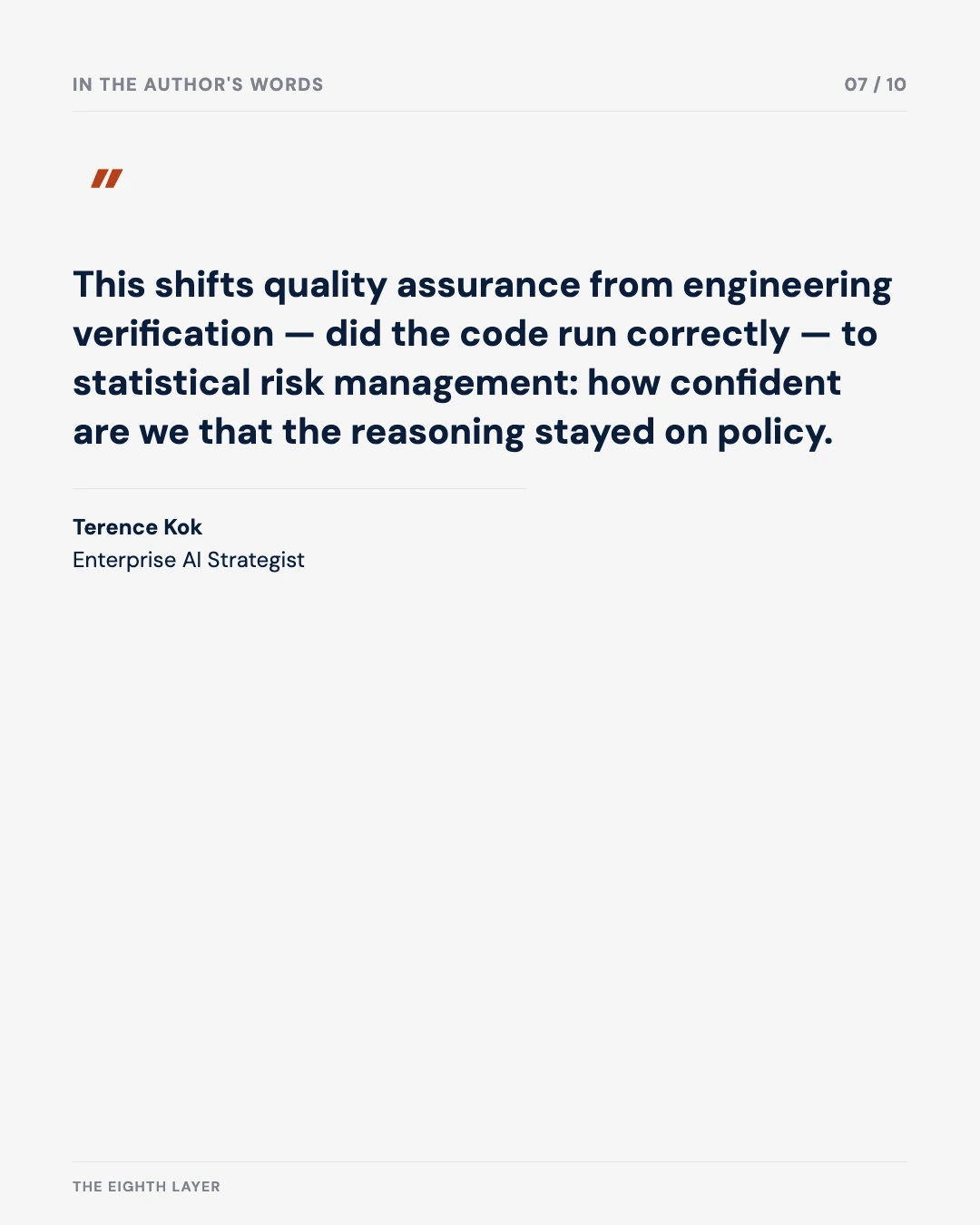
Alignment(A, B) = (A · B) / (‖A‖ ‖B‖)Here, A is the system’s output and B is the corporate policy ground truth. The closer the two vectors align, the more confidently the output can be trusted. This shifts quality assurance from engineering verification (did the code run correctly?) to statistical risk management (how confident are we that the reasoning stayed on policy?).
Further reading: Layer 8 in Practice: A Field Guide for the Engineers Building This Stuff picks up where this article leaves off: the API contracts, routing thresholds, memory architecture, and failure modes involved in shipping a cognitive layer to production.
This article is the origin of framework 06. The Governed Cognitive Layer (Layer 8) page carries the reference architecture diagram, the three pillars as a checklist, a versioned citation and a PDF brief.
Free tool
AI Trust, Risk & Governance Dashboard
Operationalises the guardrail layer described above: threat monitoring, data lineage, and privacy compliance mapped against the regulatory frameworks a Layer 8 architecture needs to satisfy before an AI recommendation reaches production.
Was this useful?