

Listen to this article
Jump to a section
In this article
Executive Summary
For thirty years the technological singularity was a date on a chart. Vernor Vinge put it within thirty years of 1993. Ray Kurzweil put it at 2045. Both described a moment when machine intelligence overtakes ours and the future stops being predictable from the past. We were told to expect an event. What arrived looks more like a slope. In June 2025 Sam Altman wrote that “we are past the event horizon; the takeoff has started.” In January 2026 Elon Musk posted that “we have entered the Singularity.” Dario Amodei has described frontier AI as “a country of geniuses in a datacenter”, working at 10 to 100 times human speed. In July 2026, Terence Tao told the International Congress of Mathematicians that his field should prepare to move from proof scarcity to proof abundance, with more AI-generated proofs than people can check or understand. None of this proves that superintelligence is here. It does show that the limit on progress in some fields is now how fast people can absorb and verify what the machines produce. That is the question this series starts from.
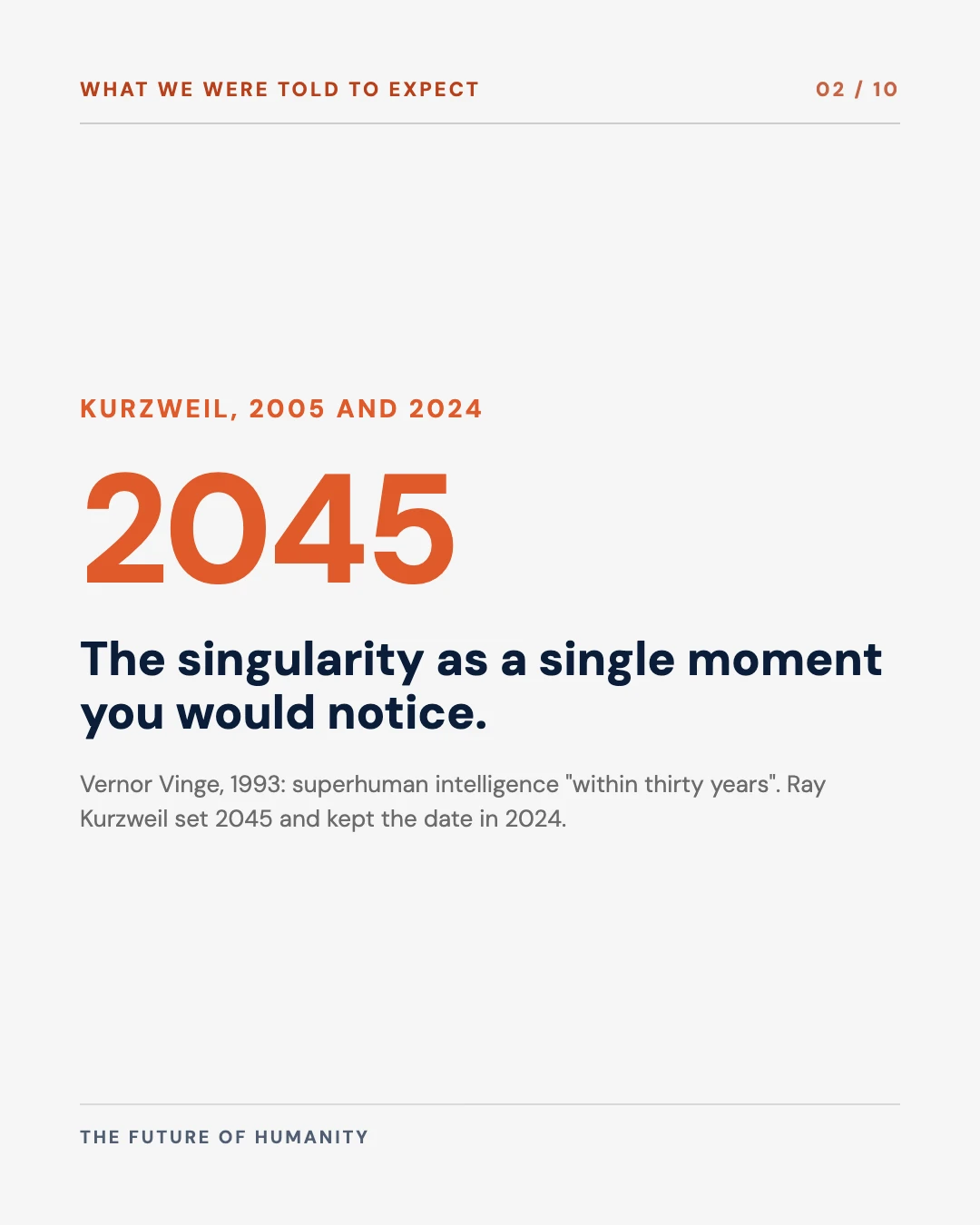
2045
the year Ray Kurzweil gave for the singularity in 2005, and repeated in 2024
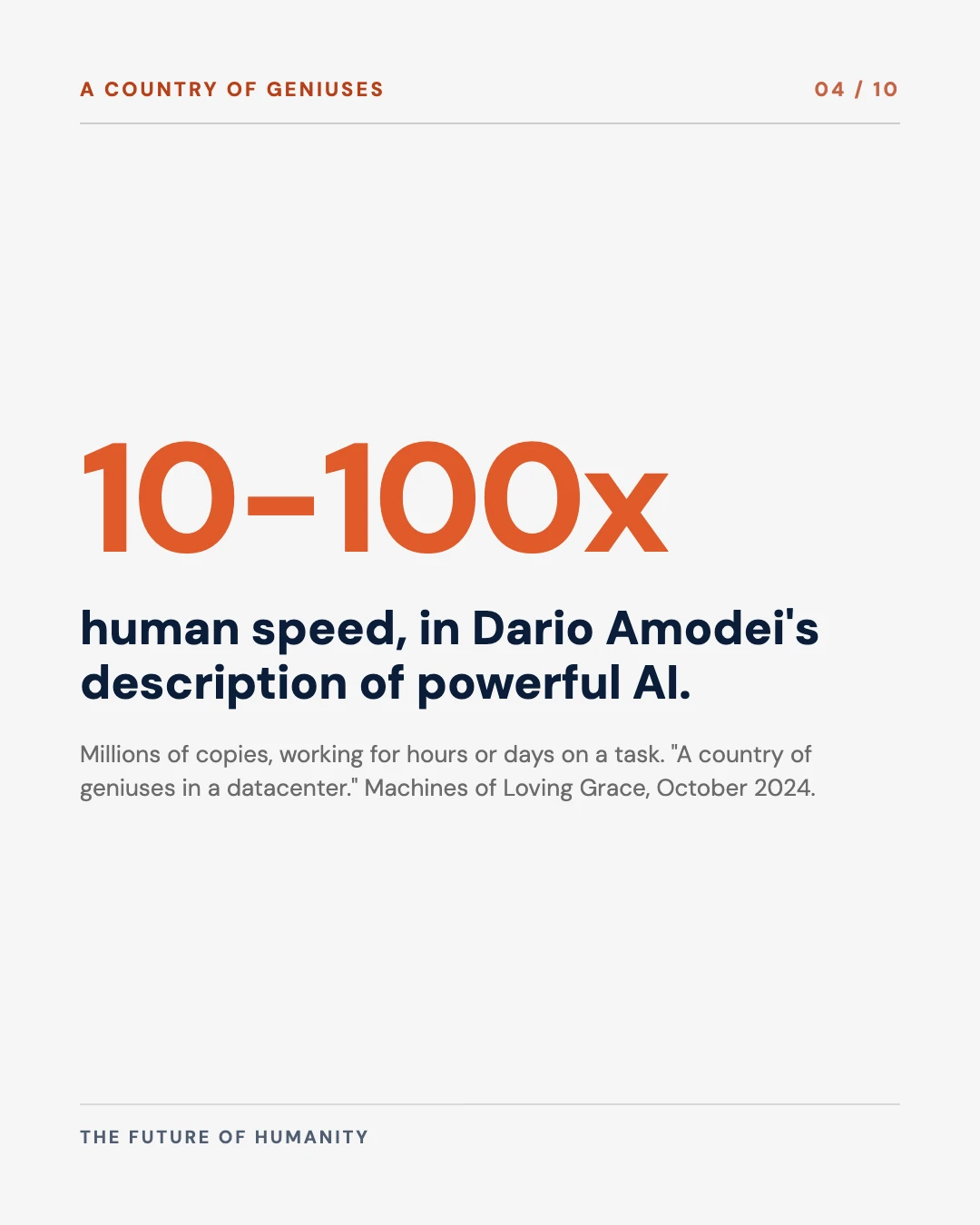
10-100x
human speed at which Dario Amodei expects powerful AI to absorb information and act, Machines of Loving Grace, October 2024
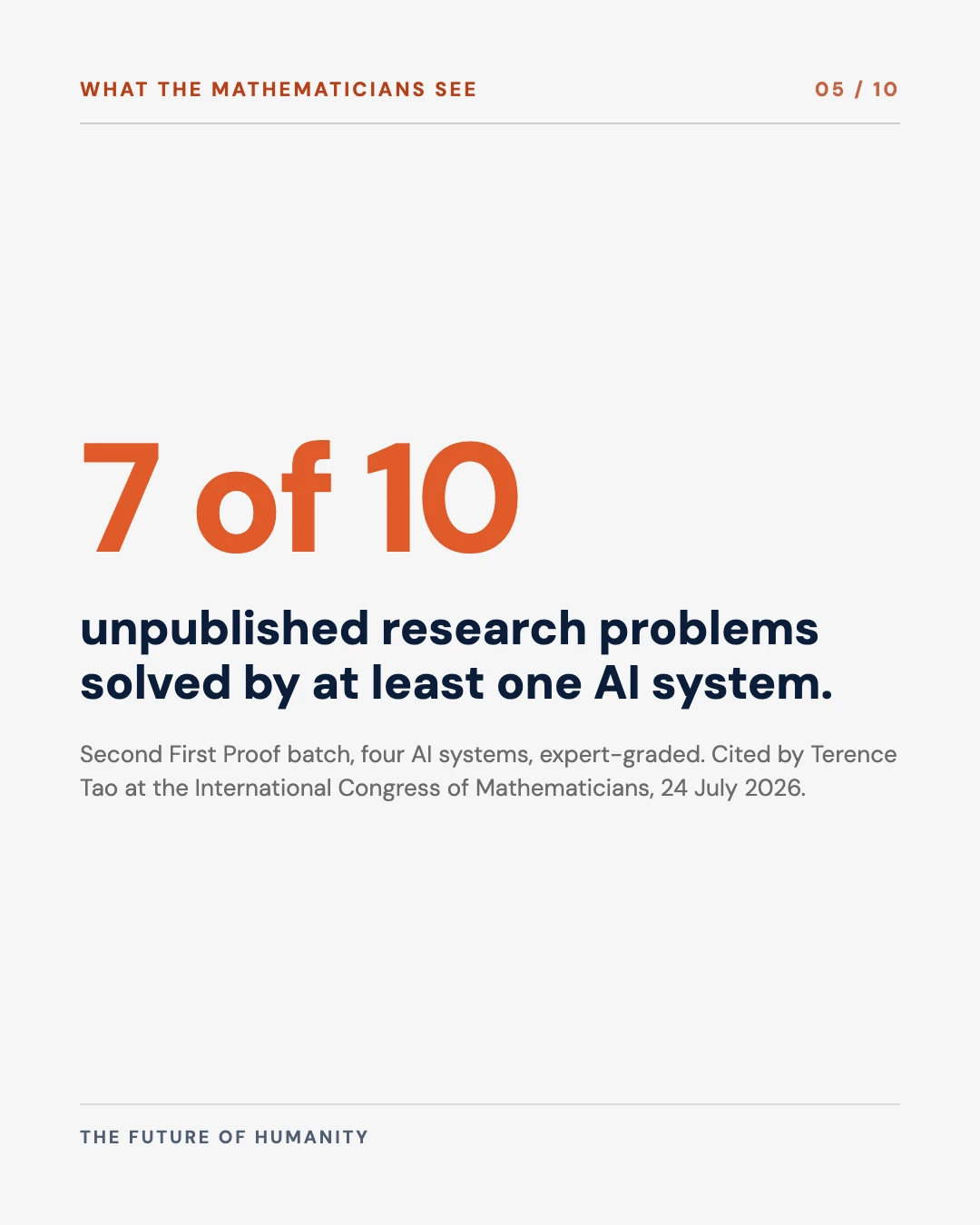
7 of 10
unpublished research problems in the second First Proof batch solved by at least one AI system, as cited by Terence Tao at ICM 2026
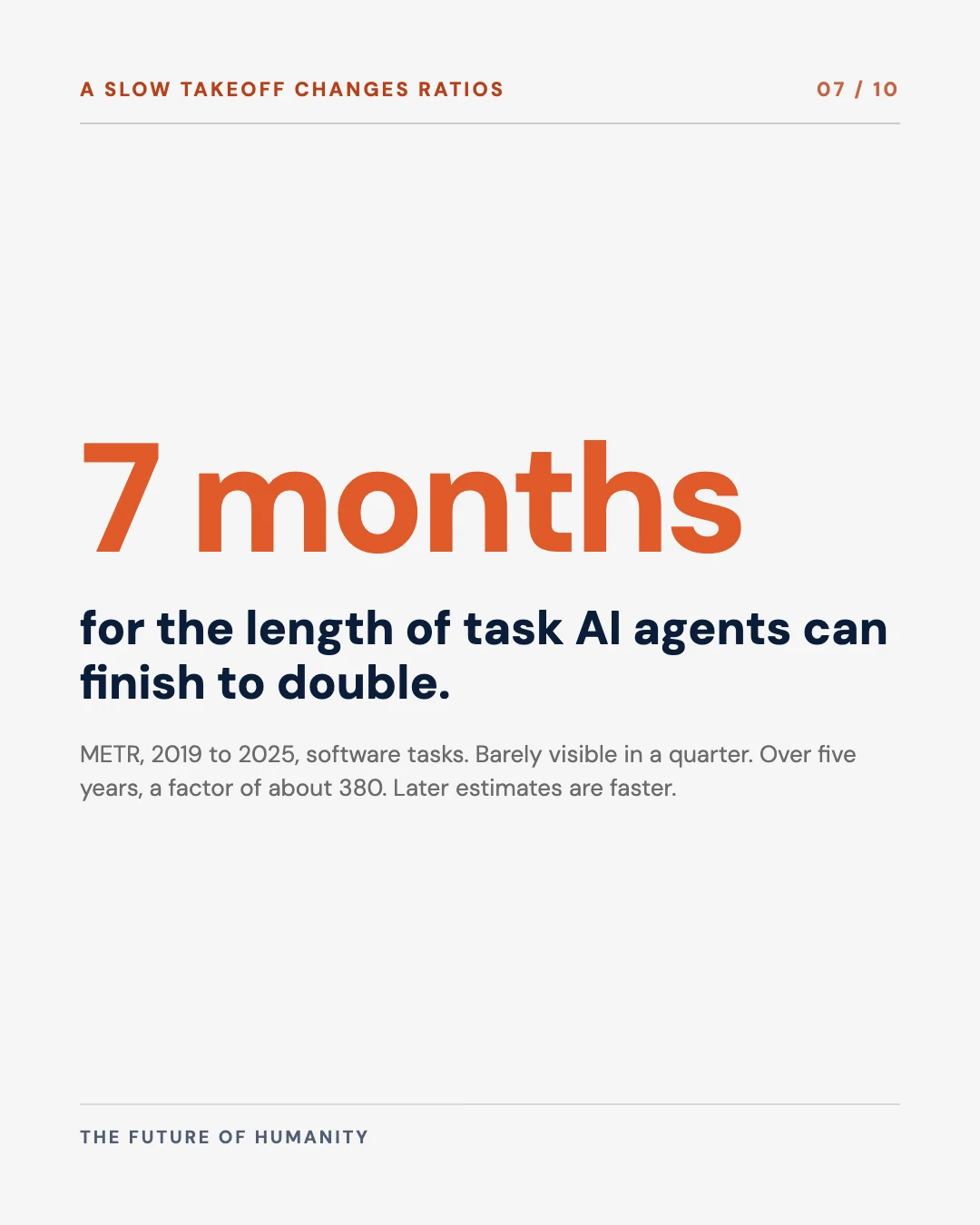
7 months
doubling time METR measured in 2025 for the length of task AI agents can complete; later estimates are faster
Core conclusions
- The singularity was imagined as a single moment. The people closest to the technology now describe a gradual takeoff that is already under way, and that kind of change is easy to miss while you are living through it.
- The first visible effect is a speed mismatch. Machines can now produce proofs, code and analysis faster than people can verify and understand them, and Tao calls the result “proof indigestion”.
- For leaders, the useful question is where in your organisation the machines already outrun your ability to check their work, and what you will do about it.
The argument, in ten slides
Save it, or send it to the people on your board who think the singularity is still decades away.
The singularity we were told to expect
The word comes from Vernor Vinge, a mathematician and science fiction writer. In a 1993 paper for a NASA symposium he wrote that “within thirty years, we will have the technological means to create superhuman intelligence. Shortly after, the human era will be ended.” He borrowed the term from physics. At the edge of a black hole the normal rules stop working, and Vinge argued that the future after superhuman intelligence would be just as impossible to see from here.
Ray Kurzweil gave it a date. In The Singularity Is Near (2005) he set 2045 as the year machine intelligence would overtake human intelligence and merge with it. In The Singularity Is Nearer (2024) he kept that date.
Both versions trained us to expect a threshold you would notice. A machine passes a test, an announcement is made, the world divides into before and after. That expectation is the reason so few people have noticed what the builders are now saying.
The singularity we were told to expect
Dates from the post: Vernor Vinge's 1993 NASA symposium paper, and Ray Kurzweil's 2045, set in 2005 and kept in 2024. Drawn as people expected it: one event, clearly marked.
What the builders now say
Three of the people with the most direct view of frontier AI have said, in public and in writing, that the takeoff has begun.
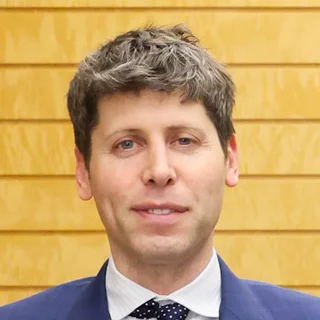
Sam Altman
CEO, OpenAI
"We are past the event horizon"

Elon Musk
CEO, xAI
"We have entered the Singularity"
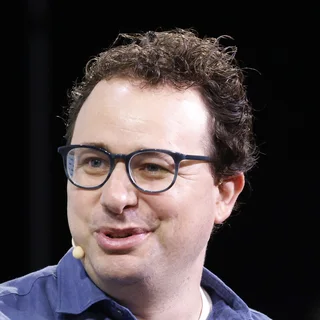
Dario Amodei
CEO, Anthropic
"A country of geniuses in a datacenter"
Photos: Sam Altman, Office of the Prime Minister of Japan, CC BY 4.0; Elon Musk, Gage Skidmore, CC BY-SA 4.0, cropped; Dario Amodei, TechCrunch, CC BY 2.0, cropped.
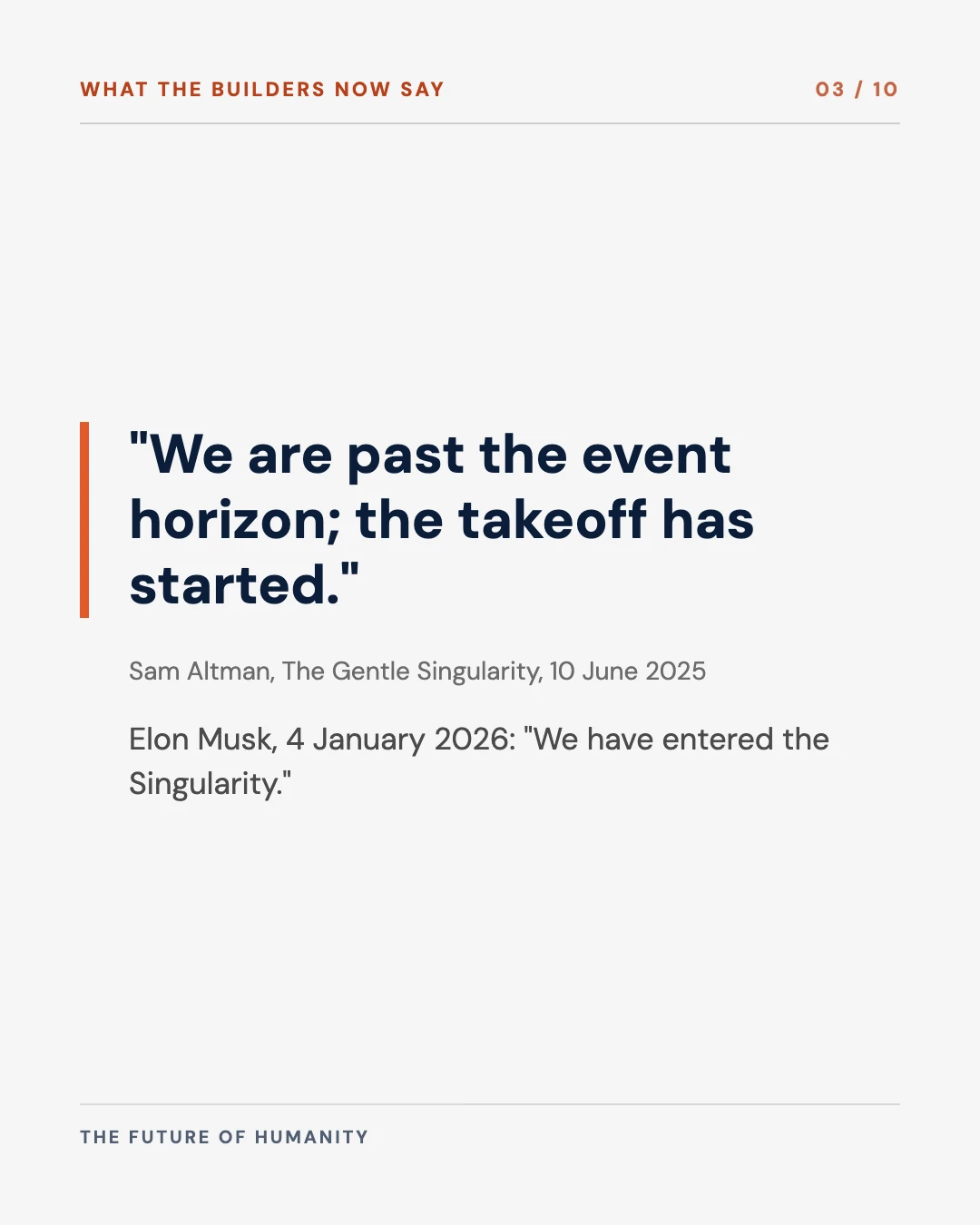
Sam Altman, OpenAI. On 10 June 2025 he published an essay called The Gentle Singularity. Its first line is “We are past the event horizon; the takeoff has started.” The rest of the essay argues that the change will feel gradual and manageable while it happens. On a podcast in July 2026 he went further: “We are now, like, in the singularity.” In the same conversation he added that “any one moment is not the tipping point.”
Elon Musk, xAI. On 4 January 2026, replying to engineers describing how much work AI coding tools were now doing for them, Musk posted “We have entered the Singularity.” Hours later he added “2026 is the year of the Singularity.”
Dario Amodei, Anthropic. His October 2024 essay Machines of Loving Grace describes what he calls powerful AI: systems smarter than a Nobel Prize winner across most fields, able to work on tasks for hours or days, run as millions of copies, and “absorb information and generate actions at roughly 10x-100x human speed.” He summarised it as “a country of geniuses in a datacenter.”
These are not neutral observers. Each runs a company that raises money on the strength of the technology’s future, and critics have pointed out that Altman’s “gentle” version redefines the term. I give their statements weight for a narrower reason. They see internal results months before the rest of us do, and their public language has moved from “if” and “when” to “now”.
From a date on a chart to a takeoff already under way
Sources: Vinge (1993); Kurzweil (2005, 2024); Amodei, Machines of Loving Grace (2024); Altman, The Gentle Singularity (2025); Musk on X, 4 January 2026, as reported; Tao, ICM lecture, 24 July 2026.
What the mathematicians see
The more useful evidence comes from a field with no product to sell.
On 24 July 2026, Terence Tao gave a public lecture called Mathematics in the Age of AI at the International Congress of Mathematicians in Philadelphia. Tao is a Fields Medallist and probably the most widely respected working mathematician in the world. He has also used AI tools in his own research more openly than almost anyone in his field.
His argument was careful. He set out a working hypothesis that AI tools will, reasonably soon, be able to do a reasonable fraction of research-level mathematical tasks. He pointed to the First Proof project, which sets frontier AI systems batches of ten unpublished research problems and has experts grade the answers. In its second batch, seven of the ten problems got at least one passing solution from at least one of four AI systems.
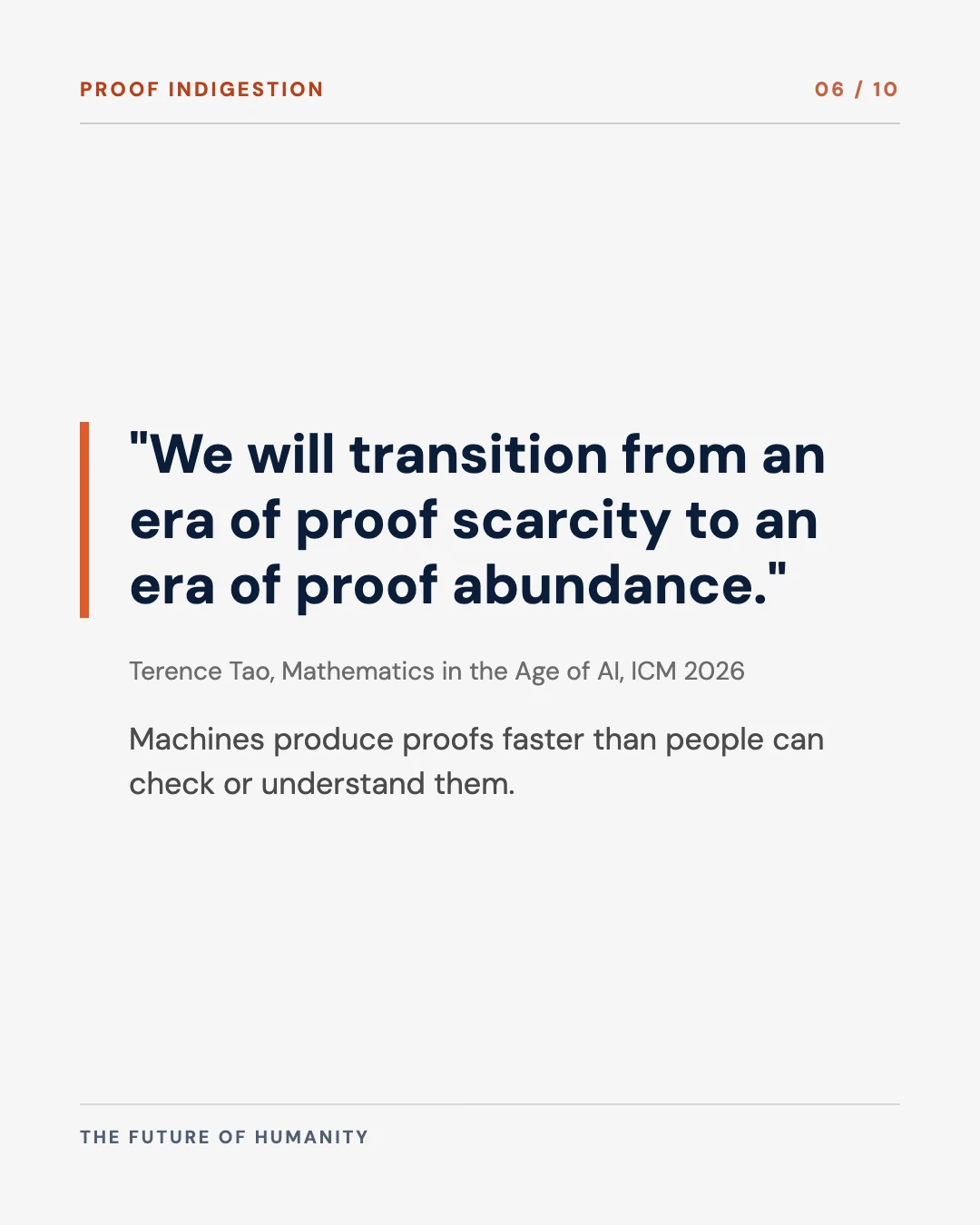
Then he described the consequence. If the hypothesis holds, Tao said, “we will transition from an era of proof scarcity to an era of proof abundance.” AI-generated proofs will pile up waiting to be checked. Referees and journals will be overwhelmed. Even correct, published results will arrive faster than the community can digest them. He called this “proof indigestion”, and said some signs of it are already showing.
From proof scarcity to proof abundance
First Proof, second batch
7 of 10 passed for at least one AI system
"Proof indigestion"
Left: second First Proof batch, ten unpublished problems, four AI systems, expert-graded, as cited by Terence Tao at ICM 2026; which cards passed is illustrative. Right: schematic of Tao's warning that AI-generated proofs will pile up waiting to be checked.
He also asked the question that matters most for the rest of this series: “Could we have a verified proof of a major result that no human understands enough to explain it?” Tao’s answer was to protect understanding on purpose. He wants mathematicians to disclose what AI they used, and he wants a result held back from publication if its authors cannot give a clear, expert-level talk on it.
Why this kind of takeoff is hard to notice
A slow takeoff changes ratios before it changes headlines. Nothing about July 2026 looked like Vinge’s black hole. Planes flew, markets opened and most people’s jobs were the same as the year before. What changed was a ratio: the volume of work machines can produce compared with the volume people can check.
The METR research group has tracked one version of that ratio since 2019. It measures the length of software task, in human working time, that AI agents can complete half the time. In March 2025 METR reported that this length had doubled about every seven months for six years. Updates published in 2026 suggest the recent pace is faster. A doubling every seven months is barely visible in any single quarter. Over five years it is a factor of about 380.
How far machine output pulls ahead of human review in five years

Schematic. Applies METR's measured 2019 to 2025 doubling time of about seven months for the length of task AI agents can complete (Measuring AI Ability to Complete Long Tasks, March 2025), with review capacity held flat. The first two years barely register on a linear scale; by year five the gap is a factor of about 380.
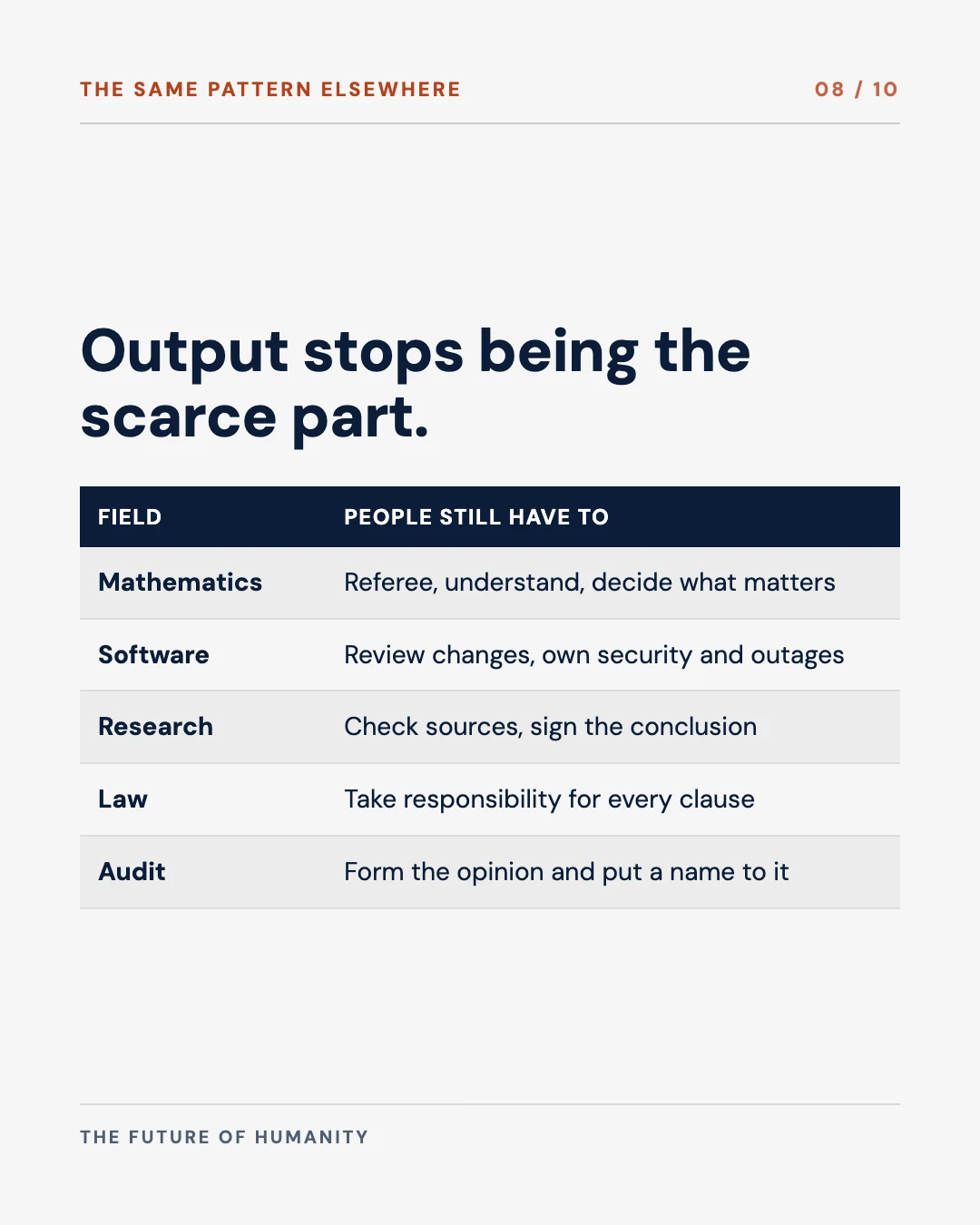
Mathematics is simply the first place where the mismatch is easy to measure, because a proof is either checked or it is not. The same pattern is forming in places that are harder to see:
| Field | What machines now produce faster | What people still have to do |
|---|---|---|
| Mathematics | Candidate proofs, including formally verified ones | Referee them, understand them, decide which matter |
| Software | Code, tests and fixes across whole repositories | Review changes, own the security and the outages |
| Research and analysis | Literature reviews, models and draft reports | Check sources, judge what is true, sign the conclusion |
| Law and compliance | Contracts, filings and policy drafts | Take legal responsibility for every clause |
| Audit and assurance | Evidence gathering and testing of controls | Form the opinion and put a name to it |
My own mapping, extending Tao’s argument about proof abundance beyond mathematics.
In each row the machine’s output has stopped being the scarce part. The scarce part is a person who can understand it well enough to stand behind it.
When human thought stops setting the pace
For the whole of recorded history, progress has moved at the speed of human thought. Ideas spread as fast as people could read, argue, test and teach them. Every institution we have, from peer review to board papers to parliamentary committees, assumes that the people deciding can keep up with the work being decided.
That assumption is starting to fail. It is failing first in narrow fields with clear right answers, and it will spread as the time horizon of AI agents keeps growing. When it fails, an institution has three choices.
It can slow the machines to human speed, and accept that a competitor or another country probably will not. Part 4 of this series is about why that choice is so hard to hold.
It can stop checking, and accept output it does not understand because the output has been right before. This is the quiet path, and in my advisory work it is the one I see most often. Teams approve AI-drafted work they could not have produced and cannot fully explain, because the queue is long and the last hundred were fine.
Or it can invest deliberately in understanding: protect the people and the time needed to verify, explain and own what the machines produce, even when that is the slowest step in the process. This is what Tao is asking mathematicians to do. It is also the hardest choice to fund, because the payoff is a failure that never happens.
The rest of this series follows the first two paths to their ends, then comes back to the third.
Three choices when machines outrun the people checking them
The three choices set out in this section. Path two is the one I see most often in my advisory work; path three is the hardest to fund, because its payoff is a failure that never happens.
Questions for leaders
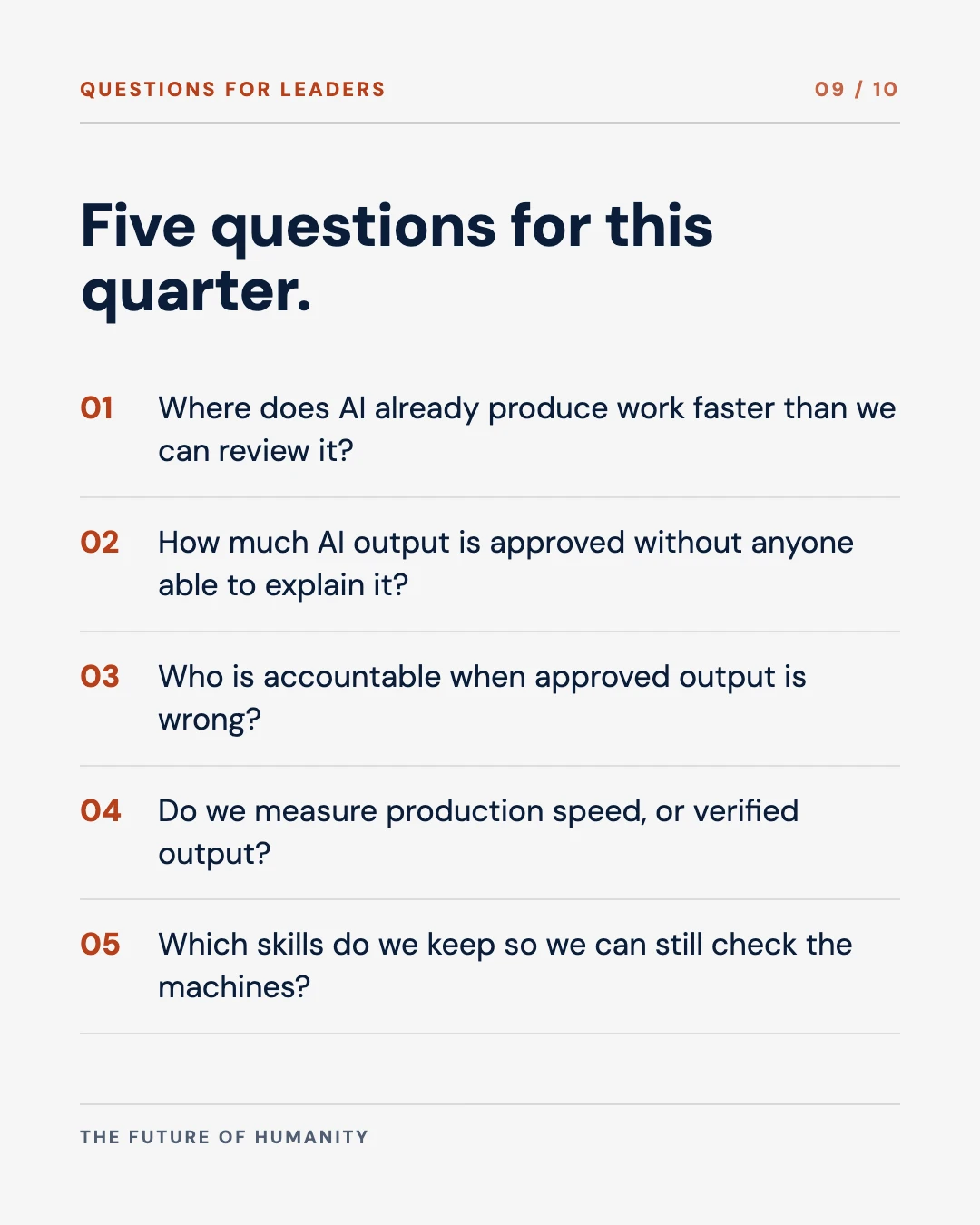
Five questions I would put to any executive team or board this quarter:
- Where in our organisation does AI already produce work faster than our people can review it?
- In those places, what share of AI output is approved without anyone being able to explain how it was reached?
- Who is accountable when an approved AI output turns out to be wrong, and do they know it?
- Are we measuring the speed of production, or the speed of verified, understood output?
- Which skills are we keeping in-house deliberately, so we can still check the machines in five years?
Five questions for the board this quarter

The five questions from this section. Most organisations I work with can answer the first in one meeting.
The first question is where I would start. Most organisations I work with can answer it in one meeting, and most are surprised by the answer.
Evidence & Methodology
The quotes from Vinge, Altman, Musk, Amodei and Tao come from their own essays, lectures and posts, cited below. The First Proof and METR figures are their own published results. The table of fields and the three choices are mine.
| Claim | Source | Grade |
|---|---|---|
| Vinge wrote that superhuman intelligence would be possible “within thirty years” of 1993 | Vinge, The Coming Technological Singularity, VISION-21 Symposium, NASA Lewis Research Center, 1993 | Measured, primary text |
| Kurzweil dates the singularity to 2045 and kept the date in 2024 | The Singularity Is Near (2005); The Singularity Is Nearer (2024) | Measured, primary text |
| Altman: “We are past the event horizon; the takeoff has started” | The Gentle Singularity, blog.samaltman.com, 10 June 2025 | Measured, primary text |
| Altman: “We are now, like, in the singularity” | Podcast interview, July 2026, as reported by Fortune and Al Jazeera | Reported |
| Musk: “We have entered the Singularity” and “2026 is the year of the Singularity” | Posts on X, 4 January 2026, as reported by Yahoo Finance | Reported |
| Amodei: powerful AI working at “roughly 10x-100x human speed”, “a country of geniuses in a datacenter” | Machines of Loving Grace, darioamodei.com, October 2024 | Measured, primary text, a forecast |
| Tao: the shift from “proof scarcity” to “proof abundance”, “proof indigestion”, and the question of a verified proof no human understands | Tao, Mathematics in the Age of AI, lecture slides, ICM 2026, Philadelphia, 24 July 2026 | Measured, primary text |
| Seven of ten problems in the second First Proof batch passed for at least one of four AI systems | First Proof results as cited by Tao at ICM 2026 and reported by The Decoder | Measured, small sample |
| Agent task length doubled about every seven months, 2019 to 2025 | METR, Measuring AI Ability to Complete Long Tasks, March 2025 | Measured, software tasks only |
| The proof-abundance pattern extends to software, research, law and audit | My own mapping | My call |
| Teams approving AI output they cannot explain is the most common path | My own advisory work | My call |
Sources
- Vinge, V. (1993). The coming technological singularity: How to survive in the post-human era. VISION-21 Symposium, NASA Lewis Research Center.
- Kurzweil, R. (2005). The Singularity Is Near. Viking. Kurzweil, R. (2024). The Singularity Is Nearer. Viking.
- Altman, S. (2025, June 10). The gentle singularity.
- Al Jazeera. (2026, July 27). Sam Altman says AI has entered ‘singularity’: Should we be worried?
- Yahoo Finance. (2026, January). Elon Musk says we have entered the singularity.
- Amodei, D. (2024, October). Machines of loving grace: How AI could transform the world for the better.
- Tao, T. (2026, July 24). Mathematics in the age of AI. Public lecture, International Congress of Mathematicians, Philadelphia.
- The Decoder. (2026, August 20). Terence Tao says AI could trigger math’s biggest crisis since Gödel.
- Kwa, T., West, B., et al. (2025, March). Measuring AI ability to complete long tasks. METR.
The AI Model Is Becoming the Software
How capability moving into the model changes what organisations build and own.

What You Can Do Without AI Is What I Hire For
Why the ability to check the machine is becoming the scarce skill.

Build the Part of AI That Nobody Sees
The records, checks and controls that let people stand behind what AI produces.
Part 2 of this series looks at what happens to truth when machines prove things through methods people cannot follow. If your board is working out where AI already outpaces its ability to check the work, that is a conversation my executive programme is built for.
Cite or quote this article
Was this useful?