

Listen to this article
Jump to a section
In this article
Executive Summary
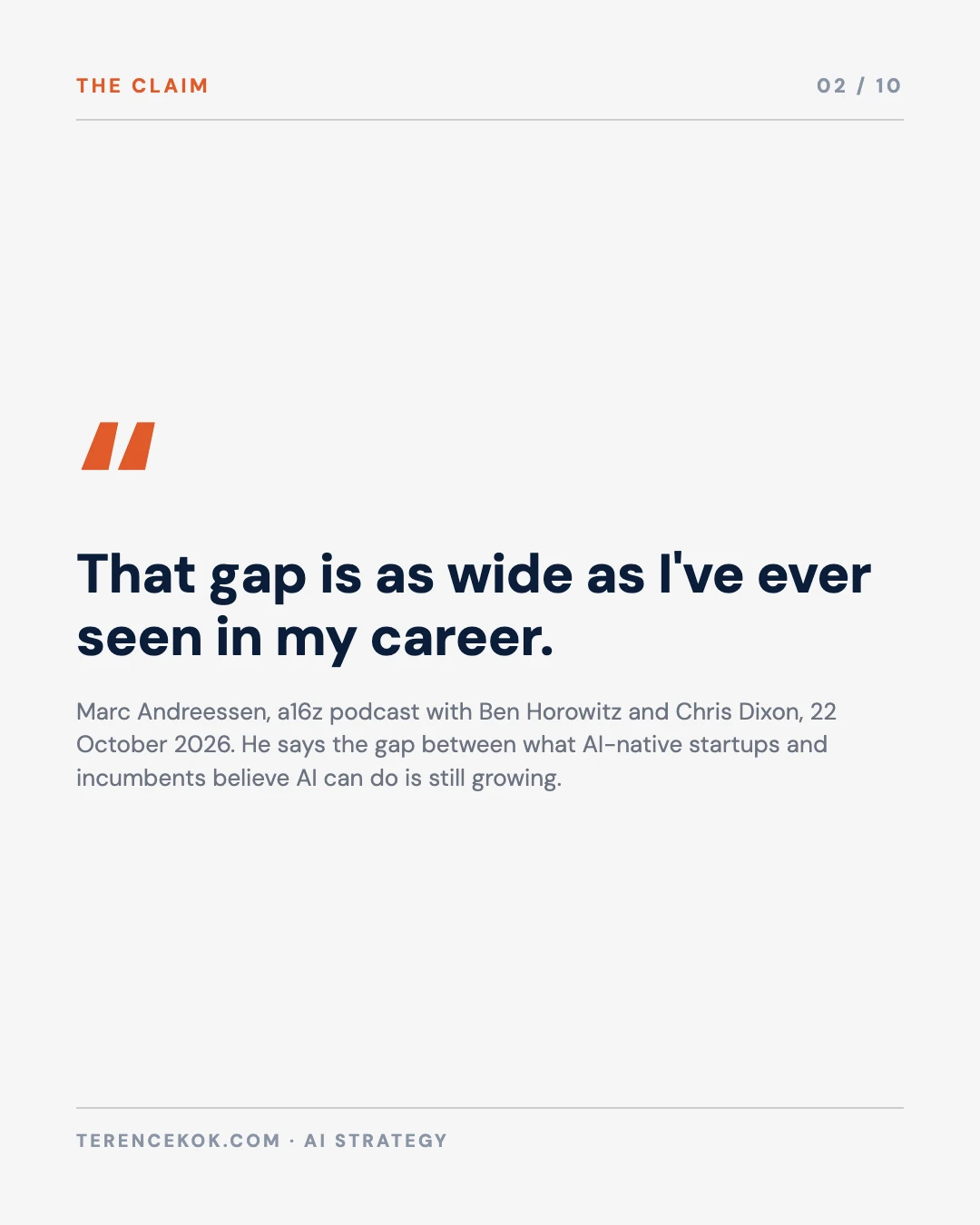
In an a16z podcast released on 22 October 2026, Marc Andreessen said the gap between what AI-native startups believe they can do with AI and what established companies believe is “as wide as I’ve ever seen in my career”, and that it is still growing. He expects founders to build broader, more ambitious companies that grow faster than any before, and he expects whole industries to be “up for grabs” as a result. The evidence mostly supports the first half of his claim. Startups already write most of their code with AI, while most large organisations have yet to scale AI beyond a few functions. The second half is less certain. Incumbents still hold the data, the customers, the licences and the trust, and in regulated industries those count for a great deal. The gap is real, and it sits mainly in how incumbents grant permission to act on AI, because both sides have access to the same models.
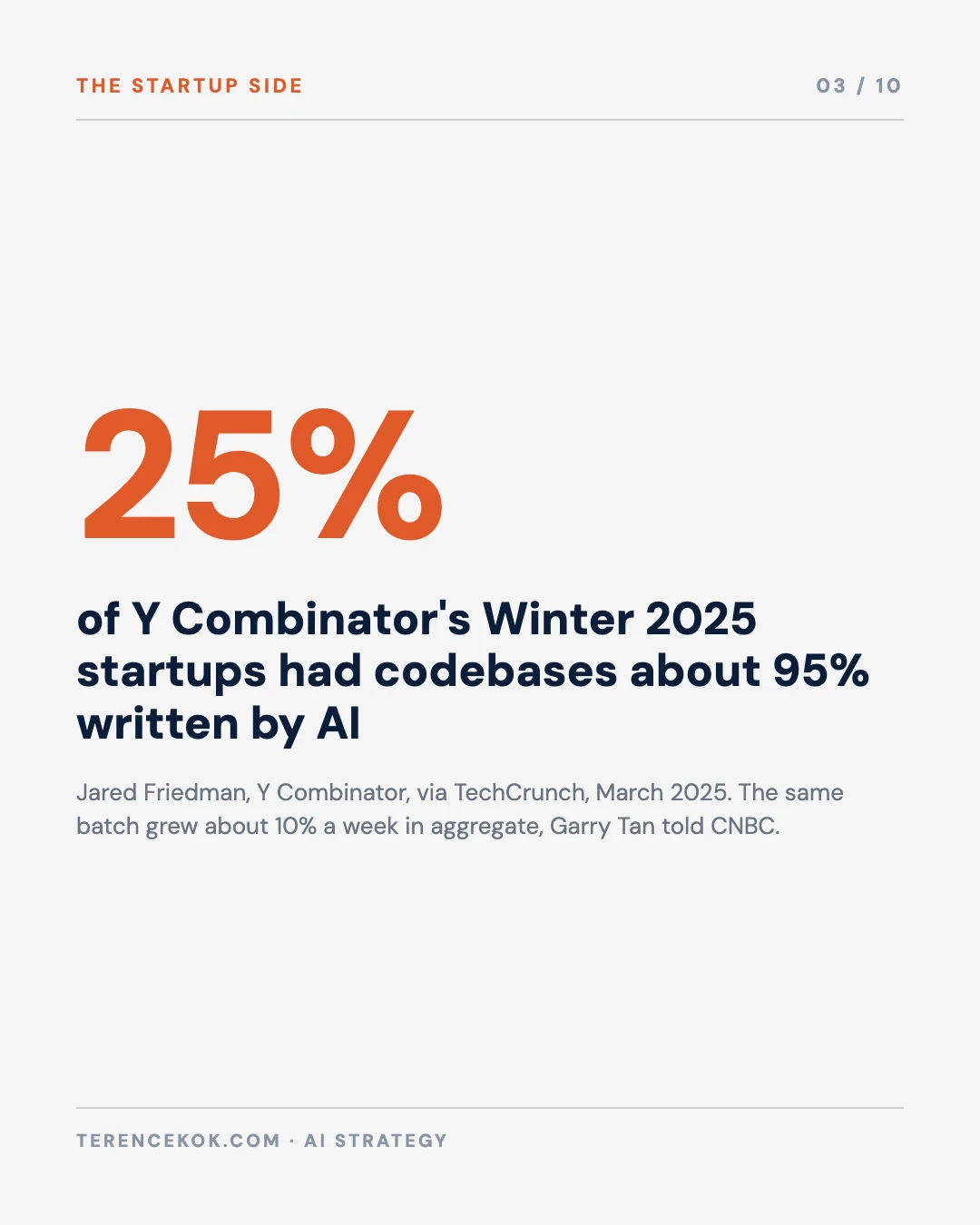
25%
of startups in Y Combinator’s Winter 2025 batch had codebases about 95% written by AI, YC managing partner Jared Friedman via TechCrunch
10%
weekly growth across the same YC batch in aggregate, as YC chief executive Garry Tan told CNBC in March 2025
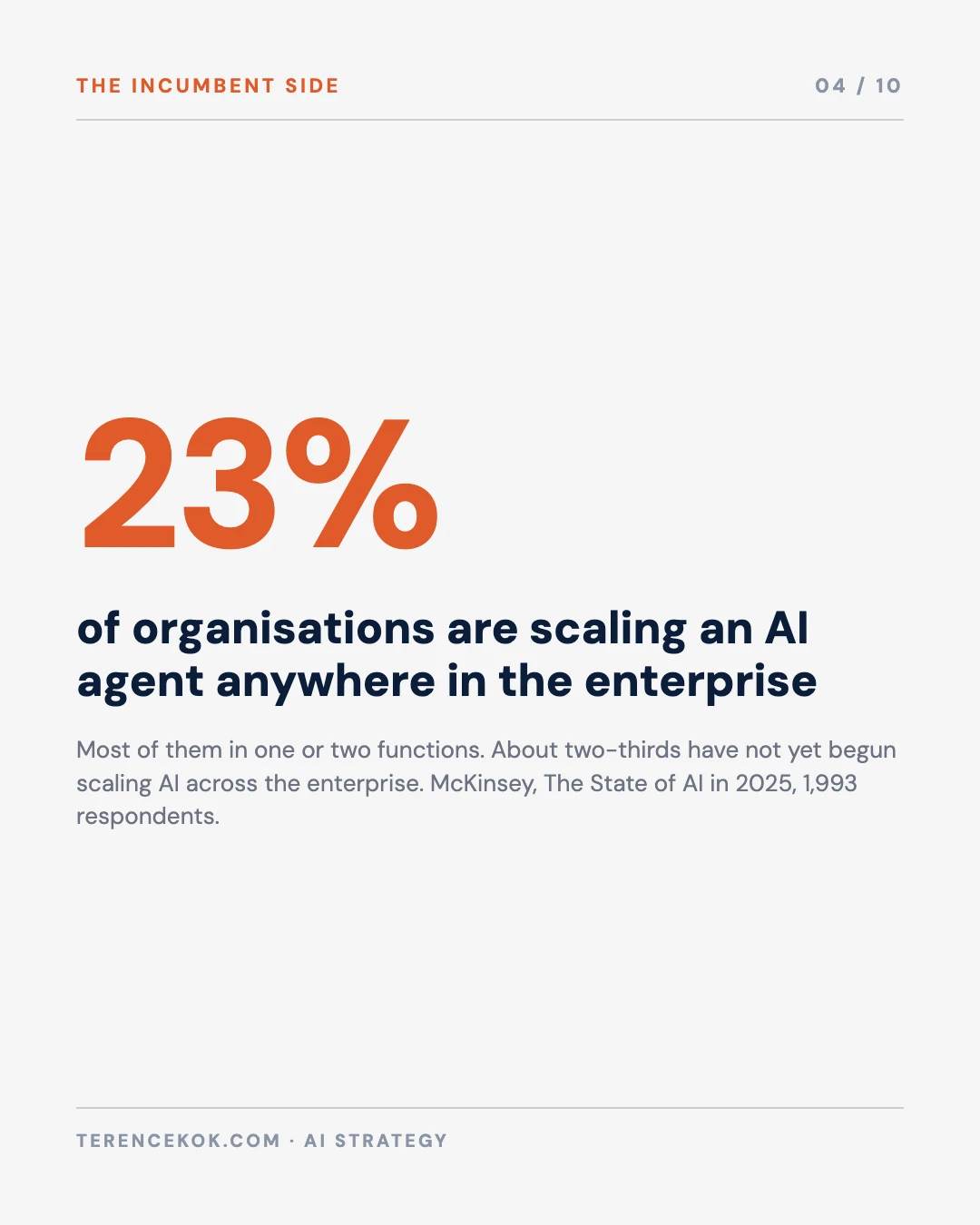
23%
of organisations scaling an AI agent anywhere in the enterprise, mostly in one or two functions, McKinsey State of AI 2025
~2/3
of organisations have not yet begun scaling AI across the enterprise, same McKinsey survey of 1,993 respondents
Core conclusions
- Startups and incumbents use the same models. The difference lies in how quickly each one lets people act on what those models can do.
- The threat to an incumbent is unlikely to come from a direct competitor. It is more likely to come from a startup in a neighbouring field that does not see a boundary between its business and yours.
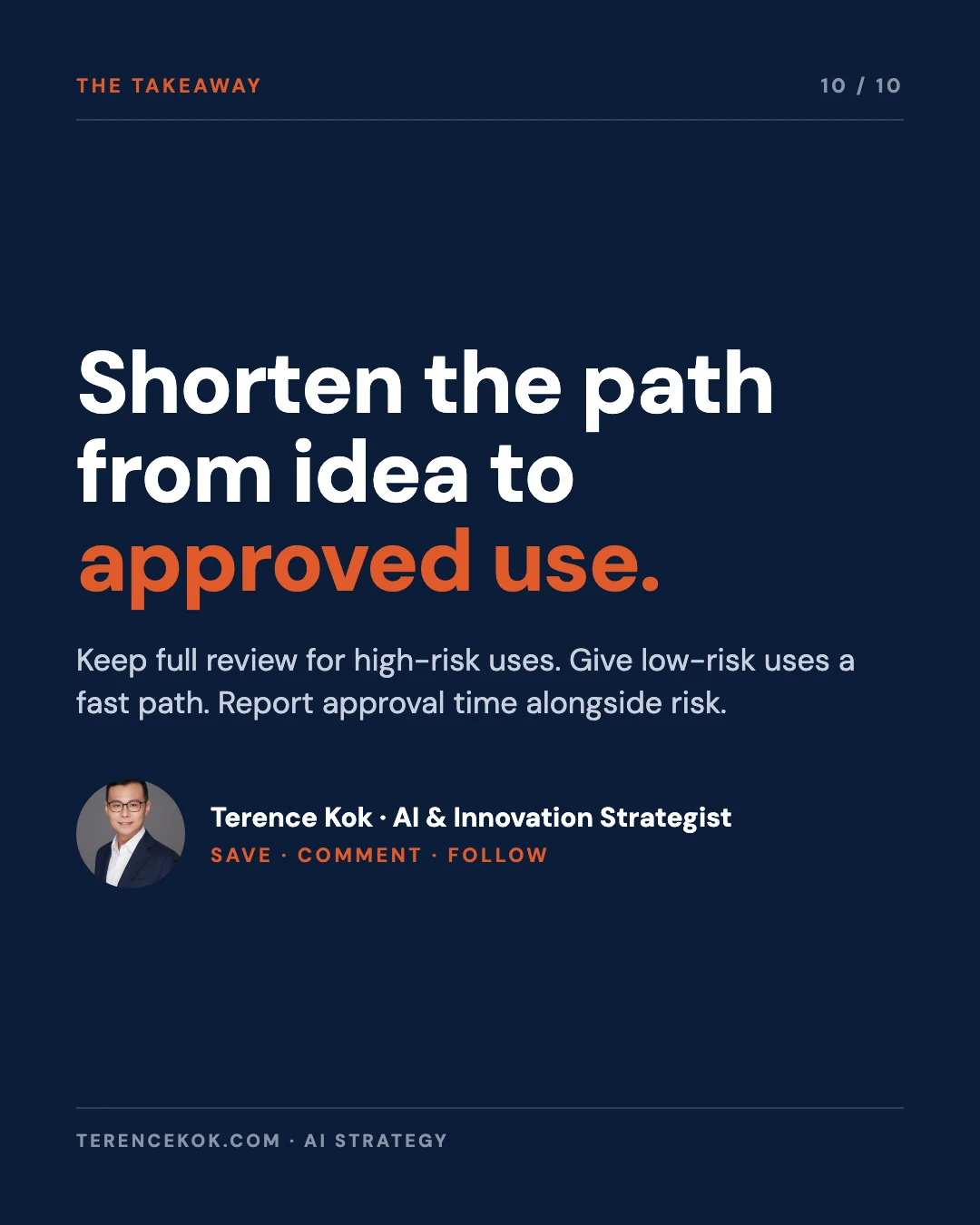
- Incumbents that close the gap will do it by shortening the path from idea to approved use, with governance that is quick and proportionate to the risk.
The argument, in ten slides
Save it, or send it to whoever sets your AI approval process.
What Andreessen said
The conversation was an a16z podcast with Marc Andreessen, Ben Horowitz and Chris Dixon, released on 22 October 2026. Andreessen’s central claim was short. The gap between what early adopters of AI understand to be possible and what everyone else understands is “the biggest delta I’ve ever seen”. He said this holds for individuals, and holds even more strongly for companies. “The early AI-native early stage startups have a completely different view on what they can do with AI than the typical incumbents in almost any industry. Almost without exception.”
He added that the gap is widening, because AI capability is improving “even week by week” and the leading founders keep pace while typical incumbents do not.
From there he drew a conclusion about markets. If the gap holds, “there are going to be a lot of industries that are really up for grabs in a fundamentally more profound way than maybe has been the case in the past.” Founders will write product plans that are more technically ambitious, business plans that are broader, and companies that grow much faster. They will not describe themselves as a software company, a hardware company or even an AI company. They will decide how many fields they want to work in and combine them.
He made the point personal by looking back to Netscape, which he co-founded in 1994 and where Ben Horowitz later worked with him. He asked what the two of them could have done there with today’s tools, and answered himself: “We would have built the whole damn internet.”
Andreessen is a venture investor, and his firm profits when startups beat incumbents. That does not make him wrong. It does mean his claim should be checked against evidence before a board acts on it.
The evidence for the gap
On the startup side, the evidence is strong. In March 2025, Y Combinator managing partner Jared Friedman said that about a quarter of the startups in the Winter 2025 batch had codebases that were 95% written by AI. These were founders who could write the code themselves and chose not to. YC chief executive Garry Tan told CNBC the same batch was growing 10% a week in aggregate, which he described as unprecedented for early-stage companies. Those figures are a year and a half old, and the tools have improved a great deal since.
On the incumbent side, McKinsey’s State of AI 2025 survey of 1,993 respondents found that about two-thirds of organisations had not yet begun scaling AI across the enterprise. Only 23% said they were scaling an AI agent anywhere in the business, and most of those were doing it in one or two functions. Another 39% were experimenting with agents.
| Measure | AI-native startups | Established organisations |
|---|---|---|
| Share of code written by AI | About 95% in a quarter of the YC Winter 2025 batch | Not reported in comparable form; most enterprise use remains assisted coding with human review |
| Agents in use | Built into the product from day one | 23% scaling an agent anywhere, mostly in one or two functions |
| Scope of AI use | Across the whole company | About two-thirds not yet scaling AI across the enterprise |
Sources: TechCrunch, March 2025 (YC); McKinsey, The State of AI in 2025. The two sides are measured differently, so treat the comparison as indicative.
How far established organisations have taken AI agents
Source: McKinsey, The State of AI in 2025, survey of 1,993 respondents, June to July 2025. Most of those scaling an agent do so in one or two functions.
My own experience fits the pattern. This year I have built working proof-of-concept systems with an AI coding agent in days, for clients across banking, logistics, retail and the public sector. In almost every case the build was the quick part. The slow part was getting the organisation to agree on who could use it, with which data, under whose approval.
Why incumbents fall behind
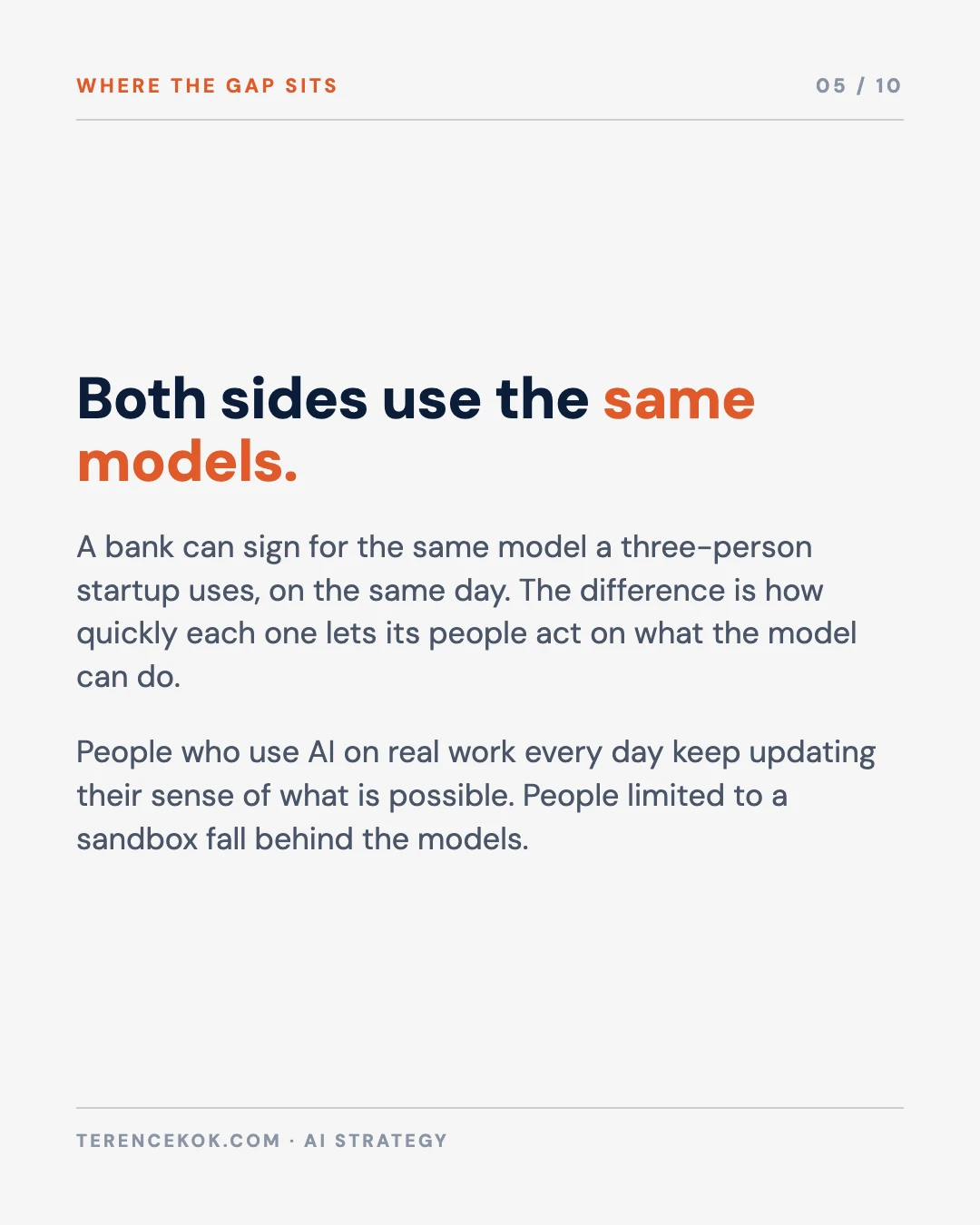
Startups and incumbents can buy access to the same models on the same day. A bank can sign an enterprise agreement for the same model that a three-person startup uses. Access to the technology does not explain the gap.
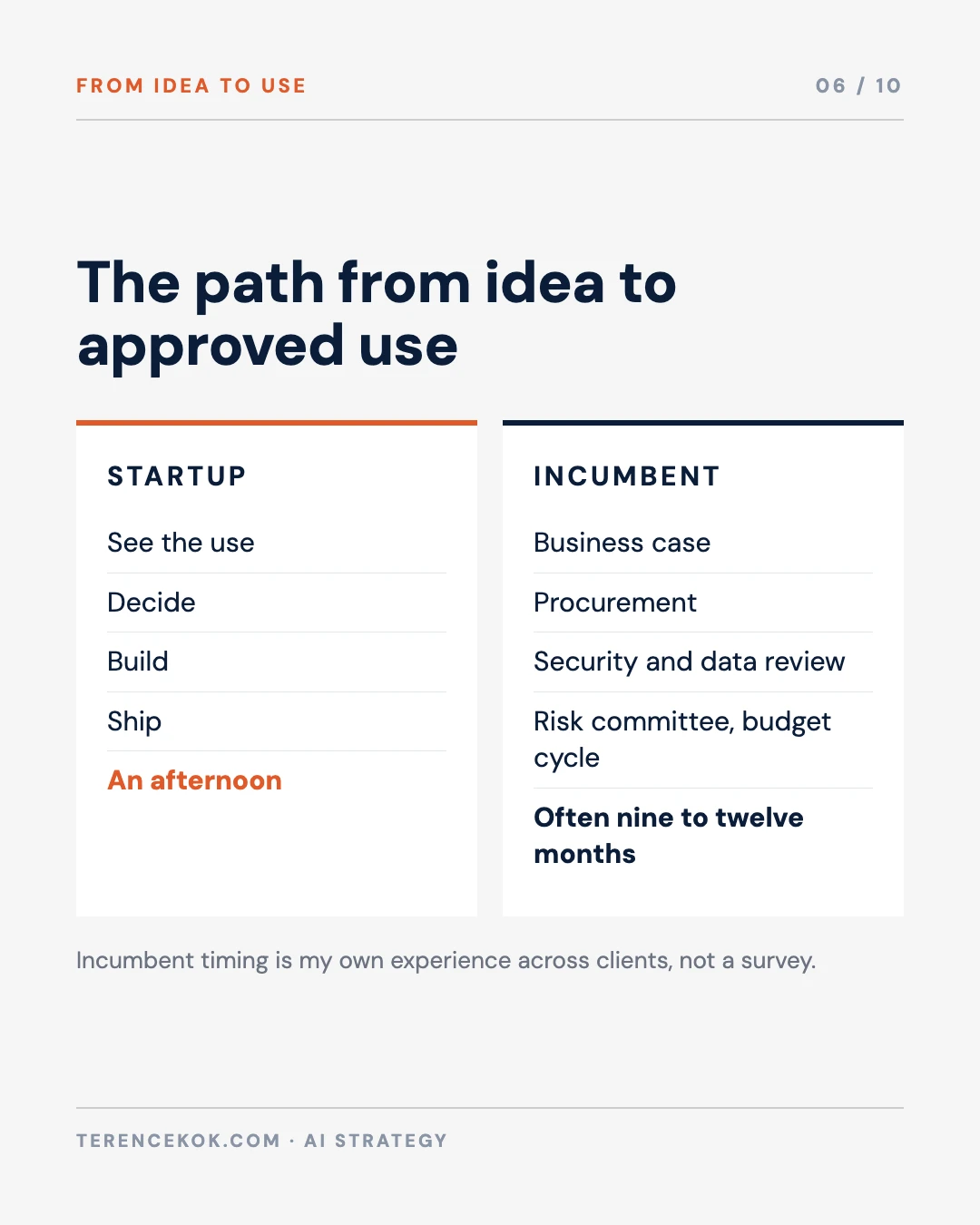
What explains it is the distance between seeing a use and being allowed to act on it. In a startup, the person who sees what the model can do is often the person who decides to use it, and the decision takes an afternoon. In a large organisation, the same idea passes through a business case, a procurement review, a security assessment, a data protection review, a risk committee and a budget cycle. Each step exists for a reason. Together they can take nine to twelve months, and in that time the model has changed two or three times.
The path from an AI idea to approved use
Schematic. The model both sides use is the same. Incumbent timing is my own experience across clients, not a survey.
There is a second effect that matters more over time. People in a startup use AI on real work every day, so their sense of what is possible keeps moving. People in an incumbent who are allowed to use AI only in a sandbox, or only on a short list of approved tasks, form their view of AI from those limited uses. Their picture of what AI can do falls behind the models themselves. This is the gap Andreessen describes. Incumbents have the same tools available. Their people have simply had far less practice with them.
Fear makes this worse. I have written about how fear of AI shows up as governance that looks thorough on paper and stops everything in practice. A ban on AI coding tools, or an approval process with no deadline, feels safe to the person who signs it. It is safe only in the short term.
Where the argument goes too far
Andreessen’s claim that whole industries are up for grabs deserves more caution than his claim about the gap.
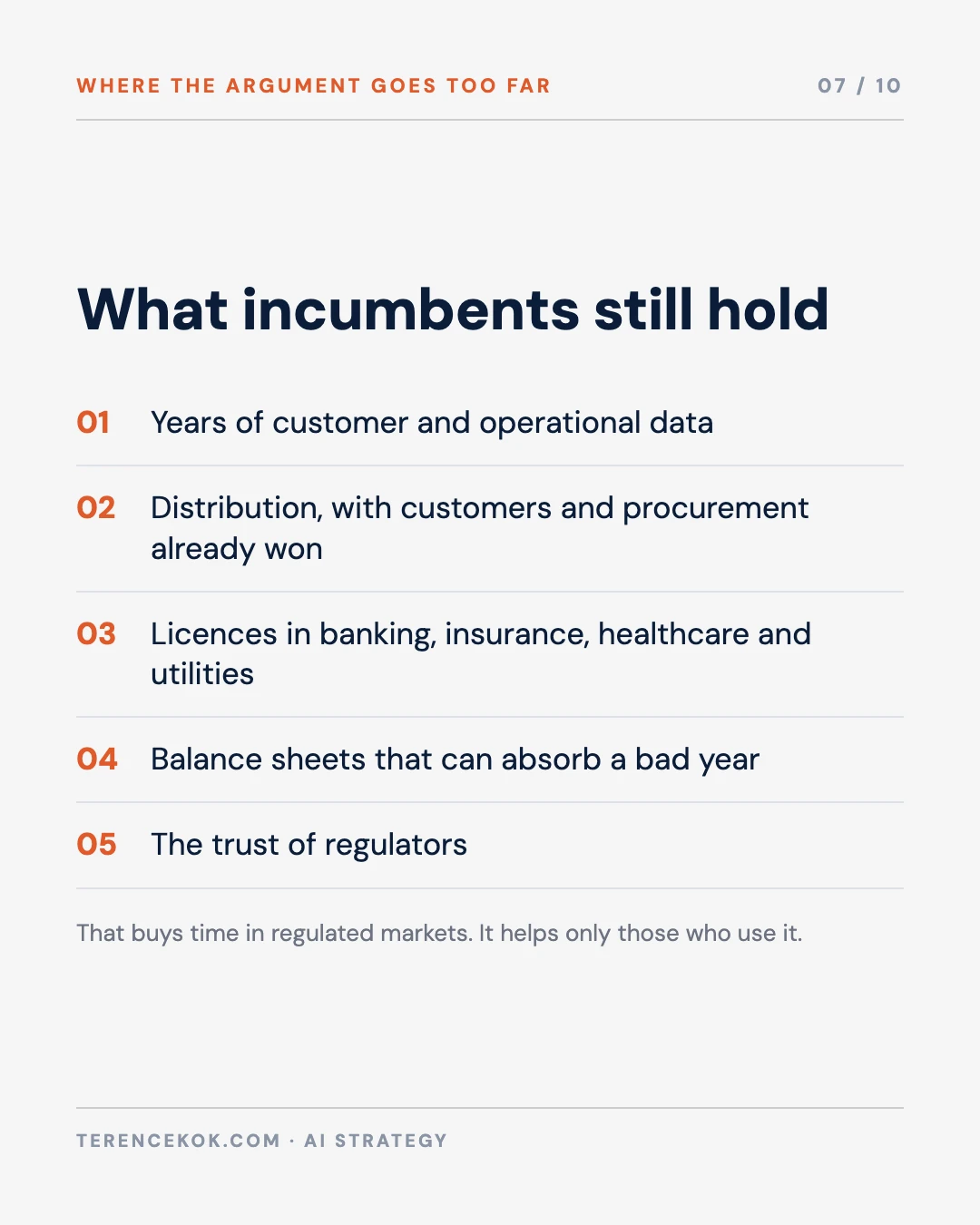
Incumbents hold things that a model cannot produce on request. They have years of customer and operational data. They have distribution, meaning customers who already buy from them and procurement teams who have already approved them. They have licences in regulated sectors such as banking, insurance, healthcare and utilities. They have balance sheets that can absorb a bad year. And they have the trust of regulators, which a startup earns only over years.
In regulated industries, the speed of an AI-native startup can also become a weakness. A company that ships a new feature every week, written mostly by AI, has to show a regulator how each change was tested and approved. The startups that win in these sectors will be the ones that build that discipline in from the start. Many do not.
So my reading is more cautious than his. In lightly regulated markets where the product is mainly software and information, such as marketing services, research, design and parts of professional services, I think he is broadly right, and the change will be fast. In heavily regulated markets, incumbents have more time. But that time is limited, and it only helps those who use it to change how they work.
The threat from a neighbouring field
The part of the argument I find most useful is the one about scope. Andreessen expects founders to stop thinking of themselves as one kind of company and to combine fields freely.
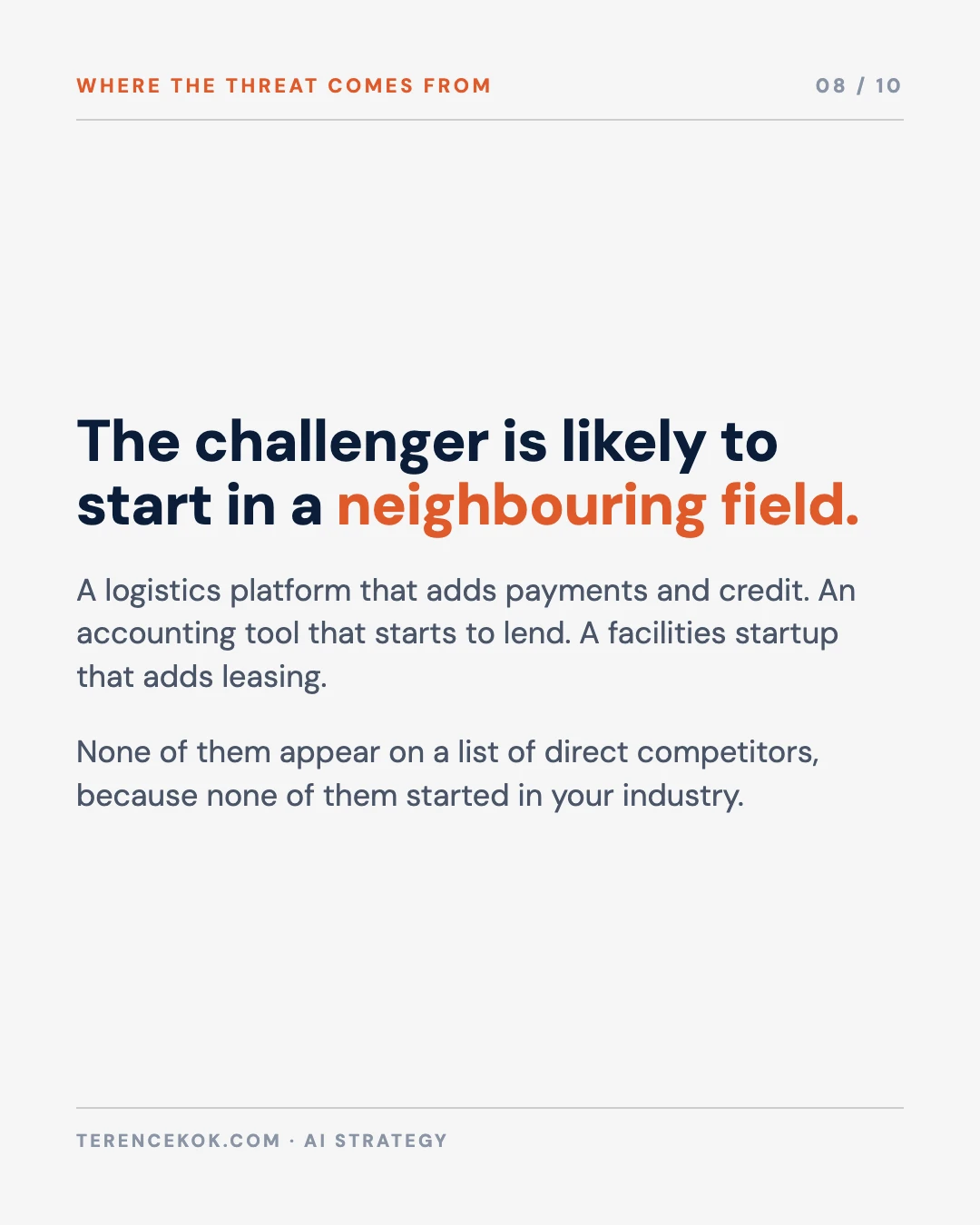
For an incumbent, this changes where to look for the threat. A bank watches other banks and a few fintech companies. The more likely challenger in the next few years may be a logistics platform that adds payments and credit for its customers, or an accounting tool that starts to lend. A property firm may find its tenants’ needs met by a facilities-management startup that has added leasing. These companies do not appear on a list of direct competitors, because they did not start in your industry.
When a small team can build a working product in a new field in weeks, the cost of entering a neighbouring market falls sharply. A startup’s view of the boundaries between industries changes as a result. Most incumbents’ strategy reviews still assume those boundaries hold.
What a board can do this quarter
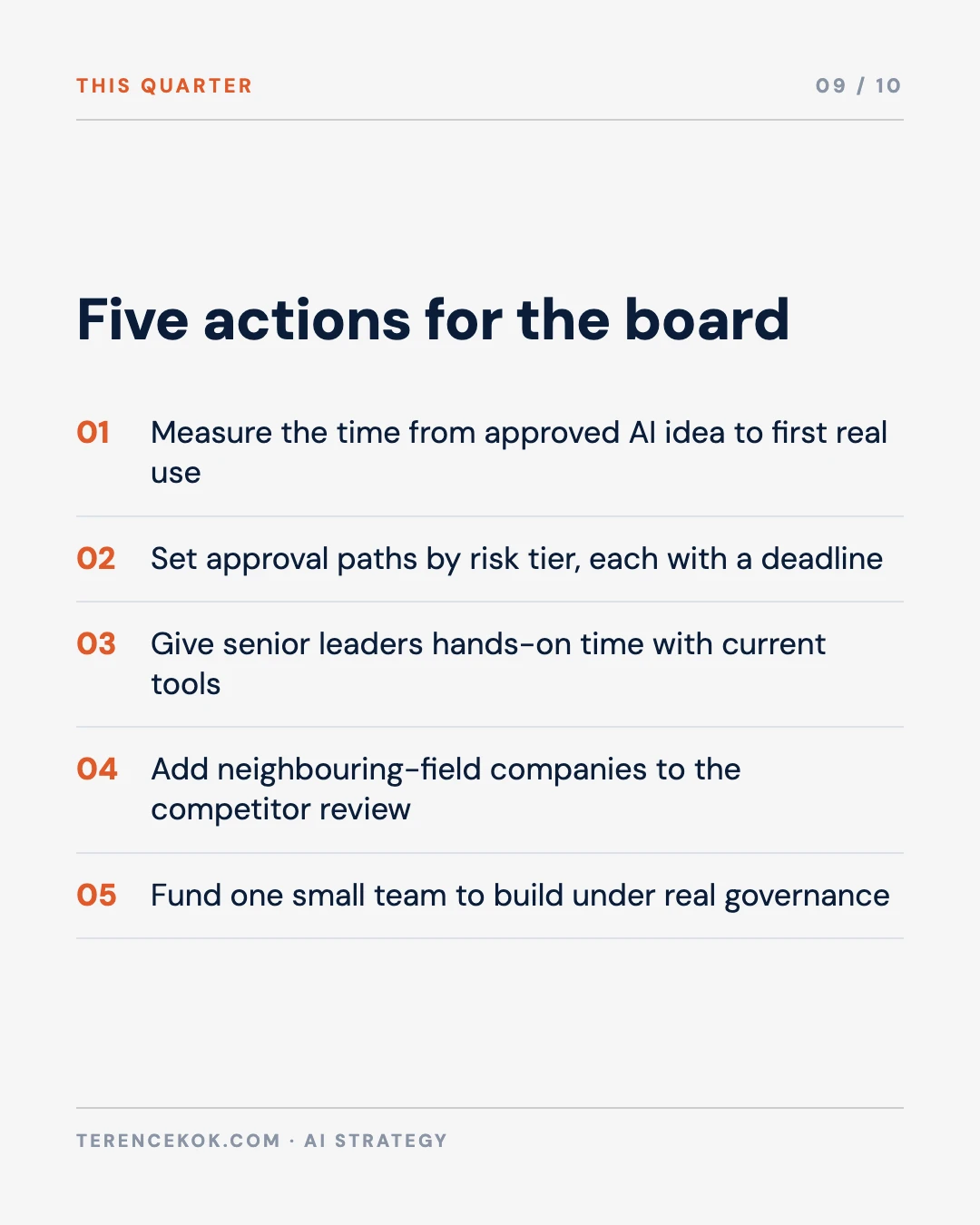
Five actions I would put to any board that sits on the incumbent side of this gap.
| Action | What it changes |
|---|---|
| Measure the time from an approved AI idea to its first use on real work | Makes the delay visible, so it can be managed. Most organisations I work with do not know this number. |
| Set approval paths by risk tier, with a deadline for each tier | Low-risk uses, such as drafting and internal analysis, get approved in days. High-risk uses still get full review. |
| Give senior leaders hands-on time with current tools on their own work | Updates their view of what AI can do. A demonstration does not have the same effect. |
| Add companies from neighbouring fields to the competitor review | Puts the most likely challengers on the agenda before they arrive. |
| Fund one small team to build with AI under real governance, on a real process | Shows what is possible inside your own controls, and finds which controls slow the work without reducing risk. |
Actions are my own, drawn from AI governance and adoption work with clients.
The first action matters most. An organisation that does not measure how long it takes to act on AI will assume the delay is acceptable. When boards see the actual figure, usually counted in months, they tend to act on it quickly.
Free tool
AI Readiness Assessment
See where your organisation stands on strategy, data, people and governance, and where the delays are most likely to sit.
Governance that moves at the speed of the work
None of this is an argument for removing controls. An incumbent that copies a startup’s speed without its own discipline will produce the incidents that confirm every fear its risk committee had.
The goal is governance that is proportionate and quick. Low-risk uses need a light, fast path. High-risk uses need full review, done by people who understand the technology well enough to judge it. The organisations I see doing this well treat approval time as a measure they report on, alongside risk. They also review their controls every few months, because a control written for last year’s models may now be blocking safe work or missing new risks.
Andreessen is right that the leading founders now have abilities that no previous generation of founders had. Incumbents have access to the same abilities. Whether they use them depends on how quickly their own organisations allow it.
Evidence & Methodology
Andreessen’s words come from the podcast transcript. The startup and enterprise figures come from published reporting and one large survey. The explanation of why incumbents lag, the assessment of which markets are most exposed and the board actions are my own.
| Claim | Source | Grade |
|---|---|---|
| Andreessen said the gap between AI-native startups and incumbents is the widest of his career and is growing | a16z podcast with Andreessen, Horowitz and Dixon, released 22 October 2026 | Measured |
| About a quarter of YC Winter 2025 startups had codebases about 95% written by AI | Jared Friedman, YC, reported by TechCrunch, March 2025 | Reported |
| The YC Winter 2025 batch grew about 10% a week in aggregate | Garry Tan to CNBC, March 2025; company-reported, not audited | Reported |
| 23% of organisations are scaling an AI agent somewhere; about two-thirds have not begun scaling AI across the enterprise | McKinsey, The State of AI in 2025, survey of 1,993 respondents, June to July 2025 | Measured |
| The gap lies in permission to act, because both sides can access the same models | My own observation from client work, not a survey | My call |
| Regulated industries give incumbents more time than lightly regulated ones | My own assessment | My call |
| Approval of AI use in large organisations often takes nine to twelve months | My own experience across clients; not measured systematically | My call |
Sources
- Andreessen, M., Horowitz, B., & Dixon, C. (2026, October 22). Marc Andreessen: The biggest gap I’ve seen in my career [Podcast episode]. The a16z Show.
- Mehta, I. (2025, March 6). A quarter of startups in YC’s current cohort have codebases that are almost entirely AI-generated. TechCrunch.
- CNBC. (2025, March). Y Combinator startups are fastest growing, most profitable in fund history because of AI.
- McKinsey & Company. (2025). The state of AI in 2025: Agents, innovation, and transformation.

Governance Theatre Is What Fear Looks Like on a Slide
How fear turns governance into a process that looks thorough and stops everything.

Use AI to Disrupt Yourself, Before It's Done to You
What it takes for an established company to challenge its own business model.

The AI Model Is Becoming the Software
Why the software most people use lightly is the most exposed.
If your organisation takes months to move an AI idea into real use, my AI governance advisory work focuses on making approval quicker while keeping the controls that matter.
Was this useful?