

Listen to this article
Jump to a section
In this article
Executive Summary
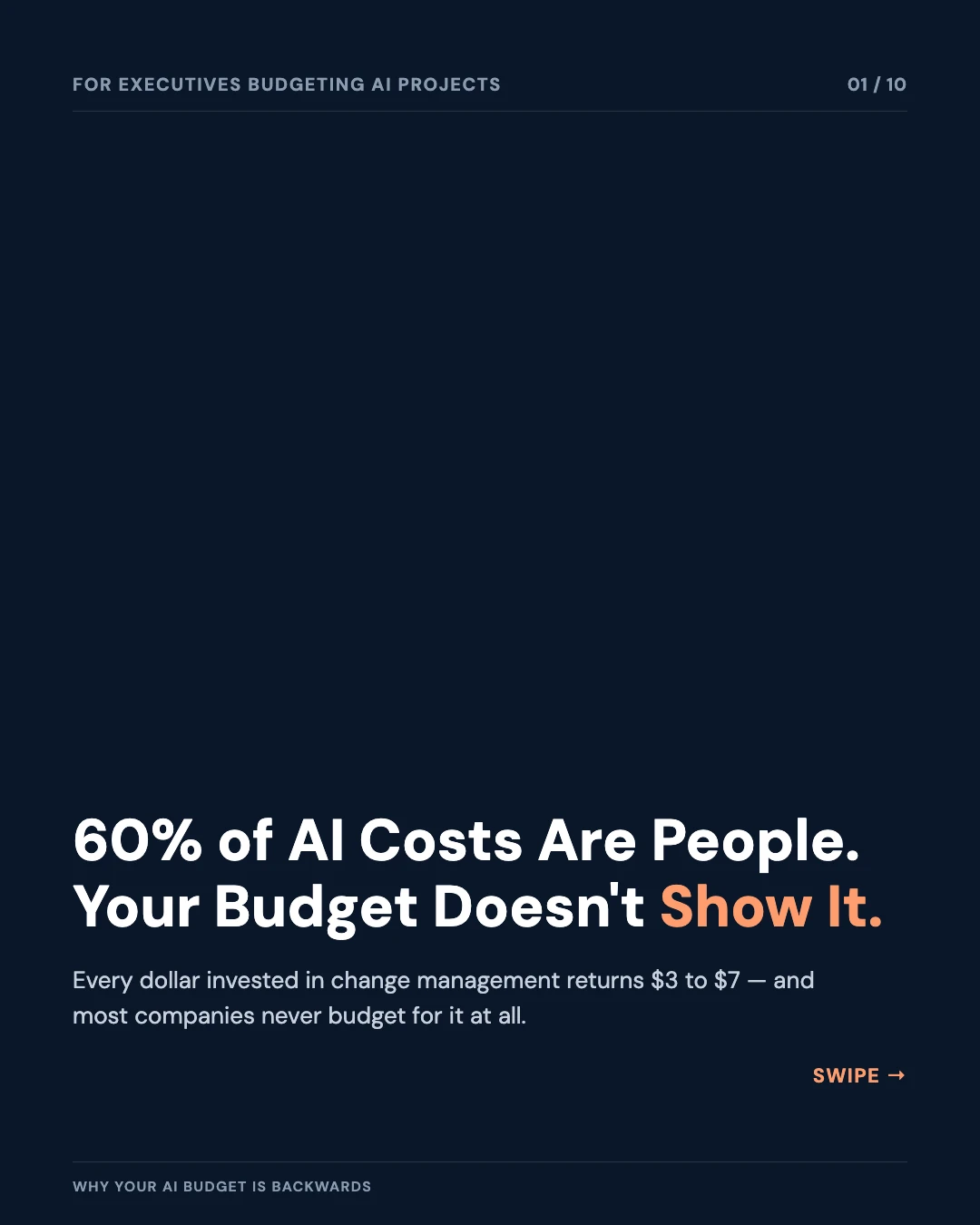
Most AI budgets are backwards: they fund infrastructure and software first and treat change management as an afterthought, when people costs (training, adoption, retraining) are where the majority of total AI spend lands.
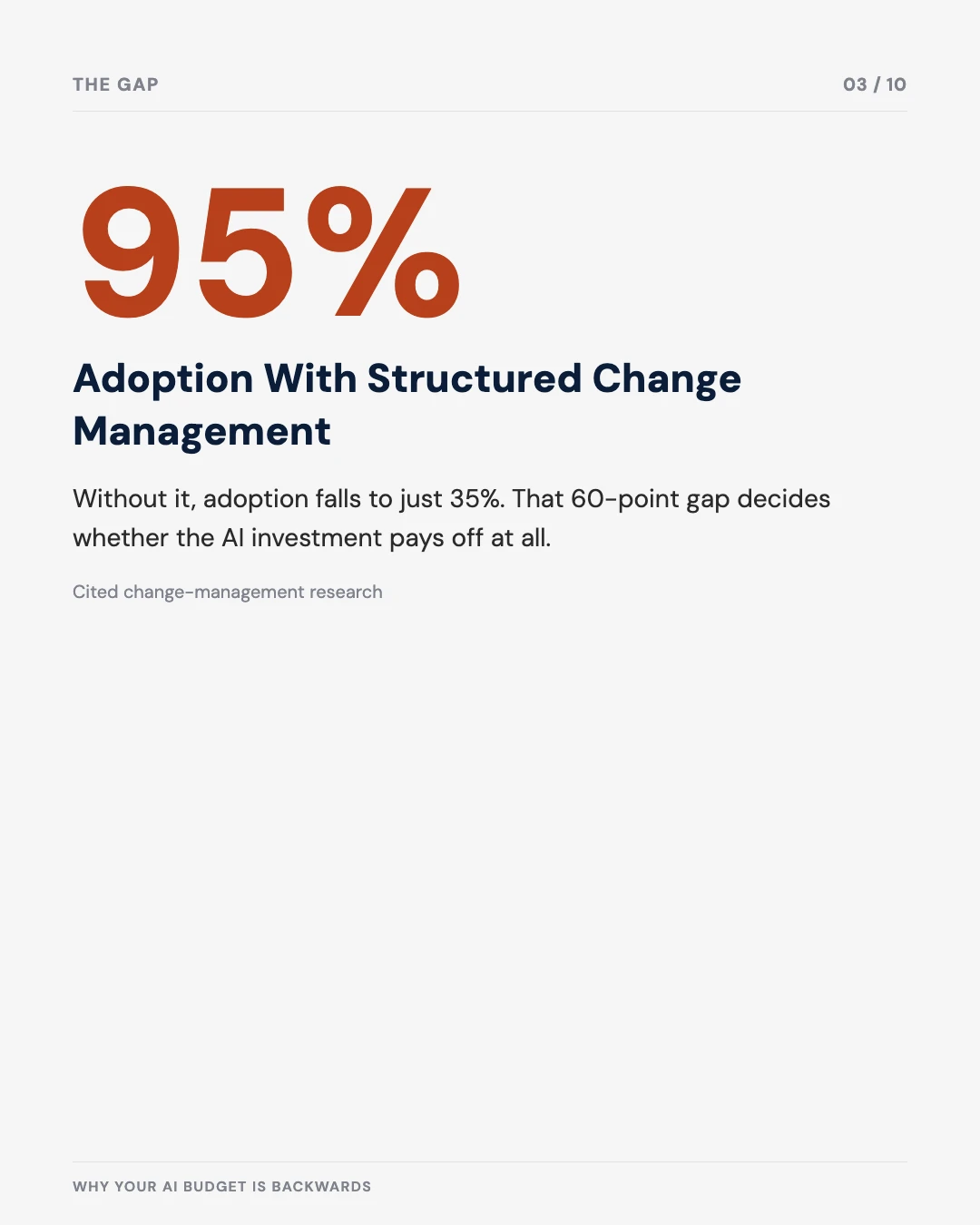
95% vs 35%
adoption rate with structured change management versus without it (Prosci)
3:1–7:1
documented return on every dollar invested in change management
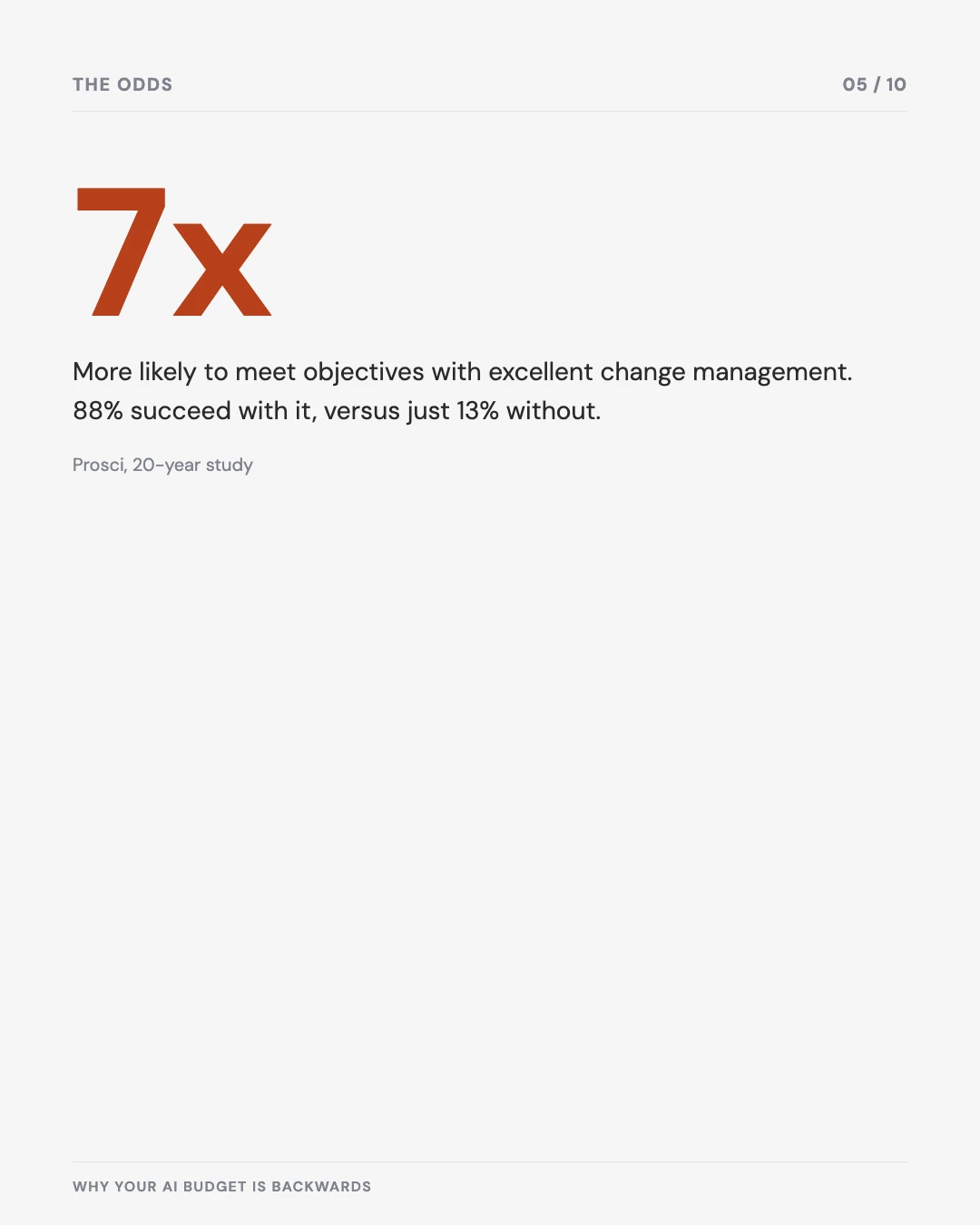
88% vs 13%
project success rate with excellent change management versus without it (Prosci)
Core conclusions
- Adoption, not model sophistication, is what determines whether a project’s benefits get realised at all. A smarter budget reserves a protected 25-30% of total spend for change management, training, and enablement.
- The 60-percentage-point adoption gap between structured and unstructured change management is the difference between an AI investment paying for itself several times over and becoming an expensive system nobody uses.
- This is a reallocation, not a bigger budget: it shifts money from fixing adoption failures later to preventing them from the start.
Where the real costs hide, in ten slides
Save it, share it, or send it to whoever signs off the AI budget.

Most AI budgets are built like software purchases
Most executives treat AI projects like software purchases: buy the tech, install it, done. Except it’s never done. And the biggest line item is something that rarely makes it into the budget: people.
The biggest line item in most AI budgets is something that rarely makes it into the budget: people.
The real cost of AI is change management
When companies plan AI projects, they budget for the obvious stuff: infrastructure, licenses, development. Change-management research points the other way: return on every dollar invested in change management is widely documented at $3 to $7, a 3:1 to 7:1 range that shows up across independent studies of technology transformation.
And here’s the pattern I keep seeing: whether employees use the new system determines most of a project’s realised benefits, far more than how sophisticated the AI itself is. I go deeper on why adoption, not model quality, is the real predictor of success in After All the AI Hype.
Across the AI implementations I have advised on, training, change management, and the ongoing work of scaling adoption routinely account for more of total spend than the initial build itself, even though almost none of it appears in the original budget line.
Where the Money Really Goes
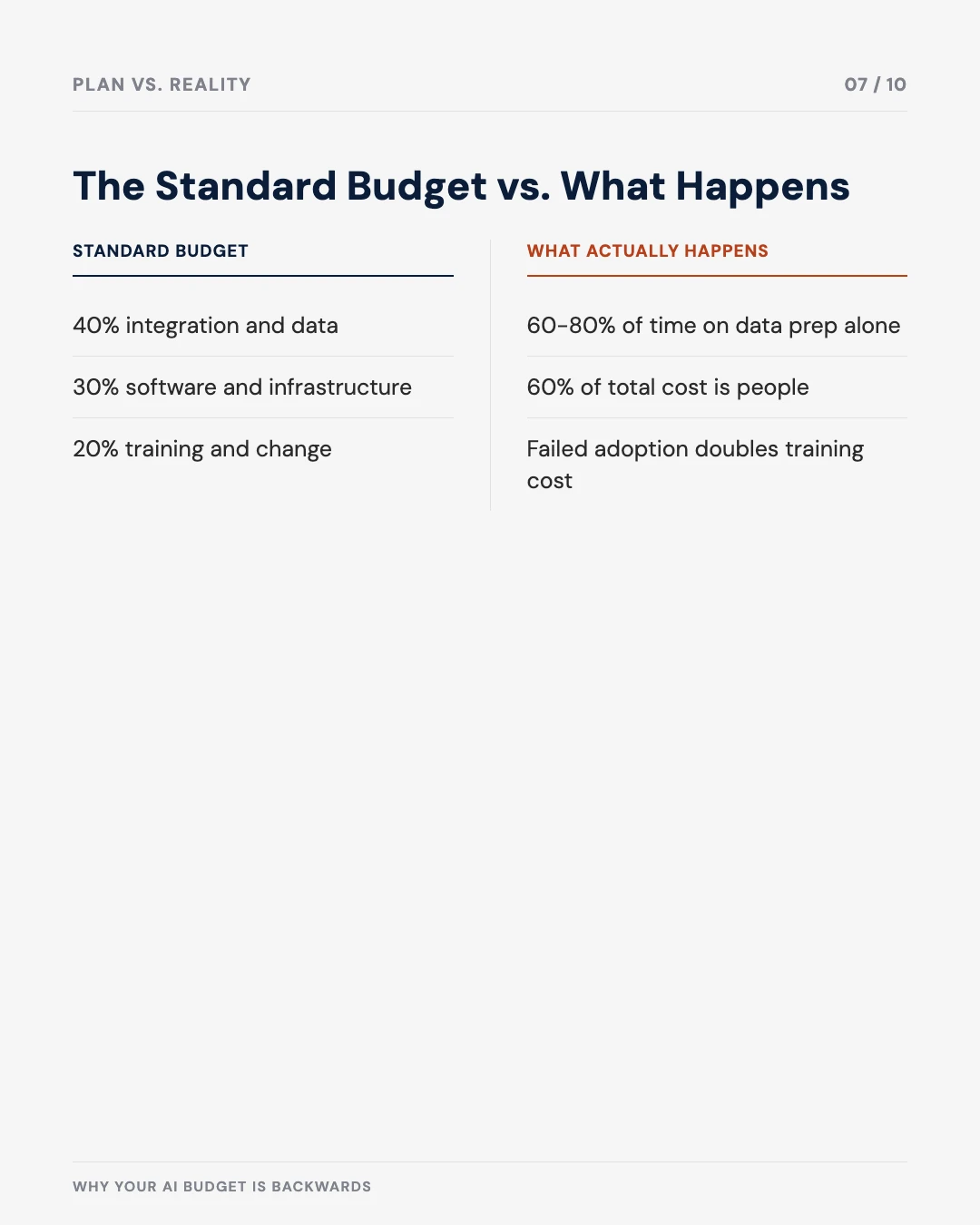
The standard AI budget looks something like this: mostly integration and data work, then software and infrastructure, with training and change management getting whatever is left over, usually the smallest slice.
Seems reasonable, right? Except execution tells a completely different story.
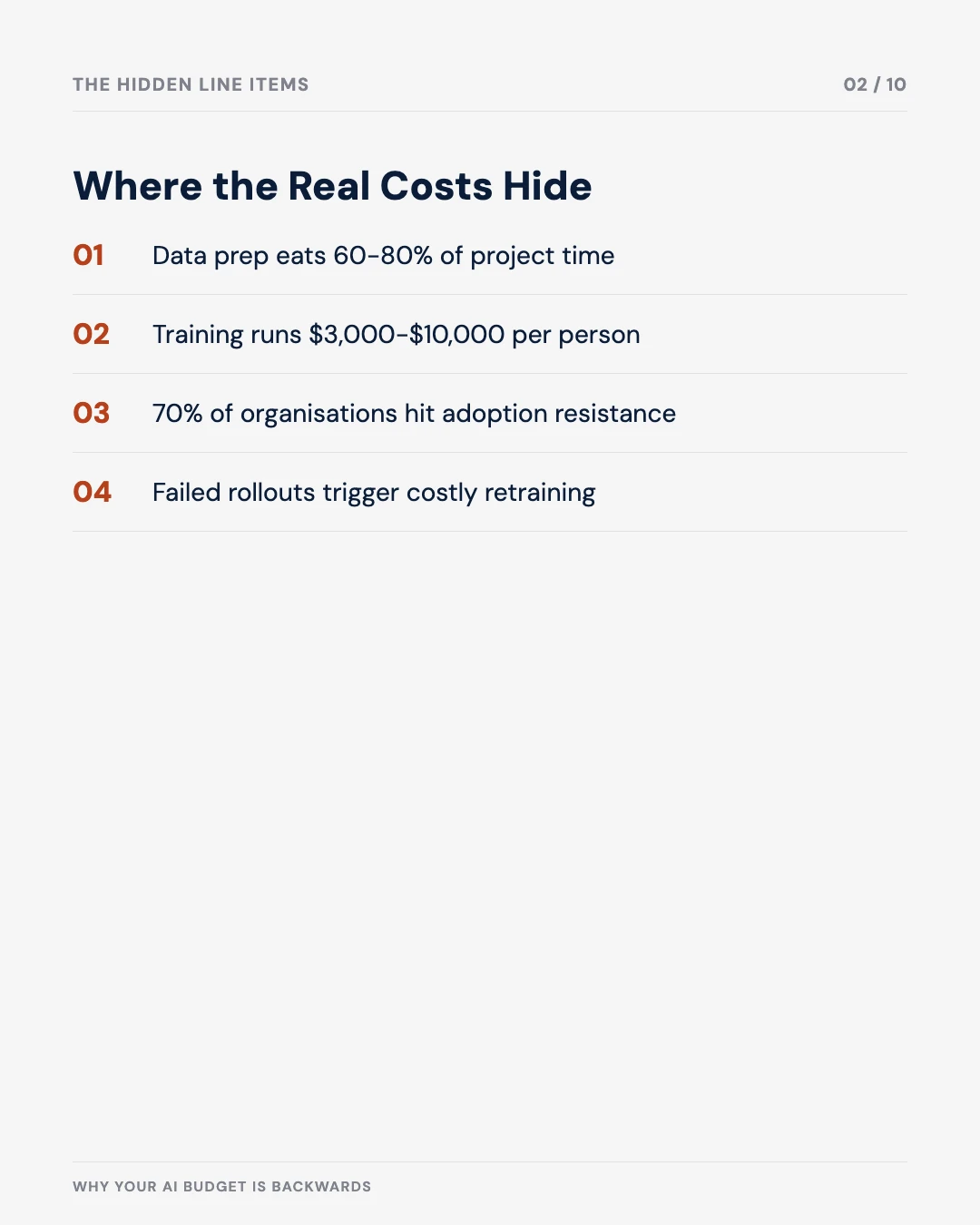
Data preparation is consistently one of the largest time sinks on any AI project, and it is mostly labour. The exact share varies by study, but every serious survey of data science work puts it at the top of the list.
Training employees on AI-enabled workflows is a real, recurring cost most budgets underestimate, and productivity typically dips for a period during the transition as people learn the new way of working.
When people resist the change, which is common, training and support costs run well past the original estimate.
Here is how this typically plays out, based on a pattern I see across engagements rather than any single named case: a company hits real cost growth in year two when initial adoption falls short, and has to spend again on retraining that was never in the original plan. These “hidden costs” never made it into the original budget. They just become expensive surprises.
The 60-Point Gap That Kills ROI
Prosci’s research puts structured change management at around 95% adoption. Without it, that figure drops to roughly 35%.
That 60-percentage-point difference is the difference between an AI investment paying for itself several times over and becoming an expensive system nobody uses.
The same research, covering 20 years and thousands of projects, backs up the success-rate split in the tile above: projects with excellent change management are 7x more likely to meet their objectives.
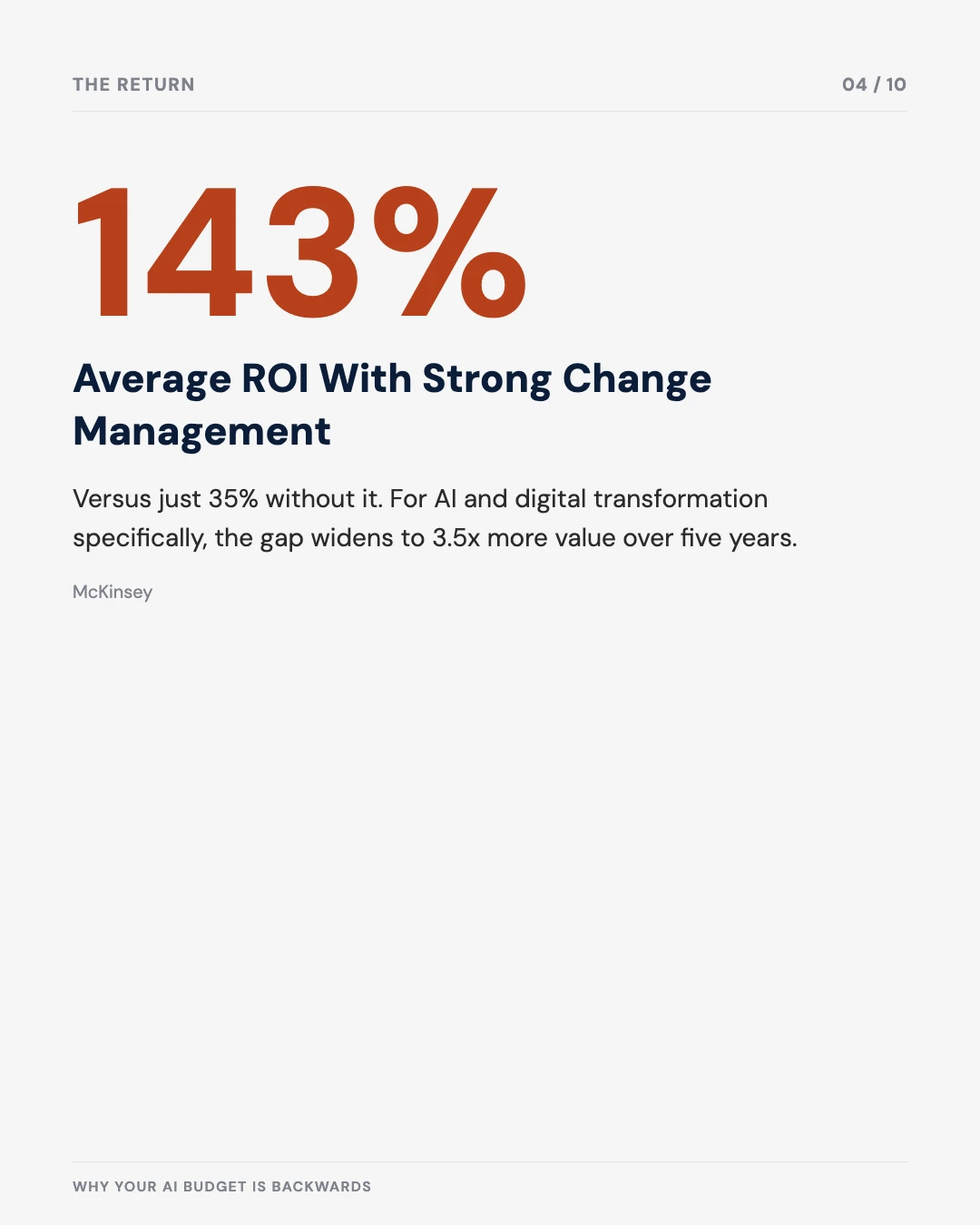
Other change-management research points the same direction: organisations with strong, structured change capability consistently report a substantially higher return on transformation spend than those without it, and the gap widens further when the transformation is specifically an AI or digital one.
Why People Costs Can Explode
The McKinsey 7S framework explains why people costs exceed tech costs. Four of the seven critical elements (Staff, Skills, Style, and Shared Values) are entirely about people.
These are where transformations typically stall:
- Leadership resistance
- Employee anxiety about job security
- Unclear role definitions
- Cultural misalignment
When companies treat change management as an afterthought, these issues eat into the project budget in ways that never show up as their own line item. When change management is built in from day one, that spend goes down and the overall return goes up.
How the 3:1 Return Works
The 3:1 ROI shows up consistently enough across change-management research to treat it as a floor, not a stretch target. Here is where the returns come from:
1. Reduced implementation costs
Good change management prevents costly delays, rework, and false starts, the kind of costs that are easy to miss until the project is already over budget.
2. Faster benefit realization
When adoption runs at 95% instead of 35%, the project reaches full utilisation months sooner instead of dragging out.
3. Avoided productivity loss
Managing adoption carefully avoids the productivity dip that shows up during almost every technology transition, the difference between weeks of disruption and months of it.
4. Better employee retention
People who feel supported through change are less likely to leave, and replacing a skilled employee is expensive on its own before you even count the disruption to the project.
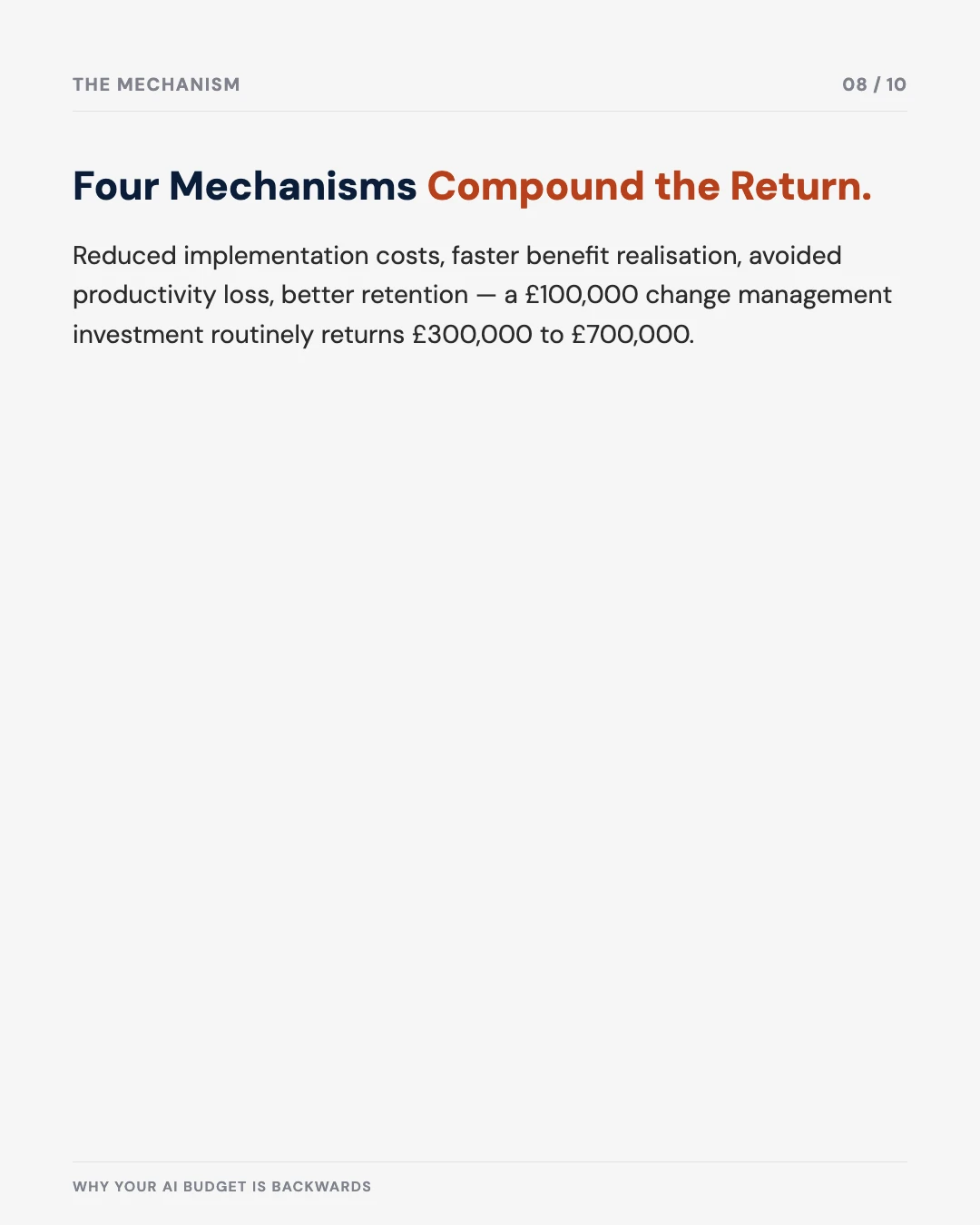
These four mechanisms operate simultaneously, which is why the return compounds.
How to Fix Your AI Budget
If most of your AI budget is going to infrastructure, software, and hiring data scientists, you’re probably shortchanging the one thing that determines success: adoption. Team composition itself is worth auditing here too: see Why Team Design Is the Bottleneck.
A smarter allocation would reserve a protected 25-30% of total programme spend, a working target I use with clients rather than a universal constant, for change management, training, communication, and enablement, especially during pilot and scaling phases.
The total budget stays roughly the same either way. What changes is when the money gets spent: earlier, on prevention, instead of later, on fixing underutilisation, retraining, and rework after the fact.
What Winners Do Differently
Companies that consistently achieve strong change-management ROI use structured frameworks like ADKAR (Awareness, Desire, Knowledge, Ability, Reinforcement) or Kotter’s 8-step model.
These frameworks share common elements:
- Explicit measurement of adoption milestones
- Stakeholder segmentation
- Transparent communication about why changes are happening
- Role-specific training
- Active management of resistance through coaching
When applied from project kickoff instead of bolted on later, organisations see faster adoption, shorter timelines, less rework, and benefits that land sooner, the same pattern Prosci’s research documents at the project level, playing out step by step.
Change management as a budget line
Change management multiplies what an AI investment returns, and a 3:1 floor is well documented enough to budget against.
Companies that view people management as secondary to technology will keep seeing disappointing returns from AI investments. Those that recognize change capability as the primary value driver, and allocate resources accordingly, will see AI deliver measurable, sustained business value.
For leaders accountable for AI outcomes, the question is how much to invest in change management, and how early.
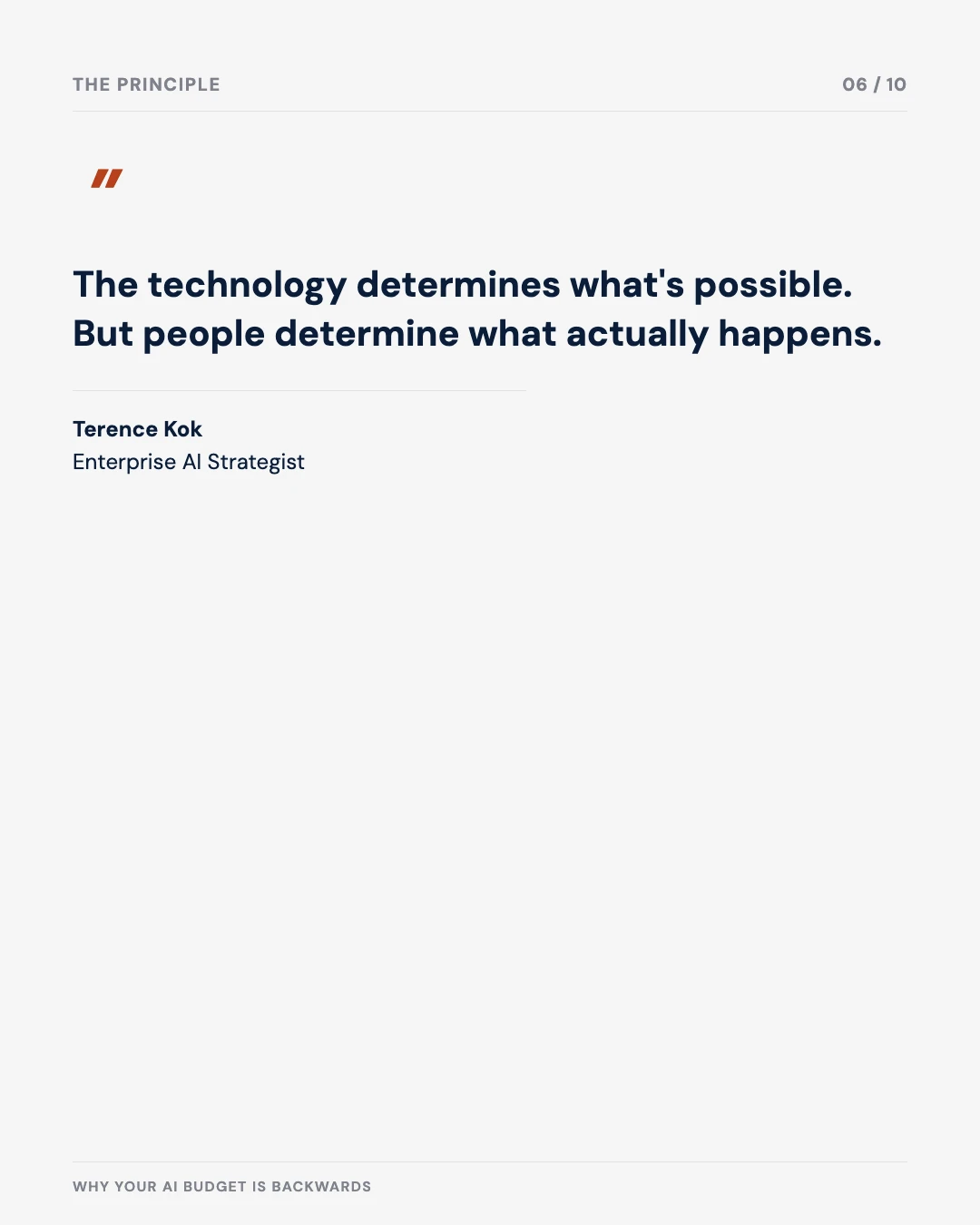
The technology determines what’s possible. But people determine what happens.
Evidence & Methodology
Prosci’s numbers are the ones I would put in front of your CFO without hesitation. Everything else on this page is either a range documented across the broader change-management field or my own read from client work, labelled that way rather than dressed up as a single study.
| Claim | Source | Grade |
|---|---|---|
| Structured change management produces 95% adoption versus 35% without, an 88% versus 13% success split, and makes objectives 7x more likely to be met | Prosci’s research, spanning 20 years and thousands of projects | Measured |
| Change management ROI runs 3:1 to 7:1 | Widely documented across change-management research, not one single study | Reported |
| Training, change management, and scaling account for more of total AI cost than the initial build | My own pattern from advisory engagements, not a named study | My call |
| The manufacturing cost-growth example in “Where the Money Really Goes” | An illustrative composite, not a named or independently sourced case | Illustrative |
Sources
- Prosci. (2023). The correlation between change management and project success.
Free tool
AI ROI Calculator
Model your own project’s numbers before you set the budget split, so change management gets its real share instead of the leftover 20%.
Was this useful?