

Listen to this article
Jump to a section
In this article
Executive Summary
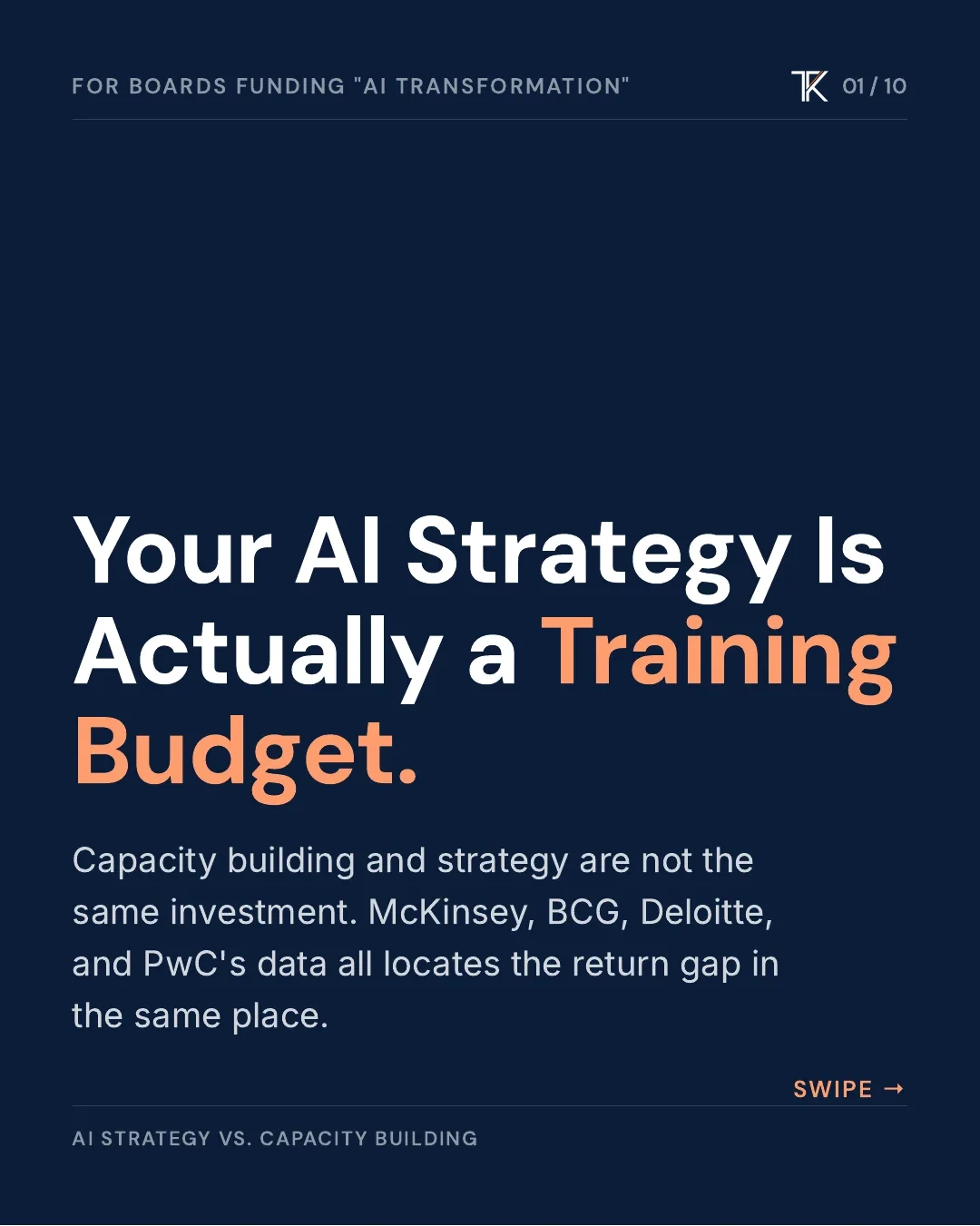
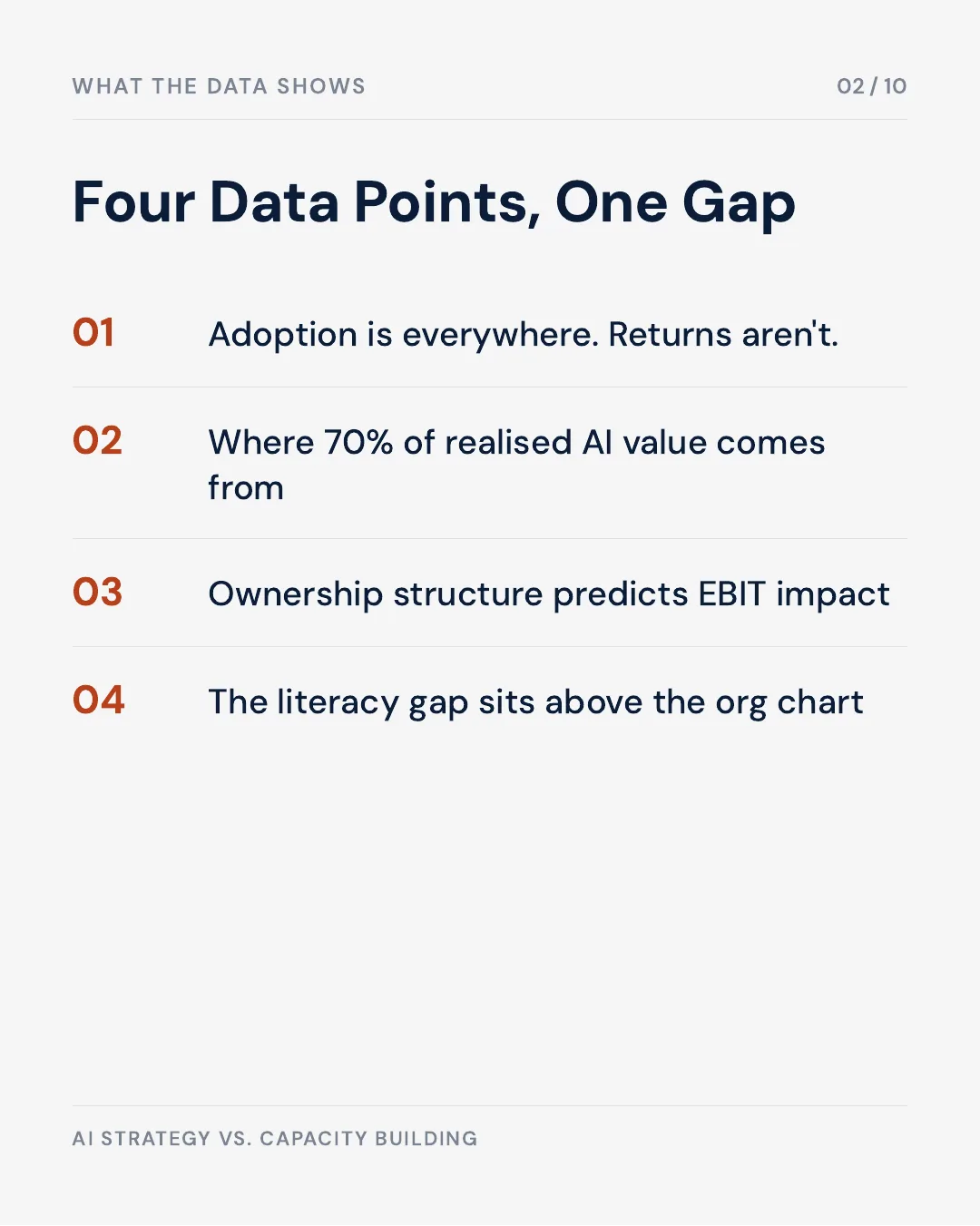
Training your staff to use AI is not the same as having an AI plan. Four separate studies found the same thing: what predicts real results from AI is how well top leaders and board members understand it, not how well regular staff do. Most companies are spending their money on the wrong group.
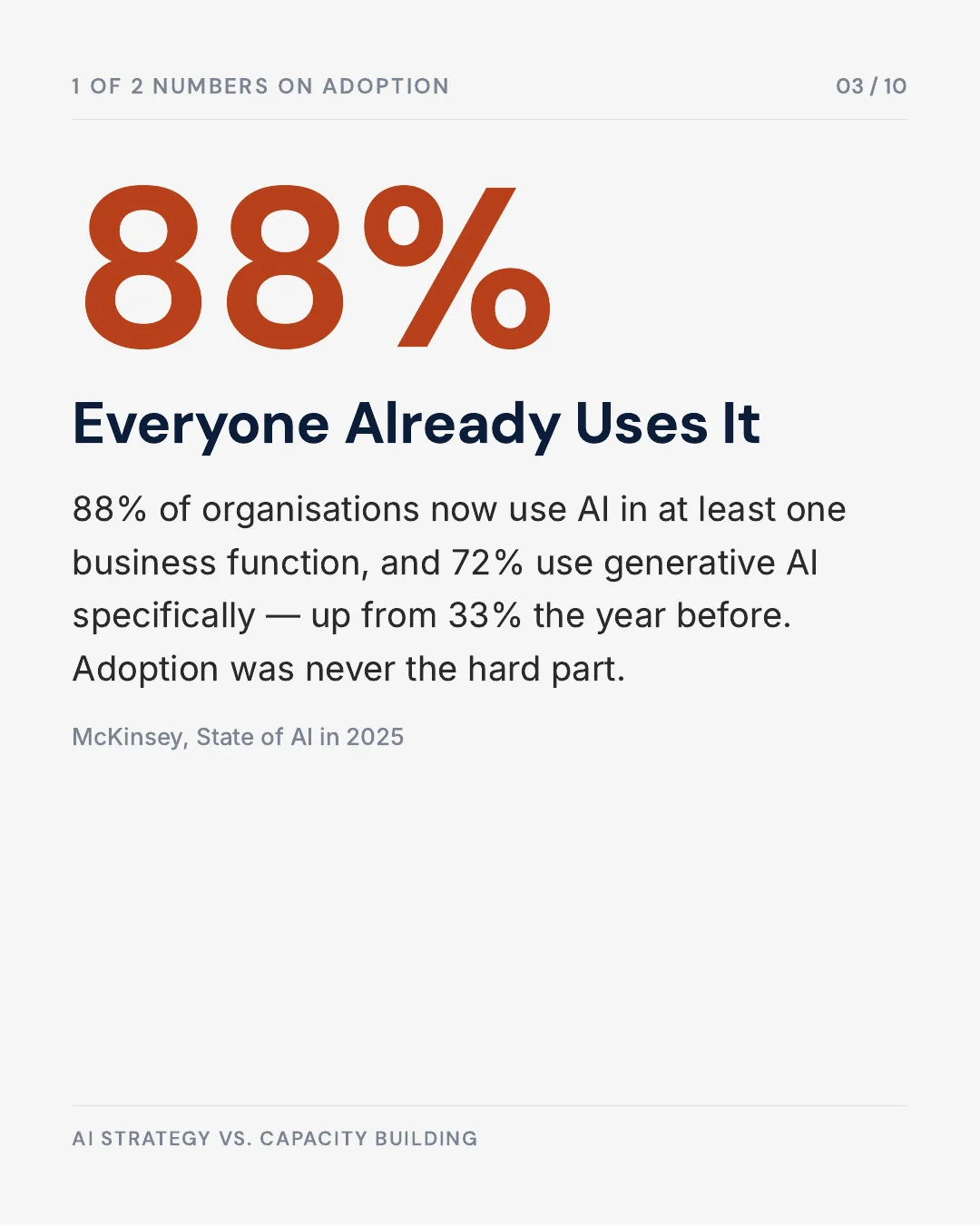
88%
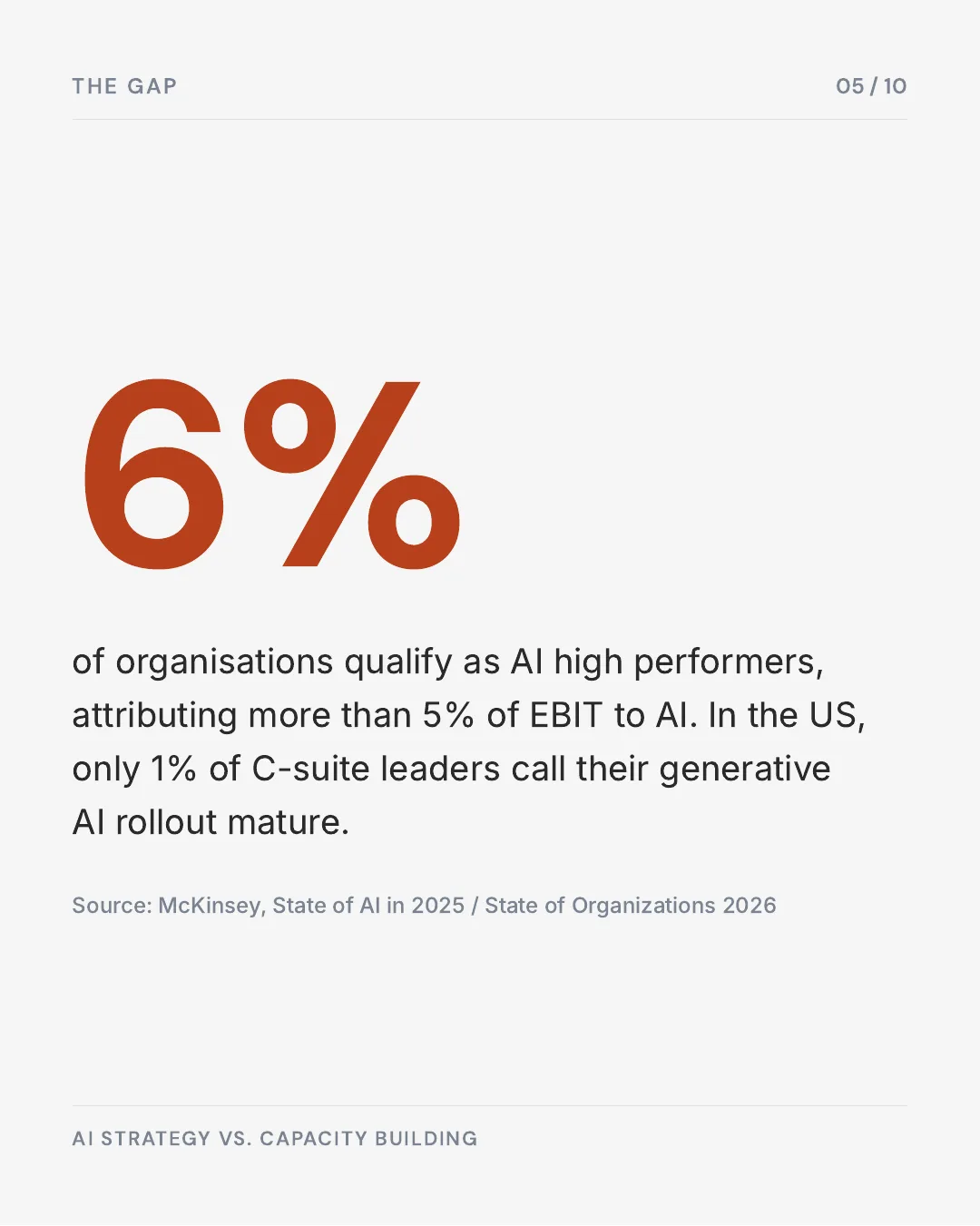
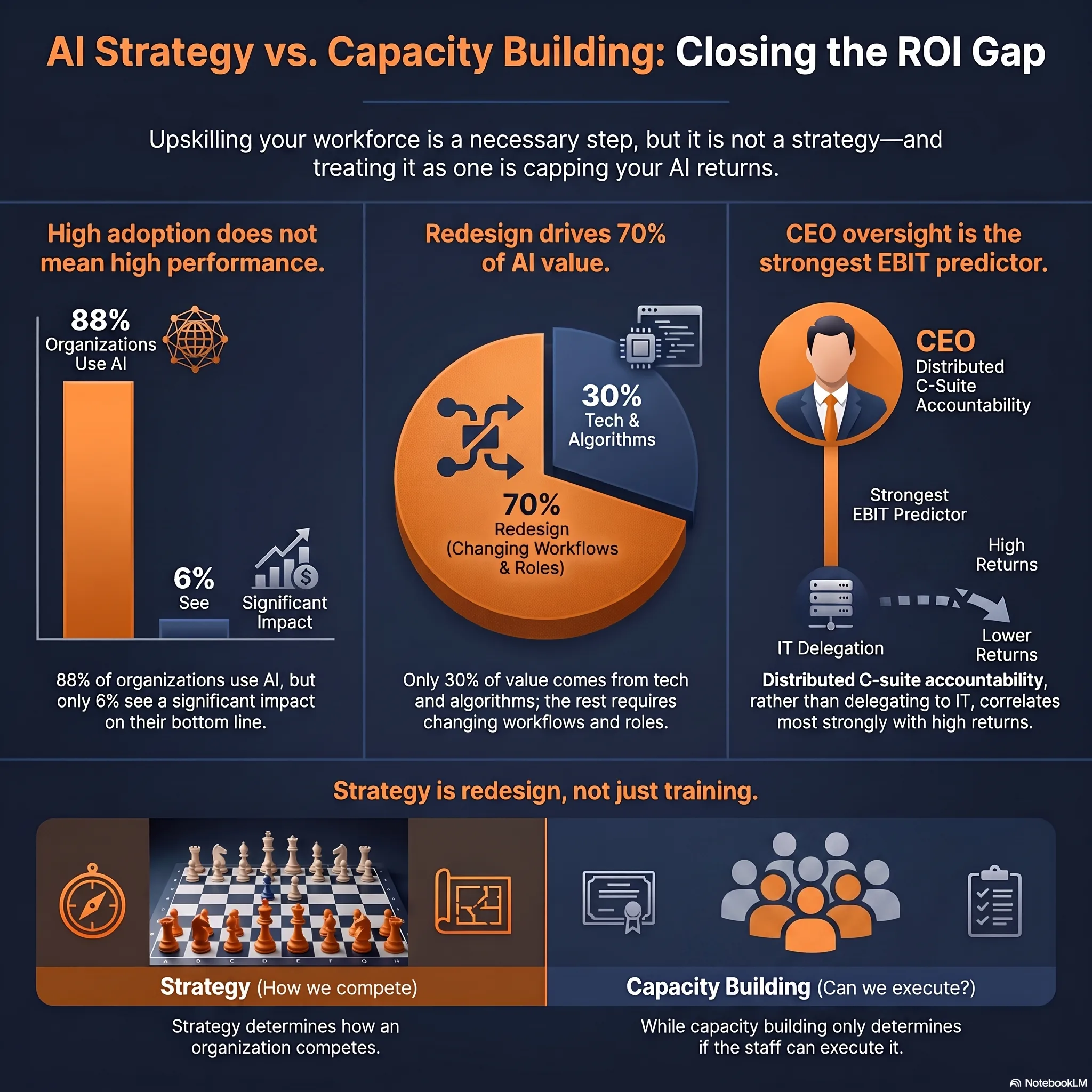
of companies use AI in at least one part of the business, but only 6% get a big money benefit (over 5% of profit, called EBIT) from it
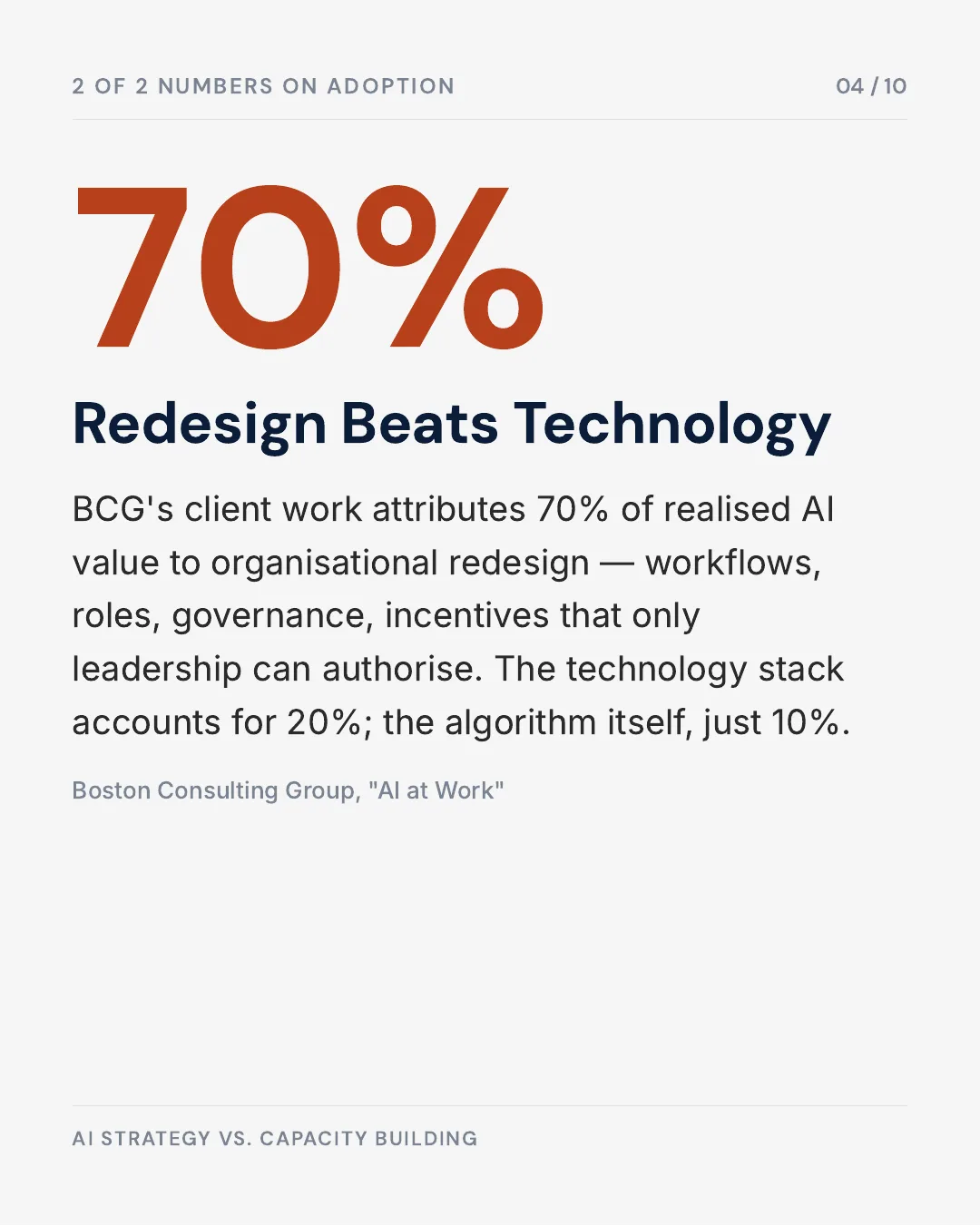
70%
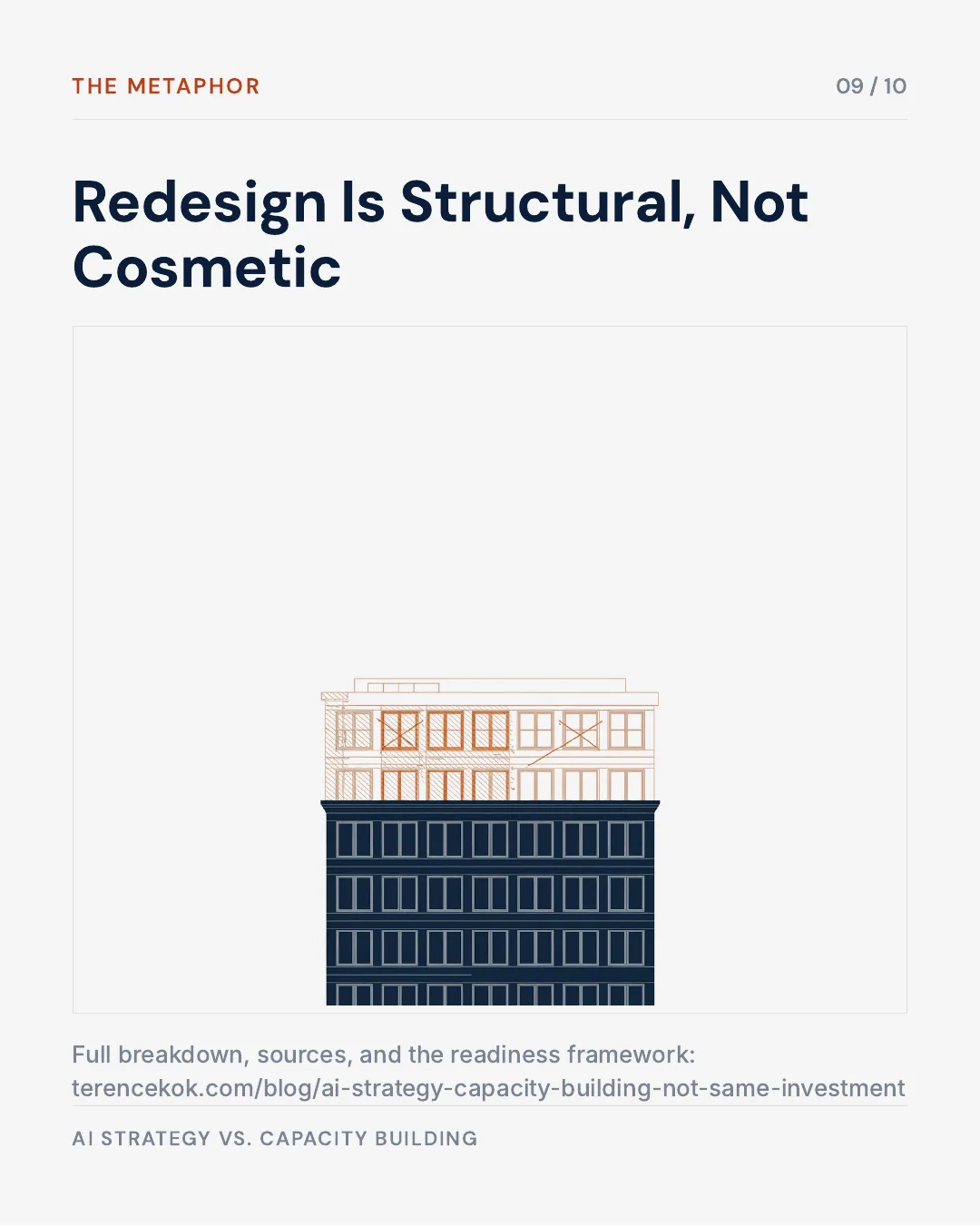
of the real value from AI comes from changing how the company works, not from the AI technology itself
1%
of top US business leaders say their company’s AI rollout is fully ready
55%
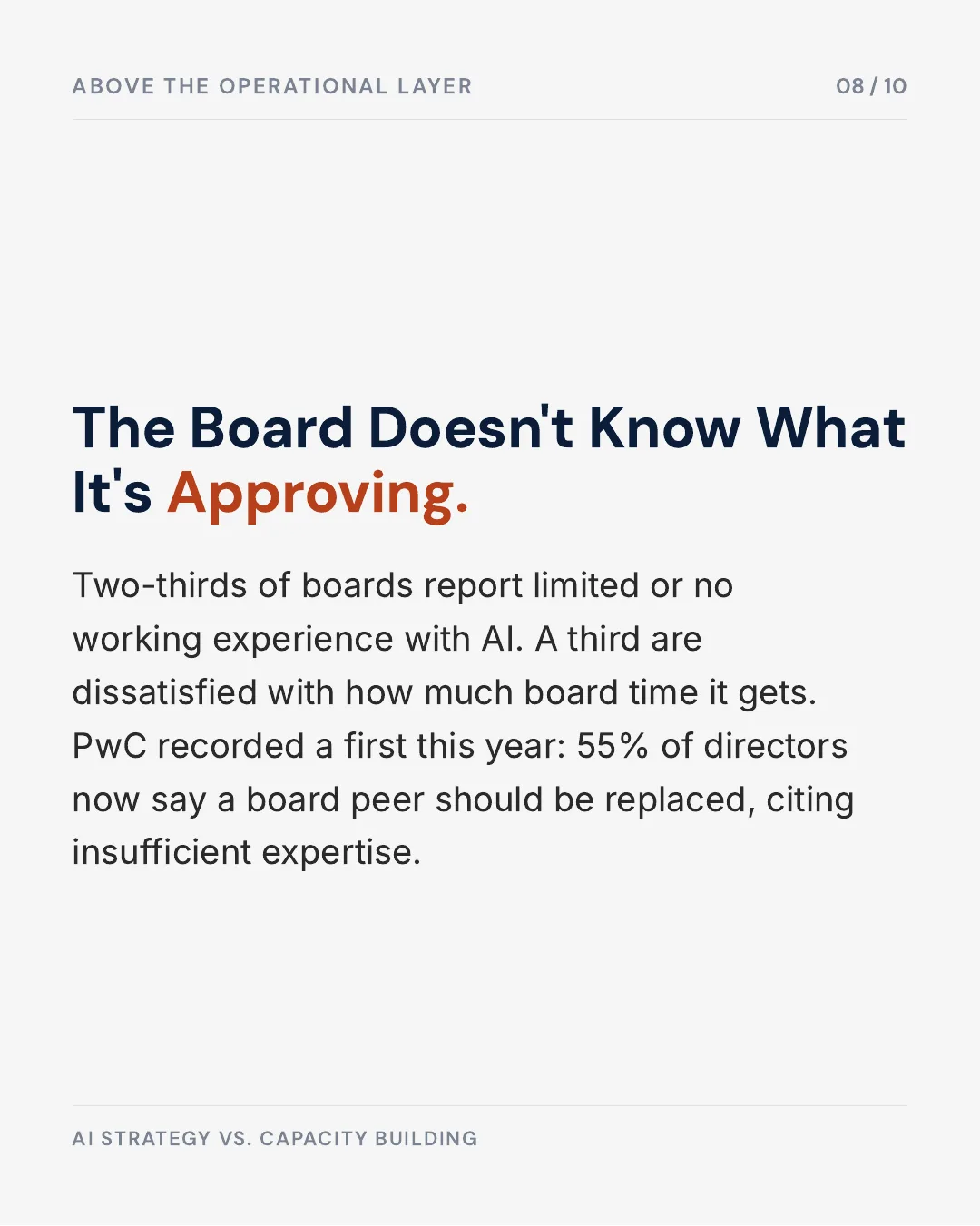
of board members think a fellow board member should be swapped out, the highest number ever recorded, with skills gaps in areas like AI among the reasons cited
Main points
- Training staff on AI tools matters, but it cannot replace a real rethink of how the business runs, who makes decisions, and how work gets done. Top leaders have to start and own that rethink.
- McKinsey, BCG, Deloitte, and PwC each ran separate studies and landed on the same answer: how much leaders and the board understand AI matters far more to profit than how much regular staff know.
- The fix is doing both at once. Checking how AI affects the business at the leadership and board level needs to happen at the same time as training staff.
The main idea, in ten slides
Save it, share it, or send it to whoever approves the AI budget.
The numbers
Lots of companies use AI. Few see real results.
| What was measured | Number | Source |
|---|---|---|
| Companies using AI in at least one part of the business | 88% | McKinsey, State of AI in 2025 |
| Companies using generative AI | 72% | McKinsey, State of AI in 2025 |
| Companies getting a big payoff from AI (over 5% of profit) | ~6% | McKinsey, State of AI in 2025 |
| Top US business leaders who call their AI rollout “mature” | 1% | McKinsey, State of Organizations 2026 |
| Employees who feel they got enough AI training | 36% | BCG workforce research |
| Employees who say leadership gave clear direction | 33% | BCG workforce research |
About 10,000+ people answered the McKinsey surveys above; the BCG numbers come from a separate study of employees.
Where AI’s real value comes from
| What drives the value | Share of the value (BCG) |
|---|---|
| The AI algorithms themselves | ~10% |
| The supporting technology | ~20% |
| Changing how the company works (workflows, roles, rules, rewards) | ~70% |
Based on BCG’s work with client companies. Changing how the company works is the one part only leaders can approve.
The gap in what boards and leaders know
| What was measured | Number | Source |
|---|---|---|
| Boards with little or no hands-on experience with AI | 66% | Deloitte, 2025 Global Board Survey |
| Boards unhappy with how much time they spend on AI | 33% | Deloitte, 2025 Global Board Survey |
| Directors who think a fellow board member should be swapped out, skills gaps like AI among the cited reasons | 55% (highest ever recorded) | PwC, 2025 Annual Corporate Directors Survey |
| Large companies expected to appoint a Chief AI Officer reporting straight to the CEO or COO | A growing share | Gartner |
Article 4 of the EU AI Act, requiring boards to understand AI, has been in effect since February 2025, and it applies to any company doing business in the EU, wherever its board sits.
Using AI widely is not the same as redesigning how it’s used
McKinsey’s State of AI in 2025 survey found the adoption-versus-payoff split shown in the table above: broad usage that’s grown fast from just 33% the year before, but almost two-thirds of these companies had not grown their AI use past that first small step. McKinsey’s follow-up survey, State of Organizations 2026, asked just over 10,000 people and found that in the United States, top business leaders rarely called their AI rollout “mature,” meaning fully ready, as the table above shows.
Boston Consulting Group’s research on employees shows the same pattern from a different angle. 72% of employees say the skills they need have changed, but only 36% feel they got enough training, and only a third think leadership gave clear direction. So AI use is spreading fast, and the skills employees need are rising fast too. What isn’t rising is real, measurable payoff. That gap shows up right where business decisions get made, not on the factory floor.
Leaders’ understanding of AI matters more than staff understanding
BCG’s work with client companies found that about 10% of AI’s real value comes from the algorithms, 20% from the supporting technology, and 70% from changing how the company works: its workflows, job roles, rules, and rewards. Only leaders can approve that kind of change. BCG’s research also found that how engaged top leaders are is one of the strongest signs of whether a company is doing well with AI.
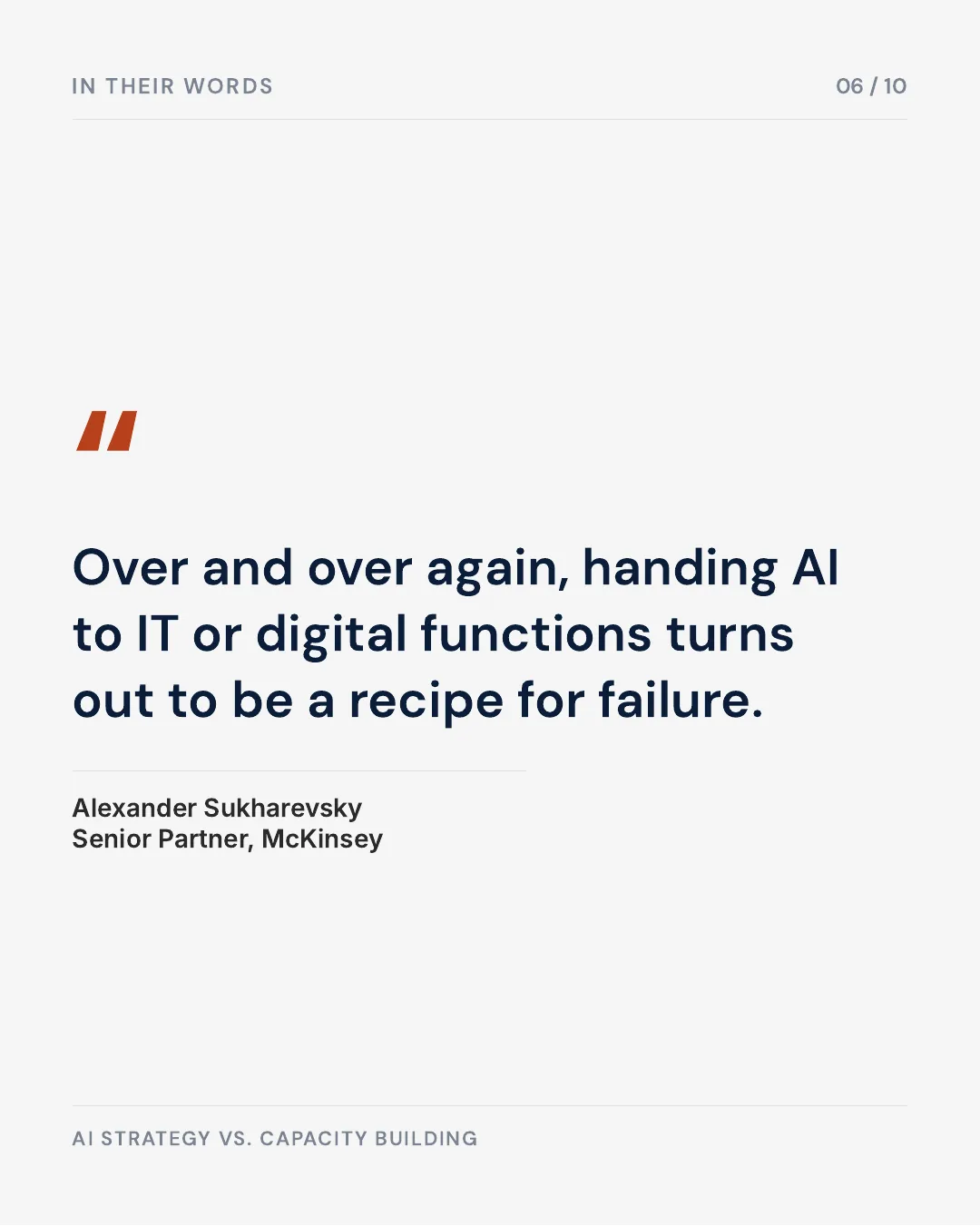
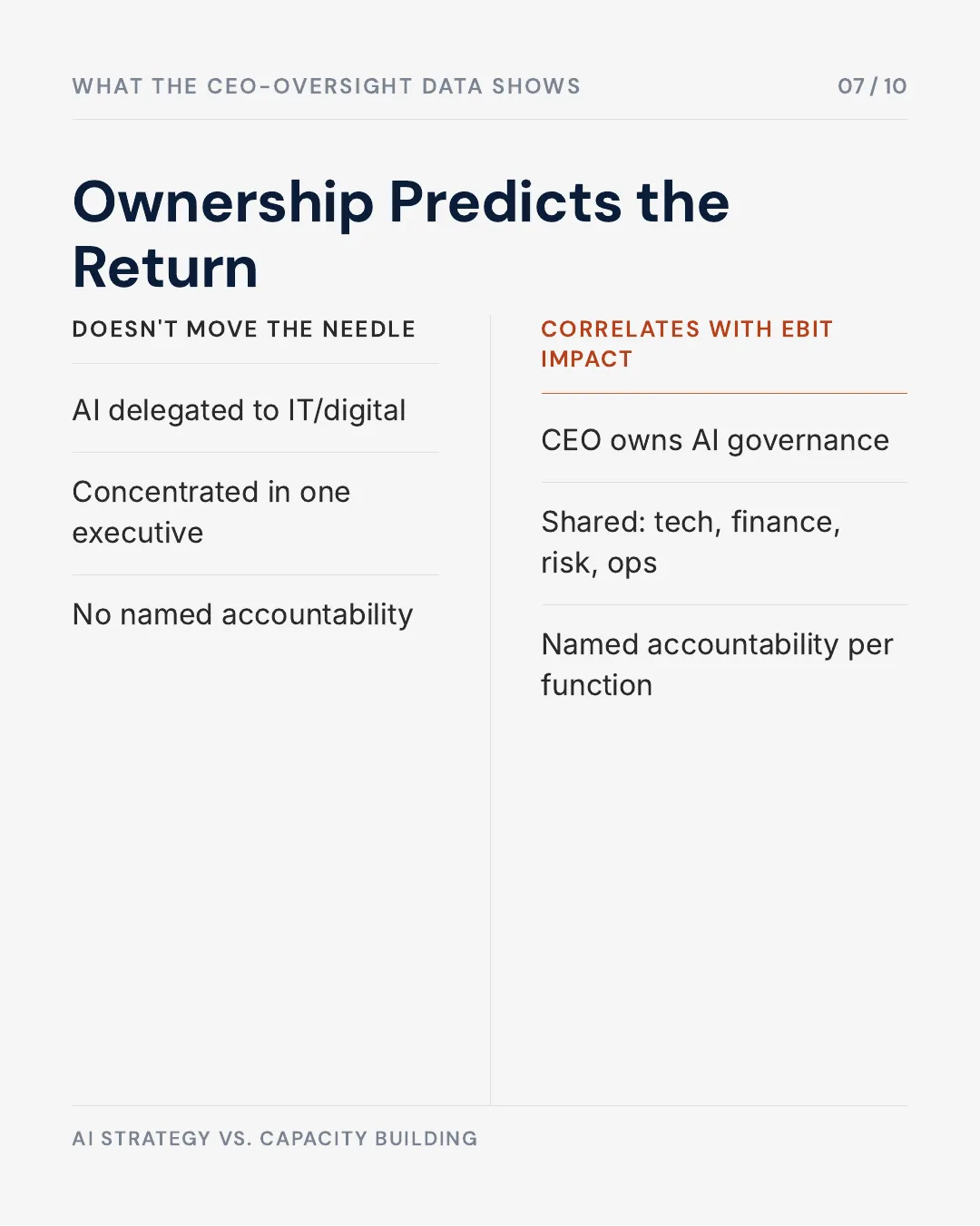
McKinsey looked at generative AI in retail banking and found that when the CEO personally oversees how AI is governed, that’s the single strongest sign of a bigger profit payoff, and the effect is even bigger at large banks. McKinsey senior partner Alexander Sukharevsky, talking about the common habit of handing AI projects off to the IT department, says “over and over again, this turns out to be a recipe for failure.” Deloitte studied 550 leaders in December 2025 and found something similar from a different angle: companies get the best AI results when the CEO shares ownership of AI across tech, finance, risk, and operations leaders, instead of handing the whole job to just one person. Giving the job to one leader alone doesn’t work well. Spreading it too thin with no clear owner doesn’t work well either. What works is the CEO setting up shared, clearly assigned ownership across the top team.
BCG found that roughly 70% of AI’s real value comes from changing how a company works, not from the algorithm or the technology itself. That kind of change is something only leaders can approve.
The knowledge gap is biggest at the top
What’s true for leaders is also true for company boards. Deloitte’s 2025 Global Board Survey found that two-thirds of boards have little or no hands-on experience with AI, and a third are unhappy with how little time they spend discussing it. PwC’s 2025 Annual Corporate Directors Survey recorded the highest number ever: 55% of directors think at least one fellow board member should be replaced, with skills gaps in emerging areas like AI among the reasons named. For the first time, more than half of directors admitted their board has real skill gaps, in AI and also in areas like cybersecurity and world events.
New rules are starting to make this official. Article 4 of the EU AI Act requires people to understand AI, and it has been in effect since February 2025. It applies to any company doing business in the EU, no matter where its board is based. (The Act’s separate high-risk-system provisions, originally due in August 2026, have since been pushed back to December 2027 under the EU’s Digital Omnibus on AI.) Gartner has pointed to a growing trend of large companies appointing a Chief AI Officer who reports straight to the CEO or COO, rather than to the tech chief — a sign that companies are moving AI decisions into the business itself.
Training staff and fixing leadership have to happen together
Paul McDonagh-Smith of MIT Sloan says the real challenge is getting three things to line up: the work itself, the people doing the work, and the structures around them. When these three things are out of sync, results get delayed or blocked, no matter how good any one piece is on its own. That matches everything in the data above. Well-trained staff can’t make up for a business model that hasn’t been checked for how AI might replace or disrupt it. And a great new plan can’t be carried out by staff who haven’t been given the skills or the setup to do it.
In practice, this means checking how AI affects the business at the leadership and board level, including looking hard at the current business model, deciding who makes which calls, and naming who is responsible, has to happen at the same time as training staff. The evidence so far shows that companies treating staff training as their whole AI plan are limiting their own results, no matter how skilled their staff become. Across McKinsey, BCG, Deloitte, and PwC’s separate studies, the one thing that keeps predicting success is how well leaders and the board understand AI, not how well the people below them do.
Evidence & Methodology
Every number below traces to a named firm’s published study except one. The Chief AI Officer trend is cited secondhand, through a board-recruitment analysis I have not checked against Gartner’s own report.
| Claim | Source | Grade |
|---|---|---|
| 88% of companies use AI somewhere in the business, but only about 6% see a significant profit impact | McKinsey, State of AI in 2025, cited below | Measured |
| About 70% of AI’s real value comes from redesigning how the company works, not from the technology itself | Boston Consulting Group, cited below | Measured |
| CEO-level ownership of AI governance is the strongest predictor of profit payoff | McKinsey’s retail banking research and Deloitte’s study of 550 leaders, both cited below | Measured |
| Large companies are increasingly appointing a Chief AI Officer who reports to the CEO or COO | Gartner, cited secondhand through a board-recruitment analysis, not Gartner’s own report directly | Secondhand |
Sources
- McKinsey & Company. (2025). The state of AI in 2025.
- McKinsey & Company. (2026). The state of organizations 2026.
- Boston Consulting Group. (2026). AI at work: Why strategy matters more than tools.
- Boston Consulting Group. (2026). AI transformation is a workforce transformation.
- Deloitte. (2025). “Governance of AI: A critical imperative for today’s boards, 2nd edition,“
- PwC. (2025). “2025 Annual Corporate Directors Survey,“
- Gartner. (2026). Cited in board-recruitment analysis.
- MIT Sloan. (2026). “How to accelerate AI transformation,” interview with Paul McDonagh-Smith.
- European Union. (2024). Regulation (EU) 2024/1689 (EU AI Act), Article 4.
The Five-Dimension AI Readiness Assessment checks whether your company’s rules and team skills, not just staff training, are ready before you spend the budget.
Free tool
The Discipline Gap
The leadership-level version of the argument above: a 32-page briefing on why AI projects stall at the top of a company, not on the front line.
Was this useful?