

Listen to this article
Jump to a section
In this article
Executive Summary
A model can draft a report, a deck, a block of code and a reply to every email in the time it takes to make a coffee. The easy part of work has become very cheap. The hard parts have not moved: knowing what the work is for, checking that it is right, and standing behind it when someone asks. Those parts belong to the person who hands the work in, whatever tool helped to make it. Courts, tribunals and clients have already said so. This post covers the volume problem that AI creates, why “the AI did it” fails as an answer at every level of an organisation, and a short routine of six checks to run before any AI-assisted work leaves your desk.
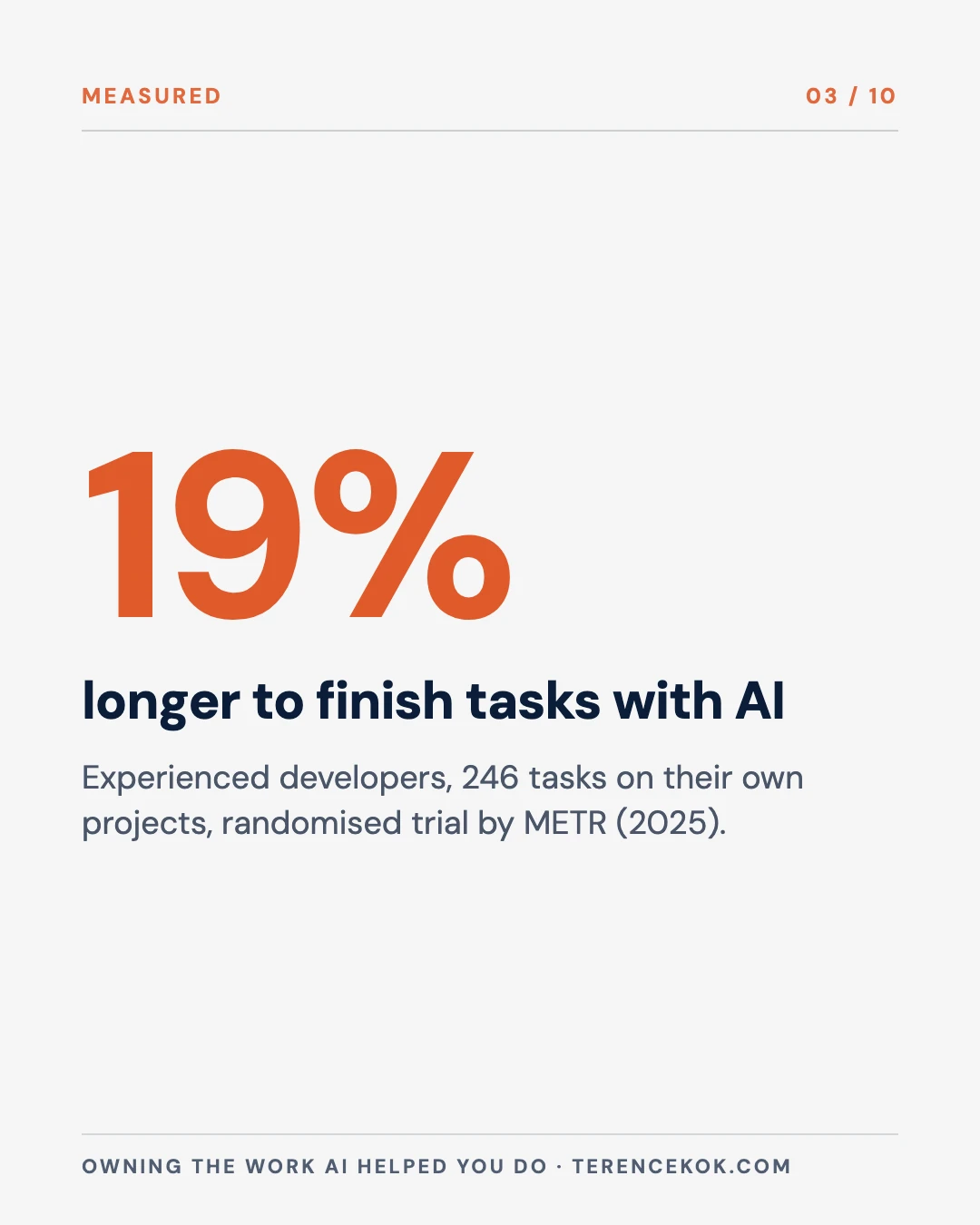
19%
longer to finish tasks when experienced developers were allowed to use AI, in a randomised trial by METR
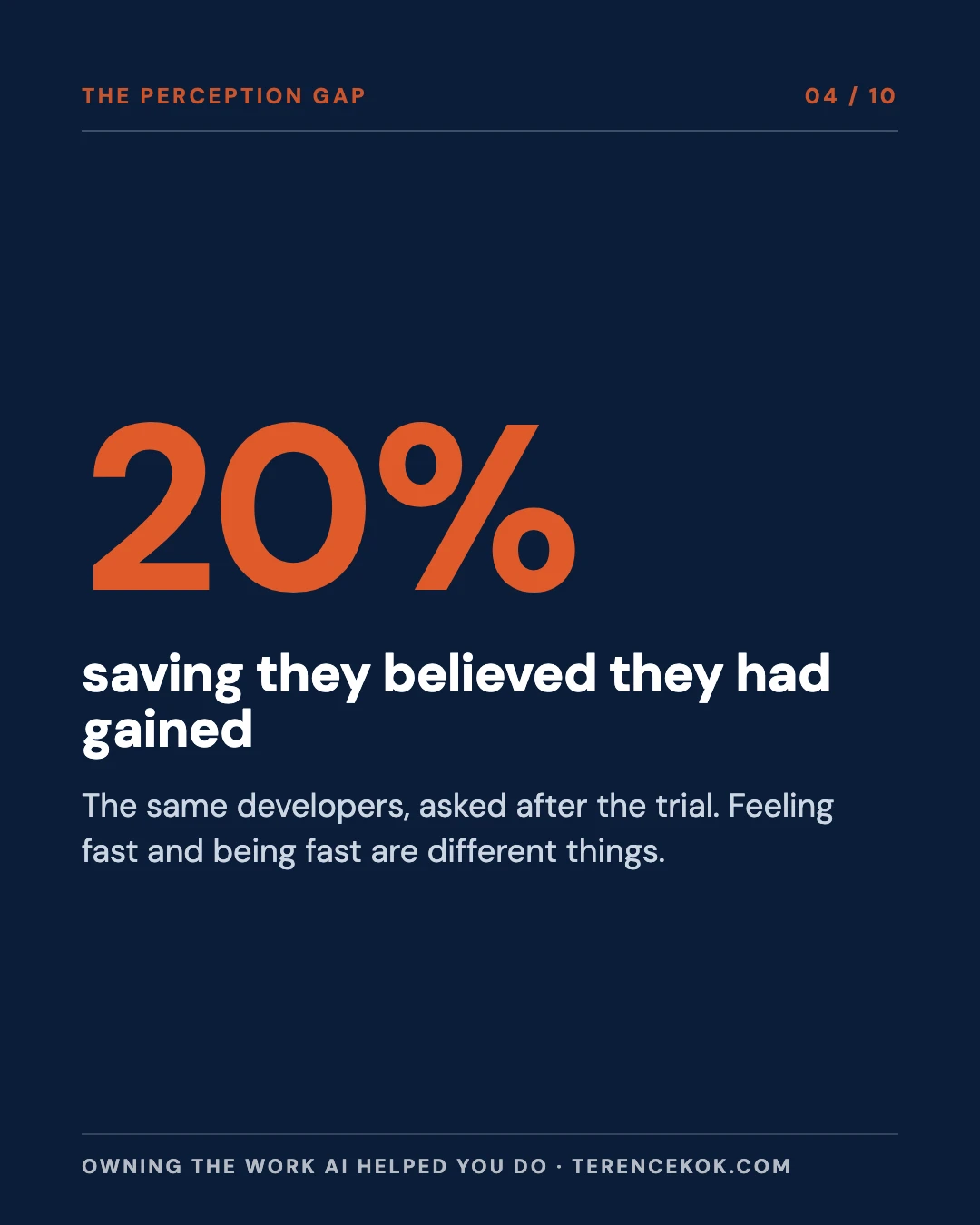
20%
time saving those same developers believed they had gained, after the trial
14 of 141
citations removed from a Deloitte report for the Australian government after fabricated references were found
6
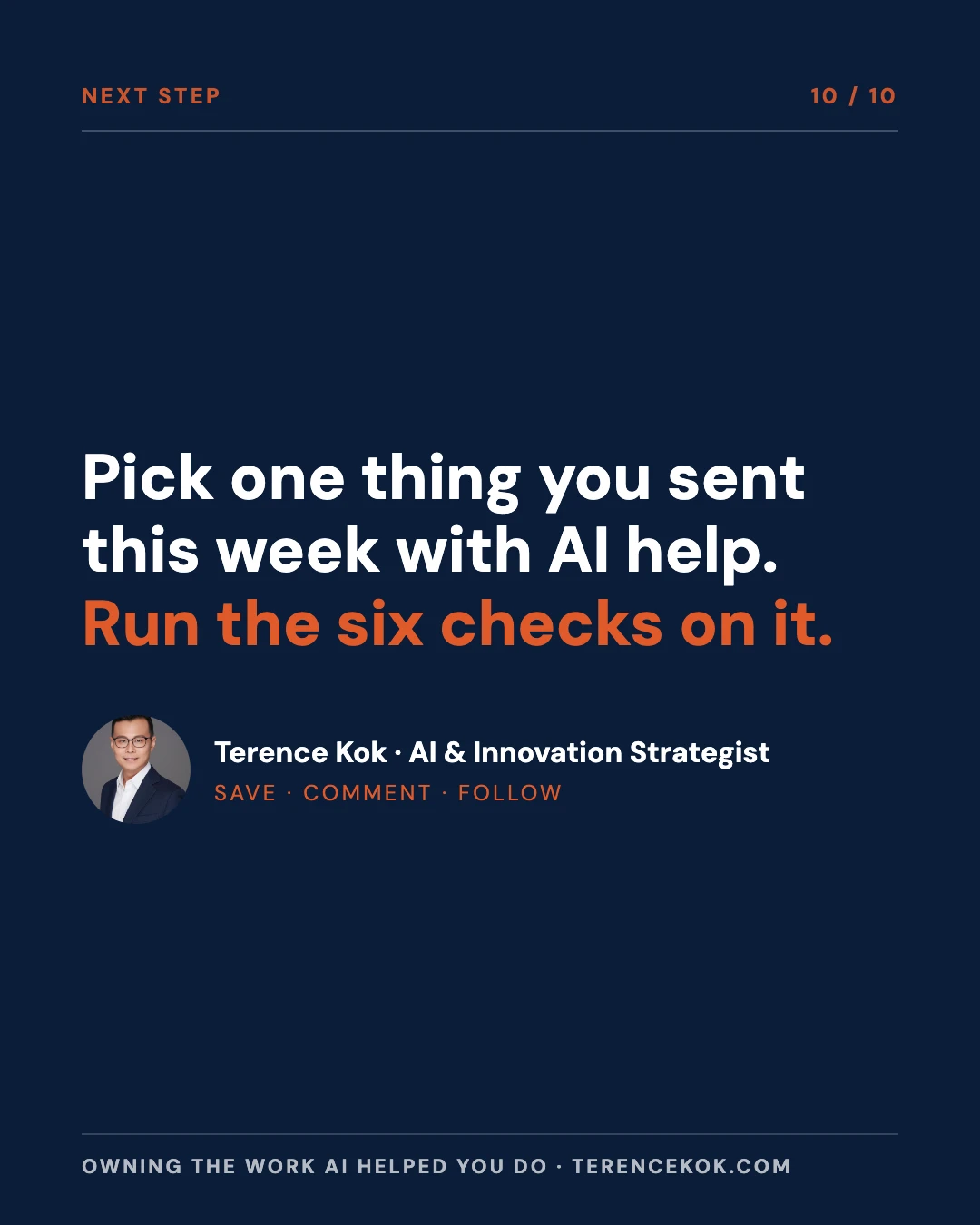
checks to run before submitting AI-assisted work, each taking a few minutes
Core conclusions
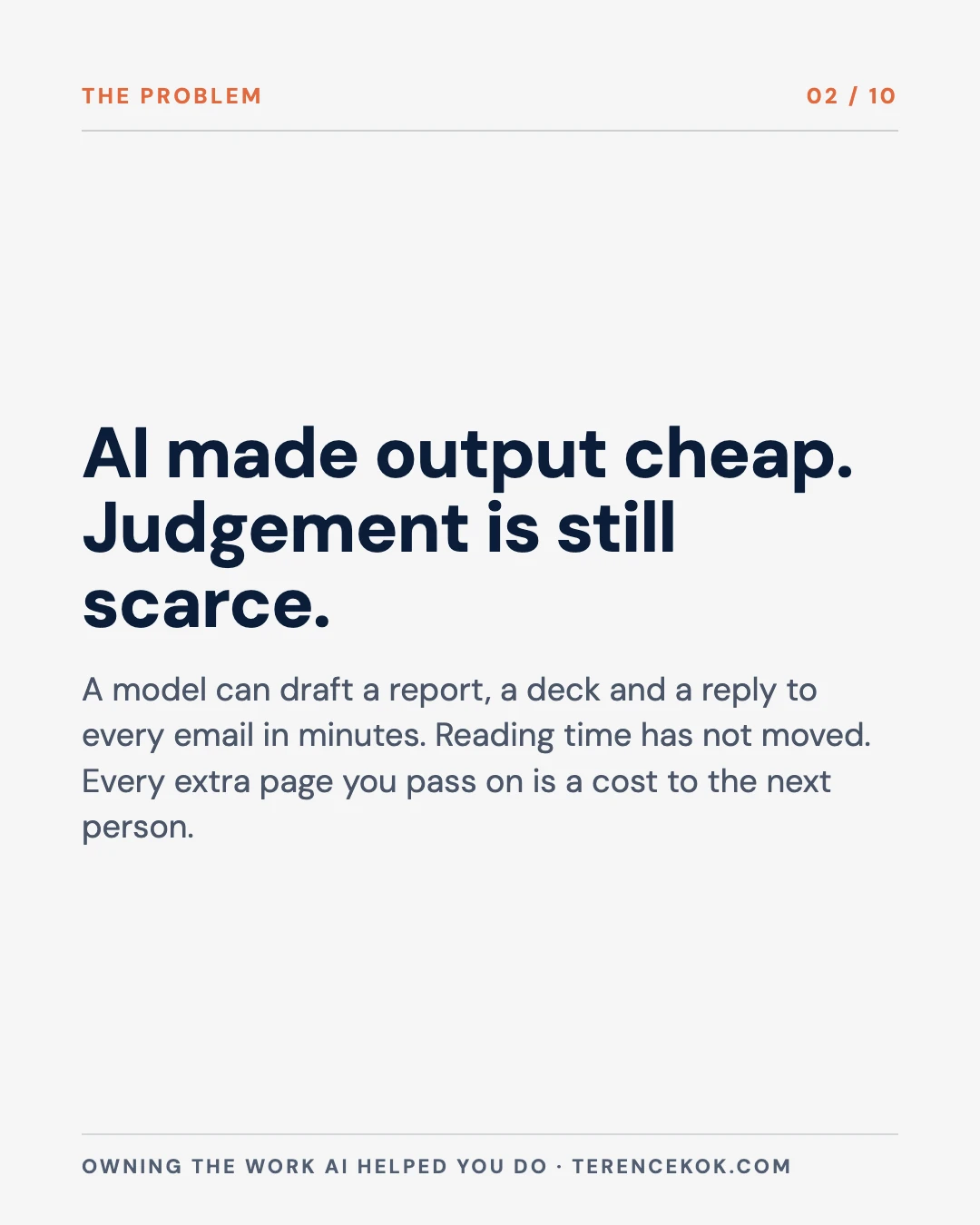
- AI makes output cheap and judgement scarce. The person who submits the work supplies the judgement, so the person who submits it owns the result.
- More output is not more value. Every extra page you pass on is a cost to the next person, who has to read, check and decide.
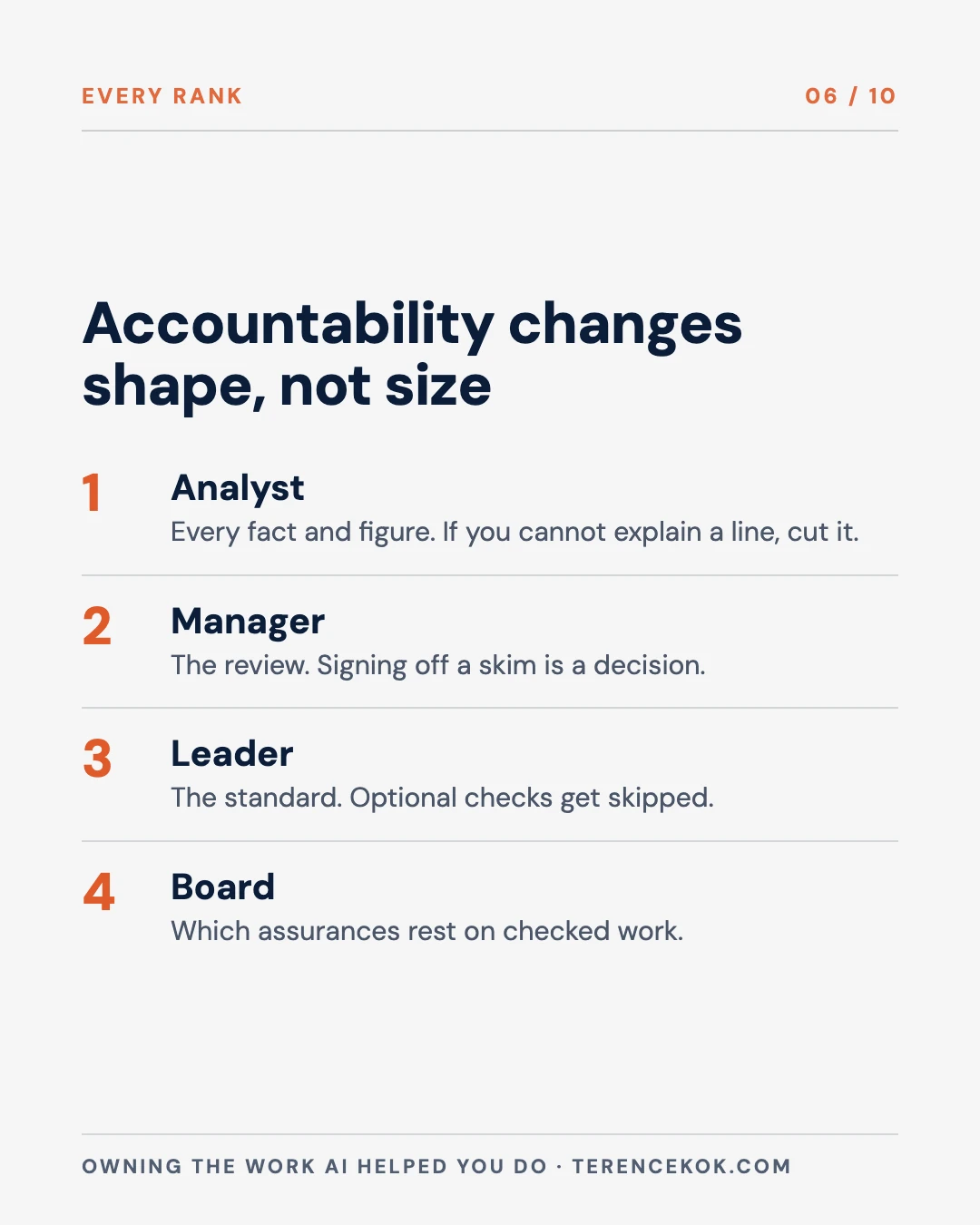
- Accountability does not shrink with rank. It changes shape: an analyst answers for accuracy, a manager for review, an executive for the standard the organisation sets.
- A short pre-submit routine, done every time, catches most of what goes wrong. The habit matters more than any single check.
The argument, in ten slides
Save it, or send it to the person who signs off your team’s work.
Output arrives faster than anyone can digest it
Ask a model for a market scan and you get twelve pages before you have finished reading the request. Ask for the summary of the scan and you get that too. Ask for the deck, the email to the client and the follow-up plan, and the morning is gone and the folder is full.
I call the feeling that follows output indigestion. You have a lot of material and no clear sense of what is in it. You are tempted to forward it on, because it looks finished, and because reading it properly would take longer than producing it did.
That temptation is where the trouble starts. Production time has collapsed, but reading time has not. A twelve-page document still takes a person about twenty minutes to read with care. Whoever receives it takes on that cost, and if they are also receiving a dozen other documents like it, they will skim. The cost you saved by not checking has moved to someone else, and it usually comes back to you later with interest.
I wrote about this in AI Fatigue: Why Verification Is Harder Than Creation. The same pattern shows up in one more place. The METR trial of experienced developers found that allowing AI tools made them 19 per cent slower on their own projects. Those developers believed the opposite. After the trial they estimated that AI had saved them about 20 per cent of their time. Feeling fast and being fast are different things, and the feeling comes from watching text appear on a screen.
The developers thought they were quicker. The clock said they were slower.
Source: Becker, Rush, Barnes and Rein, METR (2025), arXiv:2507.09089. 16 experienced developers, 246 tasks on their own projects. The authors say the result may be specific to that setting.
Start with what and why
The first discipline is older than AI. Before you ask for anything, you need to know what the work is for and who will use it.
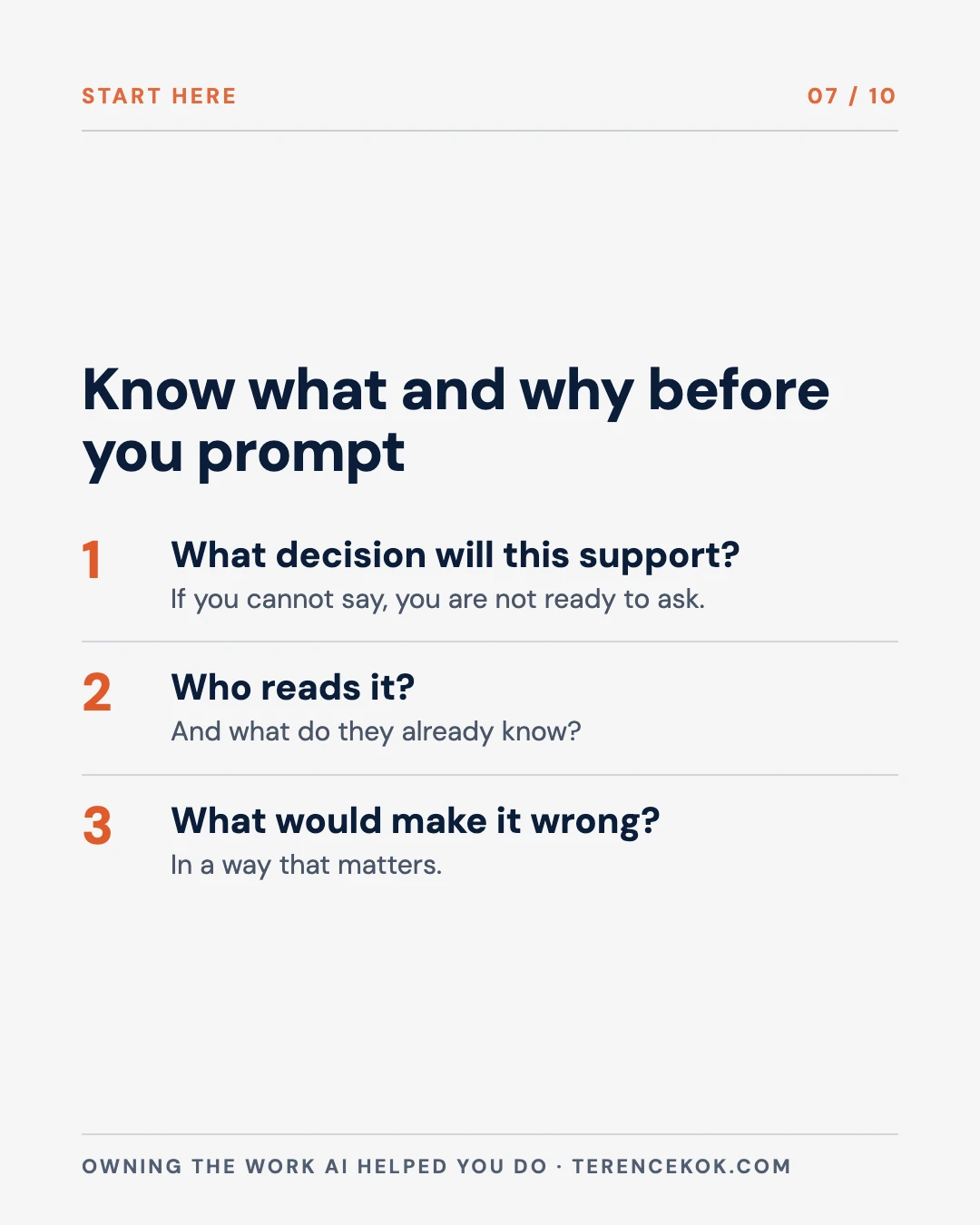
Three questions do most of the work:
- What decision or action will this support?
- Who will read it, and what do they already know?
- What would make it wrong in a way that matters?
If you cannot answer the first one, you are not ready to prompt. A model will give you something plausible either way, and plausible work with no purpose is the most expensive kind. It takes time to read, it invites debate about the wrong things, and it makes the team feel busy while the real question stays open.
Writing the purpose in one sentence before you begin has a second benefit. It gives you something to check the result against. A report that was meant to help a board decide whether to extend a contract can be tested: does it say whether to extend, and what the choice would cost? A report with no stated purpose can only be tested for whether it sounds good, and AI output always sounds good.
The work is yours when you hand it in
There is a reflex that appears whenever something goes wrong with AI-assisted work: the tool made the error. I understand the instinct. It is also not a defence, and the record is clear on that.
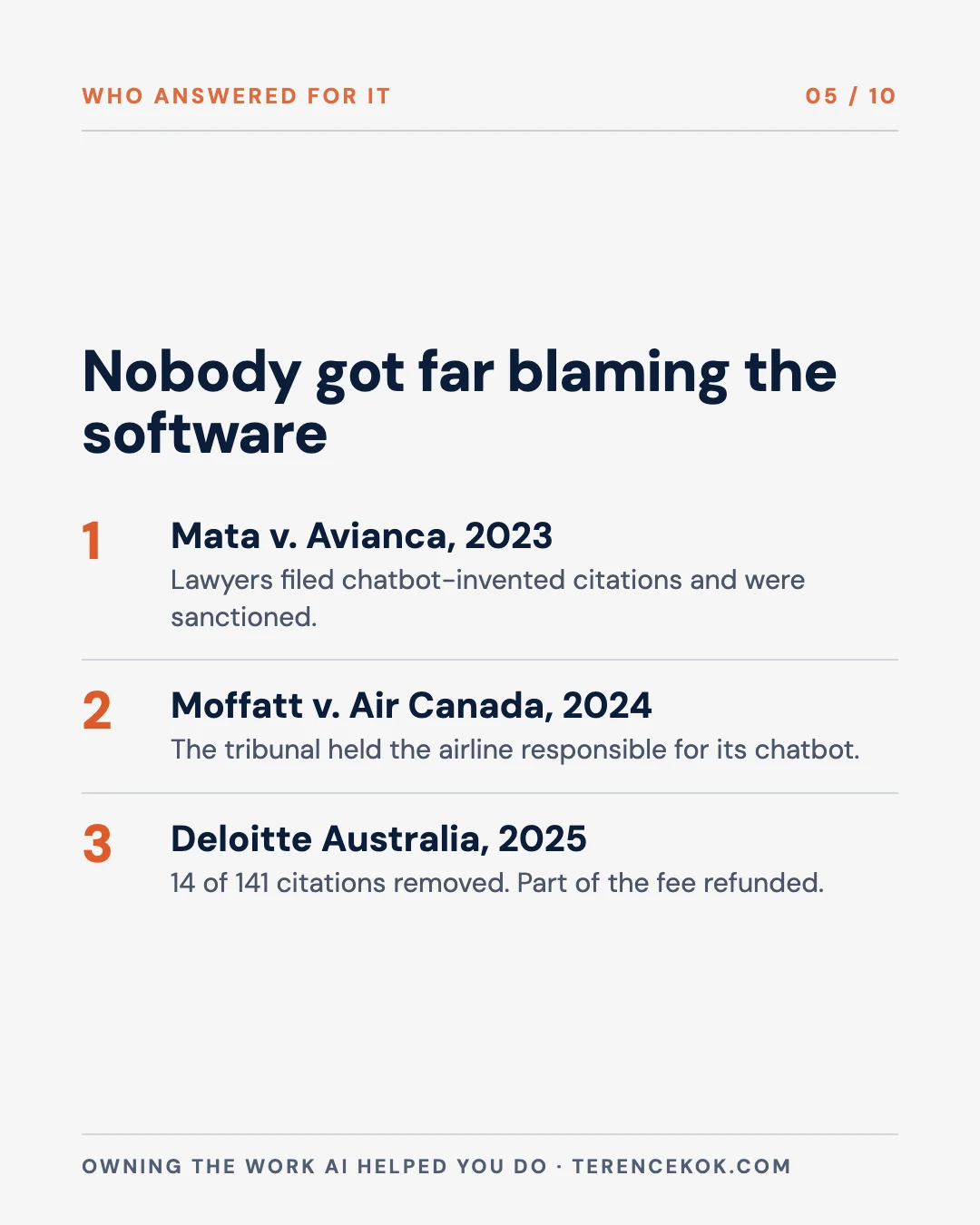
In Mata v. Avianca (2023), lawyers filed a court brief with case citations that a chatbot had invented. The court sanctioned them. In February 2024 a British Columbia tribunal heard Moffatt v. Air Canada, where a customer relied on wrong fare information from the airline’s own chatbot. The airline argued that the chatbot was a separate source responsible for its own words. The tribunal rejected the argument and held that Air Canada was responsible for what appeared on its website, chatbot included.
The most instructive recent case involves a large consulting firm. In October 2025 Deloitte Australia agreed to refund part of its fee for a report to the Department of Employment and Workplace Relations, a contract reported at about A$440,000. A university researcher found citations and a quotation that did not exist. The revised report removed 14 of the original 141 citations and disclosed that a generative AI model had been used in its preparation. The substance of the recommendations was reported as unchanged, but the firm still paid, and its name was in the headlines for a week.
In none of these cases did anyone get far by pointing at the software. A court, a tribunal and a client all asked the same thing: who put this forward? The answer was a person or an organisation, and that was where responsibility landed.
This matters for how you talk about your own work. “The AI got that wrong” describes how the error happened. It does not answer the question of why the work went out without being checked. Only the second question has an owner, and the owner is whoever pressed send.
What this means at every rank
AI changes the job at every level, and the accountability changes with it.
| Role | What AI changes | What you answer for |
|---|---|---|
| Analyst or junior | You can produce a polished draft in minutes, even on a topic you do not know | Every fact and figure in it. If you cannot explain a line, it should not be in the document |
| Manager | You receive more drafts, and they all look finished | The review. Signing off work you skimmed is a decision you made |
| Senior leader | Your teams move faster and decisions arrive with more material attached | The standard. If checking is optional, people will skip it under pressure |
| Executive or board | Reports, risk papers and forecasts can all be machine-assisted | Knowing which of your assurances rest on checked work, and which rest on volume |
| Client or customer | You rarely see the tool, only the output | Nothing, but you are the one who pays when it is wrong |
My own summary of how accountability maps to role. It is a framing, not a sourced finding.
Two points follow from the table. First, juniors carry a special risk. They are the people most likely to be handed a tool that makes them sound expert, and the least likely to feel able to say “I have not verified this.” Leaders have to make that sentence safe to say. Second, seniority does not exempt anyone. A senior leader who forwards a machine-written paper under their own name has adopted it, and will be asked about it as if they had written every word.
Six checks before you submit
I use six checks. None needs special tools. Together they take me ten to fifteen minutes on a normal piece of work, and they have caught something almost every time.
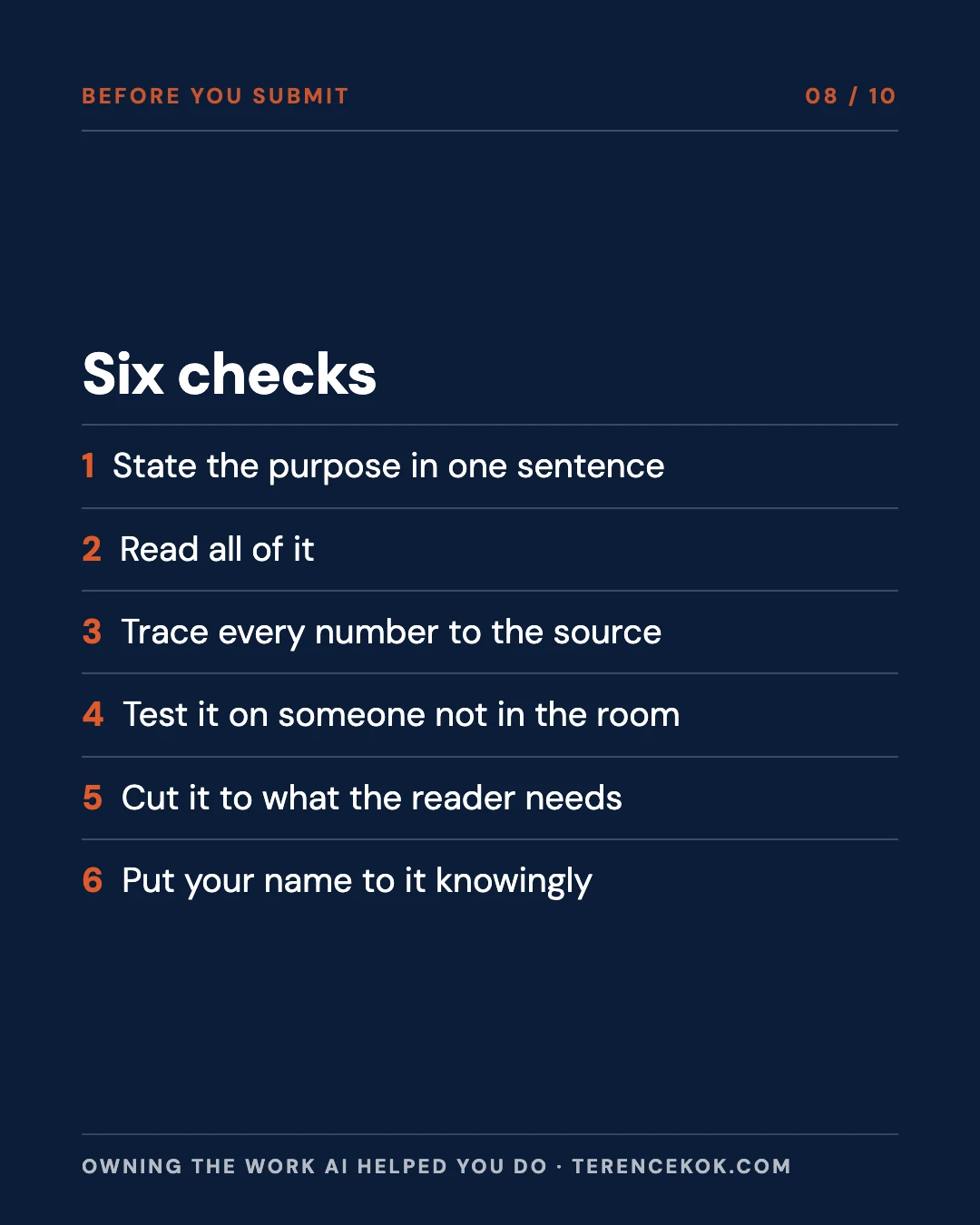
- State the purpose in one sentence. Write what the work is for and who will act on it. If the sentence will not come, stop and find out before you go further.
- Read all of it. Every line, in order, as if someone else wrote it. Skimming a long output is how an invented claim in paragraph nine gets through.
- Trace every number and every source to the original. Open the document the figure is said to come from. Check that the source exists, that it says what the draft says it says, and that the date is right. Names, dates, quotations and statistics are where models most often invent detail.
- Test it on someone who was not in the room. Give it to one person with no context and ask what they think it says and what they would do next. If their answer differs from your purpose sentence, the work is not ready.
- Cut it to what the reader needs. Remove the paragraphs that exist because they were easy to generate. The reader’s time is part of the cost of your work.
- Put your name to it knowingly. Ask yourself whether you would be comfortable explaining any line of this to the person it affects. Then follow your organisation’s rule on disclosing AI use, and keep your prompts and sources so that you can show how the work was made.
Six checks, in the order I run them.
My own routine, not a published standard. It takes me 10 to 15 minutes on typical work.
If you can only do two on a busy day, do the third and the fourth. Checking sources catches invented facts. Testing with an outsider catches a document that is accurate but does not say what you meant.
Making it a habit
Knowing the checks does not make them happen. Under deadline pressure, people drop whatever is optional. Three things have helped me make this a habit.
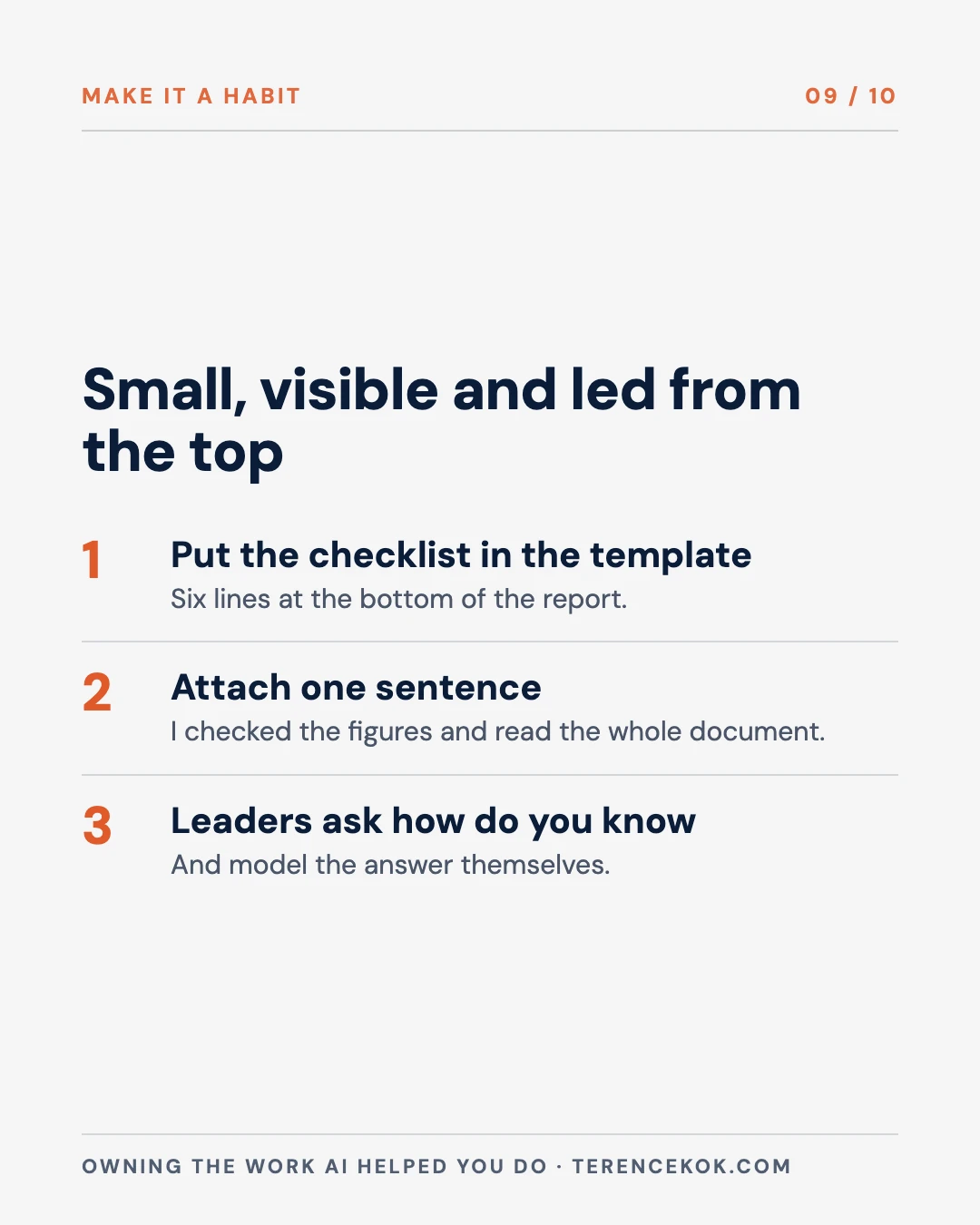
Make the routine small and put it where the work is. A six-line checklist at the bottom of your report template does more than a policy document no one opens. Tick it, or do not send.
Attach a sentence to every submission. For example: “I have checked the figures against the sources and read the whole document.” It takes seconds to write. It also makes you notice, in the moment, if you cannot honestly write it.
Let leaders go first. If a manager asks “how do you know?” about a figure and the team can answer in a minute, the habit is working. If the question is met with silence, or with “the AI said so”, the habit has not formed. People copy what is rewarded. If speed is praised and checking is invisible, volume will win.
None of this slows work down overall. The ten minutes you spend before submitting is cheaper than the hours of rework, apology and repair that follow a mistake that has already gone out. The METR developers felt the speed of the draft and did not feel the cost of everything that came after it.
Questions for leaders
- In the last month, which AI-assisted documents did we send to a client or a regulator, and who checked each one?
- If an AI-assisted report from our team turned out to contain invented sources, who would be asked to explain it?
- Can a junior colleague say “I have not verified this part” without penalty?
- Does our review process still work when documents arrive at five times the old volume?
- Do we record which work AI helped to produce, so that we can trace an error back?
- What is our rule on disclosing AI use to the person who receives the work?
Evidence & Methodology
I read the METR figures from the study’s arXiv paper and the Deloitte details from news reports of October 2025, not from the report itself or the department’s statement. The Air Canada ruling is summarised from law-firm commentary on the tribunal decision, and I did not read the decision on the tribunal’s site. The Mata case follows the court docket as cited in earlier posts on this site. Reports of the Deloitte refund disagree on the amount, so I give none.
| Claim | Source | Grade |
|---|---|---|
| AI use made 16 experienced developers 19% slower across 246 tasks; they forecast a 24% saving before and estimated 20% after | Becker et al., METR, arXiv:2507.09089 | Measured, preprint |
| The authors say the result may be specific to that setting and does not show that later tools will be slower | Same paper | Reported |
| Lawyers submitted AI-invented citations in Mata v. Avianca and were sanctioned | Court docket, S.D.N.Y. | Court record |
| The tribunal held Air Canada responsible for its chatbot’s information (Moffatt v. Air Canada, 2024 BCCRT 149) | Law-firm and press commentary | Reported, secondary |
| Deloitte Australia agreed a partial refund; the revised report removed 14 of 141 citations and disclosed use of an AI model | The Register; TechRadar; CTV News | Reported, press |
| The contract was about A$440,000 | The Register and other press | Reported, amount varies by outlet |
| The role table, the six checks and the claim that they take 10 to 15 minutes | My practice | My call |
Sources
- Becker, J., Rush, N., Barnes, E. and Rein, D. (2025). Measuring the Impact of Early-2025 AI on Experienced Open-Source Developer Productivity. METR. arXiv:2507.09089.
- Mata v. Avianca, Inc., No. 1:22-cv-01461 (S.D.N.Y. 2023). Case docket and order on sanctions.
- Moffatt v. Air Canada, 2024 BCCRT 149 (British Columbia Civil Resolution Tribunal). Commentary: American Bar Association, Business Law Today, February 2024.
- The Register. (2025, October 6). Deloitte refunds Aussie gov after AI fabrications slip into $440K welfare report.
- TechRadar. (2025, October). Deloitte forced to refund Aussie government after admitting it used AI to produce error-strewn report.
- CTV News. (2025, October). Deloitte to partially refund Australian government for report with apparent AI-generated errors.
AI Fatigue: Why Verification Is Harder Than Creation
Why checking a result costs more effort than producing one, which is the cost this post asks you to pay before you submit.

What You Can Do Without AI Is What I Hire For
The skills that let a person check a machine, and why they are worth keeping in people.

Why AI Demos Work and Production Systems Fail
What happens between work that looks finished and work that holds up under real use.
Cite or quote this article
Was this useful?