

Listen to this article
Jump to a section
In this article
Executive Summary
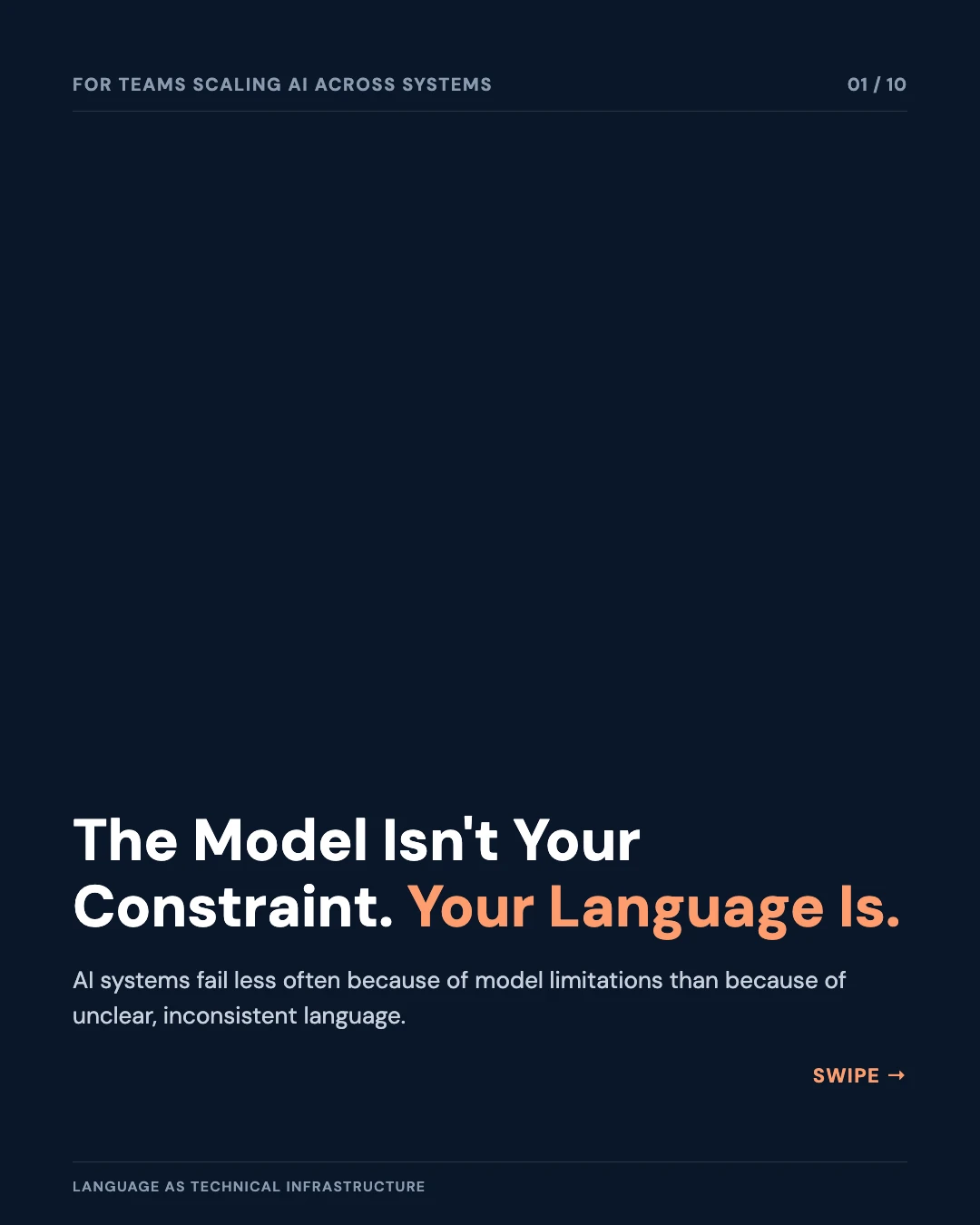
AI systems fail more often from unclear, inconsistent language than from model limitations. Precise, standardised vocabulary is technical infrastructure, and determines whether AI investments scale or plateau.
Core conclusions
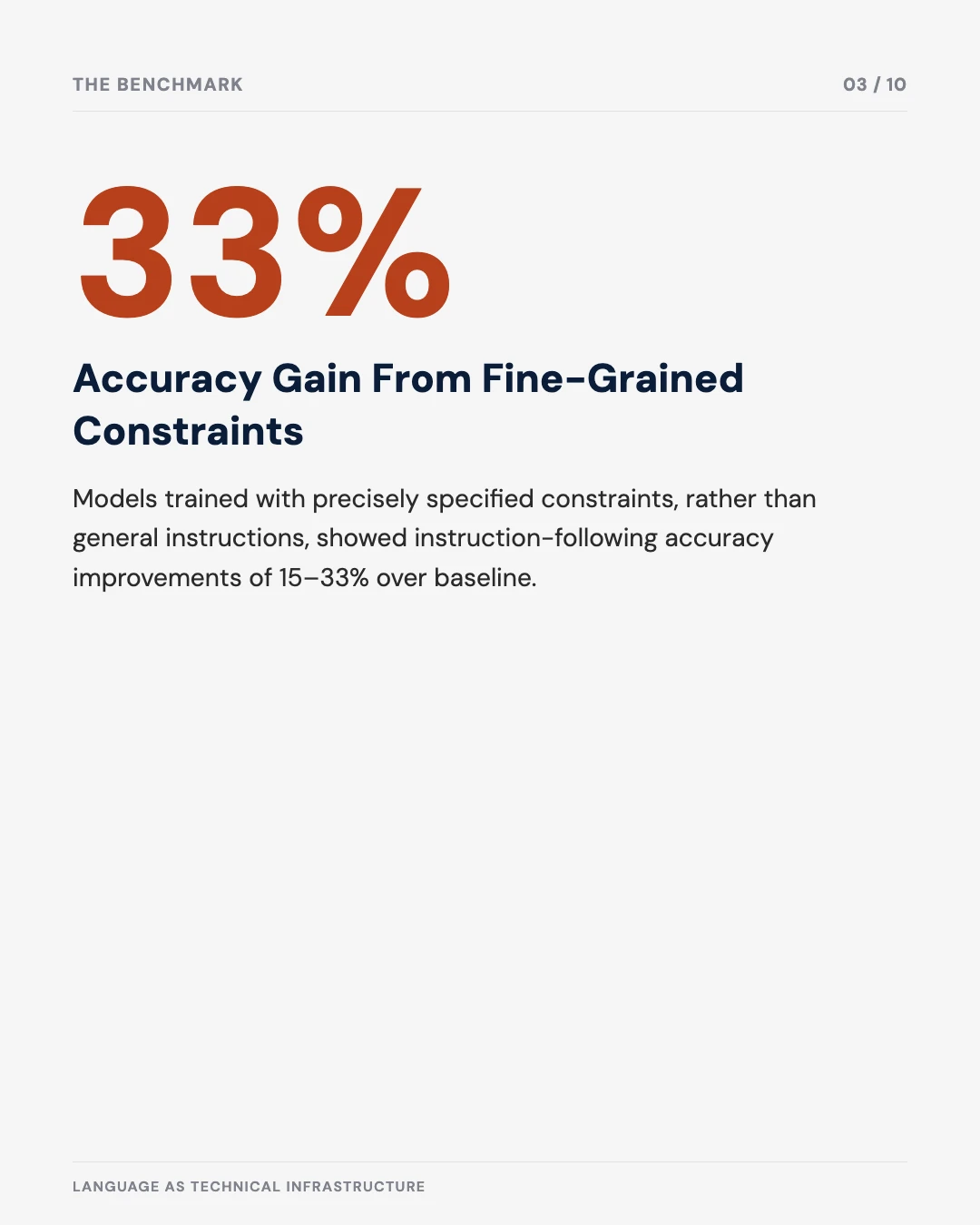
- Precise, standardised language creates stable semantic signals that measurably improve AI performance; one benchmark found fine-grained constraints improved instruction-following accuracy by 15-33% over vague baselines.
- Vocabulary consistency across teams and documents is a technical infrastructure decision. Inconsistent terminology fragments the system at the semantic level.
- Organisations with linguistic discipline produce AI systems with measurable, traceable ROI; those without produce costly pilots that plateau.
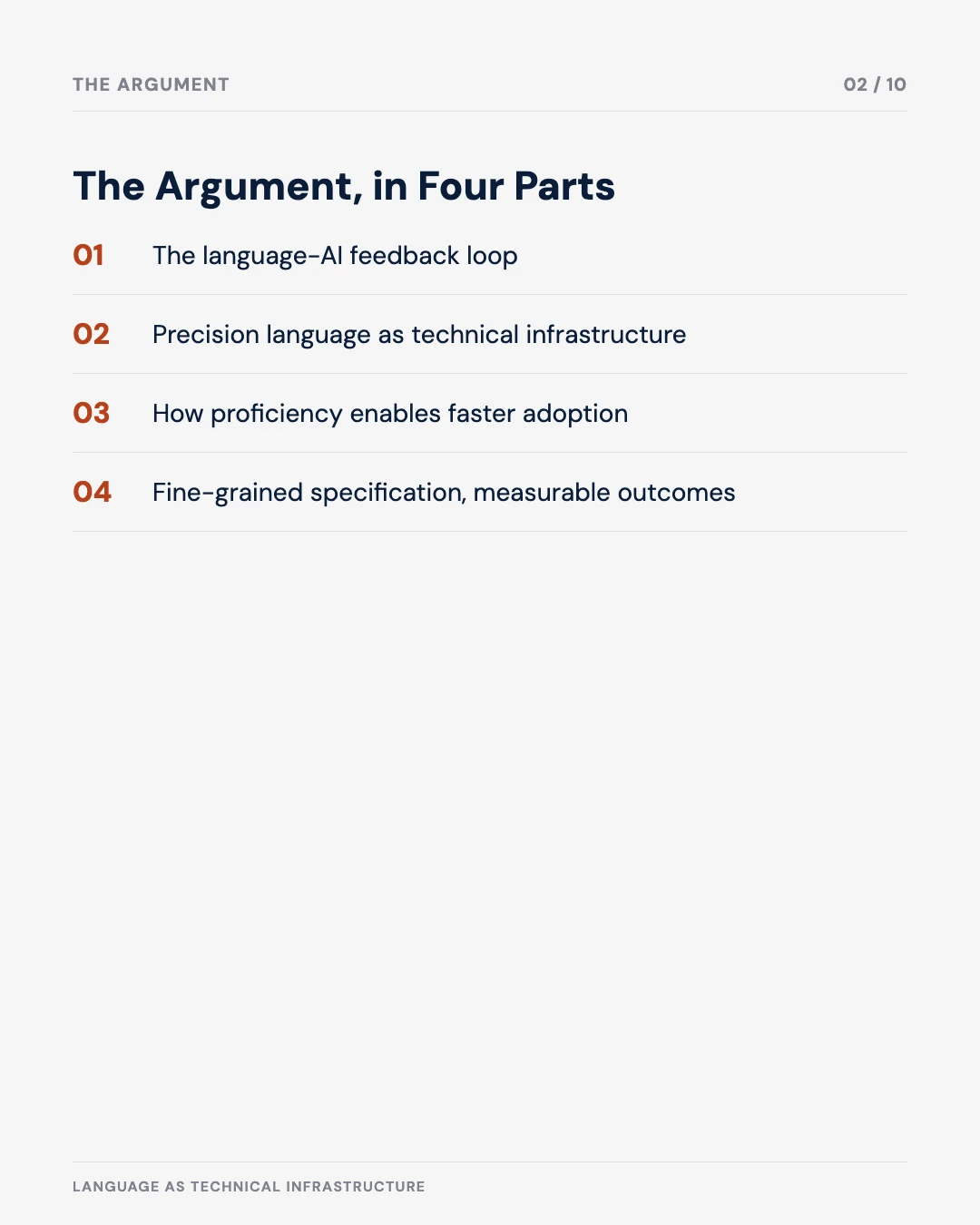
The argument, in ten slides
Save it, share it, or send it to whoever is writing your next system specification.




Language proficiency and adaptability to AI systems
- AI systems fail not because of model limitations, but due to unclear instructions
- Precise, standardised language creates “stable semantic signals” that improve AI performance by 15-33%
- Vocabulary consistency across teams is a technical infrastructure decision, not just communication
- Organisations with linguistic discipline produce AI systems with measurable ROI; those without produce costly pilots that plateau
Ambiguous instructions compound into AI system errors
When organisations deploy AI systems across operations, whether in smart city infrastructure, IoT platforms, or digital twins, they face a fundamental constraint:
The system can only be as effective as the instructions it receives.
Research links prompt clarity to output quality
- Context and structure of prompts significantly impact output quality
- AI outputs improve drastically when ambiguity is removed
- Many inaccurate responses stem from unclear instructions, not model failure
- Improving prompt clarity drives measurable improvements in AI response quality
Vague specifications create contradictory signals for the system
When your teams write vague specifications, using synonyms interchangeably, defining scope ambiguously, or mixing terminology across documents, the AI system interprets these inconsistencies as contradictory patterns.
The result: compounding errors, not model failure.
Precision language functions as technical infrastructure
Consider terminology consistency.
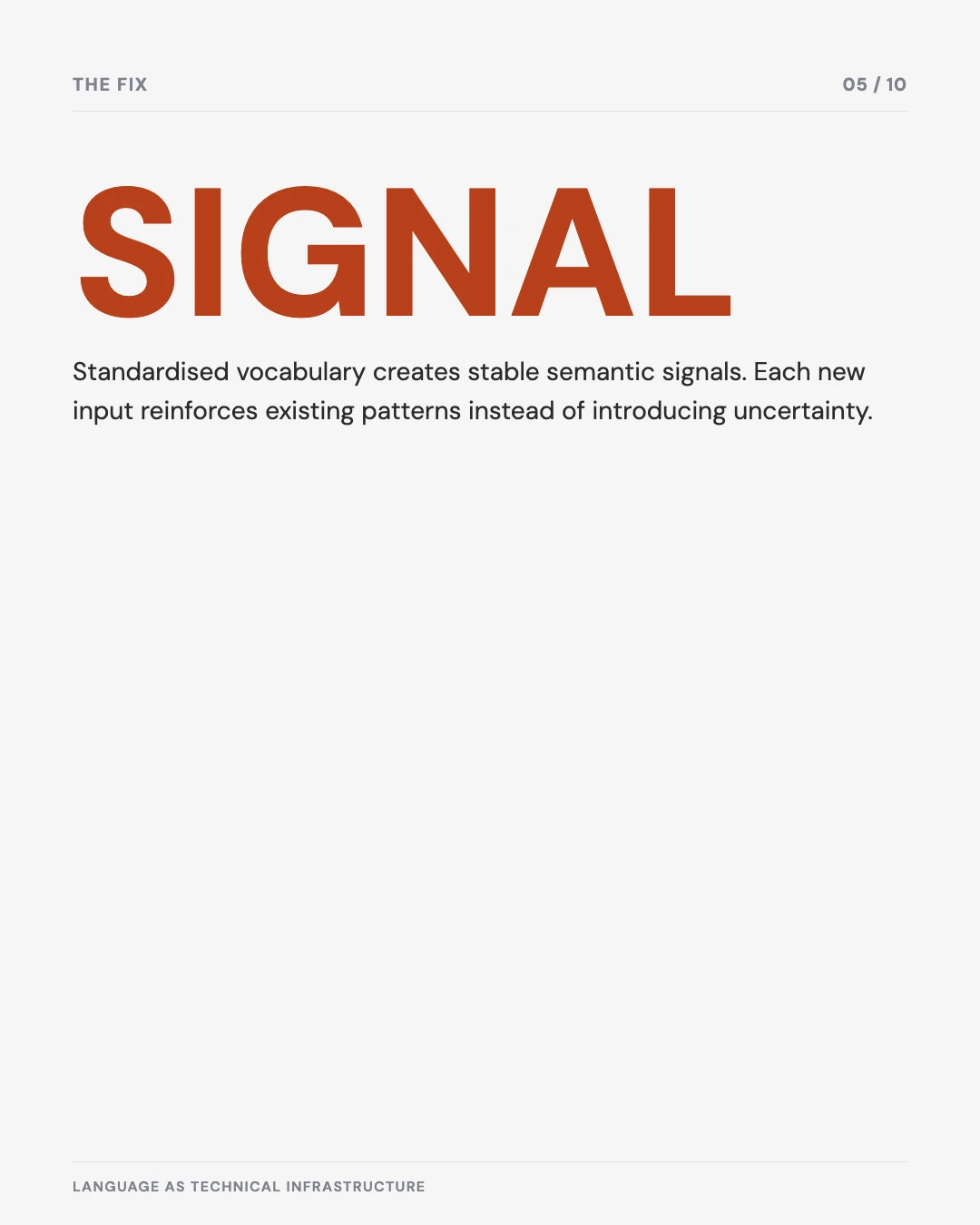
When you standardise vocabulary across your ICT infrastructure (deciding that “Active User” means a specific measurable state, not a floating definition), you create what AI researchers call “stable semantic signals.”
These signals enable the model to build cumulative understanding. Each new input reinforces existing patterns.
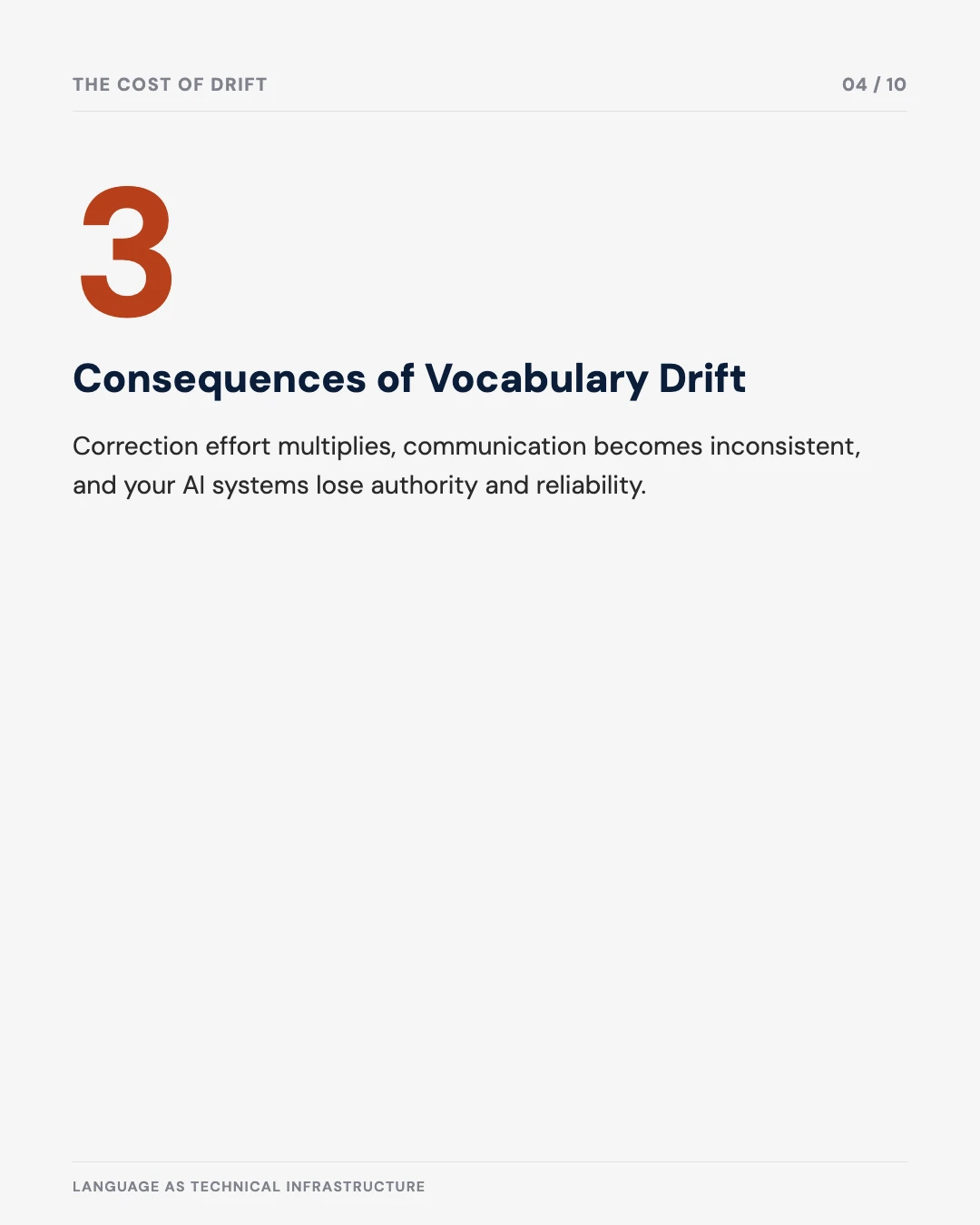
Vocabulary drift shows up without that discipline
- Different teams use “Pilot,” “Beta,” and “Experiment” interchangeably
- The AI detects these as separate categories or conflicting signals
- Correction effort multiplies
- Brand communication becomes inconsistent
- Your AI systems lose authority and reliability
If your operational teams, engineering partners, and governance bodies use different terminology to describe the same IoT sensors, data classifications, or performance metrics, your integrated digital ecosystem becomes fragmented at the semantic level.
The system cannot build trust in its own knowledge architecture.
Language proficiency speeds the adoption of new systems
Adaptation to new systems is constrained by the clarity of communication.
When you move a complex infrastructure project from pilot to scale across multiple cities and regulatory environments, your ability to articulate requirements, constraints, and success criteria determines adoption speed and stakeholder alignment.
Research on technology-driven change confirms this pattern
- Clarity of purpose is foundational for pilot-stage communication success
- Transparent, precise communication sets the foundation for effective scaling
- Ambiguity about why an innovation is being introduced leads to confusion, scepticism, and resistance
Ambiguity produces real-world consequences
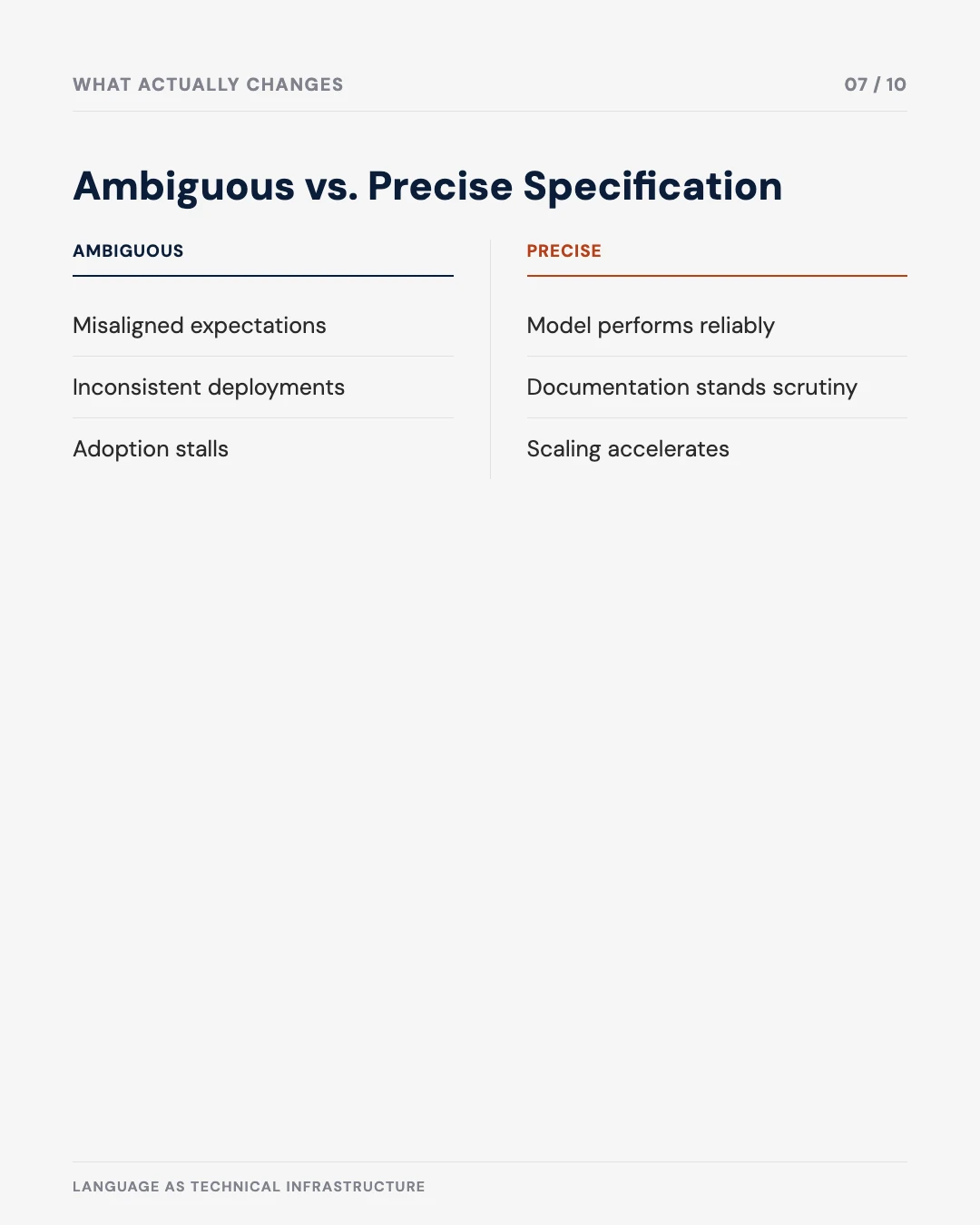
- Ambiguous specifications lead to misaligned expectations
- The same instruction interpreted differently leads to inconsistent deployments
- Questioning system reliability leads to a lack of precise documentation
- The result is that adoption stalls
Linguistic precision produces the opposite outcomes
- The model performs reliably
- Documentation stands up to scrutiny
- Stakeholders gain confidence
- Scaling accelerates
Fine-grained specification produces measurable outcomes
The technical research is unambiguous:
When AI models receive fine-grained, precisely specified constraints their performance improves substantially.
One benchmark found meaningful variation in instruction-following accuracy depending on how precisely the constraints were specified, with fine-grained constraints outperforming general instructions by a wide margin.
Precise instructions narrow the model’s interpretive space
- Vague instructions produce multiple valid interpretations
- Precise instructions reduce the interpretive space
- Fine-grained specifications focus the model’s attention on exactly what matters
- The result is measurable reliability
This is the same discipline I’ve written about at the individual-prompt level: why prompt engineering still matters once you look past the “just ask better” advice.
Infrastructure-scale deployments see fewer iterations and fewer errors
- Reduced iteration cycles
- Lower error rates
- Faster time-to-measurable-impact
Precise language is a competitive advantage
Your ability to write with precision, clarity, and consistency is not a communication skill. It is a technical architecture decision.
Organisations that standardise terminology, define specifications with granular detail, and maintain linguistic discipline across teams and documents create AI systems that perform predictably and scale reliably: the same underlying discipline behind why cleaning your data matters more than tuning your prompts.
Those that treat language as ancillary, something to document after technical decisions are made, produce fragmented systems that resist scaling and generate persistent operational friction.
Linguistic discipline determines ROI in smart city and infrastructure programmes
When you’re integrating ICT systems, cybersecurity protocols, data platforms, and intelligent operations across multiple jurisdictions:
- Organisations with strong linguistic discipline in specification and communication produce AI systems with measurable, traceable ROI
- Those without it produce costly pilots that plateau
Your ability to write clear language shapes what the model can do for you
The model itself is rarely the constraint; your ability to write good language is.
Was this useful?