

Listen to this article
Jump to a section
In this article
Executive Summary
I hear some version of this question in almost every room I’m in now, from a graduate three weeks into their first job to a CEO with a board meeting in the morning. The specifics change with the seniority of the person asking. The feeling underneath does not: there is no longer a fixed target to prepare for, and waiting for one to appear is its own kind of risk.
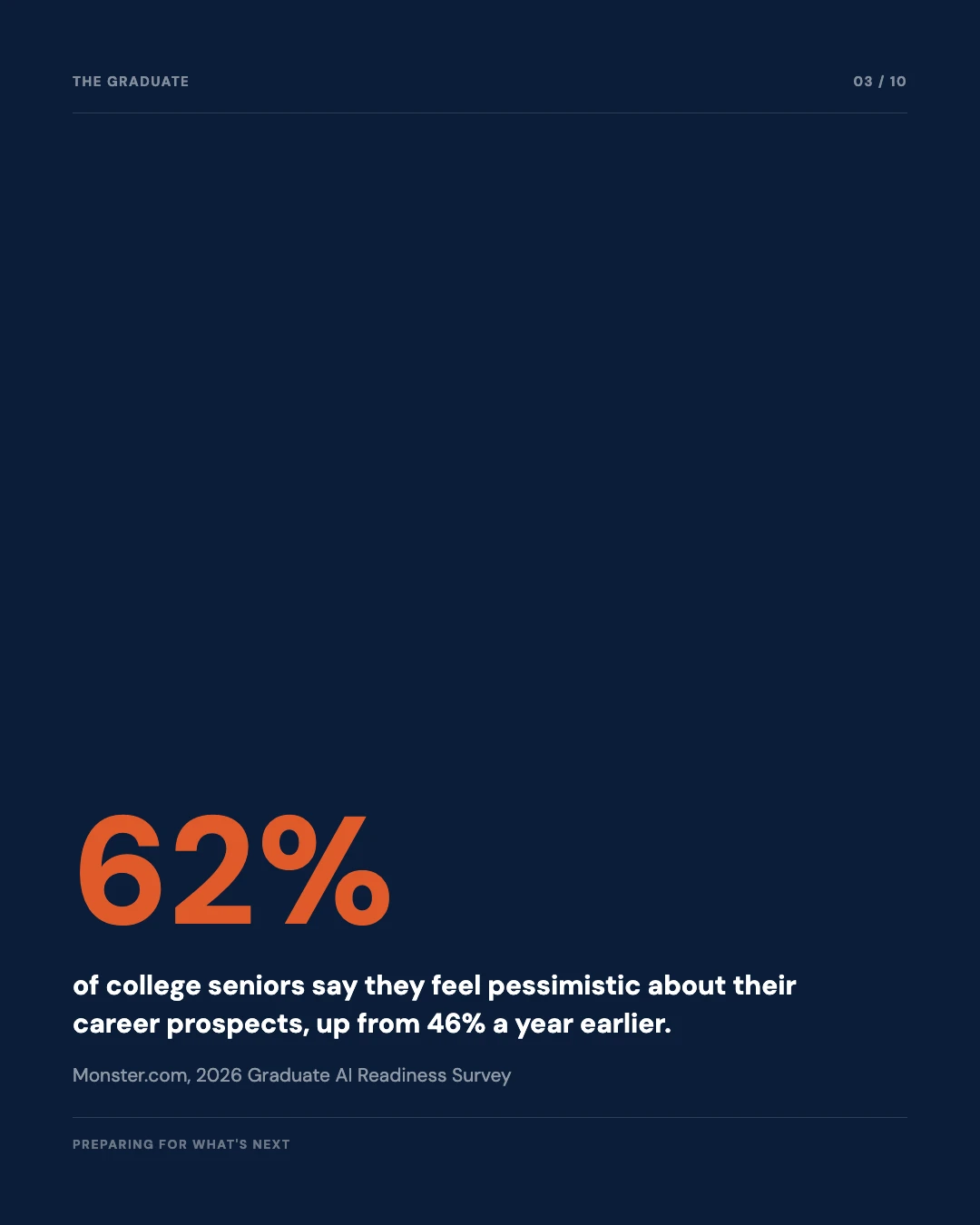
62%
of college seniors say they feel pessimistic about their career prospects, up from 46% in 2024, per Monster.com’s 2026 Graduate AI Readiness Survey
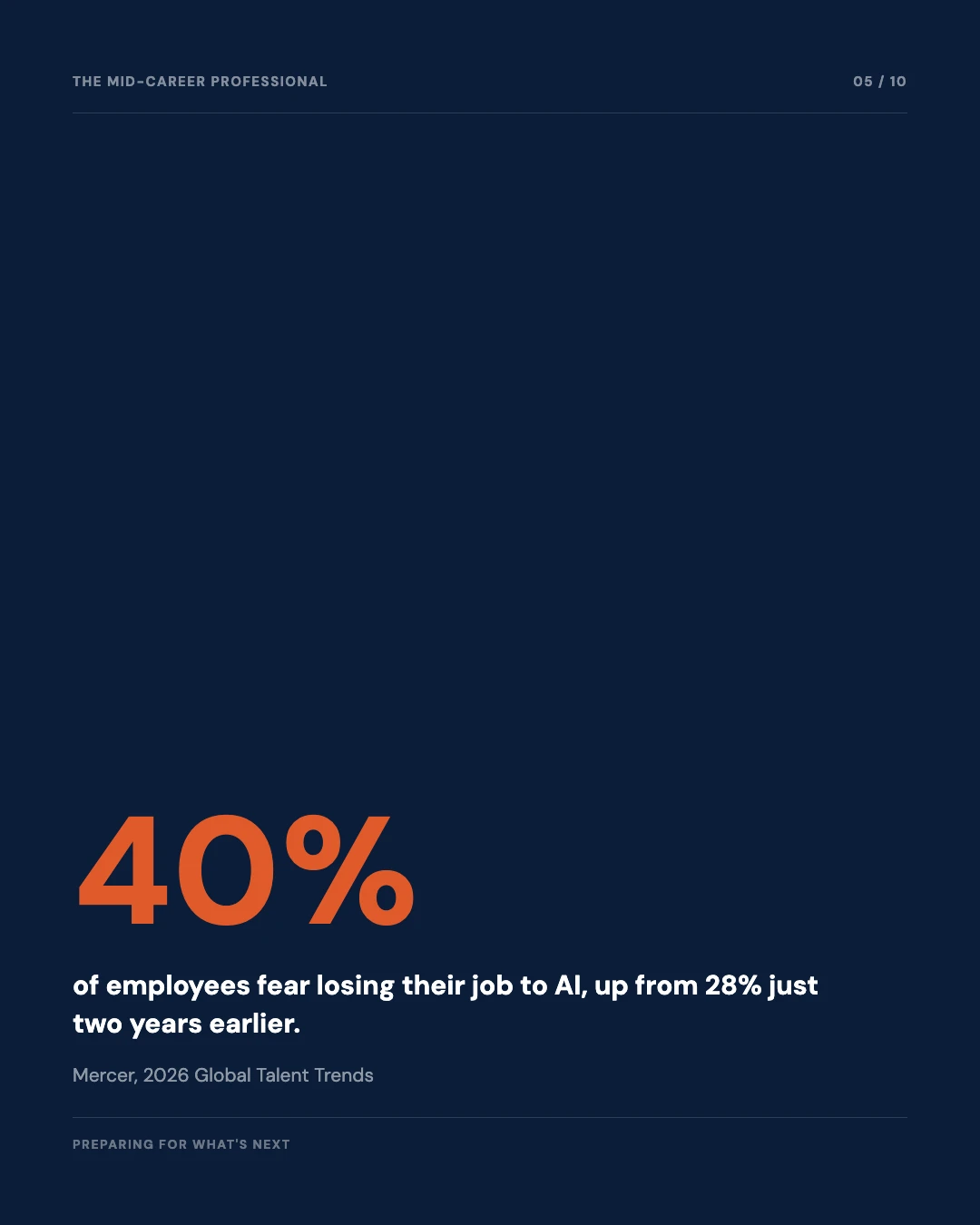
40%
of employees fear losing their job to AI, up from 28% two years earlier, per Mercer’s 2026 Global Talent Trends survey
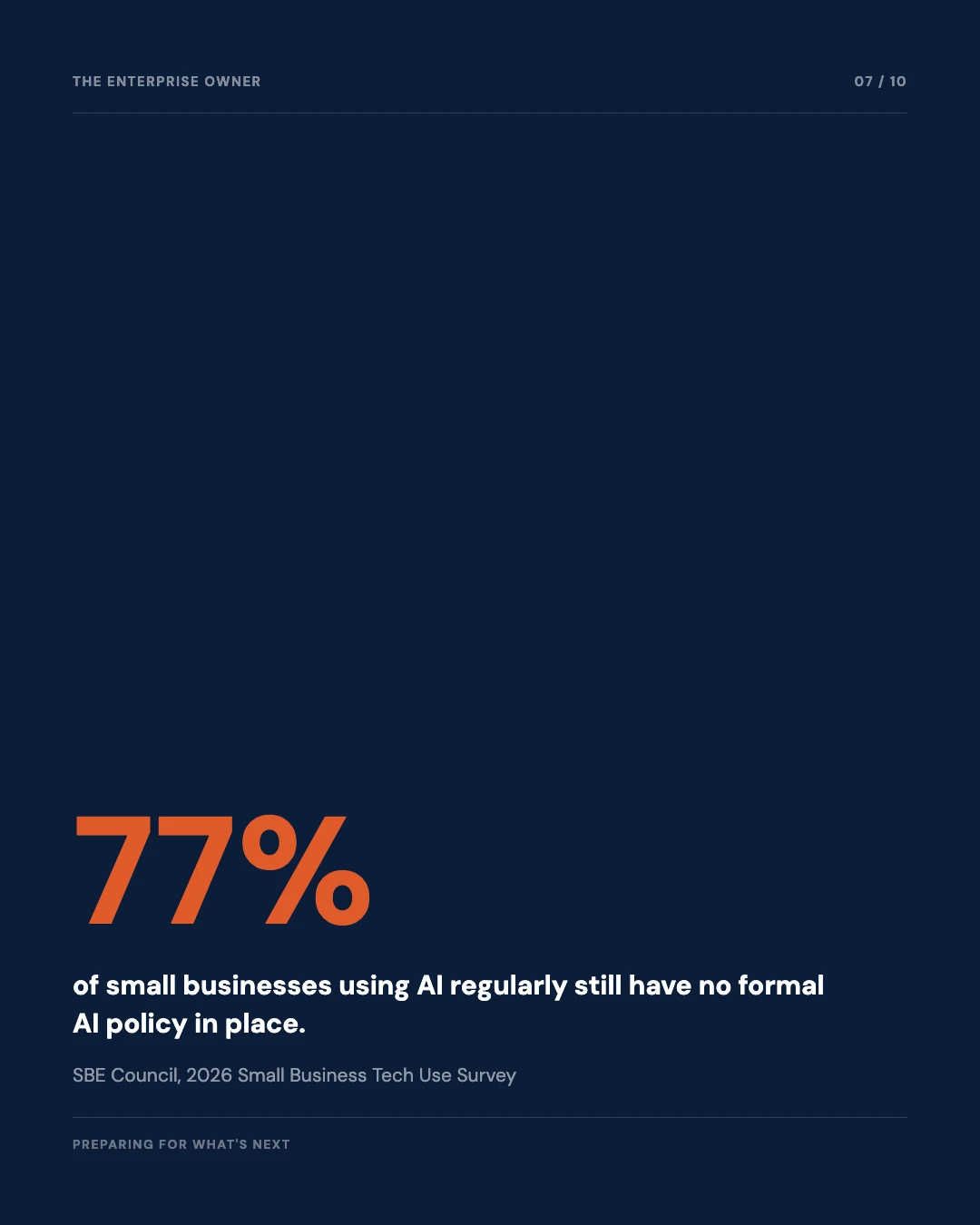
77%
of small businesses that use AI regularly have no formal AI policy, per the SBE Council’s 2026 Small Business Tech Use Survey
73%
of CEOs report stress or anxiety about their company’s AI strategy, per Dataiku’s 2026 CEO Survey of 900 executives
Core conclusions
- The anxiety is not irrational, and it is not the same anxiety at every career stage. A graduate is afraid of never getting a foothold. A CEO is afraid of a board asking why the company didn’t see this coming. Treating “AI anxiety” as one problem misses that each group needs a different kind of steadying.
- What makes this shift different from past ones is not the technology itself. It is that it is moving across every function and every seniority level at once, faster than any single strategy cycle, performance review, or curriculum can track it.
- This piece does not offer a five-step plan. The people who seem to be coping best right now are not the ones with the clearest forecast. They are the ones who have shortened how far ahead they insist on seeing before they’re willing to move.
Four fears, ten slides
Save it, share it, or send it to whoever’s asking themselves this same question right now.
The question underneath the question
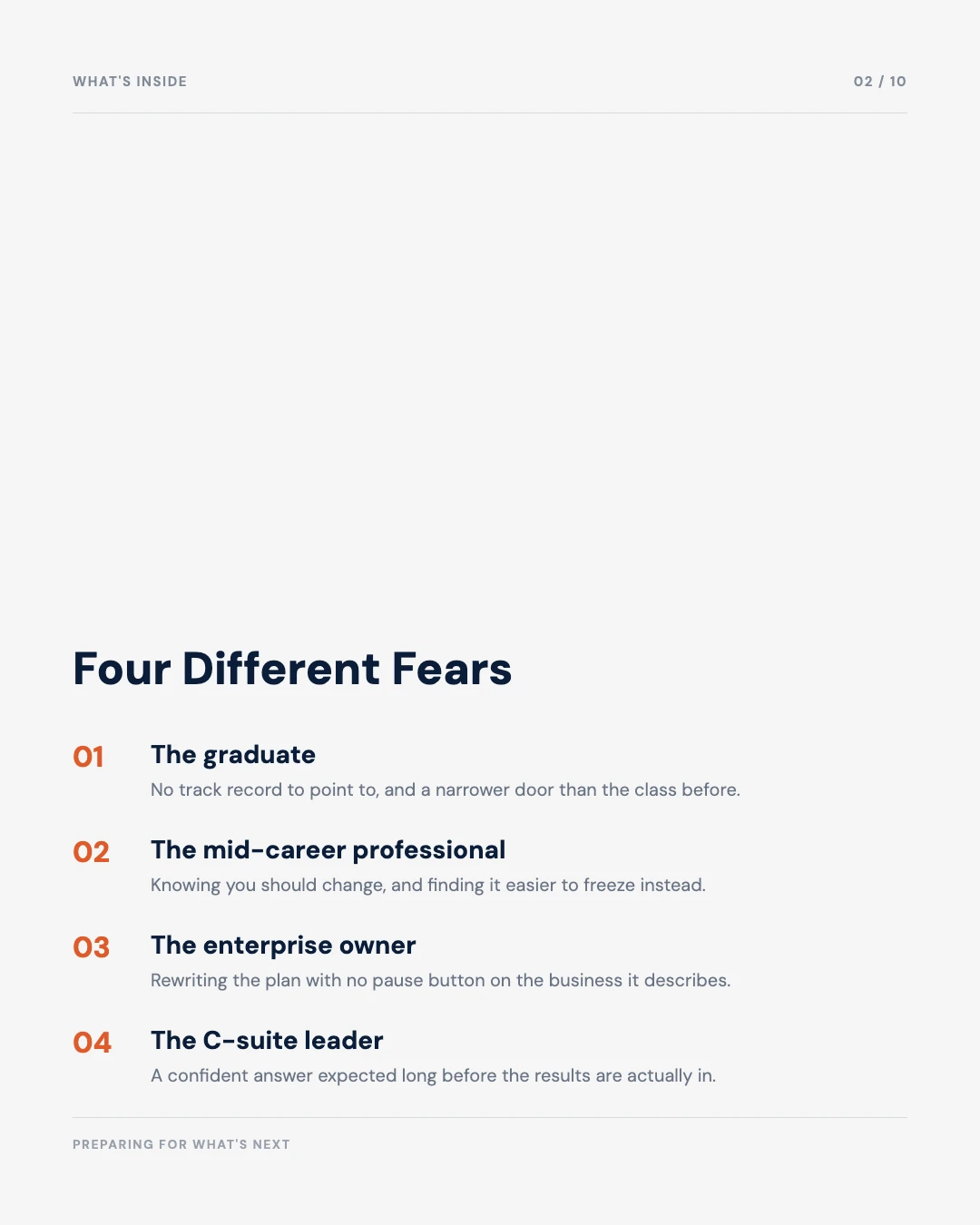
“How do I prepare for a future I can’t see?” sounds like one question. It is really four, depending on who is asking it, and the honest answer changes each time. A 23-year-old asking it is really asking whether they will ever get the first real chance to prove themselves. A manager fifteen years into a career is asking whether the specific expertise they built is still worth anything. A business owner is asking whether the model that has fed their family for a decade still works next year. A CEO is asking it in front of a board that expects a confident answer regardless of whether one exists yet.
None of these are the same fear, even though they get compressed into the same three words: AI anxiety. What ties them together is the structure of the worry, not its content. Each of these people is being asked to commit real resources, time, money, or a career, against a picture that keeps changing before the ink dries.
Previous waves of disruption at least had the decency to move at a pace a person could plan around. The shift from typewriters to word processors took years to touch most offices. E-commerce reshaped retail over roughly two decades. This one is different mainly in tempo. It is touching hiring, product design, customer service, finance, and the boardroom simultaneously, and the tools themselves are still meaningfully different from what they were a year ago. Pew Research found that 51% of US adults are now more concerned than excited about AI’s growing role in daily life, up from 37% in 2021, and the American Psychiatric Association’s 2026 Annual Mental Health Poll found that nearly half of Americans feel more anxious than they did a year earlier, with AI now named among the contributing causes. That is not a fringe reaction. It is close to a majority position.
| Signal | Value | Source |
|---|---|---|
| College seniors who feel pessimistic about their career prospects | 62%, up from 46% in 2024 | Monster.com, 2026 Graduate AI Readiness Survey |
| Hiring managers who’d rather invest in AI tools than hire and train a recent graduate | 48% | Monster.com, 2026 Graduate AI Readiness Survey |
| Employees who fear losing their job to AI | 40%, up from 28% two years earlier | Mercer, 2026 Global Talent Trends |
| Small businesses using AI regularly with no formal AI policy | 77% | SBE Council, 2026 Small Business Tech Use Survey |
| CEOs reporting stress or anxiety about their company’s AI strategy | 73%, with 38% at high or “crippling” levels | Dataiku, 2026 CEO Survey |
| CEOs who say their company won’t be viable in 10 years on its current path | Nearly 4 in 10 | PwC, 29th Annual Global CEO Survey, 2026 |
| US adults more concerned than excited about AI’s role in daily life | 51%, up from 37% in 2021 | Pew Research Center, March 2026 |
Every stage of a career shows up somewhere in this table. Nobody is exempt from the uncertainty, and nobody has a clean read on it either.
The fresh graduate must prove value with no track record to point to
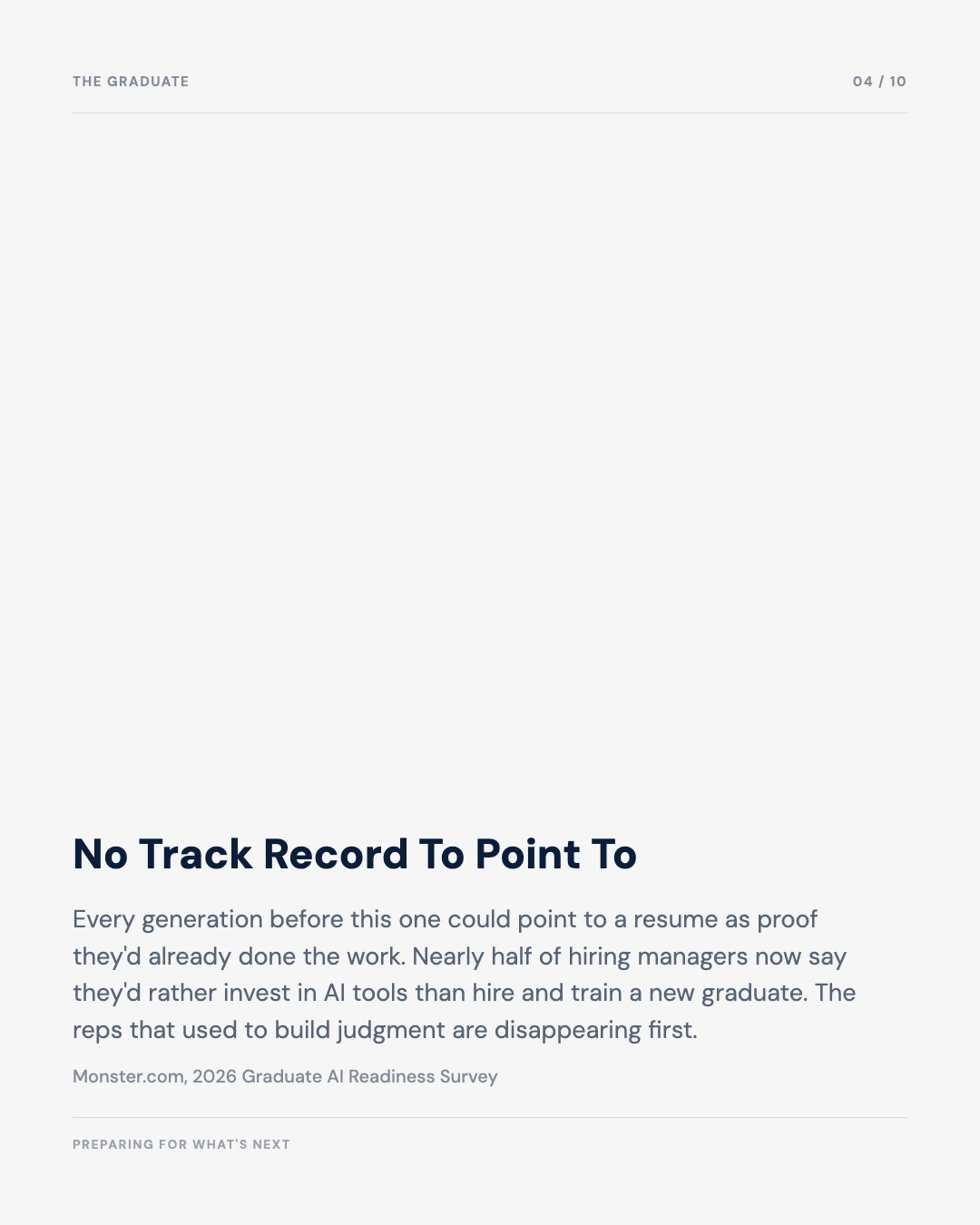
A graduate’s problem has a particular cruelty to it. Every generation before this one could point to a resume, an internship, a grade point average, evidence that they had already done some version of the work. That evidence used to be enough to get a foot in the door, where judgment and real skill got built on the job over the following few years. Now the door itself is narrower. Nearly half of hiring managers say they would rather invest in AI tools than hire and train a recent graduate, and college seniors’ pessimism about their own prospects has jumped from 46% to 62% in a single year.
What makes this worse is that the usual advice, work harder, get better grades, add another certificate, does not address the actual problem. A graduate is not competing against AI on raw execution speed; nobody wins that race. They are competing to be the person a company trusts to notice when the AI’s confident answer is wrong, and that kind of judgment is normally built through years of exactly the entry-level reps that are disappearing first. I wrote about the shape of that gap, and where it is opening a different door, in The Entry-Level Job Market Broke. Here’s the Opening It Left Behind.
There is no shortcut around needing real reps. What seems to help is not waiting for the perfect first role to start getting them. A smaller company, a messier project, a task nobody senior wants to own, all of these still build the pattern-recognition that a resume alone cannot fake, and they build it faster than another course does.
The mid-career professional must unlearn what used to work
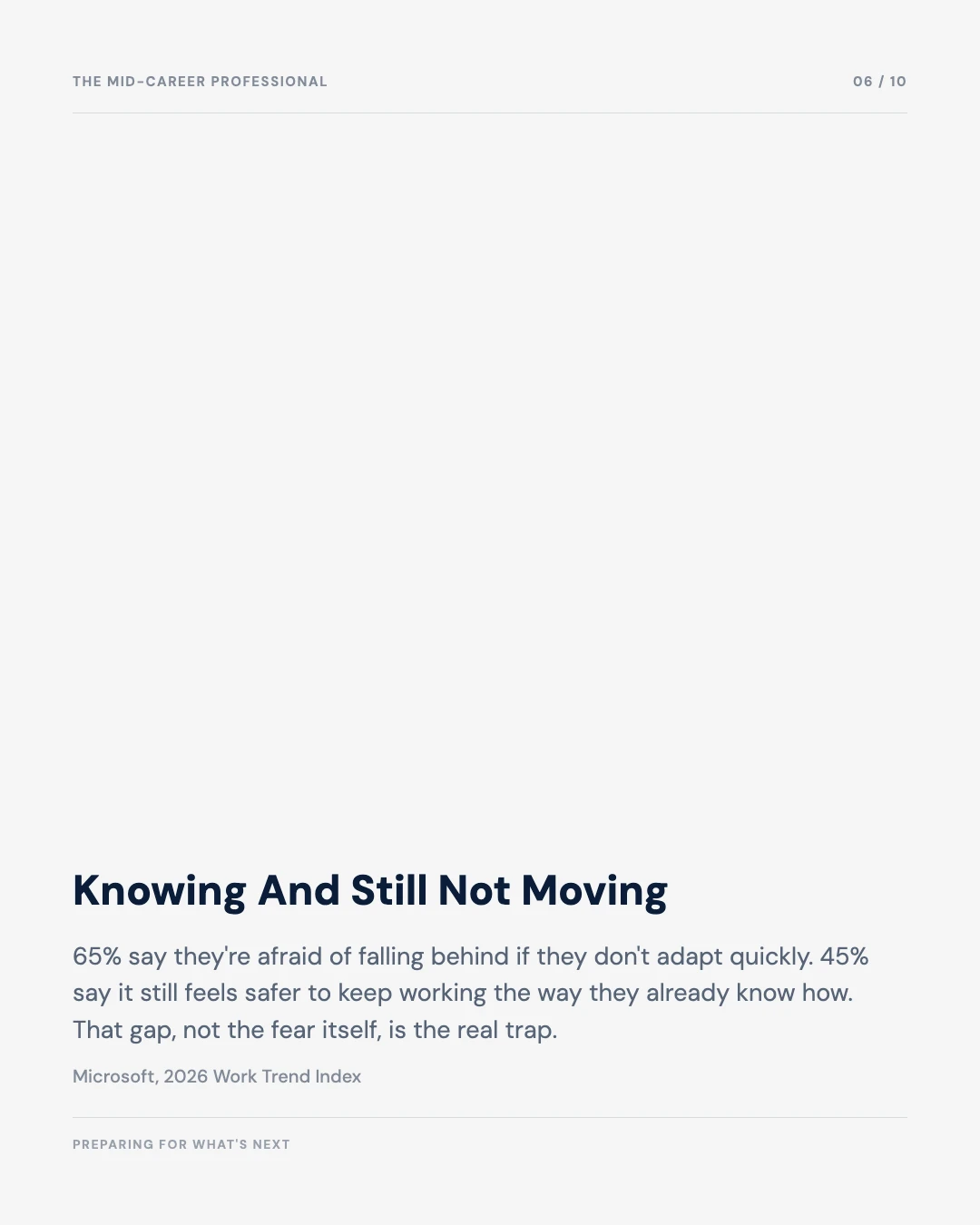
The mid-career fear is quieter than a graduate’s, but it runs deeper, because it attacks something that felt earned. You spent a decade or more getting good at something specific, and for most of working history, that specificity was the whole plan. Now 40% of employees say they fear losing their job to AI, up twelve points in two years, and Microsoft’s 2026 Work Trend Index found something sharper underneath that number: 65% of AI users say they are afraid of falling behind if they don’t adapt quickly, while 45% say it still feels safer to keep doing their current job the way they already know how.
That gap, between knowing you should change and choosing not to yet, is the actual trap. That gap is a rational response to genuine risk, not laziness: redesigning how you work takes time and looks uncertain, while doing the job you already know how to do feels safe, right up until it isn’t. I went into this specific dynamic, and what tends to replace raw tenure as the thing that earns pay now, in Why Experience Alone No Longer Guarantees Higher Pay.
The honest reframe here is that expertise was never really the asset. Judgment was, and expertise was just how you used to build it. That means the years already spent are not wasted. They just need to be pointed at a slightly different target: not defending the specific way you’ve always done the work, but using what you already know to catch what a model gets wrong.
The enterprise owner must rewrite the plan while running the business it describes
Business owners carry a version of this anxiety that graduates and employees don’t have to deal with: there is no separate planning department, and no pause button. Sixty-eight percent of small businesses already use AI regularly, but 77% have no formal AI policy, and only 23% of the businesses using it have given anyone formal training on how. That is not recklessness. It is what happens when you have to decide and act at the same time, with no slack in the schedule to do the redesign properly first.
What’s notable is that this gap coexists with genuine confidence. Ninety percent of small business owners say they feel capable of adopting digital tools and AI, and only 9% describe themselves as pessimistic about it. The anxiety, where it exists, is quieter and more specific than dread: it is the worry that you are building the plane while flying it, and that a competitor with a cleaner process gets to the same customers first. I wrote about how to pressure-test the assumptions underneath a multi-year plan before a board, or a competitor, does it for you, in Building Resilience: Why Your Strategic Assumptions Are Dangerous
Free tool
AI Readiness Self-Assessment
Five questions, ten minutes, and an honest scored read on where the gap between your AI use and your AI plan sits.
The C-suite leader is accountable for a strategy no one can fully verify yet
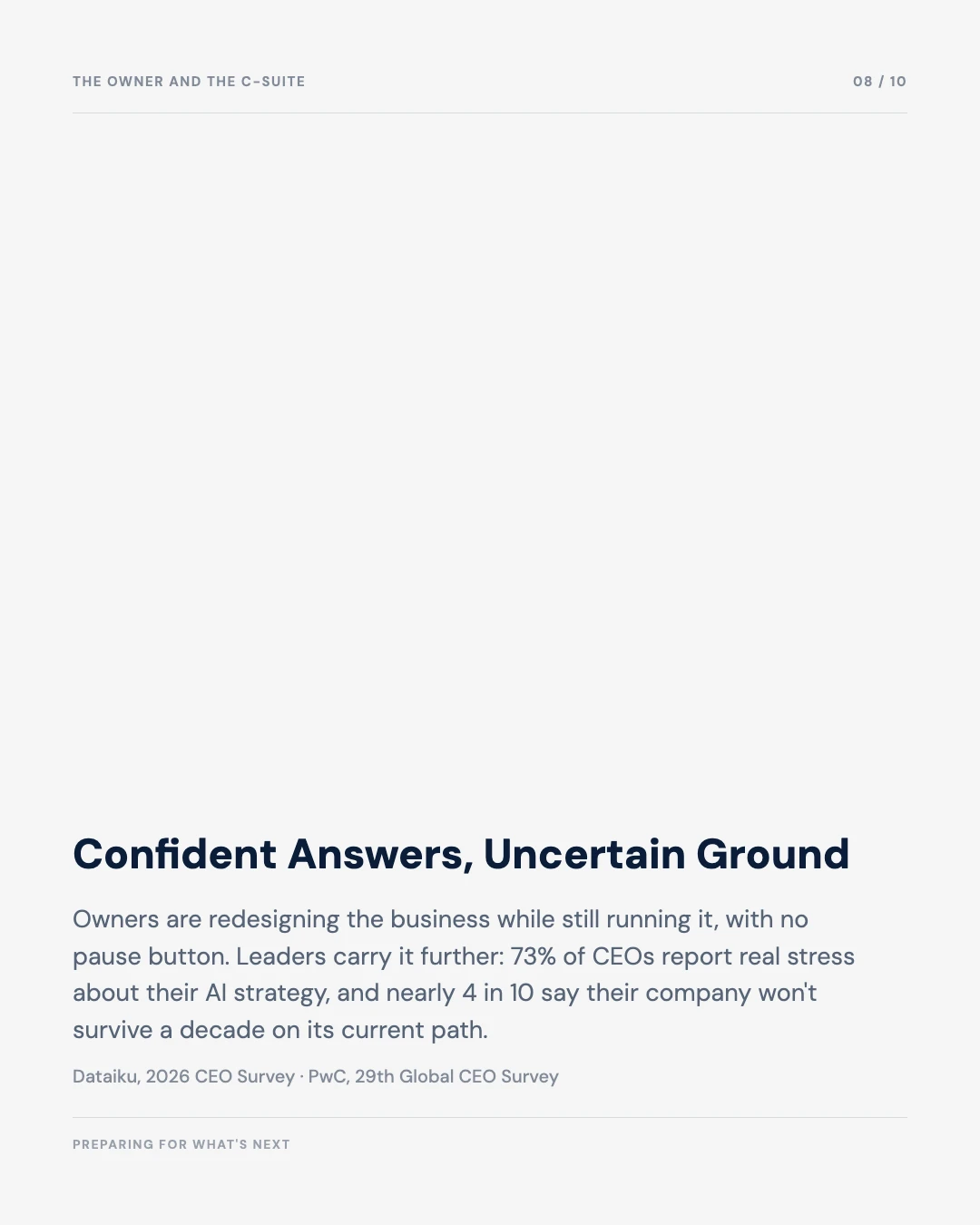
At the top of an organisation, the anxiety compounds because it stops being private. Seventy-three percent of CEOs report stress or anxiety about their company’s AI strategy, and 38% describe it as high or “crippling.” Nearly four in ten say, in PwC’s own words, that their company will not be viable in ten years if it stays on its current path. What makes this harder than any other seat in this piece is that a CEO is expected to hold a confident public position on a question the entire industry is still arguing about, and that position gets judged by a board long before the results are in.
The instinct under that kind of pressure is to reach for false certainty, to pick a bold narrative and defend it, because admitting “we don’t fully know yet” feels like it undermines the confidence the role is supposed to project. That instinct is usually the mistake. I wrote about the specific failure pattern this produces, chasing an ambitious AI story while skipping the unglamorous sequencing that determines whether it lands, in The Avenger Tower Fallacy: Why Your AI Strategy Is Failing Before It Starts
Free tool
Chief AI Officer Personality Test
Twenty questions across five dimensions. A useful, low-stakes way to see your own default instincts under exactly this kind of pressure before a board meeting forces the question.
What seems to help
I said at the start that this is not a five-step plan, and I want to hold to that, because I think the pretence of a clean plan is part of what makes the anxiety worse. Certainty about the future was probably never really available, at any career stage, in any era. It used to feel available only because change moved slower than a career did. The real difference now is the gap between how fast the picture shifts and how fast any of us can personally verify what’s true.
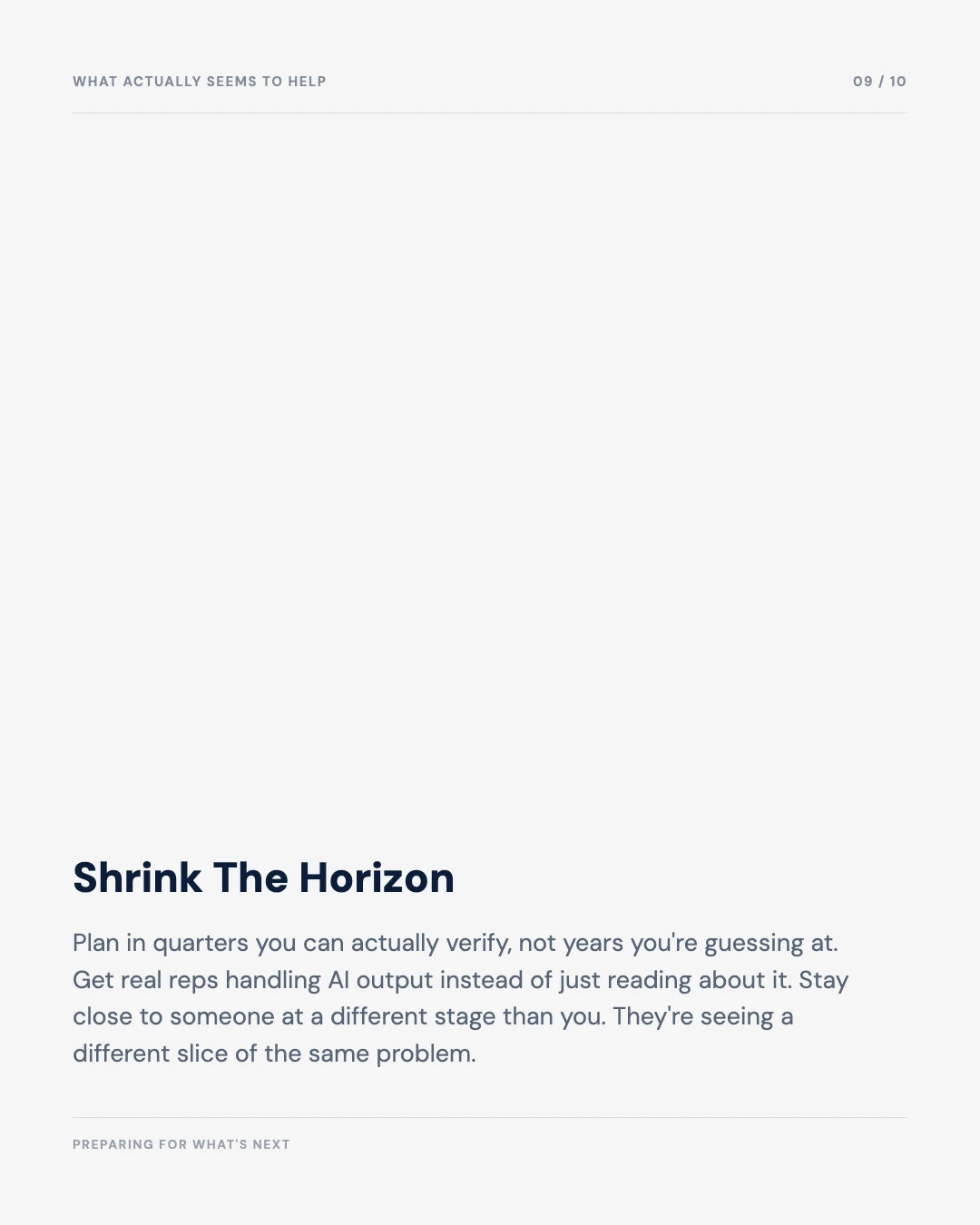
A few things seem to help close that gap, across every person in this piece. Shortening the planning horizon to something you can check, a quarter rather than five years, and revising honestly when it’s wrong. Getting real reps handling AI output directly, because judgment only builds through contact with the actual work. And staying close to people at a different stage than you, because a graduate, a manager, an owner, and a CEO are each seeing a different slice of the same shift, and none of them has the whole picture alone.
Where this leaves us
None of this promises the anxiety goes away, and I would not trust anyone who told you it should. A future you cannot see is uncomfortable to sit with regardless of your title or years of experience. What seems to change, for the graduates and the CEOs both, is not the discomfort itself. It’s what you’re willing to do while it’s still there.
Evidence & Methodology
Every anxiety number in this piece comes from a named survey of real people. The one piece of advice at the end does not, and I want to be upfront about that difference.
| Claim | Source | Grade |
|---|---|---|
| 62% of college seniors feel pessimistic about their career prospects, up from 46% in 2024 | Monster.com, 2026 Graduate AI Readiness Survey | Measured |
| 73% of CEOs report stress or anxiety about their company’s AI strategy | Dataiku, 2026 CEO Survey of 900 executives | Measured |
| Nearly 4 in 10 CEOs say their company won’t be viable in 10 years on its current path | PwC, 29th Annual Global CEO Survey, 2026 | Measured |
| Shortening your planning horizon helps more than having the most confident plan | What I have watched work across a lot of rooms, not a study | My call |
Sources
- Monster.com. (2026). Graduate AI readiness survey.
- Mercer. (2026). Global talent trends.
- Microsoft. (2026). Work trend index: Agents, human agency, and the opportunity for every organization.
- SBE Council. (2026). Small business tech use survey.
- Dataiku. (2026). CEO survey.
- PwC. (2026). 29th annual global CEO survey.
- Pew Research Center. (2026, March). Key findings about how Americans view artificial intelligence.
- American Psychiatric Association. (2026). Annual mental health poll.
I run a two-day programme for owners and mid-market leaders that starts from exactly this problem: how to make real decisions about AI without waiting for a certainty that isn’t coming. Details are on the masterclass page.
Was this useful?