

Listen to this article
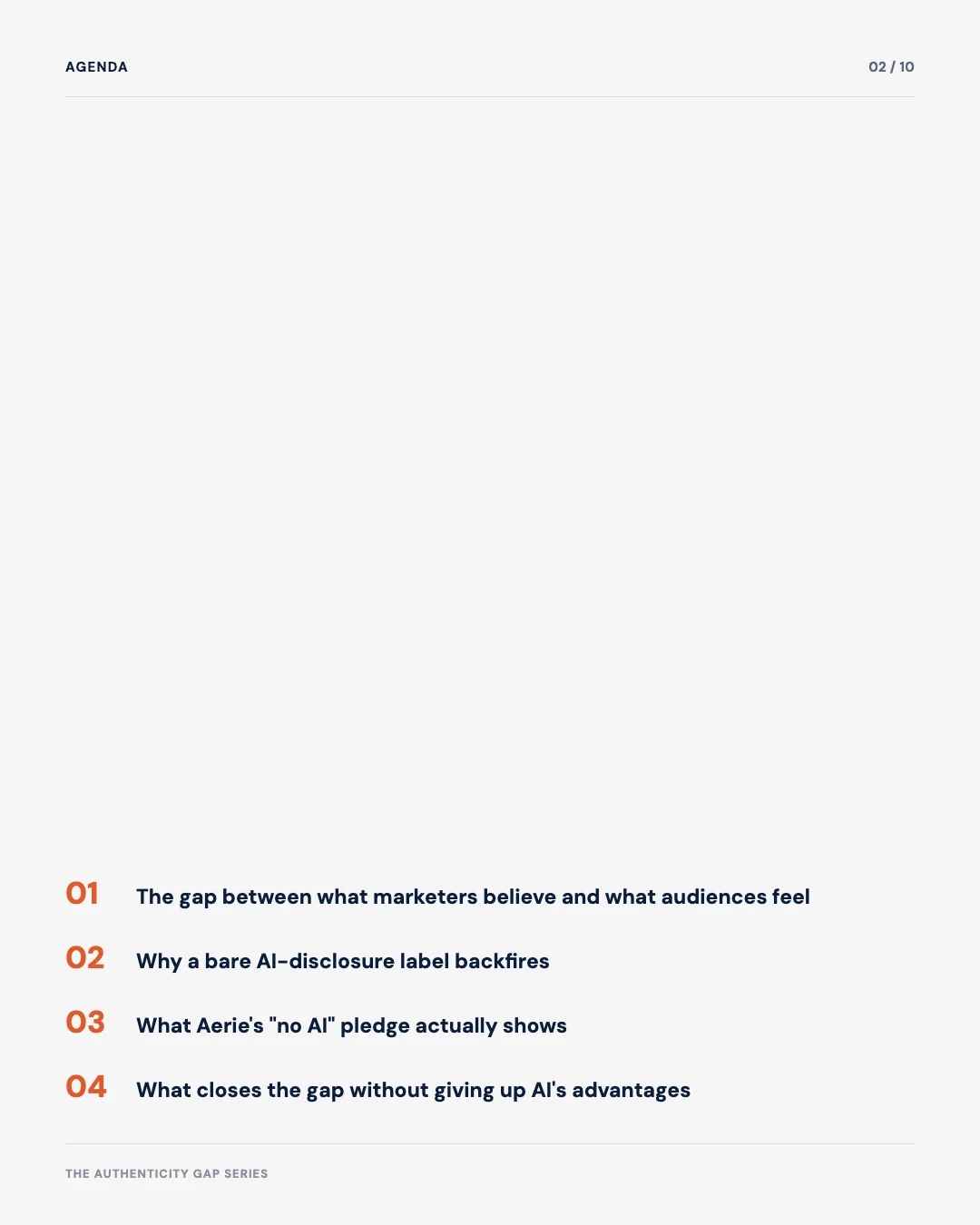
Jump to a section
In this article
Executive Summary
Advertising executives believe audiences have made their peace with AI-generated creative. Audiences haven’t, and the 2026 survey data on the gap is specific enough to act on. People aren’t rejecting AI as a production tool. They’re penalising the absence of a visible human decision, reading it as evidence the brand didn’t think the work was worth a person’s time. Disclosure alone doesn’t fix this, and in several studies it makes trust worse, because a bare “AI-generated” label reads as a confession rather than a courtesy. The brands closing the gap are the ones using AI for the repetitive layer of production while keeping a specific, visible human judgment at the point the audience can see it.
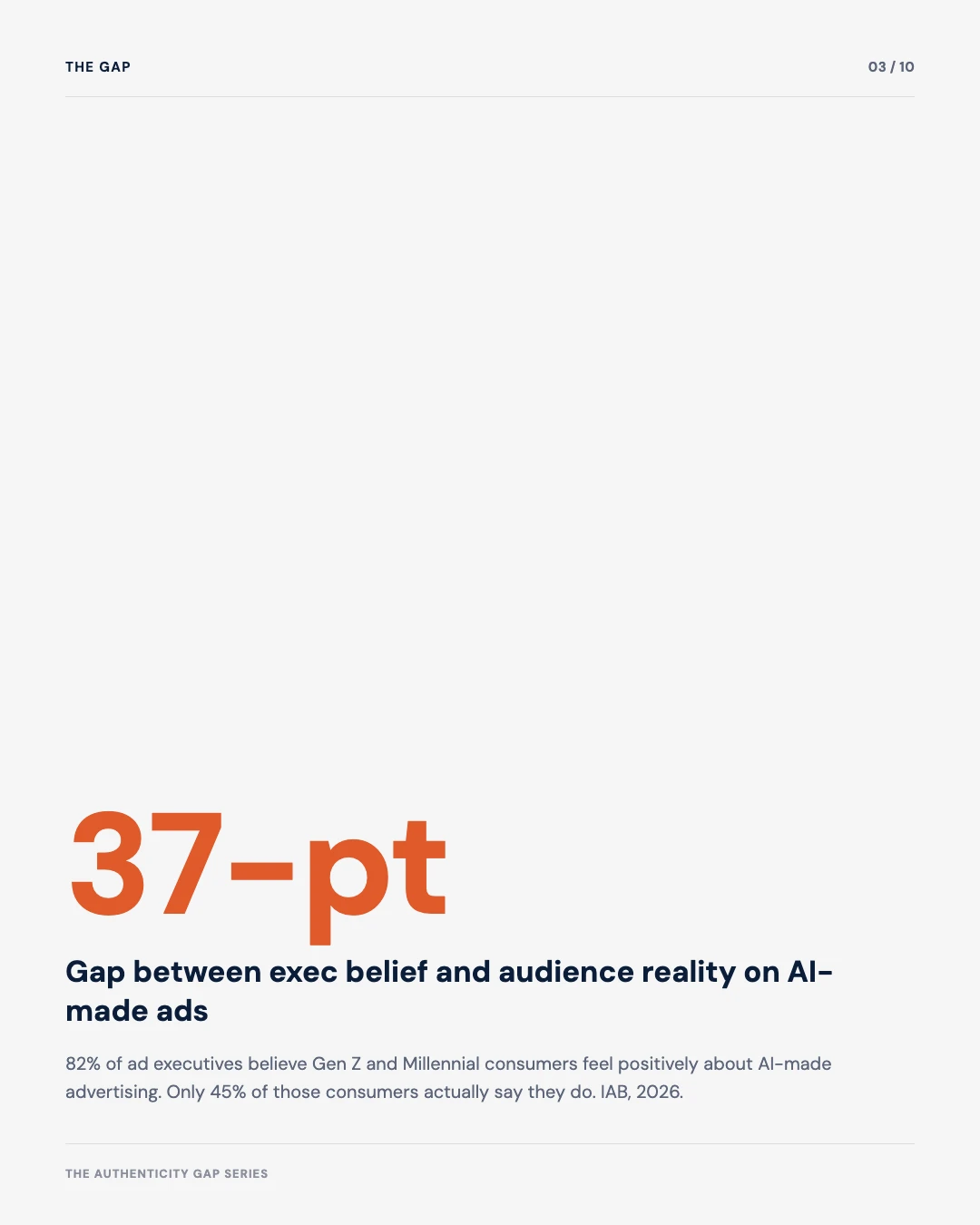
37-point gap
between the 82% of ad executives who think Gen Z and Millennial consumers feel positively about AI-made ads and the 45% of those consumers who say they do, IAB 2026
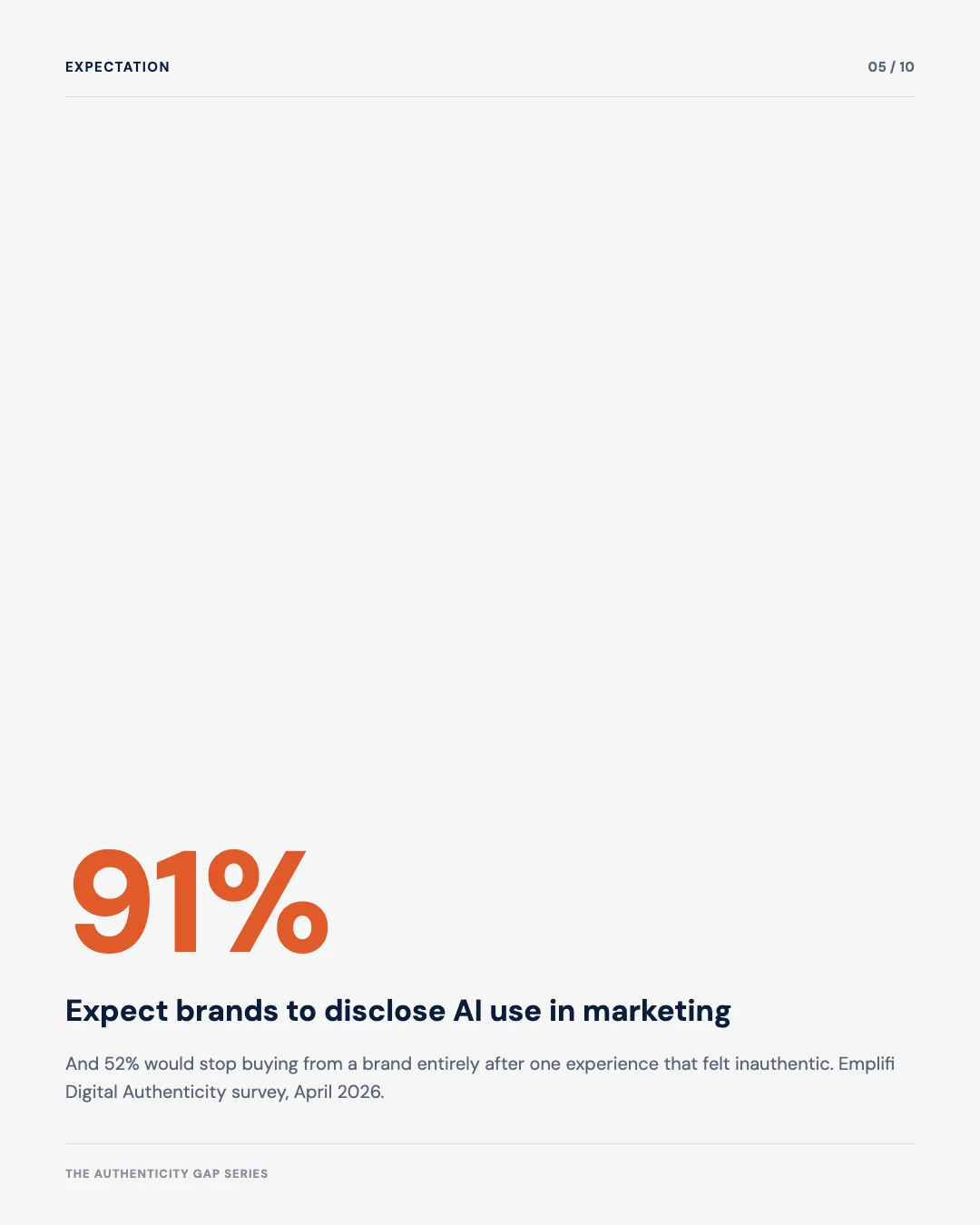
91%
of consumers expect brands to disclose when AI was used in their marketing, Emplifi 2026 Digital Authenticity survey
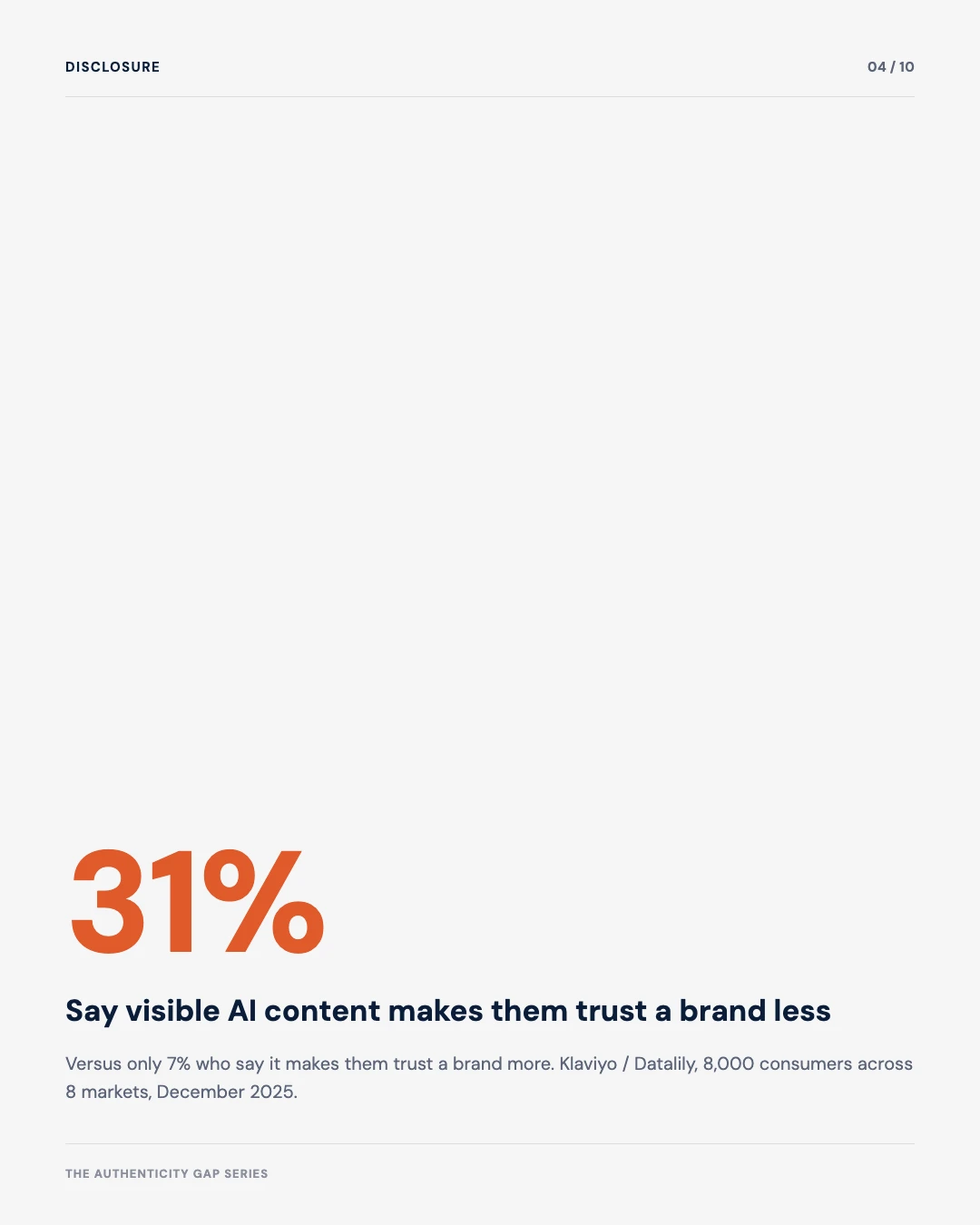
31% vs 7%
of consumers say visible AI-generated marketing content makes them trust a brand less, versus the share who say it makes them trust the brand more, Klaviyo/Datalily, December 2025
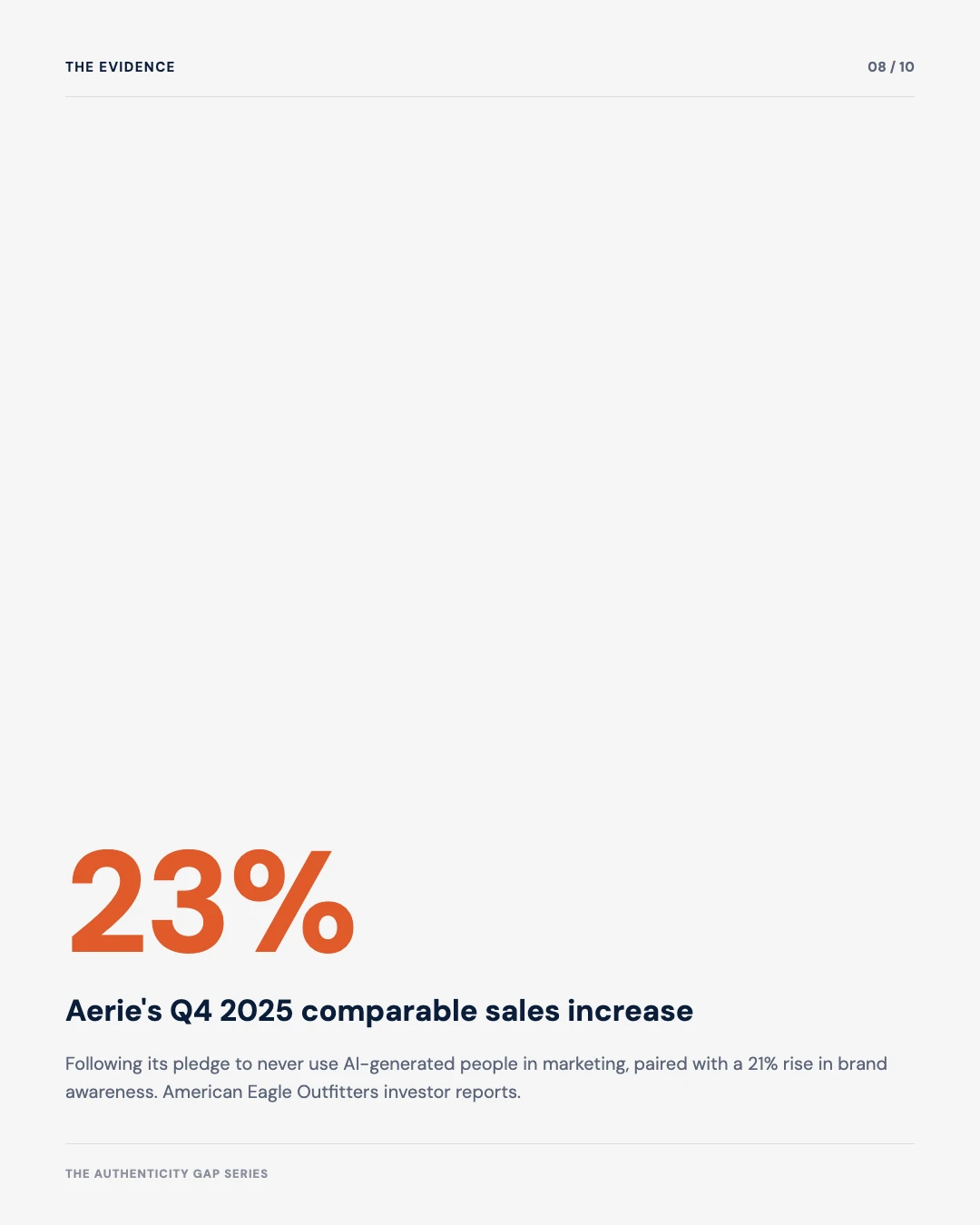
23%
Q4 2025 comparable sales increase at Aerie following its pledge to never use AI-generated people in marketing, American Eagle Outfitters investor reports
Core conclusions
- Audiences aren’t rejecting AI outright. They’re pricing the absence of a visible human decision, and reading that absence as a brand that didn’t think the work was worth doing properly.
- A bare AI-disclosure label often reduces trust, because it functions as an admission.
- The gap closes fastest for brands that use AI in the production layer, drafting, resizing, iterating, while keeping a specific, visible human judgment at the point the audience sees the finished work.
The 37-point gap between marketer belief and audience trust, ten slides
Save it, share it, or send it to whoever’s about to ship the AI-made version without a visible human decision behind it.
The gap between executive belief and audience acceptance
The Interactive Advertising Bureau’s 2026 research on this gap is precise about where the disconnect sits. Surveying 505 US Gen Z and Millennial consumers who’d engaged with ads, alongside 104 US advertising executives, between October 2025 and January 2026, IAB found 82% of ad executives believe younger consumers feel positively about AI-generated advertising. Only 45% of those consumers said they did. That 37-point gap widened from 32 points when IAB ran the same comparison in 2024, meaning the industry’s read on audience sentiment is getting less accurate, not more, as AI-made creative becomes more common.
The generational split inside that number matters as much as the gap itself. Gen Z consumers are close to twice as likely as Millennials to feel negative toward AI-made ads, 39% versus 20%, and a majority of Gen Z respondents described brands using AI as inauthentic, disconnected, or unethical. Consumers overall were also more likely than the executives surveyed to reach for harsh language: 20% called AI-using brands manipulative against 10% of executives, and 16% called them unethical against 7% of executives. The people closest to the creative decision are consistently the ones most confident the audience is fine with it, which is exactly the group least positioned to notice when that stops being true.
That confidence is already changing budgets. A Billion Dollar Boy study cited by eMarketer found 77% of senior marketing decision-makers plan to shift budget from traditional creator marketing toward generative-AI creator content. Read against IAB’s numbers, that’s a spending decision moving in the opposite direction from where the audience’s trust is sitting.
Free tool
Human-AI Interaction & Decision Quality Dashboard
Benchmark decision acceptance rates and automation-bias exposure for your own industry and role against McKinsey, BCG, Stanford HAI, and MIT research.
A bare AI-disclosure label often costs the trust it’s supposed to protect
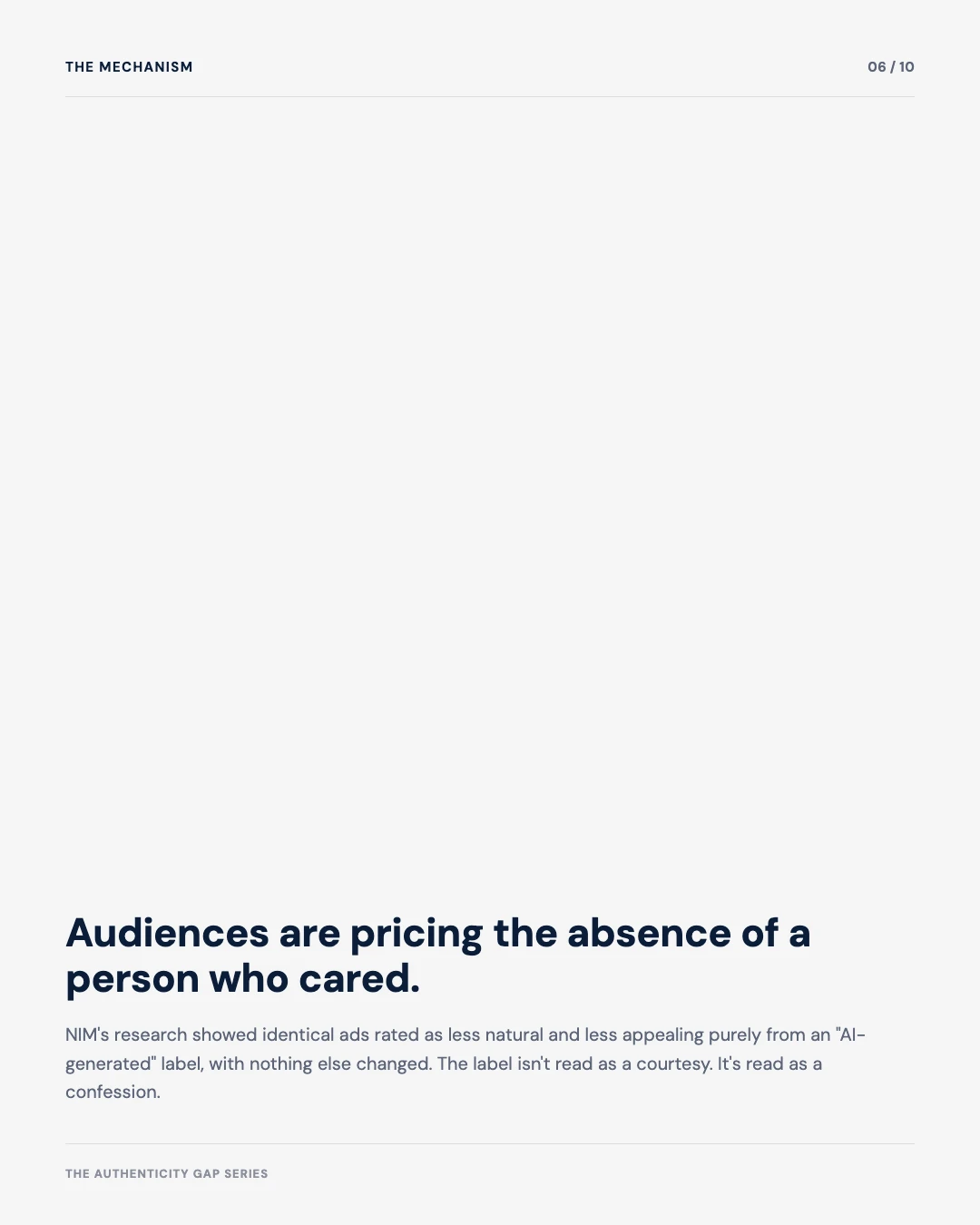
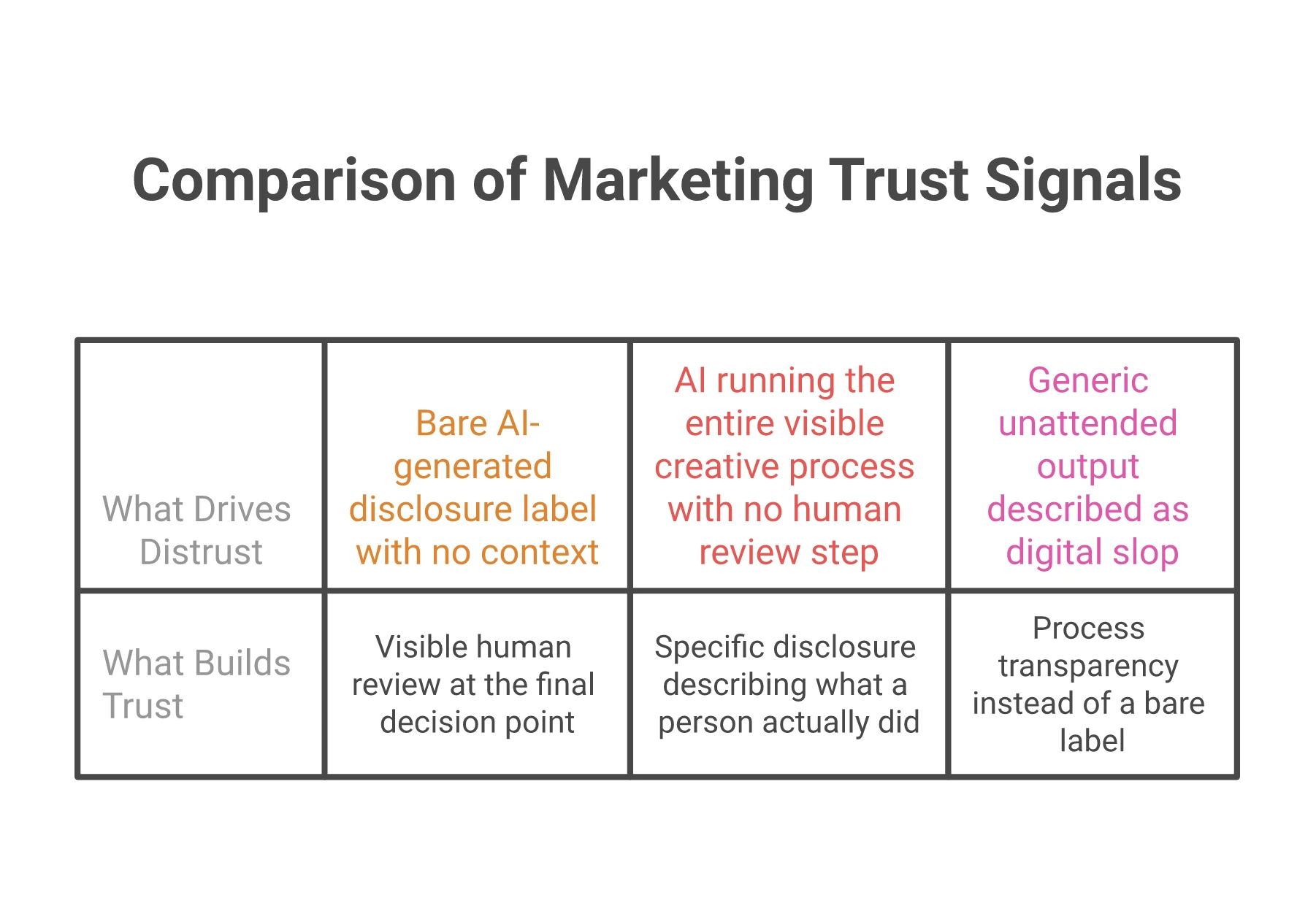
Disclosure is where the intuitive fix runs into the data. The Nuremberg Institute for Market Decisions ran the comparison directly: 1,000 participants across the US, UK, and Germany were shown identical product ads, some labeled as AI-generated and some not. The labeled version was rated as less natural, less appealing, and less useful, purely from the label, since the underlying content hadn’t changed at all. Only 25% of NIM’s participants believed they could reliably recognise AI-generated content in the first place, and just 20% said they trust AI itself. Against that low baseline of trust, a disclosure label doesn’t read as transparency. It reads as the thing the audience was already suspicious of, confirmed.
Klaviyo and Datalily’s December 2025 survey of 8,000 consumers across eight markets found the same pattern at scale: only 7% said visible AI-generated marketing content makes them trust a brand more, while 31% said it makes them trust the brand less. Emplifi’s April 2026 survey of over 1,600 US and UK consumers, run with Alchemer, found 91% expect brands to disclose AI use, and separately, 52% would stop buying from a brand entirely after one experience that felt inauthentic. Those two findings sit in tension on purpose: audiences want the disclosure, and the disclosure itself is what a lot of them are punishing.
The pattern industry commentary has settled on calling this is “digital slop,” technically competent creative that reads as generic and unattended, and the objection audiences describe isn’t a technical flaw. It’s the sense that no one with judgment was in the room. A label that says “AI made this” answers a factual question the audience didn’t ask. It doesn’t answer the one they did: did anyone here care enough to check.
Aerie’s “no AI” pledge shows what audiences are rewarding
Aerie’s “100% Aerie Real” campaign, expanded in October 2025 into a pledge to never use AI-generated bodies or people in its marketing, gives the clearest commercial test of the reverse bet. The March 2026 iteration, a 60-second spot in which Pamela Anderson prompts an AI system to generate models and then rejects the result on camera with the line “you can’t prompt this,” ran across paid social and connected TV. Per American Eagle Outfitters’ own investor reporting, Aerie’s comparable sales rose 23% in Q4 2025 against the prior year, alongside a 21% increase in brand awareness after the brand expanded its target audience from ages 18 to 35 up to age 45.
That figure needs the same caution any single company’s reported result deserves: it’s one quarter, tied to a broader repositioning that includes a celebrity partnership and an audience expansion, not a controlled experiment isolating the no-AI pledge as the sole cause. What it does show cleanly is that “made without AI” functions as a marketable claim strong enough for a public company to build a national campaign around it, the same way “organic” and “fair-trade” became purchasing signals once enough of the market treated mass production as a liability rather than a feature. Whether that specific claim, “no AI at all,” stays the winning position or gets replaced by “AI in production, human in judgment” as the more durable version of the same signal is the open question the next two years of data will answer.
What reduces the backlash without giving up AI’s production advantages
None of this requires opting out of AI. It requires being deliberate about which parts of the process stay visible to the audience and which don’t.
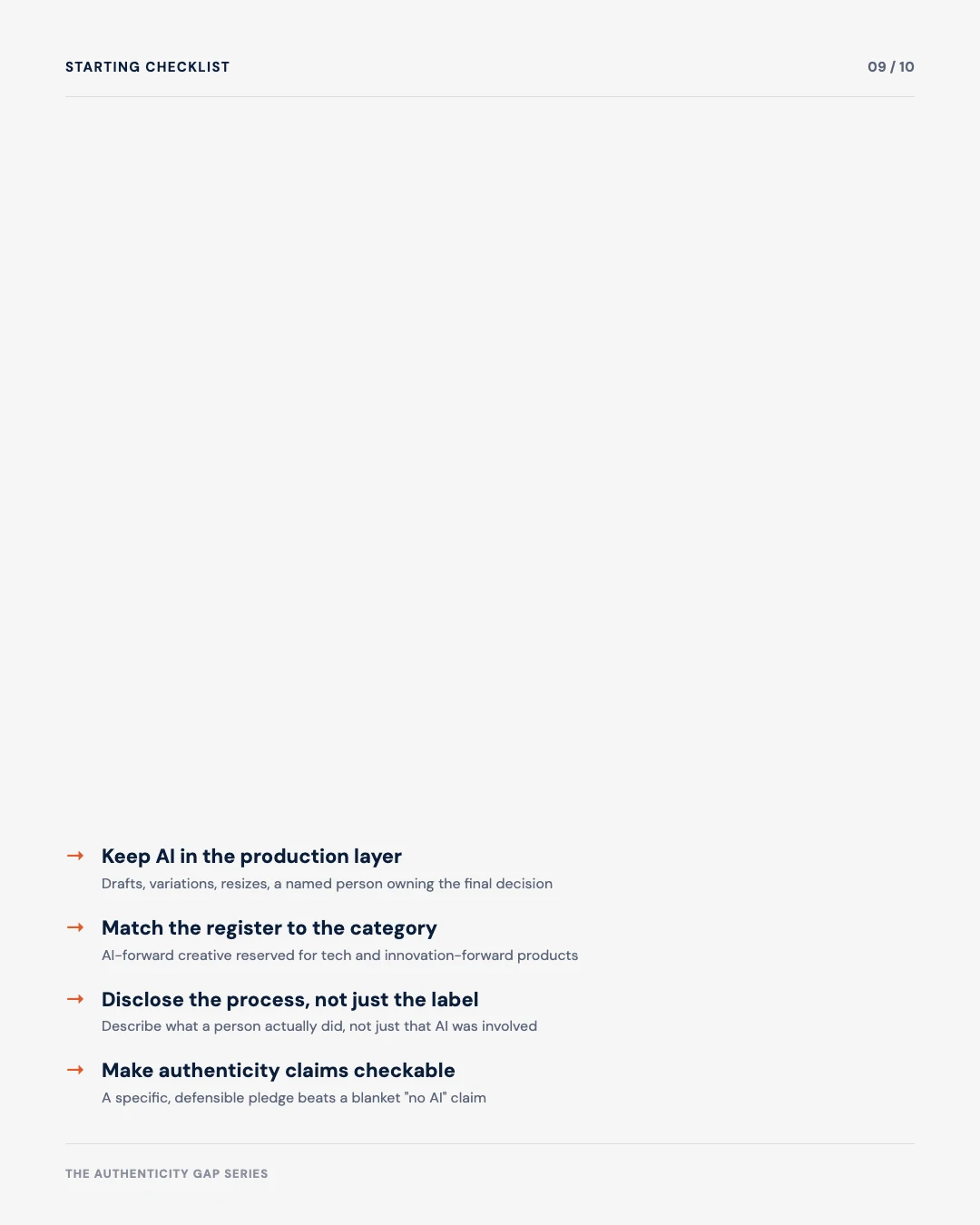
Keep AI in the production layer and the human decision at the point the audience can see. Draft variations, resizes, and first-pass copy are reasonable places for AI to do the volume work. The decision an audience evaluates, the final image, the argument a piece of writing makes, the claim on a package, is where a specific person’s judgment needs to remain visible.
Match the register to the category. NIM’s second experiment found the trust penalty for AI-labeled content was consistently weaker for innovative, tech-forward products than for traditional, emotionally-loaded ones. A cloud software ad and a baby-formula ad are not the same bet, and treating them identically in how openly AI gets used is where several of the strongest negative reactions in this research concentrated.
Disclose the process. NIM’s finding was that a bare label is what triggers the penalty, identical content, worse rating, purely from the tag. Explaining what a person did, directed the brief, selected the final cut, rejected four other versions, gives the audience something to evaluate besides the fact of AI’s involvement. A label states a fact the audience already distrusts. A process description answers the actual question underneath it.
Treat “made by a person” as an earned claim, not a blanket one. Aerie’s pledge works because it’s specific and checkable. A brand that claims “no AI” while using it anywhere in the pipeline is building the exact kind of discoverable gap that turns a trust asset into a bigger story than the AI use would have been on its own.
Keep the human layer fast and visible where it counts most. Emplifi found 84% of consumers consider rapid response essential in customer care, and 63% cite user-generated content, other people’s unscripted reactions, as a source of authenticity brands can’t manufacture. Both are cheaper trust-builders than any amount of AI-content optimisation, and neither requires touching the creative pipeline at all.
| Discipline | What good looks like | What to avoid |
|---|---|---|
| Where AI sits in the pipeline | Drafts, variations, and resizes, with a named person owning the final decision | AI-generated output shipped as the finished creative with no visible review step |
| Category fit | AI-forward creative reserved for tech and innovation-forward products | The same AI-heavy approach applied to emotionally-loaded or traditional categories |
| Disclosure | A specific description of what a person did: directed, selected, rejected alternatives | A bare “AI-generated” label with no context for what human judgment was applied |
| Authenticity claims | A checkable, specific pledge the brand can defend if questioned | A blanket “no AI” claim that isn’t true everywhere in the pipeline |
| Human-facing layer | Fast customer-care response and genuine user-generated content | Treating AI-content polish as a substitute for a responsive human presence |
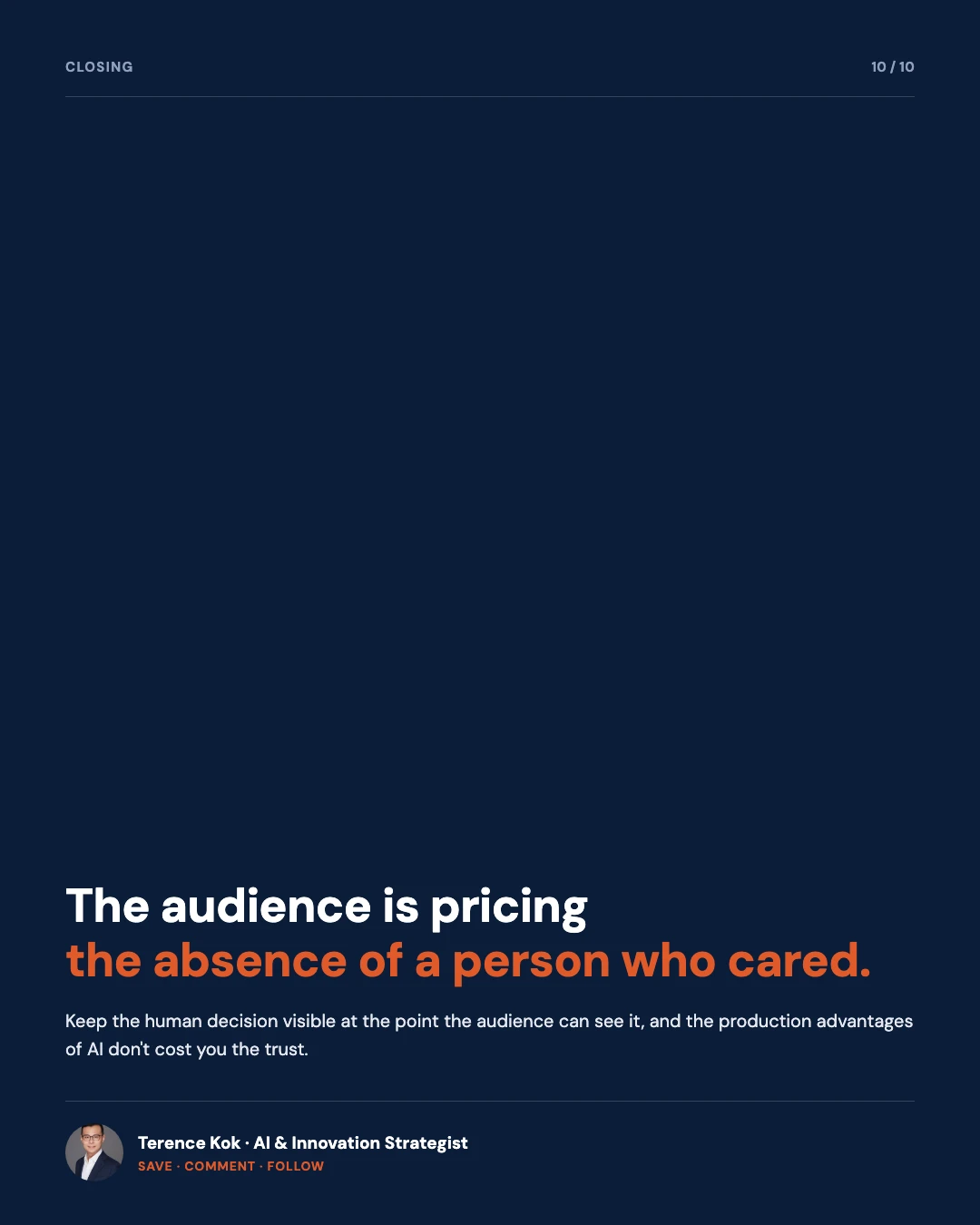
The audience is pricing the absence of a person who cared
The 37-point gap between what executives believe and what audiences report isn’t a communications problem that a better disclosure label fixes. It’s a judgment gap: the industry keeps testing whether audiences will tolerate AI-made content, when the research keeps answering a different question, whether anyone with actual judgment was involved in making it. Aerie’s bet that “no AI” is worth a national campaign, and NIM’s finding that a bare AI label makes identical content trust worse, are two sides of the same result. Audiences can’t always tell what’s AI-made. They can tell when nobody bothered to check.
Evidence & Methodology
Three of these four numbers are controlled survey findings. The fourth, Aerie’s sales lift, is a real reported figure tangled up with other changes happening at the same time. Worth knowing which is which before you cite either one to your own board.
| Claim | Source | Grade |
|---|---|---|
| 82% of executives believe Gen Z and Millennial consumers feel positive about AI-made ads, versus 45% who do | IAB 2026, 505 consumers and 104 executives surveyed | Measured |
| A bare “AI-generated” label makes identical content rate as less trustworthy | NIM, controlled experiment, 1,000 participants | Measured |
| 31% say visible AI content makes them trust a brand less, versus 7% who trust it more | Klaviyo/Datalily, 8,000 consumers, December 2025 | Measured |
| Aerie’s comparable sales rose 23% in Q4 2025 after its no-AI-people pledge | American Eagle Outfitters investor reporting | Correlational |
Sources
- Interactive Advertising Bureau. (2026). The AI Ad Gap Widens: Why Young Consumers Aren’t Yet Buying Into Gen AI Ads.
- Emplifi. (2026, April 15). Emplifi Survey: 93% of Consumers Say Authentic Brand Engagement Builds Trust as Marketers Increasingly Rely on AI-Powered Workflows. Digital Authenticity in the Age of AI report, with Alchemer.
- eMarketer. (2026). Shoppers Aren’t Impressed by AI-Generated Marketing, citing Klaviyo/Datalily (December 2025) and Billion Dollar Boy survey data.
- Nuremberg Institute for Market Decisions. Transparency Without Trust: Consumer Attitudes Toward AI-Generated Marketing Content.
- Marketing Dive. (2026). How Aerie Is Pushing Back Against AI Content With Pamela Anderson, citing American Eagle Outfitters investor reports.
- Multiply. AI Advertising Backlash, Explained.
If you’re weighing where AI should sit in your own creative or marketing pipeline, and where a human decision needs to stay visible, that’s exactly the kind of call my consulting work helps sequence.
Was this useful?