

Listen to this article
Jump to a section
In this article
Executive Summary
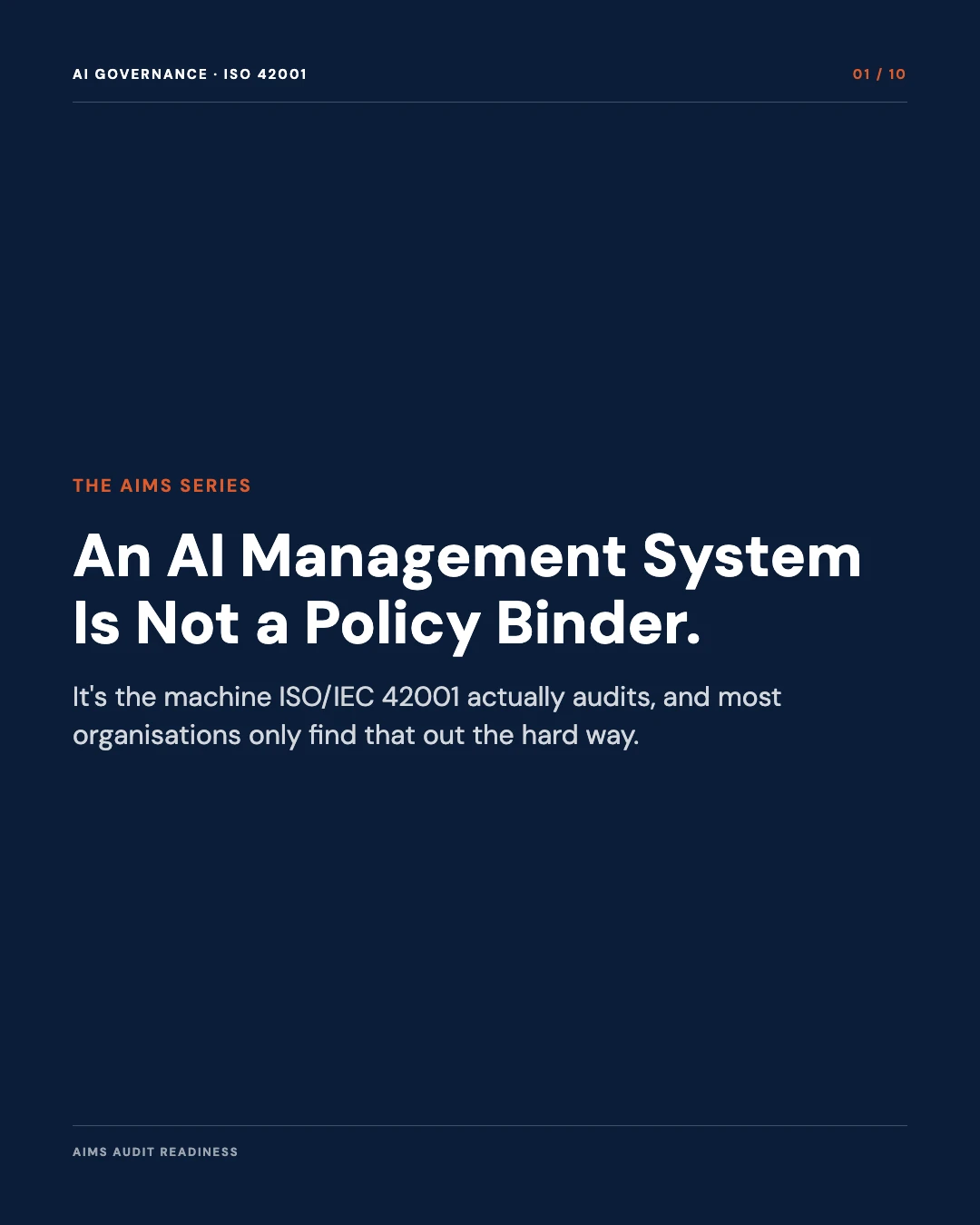
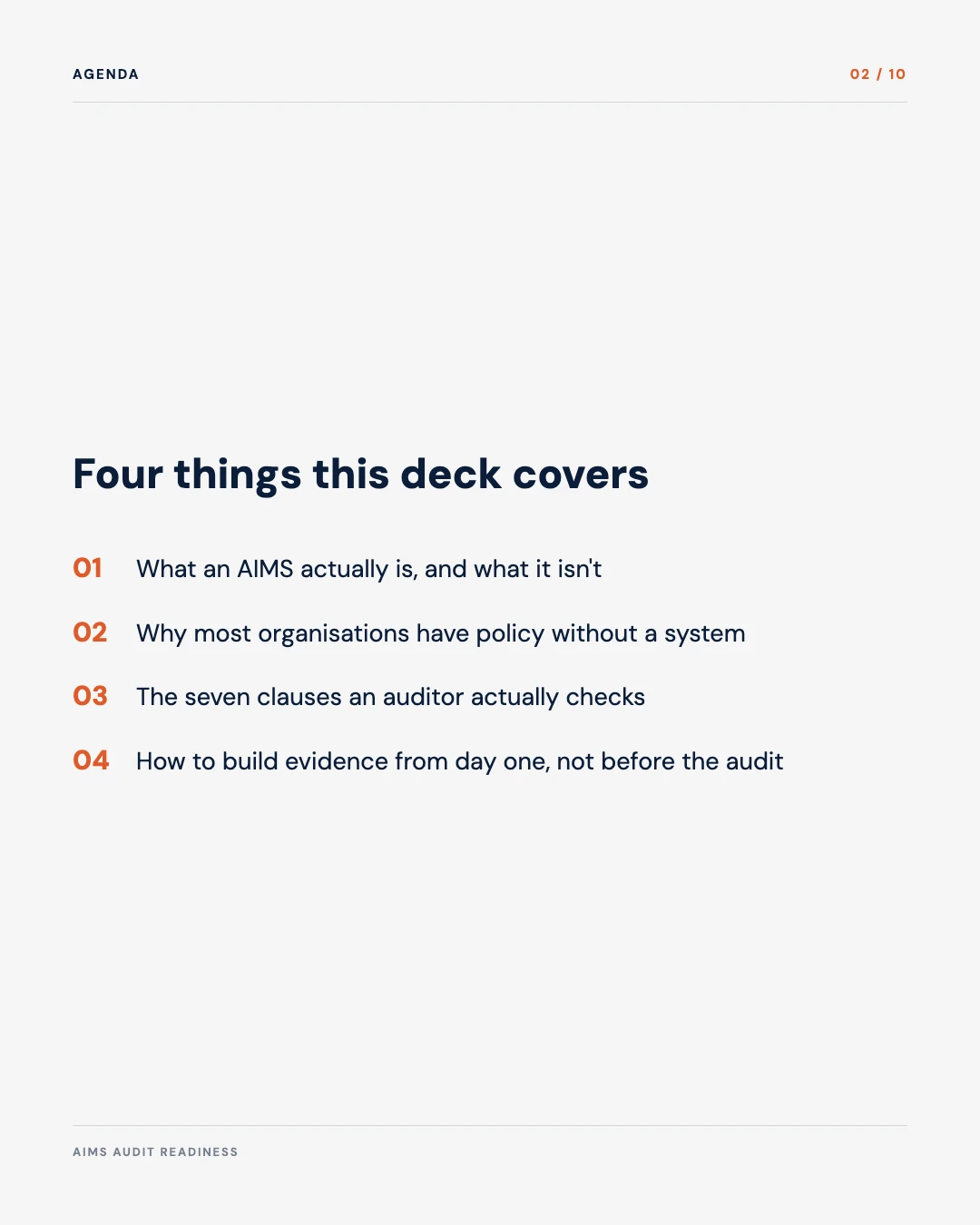
An AI management system, AIMS for short, is not the AI policy your legal team wrote. It’s the working system ISO/IEC 42001 certifies: seven clauses running from understanding your context to closing the loop on nonconformities, a set of Annex A controls, and a statement of applicability an auditor can pressure-test against real evidence. Most organisations that say they have “AI governance” have the policy and not the system behind it, which is exactly what an auditor finds out first. Building the evidence trail from the day a use case starts, rather than reconstructing it the month before certification, is the difference between an audit that takes a week and one that takes a quarter.
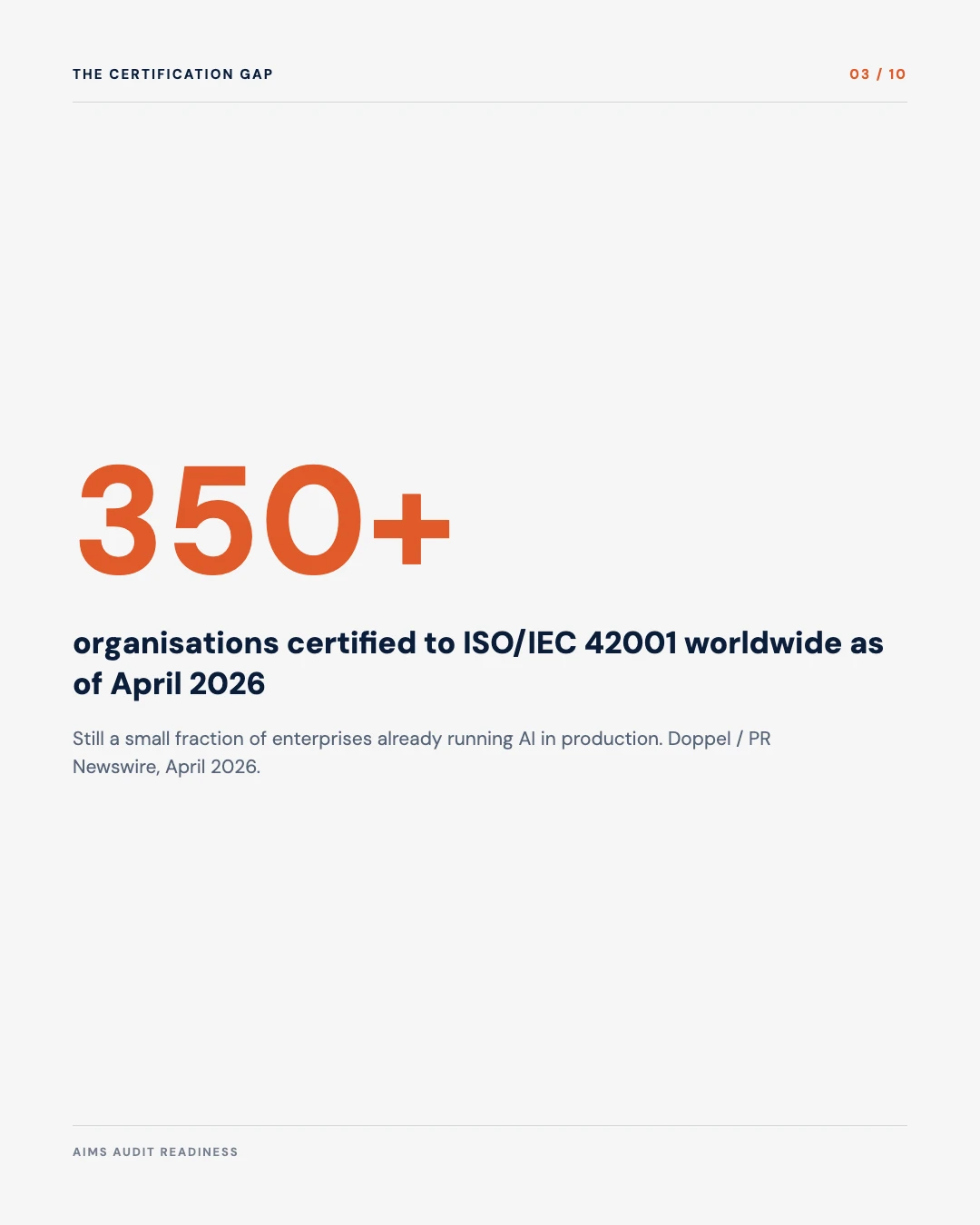
350+
organisations certified to ISO/IEC 42001 worldwide as of April 2026, still a small fraction of enterprises using AI, Doppel / PR Newswire
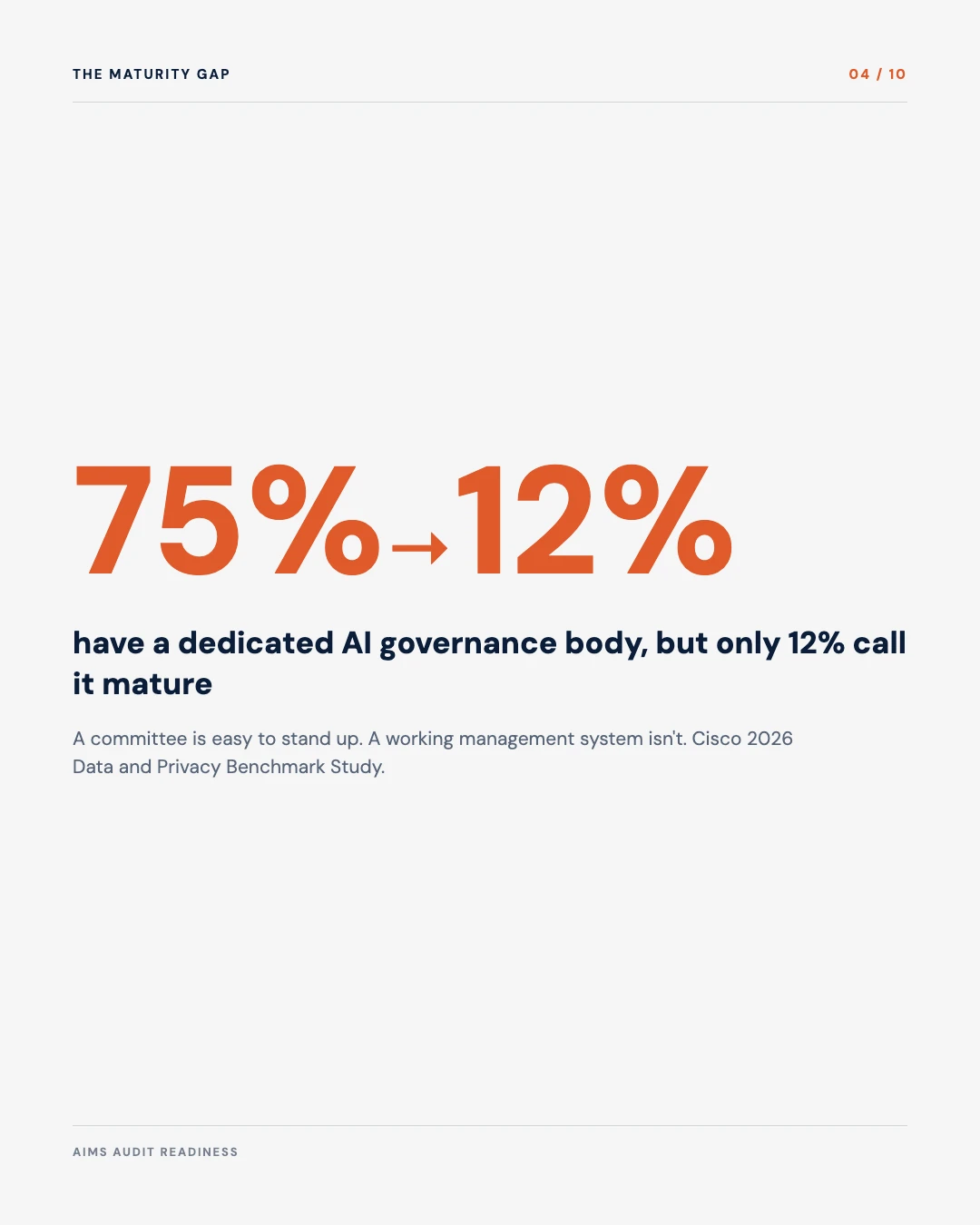
75% → 12%
of organisations have a dedicated AI governance body, but only 12% call it mature, Cisco 2026 Data and Privacy Benchmark Study
69%
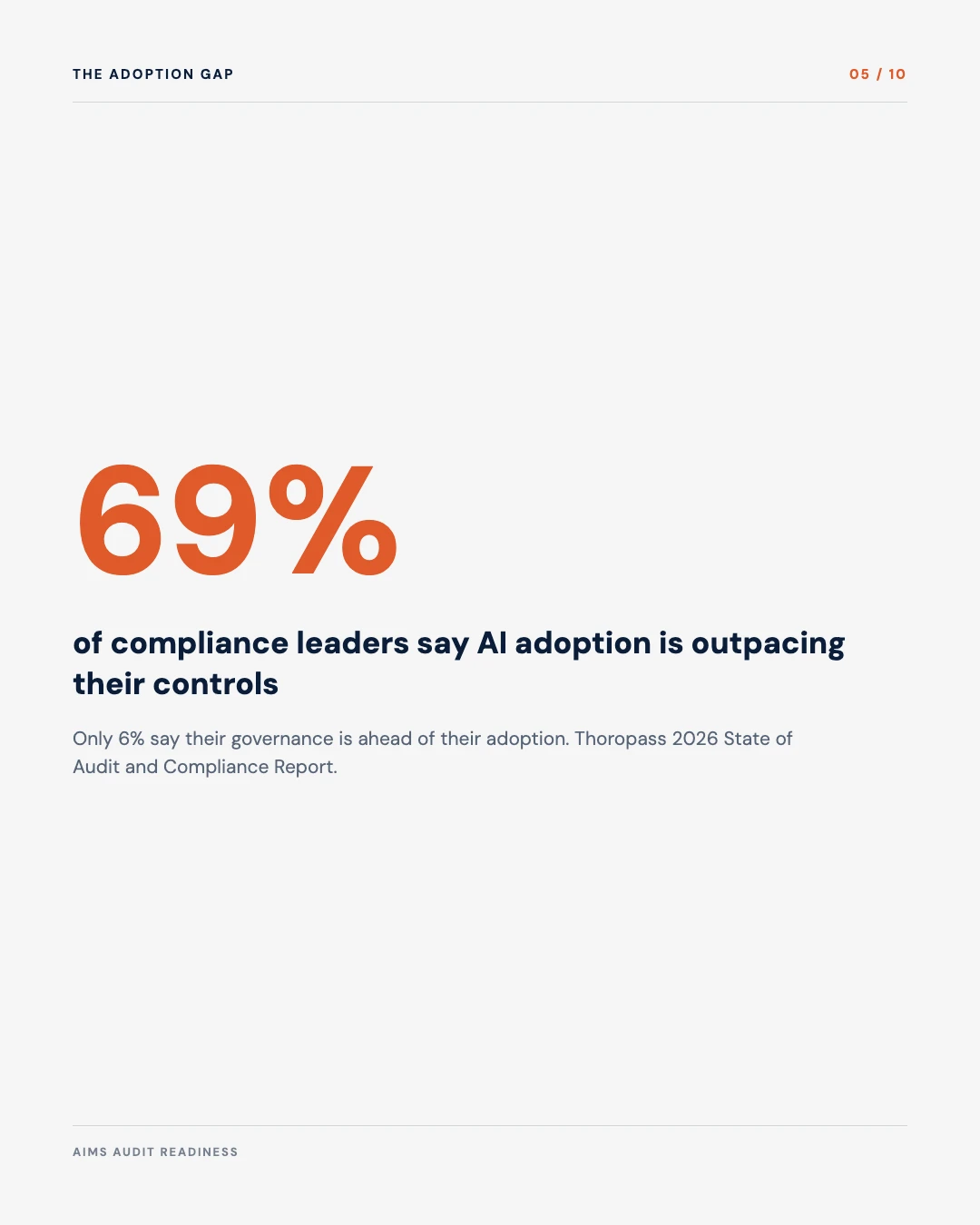
of security and compliance leaders say AI adoption is outpacing their compliance controls, Thoropass 2026 State of Audit and Compliance Report
Dec 2027
when EU AI Act Article 9 risk-management obligations become enforceable for stand-alone high-risk systems, after the 2026 Digital Omnibus delay
Core conclusions
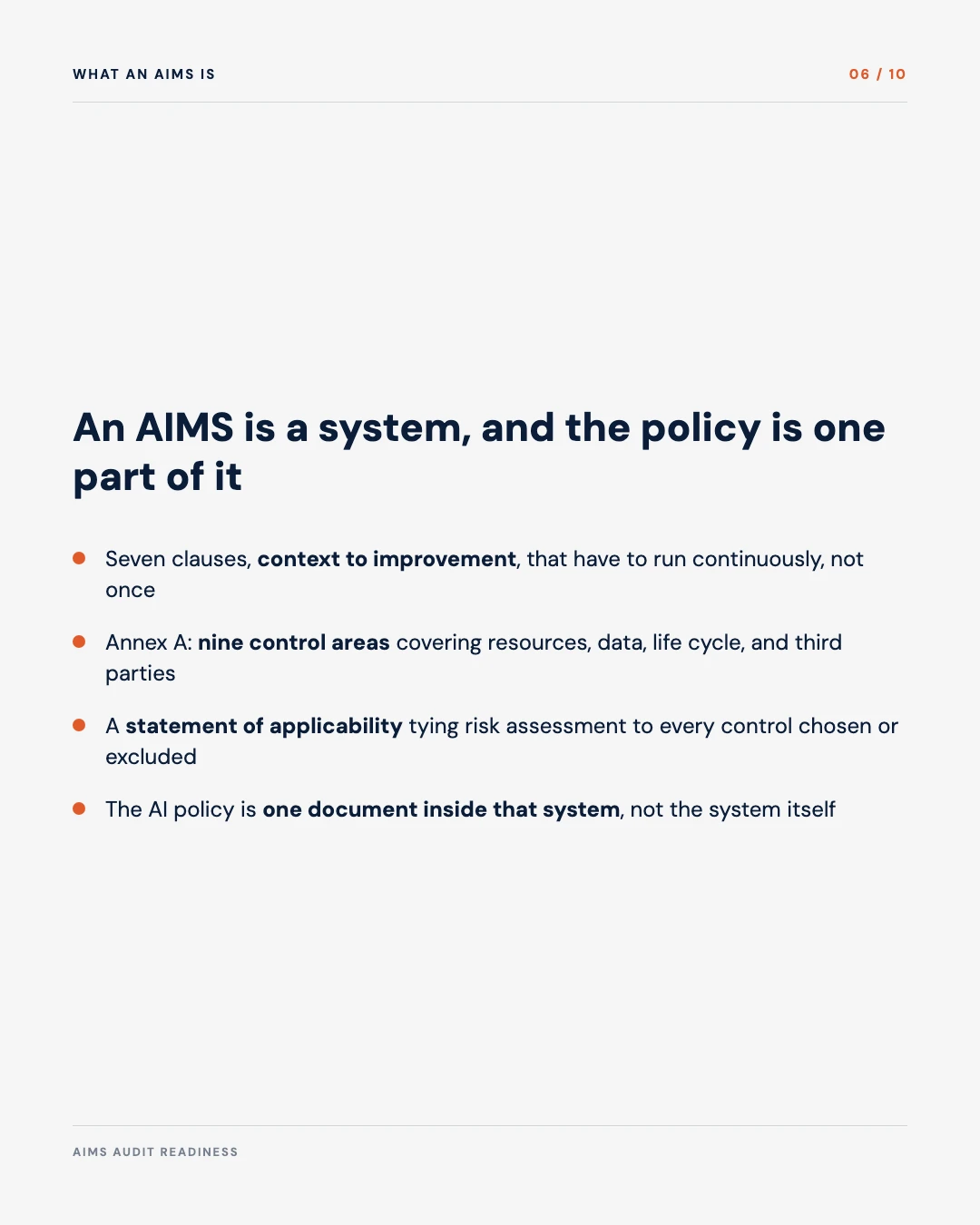
- An AIMS is the clause 4 to clause 10 management system plus Annex A controls and a statement of applicability. The AI policy is one artefact inside it, not the whole thing.
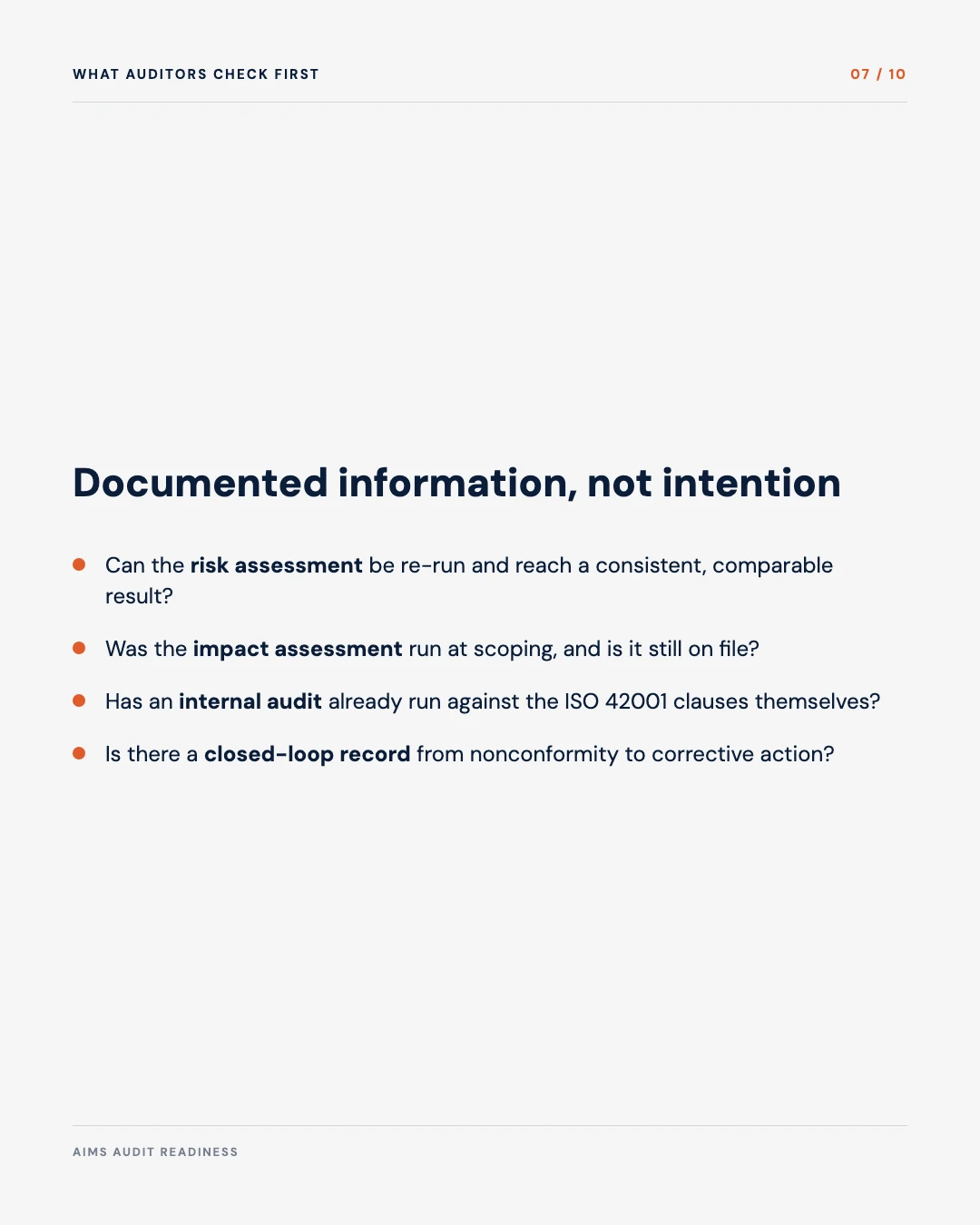
- Most of what an ISO 42001 auditor checks first is documented information, not intention: risk assessments, impact assessments, competence records, internal audit results, management review minutes.
- Generating that evidence from the point a use case starts is materially cheaper than reconstructing a paper trail in the weeks before a certification audit.
What an AIMS is, and how to make it audit-ready, ten slides
Save it, share it, or send it to whoever thinks the AI policy document is the finish line.
ISO 42001 certifies a management system
The standard’s own definition is precise about this. A management system is “a set of interrelated or interacting elements of an organization to establish policies and objectives, as well as processes to achieve those objectives.” An AI management system takes that same structure and points it at AI: the organisation has to “establish, implement, maintain, continually improve and document an AI management system, including the processes needed and their interactions.” A policy is a single artefact inside that system. The system is the whole loop, planning, doing, checking, and improving, that the policy is supposed to sit on top of.
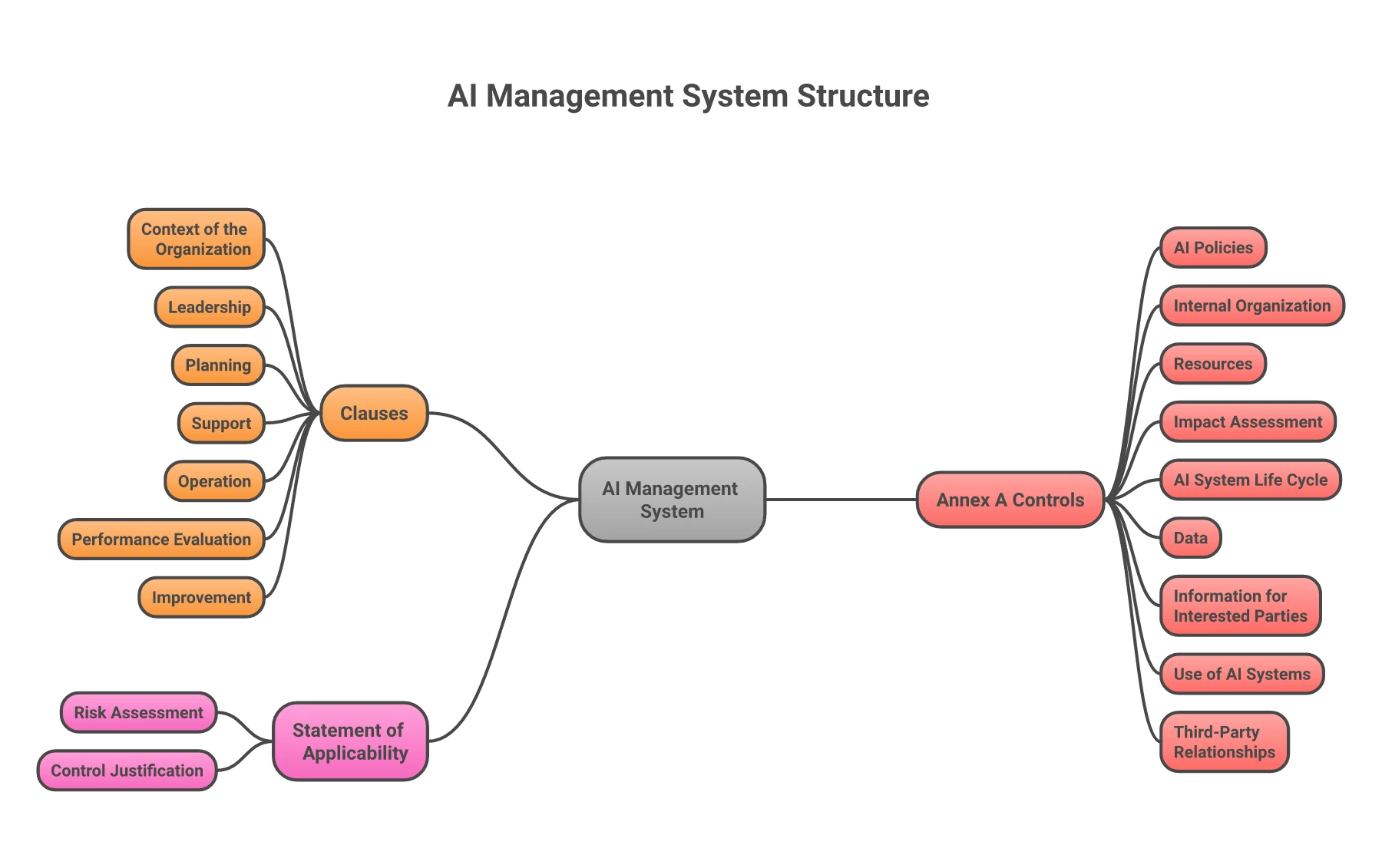
That loop is the seven clauses that make up the certifiable core of ISO/IEC 42001: context of the organization, leadership, planning, support, operation, performance evaluation, and improvement. Sitting alongside them is Annex A, a normative set of control objectives across nine areas, from AI policies and internal organisation through resources, impact assessment, the AI system life cycle, data, information for interested parties, responsible use, and third-party relationships. The document that ties the two together is the statement of applicability: a record of every Annex A control the organisation includes or excludes, with a justification for each decision. That’s the artefact an auditor typically asks to see first, because it’s the map of everything else they’re about to go check.
None of this is a document a policy team can write in an afternoon. It’s a system that has to keep producing evidence, month after month, that it’s running.
Free tool
AI Management System Checklist
Walk all seven AIMS clauses plus the statement of applicability, the same order and the same gaps an ISO 42001 auditor checks first.
Most organisations have AI policies without an AI management system behind them
The gap between having an AI policy and having a functioning AIMS shows up clearly in the data. Cisco’s 2026 Data and Privacy Benchmark Study, surveying over 5,200 privacy and security professionals across 12 markets, found three in four organisations already have a dedicated AI governance body in place. Only 12% describe that structure as mature. A governance committee is easy to stand up. A management system that produces repeatable risk assessments, documented impact assessments, and closed-loop corrective actions is a different order of investment, and most organisations haven’t made it yet.
Thoropass’s 2026 State of Audit and Compliance Report, based on a survey of more than 500 security and compliance professionals, puts a number on the same gap from the other direction: 69% say AI adoption inside their organisation is outpacing their compliance controls, and only 6% say their AI governance is more advanced than their AI adoption. Certification volume tells the same story. As of April 2026, Doppel’s ISO 42001 certification announcement noted it was among the first 350 organisations worldwide to achieve it, a small number set against how many enterprises are already running AI in production.
The regulatory pressure behind this is not going away, even after 2026’s delays. The EU AI Act’s Digital Omnibus pushed the compliance deadline for stand-alone high-risk AI systems (Annex III) from August 2026 to 2 December 2027, and for AI embedded in regulated products (Annex I) to 2 August 2028. Article 9 of the Act requires a continuous, systematic risk management process across the AI system’s life cycle, identification, analysis, evaluation, control, and post-market monitoring, which is close to a description of ISO 42001’s own clause 6 and clause 8 requirements. An AIMS built properly to the ISO standard is the most direct path most organisations have to demonstrating that obligation when the deadline arrives.
Free tool
Board AI Oversight Checklist
Clause 5.3 requires AI roles, responsibilities, and authorities to be assigned and communicated. Check who owns each one before an auditor asks.
Seven clauses run from understanding context to closing the loop on nonconformities
The clause structure is the same “harmonised” shape used across ISO management-system standards, which is deliberate, it’s built to sit alongside an existing ISO 27001 or quality system. What’s specific to AI is what each clause requires you to produce.
| Clause | What it covers | What an auditor checks first |
|---|---|---|
| 4. Context of the organization | Internal and external issues, interested parties, AIMS scope | Does a documented scope statement exist, and does it match what’s running in production? |
| 5. Leadership | AI policy, roles and responsibilities, top management commitment | Is the AI policy available as documented information, and has it been communicated? |
| 6. Planning | AI risk assessment, AI risk treatment, AI system impact assessment, AI objectives | Can the risk assessment process be re-run and produce consistent, comparable results? |
| 7. Support | Resources, competence, awareness, communication, control of documented information | Is there training or competence evidence for the people making AI risk decisions? |
| 8. Operation | Operational planning and control, ongoing risk and impact assessment execution | Were risk and impact assessments performed at the planned intervals? |
| 9. Performance evaluation | Monitoring, measurement, internal audit, management review | Has an internal audit run against the ISO 42001 clauses themselves? |
| 10. Improvement | Continual improvement, nonconformity and corrective action | Is there a closed-loop record connecting a nonconformity to the corrective action taken and its review? |
Every row in this table is a documented-information requirement, not a discretionary one. An auditor working through Clause 9.2 is explicitly checking whether Clause 6 through 8 happened, not whether they were planned to happen.
Free tool
Agent Risk Assessment Matrix
Clause 6 asks for a risk assessment per AI system. Rate each agent on autonomy and consequence, and print a register with the controls and the Annex A reference each one satisfies.
Documented information is what an auditor asks to see
Clause 7.5 defines documented information broadly: the management system and its processes, information created so the organisation can operate, and evidence of results achieved. In practice that third category, the records, is where audits succeed or fail, and it’s also where most organisations underinvest relative to the policy document itself.
Glocert International’s review of common ISO 42001 nonconformities lays out where the gaps appear in practice. AI system impact assessments aren’t conducted for every system in scope, or don’t address impacts on the people affected by them. Personnel responsible for AI governance lack documented evidence of AI-specific competence. The statement of applicability doesn’t address every Annex A control, or excludes controls without adequate justification. Management reviews either don’t happen on schedule or skip required inputs. Internal audits get run, but not against the ISO 42001 clauses themselves, or the auditors aren’t independent, or findings never get tracked to closure. And AI services brought in from third parties, an API, a SaaS tool with an embedded model, never make it into the risk assessment or supplier management process at all.
None of these are exotic failures. They’re the predictable result of treating the AIMS as a policy-writing exercise.
Free tool
AI Trust & Governance Assessment
Score where your organisation stands on AI risk assessment, impact assessment, and documented evidence, before an auditor scores it for you.
Evidence generated from day one is cheaper than evidence reconstructed before an audit
The practical difference between an easy audit and a hard one is almost never the standard’s requirements. It’s whether the organisation was generating the required evidence continuously or trying to manufacture a year of it in the six weeks before the certification body arrives.
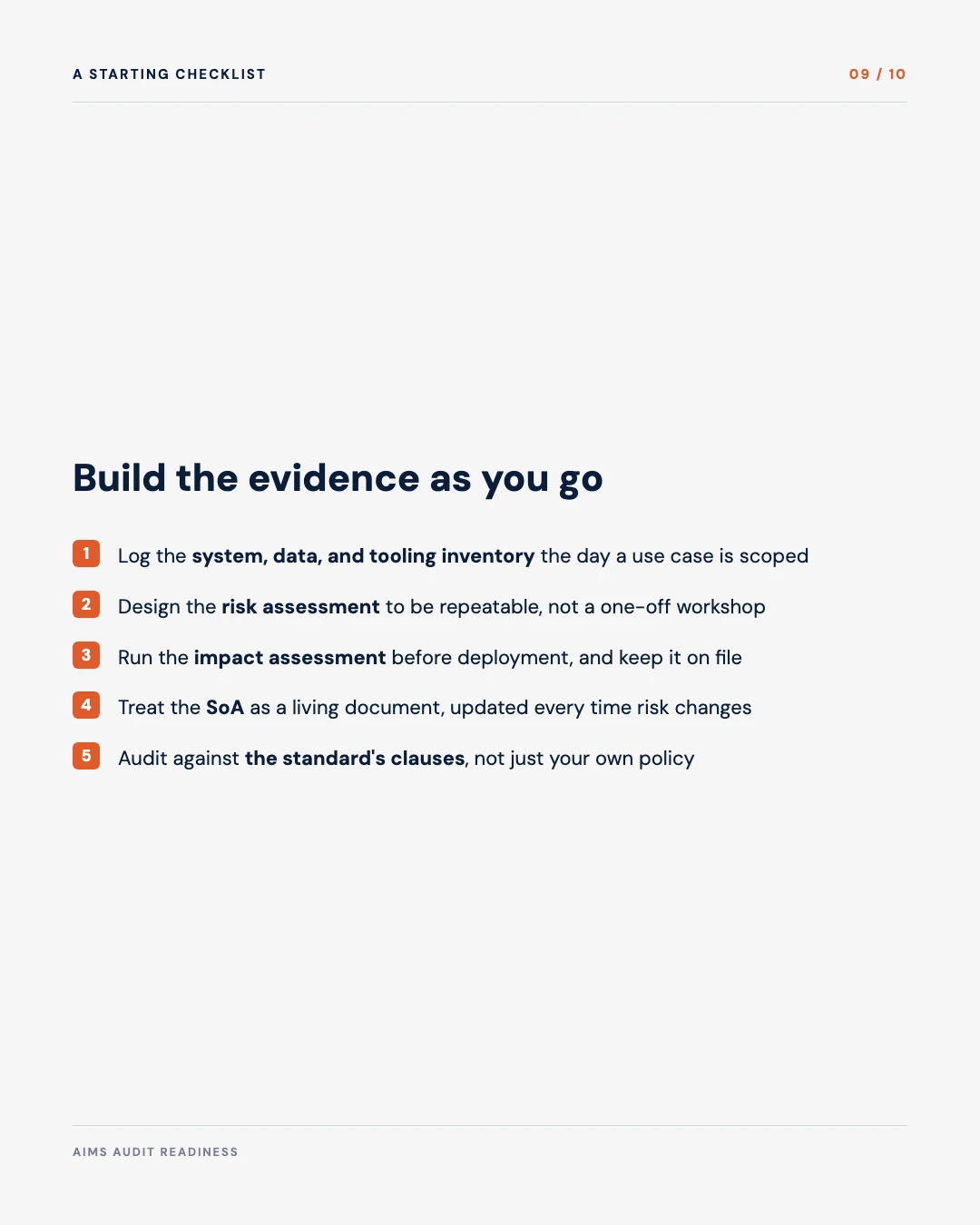
Start with resource documentation. Annex A.4 requires the organisation to document the data, tooling, computing, and human resources behind each AI system. That’s a five-minute exercise at the point a use case is scoped and a difficult one to reconstruct eighteen months later, once the original team has moved on and the data sourcing has been forgotten. Build it into the intake step for every new AI use case instead of into a pre-audit scramble.
Design the AI risk assessment process for repeatability from the start. Clause 6.1.2 explicitly requires the process to be “designed such that repeated AI risk assessments can produce consistent, valid and comparable results.” An ad hoc workshop that reaches a good answer once but can’t be re-run the same way a year later technically satisfies nothing, because the standard is testing the process, not the individual answer. The same applies to the AI system impact assessment under 6.1.4 and A.5: run it when a system is scoped, not after it’s already deployed, document the result, and retain it for a defined period.
Start the internal audit programme early, and run it against the ISO 42001 clauses themselves. Clause 9.2 requires evidence that internal audits happened at planned intervals and were reported to relevant managers, and a certification body will expect to see at least one completed internal audit cycle before a stage 2 audit. Auditing against your own internal AI policy instead of against the standard’s actual clauses is one of the most common findings Glocert flags, and it’s entirely avoidable by scoping the audit criteria correctly from the first cycle.
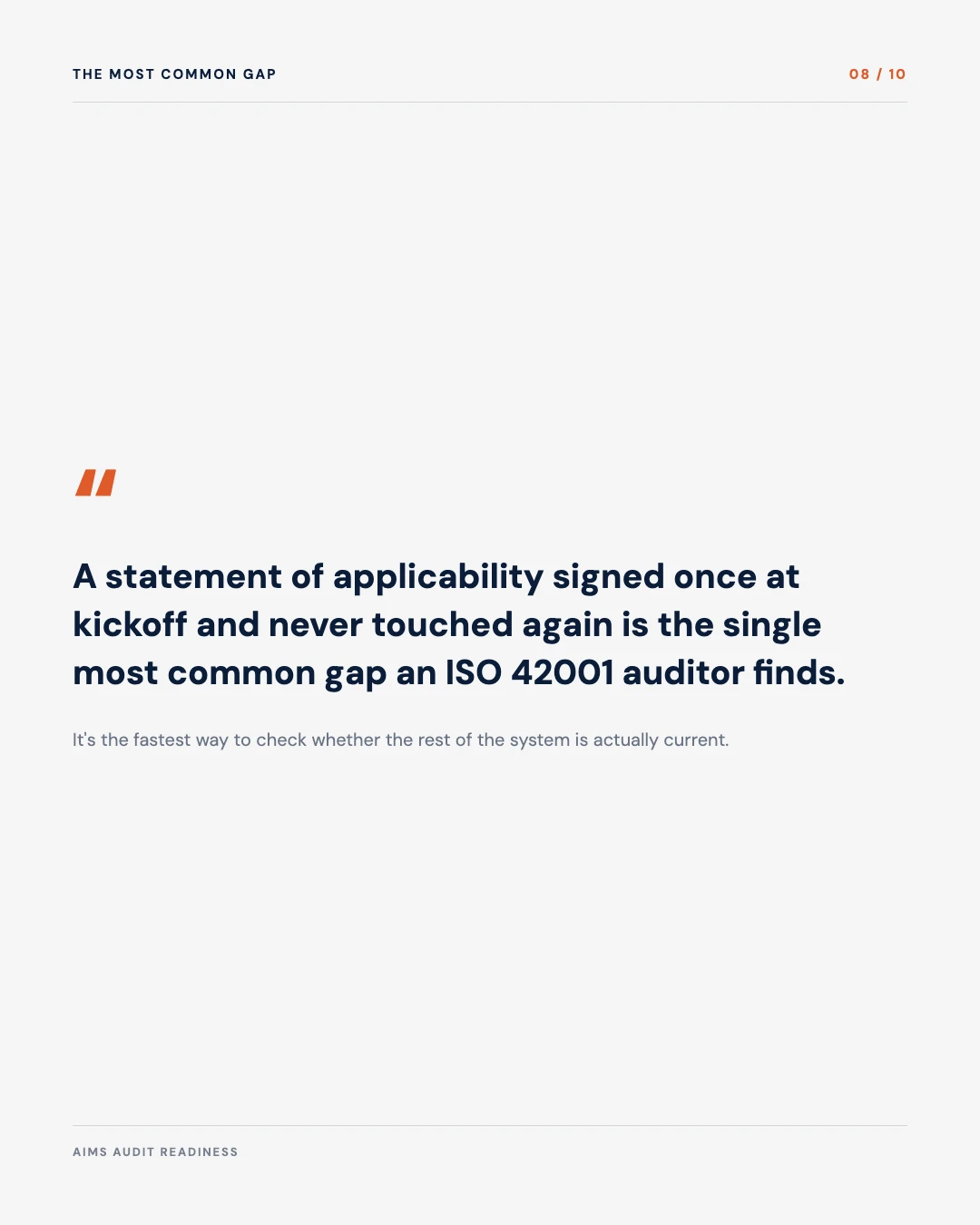
And treat the statement of applicability as a living document, not a kickoff deliverable. Every time a risk assessment identifies something new, every time a new AI system enters scope, the SoA needs to be revisited. A document signed once at project kickoff and never touched again is the single most common gap an ISO 42001 auditor finds, because it’s the fastest way to check whether the rest of the system is current.
A practical starting checklist
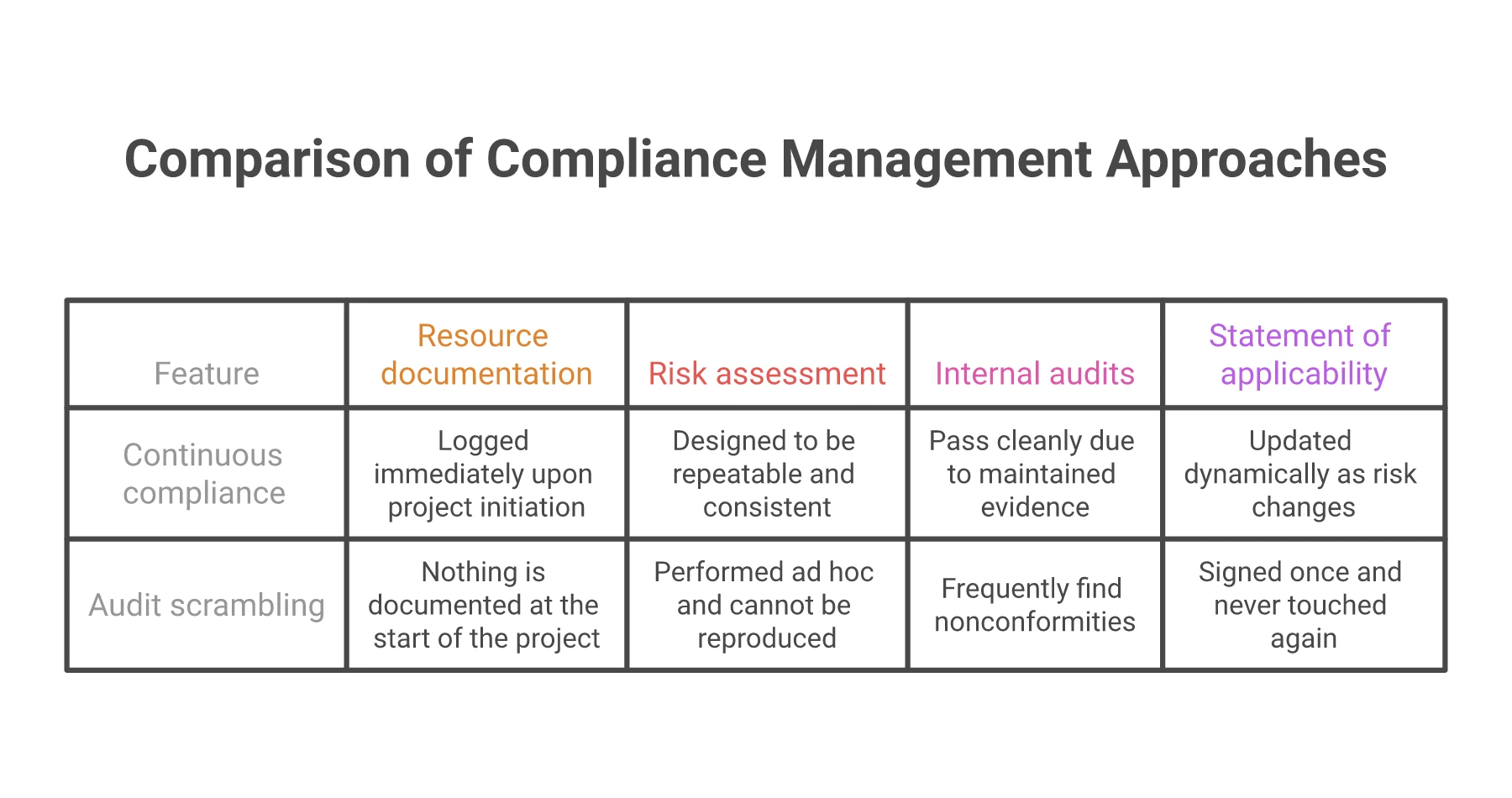
None of this requires a compliance department. It requires treating the AIMS as something that produces evidence continuously, not a certificate to earn once and file away.
| Discipline | What good looks like | What to avoid |
|---|---|---|
| Resource documentation | AI system inventory, data, tooling, and compute resources logged the day a use case is scoped | Reconstructing the system inventory from memory the week before the audit |
| AI risk assessment | A repeatable process producing consistent, comparable results on a second run | An ad hoc workshop that can’t be re-run the same way twice |
| AI system impact assessment | Run at scoping, documented, retained on a defined schedule | Only performed after deployment, if it happens at all |
| Statement of applicability | A living document updated every time risk assessment finds something new | A one-time PDF signed at kickoff and never touched again |
| Internal audit | Run against the ISO 42001 clauses themselves, by an independent, trained auditor | Run against your own internal policy instead of the standard’s requirements |
The management system has to be run
Every clause in ISO 42001 exists because a policy document, on its own, tells an auditor nothing about whether the organisation manages AI risk. A management system does, because it’s built to keep generating the evidence that proves it. Context, leadership, planning, support, operation, performance evaluation, improvement: none of it is optional, and none of it is a one-time project with a finish line, because clause 10.1 requires continual improvement for as long as the AIMS exists.
The organisations that clear a certification audit without a scramble won’t be the ones who wrote the sharpest AI policy. They’ll be the ones who treated every risk assessment, every impact assessment, and every internal audit as a record worth keeping from the first day it was performed.
Evidence & Methodology
Three of these four numbers are survey findings from named research firms. The fourth is my own conclusion, drawn from what auditors are documented as flagging, not a survey result.
| Claim | Source | Grade |
|---|---|---|
| 350+ organisations certified to ISO/IEC 42001 worldwide as of April 2026 | Doppel, via PR Newswire | Reported |
| 75% of organisations have a dedicated AI governance body, but only 12% call it mature | Cisco 2026 Data and Privacy Benchmark Study, 5,200+ professionals surveyed | Measured |
| 69% of compliance leaders say AI adoption is outpacing their compliance controls | Thoropass 2026 State of Audit and Compliance Report, 500+ professionals surveyed | Measured |
| Evidence generated continuously is cheaper than evidence reconstructed before an audit | My own reading of Glocert’s documented nonconformity list, not a controlled comparison | My call |
Sources
- International Organization for Standardization / International Electrotechnical Commission. (2023). ISO/IEC 42001:2023, Information technology — Artificial intelligence — Management system.
- Doppel. (2026, April 13). Doppel Among First 350 Organizations Worldwide to Achieve ISO 42001 Certification for AI Governance Standards. PR Newswire.
- Cisco. (2026). AI Fuels Surge in Data Privacy Investments and Redefines Governance, 2026 Data and Privacy Benchmark Study.
- Thoropass. (2026, March 25). Thoropass Releases 2026 State of Audit And Compliance Report: AI Emerges as the Top Compliance and Audit Risk. Business Wire.
- Gibson Dunn. (2026). EU AI Act Omnibus Agreement — Postponed High-Risk Deadlines and Other Key Changes.
- European Union. Article 9: Risk Management System, EU Artificial Intelligence Act.
- Glocert International. Common ISO 42001 Nonconformities & How to Fix Them.
The AI Governance & ROI Executive Programme builds an AIMS your own organisation can run, clause by clause, evidence by evidence, before a certification body tests it. Details are on the workshops page.
Was this useful?