What Carl Sagan would ask about AI.
Ten essays that set his writing on machines, minds and the future beside the AI debate of 2026.
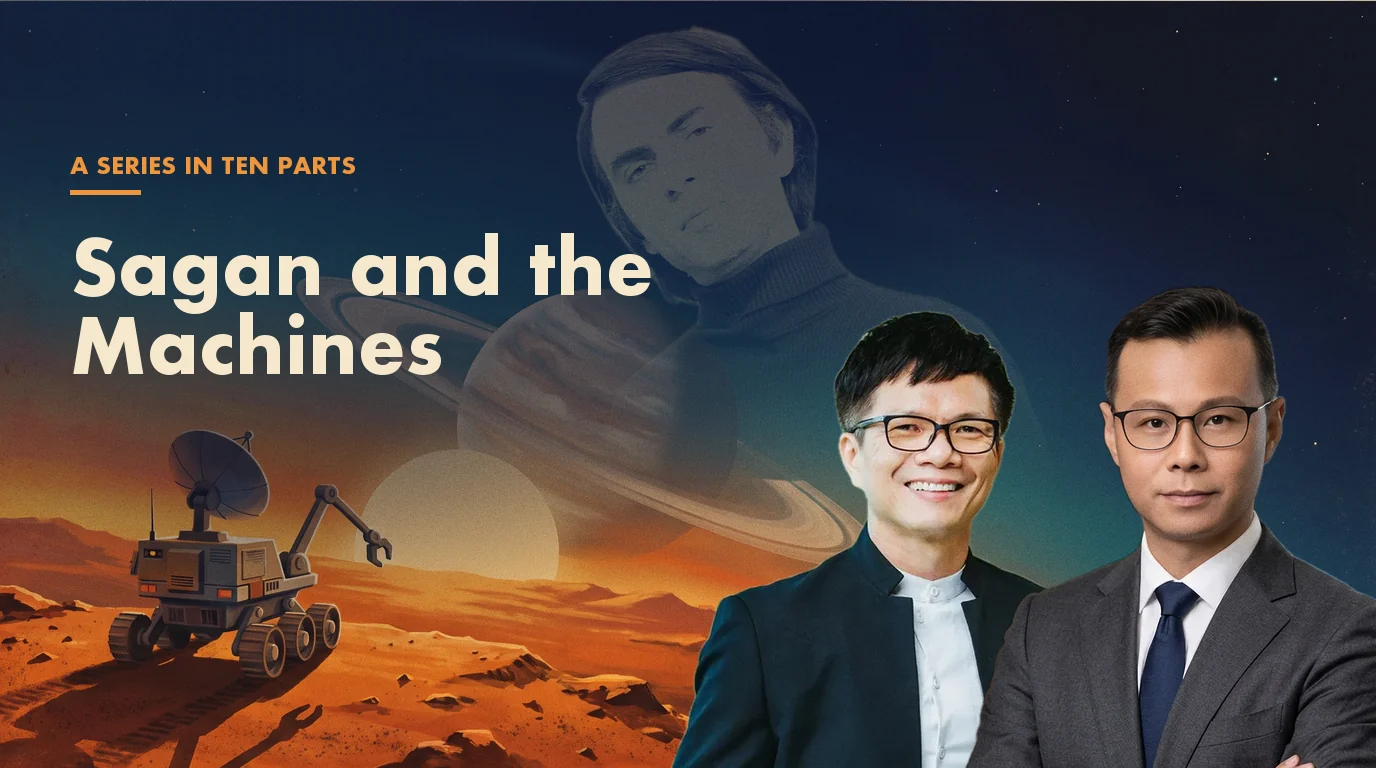
Carl Sagan is remembered for the stars. In the 1970s and again in the 1990s he also wrote, more than most people realise, about machines that think: a chapter defending robots, a book on how brains evolved to store information, and a late warning about a society that depends on technology nobody understands. He did not live to see a language model.
Each part takes one of his ideas, quotes him exactly, and puts it up against the AI debate of 2026. I give his case, then the strongest objection I can find, then a verdict. Sometimes he was right early. Sometimes the world has moved past him. Michael Low and I write it together, and we would like to honour Sagan by taking him seriously enough to make his wisdom practical, and to disagree where the evidence says we should.
Claims are checked or they are left out.
Sagan is one of the most misquoted writers on the internet. Every quotation here is taken from a page I have read, with the book and chapter named. If I cannot verify a line, I leave it out.
Speculation is labelled as speculation.
He wrote in the 1970s and 1990s. I will say what he knew then, and keep it apart from what I know now.
It is not a eulogy.
Where his optimism has not held, I will say so, and explain why.
Every part ends with something to do.
A question for the board, a test to run or a decision you can make this quarter.
The ten parts
2 of 10 published
The Man Who Wasn’t Afraid of Robots
In 1979 Carl Sagan wrote a chapter defending intelligent machines against what he called speciesism. What he argued, what he got right in the decades since, and where the argument now meets its hardest tests.
What you take away Sagan’s case in his own words, and the questions the rest of the series puts to it.
Read article →Present the lecture →Moving the Goalposts
Every time a machine passes a test of intelligence, the test is redefined. Sagan saw the reflex in 1979. Is it vanity, or is it sometimes right to move the line?
What you take away How to tell a fair new test from a defensive one when you judge an AI system.
Read article →Present the lecture →The Terminal That Listens
Sagan imagined booths where anyone could talk to a patient, non-directive machine therapist. Joseph Weizenbaum, who built ELIZA, was alarmed. Today’s companion bots settle part of the argument.
What you take away What a conversational system owes the person who confides in it, and what to ask before you deploy one.
In progress
Lecture deck published with the article
Memory Outside the Body
The Dragons of Eden traced how life stores information, from genes to brains to libraries. Language models are the newest store outside the brain, and storage has a cost.
What you take away Which memories and skills your organisation should keep inside people.
In progress
Lecture deck published with the article
Robots on Other Worlds
A rover on Mars cannot wait forty minutes for permission. Sagan used that delay to argue for machines that decide for themselves. It is the agent-autonomy question, set on another planet.
What you take away How much autonomy to grant an agent when you cannot supervise it in real time.
In progress
Lecture deck published with the article
Who Meets Us First
If other civilisations are older than ours, the first to reach us may be machines. Sagan’s 1983 reply to Frank Tipler on self-replicating probes asked what a civilisation would build, and what it would fear.
What you take away What the probe argument says about building systems that copy themselves.
In progress
Lecture deck published with the article
The Candle in the Dark
Sagan’s baloney detection kit was written for pseudoscience. Applied to AI claims, it is a way to read a vendor benchmark, a demo or a forecast.
What you take away A short set of tests to run on any AI claim before it reaches a decision.
In progress
Lecture deck published with the article
A Society Nobody Understands
Sagan warned of a society dependent on science and technology in which hardly anyone understands either. AI makes the gap wider, and concentrates the understanding in few hands.
What you take away What AI literacy has to mean for a board, and who holds the knowledge in your organisation.
In progress
Lecture deck published with the article
Who Holds the Button
Sagan’s nuclear-winter work was a warning about decisions that cannot be taken back. Applied to AI in command and control, it asks which decisions must stay with a person.
What you take away A rule for the decisions you will not hand to a machine.
In progress
Lecture deck published with the article
Who Speaks for Earth
The Golden Record, Contact and the closing questions. If we build minds that outlast us, what should they carry, and who should decide?
What you take away What to keep from Sagan’s humility when you decide what to build.
In progress
Lecture deck published with the article
This series is independent. It is not authorised, sponsored or endorsed by the estate of Carl Sagan or by his publishers.

Michael and I both honour Carl Sagan as one of the authors who gave us wisdom early in our lives. We wanted to explore that wisdom and make it practical now, because we are at the event horizon of what is coming, and the questions he asked about machines have stopped being hypothetical. He was generous toward technology and hard on wishful thinking, which is the combination this debate needs. Write back and tell us which part you would challenge.

Ten essays, one a week.
Each part goes out to the newsletter first and is narrated for the audio library. If you would rather talk about the specific decision sitting on your desk than read ten essays about it, the other door is open.