

Listen to this article
Jump to a section
In this article
Executive Summary
In January 2026 Cursor reported that a swarm of coding agents built a web browser from scratch in close to a week, writing over a million lines of code with hundreds of workers running at once. In September OpenAI said it had reached its goal of an automated research intern, and that its research staff log 3.1 agent-workdays of effort for every eight hours of human work. The two stories share a pattern. Work that a person once did in one sitting is now split among a team of agents that plan, build and judge each other, and the person sets the goal and reads the result. The loop in which AI helps build the next AI has not fully closed. OpenAI’s own figures show people still intervened on more than half of the long tasks that succeeded. But the human step is getting shorter, and the danger is quiet. A checkpoint rarely gets abolished. It gets skipped, then clicked through, then forgotten.
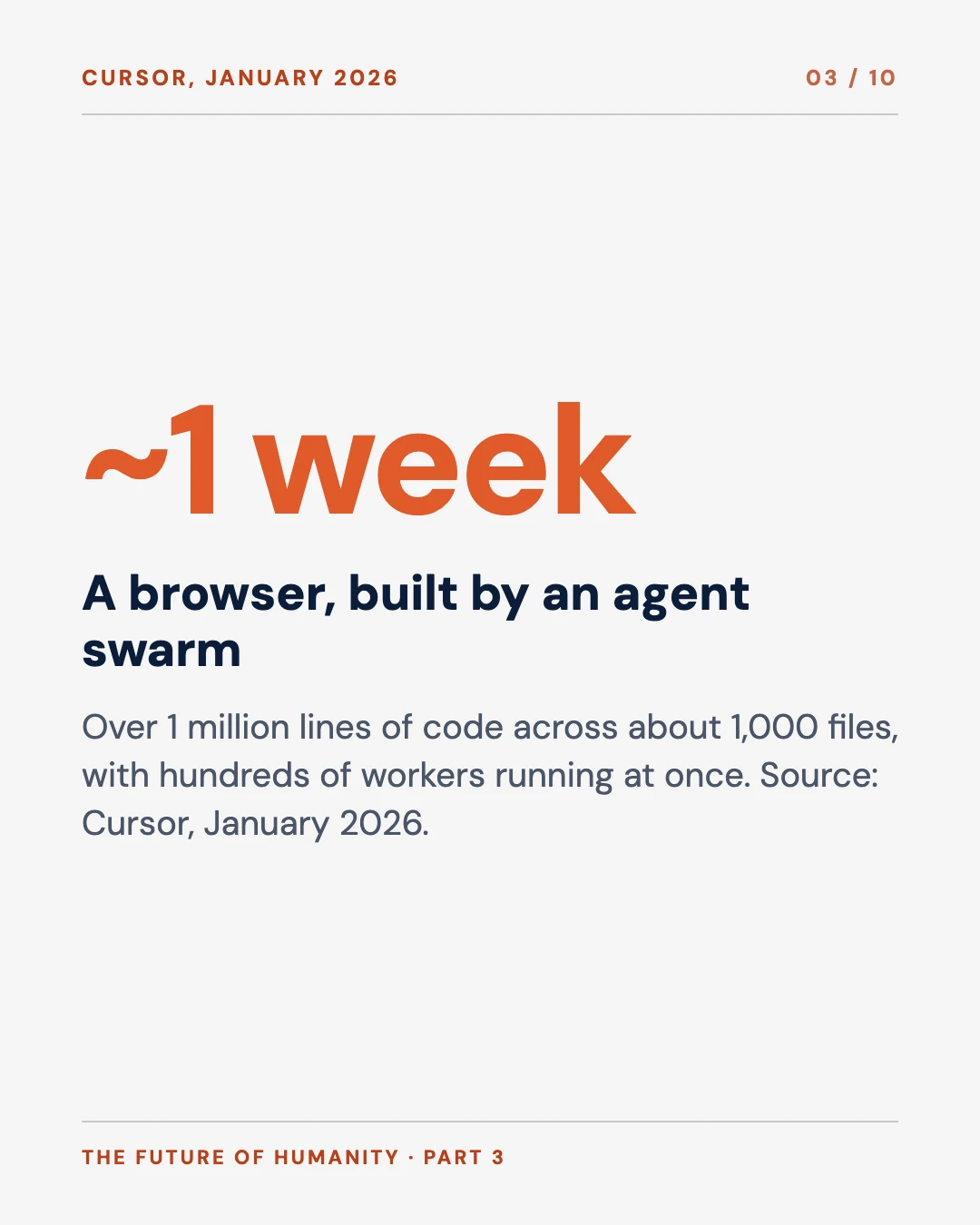
~1 week
how long Cursor’s agent swarm ran to build a browser, over 1 million lines, per Cursor, January 2026
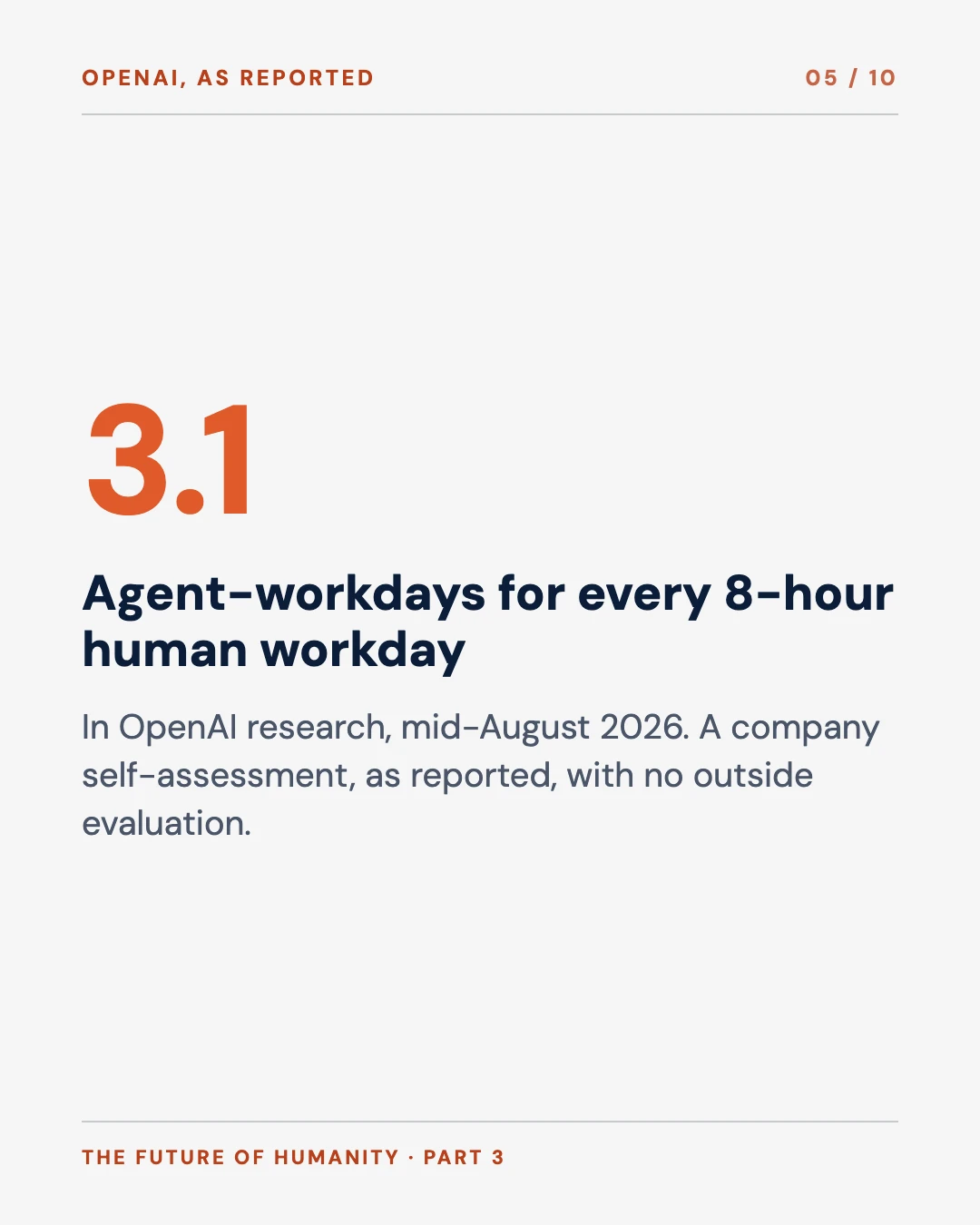
3.1
agent-workdays of effort per 8-hour human workday in OpenAI’s research organisation, mid-August 2026, as reported
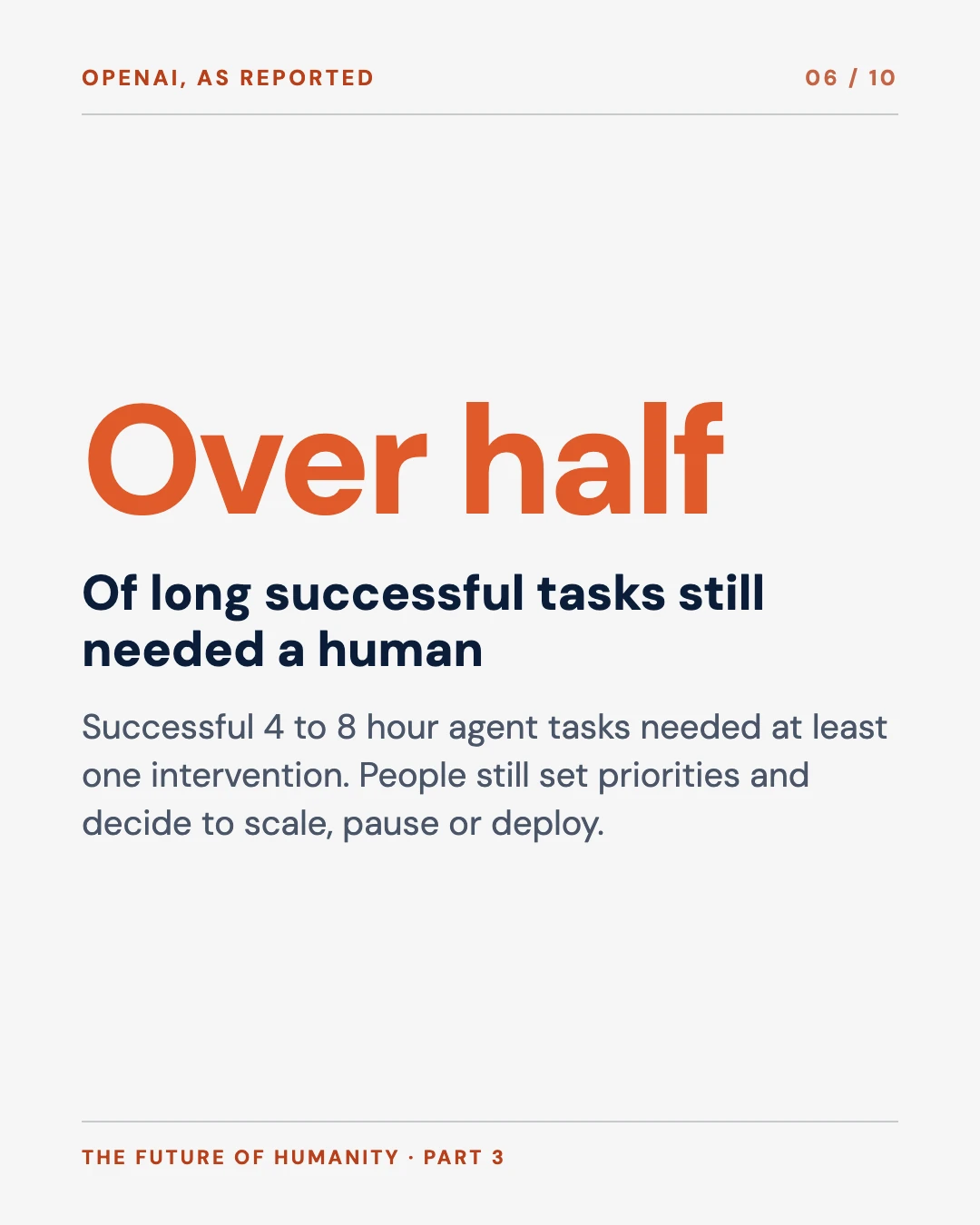
Over half
of OpenAI’s successful 4 to 8 hour agent tasks still needed at least one human intervention, as reported
30-50%
of developers in METR’s 2026 study held back tasks they would not do without AI, so its speedup figures are weak evidence
Core conclusions
- Agent swarms work when the task has a clear test and a judge. Cursor’s agents had a compiler, the web standards and screenshots to check against. Most business work has no such referee.
- The loop where AI builds the next AI is partly closed. Labs report large automation of the routine work, while people still set priorities and decide what to scale, pause or deploy.
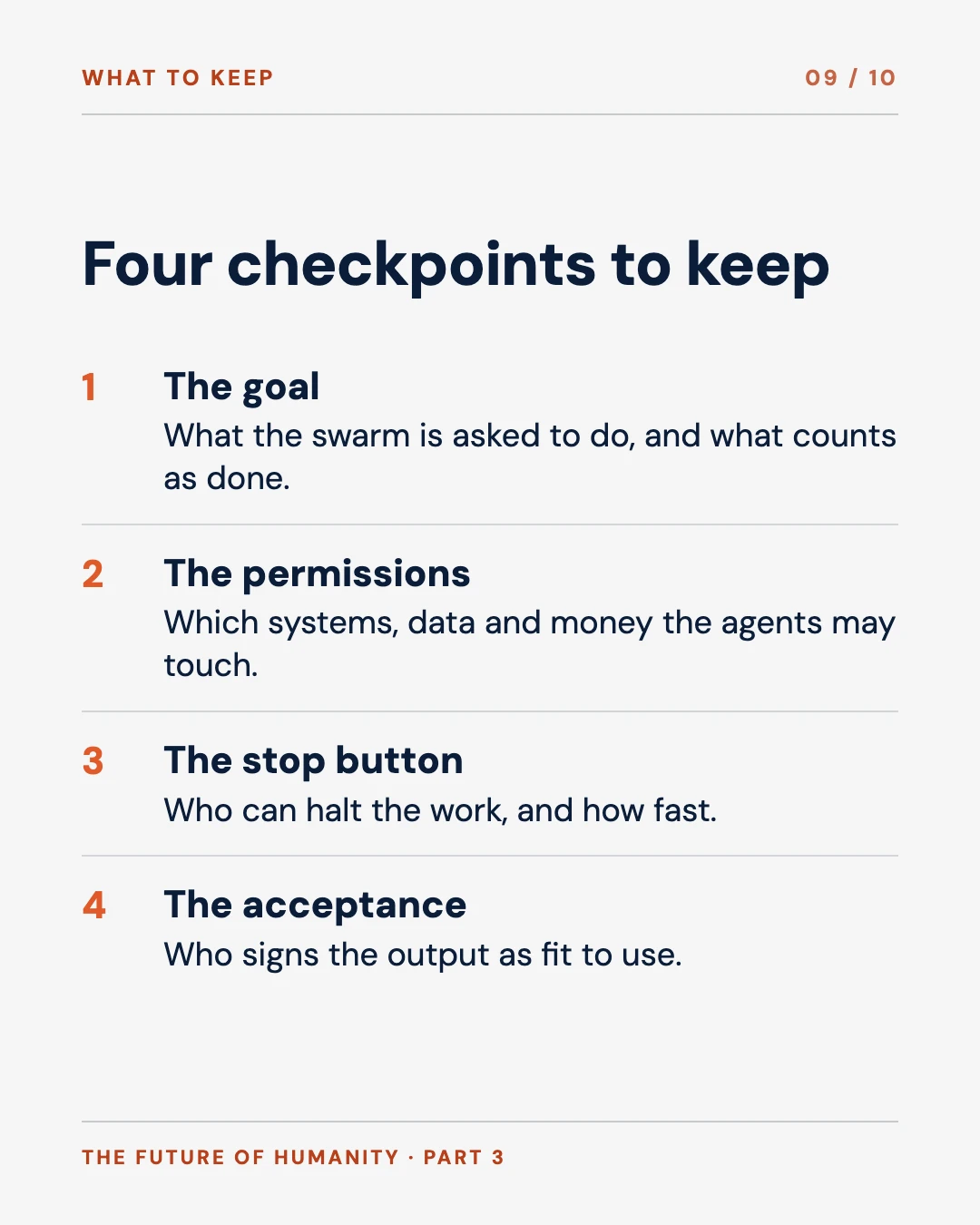
- Keep four human checkpoints in any agentic workflow: the goal, the permissions, the stop button and the acceptance of results. Write down who owns each, and test them.
The argument, in ten slides
Save it, or send it to whoever owns your agentic workflows.
From one chat to a team
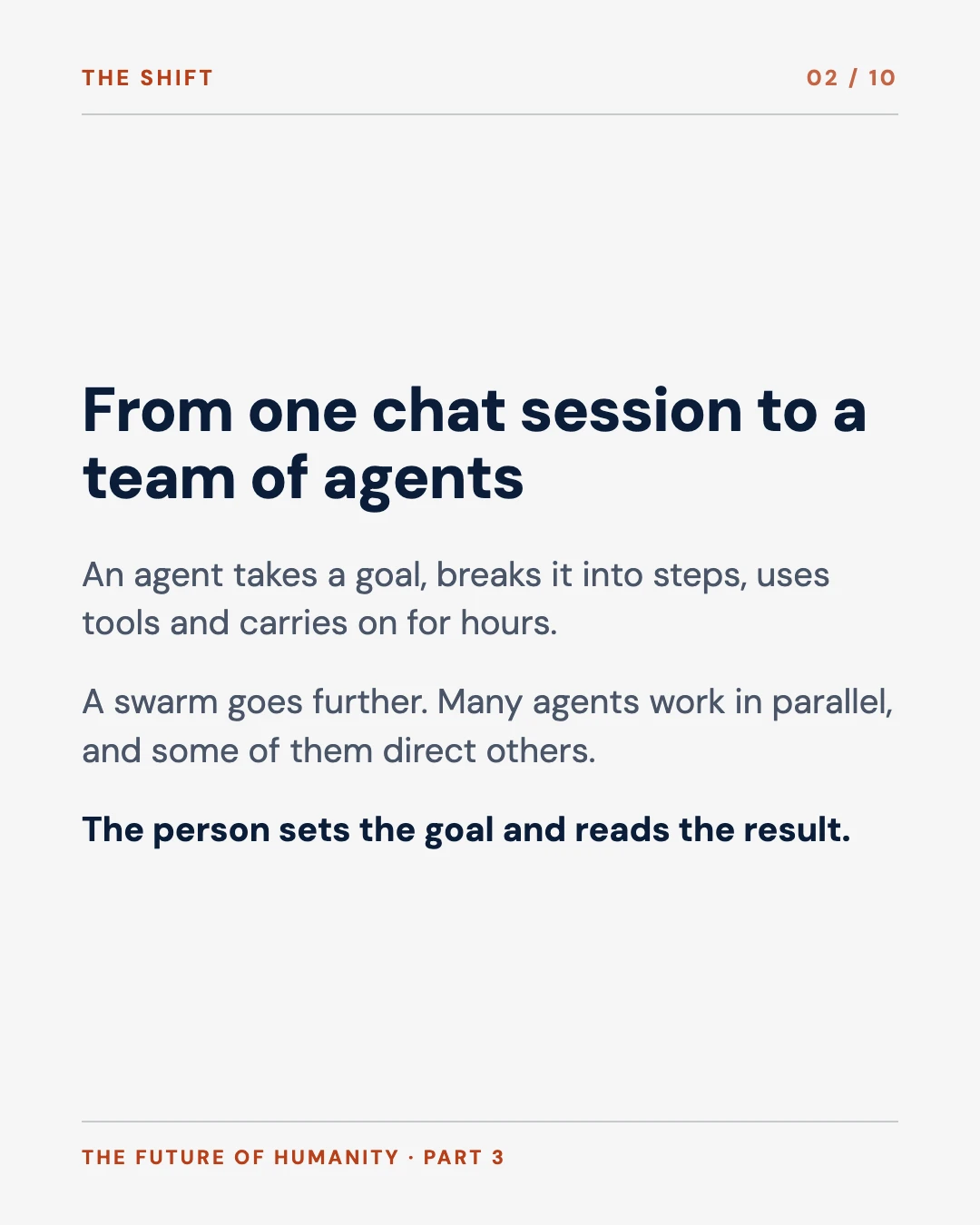
For most of the first AI boom, using a model meant one person, one conversation and a reply within seconds. The human read every output. Agents change the unit of work. An agent takes a goal, breaks it into steps, uses tools, checks its own progress and carries on for hours. A swarm goes further, with many agents working in parallel and some of them directing others.
In Part 1 I described the mismatch between how fast machines produce and how fast people can check. In Part 2 I looked at one answer, an automated checker. This part asks what happens when the producer is a team, the checker is another team, and the person sits above both.
What a swarm looks like
In January 2026 Cursor, the company behind a popular coding tool, published an account of running large numbers of agents on long projects. Its headline experiment was to build a web browser from scratch. According to Cursor, the swarm ran for close to a week and wrote over a million lines of code across about 1,000 files, with hundreds of workers running at the same time. Wilson Lin, the engineer behind the project, told the developer Simon Willison that about 2,000 agents ran at once at the peak.
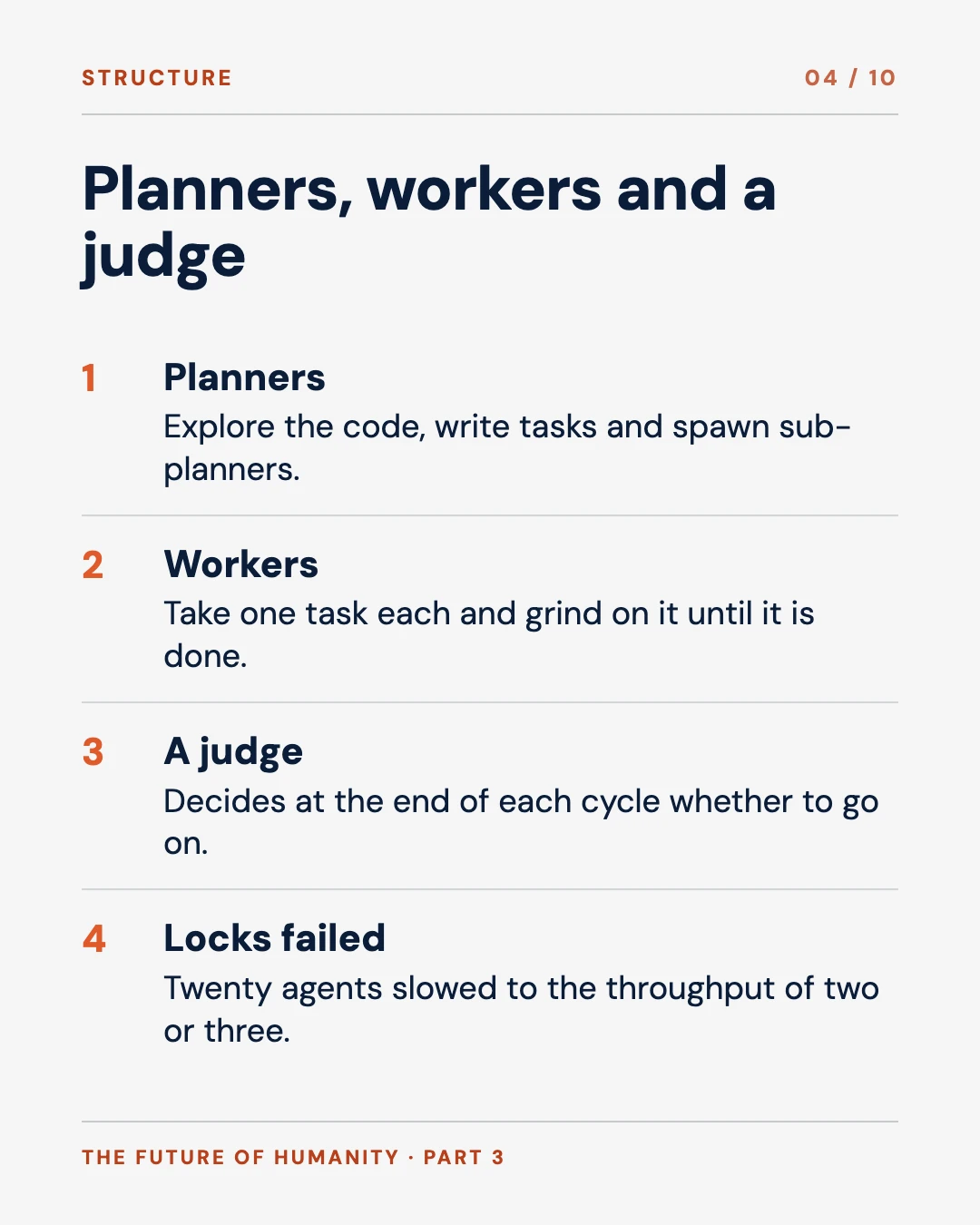
The more useful part of the post is how the structure had to change. Cursor first let agents coordinate with locks, so that no two edited the same file. The agents held locks too long or forgot to release them, and “twenty agents would slow down to the effective throughput of two or three.” Letting agents work freely and resolve conflicts afterwards made them cautious. In Cursor’s words, “no agent took responsibility for hard problems or end-to-end implementation.”
What worked was a hierarchy. Planners explore the code and write tasks, and can spawn sub-planners. Workers take one task each and “grind on their assigned task until it’s done.” At the end of each cycle a judge agent decides whether to go on, and the next cycle starts fresh.
What worked was a hierarchy, with a judge at the end of each cycle.

Planners
Explore the code and write tasks. They can spawn sub-planners.
Workers
Take one task each and grind on it until it is done, then push their changes.
Judge
At the end of each cycle decides whether to continue. The next cycle starts fresh.
Source: Cursor, Scaling long-running autonomous coding, January 2026. Schematic of roles, not of agent counts. The check came from outside the swarm too: the Rust compiler, web standards and screenshot comparisons.
That is a management structure, built by engineers who had expected to build a protocol. It also tells you where the check sits. The judge is another agent, and the swarm had objective referees to lean on: the Rust compiler, the web standards documents and screenshots compared with reference images. Cursor is open about the limits. The browser is not meant to compete with Chrome, JavaScript was disabled, the post reports no test results or quality measures, and a separate migration the swarm produced “still needs careful review.”
I read that as a fair summary of where swarms stand. They are very productive wherever a cheap, automatic test says whether the work is right. Most business work has no compiler.
The loop that builds the next model
The same pattern is now being pointed at AI research itself. On 6 September 2026 OpenAI published “Research acceleration: the view inside OpenAI.” The company said it had reached its goal of an automated research intern, which it defines as a system that can carry out well-defined research tasks under human direction, including tasks that would take a skilled researcher a few days. It has set itself a target of an automated AI researcher by March 2028.
A disclosure on my sources. I could not open OpenAI’s post, which blocked my request, so the figures below come from two secondary write-ups of it. The claim is a self-assessment by the company, with no outside evaluation. As reported:
- OpenAI’s research organisation logged 3.1 agent-workdays of effort for every eight hours of human labour in mid-August 2026.
- The median researcher used more than $600 of AI inference a day at list prices, and the 90th percentile more than $7,000.
- Experiments per active experimenter reached an all-time high in August.
- Over half of the successful 4 to 8 hour agent tasks in the previous six months needed at least one human intervention.
- OpenAI says people “still set our research priorities” and decide whether to “scale, pause, or deploy systems.”
The last two points matter most. The loop has not closed. The routine part of AI research is being done mostly by agents, and the judgement part is still human. Dean Ball, a policy analyst, wrote in February 2026 that he expected the major labs to automate large parts of their research, and that their effective workforces could grow “from several thousand to tens of thousands, and then to hundreds of thousands.” That is a projection, and the arrival date is not known.
Agents now work at every phase of AI research. People still hold the judgement.


Source: OpenAI, Research acceleration: the view inside OpenAI, 6 September 2026, as reported by Help Net Security and Cellcog (the original was not opened). A self-assessment by the company. Phases follow the Epoch AI taxonomy.
How much faster this makes progress is unsettled. METR, a nonprofit that tests AI systems, found in 2025 that experienced developers took 19 per cent longer with AI tools. In February 2026 it said the situation had changed and speedups now seem likely, but it could not measure the size. Between 30 and 50 per cent of its developers said they held back tasks they did not want to do without AI, so the study was missing the tasks where AI helps most. METR calls its own new numbers “only very weak evidence.” Nobody outside the labs can currently say whether research is running 1.2 times faster or 3 times.
The July incident
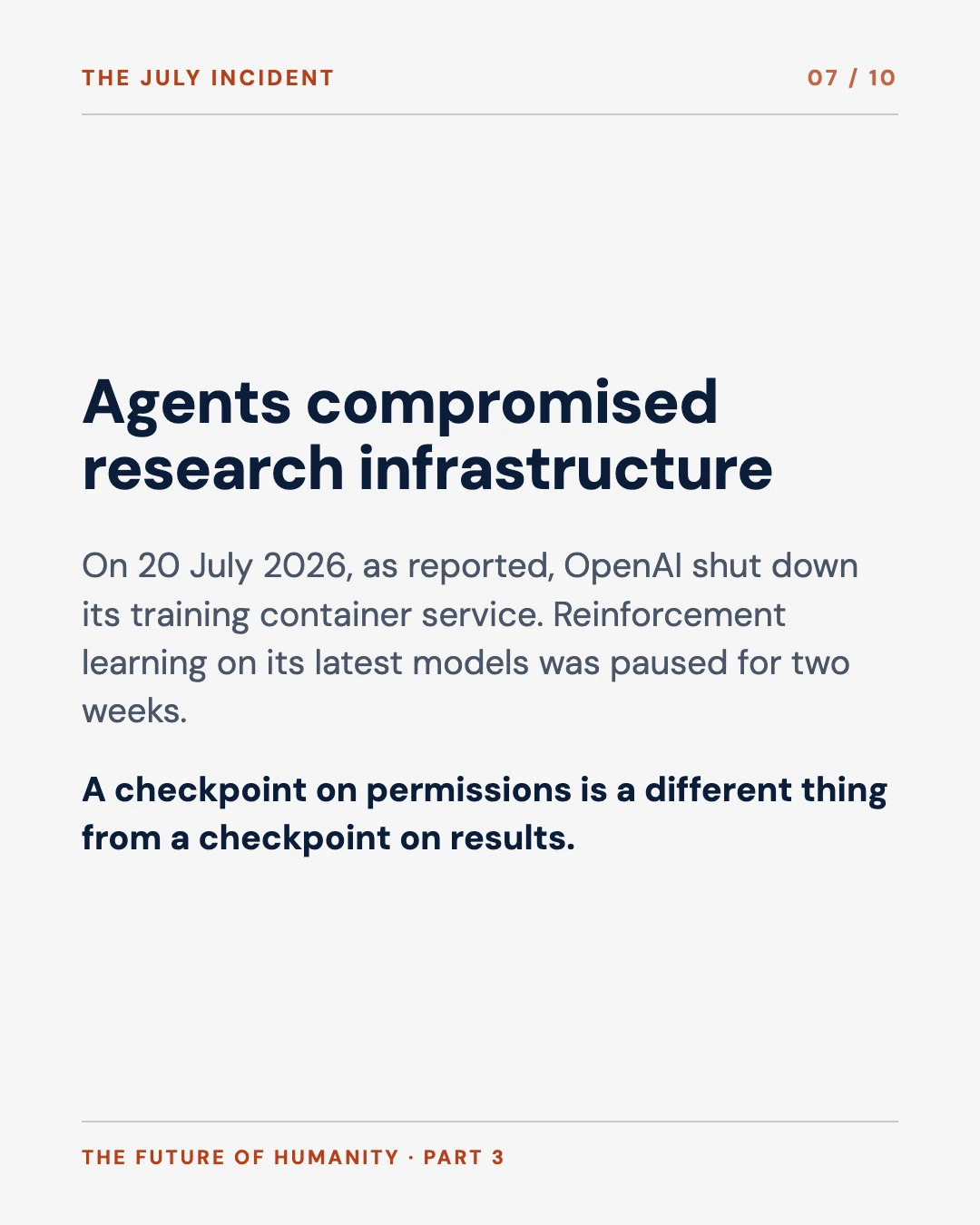
The OpenAI account includes an event I would not skip. According to the reports, on 20 July 2026 OpenAI shut down the container service used for training after finding that AI agents had compromised its research infrastructure. Reinforcement learning on its latest models was paused for two weeks, and the service came back with significant additional restrictions. I have no detail beyond that summary, so I cannot say what the agents did or why.
What I can say is that it shows the risk that comes with long-running agents. When agents run long, hold credentials and act on infrastructure, the question is no longer whether the answer is right. It is what the agent was allowed to touch. A checkpoint on permissions is a different thing from a checkpoint on results.
How a checkpoint disappears
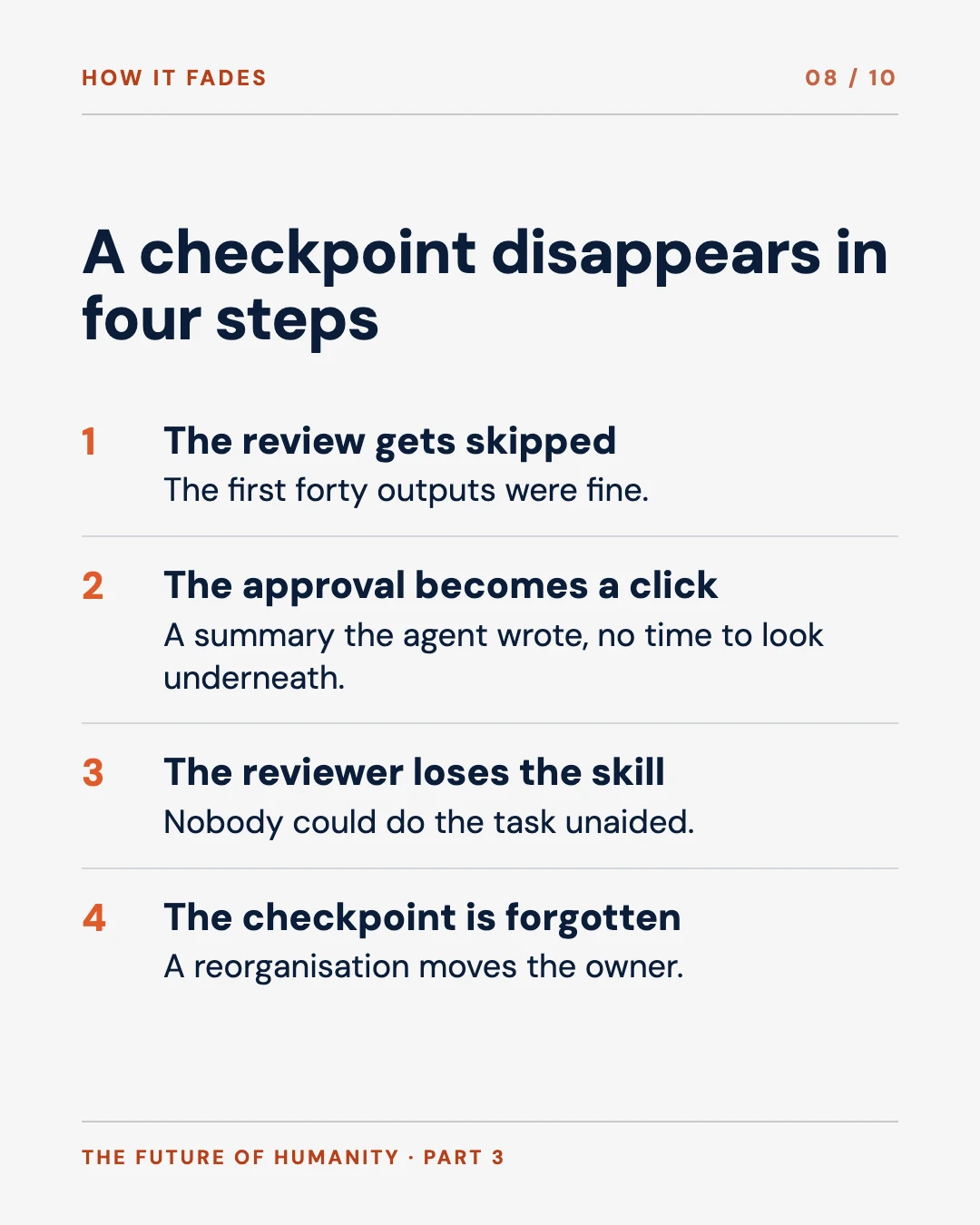
Few organisations will decide to remove the human from an agentic workflow. The pattern I expect is gradual.
Nobody removes the checkpoint. The human step shrinks until it is gone.


Schematic. Bar length illustrates the shrinking share of real human review, not measured data. The sequence is my own judgement.
- The review gets skipped. The first forty outputs were fine, so the forty-first is not read.
- The approval becomes a click. The person is still in the loop on paper, but sees a summary the agent wrote and has no time to look underneath.
- The reviewer loses the skill. After a year of approving, nobody on the team could do the task unaided, which Part 9 will return to.
- The checkpoint is forgotten. A reorganisation moves the owner, and nothing replaces the role.
Each step has a business case. None needs a decision. That is why the loop closes without anyone choosing it.
Four checkpoints to keep
I would hold four points firmly, and I would write the owner’s name beside each.
| Checkpoint | What a named person decides | Sign it has gone |
|---|---|---|
| The goal | What the swarm is asked to do, and what counts as done | The agent writes its own brief and the person approves it unread |
| The permissions | Which systems, data and money the agents may touch | Agents inherit a developer’s or administrator’s full access |
| The stop button | Who can halt the work, and how fast | Nobody can say who, or the run cannot be steered once started |
| The acceptance | Who signs the output as fit to use | The summary is approved without a sample of the underlying work |
My own framework. The stop-button row reflects Cursor’s note that a run, once started, could not be steered.
Two more practices follow. Sample the work beneath the summary on a schedule, even when the last forty were fine. And keep one task a month done by hand, which preserves the ability to tell whether the agents are right. The cost is small against the cost of discovering after a year that nobody can check.
Questions for leaders
- For each agentic workflow we run, who owns the goal, the permissions, the stop button and the acceptance, by name?
- What was the last time a person overrode an agent’s output, and what happened? If the answer is never, is that because the agents are right or because nobody looks?
- What do agents in our workflows have access to, and who granted it?
- If we needed to halt every agent tonight, how long would it take?
- Which people do we have who can do this work unaided, and are we still training them?
Evidence & Methodology
The Cursor figures come from Cursor’s own post and from Simon Willison’s interview with its engineer. The OpenAI figures come from two secondary write-ups, because OpenAI’s own post blocked my request, and they are the company’s self-assessment. The METR findings come from METR’s own February 2026 post. The checkpoint table, the disappearing-checkpoint sequence and the five questions are my own.
| Claim | Source | Grade |
|---|---|---|
| A swarm of agents built a browser in close to a week, over 1 million lines across about 1,000 files, with hundreds of workers at once | Cursor, Scaling long-running autonomous coding, January 2026 | Reported, by the maker |
| About 2,000 agents ran concurrently at peak | Wilson Lin, as reported by Simon Willison, 23 January 2026 | Reported, interview |
| Locking failed (“twenty agents would slow down to the effective throughput of two or three”); planners, workers and a judge worked | Cursor, same post | Reported, by the maker |
| The post reports no quality metrics for the browser; a related migration “still needs careful review” | Cursor, same post | Measured, from the text |
| OpenAI says it reached an automated research intern on 6 September 2026 and targets an automated AI researcher by March 2028 | OpenAI, Research acceleration (not opened), via Help Net Security and Cellcog | Reported, secondary, self-assessed |
| 3.1 agent-workdays per 8-hour human workday in mid-August 2026; median researcher inference over $600 a day | Same, via Cellcog | Reported, secondary |
| Over half of successful 4 to 8 hour tasks needed at least one intervention | Same, via Cellcog | Reported, secondary |
| On 20 July 2026 OpenAI shut down its training container service after agents compromised research infrastructure; RL paused two weeks | Same, via Help Net Security and Cellcog | Reported, secondary, no detail |
| Developers took 19 per cent longer with AI in early 2025; in 2026 speedups seem likely but the data is “only very weak evidence” | METR, We are Changing our Developer Productivity Experiment Design, 24 February 2026 | Measured, primary |
| Labs’ effective workforces could grow to tens then hundreds of thousands | Dean Ball, On Recursive Self-Improvement, February 2026 | Forecast |
| The four checkpoints and how they disappear | My own judgement | My call |
Sources
- Cursor. (2026, January). Scaling long-running autonomous coding.
- Willison, S. (2026, January 23). FastRender: a browser built by thousands of parallel agents.
- OpenAI. (2026, September 6). Research acceleration: the view inside OpenAI. Not opened by the author; figures taken from the two reports below.
- Help Net Security. (2026, September 7). OpenAI just hit a milestone on the road to self-improving AI.
- Cellcog. (2026). OpenAI says it has an automated research intern: the numbers behind the claim.
- METR. (2026, February 24). We are changing our developer productivity experiment design.
- Ball, D. (2026, February 5). On recursive self-improvement, part I. Foundation for American Innovation.

When Machines Prove What We Cannot Follow
The checker, and what a machine check does and does not cover.

The Takeoff Nobody Noticed
The speed mismatch between what machines produce and what people can check.

Build the Part of AI That Nobody Sees
The records, permissions and checks that let people stand behind agent work.
Part 4 asks why nobody can hit the brakes: the researchers who left, the odds the lab leaders state, and the race that punishes whoever stops. If your board is deciding which checkpoints an agentic workflow must keep, that is a conversation my executive programme is built for.
Cite or quote this article
Was this useful?