

Listen to this article
Jump to a section
In this article
Executive Summary
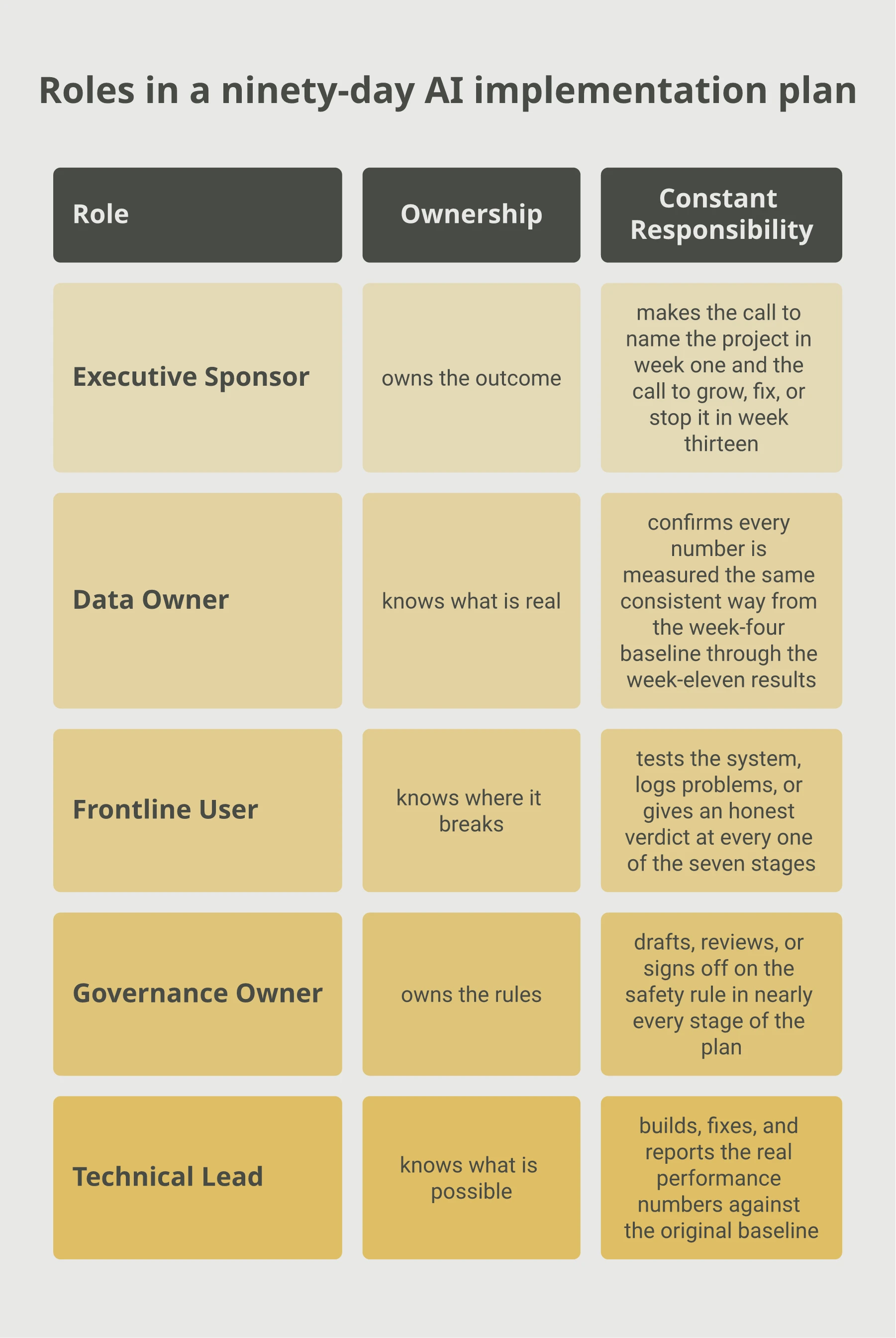
The seven-stage, thirteen-week AI plan tells you the order to work in. It does not tell you, stage by stage, which of your five people is responsible for what. This page answers that. For each of the seven stages, here is exactly what the executive sponsor, data owner, frontline user, governance owner, and technical lead each need to do.
Core conclusions
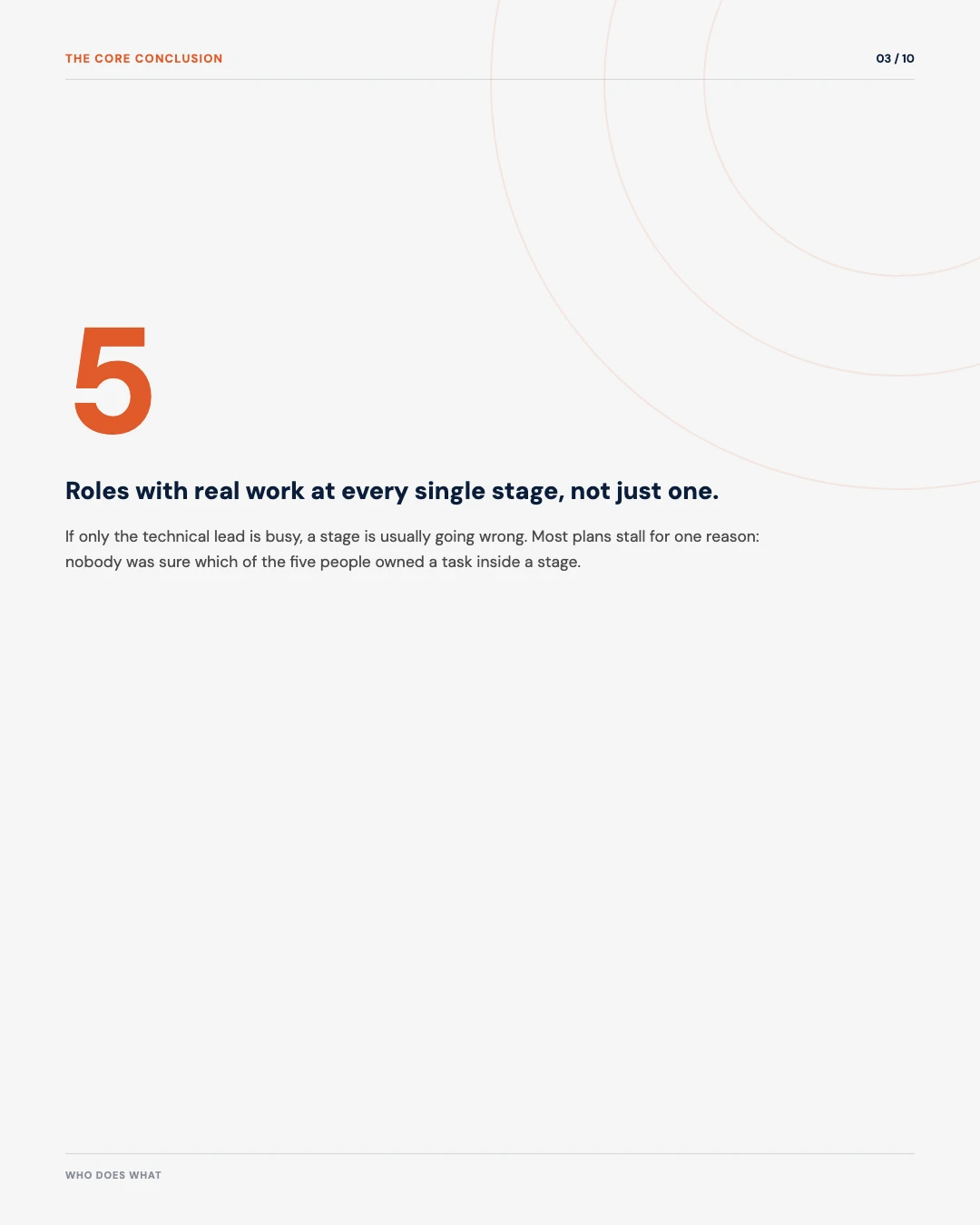
- Every stage needs work from all five roles. If only the technical lead is busy, the stage is usually going wrong.
- Most ninety-day plans stall for one reason: nobody was sure which of the five people owned a task inside a stage. Skipped stages are rare. Unclear ownership is not.
- The frontline user and the governance owner have real work in more of the seven stages than most people expect. Neither one disappears once the technical lead starts building.
The role-by-role breakdown, ten slides
Save it, share it, or send it to whoever on your team is still asking who owns which task.

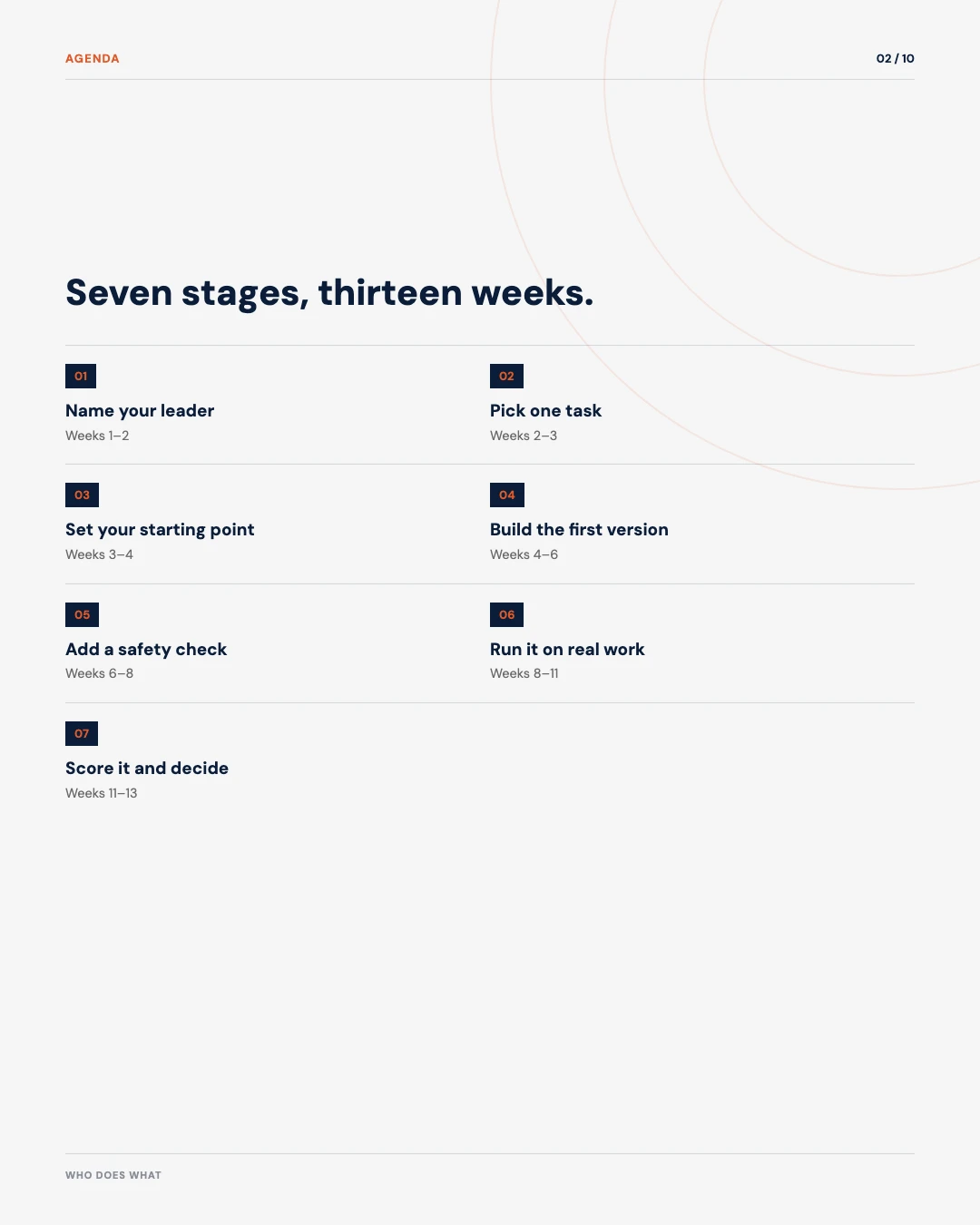
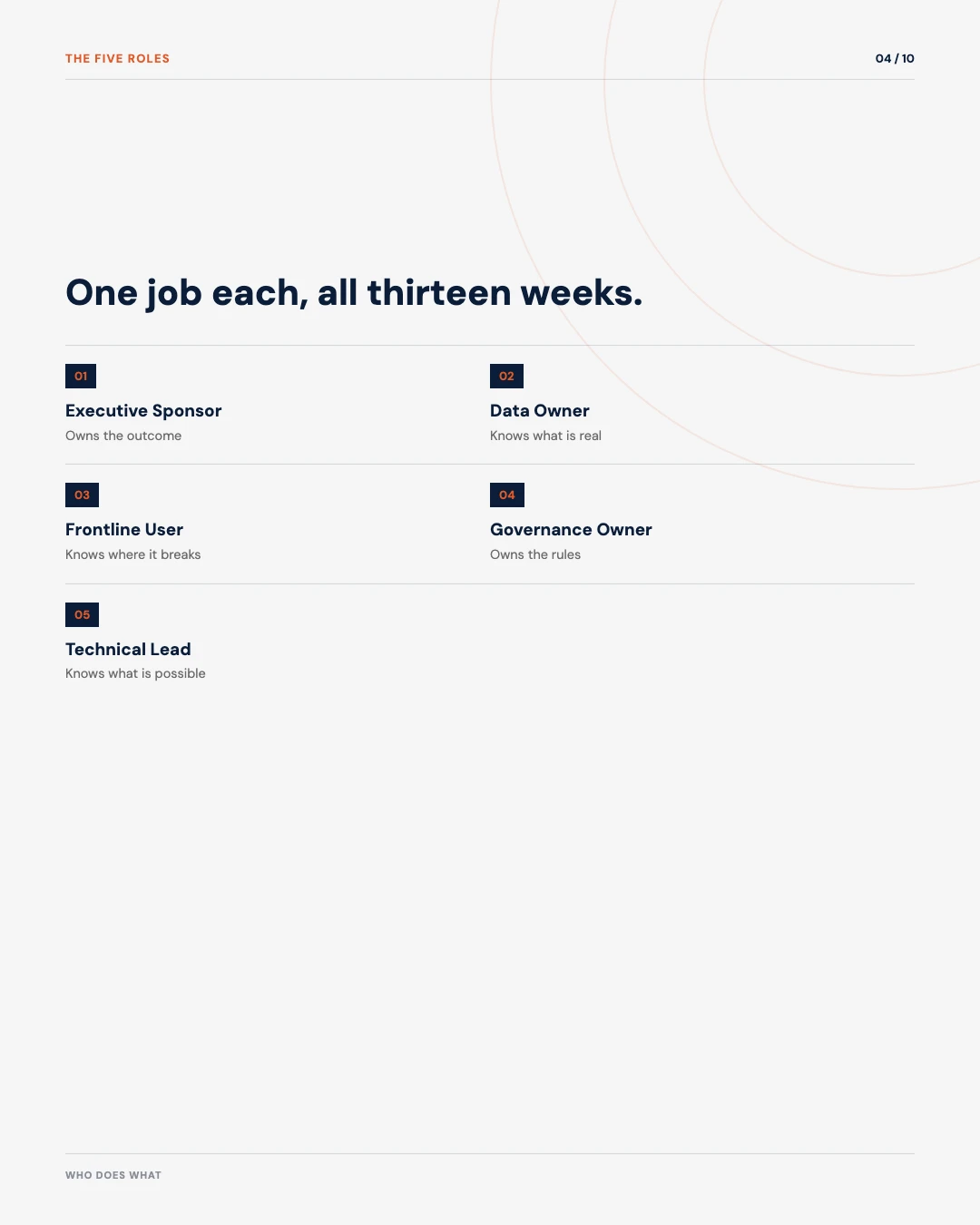
This page is the companion to a guide I wrote for people just starting out: New to AI? A Step-by-Step Guide to Starting Your Enterprise Transformation. The guide lays out the seven-stage, thirteen-week order and the five people you need in the room: the executive sponsor, the data owner, the frontline user, the governance owner, and the technical lead. This page assumes you already have those five people named. Here is the part most plans skip: what each of those five people has to do, at every one of the seven stages.
Here is the full map before the stage-by-stage detail below. The color of each section further down matches its bar here, so you always know where in the thirteen weeks you are as you scroll.
Where You Are
Thirteen weeks, seven stages at a glance
Stage 1 of 7
Name the leader in the first two weeks
The whole plan rests on this stage. Every role has a job here.

Executive Sponsor
Confirms the budget, the deadline, and their own accountability, then pulls the team together.
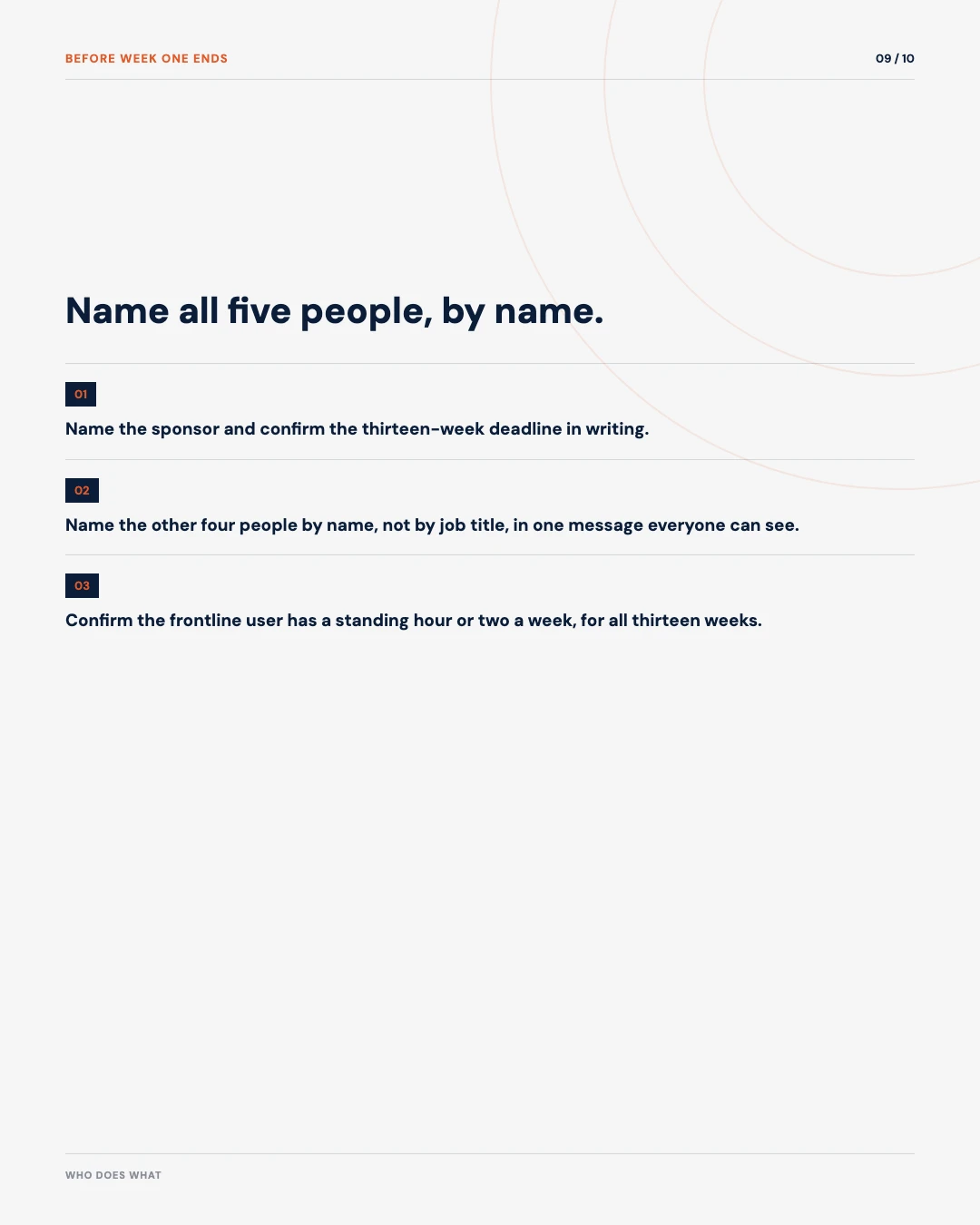
- Names themselves, or one other leader, as sponsor: someone who can say yes or no without calling a meeting first.
- Confirms the budget and the thirteen-week deadline in writing.
- States clearly that they personally own the grow, fix, or stop call at week thirteen.
- Names the other four people by name, not by job title, in one message everyone on the team can see.
Data Owner
Confirms they are in and flags anything that could eat into the clock early.
- Confirms availability and gets a heads-up that a real data sample is due in week three.
- Flags right away if any system they own needs an IT ticket, an access approval, or a compliance sign-off.
- Names which systems hold the data most likely to matter, before anyone asks.
Frontline User
Is identified by name and told their honest opinion carries real weight.
- Is the actual person doing the task today, not their manager and not a job description.
- Is told plainly that saying “this will not work” is welcome.
- Agrees to a standing hour or two a week for the next thirteen weeks.
Governance Owner
Starts the safety rule early, in parallel with everything else.
- Is named and briefed on the general task category.
- Starts a rough first draft of the one-page rule for what the AI can do unsupervised.
- A head start here means the rule is ready by week six.
Technical Lead
Is briefed on scope and starts flagging anything that needs lead time.
- Is named, whether from inside the company or brought in.
- Is told the general task category, not yet the specific task, so they can start thinking about what is realistic.
- Flags early if any tooling or platform decision needs lead time to arrange.
Stage 2 of 7
Pick one task in weeks two to three
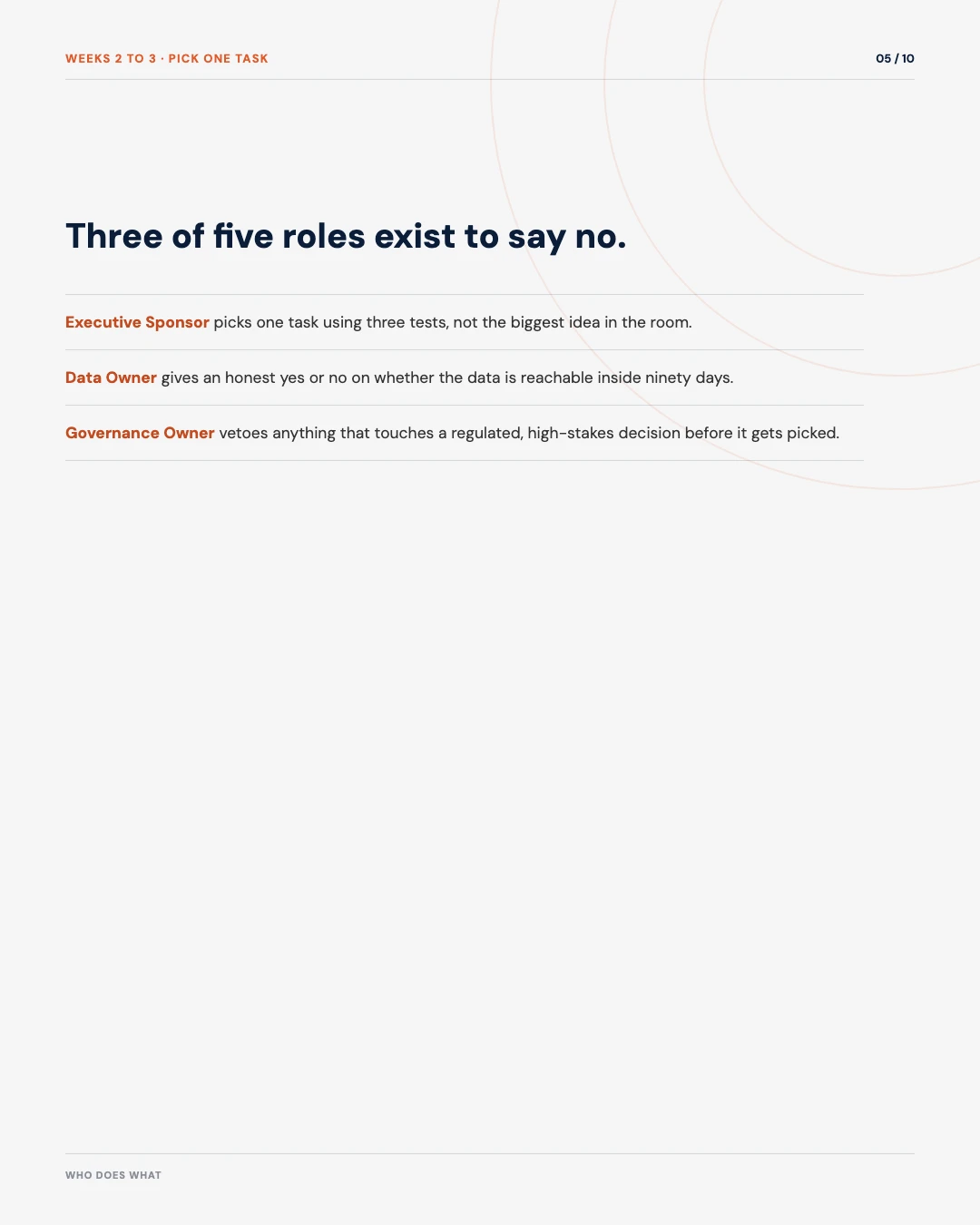
This stage needs the most pushback against ambition, and three of the five roles exist partly to provide it.

Executive Sponsor
Picks the task personally, using the three tests, and resists the pull toward something bigger.
- Hears the shortlist of candidate tasks from the other four roles.
- Picks one task using the three tests: a real person does it today, the data is reachable, a mistake is cheap to fix.
- Resists the pull toward something bigger or more visible. That is the single most common way this stage goes wrong.
Data Owner
Gives an honest yes or no on data reachability for each candidate.
- Checks each candidate task against what data exists today, not what the system diagram implies.
- Gives an honest yes or no: reachable inside ninety days, or not.
- Flags any task needing data from three systems and two approvals as a no, however good it looks on paper.
Frontline User
Says which candidate task hurts the most today.
- Ranks the candidate tasks by how painful or time-consuming they really are, not how they look on a slide.
- Their read on which task bites should outweigh a spreadsheet ranking.
- Is the first to notice, later, if the chosen task fails to help.
Governance Owner
Vetoes anything regulated before the sponsor commits.
- Flags immediately if any candidate task touches a regulated or high-stakes decision: credit, hiring, medical, legal.
- Vetoes those candidates outright, before the sponsor has a chance to fall in love with one.
- Confirms the remaining shortlist is easy to explain if it goes wrong.
Technical Lead
Scopes each candidate at a rough level and says which is buildable in the time left.
- Scopes the smallest version that could plausibly help, for each candidate task.
- Says which one is buildable in the roughly ten weeks remaining.
- This is the moment to say “that one is a nine-month project,” not week five.
Free tool
AI Use Case Prioritisation Matrix
Score up to five candidate tasks so this stage ends with a ranked list, not a group opinion.
Stage 3 of 7
Set your starting point in weeks three to four
Nothing built in weeks four to six can be judged fairly without a real baseline. That baseline gets built here, before any AI touches the task.

Executive Sponsor
Sets the specific success bar in writing before it can be disputed later.
- Sets a specific number: forty percent faster, half the error rate.”
- Confirms that number with the data owner and frontline user before it is locked in.
- Writes it down somewhere the whole team can see, so nobody disputes it at week thirteen.
Data Owner
Pulls the real baseline by hand. It is the single most load-bearing number in the plan.
- Pulls current time taken, current cost, and current error rate from real historical records.
- Does this by hand, not from memory or an estimate.
- Treats this number as worth getting right slowly, since everything else compares against it.
Frontline User
Documents the task exactly as it is done today, shortcuts included.
- Walks through every step of the task as it is really done, not the official version.
- Includes the shortcuts and workarounds nobody ever wrote down.
- Knows this walkthrough becomes the yardstick everything gets measured against later.
Governance Owner
Defines what “wrong” looks like before AI is anywhere near the task.
- Confirms what a mistake looks like for this specific task.
- Confirms what harm that mistake causes today, before any AI touches it.
- Hands this definition directly to the safety check built in weeks six to eight.
Technical Lead
Turns the walkthrough into a spec the build will follow.
- Turns the frontline user’s walkthrough into a technical spec.
- Defines what data goes in and what needs to come out.
- Flags exactly where the current process would break under an AI system.
Stage 4 of 7
Build the first version in weeks four to six
The technical lead does most of the visible work here. The other four roles keep the build honest instead of impressive.

Executive Sponsor
Steps back, clears blockers, and resists asking for an early demo.
- Steps back from daily involvement once the spec is handed to the technical lead.
- Clears blockers as they are reported: budget, access, other departments.
- Resists asking for an early demo. A rushed demo tends to become the version that ships, flaws included.
Data Owner
Stays on call to separate data problems from model problems.
- Stays reachable for questions when the AI’s output looks wrong.
- Helps the technical lead work out fast whether it is a data problem or a model problem.
- That single distinction saves days of debugging the wrong layer.
Frontline User
Reviews early drafts against how the work really gets done.
- Reviews early drafts and flags when the output does not match reality.
- Tests the edge cases they already know cause problems in real life.
- Flags anything a technical spec would never have captured on its own.
Governance Owner
Confirms the build still runs under supervision, nothing unsupervised yet.
- Reviews what the first version can and cannot do on its own.
- Confirms it still runs under human supervision at this stage.
- Nothing built in this window should be making unsupervised decisions. That comes only after the safety check exists.
Technical Lead
Builds the smallest working version and tests it weekly against the baseline.
- Builds the smallest working version, using the narrowest set of tools that could plausibly help.
- Uses real sample data instead of synthetic data.
- Tests it against the week-four baseline every week.
Stage 5 of 7
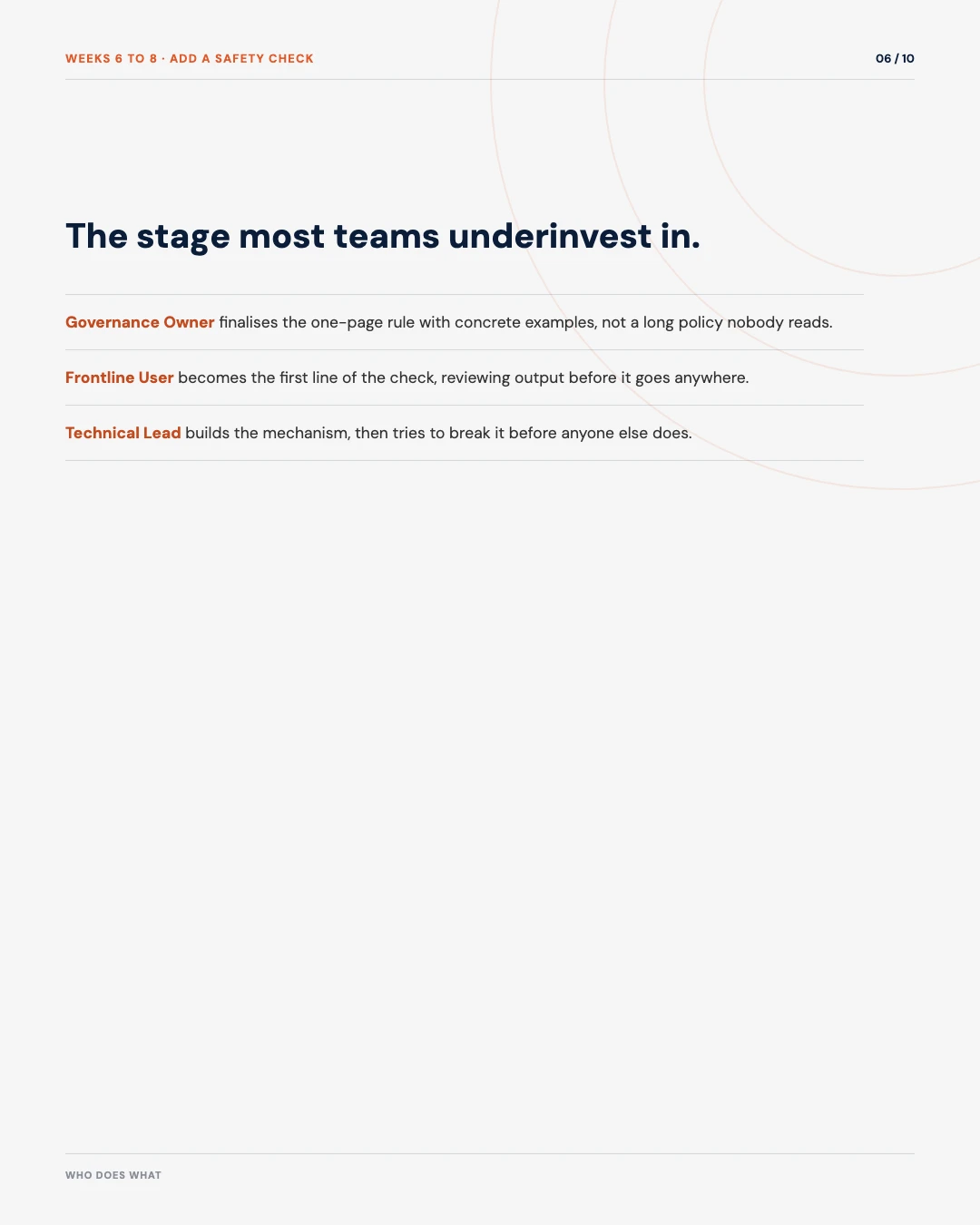
Add a safety check in weeks six to eight
Most first-time teams underinvest in this stage, because none of it looks like “the AI project.” It is where the governance owner’s work finally gets real and specific.

Executive Sponsor
Signs off on the rule and makes rejecting output the norm.
- Signs off on the one-page rule as final.
- Makes it clear across the team that rejecting an AI output is simply the job working correctly.
- A safety check nobody is allowed to use catches nothing.
Data Owner
Confirms the audit trail captures what governance needs.
- Confirms the log of what data went in and what came out is complete.
- Checks it captures what the governance owner will need to review later.
- A safety check built on an incomplete log cannot be trusted at week eleven.
Frontline User
Becomes the first line of defense, reporting every mistake honestly.
- Reviews output before it goes anywhere, as the first line of the safety check.
- Reports every mistake honestly, even small ones.
- Under-reporting here breaks the score the whole team relies on in week eleven.
Governance Owner
Finalises the rule with concrete examples and a clear escalation path.
- Finalises the one-page rule with concrete examples: ships automatically, or needs a person first.
- Sets up exactly how a caught mistake gets logged and escalated.
- Writes it in plain language the whole team can follow.
Technical Lead
Builds the mechanism, then tries to break it before anyone else does.
- Builds the actual mechanism: a review queue, a confidence threshold, a hold-for-approval flag.
- Deliberately tries to break it before anyone else does.
- A safety check nobody has stress-tested is just a hope.
Free tool
AI Trust, Risk & Governance Dashboard
Scores exactly what this stage needs: policy currency, review points, and where the gaps in your safety check are.
Stage 6 of 7
Run it on real work in weeks eight to eleven
The build is done and the safety check exists. Now it has to survive three weeks of the actual job.

Executive Sponsor
Checks progress weekly and protects the team from scope creep.
- Stays hands-off day to day.
- Checks progress weekly against the week-four baseline.
- Protects the team from “just add this one more thing.” That is the top way a ninety-day test becomes a nine-month one.
Data Owner
Watches for the data shifting underneath the test.
- Watches whether the data feeding the system stays current.
- Flags a new category, a new format, or a source going stale the moment it appears.
- Knows the real world tends to shift underneath a test in progress.
Frontline User
Uses it for real work every day and keeps an honest log.
- Uses the system for the real task every day, not test cases.
- Keeps a running log of everything that felt wrong or slow.
- Knows this log becomes the raw material for the honest score in the final stage.
Governance Owner
Reviews real output weekly.
- Reviews a sample of real output every week.
- Confirms the safety check is catching what it was built to catch.
- Says so immediately if it is not.
Technical Lead
Fixes real bugs and resists adding features mid-test.
- Fixes real bugs as they surface.
- Tracks performance and cost against the baseline.
- Resists adding new features mid-test, since any change breaks the clean before-and-after comparison.
Stage 7 of 7
Score it and decide in weeks eleven to thirteen
Everyone’s work up to this point either holds up under an honest score, or it does not. This stage is where that gets decided out loud.

Executive Sponsor
Makes the call and owns it publicly, including if it is to stop.
- Makes the actual call: grow it, fix it, or stop it.
- Owns that decision publicly, including if the honest answer is to stop.
- A sponsor who only ever says “grow it” is not really running a test.
Data Owner
Confirms the final numbers are measured the same way the baseline was.
- Confirms the final numbers use the exact same measurement as the week-four baseline.
- Flags anything that would make the comparison apples-to-oranges.
- A differently defined number is not a real comparison, however good the final figure looks.
Frontline User
Gives the one verdict that matters most.
- Gives the final honest verdict: would they choose to keep using this if nobody made them.
- That one answer often matters more than the entire spreadsheet.
- Is the one answer worth listening to most closely.
Governance Owner
Confirms mistakes were handled the way the rule said they would be.
- Confirms mistakes caught during the run were handled the way the week-six rule said they would be.
- Signs off, or declines to, on any request to scale the system further.
- Owns the no if the safety check did not hold up.
Technical Lead
Presents the real numbers plainly and recommends what changes next.
- Presents the real numbers against the ninety-day-old baseline, including where it underperformed.
- Recommends what a next version would need to change.
- Applies only if the decision is to grow or fix.
Free tool
AI ROI Calculator
Turns the week-four baseline and the week-eleven results into the one comparison the executive sponsor’s decision rests on.
The pattern underneath all seven stages
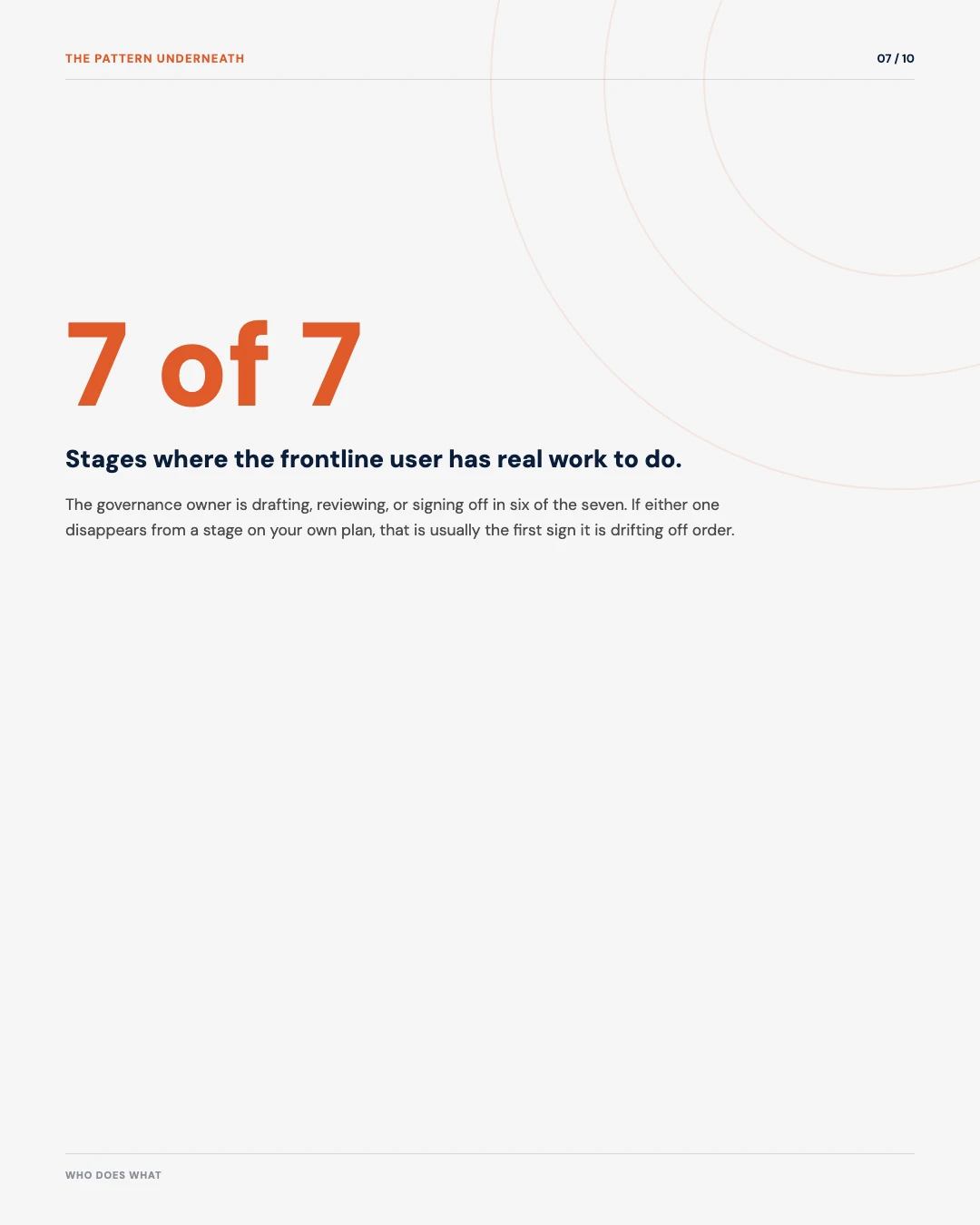
One thing repeats across all thirteen weeks: the frontline user and the governance owner never go quiet, even during the stages that look like “building” or “running.” The frontline user is testing, logging, or giving a verdict in every single stage. The governance owner is drafting, reviewing, or signing off in six of the seven. If either one disappears from a stage on your own plan, that is usually the first sign the plan is drifting off the order this guide laid out.

New to AI? A Step-by-Step Guide to Starting Your Enterprise Transformation
The full six-question guide this page is a companion to, including the five roles this breakdown assumes you already have named.

Why Your Choice of First AI Use Case Will Make or Break the Programme
Goes deeper on the "pick one task" stage above. Six clear tests for choosing the right first task, from research on why most pilots fail.

How to Build Your First AI Agent at Work: A Simple, Step-by-Step Guide
For the technical lead once weeks four to six begin. A plain, step-by-step walk through building the first working version.

Beyond the Pilot: A Risk Governance Framework for Scalable AI Deployment
For the governance owner. The full framework behind the one-page rule this page only sketches, built for once AI moves from a small test into real infrastructure.
Still working out which of your five people should own which task? That is exactly the conversation my consulting work begins with.
Was this useful?