

Listen to this article
Jump to a section
In this article
Executive Summary
Work is moving from analysis to strategy and execution. The services that will still command premium fees in the AI era share one profile: they run on judgment earned from experience, not on anything a model can compute from a dataset. Ten categories of consulting work fit that profile, and the firms that consistently deliver on them rely on the same four underlying capabilities.
70%
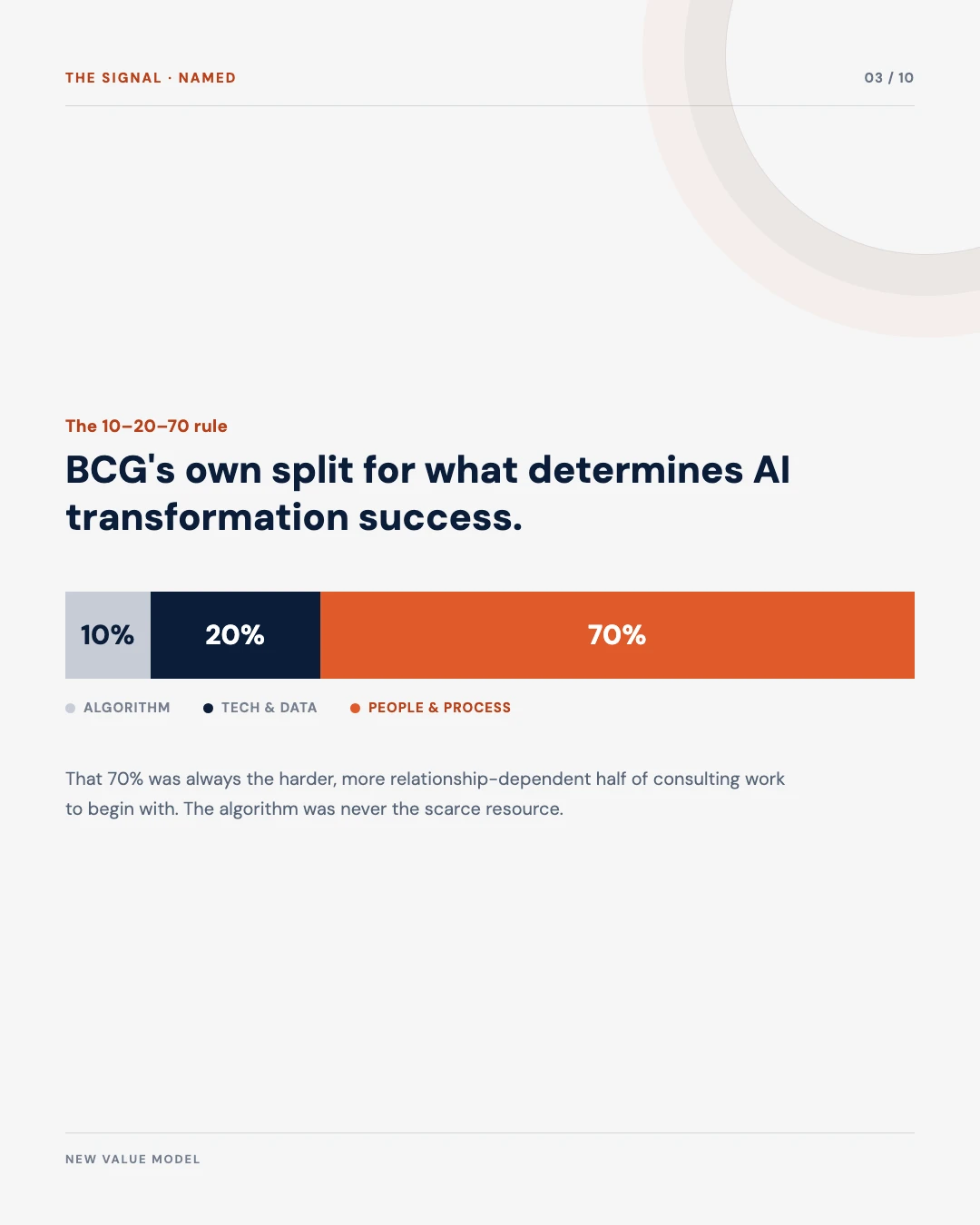
of what determines AI transformation success is people and process, not the algorithm, per BCG’s research
1%
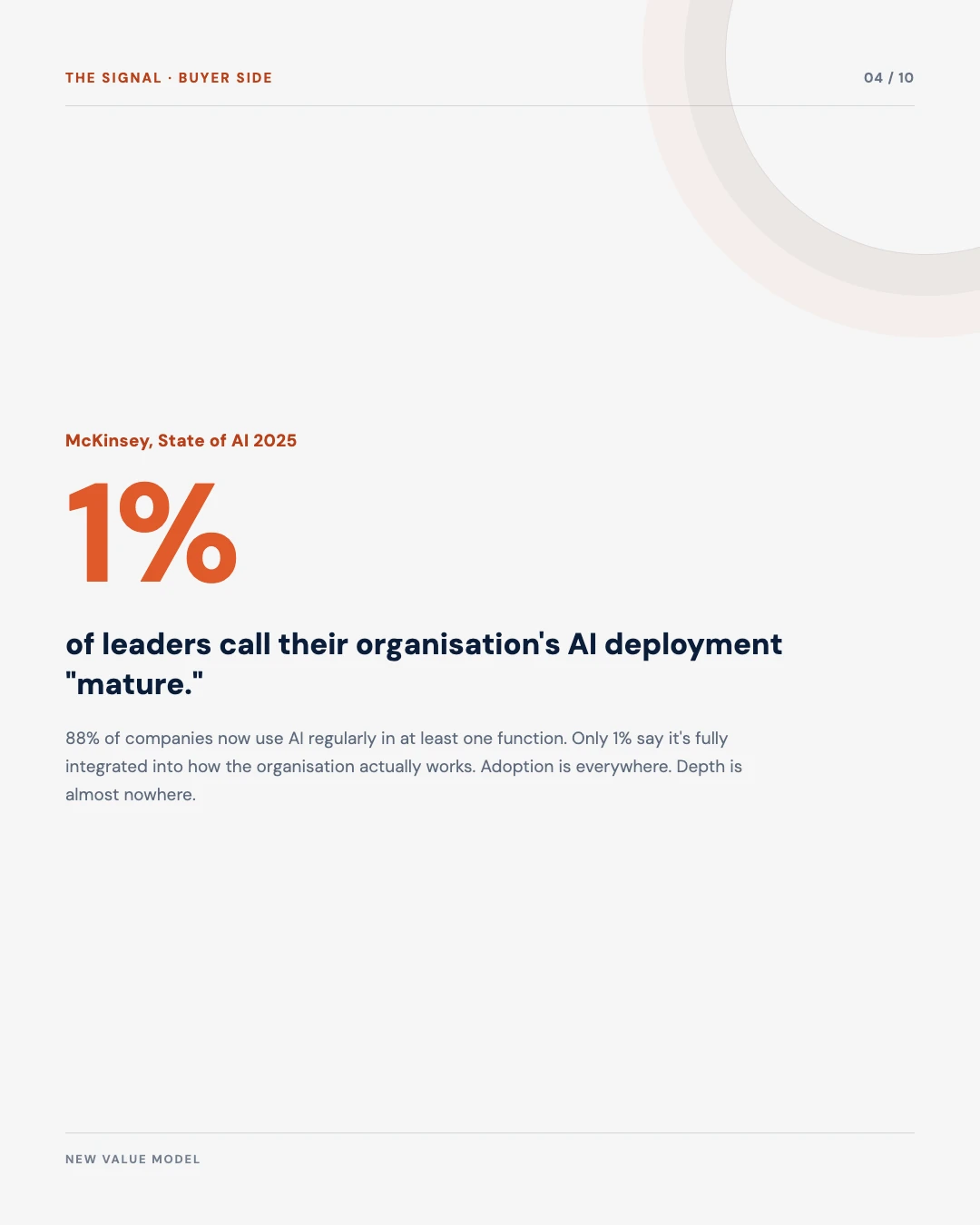
of leaders call their organisation’s AI deployment “mature,” McKinsey’s 2025 State of AI report
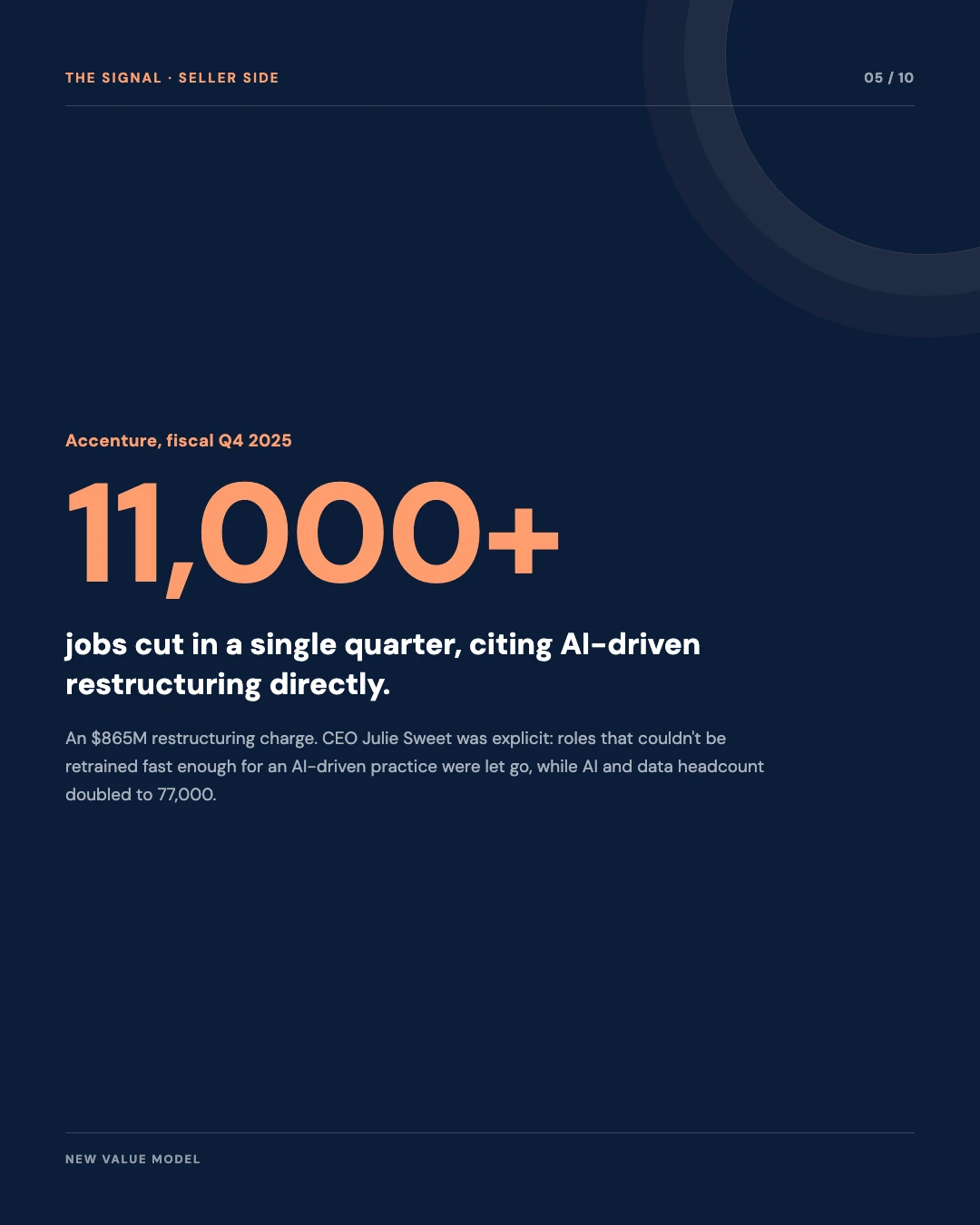
11,000+
jobs Accenture cut in a single 2025 quarter, citing AI-driven restructuring directly
$865M
restructuring charge Accenture booked for that same round of cuts
Core conclusions
- BCG’s own research on what makes AI transformations succeed already puts 70% of the effort in the organisational layer, not the technical one, which is exactly where consultants still get paid.
- The layer being cut is the layer AI can already do: research, drafting, first-pass analysis. Accenture’s 2025 layoffs and McKinsey’s 1% maturity number are the same trend, seen from the seller’s side and the buyer’s side.
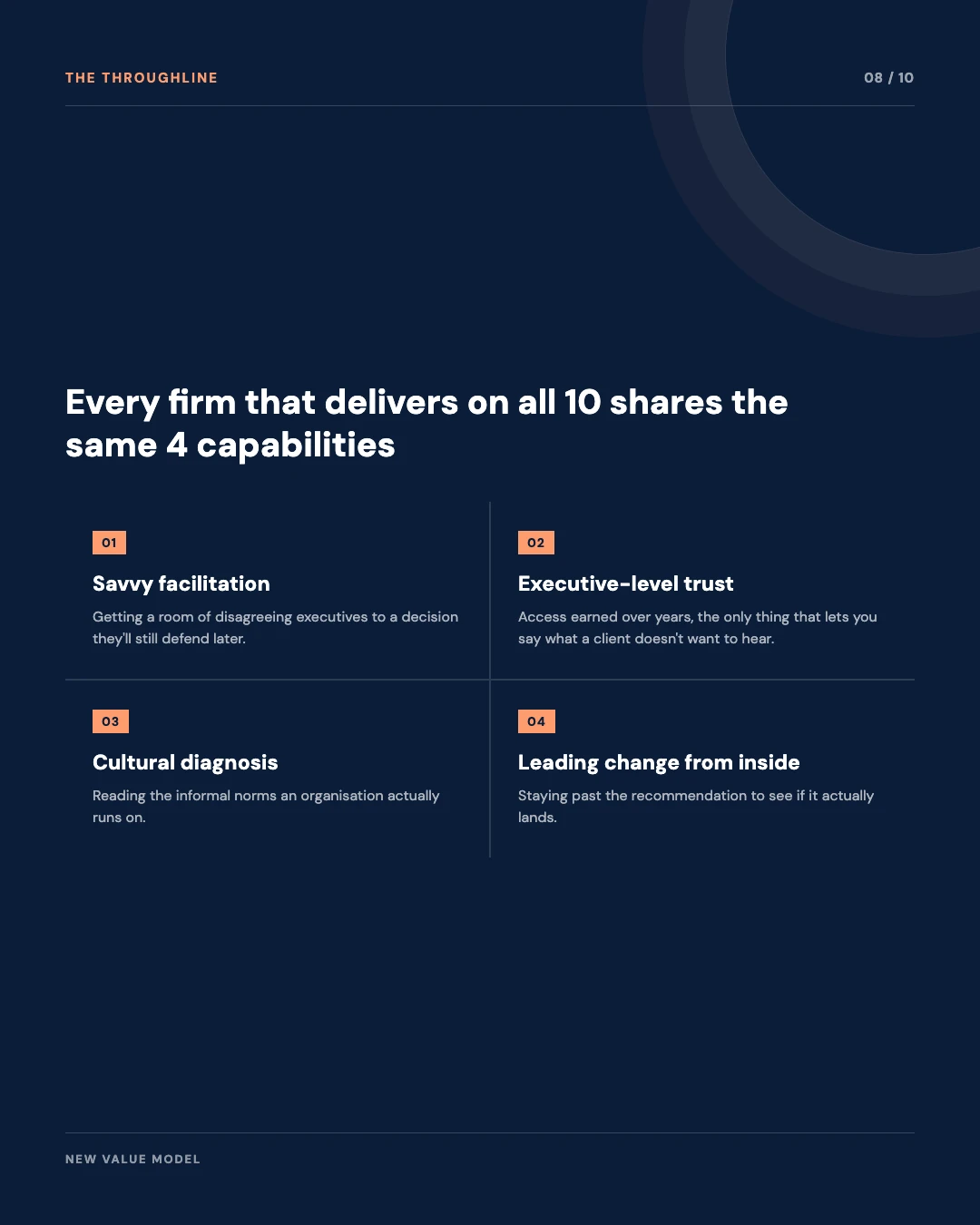
- What survives is a specific list of ten kinds of work, and every firm that delivers on them consistently shares four capabilities: facilitation, executive-level trust, cultural diagnosis, and the willingness to lead change from inside the organisation.
The ten categories and four capabilities, ten slides
Save it, share it, or send it to whoever’s still pricing your team by hours of research.
The 70% BCG never meant as a warning
BCG published a number a while back that should have reframed the entire conversation about what’s disappearing from professional services, and I don’t think enough people are reading it as reassurance rather than alarm. Its research on what determines whether an AI transformation succeeds landed on a specific split, since named the 10-20-70 rule: roughly 10% of the effort is the algorithm itself, 20% is the surrounding technology and data infrastructure, and 70% is people and process, change management, role redesign, governance, manager coaching, the parts that never make it into a vendor’s product demo.
Where AI transformation effort goes
Source: BCG research on what determines AI transformation success, the 10-20-70 rule. The 70% is the organisational layer where consultants still get paid.
BCG didn’t publish that split to describe a cost center someone should try to shrink. They published it because it’s the actual determinant of whether the other 30% pays off at all, and it happens to be the same 70% that was always the harder, more relationship-dependent half of consulting work to begin with. The algorithm was never the scarce resource. The ability to get seventy people to change how they work was.
What’s getting cut
The layer that’s disappearing first is the layer AI can already do on its own: research, drafting, first-pass analysis, the work that used to justify a junior team and a few weeks on the clock. Accenture put a number on it. In its fiscal Q4 2025 earnings call, CEO Julie Sweet confirmed the firm had cut more than 11,000 employees in a single quarter, booking an $865 million restructuring charge, and was explicit about the reasoning: people in roles that couldn’t be retrained fast enough for an AI-driven practice were being let go, while the firm doubled its own AI and data specialist headcount to 77,000 over the prior two years.
McKinsey’s 2025 State of AI report shows the same shift from the buyer’s side. 88% of companies now use AI regularly in at least one function, up from 78% the year before. But only 1% of leaders call their organisation’s deployment “mature,” meaning fully integrated into workflows and driving real business outcomes. Adoption is everywhere. Depth is almost nowhere. That gap is the analysis-and-drafting layer getting automated while the organisational layer above it, the one BCG’s 70% points at, sits mostly untouched.
AI adoption against AI maturity in 2025
Source: McKinsey, 2025 State of AI report. Adoption is measured across companies; maturity is how leaders describe their own organisation's deployment.
I wrote about the front half of this shift back in February, when the knowledge economy started deflating faster than most organisations had priced in. What’s below is the other half of that argument: not what’s disappearing, but what’s left once it does.
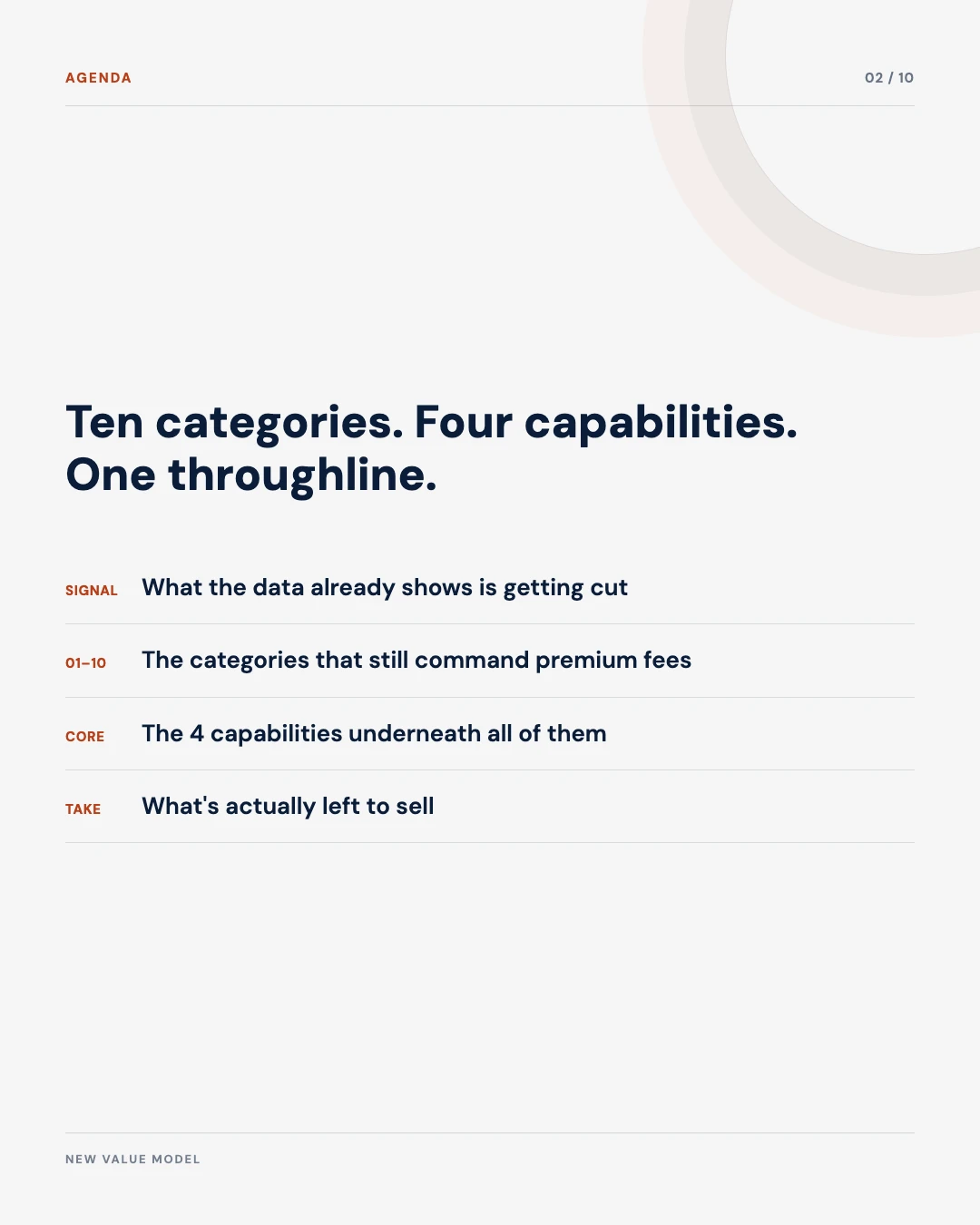
Ten categories, one throughline
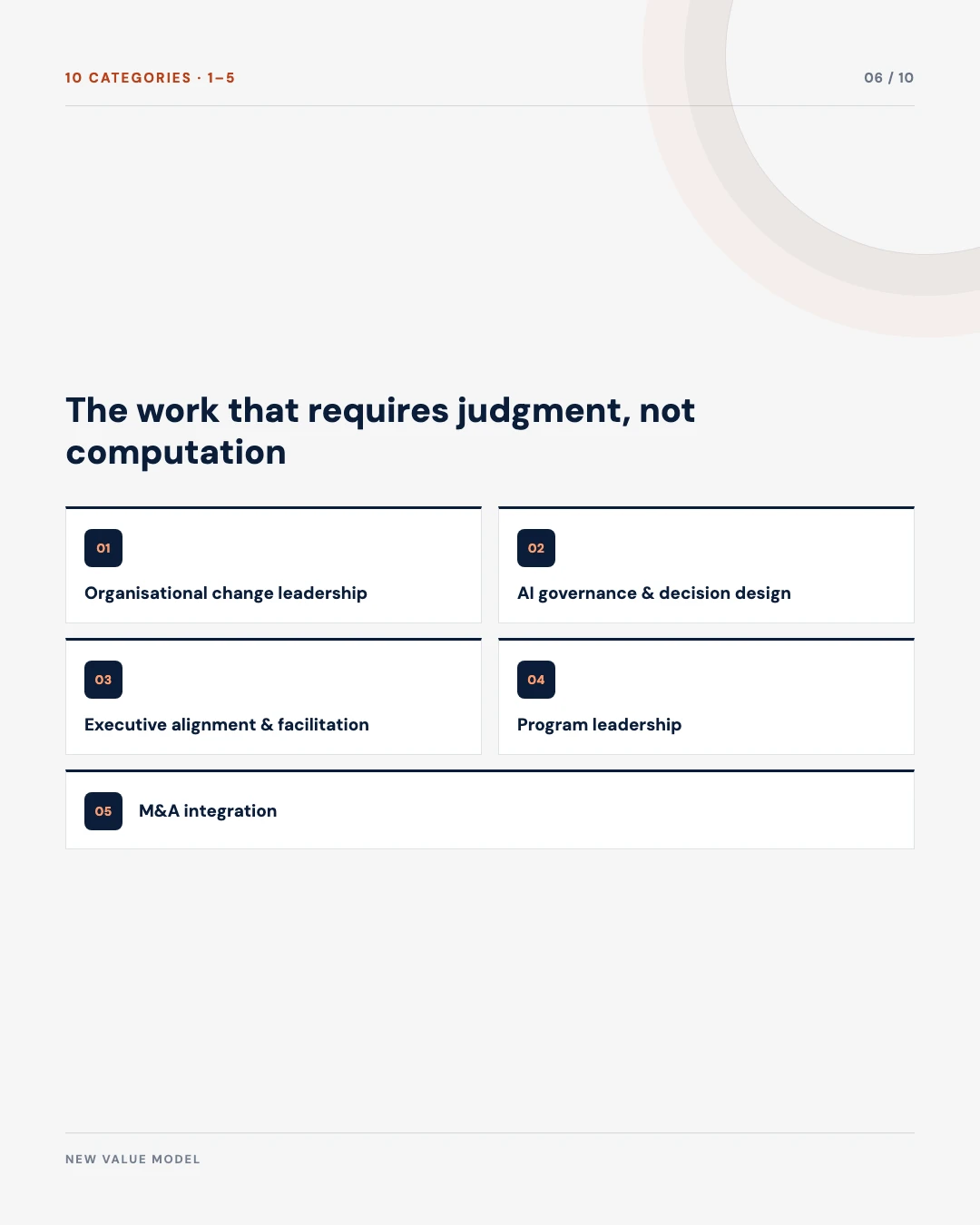
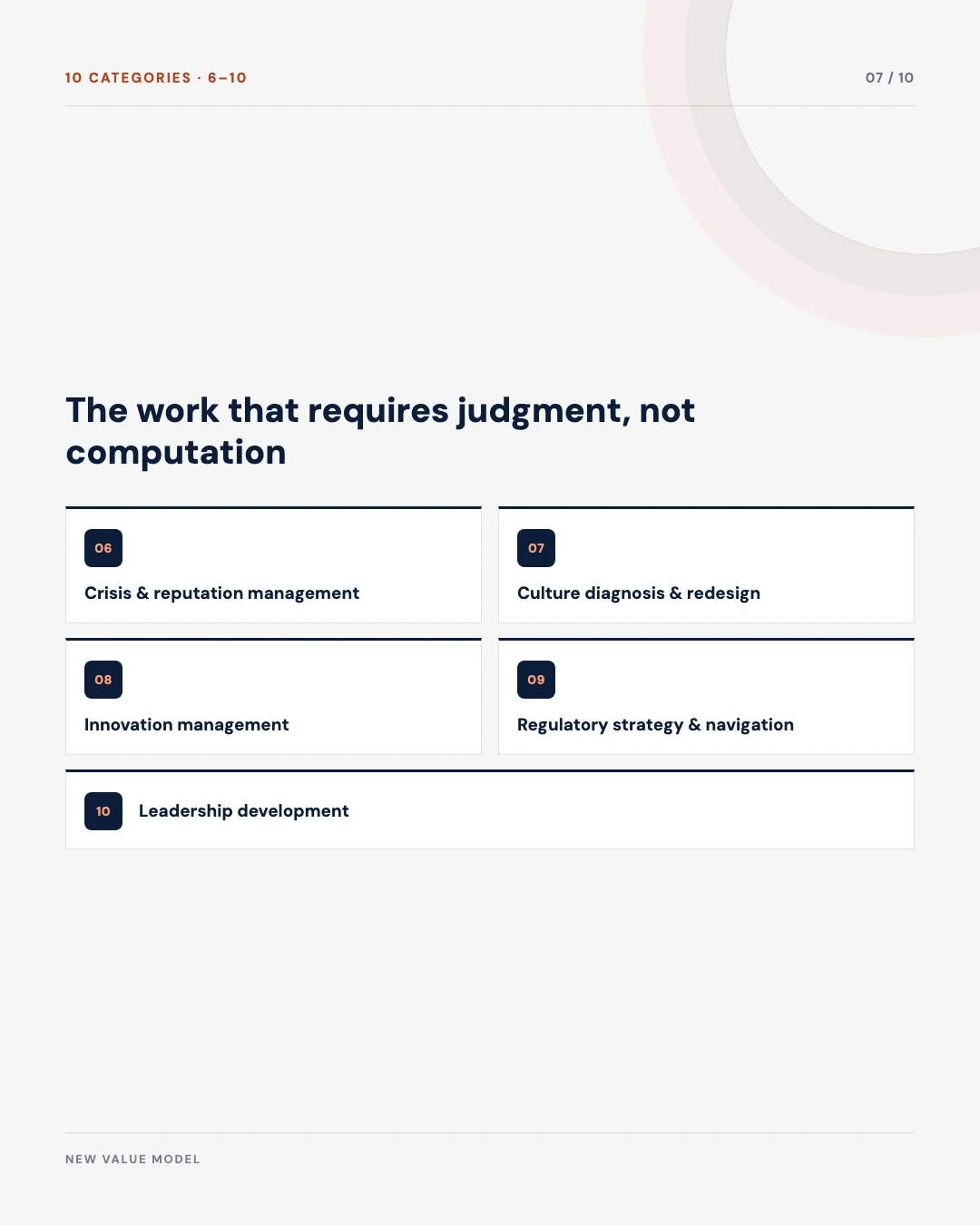
Here’s what I think will define the industry’s next decade. Every one of these ten categories requires judgment built from experience, not something computed from a dataset, which is exactly why none of them show up on a list of tasks a model can be assigned outright.
| # | Category | Why it resists commoditisation |
|---|---|---|
| 1 | Organisational change leadership | Getting a real workforce to adopt a new way of working, not just approve it in a steering committee |
| 2 | AI governance and decision design | Defining which decisions AI is allowed to own, and who answers for it when one goes wrong |
| 3 | Executive alignment and facilitation | Walking a room of senior leaders who disagree about the problem itself into a decision they’ll still defend six months later |
| 4 | Program leadership | Carrying end-to-end accountability for the full change, not a workstream inside someone else’s plan |
| 5 | M&A integration | The cultural and human reconciliation work no financial model in the deal room ever fully priced in |
| 6 | Crisis and reputation management | High-stakes judgment built from having sat in comparable situations before, not from a playbook |
| 7 | Culture diagnosis and redesign | Naming the informal norms and power dynamics blocking the strategy the board already approved |
| 8 | Innovation management | Backing a specific bet when the market data runs out, then staying to build what got chosen |
| 9 | Regulatory strategy and navigation | Knowing how one specific regulator behaves, earned from years of direct engagement, not from the published guidance |
| 10 | Leadership development | Accelerating a leader’s judgment and resilience through direct coaching under real stakes, not a training module |
Every row is a judgment call inside a specific human relationship. None of them is an output a model can generate on request, no matter how good the prompt is.
Free tool
Board AI Oversight Checklist
Category 2 in practice: who owns AI risk, and what requires sign-off, and from whom, before the decision-design conversation turns into a real governance gap.
The four capabilities underneath all ten
Look across the firms and individuals who consistently deliver on all ten categories, and the same four capabilities show up underneath every one of them. Savvy facilitation: the ability to get a room full of disagreeing executives to an actual decision, not a diplomatic non-decision everyone can live with until the next meeting. Executive-level trust: access earned over years of prior engagements, not granted on day one of a new contract, and the only thing that lets a consultant say something the client doesn’t want to hear and still be in the room next week. Cultural diagnosis: reading the informal rules an organisation runs on, which are rarely the ones printed in the employee handbook or the values poster in the lobby. And leading change from inside the organisation, staying past the recommendation long enough to see whether it lands, instead of handing over a report and moving to the next client.
None of those four are analytical skills. You can’t prompt your way to executive trust, and you can’t scrape cultural diagnosis off a company’s internal wiki. They’re built the slow way, one engagement at a time, and that’s precisely what makes them hold their price while the analysis around them goes to zero.
Free tool
AI Use Case Prioritisation Matrix
Category 8 in practice: rank the bets worth backing when the market data runs out and conviction has to fill the gap.
The only thing left to sell
Every client I work with can now run a first-pass market scan, draft a strategy memo, or produce a governance policy template in an afternoon, with a tool that costs less than a single billable hour did two years ago. That’s not a threat worth spending energy resisting. It’s just true, and pretending otherwise wastes everyone’s time, including the client’s.
What none of those tools can do is walk into a room of executives who disagree about the actual problem and get them to a decision they’ll defend six months later. None of them know, from having sat through three comparable crises before, which move calms a regulator down instead of provoking a harder response. None of them stay inside an organisation long enough to find out whether the change took, past the point where the deliverable was accepted and the invoice was paid.
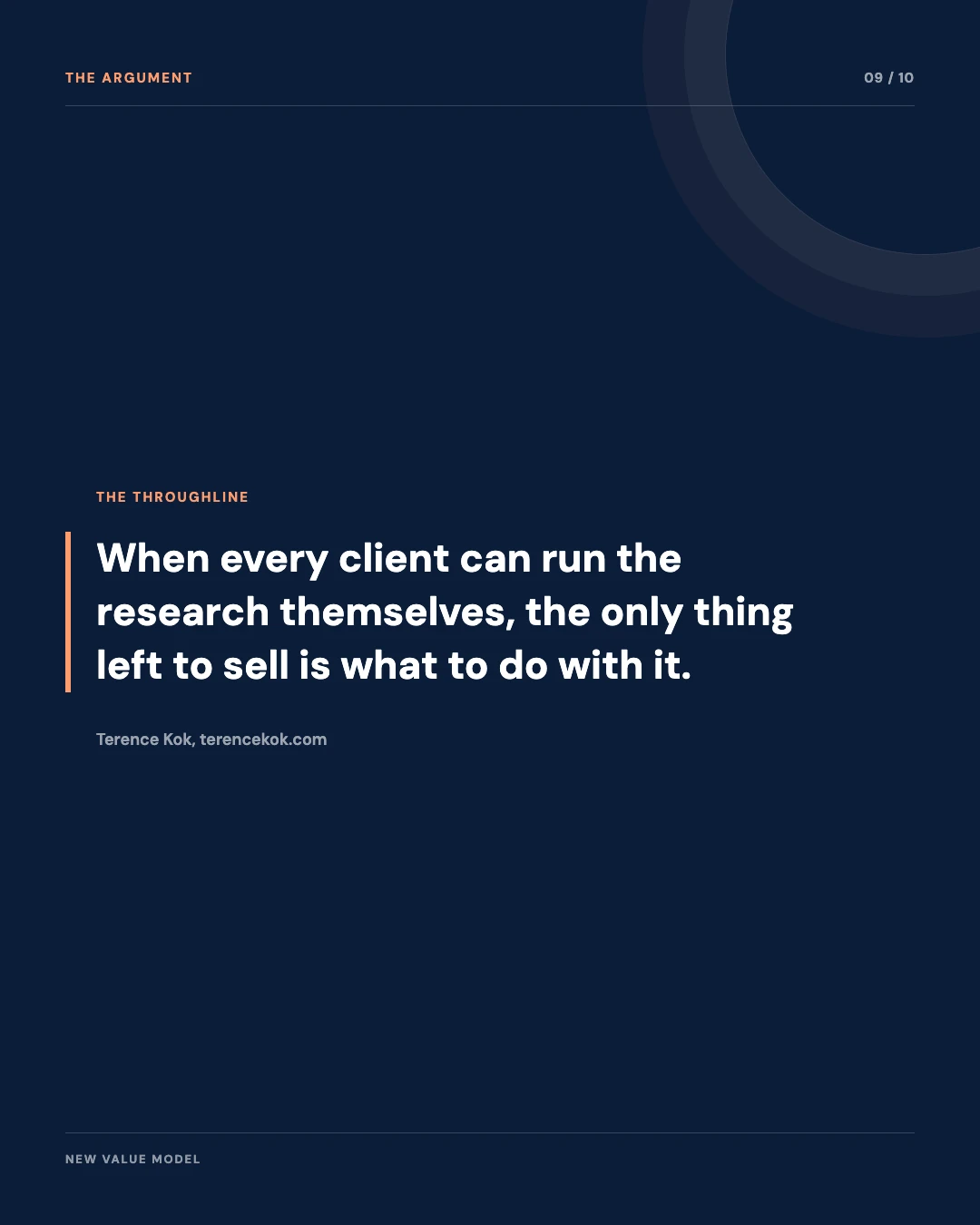
Underneath the consulting layoffs is a restructuring of the industry’s fundamental value proposition, not a shrinking of it. When every client can run the research themselves, the only thing left to sell is what to do with it.
Evidence & Methodology
Three of these four claims come from a company’s own earnings call or a named research report. The ten-category list and the four capabilities underneath it are mine, built from what I’ve been paid to do, not from a study of the consulting industry.
| Claim | Source | Grade |
|---|---|---|
| 70% of AI transformation success is people and process, not the algorithm | BCG’s research, the 10-20-70 rule | Measured |
| Accenture cut 11,000+ jobs in Q4 2025, citing AI-driven restructuring directly | Accenture’s own fiscal Q4 2025 earnings call | Documented |
| Only 1% of leaders call their organisation’s AI deployment mature | McKinsey, 2025 State of AI report | Measured |
| Ten categories of consulting work resist commoditisation, built on four shared capabilities | My own list, drawn from work I’ve been paid to do | My framework |
Sources
- Accenture. (2025, September). Fiscal Q4 2025 earnings call. Remarks by CEO Julie Sweet on AI-driven restructuring.
- BCG. (2025). The leader’s guide to transforming with AI.
- McKinsey. (2025). Superagency in the workplace: State of AI 2025.
The AI Governance & ROI Executive Programme spends real time on exactly this shift, the four capabilities that don’t automate. Details are on the workshops page.
Was this useful?