
Listen to this article
Executive Summary
AI success isn’t a technology problem, it’s a sequencing problem. MIT, BCG, and McKinsey’s research all converge on the same pattern: most enterprise AI pilots fail not from weak models, but from skipping the economics and adoption work required to reach production.
95%
of enterprise AI pilots fail to deliver measurable impact
70%
of resources at high-performing AI organisations go to people and process, not algorithms
65%
of organisations report regular gen AI use, nearly double in ten months
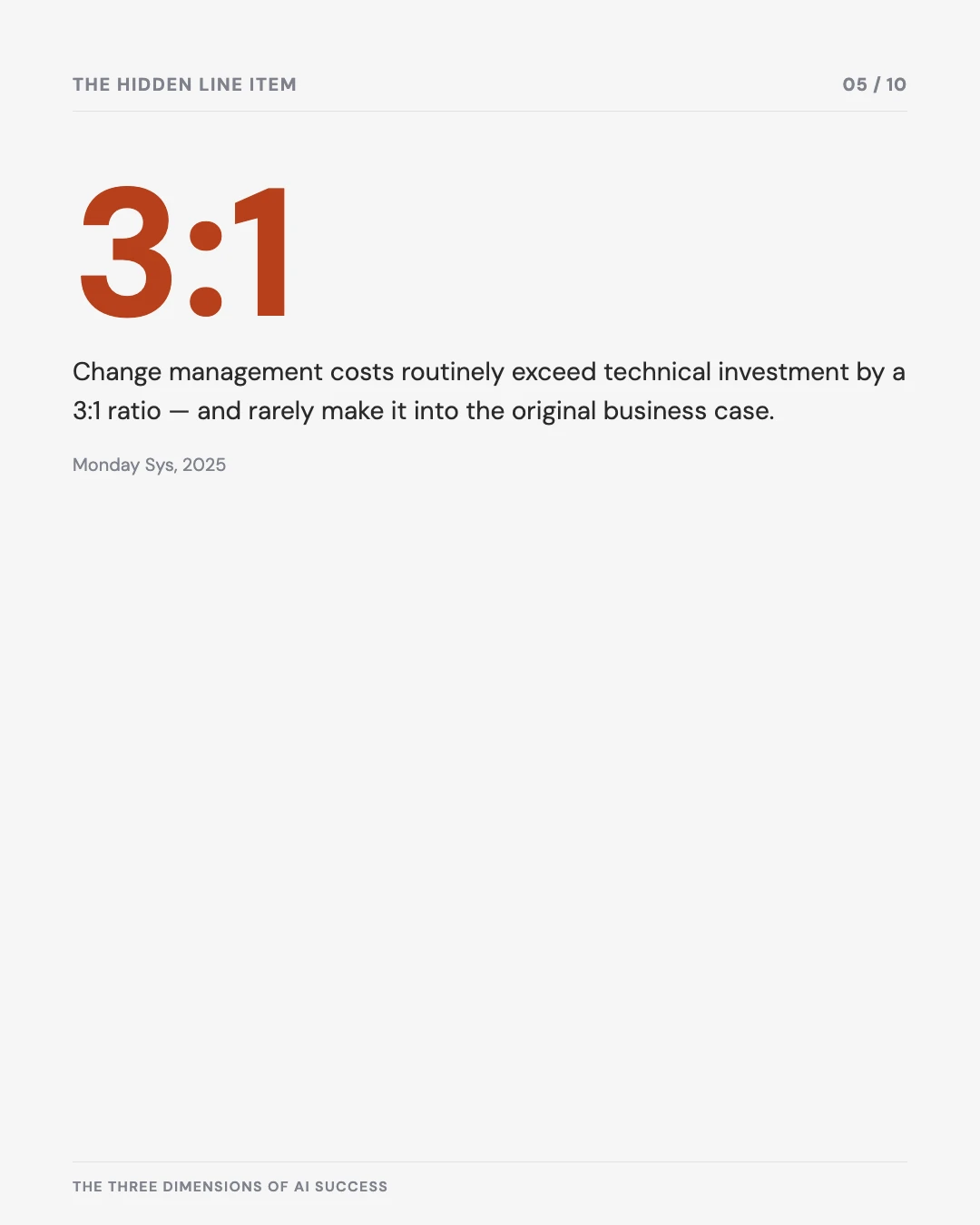
3:1
the ratio by which change management costs exceed technical investment
Core conclusions
- Technology, economics, and adoption are three separate, sequential tests every AI initiative has to pass. Clearing one doesn’t clear the others.
- BCG’s research on high performers shows the resourcing instinct most organisations follow is inverted: the winners put 70% of resources into people and process, not algorithms.
- Change management isn’t a soft cost. It routinely runs three times the technical investment, and skipping it is what turns working technology into shelfware.
The framework, in ten slides
Save it, share it, or send it to whoever’s about to greenlight the next pilot.

The data, in two tables
Where implementation actually breaks
| Metric | Value | Source |
|---|---|---|
| Enterprise AI pilots failing to deliver measurable impact | 95% | MIT Media Lab (Challapally, Cizmar & Sadeghi, 2025) |
| Companies that abandoned AI initiatives in 2025 | 42%, up from 17% in 2024 | S&P Global Market Intelligence, 2025 |
| Organisations reporting regular gen AI use, early 2024 | 65%, nearly double the figure ten months prior | McKinsey & Company, 2024 |
The 95% and 42% figures aren’t given an inline citation in the original text but correspond to the MIT Media Lab and S&P Global studies listed in the references below.
Where the AI budget actually goes
| Metric | Value | Source |
|---|---|---|
| Resource allocation at high-performing AI organisations | 70% people & process, 20% technology/data, 10% algorithms | BCG, 2024 |
| Vendor licensing and API fees as share of total AI TCO | <40% | Monday Sys, 2025 |
| Additional resource draw from continuous model retraining | 22% beyond initial deployment costs | Monday Sys, 2025 |
| Change management cost vs. technical investment | 3:1 ratio | Monday Sys, 2025 |
| Timeline and budget successful organisations allocate to data readiness | 50–70% | WorkOS, 2025 |
| Unplanned AI expenditure from infrastructure upgrades and talent acquisition | 65% | WorkOS, 2025 |
TCO: total cost of ownership. See references below for full source details.
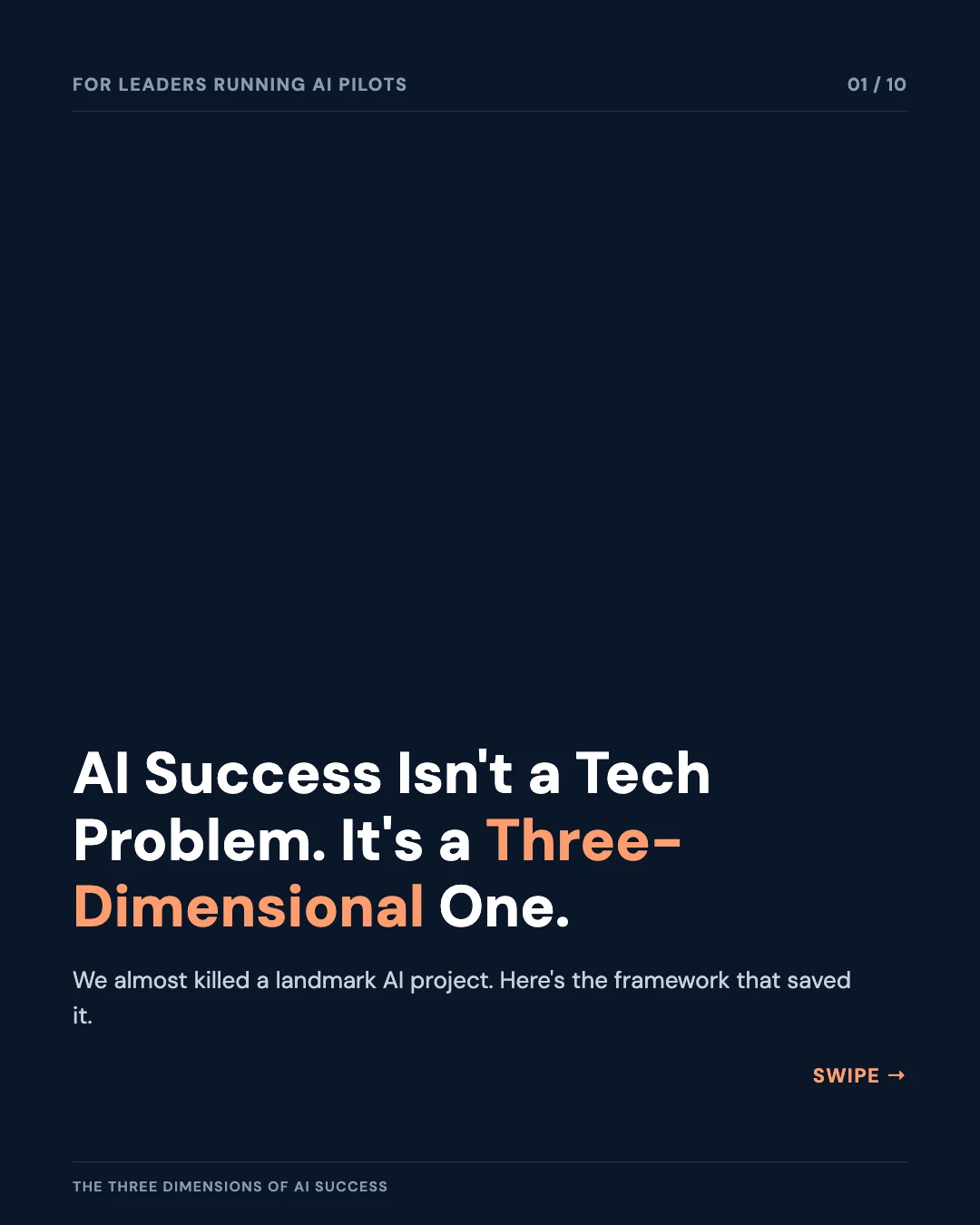
Just not too long ago, we almost killed a landmark AI project. The technology was brilliant: our data science team had built a system that could process documents 10x faster than humans. The business case showed clear ROI. But when we asked the operations team if they’d actually use it, the room went silent.
That’s when I learned the hard way: having great AI technology isn’t enough. Neither is having strong economics. You need both, plus something else entirely: people who will actually adopt it.
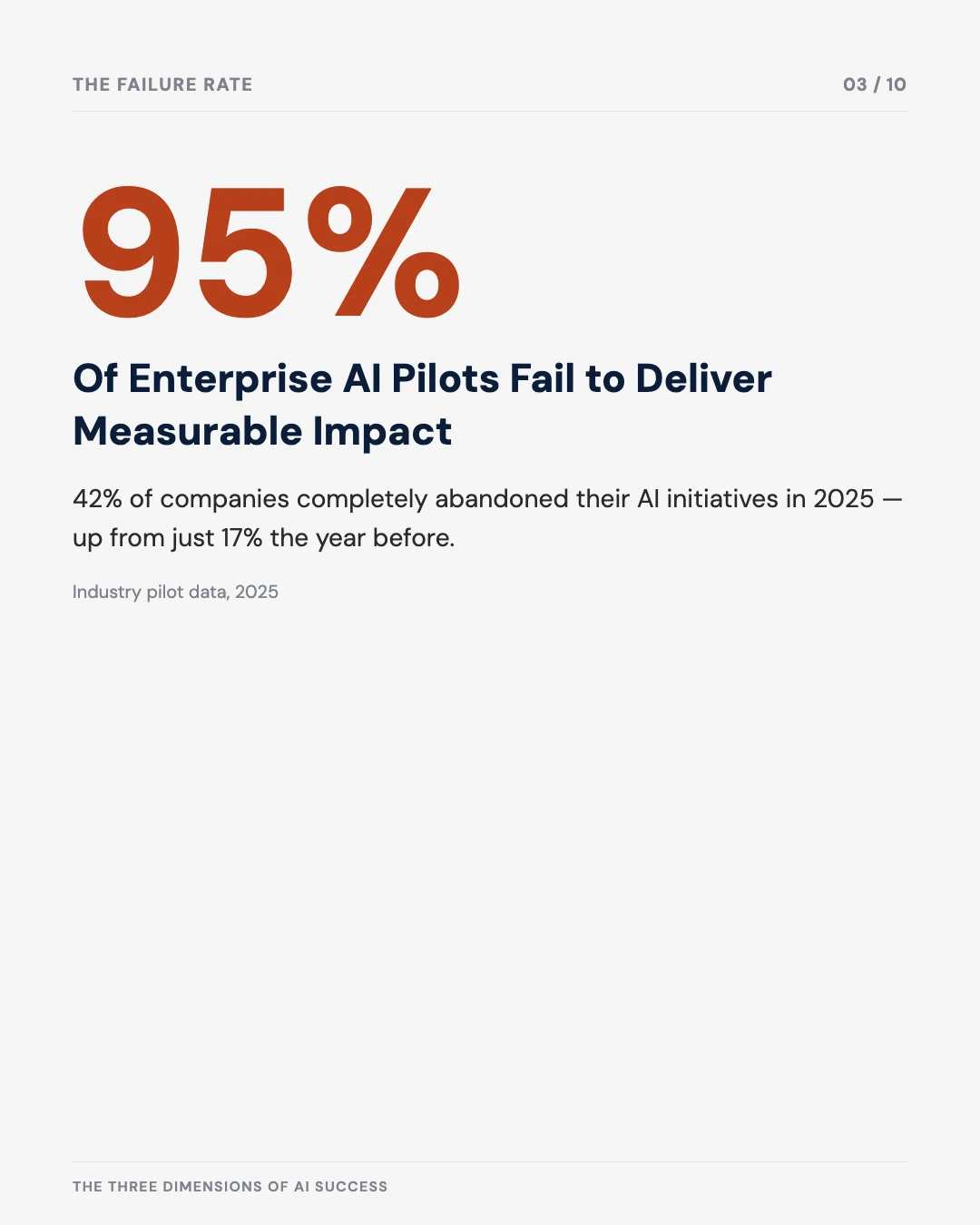
The stats back this up brutally: 95% of enterprise AI pilots fail to deliver measurable impact. Even worse, 42% of companies completely abandoned their AI initiatives in 2025, up from just 17% the year before. After studying what went wrong (and occasionally being part of what went wrong), I’ve seen a clear pattern emerge.
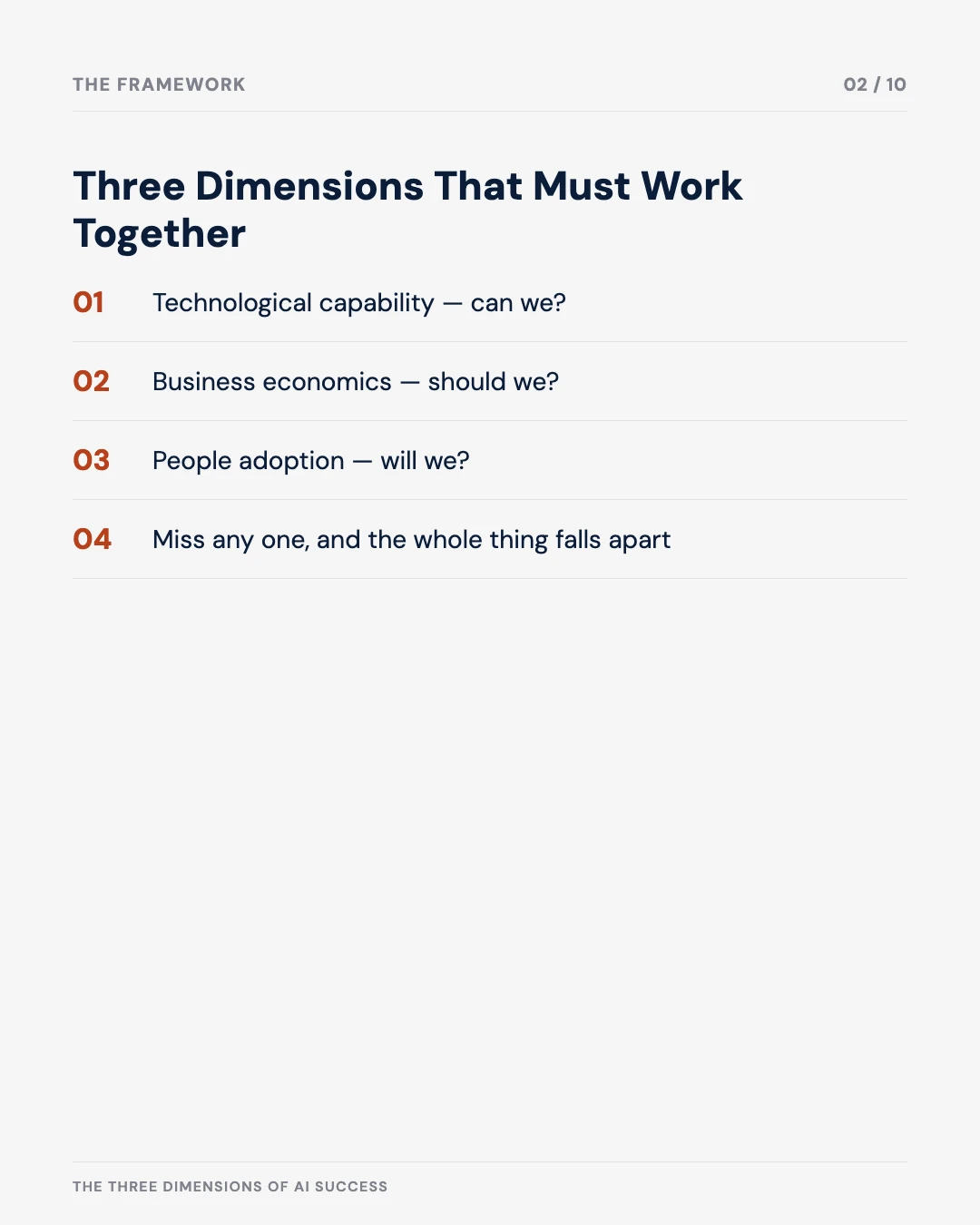
Successful AI implementation comes down to three dimensions that must work together: technological capability, business economics, and human adoption. Miss any one, and the whole thing falls apart. Let me break down what I’ve learned about each:
The Three-Dimensional Framework
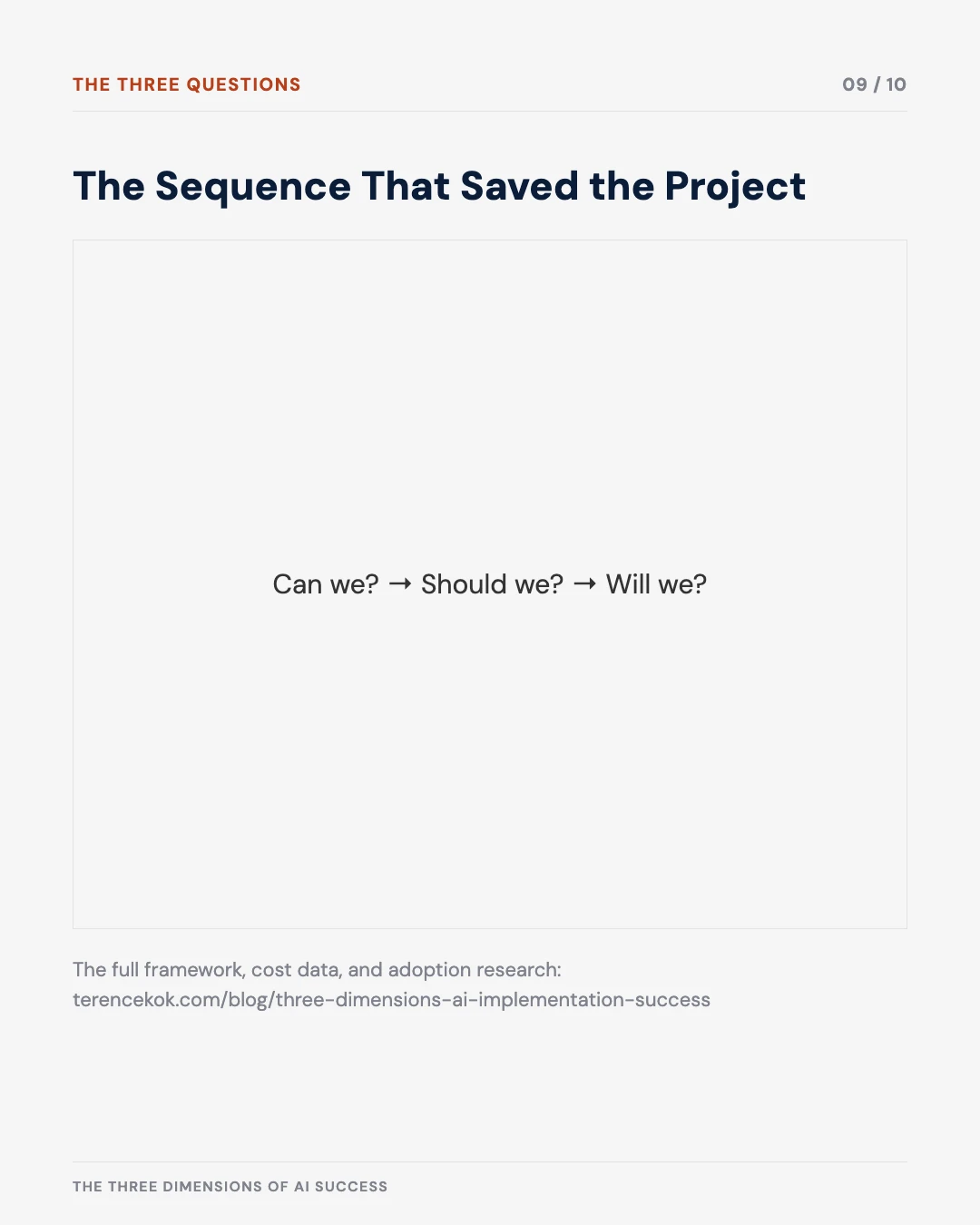
Dimension One: Technological Capability (The “Can We?” Question)
Technology naturally assumes the leading position in any AI initiative. It is the essential prerequisite: the spark that enables possibility. Whether the application involves computer vision systems for urban infrastructure, natural language processing for knowledge automation, or multimodal agent frameworks for complex workflow orchestration, the underlying technology must first be demonstrated to be viable.
The maturity curve here has been steep. Generative AI adoption has accelerated dramatically, with 65% of organisations reporting regular use of gen AI as of early 2024, nearly double the percentage from ten months prior (McKinsey & Company, 2024). Large language models have become increasingly sophisticated, edge computing architectures are maturing, and cloud infrastructure providers have substantially lowered barriers to experimentation. The tooling ecosystem is increasingly robust. Model architectures improve quarterly. Training efficiency metrics show consistent advancement.
It has also become clear that possessing pure technological capability is only a necessary condition and not sufficient by itself. Technology offers the foundation, but foundations alone do not make a building.
Dimension Two: Business Economics (The “Should We?” Filter)
Once technological feasibility is established, the conversation shifts fundamentally. This is where the separation between funded innovation and funded waste occurs. This is the dimension where many organisations stumble most conspicuously.
The question is deceptively straightforward: Does this use case stack up economically? In practice, organisations frequently fail to conduct this analysis with appropriate rigour. Executives become intellectually committed to technological capability and overlook the financial architecture underneath.
Consider the Total Cost of Ownership (TCO) for a typical machine learning implementation. Vendor licensing and API fees typically account for less than 40% of total expenses (Monday Sys, 2025). The remaining 60%+ comprises infrastructure investment, data pipeline optimisation, continuous model retraining (consuming 22% additional resources beyond initial deployment costs), security infrastructure, compliance oversight, and talent acquisition/retention. A healthcare provider examined its AI implementation costs and found that 63% of expenditures were attributable to data pipeline optimisation and GPU cluster management, costs not included in vendor proposals (Monday Sys, 2025).
Infrastructure upgrades and talent acquisition account for 65% of unplanned expenditures in enterprise AI projects (WorkOS, 2025). Change management costs (the investment required to bring the organisation along the adoption curve) frequently exceed technical investments by a 3:1 ratio (Monday Sys, 2025). That is the hidden line item I dig into in Why Your AI Budget Could Be Backwards: the people costs that rarely make it into the original business case. These are not theoretical constructs; they are budget realities that determine whether a project delivers return on capital or consumes it.
Successful organisations approach this differently. They allocate 50–70% of the project timeline and budget to data readiness activities: data extraction, normalisation, governance framework establishment, quality dashboards, and retention controls (WorkOS, 2025). They model production infrastructure costs before initiating proof-of-concept work, not after. They establish clear, quantifiable return thresholds, not vanity metrics around model accuracy or processing speed, but operational indicators aligned to business strategy: cost per unit, cycle time reduction, customer retention improvement, or revenue acceleration in specific segments.
This second dimension is where ruthlessness becomes a virtue:
“Clever technology deployed without sound economics is merely expensive debt carrying an attractive label.”
Dimension Three: People Adoption (The “Will We?” Reality)
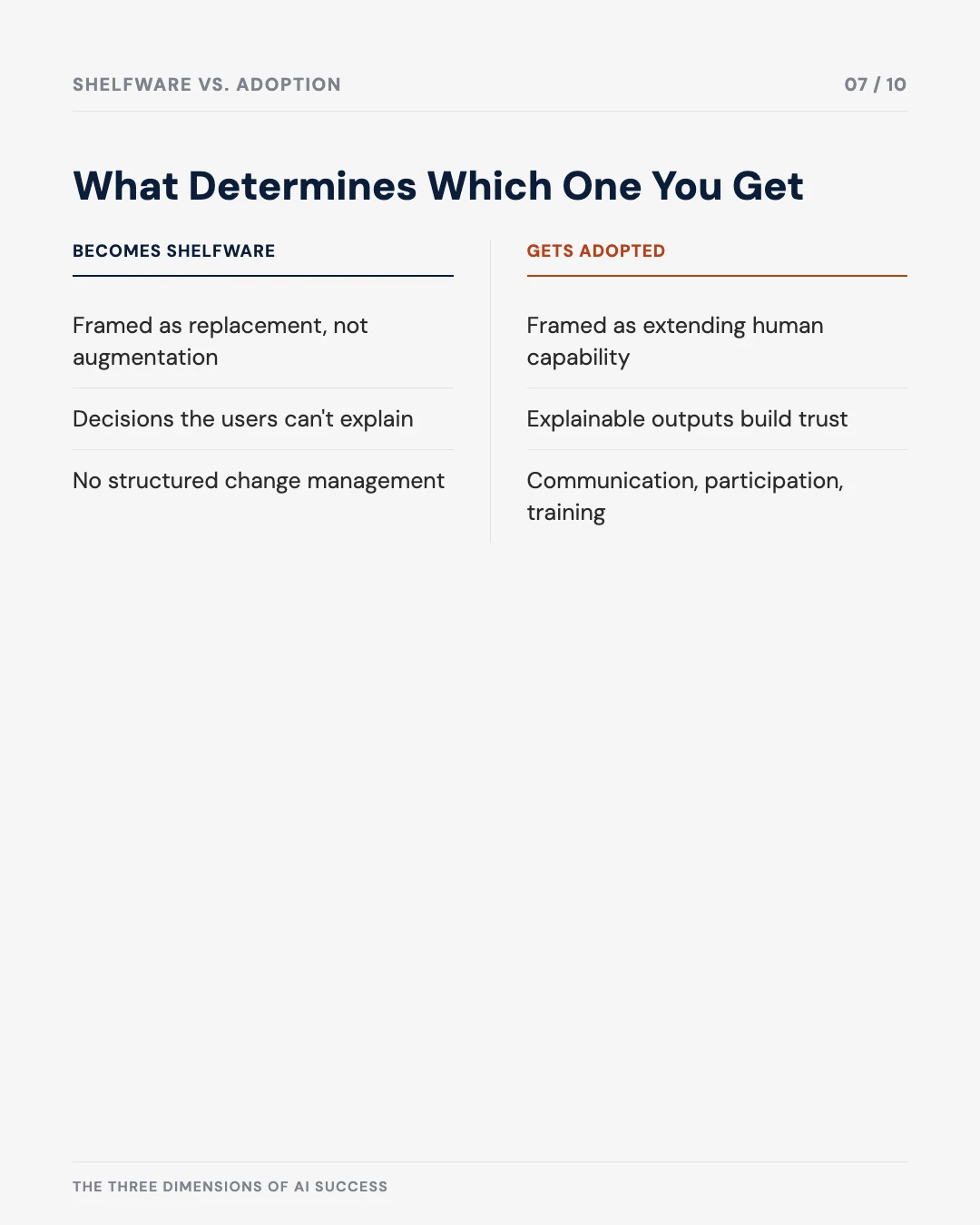
This is the dimension where the most damage occurs. Organisations can correctly execute technology and economics, yet fail spectacularly at adoption, resulting in what the industry calls “shelfware”: expensive software that sits unused because the intended users do not trust it, understand it, or see themselves reflected in the implementation narrative.
The root causes of adoption resistance are not mysterious. Priyanghaa et al. (2025), in research published in the Journal of Management and Systems Research, identified three primary resistance drivers: fear of job displacement, distrust of AI systems, and perceived complexity of the underlying technology. I have written separately about closing that same gap across a workforce with uneven AI exposure. These concerns are rational and deserve to be addressed through structured change management, not dismissed.
The narrative framing here is critical. When organisations position AI as a replacement technology, adoption resistance is not a problem to be overcome. It is a rational response. When AI is framed as augmentation, extending human capability rather than rendering it obsolete, the psychological foundation for adoption shifts substantially
Trust operates as the critical mediating variable. Research from the Nanyang Technological University (Singapore) analysing 1,002 respondents found that perceived explainability of AI systems significantly shaped trust in AI engineers across all three dimensions of organisational trust: ability, benevolence, and integrity (Hasan et al., 2025). When organisations can explain why an AI system made a particular decision, stakeholders attribute that transparency to engineered intent: a signal of ethical and competent practice. Conversely, unexplainable outputs generate uncertainty and anxiety, suppressing adoption.
This finding aligns with a broader pattern observed across mature AI implementations: explainability is not a nice-to-have compliance add-on. It is a foundational adoption driver. McKinsey & Company research indicates that explainability enhances user engagement and confidence, both of which are critical for enterprise adoption (McKinsey & Company, 2025).
Change management becomes the operational mechanism through which adoption occurs. Priyanghaa et al. (2025) found structured change management approaches involving clear communication, employee participation, and ongoing training significantly reduced adoption resistance and increased organisational readiness. However, the research also identified a critical gap: feedback mechanisms and continuous training programmes remain underdeveloped in most organisations attempting AI integration.
The Sequence and Integration Dynamics
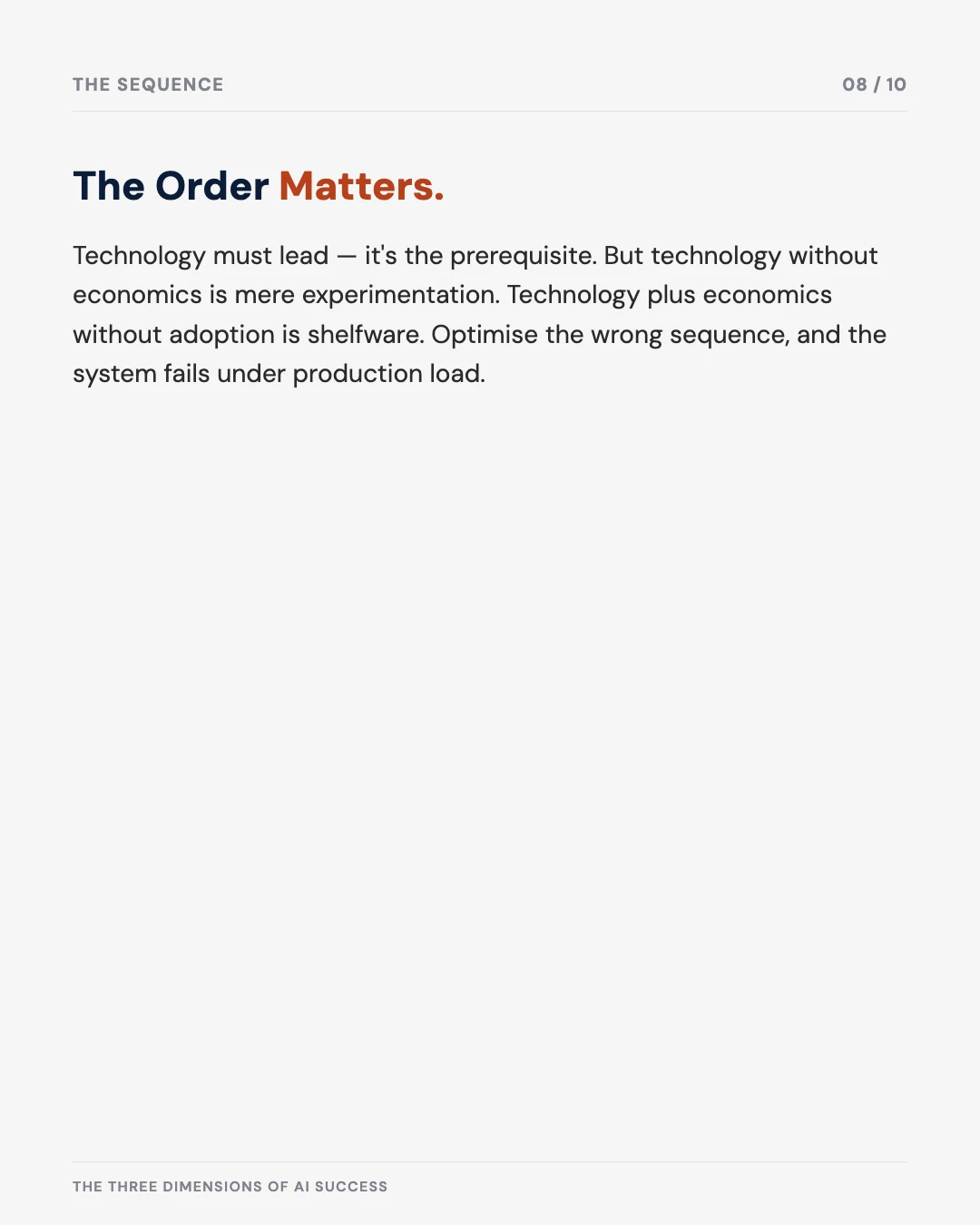
The sequence matters more than commonly recognised. Technology must lead; it is a prerequisite. But technology divorced from economics is mere experimentation. Technology plus economics without adoption is “shelfware”. The three dimensions form an interdependent system. Optimise the wrong sequence, and the system fails under production load.
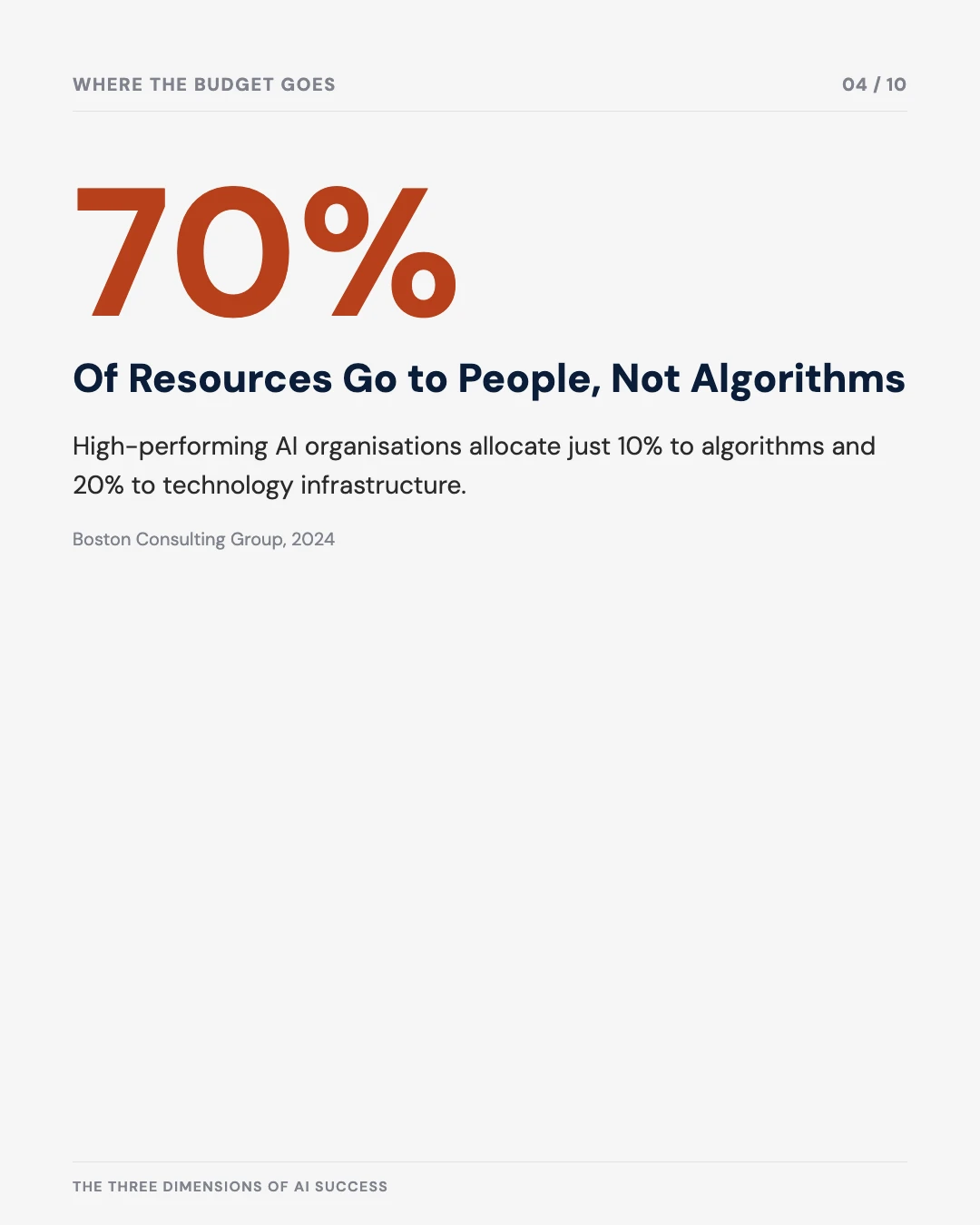
Boston Consulting Group research examining high-performing AI organisations identified a striking pattern in resource allocation: leaders allocate 10% of resources to algorithms, 20% to technology and data infrastructure, and 70% to people and processes (BCG, 2024). This inverts the typical distribution in most organisations. It signals that success is determined far more by how effectively an organisation mobilises and aligns human capability than by algorithmic sophistication
Conclusion
Here’s what I wish I’d known before that boardroom meeting: AI isn’t overhyped, but the way most organizations implement it is deeply flawed. When you balance all three dimensions (proven technology, sound economics, and genuine adoption readiness), AI delivers substantial value.
The winners won’t be the companies with the fanciest models or the biggest data science teams. They’ll be the ones that maintain equilibrium across all three dimensions: investing smartly in technology, building realistic economic models upfront, and treating adoption as a core design constraint, not an afterthought.
In today’s AI landscape, discipline beats novelty every time. Treat AI deployment like infrastructure implementation: with rigor, realistic expectations, and respect for the humans who need to use it.
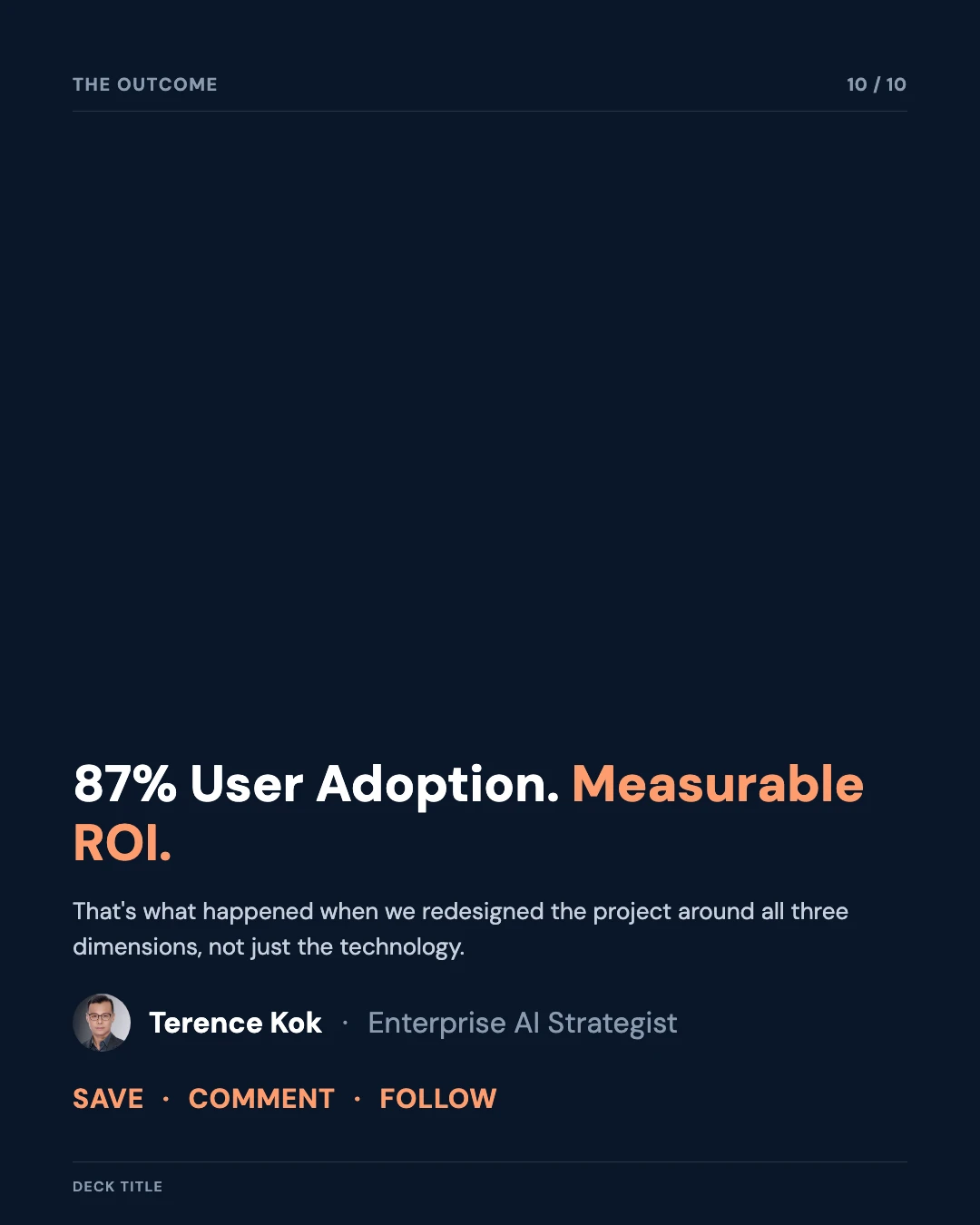
For the project that we almost canned? We redesigned it with all three dimensions in mind. Six months later, it’s running in production with 87% user adoption and delivering measurable ROI.
What’s been your experience with AI implementation? Which dimension has been your biggest challenge: technology, economics, or adoption? I’d love to hear your stories in the comments.
References
American Psychological Association. (2019). Publication manual of the American Psychological Association (7th ed.).
Boston Consulting Group. (2024). AI adoption in 2024: 74% of companies struggle to achieve and scale value [Blog post]. Retrieved from https://www.bcg.com/press/24october2024-ai-adoption-in-2024-74-of-companies-struggle-to-achieve-and-scale-value
Challapally, A., Cizmar, J. B., & Sadeghi, K. (2025). The GenAI Divide: State of AI in Business 2025. MIT Media Lab & MIT Connection Science.
Google Cloud. (2024). Real-world generative AI use cases from industry leaders. Retrieved from https://cloud.google.com/transform/101-real-world-generative-ai-use-cases-from-industry-leaders
Hasan, M., Gao, L., & Tan, A. (2025). The effectiveness of explainable AI on human factors in trust models. PLOS ONE, 20(7). https://doi.org/10.1371/journal.pone.0307662
McKinsey & Company. (2024). The state of AI in 2024. Retrieved from https://www.mckinsey.com/capabilities/quantumblack/our-insights/the-state-of-ai-2024
Monday Sys. (2025). Calculating the total cost of ownership (TCO) for AI/ML systems. Retrieved from https://mondaysys.com/ai-total-cost-of-ownership/
Priyanghaa, M., Eswaran, R., & Mohana Devi, S. (2025). AI adoption in HR: Resistance, readiness, and the role of change management. Journal of Management and Systems Research, 11(4), 401–425.
S&P Global Market Intelligence. (2025). AI implementation survey: 2025 enterprise challenges.
WorkOS. (2025). Why most enterprise AI projects fail—and the patterns that actually work. Retrieved from https://workos.com/blog/why-most-enterprise-ai-projects-fail-patterns-that-work
Free tool
The Discipline Gap
The same “can we, should we, will we” sequence that saved the project we almost killed, laid out as a briefing on why most transformations stall before they scale.
Free tool
AI ROI Calculator
Pressure-test the “should we” dimension before you build: model the TCO and return your own project’s economics actually need to clear.
Was this useful?