
Listen to this article
Executive Summary
AI has dismantled the measurement problem that kept time-based billing in place. Businesses that price on hours, seats, or licences now face a structural threat from providers who price on outcomes instead.
Core conclusions
- Time-based and per-seat pricing decouple price from value: the vendor earns the same whether the work produces a ten-times return or a marginal one, and AI has removed the measurement excuse for keeping it that way.
- The transition from time-based to outcome-based pricing works as a staged migration: instrumentation and baseline, hybrid model, outcome-led, then mature OaaS. Attempting to skip straight to pure outcome pricing produces measurement disputes and cash-flow crises.
- Five decisions have to be resolved before any outcome contract is signed: outcome unit selection, attribution methodology, floor and ceiling provisions, client-side data obligations, and exit/data portability.
The argument, in ten slides
Save it before your next pricing review, or send it to whoever owns the commercial model.
Rolls-Royce has charged airlines per flying hour (not per engine) since 1962. What is new in 2026 is that the same logic can now be applied to knowledge work, public services, and software delivery. The technology barrier has dissolved.
The service economy has operated on a simple premise for a century: you pay for hours, seats, and licences. AI has broken that premise. The question is not whether your business adapts; it is whether you move before or after the erosion of margins begins.
Who Is Most Exposed
The time-and-materials contract, the per-seat licence, and the annual managed services retainer share a common flaw: they decouple price from value. A vendor earns the same revenue whether the work produces a ten-times return or a marginal improvement. The client carries all execution risk. For decades, this worked because there was no practical alternative: outcomes were difficult to define, harder to measure, and impossible to attribute cleanly. AI has dismantled each of those objections in turn. Agentic systems can now execute complex, multi-step workflows autonomously. Machine learning can isolate the contribution of an intervention from confounding variables with statistical rigour. The measurement problem that kept time-based billing in place no longer holds.
The measurement problem that kept time-based billing in place no longer holds.
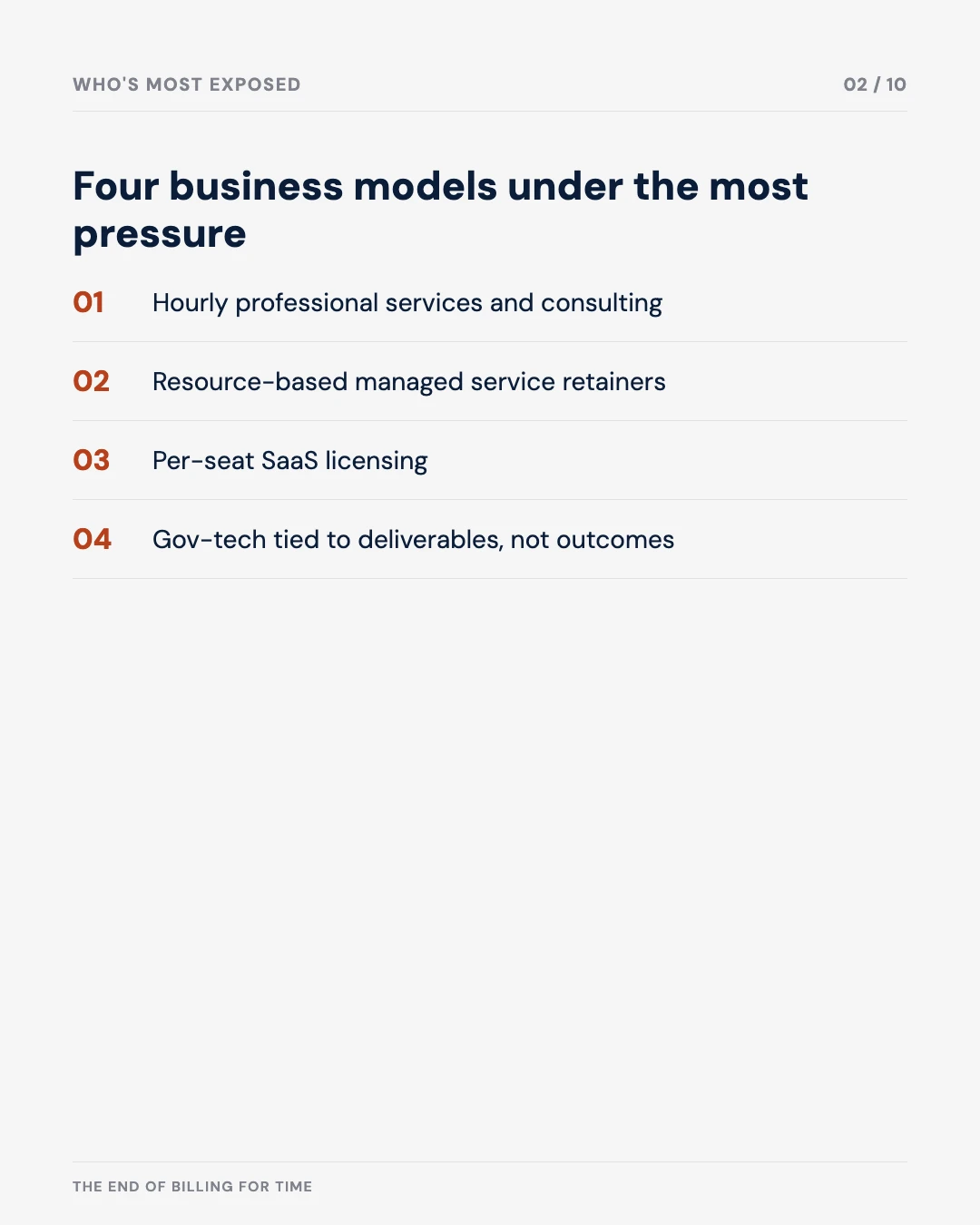
Not every business faces equal urgency. Professional services and consulting firms billing by the hour or day are acutely vulnerable: when an AI agent can execute in hours what a team of analysts required weeks to produce, the value of the time itself approaches zero. Managed service providers operating on resource-based retainers are already under pressure, as clients begin to ask why they pay a fixed monthly fee regardless of incident frequency or uptime achievement. Software vendors with per-seat SaaS models face the most technically immediate threat: when an AI agent can perform the work of multiple human users on a single licence, seat-based pricing becomes structurally indefensible. Government technology suppliers and system integrators operating in Asia and the Middle East face a different but equally significant pressure: national transformation programmes are increasingly specifying measurable citizen outcomes, not technology deliverables.
The Case for Transitioning
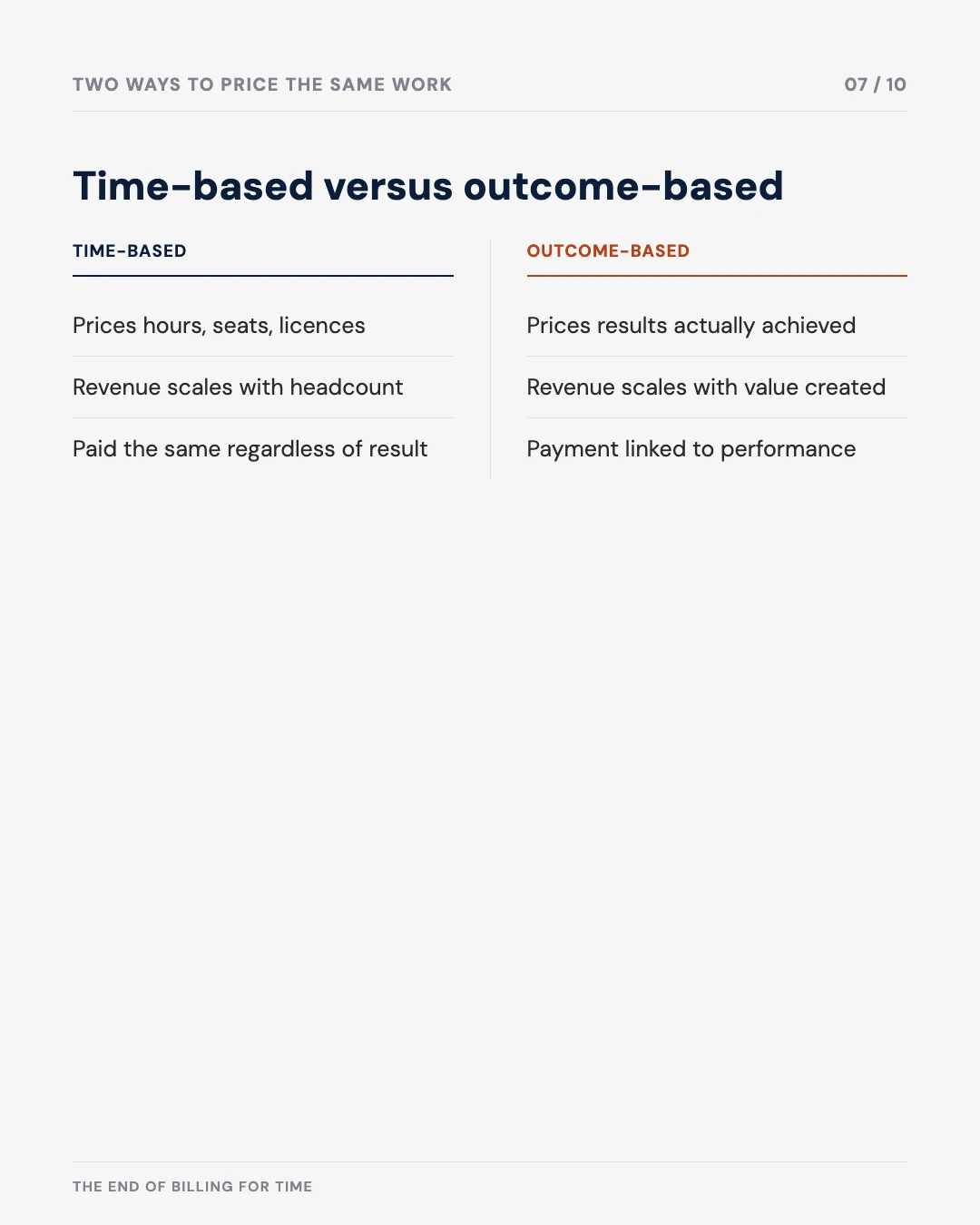
The transition from time-based to outcome-based pricing is not a pricing exercise. It is a reconfiguration of the commercial model, delivery architecture, and organisational incentive structure. The structural differences are significant: time-based models price inputs (hours, seats, licences) regardless of output; outcome-based models price results (transactions processed, threats neutralised, outcomes achieved). Revenue scales with customer value creation, not with headcount or licence count.
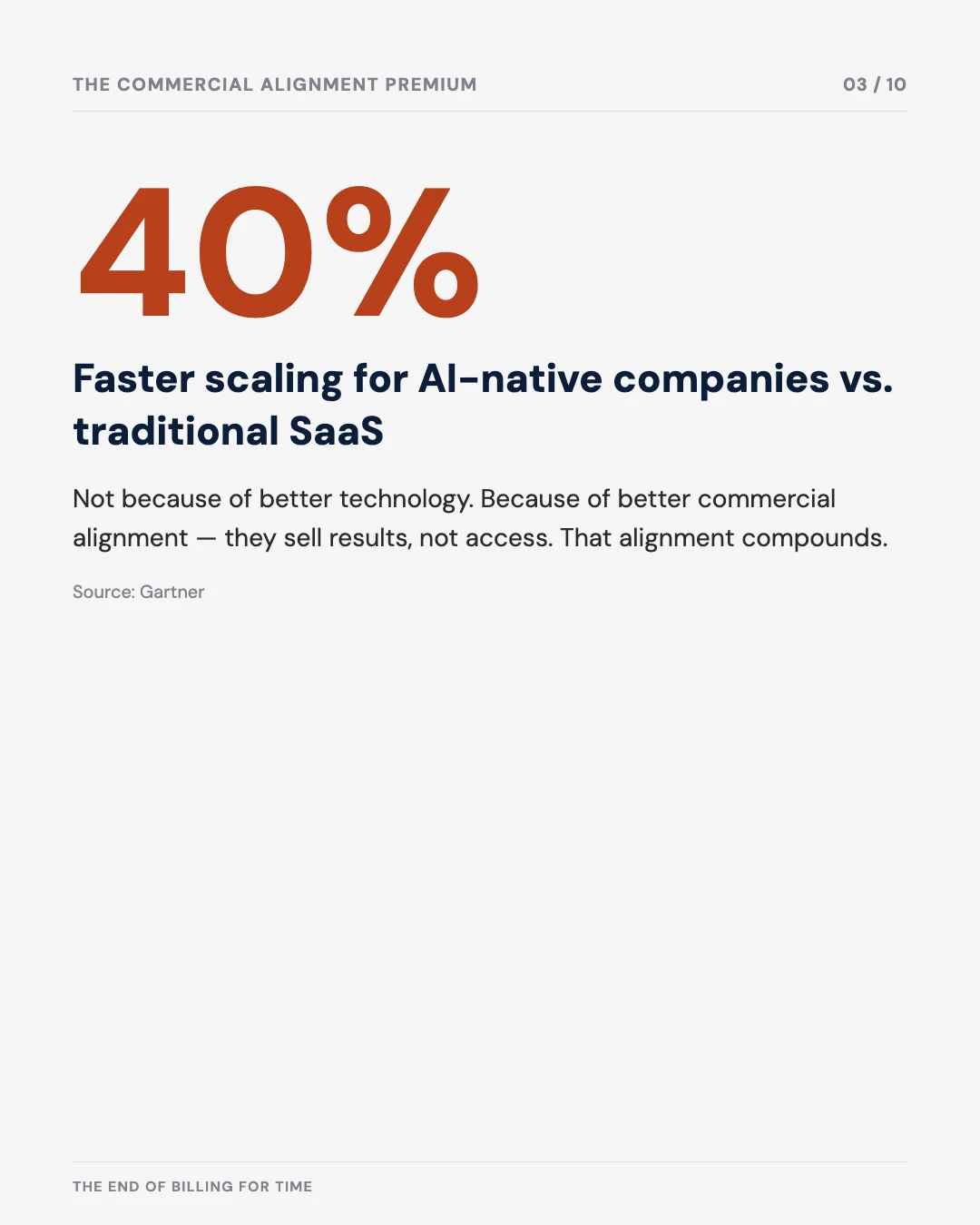
Gartner projects that AI-native companies are scaling 40% faster than traditional SaaS providers. The structural reason is not that they have better technology. It is that they have better commercial alignment: they sell results, not access. That alignment is an asymmetric competitive advantage, and it is compounding.
They sell results, not access. That alignment is an asymmetric competitive advantage, and it is compounding.
How to Transition
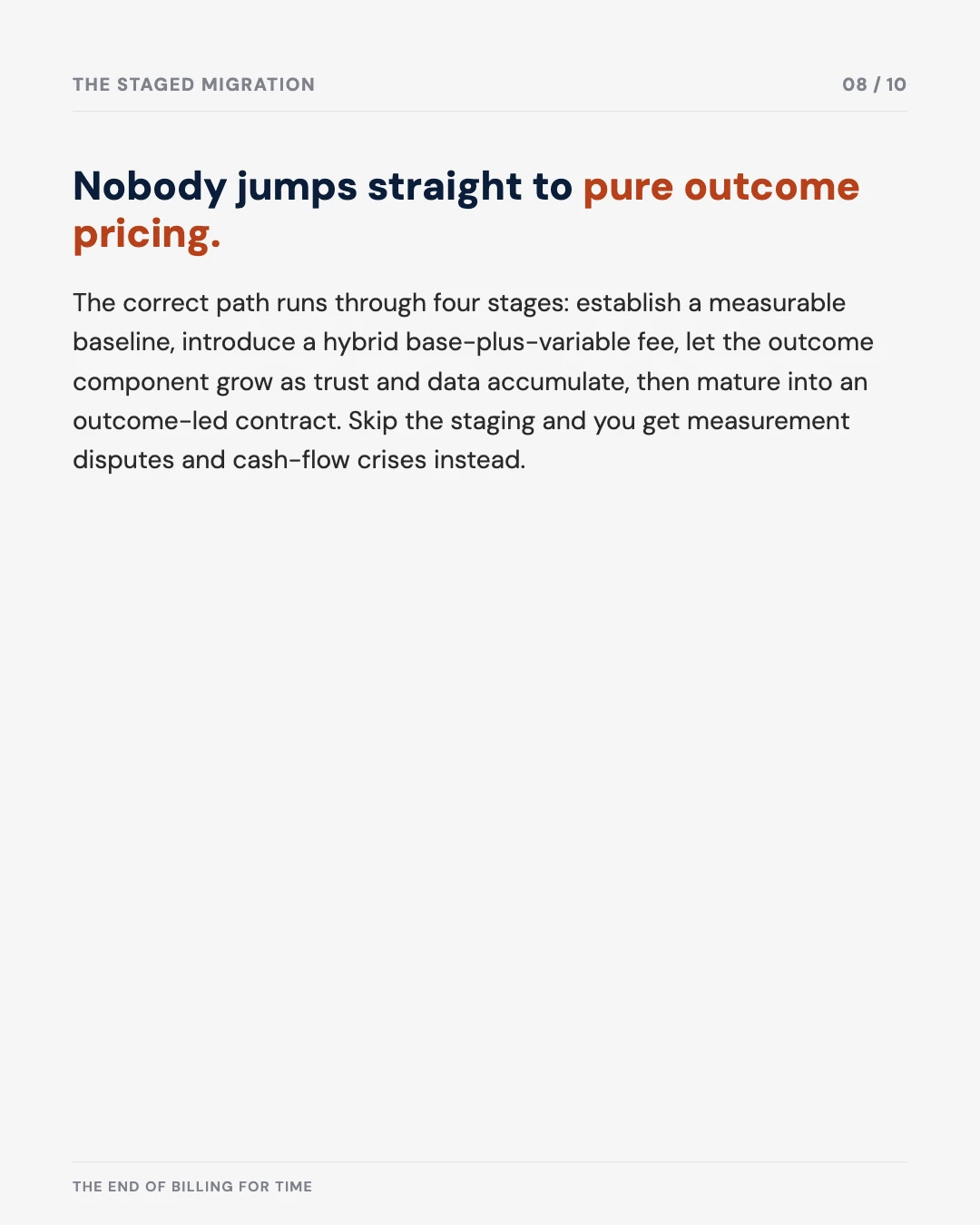
The most common failure mode in OaaS transitions is attempting to move directly from time-based pricing to pure outcome pricing without the intermediate infrastructure. This produces measurement disputes, provider cash-flow crises, and client distrust. The correct approach is a staged migration.
Instrumentation and baseline establishment
Before any outcome can be contracted, it must be measurable. This phase focuses entirely on establishing the pre-intervention baseline: identifying which operational metrics are available, which require new instrumentation, and what their current state is. This operates under the existing time-based or access-based model. The output is a documented baseline, an agreed attribution methodology, and a shortlist of contractable outcome units. Client and provider co-design this framework; shared ownership of the measurement methodology is the primary friction-reduction mechanism.
Hybrid model introduction
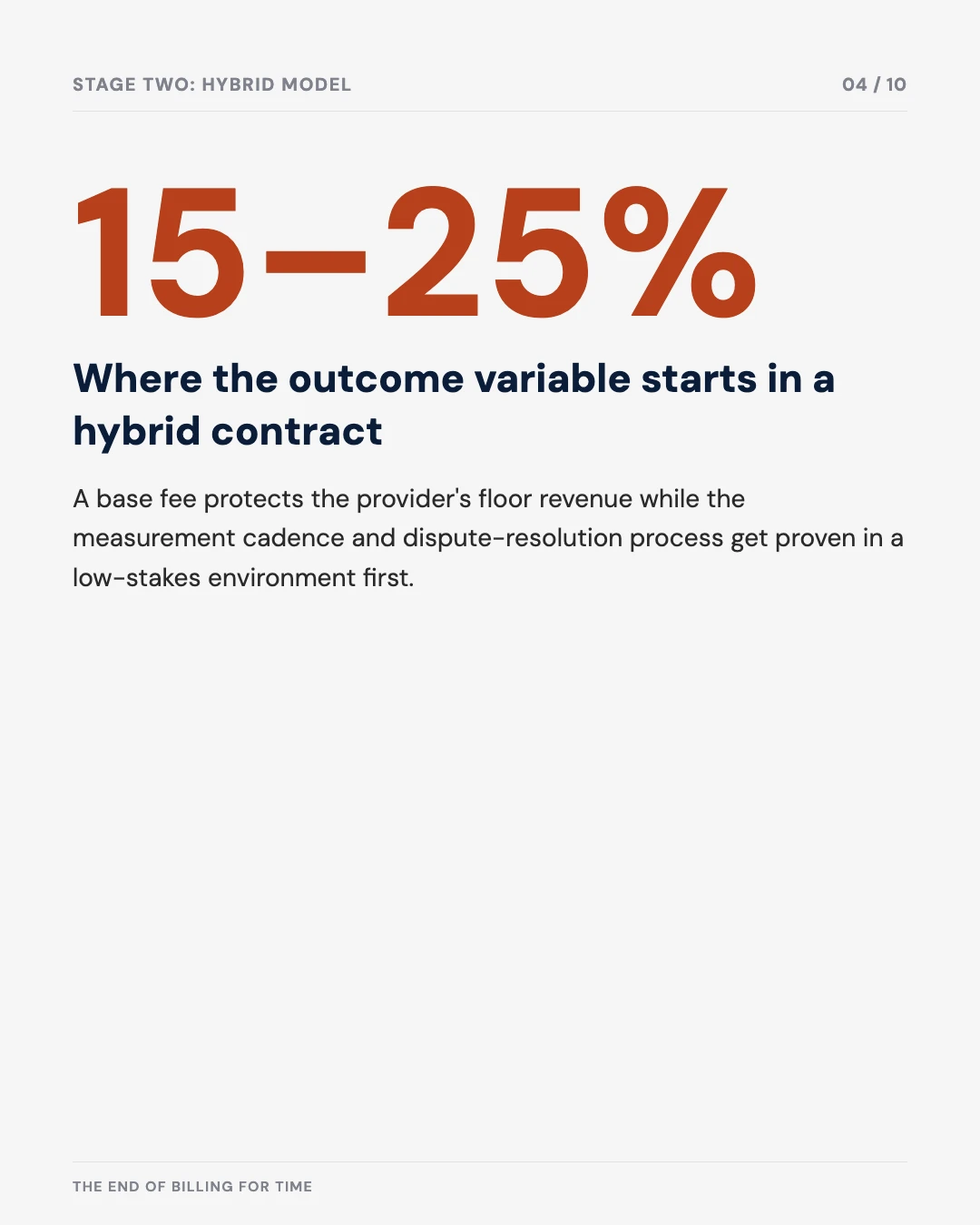
The two-part tariff is introduced: a base fee that covers the provider’s fixed delivery costs plus a variable outcome component that captures a portion of the verified performance improvement. The base fee is set to protect the provider’s floor revenue during model maturation. The outcome variable is initially modest, typically 15–25% of the total contract value, but establishes the measurement cadence, reporting infrastructure, and dispute-resolution process in a low-stakes environment. Clients experience a direct link between payment and performance for the first time without bearing full implementation risk.
Outcome-led contract transition
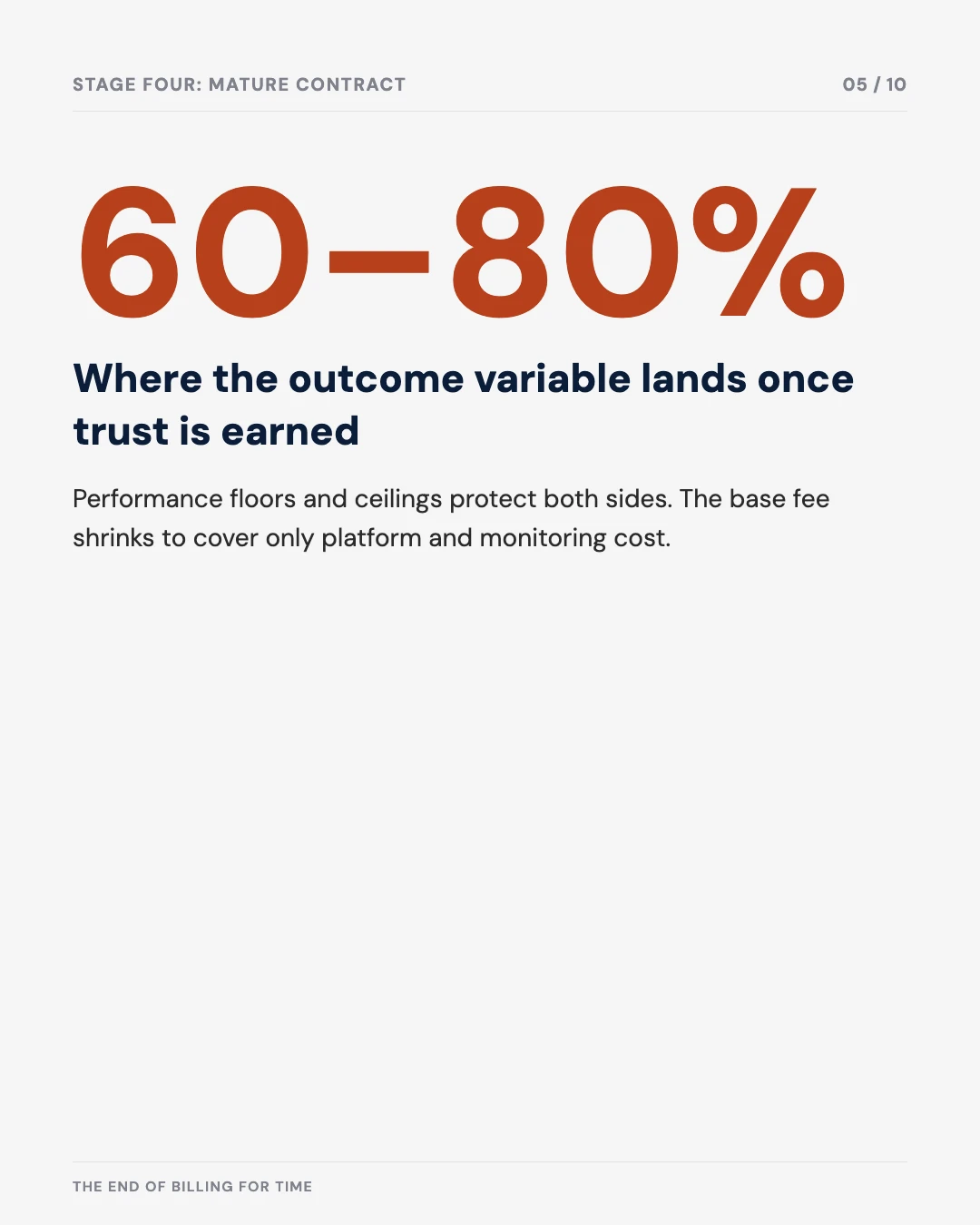
As measurement confidence and outcome data accumulate, the variable component becomes dominant. The base fee reduces to a platform and monitoring cost; the outcome variable rises to 60–80% of the total contract value. Performance floors are introduced, below which the provider is not paid, alongside performance ceilings that cap client cost during exceptional performance periods. This protects both parties and prevents the contract from becoming economically unsustainable in either direction. Attribution models are stress-tested against real data from the hybrid phase and refined where needed.
Mature OaaS contract
The contract operates primarily on outcome-linked revenue. The base fee, if retained, covers only the provider’s irreducible fixed costs. Annual renegotiation is triggered by performance data, not by relationship management. The provider’s competitive position is now based entirely on demonstrated outcome delivery. This is the sustainable long-term state and the one that generates the highest client retention, strongest renewal pricing, and most defensible margin for providers who execute it well.
What Makes or Breaks the Transition
Most OaaS transitions fail not because the model is wrong, but because specific structural decisions are made incorrectly or deferred until after conflict emerges. Five decisions must be resolved before any outcome contract is signed.
Outcome unit selection: choose the metric that scales directly with client value. If the product works twice as well, the client should receive approximately twice the value and pay approximately twice as much. Proxy metrics (API calls, queries, model inferences) are usage pricing in disguise.
Attribution methodology: the causal logic linking the intervention to the outcome must be agreed upon before deployment, not negotiated after data is visible. Pre-agreed statistical methods, independent audit provisions, and data ownership arrangements prevent the most common source of disputes.
Floor and ceiling provisions: pure outcome contracts with no floor are not commercially sustainable for providers. Minimum commitments protect provider cash flow during ramp-up. Caps protect clients during periods of exceptional performance. Both sides require these structural protections for the contract to be renewable.
Client-side data obligations: outcome contracts must specify the client’s obligations: data quality thresholds, system availability requirements, process compliance expectations. If the client’s operational behaviour degrades the outcome, the provider cannot bear the financial consequence under a pure outcome model.
Exit and data portability: when the provider controls both the AI system and the measurement infrastructure, the client’s switching cost becomes structurally high. Exit provisions (data export rights, model handover obligations, transition support) must be contractually specified at inception, not at termination.
OaaS is not a universal remedy. For new products without operational history, the baseline problem is real and not trivial to resolve. For outcomes with long measurement horizons, payment cadence and outcome realisation are structurally misaligned in ways that require bespoke financial structuring, not simply a different contract template. The model also does not eliminate delivery risk; it simply reassigns it. And for clients, outcome contracts are not a substitute for governance: regulators will hold the contracting organisation accountable for decisions made on its behalf, regardless of whether those decisions were made by an AI agent under an OaaS arrangement.
Free tool
AI ROI Calculator
Before you commit to a base-fee-plus-outcome contract structure, model the financial case so you know where the variable component should actually land.
If you’re working through what your own OaaS baselines should look like, I use the Return on Employee framework to quantify AI value through productive capacity per person rather than headcount reduction.
Was this useful?