
Listen to this article
Executive Summary
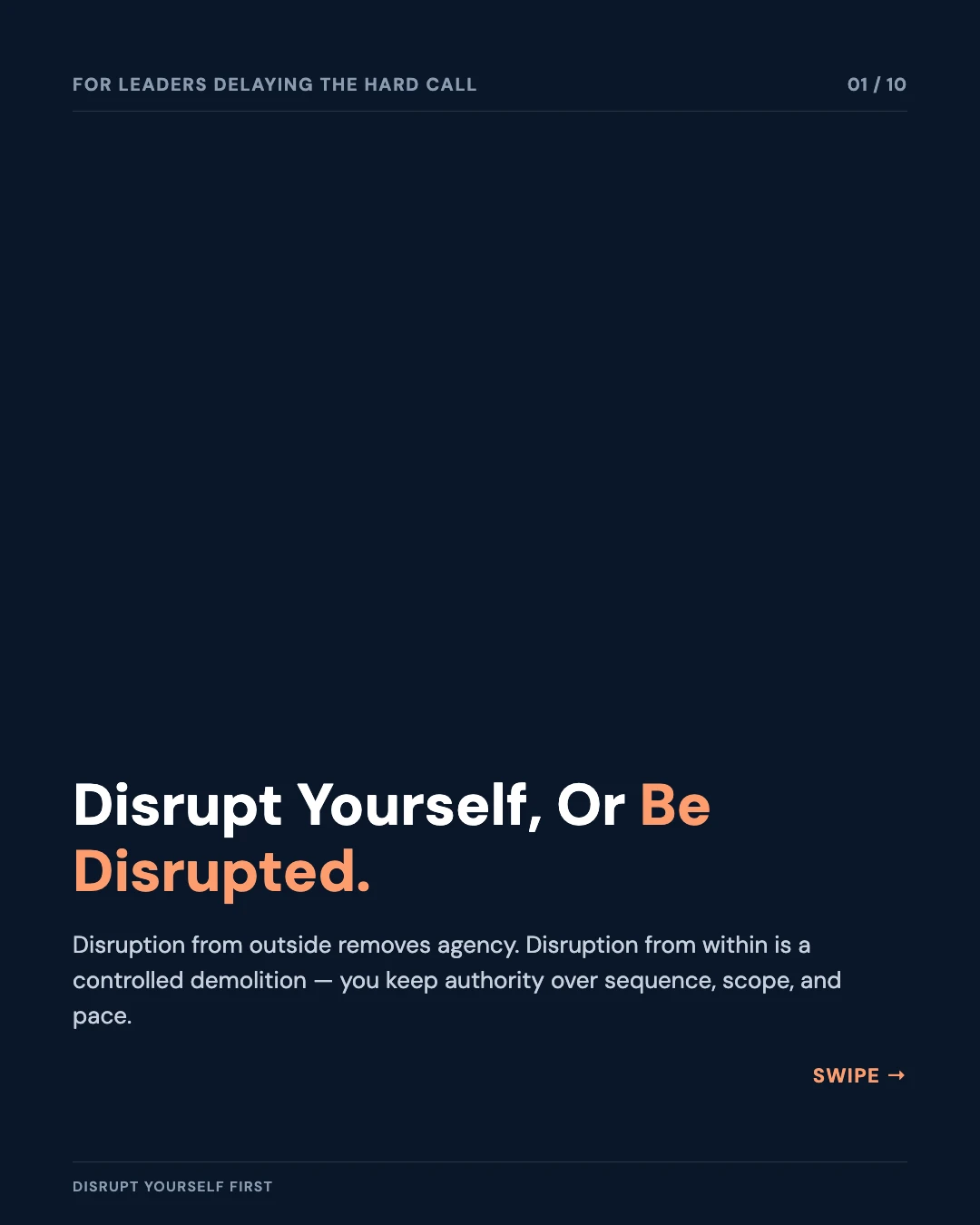
Disruption you initiate yourself preserves control over sequence, scope, and pace. Disruption imposed from outside does not, and waiting to deploy AI against your own operating model just hands that control to a competitor, an automated platform, or time.
Core conclusions
- Audit every workflow for AI-substitutability, then eliminate redundant work rather than merely automating it. Process elimination restructures the operating model; automating a redundant process just lowers the cost of the same inefficiency.
- Self-disruption without governance is technical debt with a different label: performance baselines, model accountability, continuous monitoring, and rollback protocols must exist before deployment at scale, not after an incident.
- The adoption window is narrowing. Organisations with large middle layers built on information aggregation and reporting are the most exposed, because that is precisely where AI systems now produce the highest measurable ROI.
The argument, in ten slides
Save it, or send it to whoever is still waiting for permission to start.
“The window for self-directed transformation is narrowing. Organisations that deploy AI against their own processes first retain control of the outcome. Those that wait cede that control to competitors, automated platforms, or time.”
The fundamental error most organisations make when confronting AI is framing it as an optimisation exercise. They ask where AI can reduce costs or accelerate a specific task. This framing is not wrong, but it is insufficient. The deeper question is structural: if an external actor (a competitor, an automated platform, or a government mandate) were to deploy AI against your operating model today, which parts would cease to be defensible? That question, answered honestly, defines where self-disruption must begin.
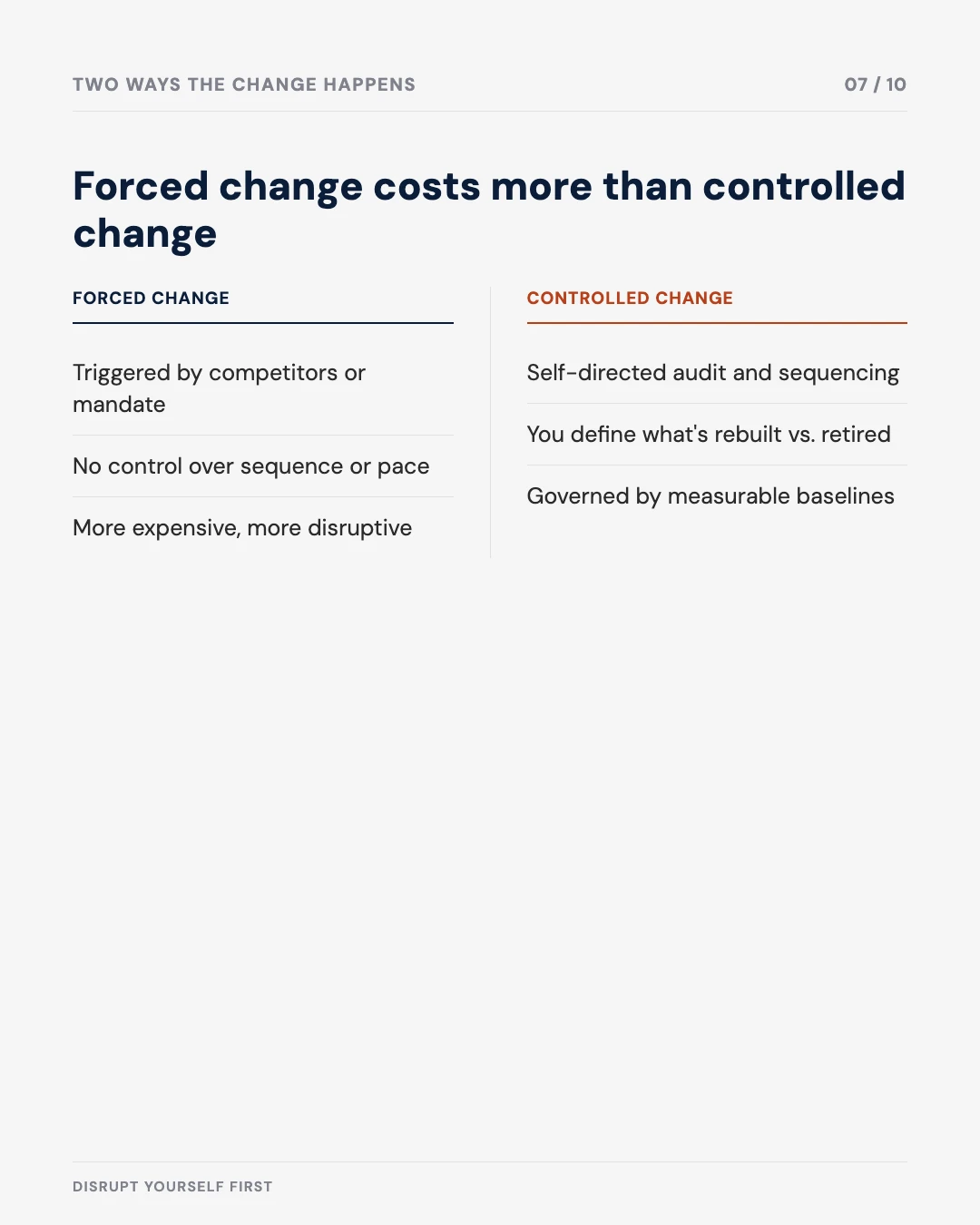
Disruption initiated from the outside is disruptive in the precise sense of the word: it breaks continuity, removes agency, and forces change under adverse conditions. Disruption initiated from within, by contrast, is a controlled demolition. The organisation retains decision authority over sequence, scope, and pace. It defines what is rebuilt and what is retired. This is not a philosophical distinction. It carries direct operational and commercial consequences.
“The organisation that maps its own vulnerabilities first retains the authority to determine the remediation. The one that waits for external pressure does not.”
The Mechanics of Self-Disruption
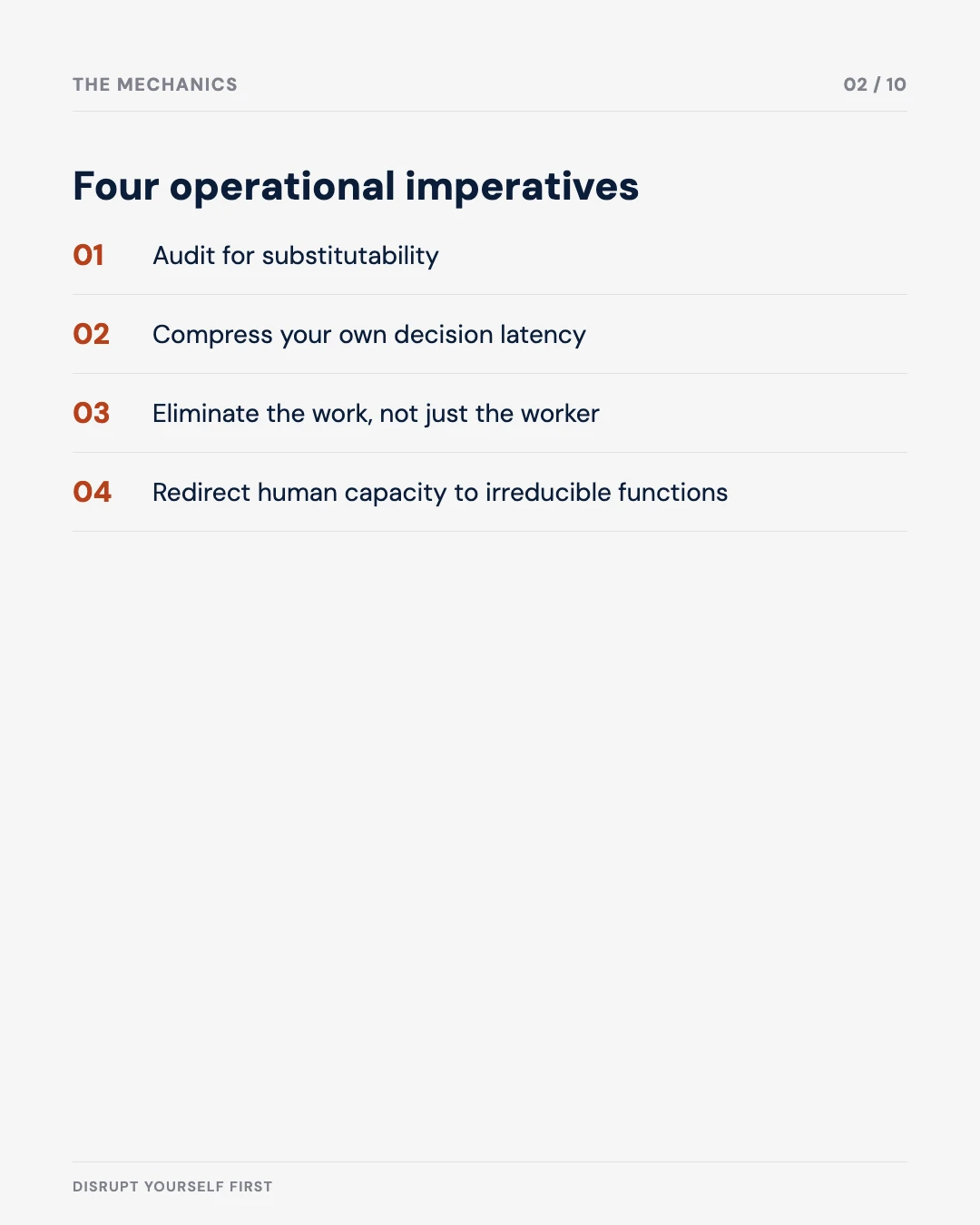
Self-disruption via AI is not the same as deploying a tool. It is a structured programme of capability substitution, process elimination, and role redefinition, executed with intent and governed with measurable baselines. Four operational imperatives define the approach.
Audit for substitutability. Every workflow, decision cycle, and data-handling process should be assessed against a single criterion: could a well-configured AI system execute it at or above parity within a defined time horizon? Workflows that score high on substitutability are primary targets. The audit output is a ranked inventory, not a strategy document: it is raw material for sequenced action.
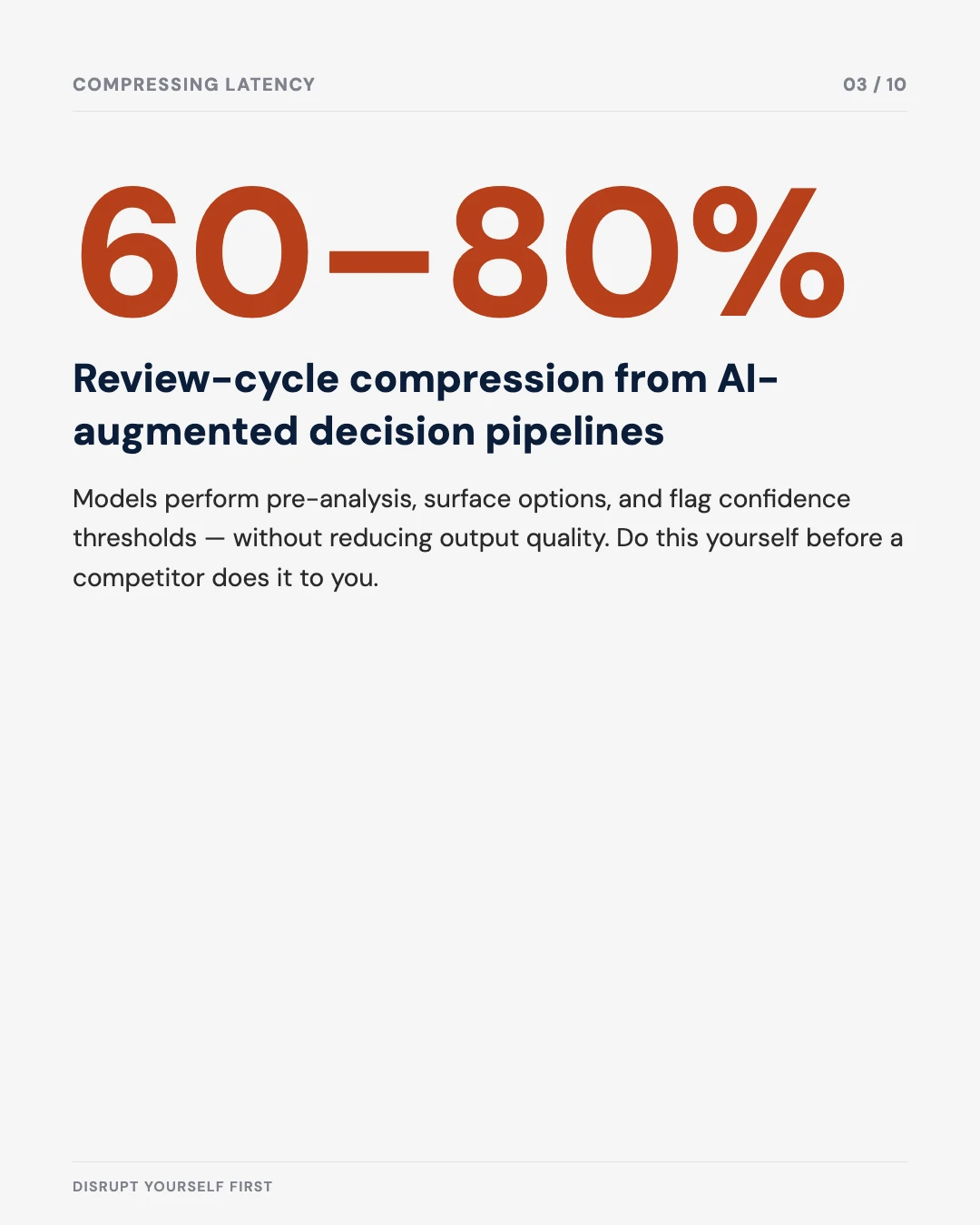
Compress your own decision latency. Many organisational processes are not slow because they are complex. They are slow because information passes through sequential human checkpoints that each add latency without adding proportionate judgement. AI-augmented decision pipelines (where models perform pre-analysis, surface options, and flag confidence thresholds) routinely compress review cycles by 60 to 80 per cent without reducing output quality. Implementing this internally, deliberately, removes the latency advantage that an external disruptor would otherwise exploit.
Eliminate the work, not only the worker. The least effective form of AI adoption replaces a person with a model that performs the same task. The more consequential intervention is process elimination: identifying tasks that exist only because of prior technical or coordination constraints that AI now resolves. Automating a redundant process preserves the inefficiency at a lower cost. Eliminating it restructures the operating model.
Redirect human capacity to irreducible functions. Self-disruption is not a headcount reduction strategy. It is a capacity reallocation strategy. When routine analytical, reporting, and coordination tasks are absorbed by AI systems, human capacity must be redirected to functions where human judgement remains structurally necessary: contextual interpretation, stakeholder accountability, ethical arbitration, and strategic positioning. Organisations that fail to make this redirection explicit will find that reclaimed capacity dissipates without traceable value.
What Is Actually at Risk
The sectors where this calculus is sharpest are those characterised by high information volume, repetitive analytical cycles, and outputs that can be evaluated against objective criteria. Government operations, infrastructure management, financial services, and professional advisory: all four fit this profile. In each, a significant proportion of senior professional time is consumed by tasks that AI systems can now perform at cost fractions that render the current model economically indefensible at scale.
The risk is not hypothetical. AI-native entrants in professional services are already winning mandates on the basis of speed and unit economics. Public-sector operators in competitive procurement environments are facing AI-augmented bidders whose cost structures were designed around automation from the outset.
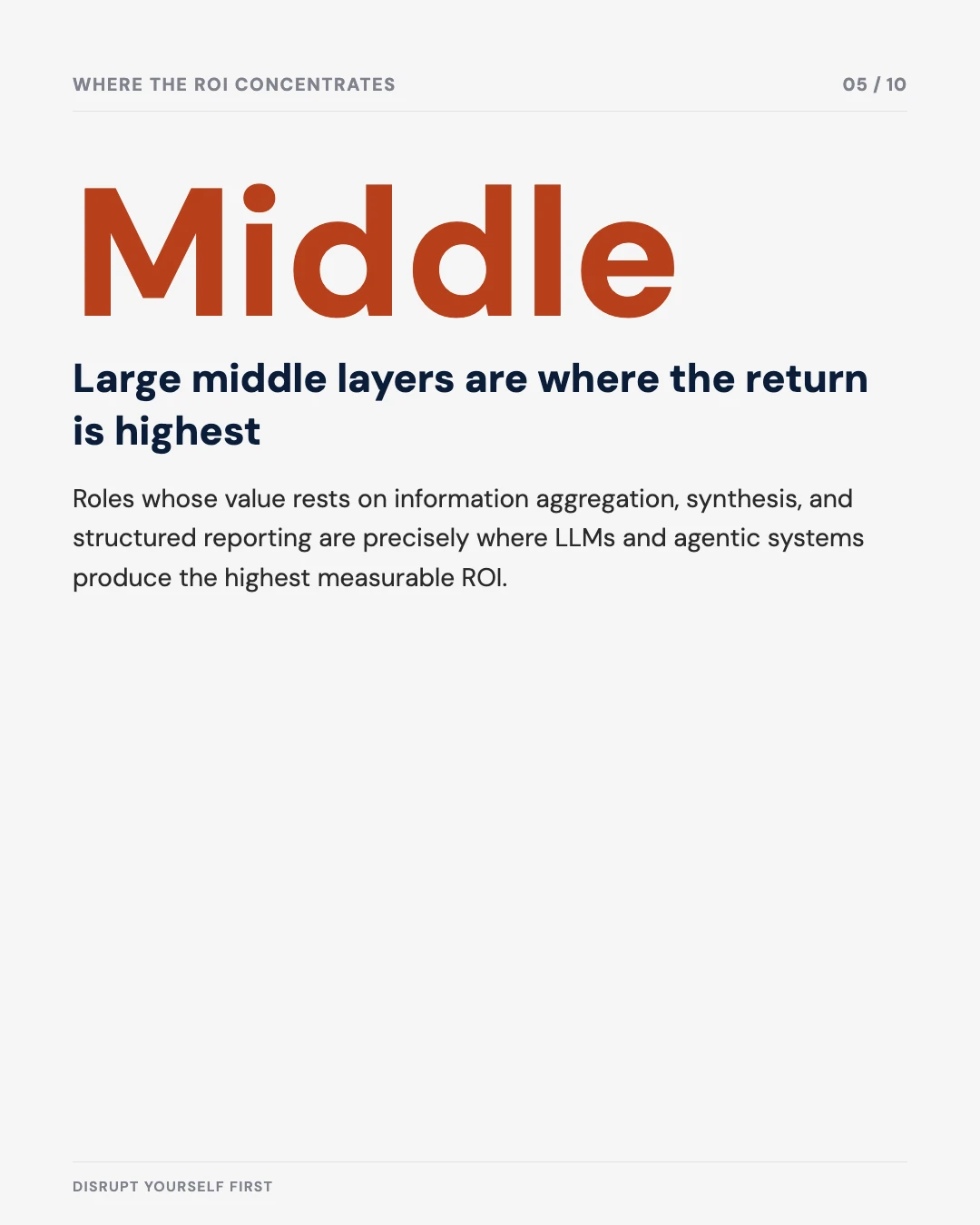
The organisations most exposed are those with large middle layers: roles whose value proposition rests on information aggregation, synthesis, and structured reporting, because these functions are precisely where large language models and agentic systems produce the highest measurable ROI.
“Protecting a function because it currently employs people is a governance decision. Failing to examine whether that function remains structurally necessary is an operational failure.”
The Governance Requirement
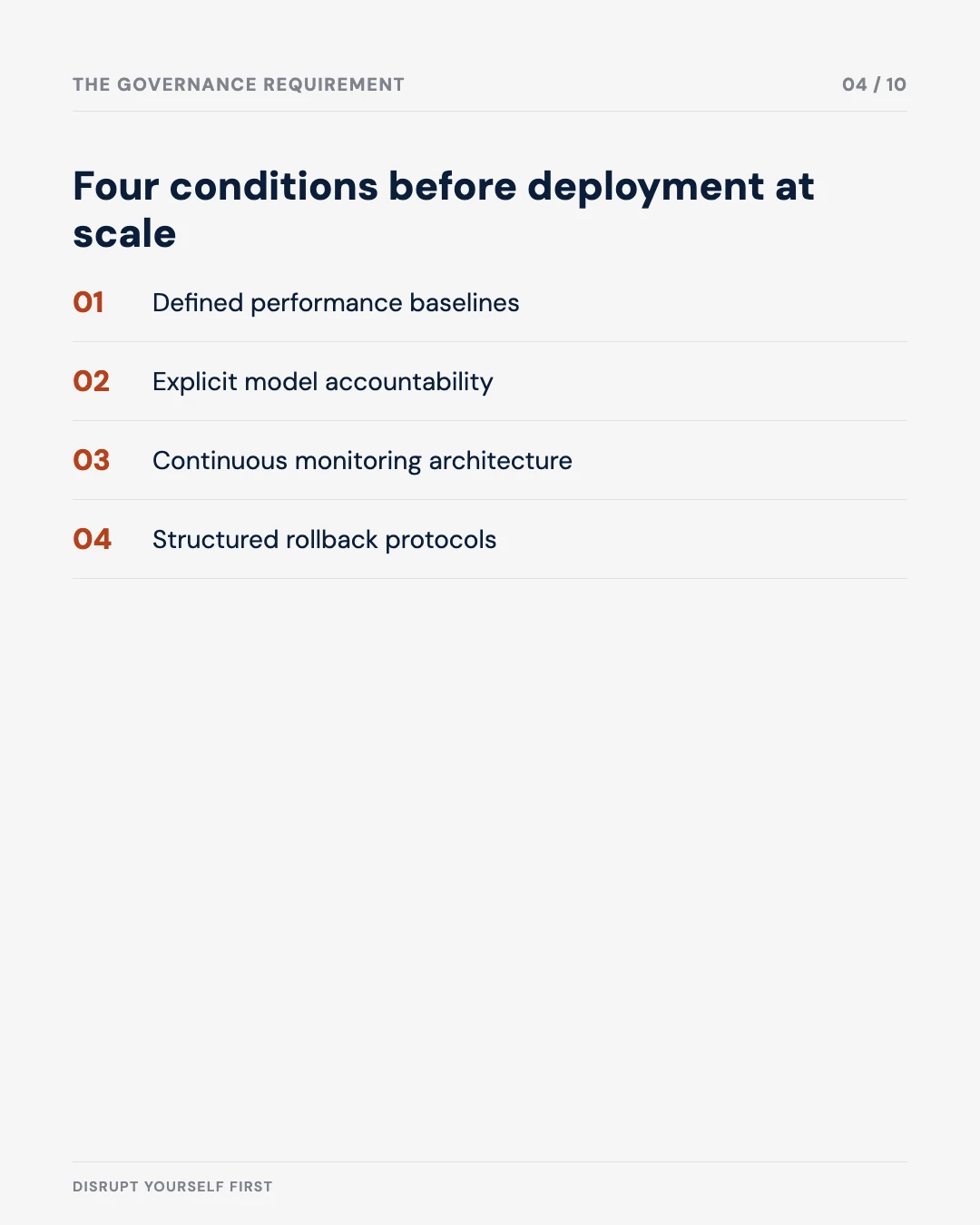
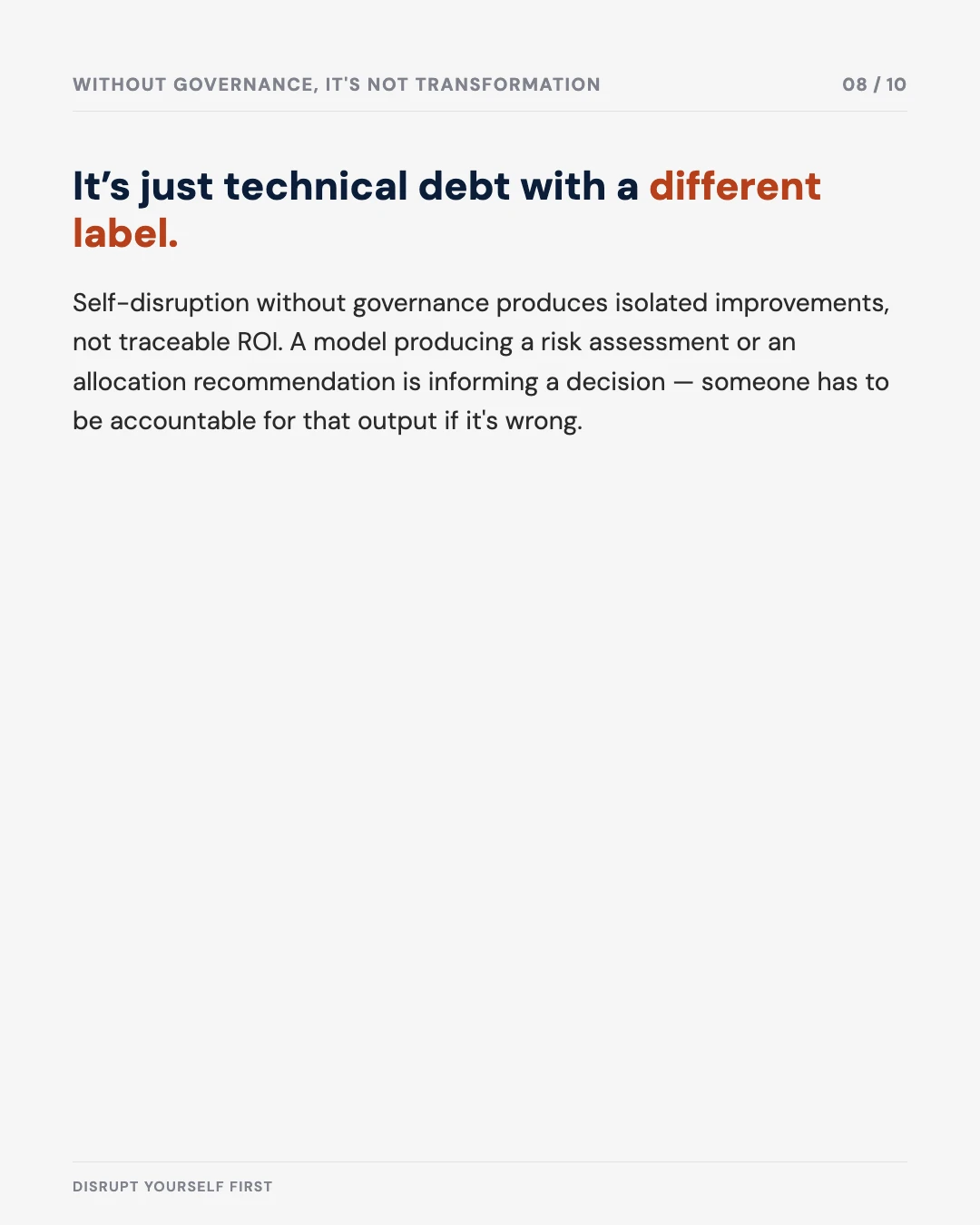
Self-disruption without governance is not transformation, it is simply accumulated technical debt with a different label. For an AI-driven process change to produce traceable ROI rather than isolated improvements, four governance conditions must be in place before deployment at scale.
Defined performance baselines. Every process targeted for AI substitution or augmentation must have a documented pre-intervention baseline: cycle time, error rate, cost per output, and decision accuracy where measurable. Without a baseline, the post-deployment comparison has no reference point, and the claimed improvement cannot be attributed to the intervention.
Explicit model accountability. AI systems deployed in operational contexts must have assigned accountability chains: not for the technology, but for the outputs. A model producing a risk assessment, a compliance summary, or an allocation recommendation is producing something that will inform a decision. Who is responsible for that output if it is wrong? That question must be answered before deployment, not after an incident.
Continuous monitoring architecture. Point-in-time validation is insufficient for production AI systems. Operational deployments require monitoring pipelines that track output drift, flag confidence degradation, and generate alerts when model behaviour deviates from validated parameters. This is an engineering requirement, not a compliance formality.
Structured rollback protocols. Any AI system inserted into a critical workflow must have a tested and documented fallback. Organisations that deploy AI without a validated rollback path are accepting operational dependency on a system they cannot exit under adverse conditions. This is an unacceptable risk posture for government and infrastructure operators.
The Asymmetry of Timing
There is an asymmetry in the timing of AI adoption that is rarely stated directly. Organisations that begin the process of self-directed transformation now are operating in a period where the tools are sufficiently mature for production deployment, the talent pool for implementation is accessible, and the regulatory frameworks are navigable. This window will not remain open indefinitely.
As AI capabilities advance and AI-native competitors consolidate their market positions, the cost of delayed adoption increases along two dimensions simultaneously. The capability gap between those who have built production AI systems and those who have not widens with each deployment cycle. And the organisational change required to adopt AI under competitive pressure, rather than on a self-directed timeline, is substantially more disruptive and more expensive than the equivalent change made under controlled conditions.
The argument for self-disruption is not that change is desirable in itself. It is that controlled change is categorically preferable to forced change. Organisations that act on this distinction (that audit their vulnerabilities, sequence their interventions, and govern their deployments with measurable baselines) will determine their own trajectory. Those who do not will find that trajectory determined for them.
“The question is not whether AI will disrupt your operating model. It is whether you will be the author of that disruption.”
Free tool
Business Automation Map
This is the audit-for-substitutability instrument the article describes: map which processes you’ve automated, then plot the gaps by impact and effort.
Free tool
AI Readiness Self-Assessment
Check whether the operational conditions for self-disruption are actually in place before you sequence the four imperatives above.
And the Return on Employee framework gives you a measurement model for quantifying the value of capacity redirected to higher-order work.
Was this useful?