
Listen to this article
Executive Summary
The AI capability divide isn’t a talent gap, it’s a design flaw: training built only for desk workers, governance that punishes experimentation, and unequal access to learning environments. A five-step inclusive framework closes it.
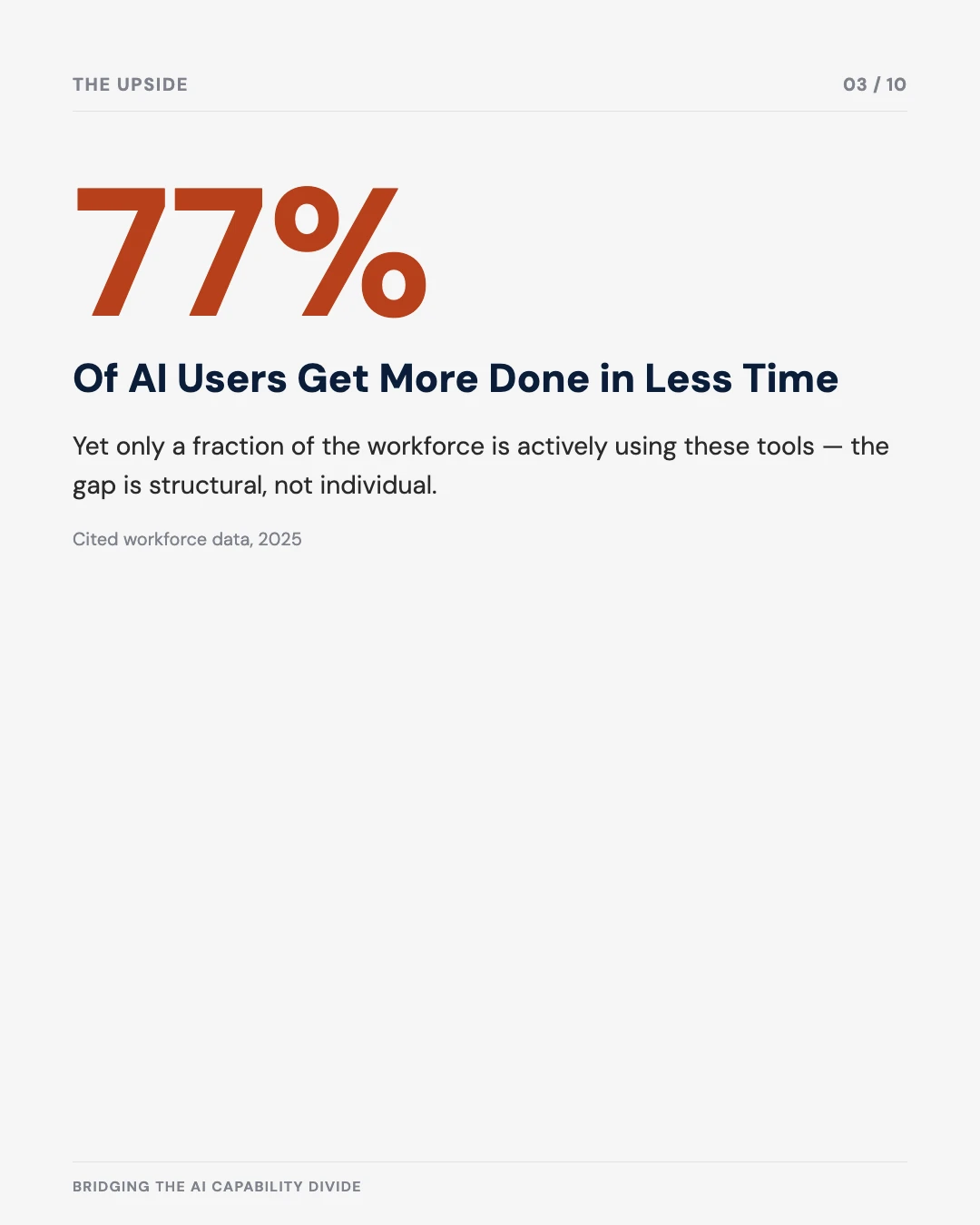
77%
of AI users report accomplishing significantly more in less time, yet only a fraction of the workforce actively uses these tools
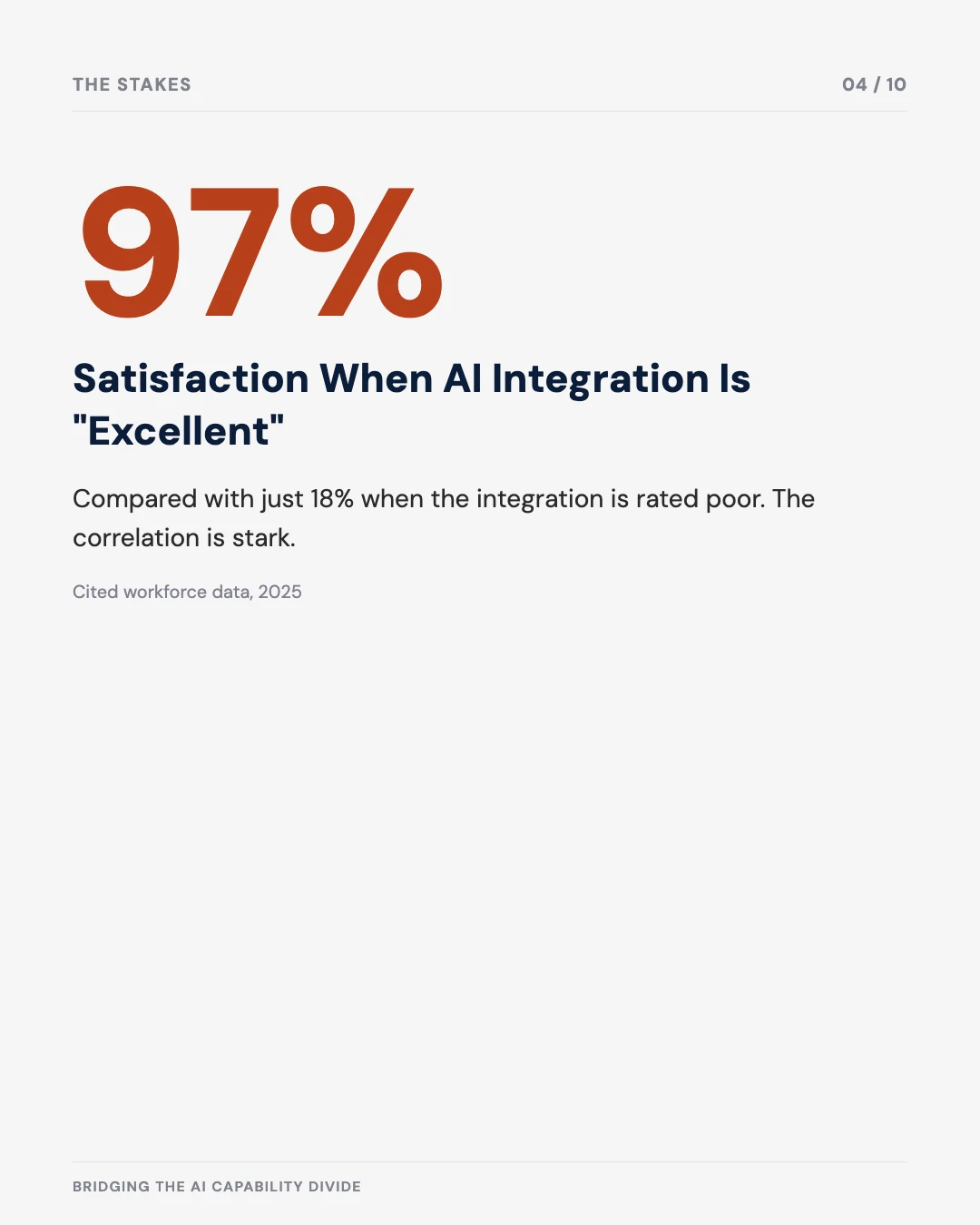
97% vs 18%
satisfaction with development opportunities when AI integration is rated excellent versus poor
60→85%
training completion rate once organisations switch to role-specific, rather than generic, AI pathways
Core conclusions
- Generic “AI Fundamentals” training fails because a warehouse coordinator and a financial analyst need entirely different competencies. Pathways must be role-specific to land.
- Governance is often the real blocker: when performance metrics punish the short-term efficiency dip of learning a new tool, employees rationally avoid adopting it.
- Closing the divide requires equity-based measurement: tracking adoption velocity and ROI distribution by cohort, not just an aggregate company-wide average.
The five-step framework, in ten slides
Save it, share it, or send it to whoever owns your upskilling budget.
Last month, I walked through our department area and noticed something that’s been keeping me up at night. On one side, I saw team members using AI tools to breeze through tasks that used to take hours. On the other hand, equally talented people were struggling with the same manual processes, falling further behind each day.
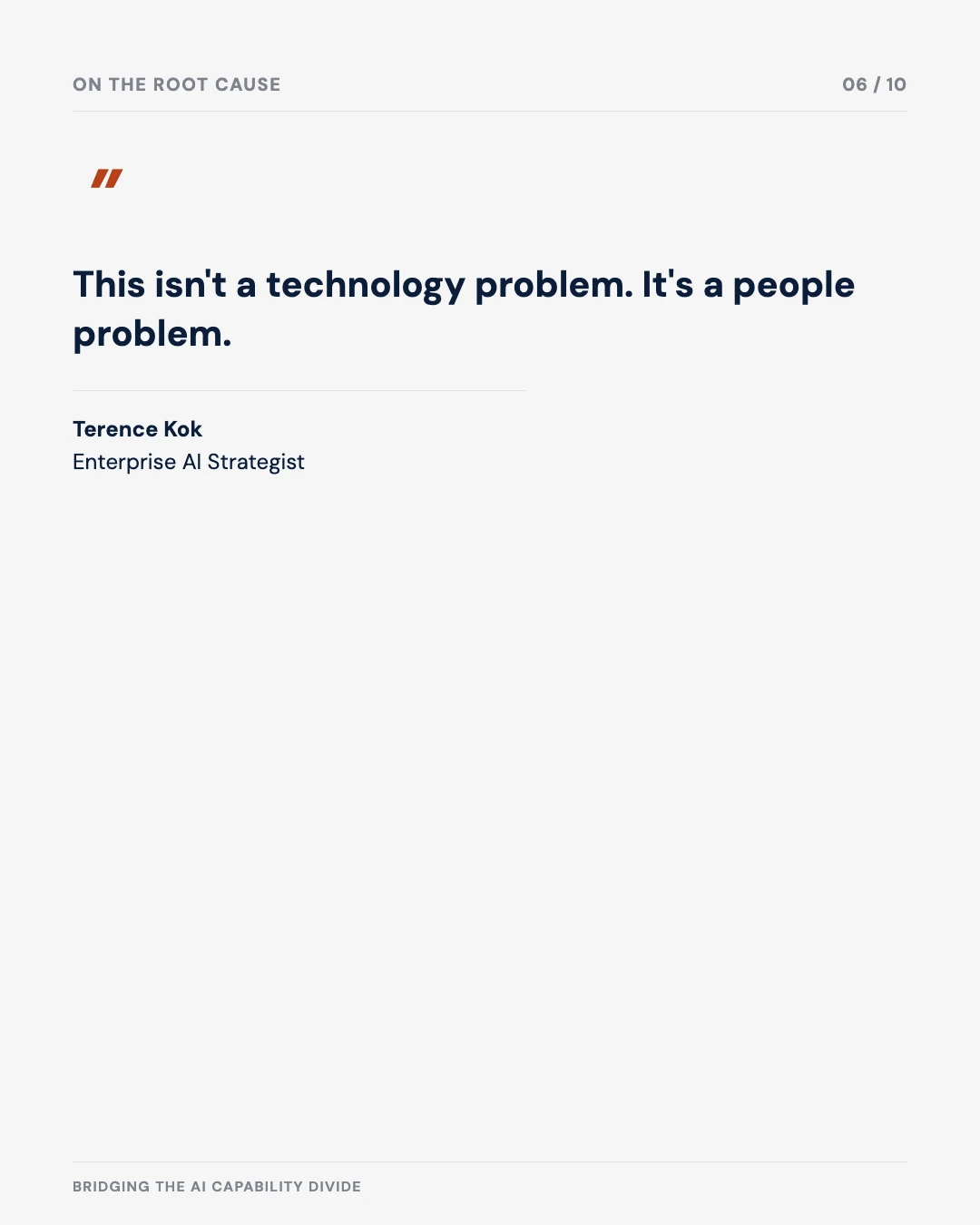
This isn’t a technology problem. It’s a people problem.
And it’s creating a dangerous split in organizations everywhere.
We’re witnessing a workforce bifurcation: some employees have cracked the code on AI integration and are achieving hyper-efficiency, while others remain disconnected from these tools. The result? A two-tier workforce where productivity, career growth, and job security are diverging at an alarming rate.
Here’s what I’ve learned: this gap isn’t about talent or capability. It’s about barriers we’ve accidentally built into our systems: training designed only for desk workers, governance that punishes experimentation, and unequal access to learning environments. We need to stop talking about “upskilling” and start building truly inclusive adoption strategies.
Understanding the Divide
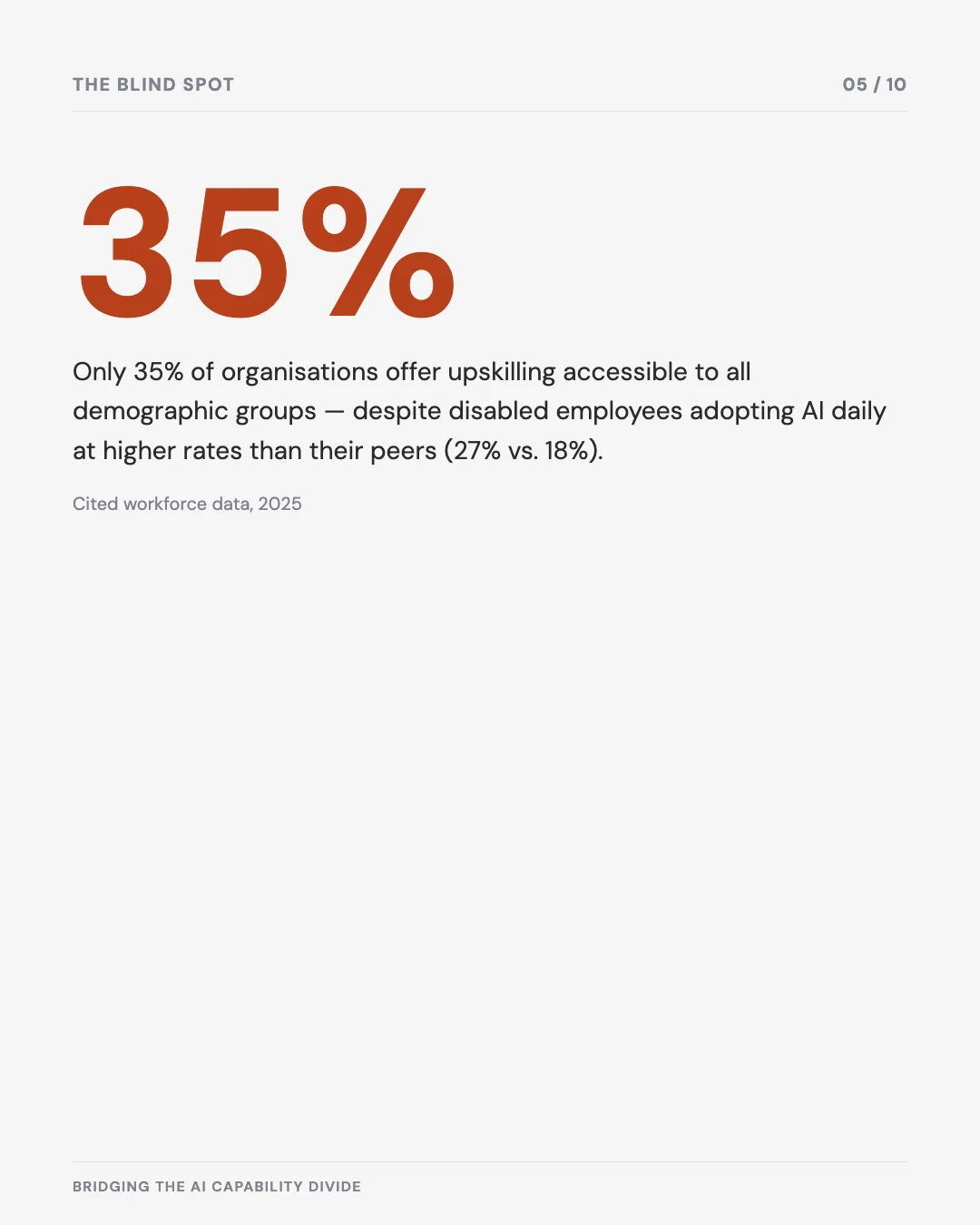
Recent data indicate that the gap is widening. While 77% of AI users report accomplishing significantly more in less time, only a fraction of the workforce is actively using these tools. The correlation between integration quality and employee sentiment is stark: satisfaction with development opportunities reaches 97% when AI and human intelligence integration is rated “excellent,” compared with just 18% when rated “poor”. Latent potential is also being overlooked: employees with disabilities demonstrate a higher propensity for adoption, with 27% using AI daily compared to 18% of their non-disabled counterparts. Yet only 35% of organisations offer upskilling programmes accessible to all demographic groups.
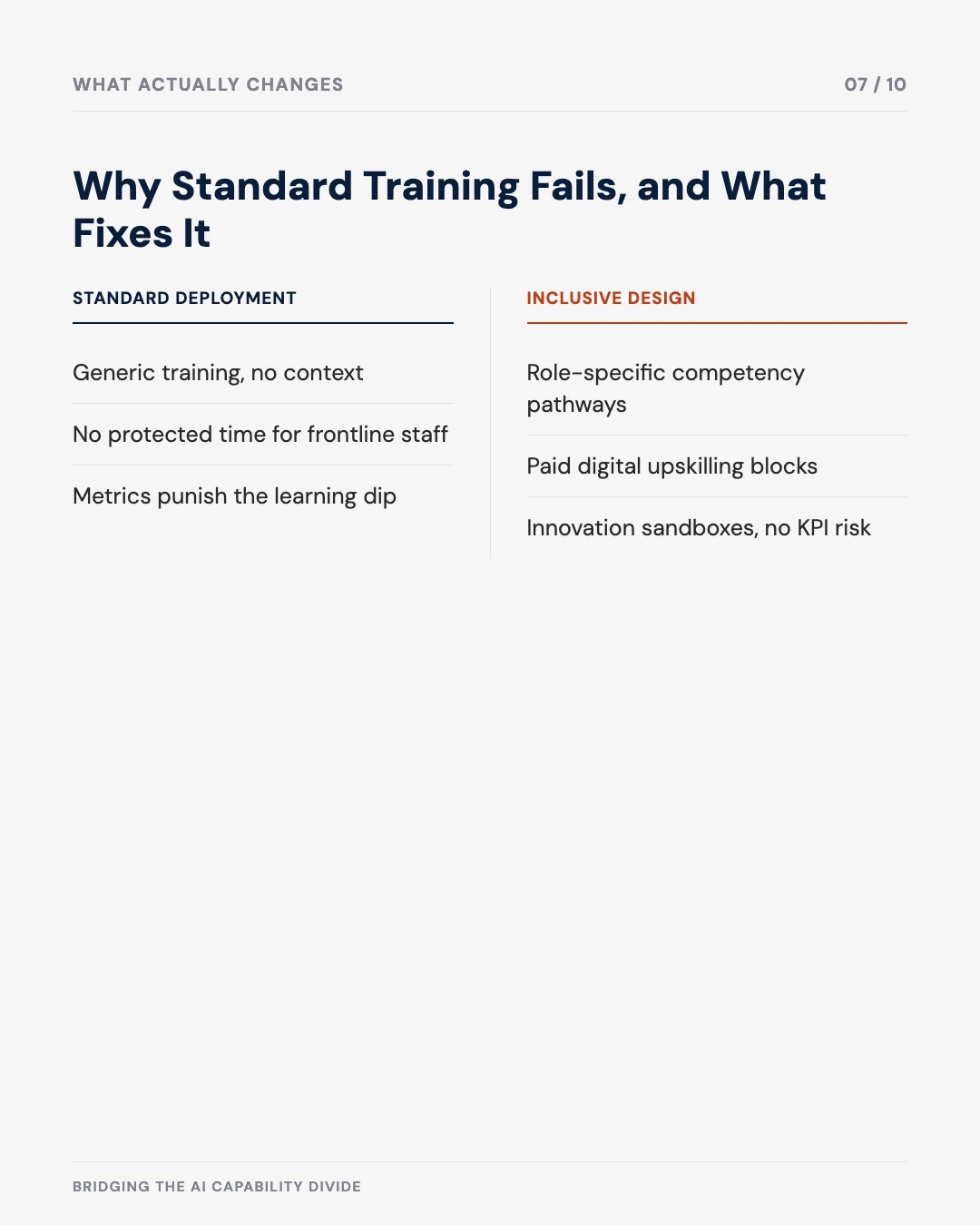
Standard deployment models fail for three critical reasons. First, contextual irrelevance: a warehouse logistics coordinator requires entirely different AI competencies than a financial analyst, and generic training lacks the contextual relevance necessary for immediate application. Second, operational friction: frontline and shift-based workers often lack the protected time blocks required for deep work and experimentation, unlike their corporate counterparts. Third, governance misalignment: when performance metrics penalise short-term efficiency dips caused by learning new tools, employees rationally choose to bypass AI adoption to maintain baseline metrics.
A Framework for Inclusive Integration
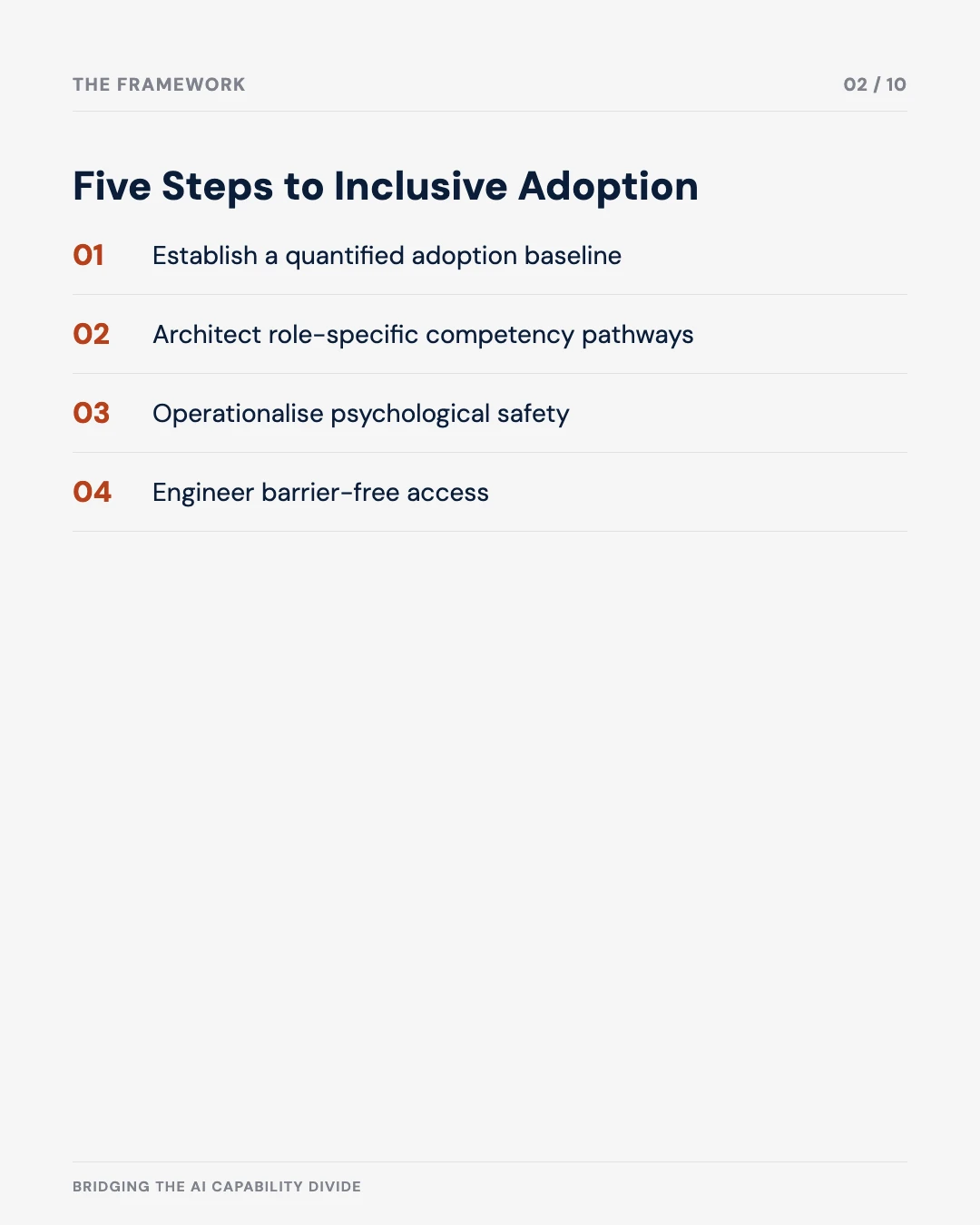
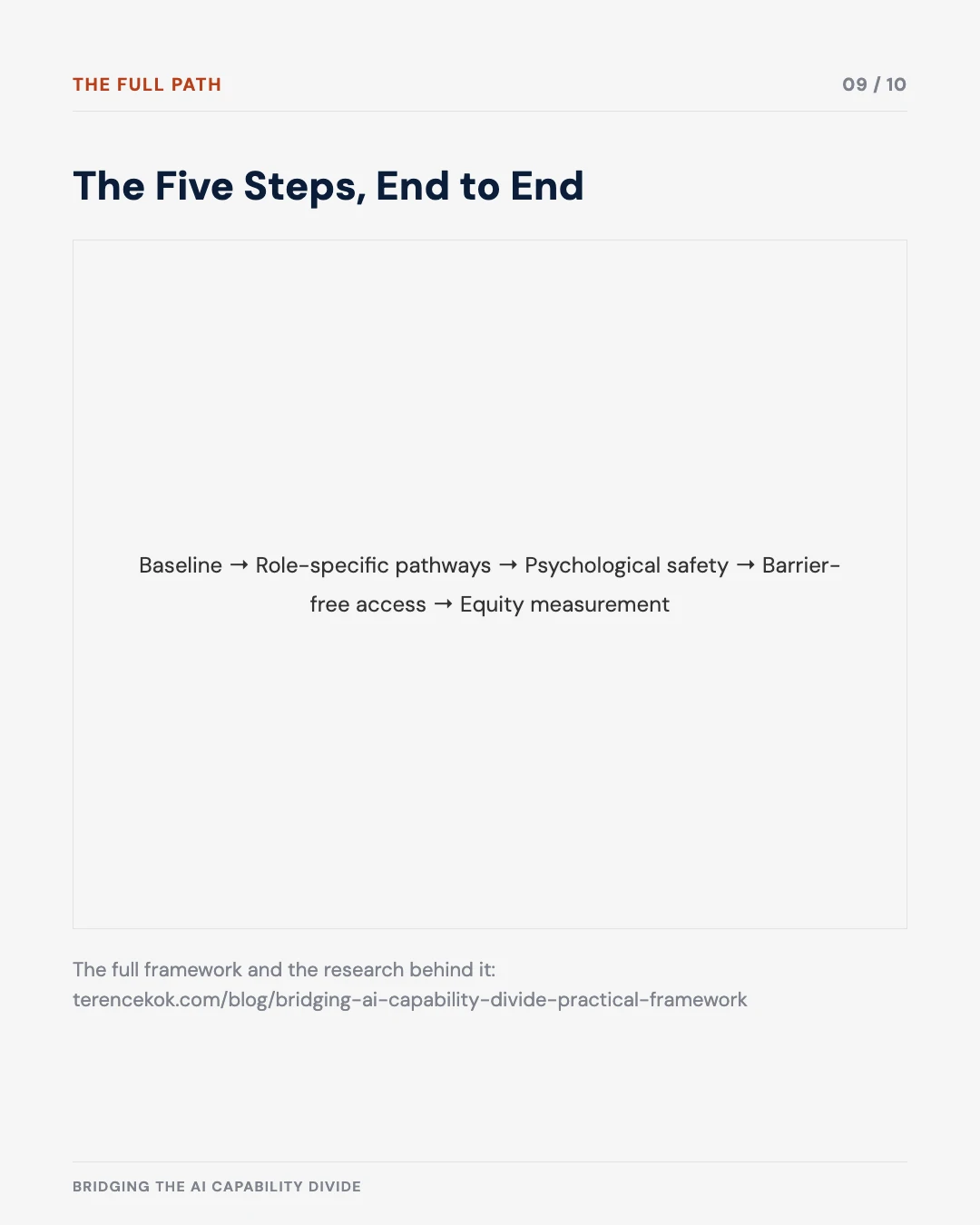
After testing various approaches across multiple teams, the following five-step framework addresses the structural barriers to inclusive adoption:
Establish a Quantified Adoption Baseline
Before deploying training, organisations must map the current adoption landscape with granular precision. This involves disaggregating adoption data not only by department but also by role, tenure, and demographic cohort. Leaders must identify specific “adoption deserts”: sectors of the organisation where usage is statistically zero. A baseline assessment prevents resource misallocation and enables measurement of specific inclusivity KPIs.
Architect Role-Specific Competency Pathways
Training must be modular and role-specific. Instead of a monolithic “AI Fundamentals” course, organisations should develop distinct pathways:
- Operational Pathway: Focuses on voice-to-text logging, computer vision for quality control, and predictive maintenance interfaces.
- Administrative Pathway: Focuses on generative drafting, scheduling automation, and data synthesis.
- Strategic Pathway: Focuses on prompt engineering for scenario planning and decision support.
Organisations implementing AI-driven, personalised training pathways see completion rates rise from 60% to 85%, with knowledge retention improving by 25%. Getting this right at scale is less about training budget than organisational design, a point I make separately.
Operationalise Psychological Safety
Psychological safety must be encoded into governance, not just culture statements. This involves establishing “innovation sandboxes”: isolated technical environments where employees can experiment with AI tools without risk to production data or operational KPIs. Furthermore, performance reviews during the transition period should weigh “attempted innovation” alongside standard output metrics to neutralise the fear of failure. Freeing up that experimentation time is ultimately a bandwidth allocation decision, not a training one.
Engineer Barrier-Free Access
Inclusivity requires removing physical and temporal friction. For frontline staff, this means deploying AI interfaces on mobile devices or ruggedised tablets rather than desktop-only applications. It also requires adjusting shift patterns to include paid “digital upskilling” blocks, ensuring training does not conflict with operational downtime or personal time.
Implement Equity-Based Measurement Loops
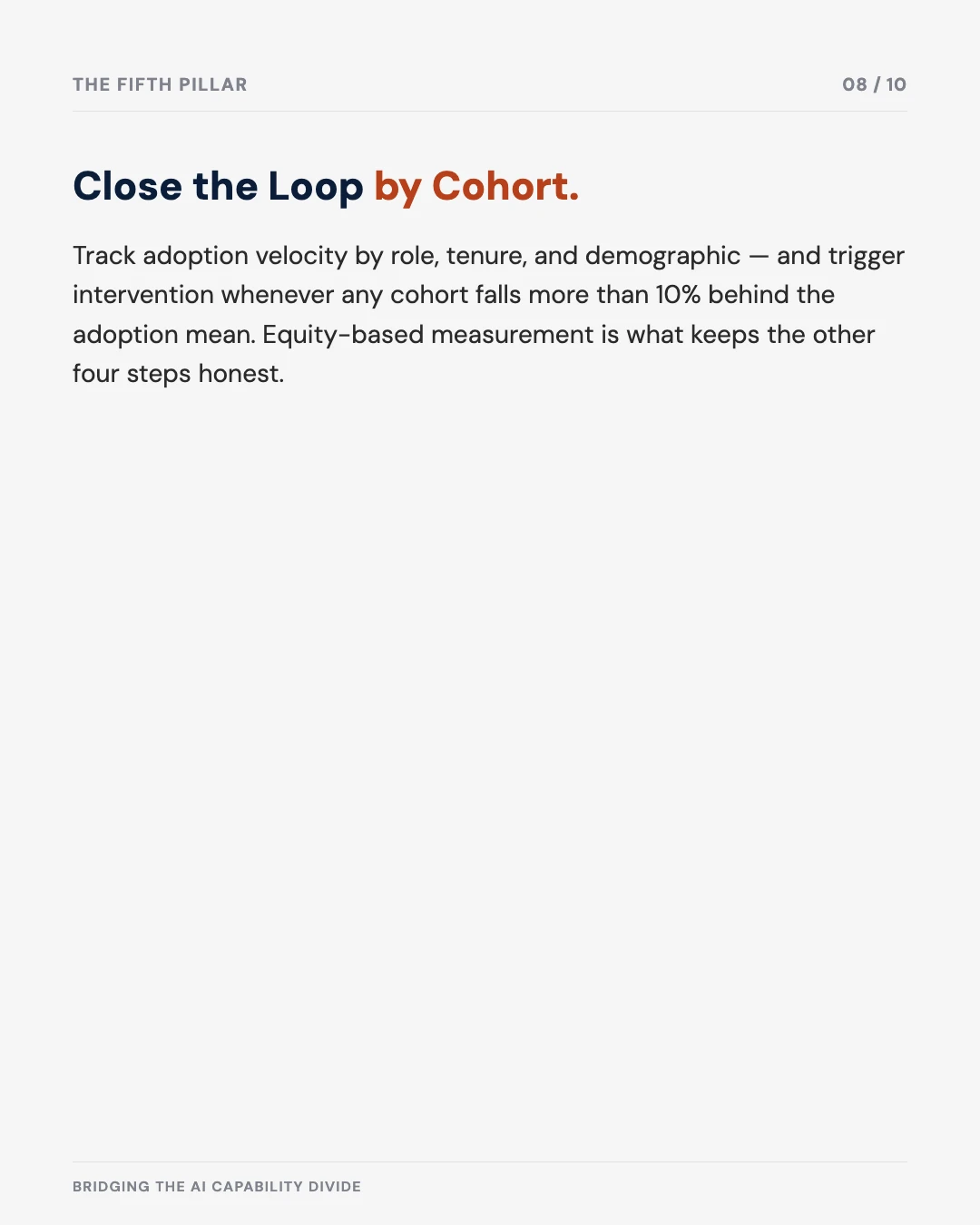
Adoption success should be measured through an equity lens. Metrics should include adoption velocity by cohort (are junior staff adopting at the same pace as senior management?), accessibility utilisation (are tools being accessed via assistive interfaces?), and ROI distribution (are efficiency gains being realised across all business units, or concentrated in IT and finance?). Organisations must establish feedback loops that trigger intervention whenever a specific demographic or role falls more than 10% behind the adoption mean.
Conclusion
Here’s the bottom line: this AI capability divide isn’t inevitable. It’s a design flaw we can fix. The organizations that will thrive aren’t the ones that throw AI at everyone and hope for the best. They’re the ones that build structured, inclusive frameworks that meet people where they are.
This AI capability divide isn’t inevitable. It’s a design flaw we can fix.
With AI skills projected to outpace other skill sets by 3.5x, bridging this divide isn’t just a diversity initiative. It’s mission-critical for your organization’s survival.
What’s your experience? Are you seeing this capability gap in your organization? What strategies are working for you? I’d love to hear how you’re approaching inclusive AI adoption. Drop a comment below.
References
MIT Technology Review Insights. (2025). Creating psychological safety in the AI era. https://www.technologyreview.com/2025/12/16/1125899/creating-psychological-safety-in-the-ai-era/
Randstad Enterprise. (2025). No one left behind: Why DEI and AI efforts must evolve together. https://www.randstadenterprise.com/insights/randstad-enterprise-insights/no-one-left-behind-why-dei-and-ai-efforts-must-evolve-together/
SHRM. (2025). AI reshaping work: Workforce prep urgent & complex. https://www.shrm.org/about/press-room/shrm-report-warns-of-widening-skills-gap-as-ai-adoption-reaches-
SuperAGI. (2025). Case studies: How major corporations are using AI to transform their training programs in 2025. https://superagi.com/case-studies-how-major-corporations-are-using-ai-to-transform-their-training-programs-in-2025/
Virtasant. (2025). AI literacy to leadership: 90 day plan to close the AI skills gap. https://www.virtasant.com/ai-today/ai-literacy-to-leadership-90-plan-to-close-the-ai-skills-gap
Free tool
Organisational AI Readiness Quiz
Establish the quantified adoption baseline this framework calls for, scored across Data, Process, Technology, People, and Governance.
Was this useful?