
Listen to this article
Executive Summary
Most AI budgets are backwards: they fund infrastructure and software first and treat change management as an afterthought, when people costs (training, adoption, retraining) are where the majority of total AI spend actually lands.
60%
of total AI implementation costs come from training, change management, and scaling, not the initial build (SmartDev, 5-year SME study)
3:1–7:1
documented return on every dollar invested in change management
88% vs 13%
project success rate with excellent change management versus without it (Prosci)
143% vs 35%
average ROI for companies with strong change management versus without (McKinsey)
Core conclusions
- Adoption, not model sophistication, determines 80-100% of a project’s realised benefits. A smarter budget reserves 25-30% of total spend for change management, training, and enablement.
- The 60-percentage-point adoption gap between structured and unstructured change management is the difference between an AI investment tripling in value and becoming an expensive system nobody uses.
- This isn’t a bigger budget. It’s a reallocation that shifts money from fixing adoption failures later to preventing them from the start.
Where the real costs hide, in ten slides
Save it, share it, or send it to whoever signs off the AI budget.

Here’s something most executives get wrong: they treat AI projects like software purchases. Buy the tech, install it, done.
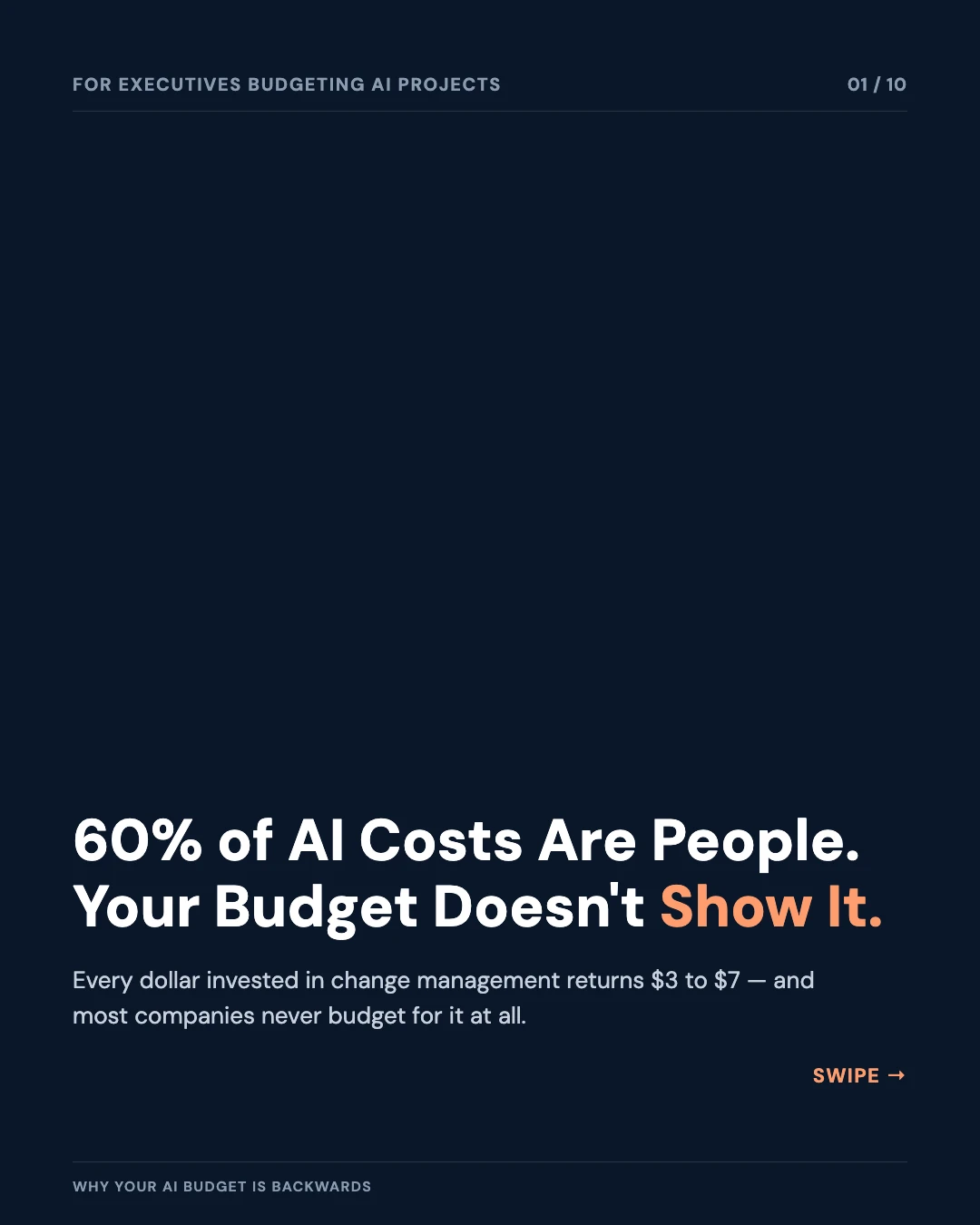
Except it’s never done. And that’s why 60% of AI costs come from something that rarely makes it into the budget: people.
60% of AI costs come from something that rarely makes it into the budget: people.
The Real Cost of AI Nobody Talks About
When companies plan AI projects, they budget for the obvious stuff: infrastructure, licenses, development. But here’s what the research shows: every dollar you invest in change management returns $3 to $7. That’s not a typo. It’s a 3:1 to 7:1 return.
And here’s the kicker: 80-100% of your project benefits depend on whether your employees actually use the new system, not on how sophisticated the AI is. I go deeper on why adoption, not model quality, is the real predictor of success in After All the AI Hype.
SmartDev studied SME AI implementations over five years and found that 60% of total costs came from training, change management, and scaling, not the initial tech build. For a typical SME spending $200,000 to $500,000 on AI over five years, this is a massive budget misalignment.
Where the Money Really Goes
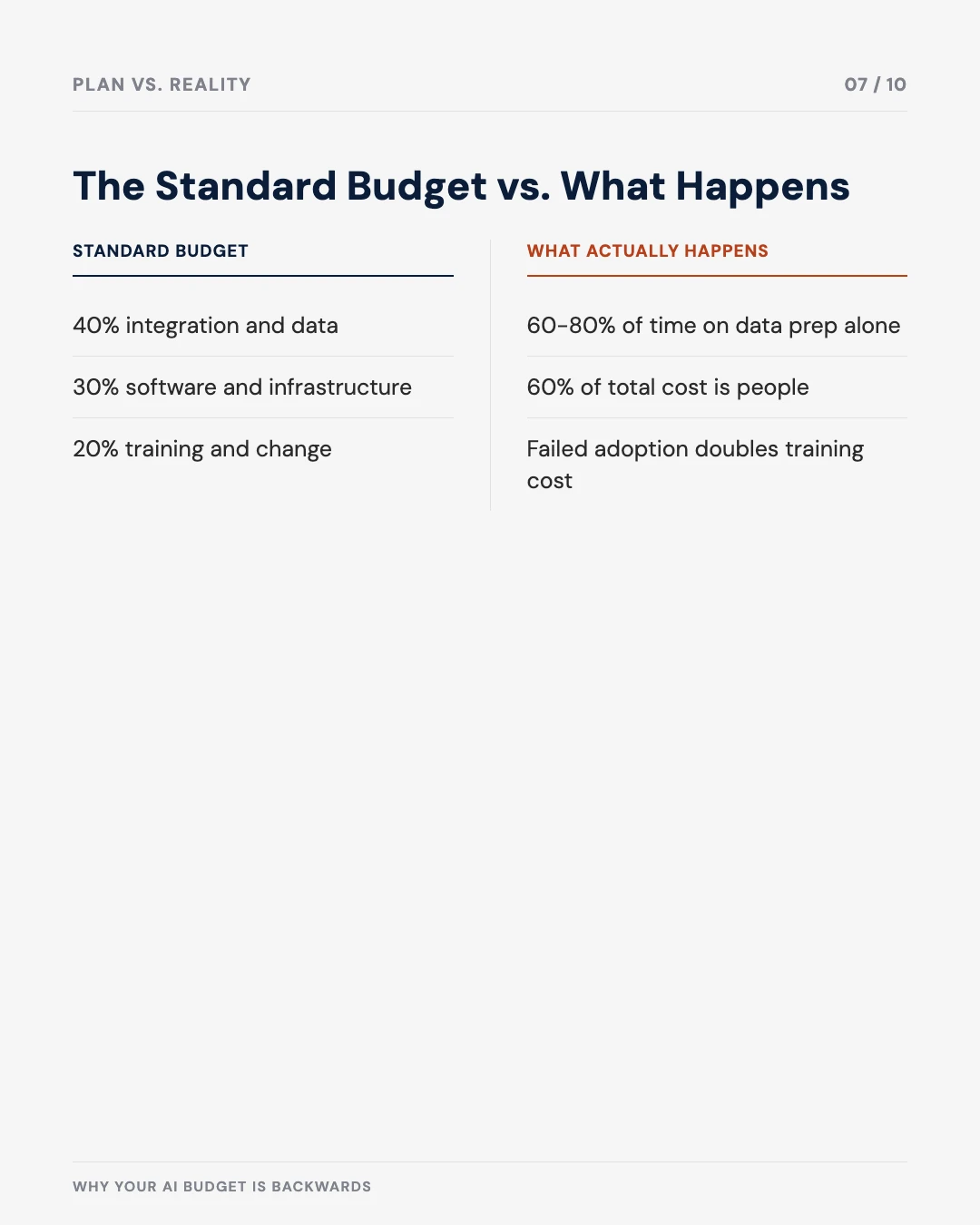
The standard AI budget looks something like this:
- 40% integration and data work
- 30% software and infrastructure
- 20% training and change management
- 10% ongoing operations
Seems reasonable, right? Except execution tells a completely different story.
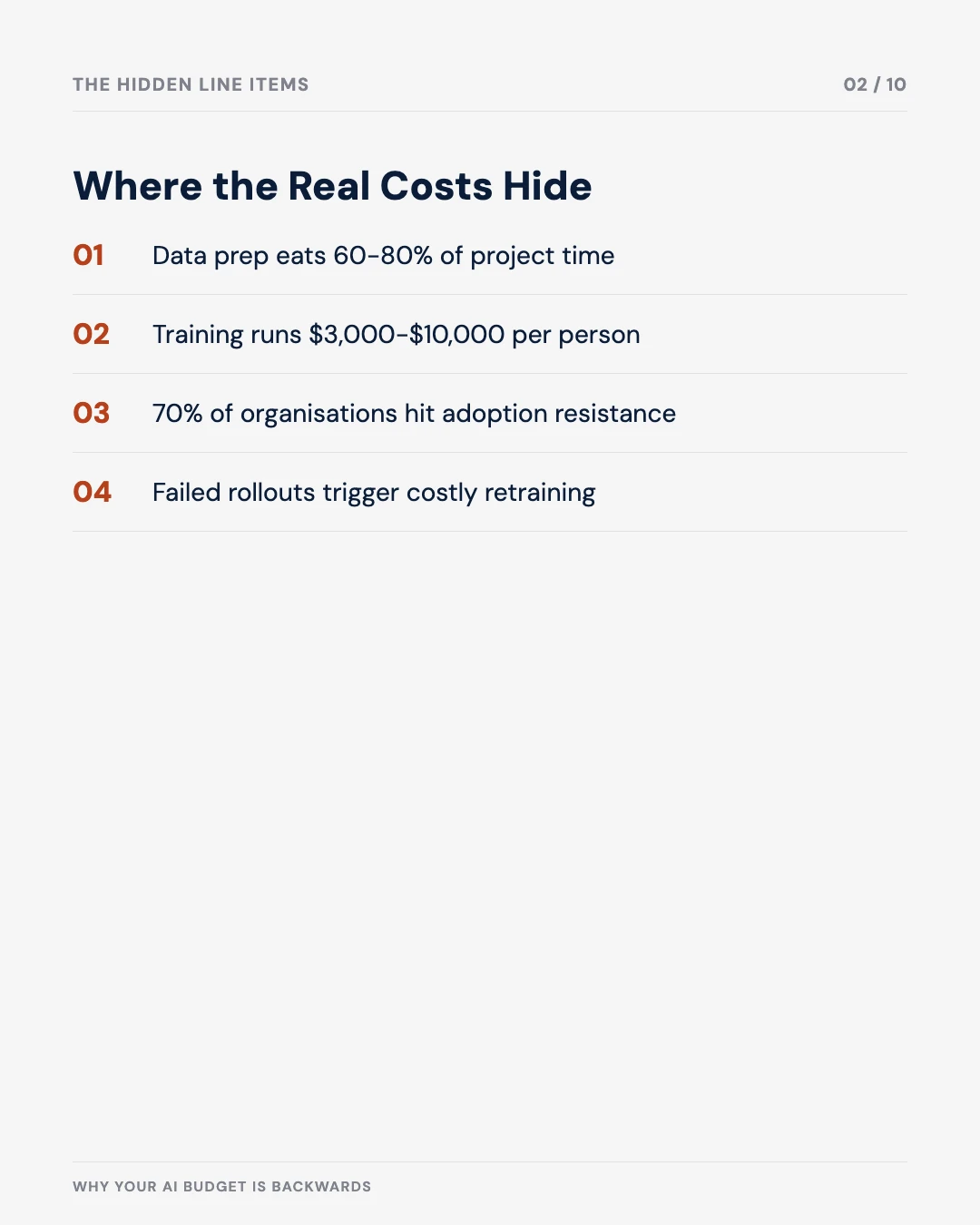
Data preparation alone eats up 60-80% of project time and resources. And that’s mostly labor, not technology. Training employees on AI-enabled workflows costs $3,000 to $10,000 per person. During adoption, productivity may drop 15-25% for 3-6 months.
When people resist the change (which happens in 70% of organizations), training costs can double.
Here’s a real example: A manufacturing SME saw costs spike 65% in Year 2 when initial adoption failed. They had to retrain everyone at an additional cost of $18,000. These “hidden costs” never made it into the original budget. They just became expensive surprises.
The 60-Point Gap That Kills ROI
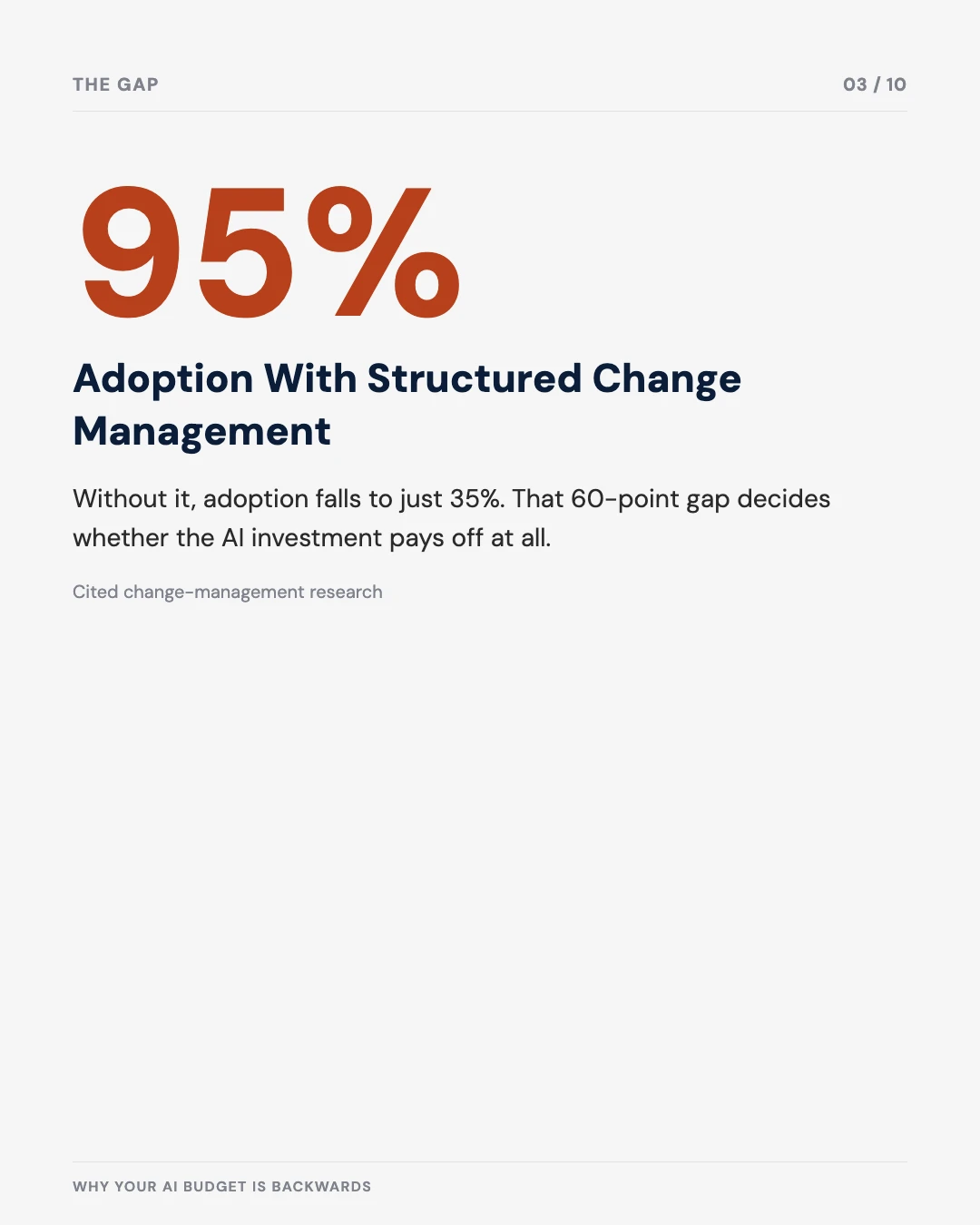
Companies with structured change management hit 95% adoption rates. Without it? Just 35%.
That 60-percentage-point difference is the difference between a £1 million AI investment delivering £3 million in value or becoming an expensive system nobody uses.
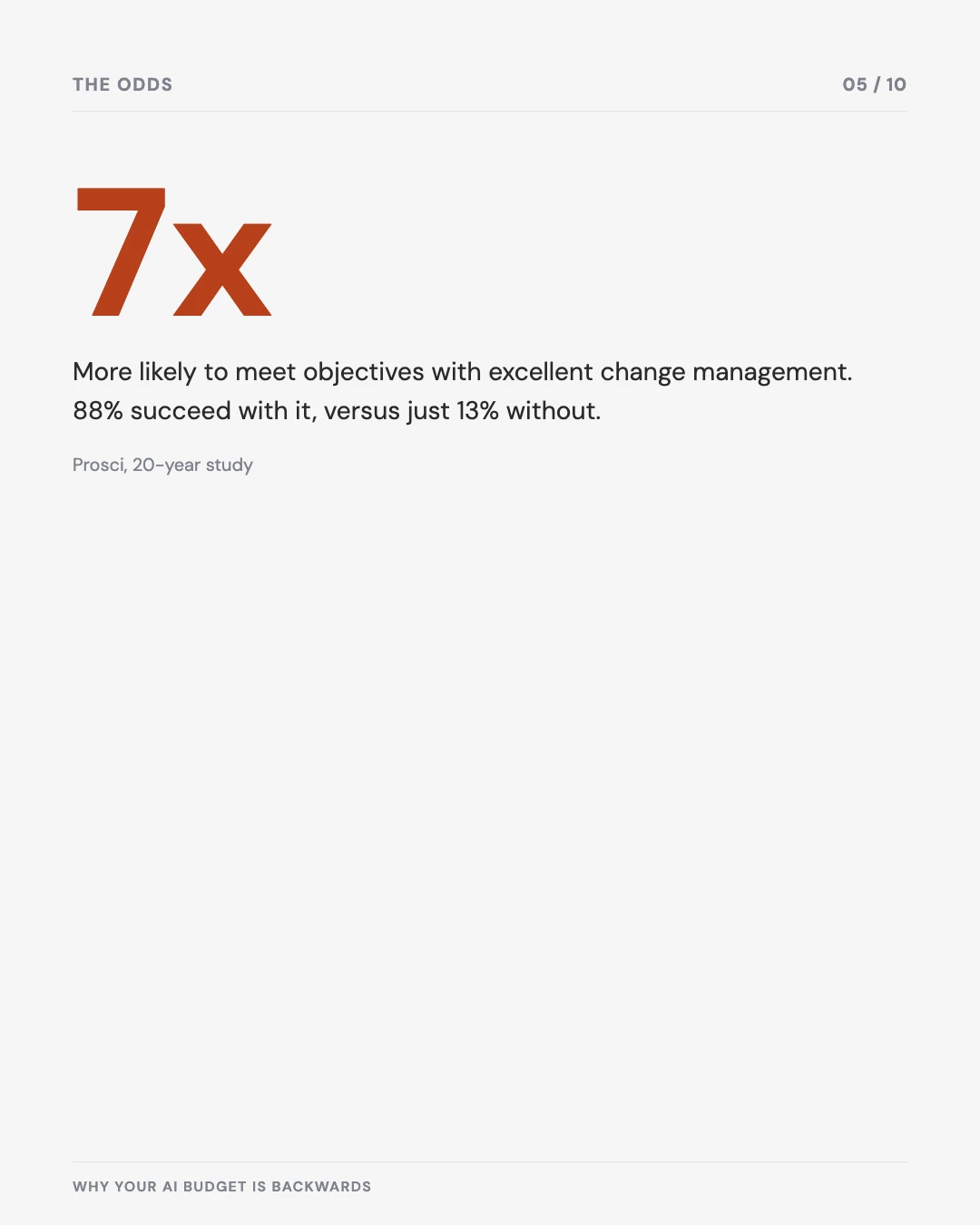
Prosci’s research (covering 20 years and thousands of projects) found that projects with excellent change management are 7x more likely to meet their objectives. Specifically: 88% succeed with good change management versus 13% without it.
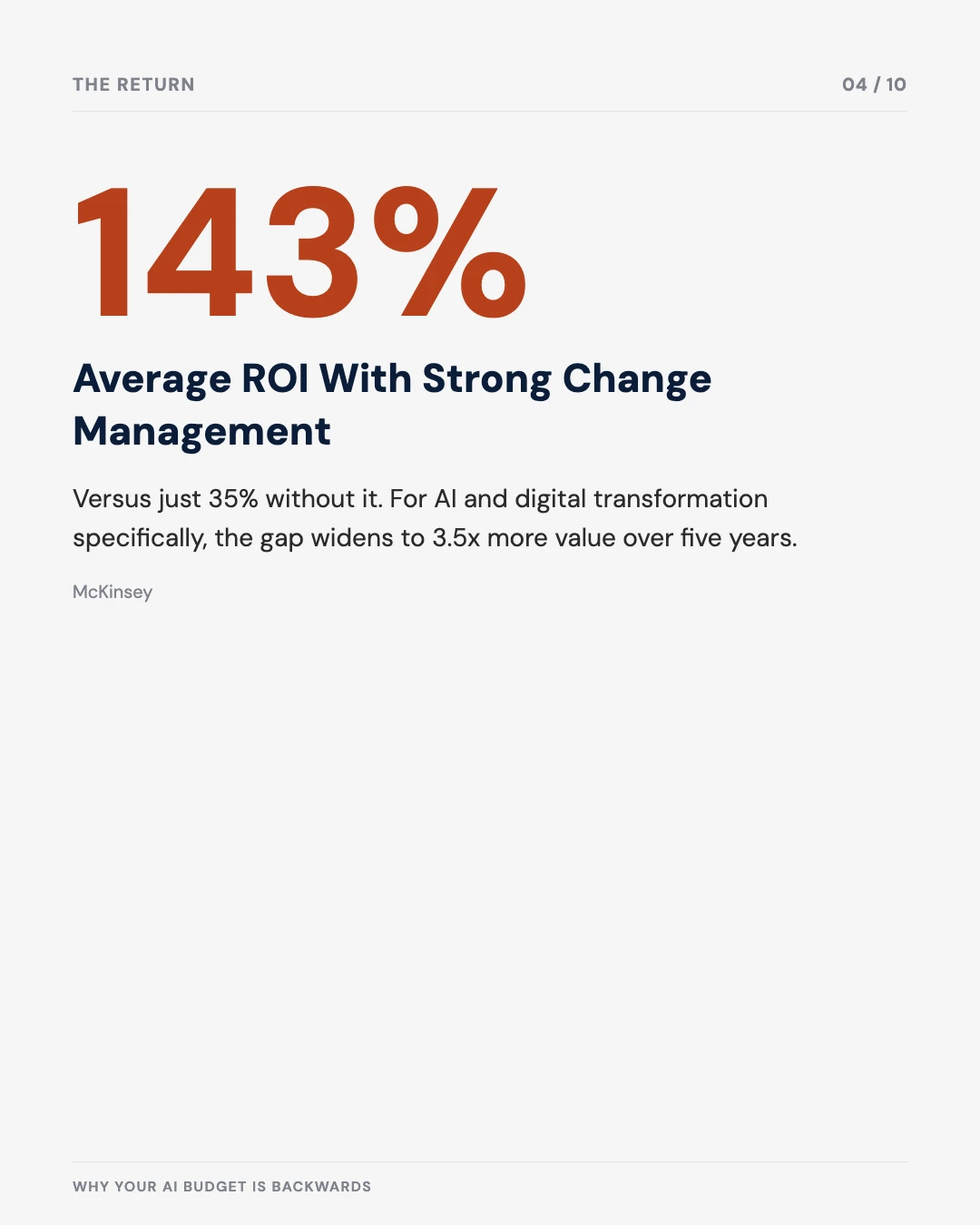
McKinsey found similar results: companies with strong change management average 143% ROI, while those without achieve only 35%. When you zoom in on AI and digital transformation specifically, the gap is even wider: organizations with robust change capability deliver 3.5x more value over five years.
Why People Costs Can Explode
The McKinsey 7S framework explains why people costs exceed tech costs. Four of the seven critical elements (Staff, Skills, Style, and Shared Values) are entirely about people, not technology.
These are where transformations typically stall:
- Leadership resistance
- Employee anxiety about job security
- Unclear role definitions
- Cultural misalignment
When companies treat change management as an afterthought, these issues consume 15-20% of the project budget. But when change management is built in from day one, costs actually decrease and ROI increases by 40-60%.
How the 3:1 Return Actually Works
The 3:1 ROI isn’t theoretical. It’s the documented minimum. Here’s where the returns come from:
1. Reduced implementation costs
Good change management prevents costly delays, rework, and false starts. One manufacturing company saved over £1.2 million in implementation costs through structured change management alone.
2. Faster benefit realization
When 95% of people adopt versus 35%, you hit full utilization 3-6 months faster.
3. Avoided productivity loss
By managing adoption carefully, you prevent the 15-25% productivity decline during transitions. For a 100-person team, this saves 7,500 to 12,500 work days, easily worth £250,000 to £500,000.
4. Better employee retention
People who feel supported through change don’t quit. Each skilled employee who leaves costs 50-200% of their annual salary to replace.
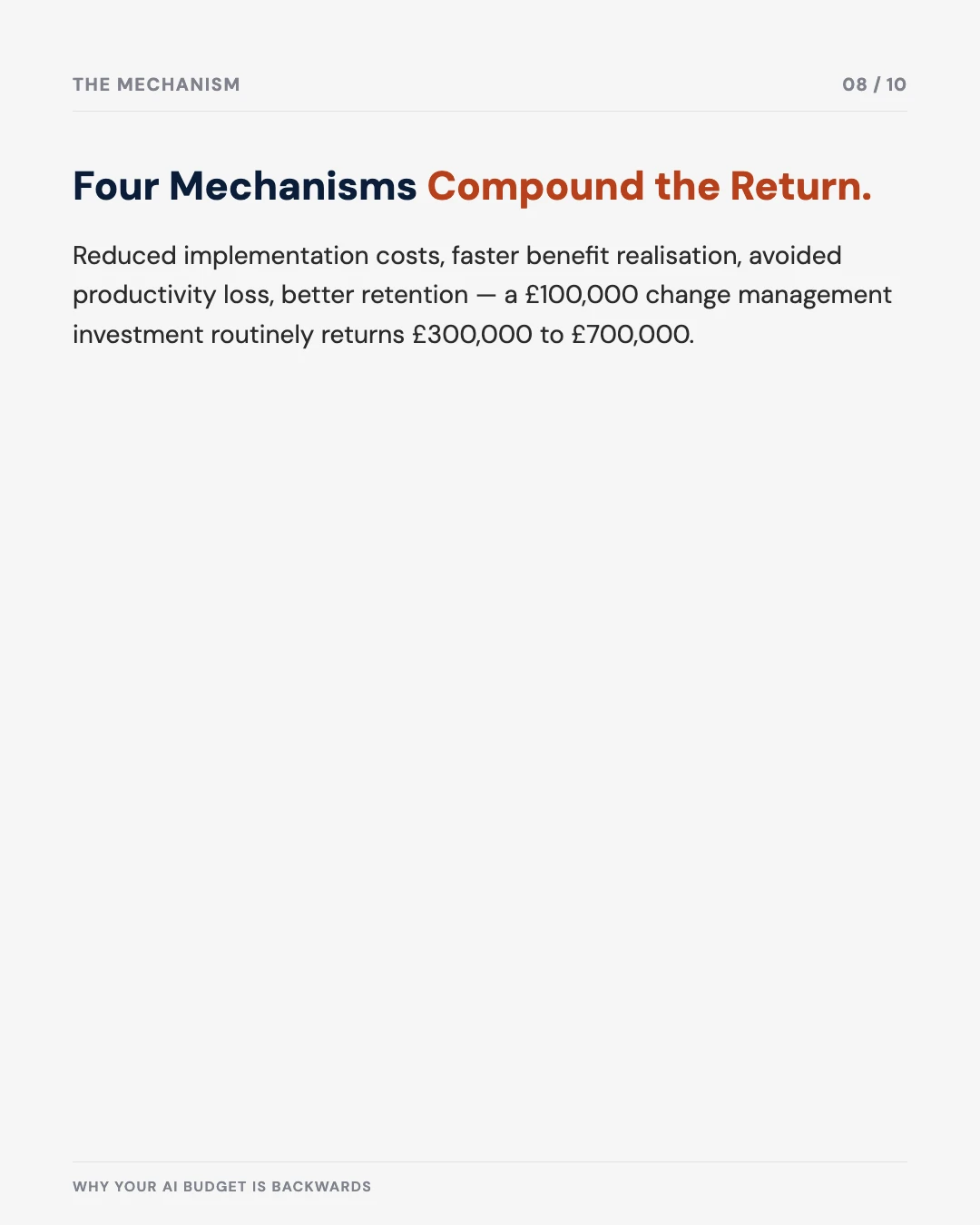
These four mechanisms operate simultaneously. A £100,000 investment in change management routinely generates £300,000 to £700,000 in captured value.
How to Fix Your AI Budget
If you’re allocating 47-67% of your AI budget to infrastructure and software, and another 30-40% to hiring data scientists, you’re probably shortchanging the one thing that determines success: adoption . Team composition itself is worth auditing here too: see Why Team Design Is the Bottleneck.
A smarter allocation would reserve 25-30% of total program spend for change management, training, communication, and enablement, especially during pilot and scaling phases.
This doesn’t increase your total budget. It just shifts money from fixing problems later (underutilization, retraining, rework) to preventing them in the first place.
What Winners Do Differently
Companies that consistently achieve 3:1 or better ROI use structured frameworks like ADKAR (Awareness, Desire, Knowledge, Ability, Reinforcement) or Kotter’s 8-step model.
These frameworks share common elements:
- Explicit measurement of adoption milestones
- Stakeholder segmentation
- Transparent communication about why changes are happening
- Role-specific training
- Active management of resistance through coaching
When applied from project kickoff (not bolted on later), organizations see:
- Adoption rates increase by 40-60 percentage points
- Project timelines compress by 20-30%
- Rework costs drop by 30-50%
- Benefit realization accelerates by 3-6 months
The Bottom Line
Change management isn’t a cost center. It’s an investment multiplier. The 3:1 ROI isn’t optimistic theory; it’s a documented floor.
Companies that view people management as secondary to technology will keep seeing disappointing returns from AI investments. Those that recognize change capability as the primary value driver, and allocate resources accordingly, will see AI deliver measurable, sustained business value.
For leaders accountable for AI outcomes, the question isn’t whether to invest in change management. It’s how much and how early.
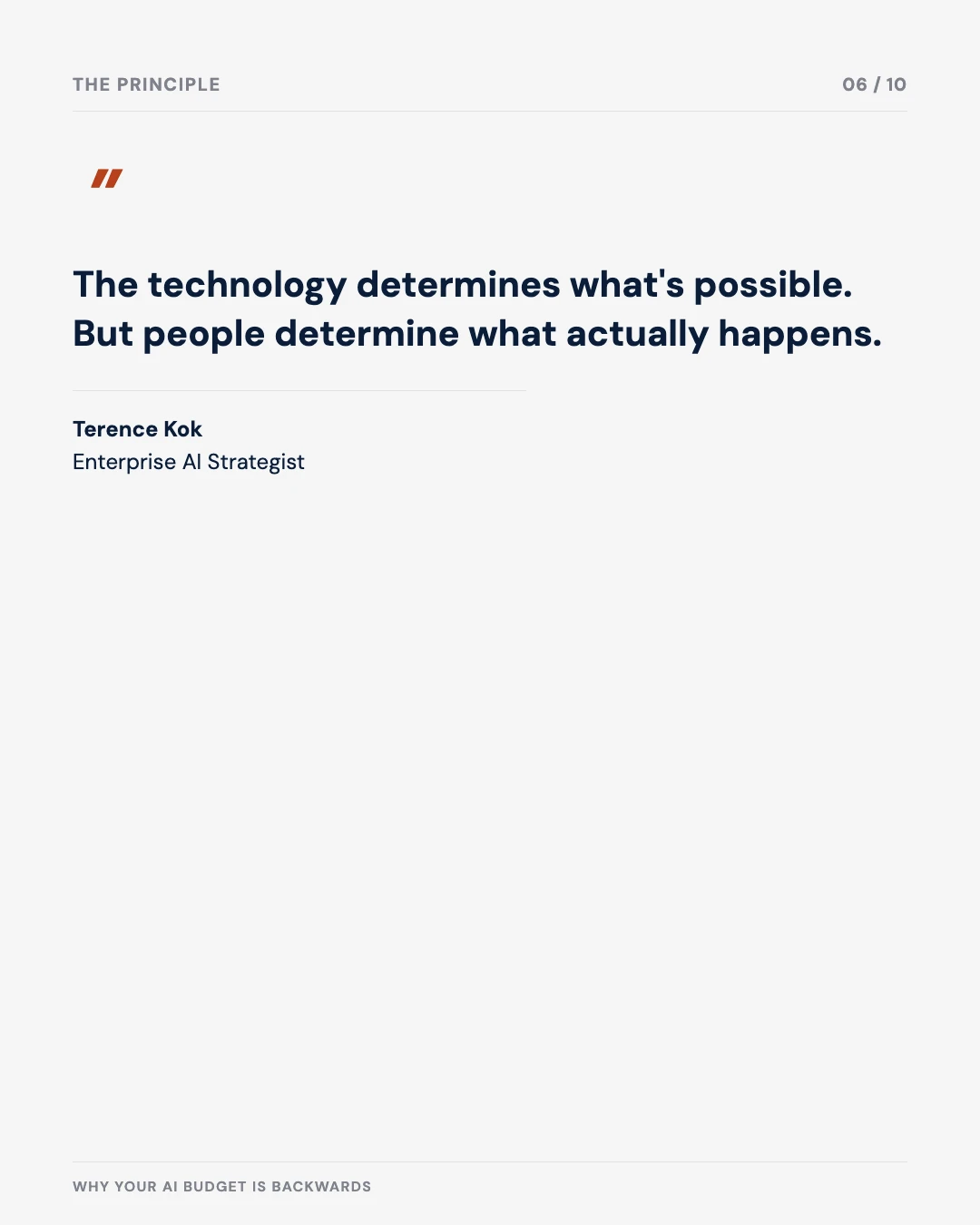
The technology determines what’s possible. But people determine what actually happens.
Free tool
AI ROI Calculator
Model your own project’s numbers before you set the budget split, so change management gets its real share instead of the leftover 20%.
Was this useful?