
Listen to this article
Executive Summary
Centralising AI capability inside a single team introduces latency and dependency instead of scale. Sustainable AI transformation requires shifting from “AI as a service” delivered by a central function to “AI as a capability” distributed to the business units closest to the work.
Core conclusions
- Central teams should own strategy, governance, and architectural coherence, not end-to-end delivery, which should sit with the business units that understand the operational context.
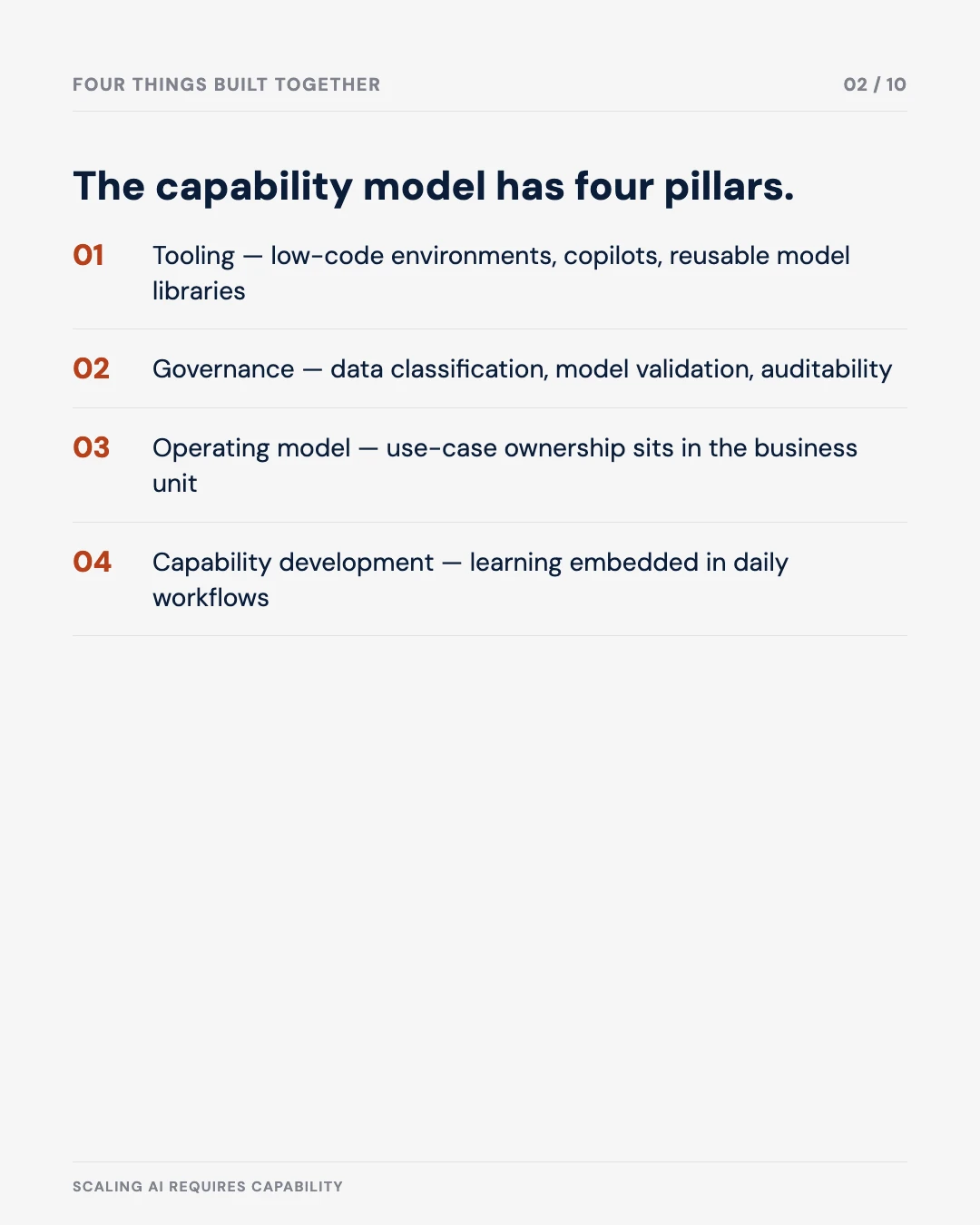
- Scaling requires four things working together: production-grade tooling, clear governance guardrails, business-unit ownership of use cases, and capability development embedded into daily workflows.
- Once aligned, deployment cycles shorten, adoption rises, ROI becomes traceable, and central teams are freed to focus on architecture and cross-domain integration instead of being a delivery bottleneck.
The argument, in ten slides
Save it, share it, or send it to whoever’s still routing every AI request through one team.
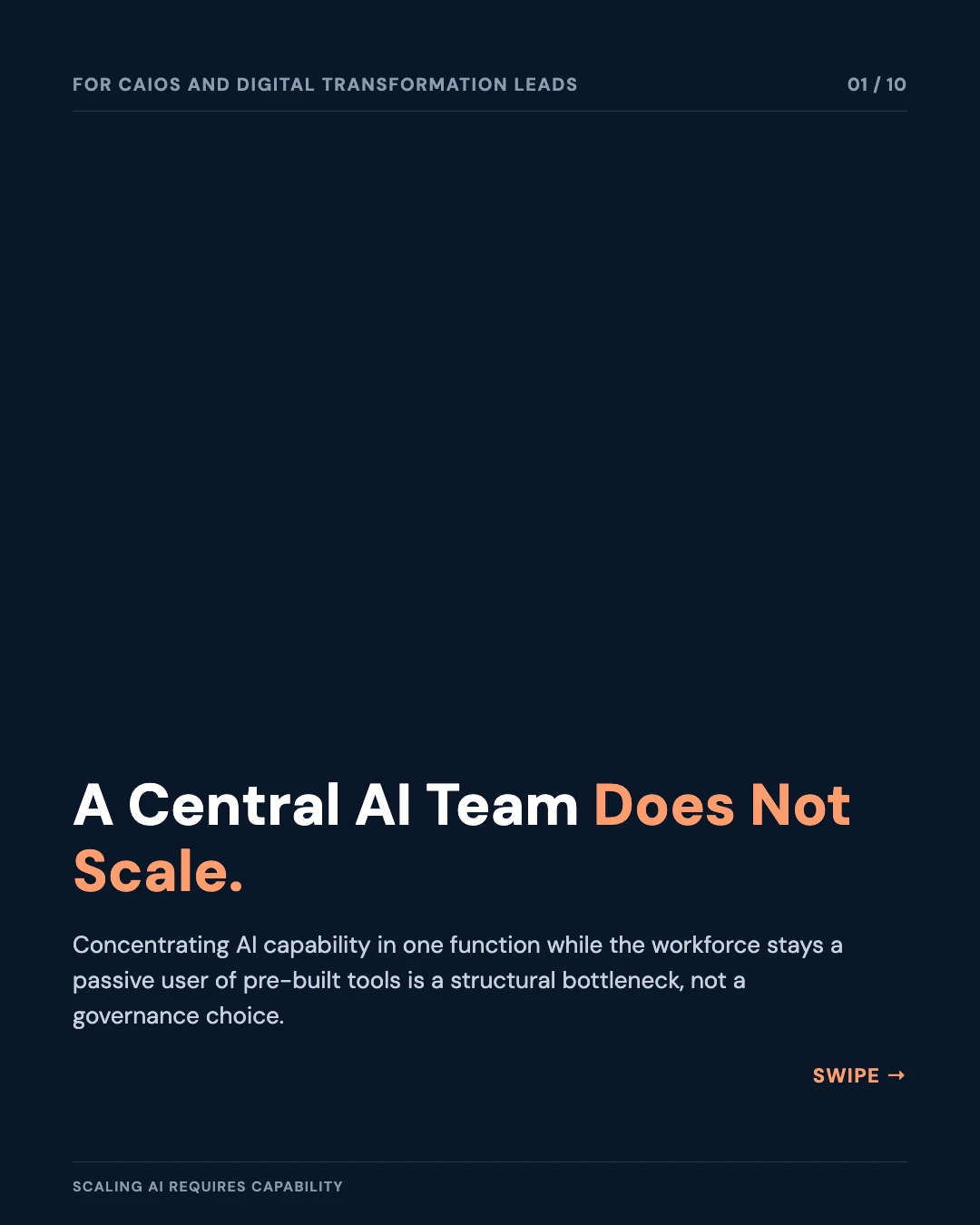
Organisations across both public and private sectors are accelerating investments in artificial intelligence. However, many remain constrained by a structural bottleneck: AI capability is concentrated within a central team, often led by a Chief AI Officer, while the broader workforce remains largely passive users of pre-built solutions.
This model does not scale.
AI-driven transformation cannot be delivered through a central function alone. While central leadership is essential for strategy, governance, and architectural coherence, the real source of value lies in distributed execution. The individuals closest to operations, assets, and service delivery are best positioned to identify inefficiencies, design interventions, and iterate rapidly.
The fundamental shift required is from “AI as a service” to “AI as an organisational capability”.
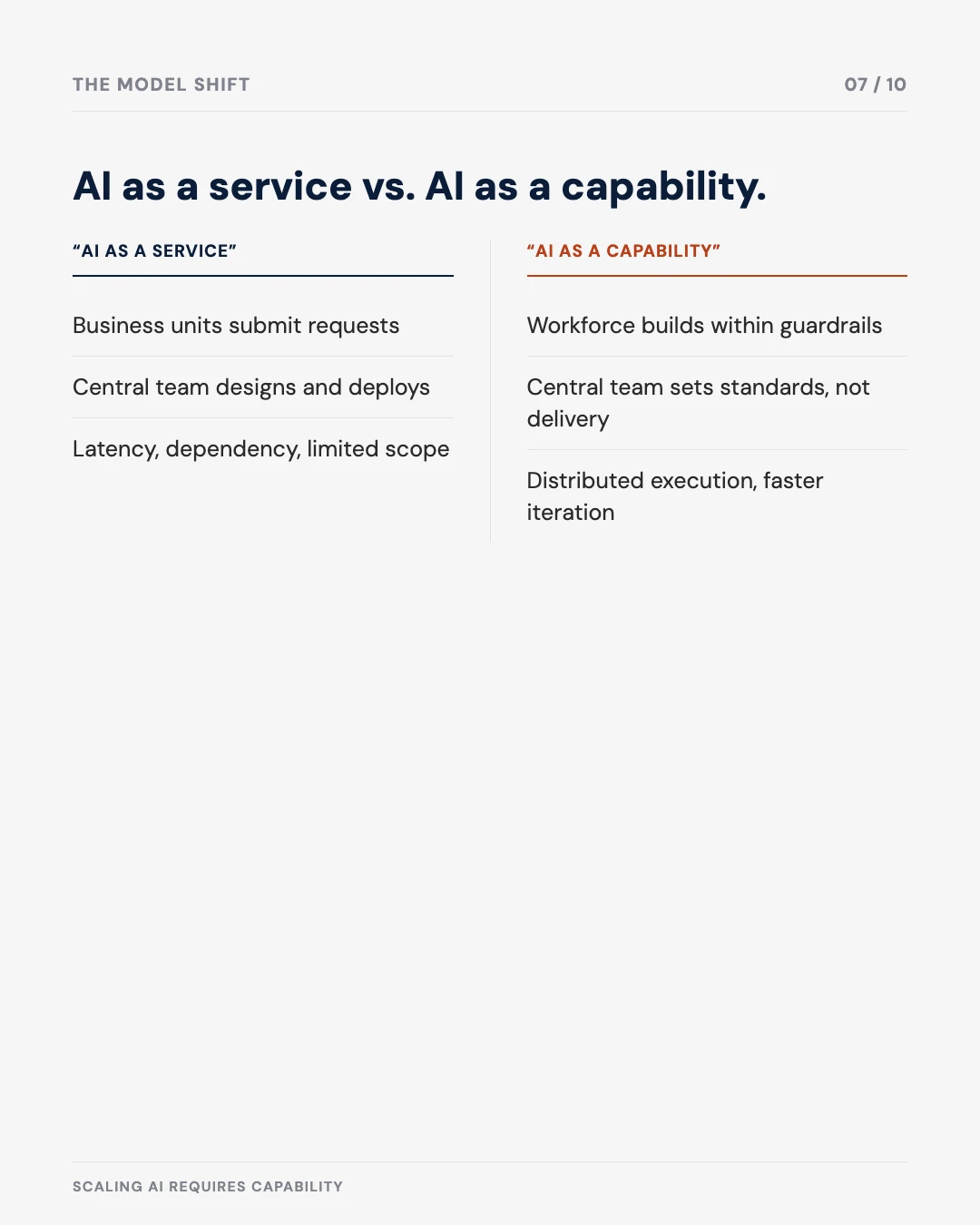
In the “AI as a service” model, business units submit requests, and a central team designs and deploys solutions. This approach introduces latency, limits experimentation, and creates dependency. It also constrains the number of use cases that can be addressed at any given time.
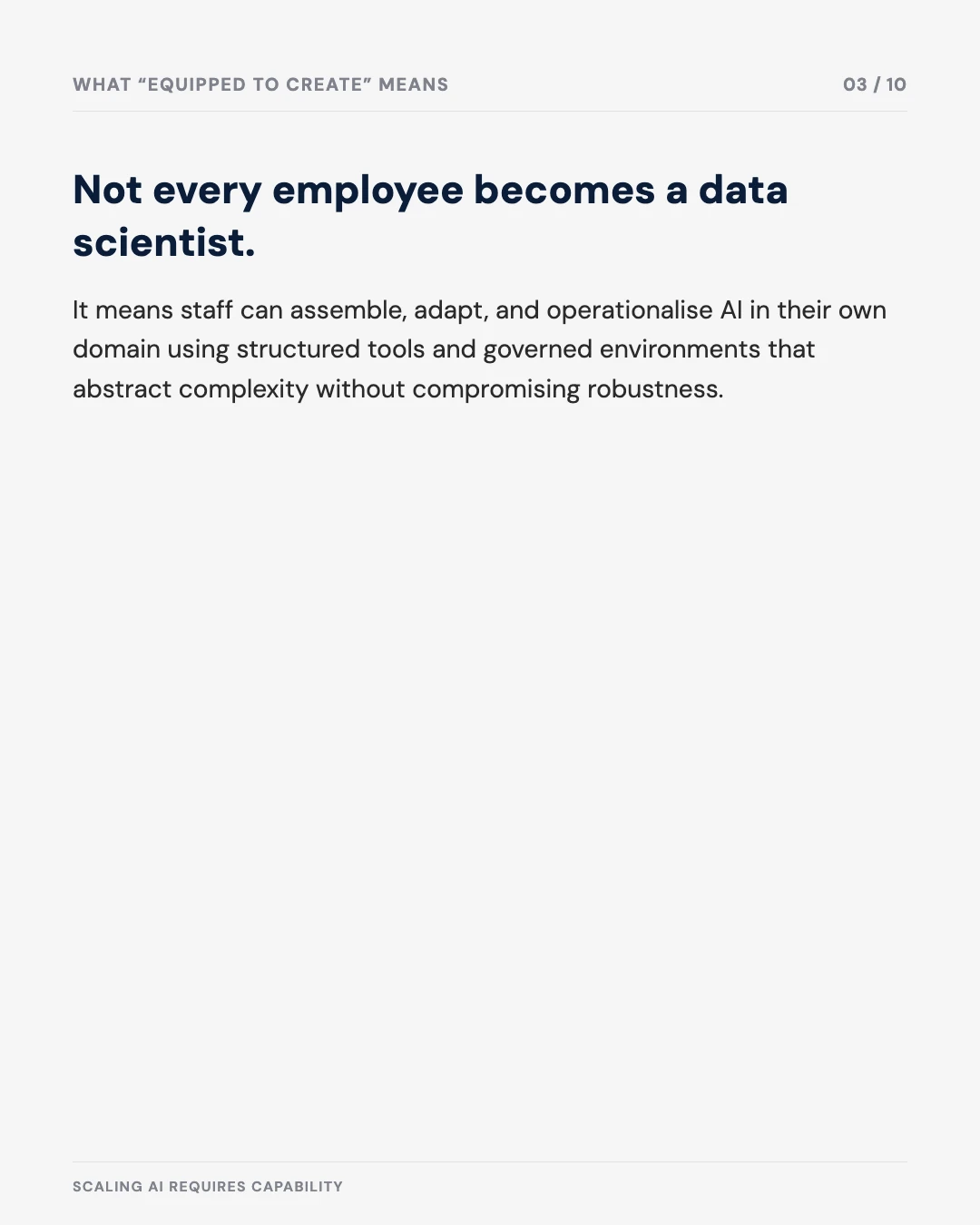
In contrast, an “AI capability” model equips the workforce to become creators. This doesn’t mean every employee becomes a data scientist; it means they’re equipped to assemble, adapt, and operationalise AI in their domain using structured tools and governed environments.
Tooling
Staff must have access to production-grade platforms that abstract complexity while retaining control. This typically includes low-code or no-code AI development environments, copilots embedded within enterprise systems, reusable model libraries, and secure data access layers. The objective is to reduce the barrier to experimentation without compromising technical robustness.
Governance
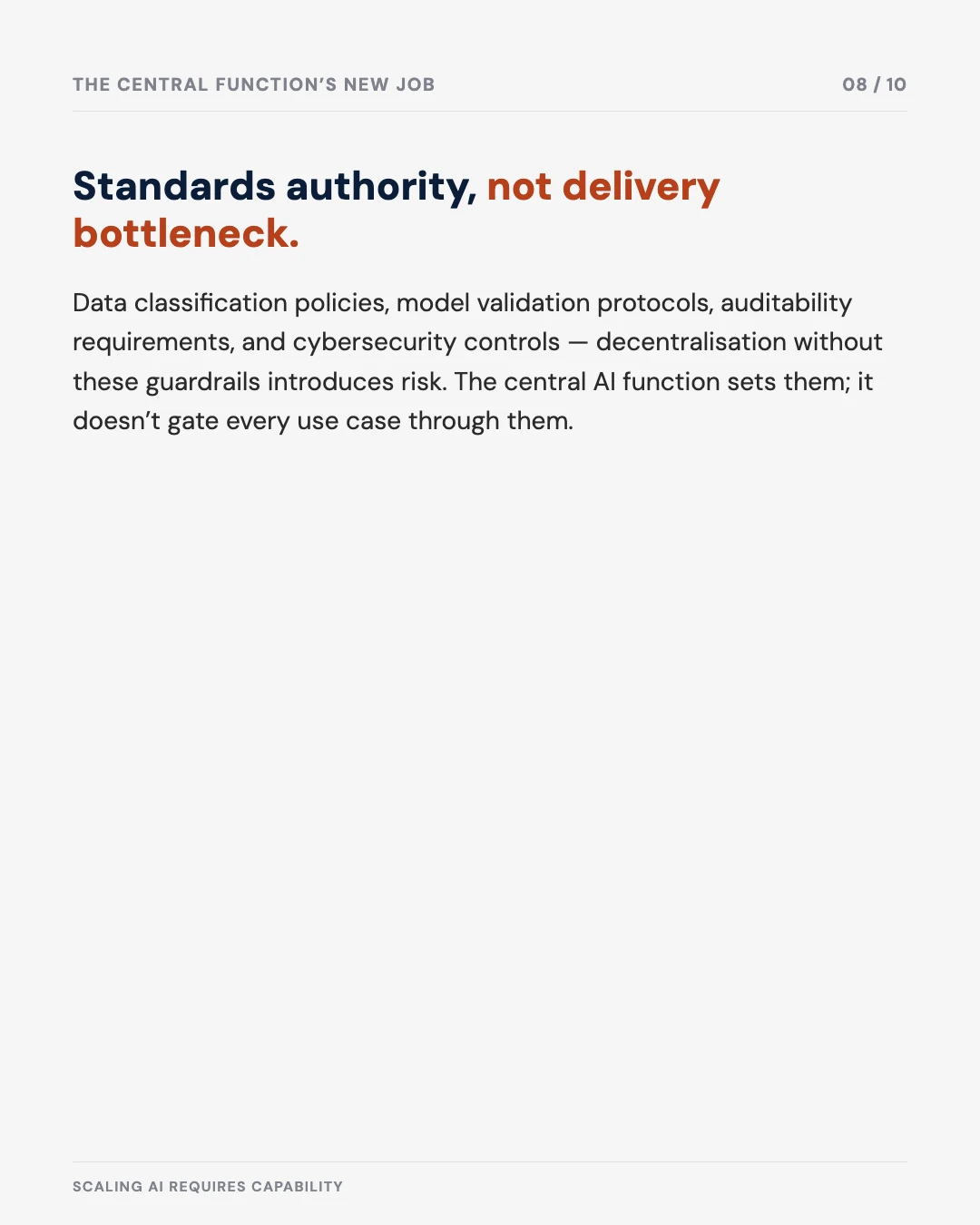
Decentralisation without control introduces risk. Therefore, guardrails must be clearly defined. These include data classification policies, model validation protocols, auditability requirements, and cybersecurity controls. The ISO 42001 AIMS Readiness Checklist is a useful starting inventory for exactly these guardrails. The central AI or digital function should act as a standards authority, not a bottleneck in delivery.
Operating model.
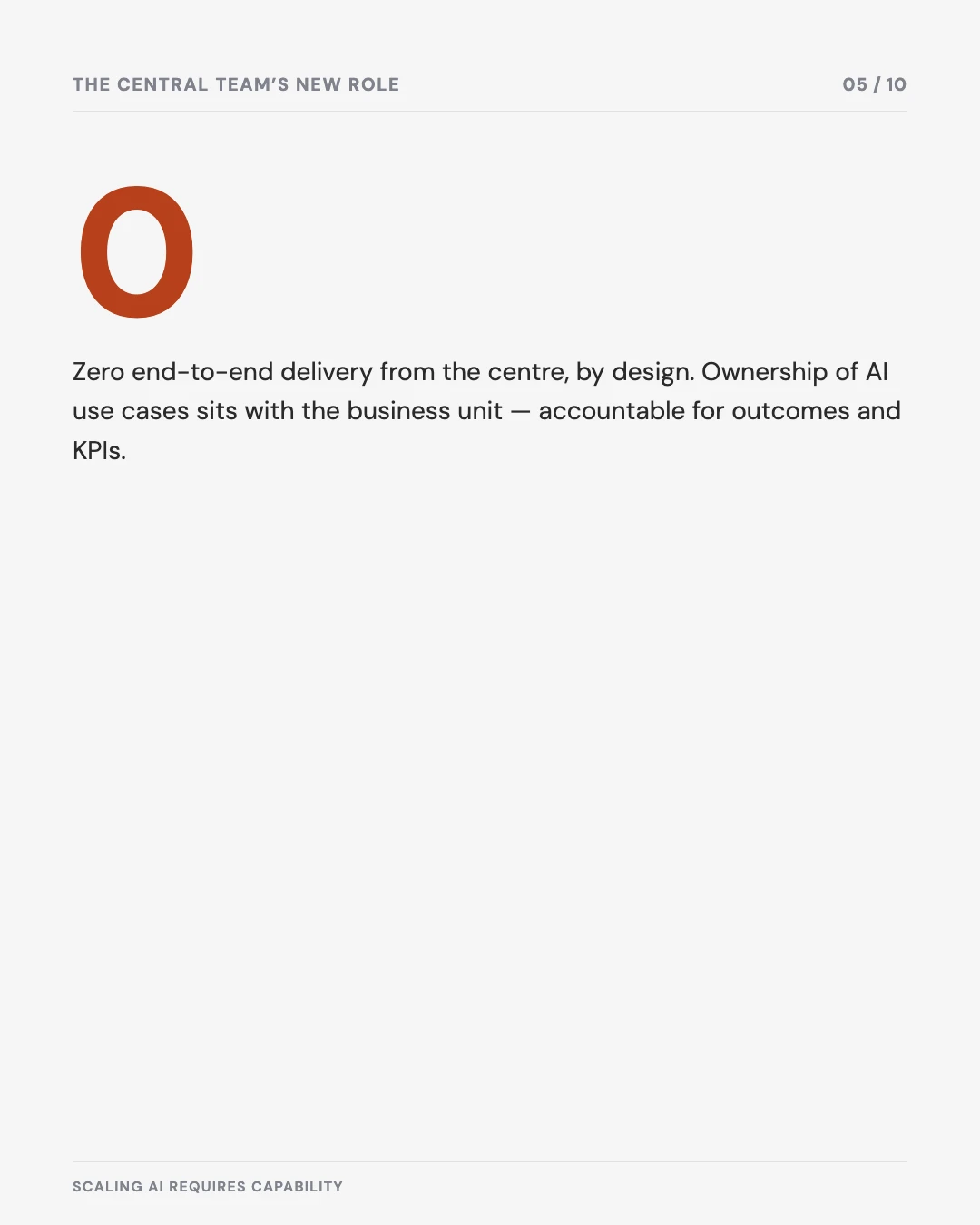
Ownership of AI use cases must sit within business units. This is precisely the ownership question that triggers quiet resistance when handled poorly, so getting it right matters as much politically as structurally. Each function should be accountable for identifying opportunities, defining expected outcomes, and tracking performance against operational KPIs. Central teams provide enablement, shared infrastructure, and oversight, but not end-to-end delivery.
Capability development.
Traditional training programmes are insufficient. Learning must be embedded into daily workflows. This can include guided use-case development, internal communities of practice, and iterative deployment cycles where teams build, test, and refine solutions against real operational data.
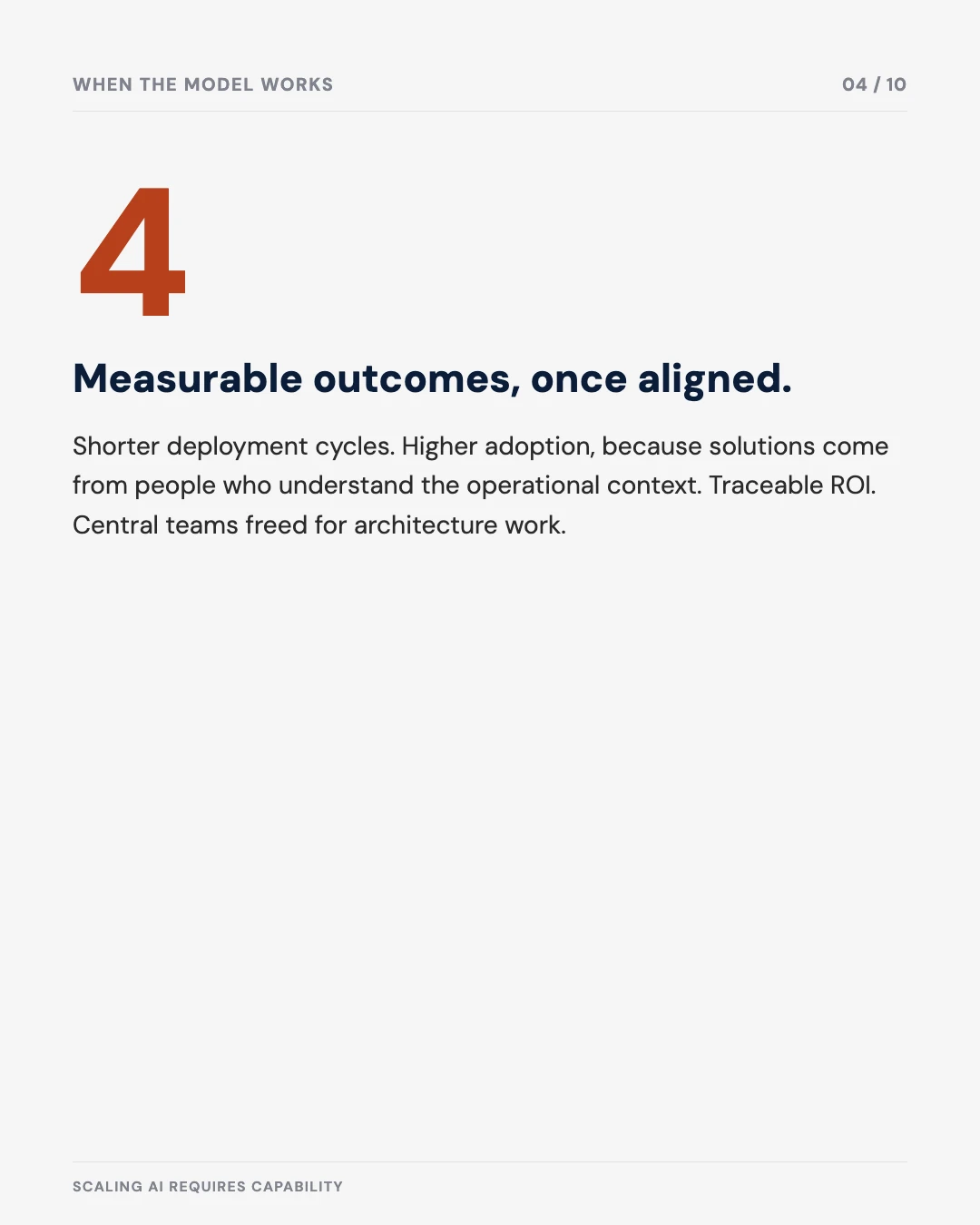
When these elements are aligned, the organisation transitions from isolated pilots to continuous value generation. Several measurable outcomes typically emerge:
- Deployment cycles shorten significantly as local teams iterate without waiting for central prioritisation.
- Adoption increases because solutions are developed by those who understand the operational context.
- Return on investment becomes traceable, as use cases are directly linked to cost reduction, service improvement, or risk mitigation.
- Central teams are freed to focus on high-value activities such as architecture optimisation, advanced modelling, and cross-domain integration.
This model also supports scalability across complex environments such as smart cities, infrastructure systems, and government services, where heterogeneity and domain specificity make centralised delivery inherently inefficient.
The role of leadership, therefore, is not to “serve finished AI solutions”, but to create the conditions for widespread, governed innovation. This includes investing in shared platforms, defining clear standards, aligning incentives, and reinforcing accountability at the business unit level.
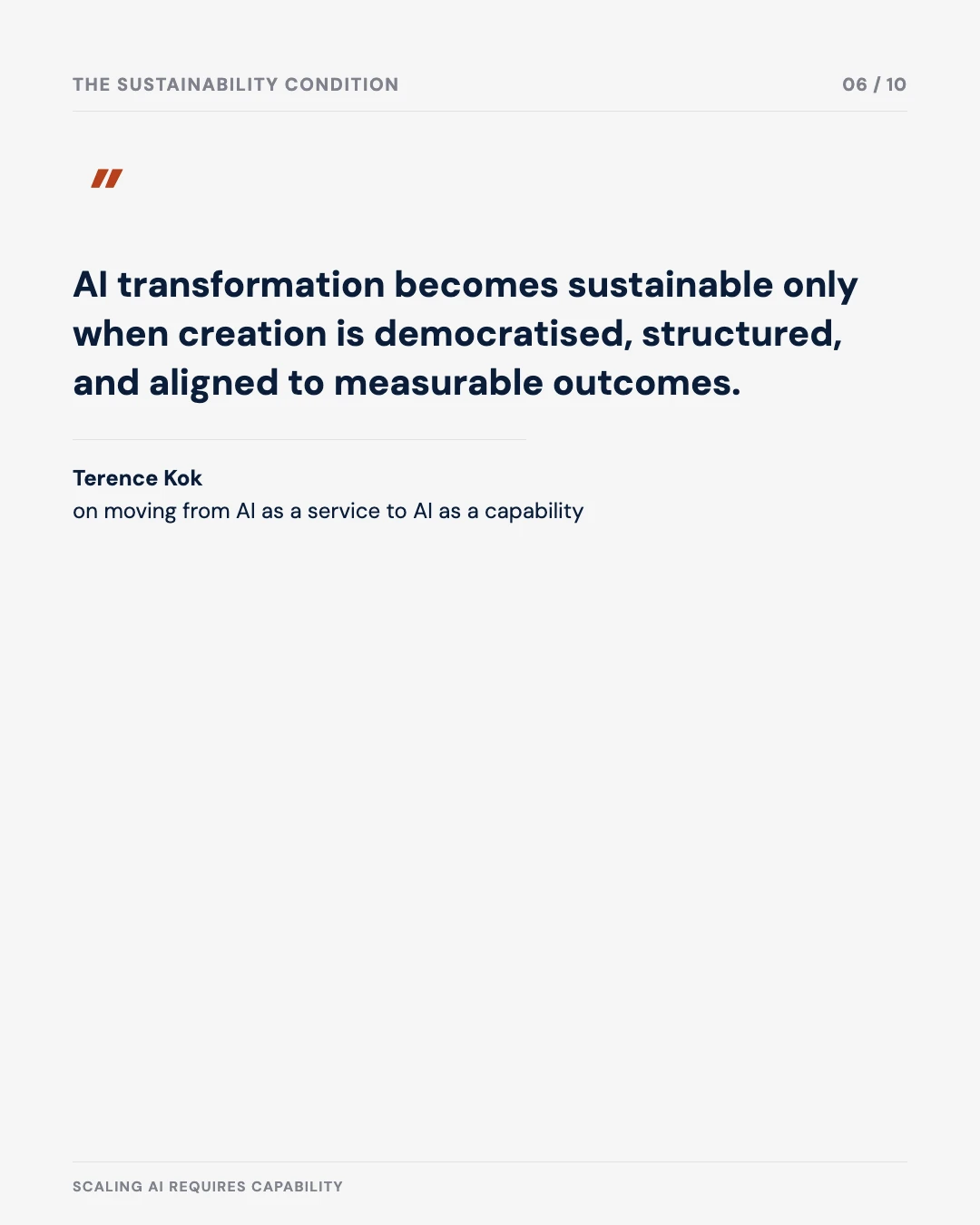
AI transformation becomes sustainable only when creation is democratised, structured, and aligned to measurable outcomes.
Free tool
ISO 42001 AIMS Readiness Checklist
Before you hand any of the four capability elements to a business unit, score your organisation against the guardrails a distributed model actually needs.
Was this useful?