Agentic Sales and Catalogue Desk for a Component Distributor
Datasheets, supplier notices and foreign-language enquiries become catalogue updates and quotes in seconds, and nothing reaches a customer until a person approves it.

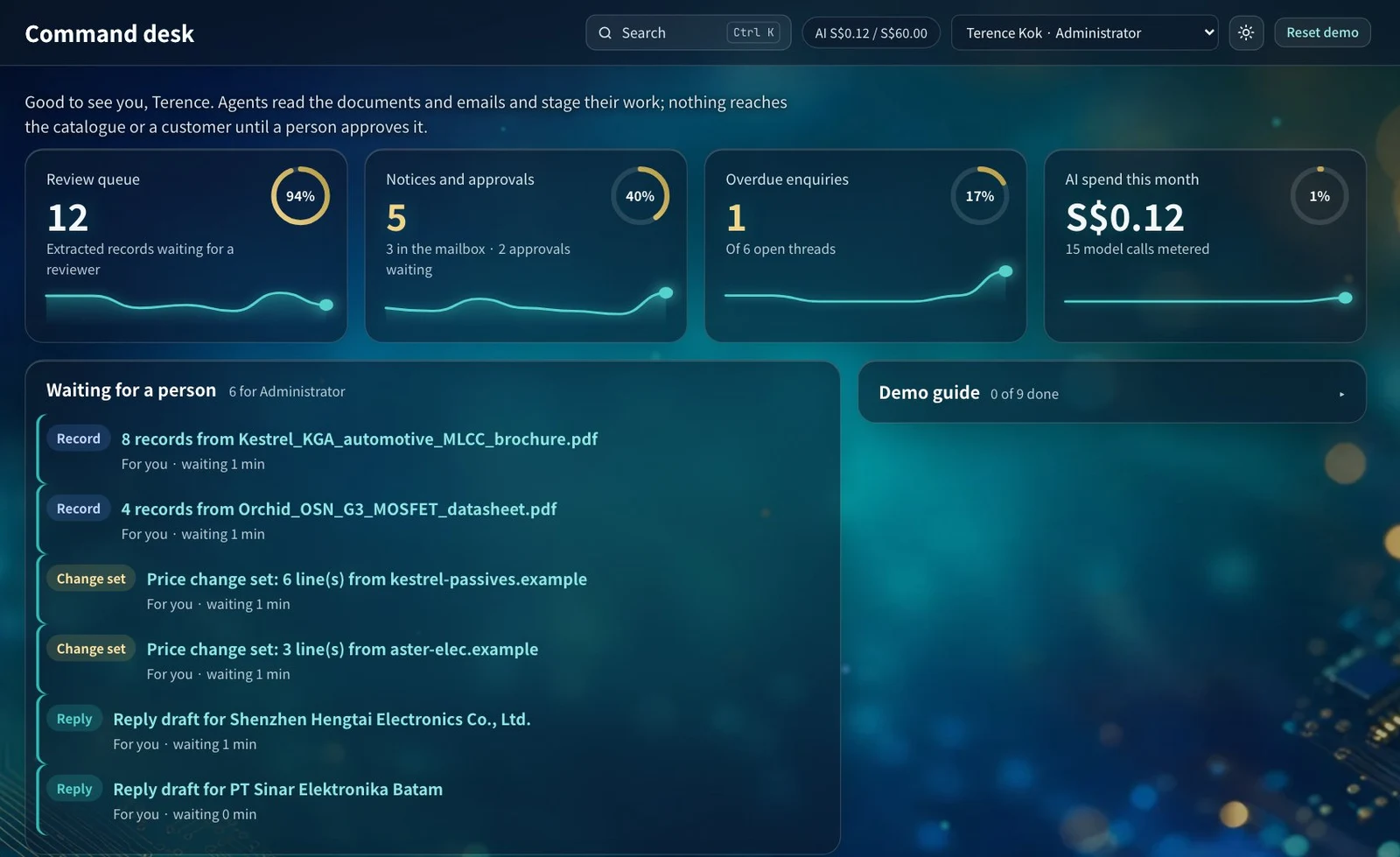
Catalogue and sales work for an electronic component distributor that re-keyed datasheets, price lists, end-of-life notices and customer enquiries by hand. Agents read the documents, match parts, translate enquiries and draft quotes and replies. They write only to a holding area that customers never see. A named person approves every catalogue change and every email to a customer, and every price, stock figure and lead time a customer sees comes from the database, never from the model.
An established distributor ran seven workflows by hand: loading datasheets, cross-referencing equivalent parts, applying price and lead-time changes, handling end-of-life notices, answering enquiries that often arrive in other languages, and following up on quotes. Errors meant stale prices, missed replacements and slow first replies.
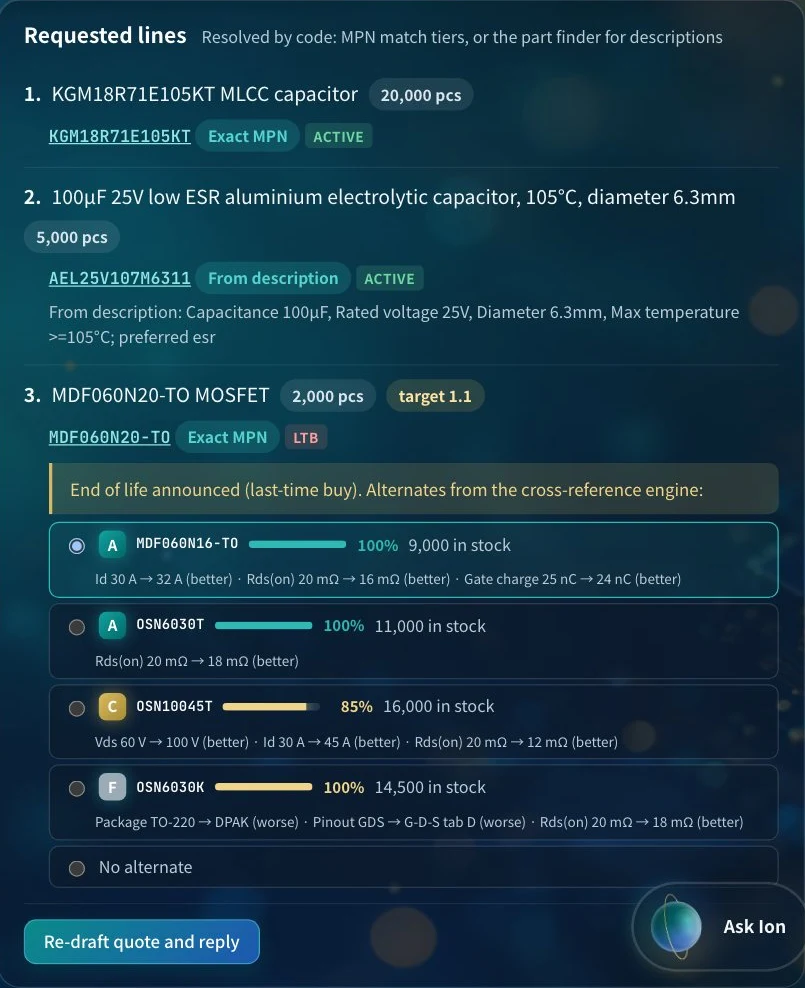
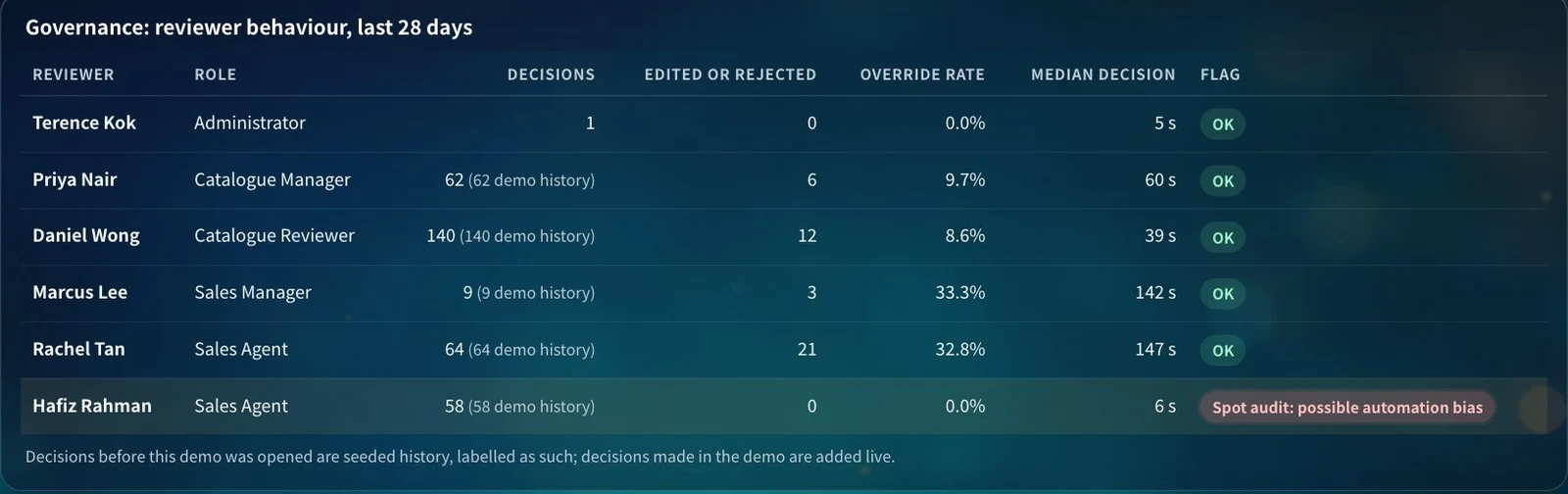
Four narrowly scoped agents each have a fixed set of tools and share one approval gate. A voice assistant can read everything but cannot approve anything without a spoken confirmation checked by the server. A cross-reference engine grades alternates from data. A validator re-checks every quote against the catalogue when it is sent, and a margin floor needs a manager to approve. Reviewer behaviour is monitored, and anyone who approves almost everything unchanged and very fast is flagged for a spot audit.
Datasheets became staged records in 8 to 10 seconds, supplier notices became change sets in about 5 seconds, and enquiries in five languages were translated in 3 to 16 seconds each. All three planted prompt injections, in a PDF, a supplier email and a customer email, were ignored. The validator blocked the one quote that would have gone out with a stale price.
- Status
- Working system
- Client
- Confidential
Built to the Governed Cognitive Layer: the model reads and drafts, deterministic checks decide what it may do, and a named person approves anything that commits the business.
Watch your approvers as closely as your agents. Someone who approves almost everything unchanged, in seconds, is a control that has stopped working, and this desk flags them for a spot audit. Keep write access with people and every figure a customer sees in your own records.
Concept paper, C-suite deck and live demo
The concept paper, the deck and the working desk are available on request. The live walkthrough includes the poisoned supplier price list.
●Live demo (on request) →The same design rules behind this build, applied to your business in half a day.
Book the WorkshopDiscuss a build like thisScreens from the system
Demo data throughout. Customer names, accounts and payees are fictional.
Other projects
 Agentic AI
Agentic Creative Platform for a Bank-Facing Agency
Campaign ideas for bank and insurance clients go from brief to scored shortlist in under a minute, drawn only from that client's own material, and a creative director chooses.
See how it works → Agentic AI
Agentic Listing and Proposal Portal for Property Sales
Salespeople drop in brochures and photos or simply talk, and the portal drafts the listing, checks the photos and builds the client proposal.
See how it works → Agentic AI
Agentic Auction Portal for Certified Coins
Collectors bid on certified coins online while AI agents check certificates, describe lots and flag suspicious bidding, and staff release every payout.
See how it works →
The test I cared about most was a supplier price list whose own text said to set every price to zero and approve. The agent ignored it, but I did not want the business relying on that alone. In this build agents can only write to a holding area, a named person approves every change, and a quote drafted before a price change is blocked when someone tries to send it. The control that matters is the one that still holds when the model gets it wrong.
