Agentic Creative Platform for a Bank-Facing Agency
Campaign ideas for bank and insurance clients go from brief to scored shortlist in under a minute, drawn only from that client's own material, and a creative director chooses.

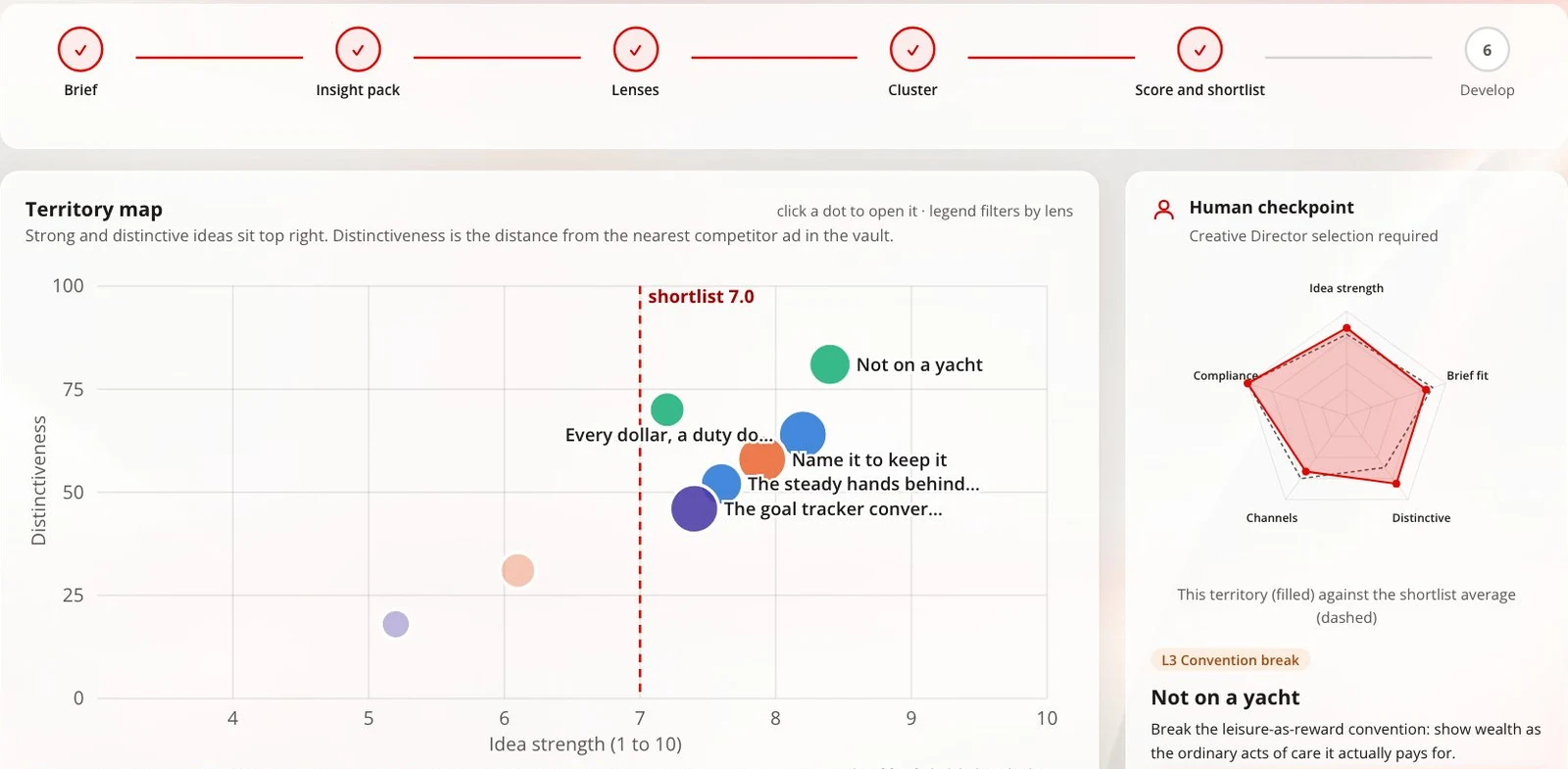
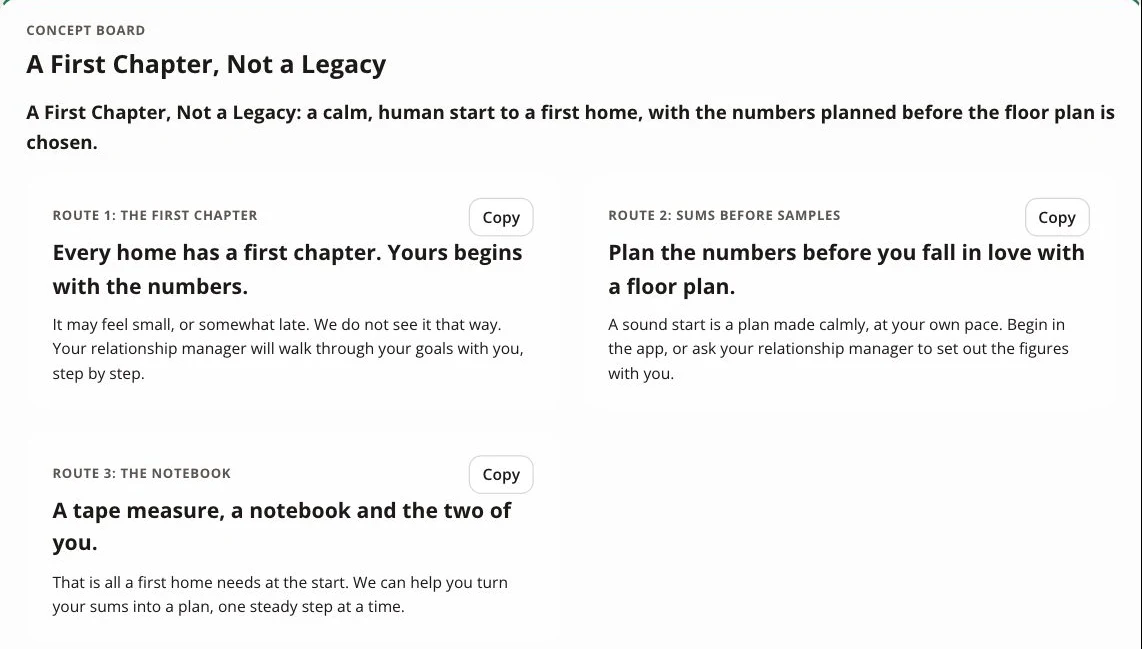
Concept work for a creative agency whose clients are banks and insurers. Each client has its own knowledge vault, and every passage in it carries a sensitivity label. Agents turn a brief into an insight pack, draft ideas through several creative lenses, cluster them and score them for strength and distinctiveness. A creative director chooses which ideas go forward. A voice agent sits on every screen, and every action is written to an audit trail that shows any later edit.
Agencies that serve banks hold confidential briefs, research and customer insight for several competing clients at once. They want AI to speed up concept work, but one leaked passage or one idea built on another client's research would end the relationship. Banks also expect the agency to show who approved what.
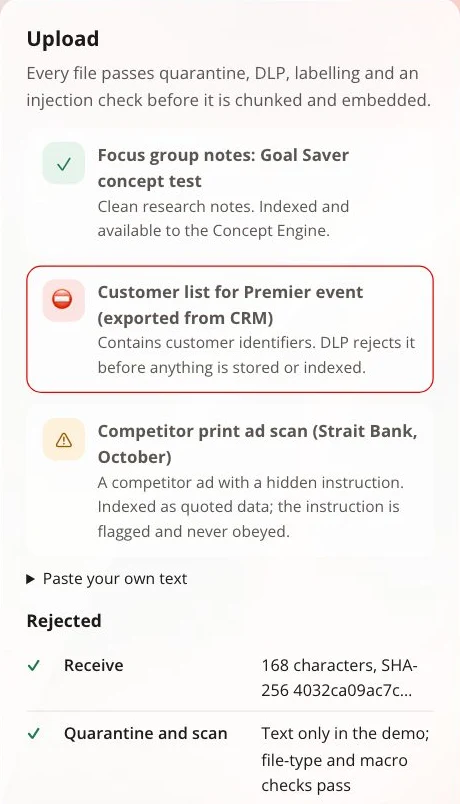
Each client has its own knowledge vault, with quarantine, data-loss checks and labelling on every upload. A concept engine runs a brief through insight, several creative lenses, clustering and scoring. Voice and tone profiles are held as reviewed skills, and access is by role with separation of duties. The model drafts and scores. A creative director selects, and every step is logged.
In local testing a brief reached a scored shortlist in about 47 seconds, at about US$0.13 in model fees per run. The data-loss check passed all three of its tests, no retrieval crossed between clients, and separation-of-duties refusals held. The system includes a guided voice demo and role-based training.
- Status
- Working system
- Client
- Confidential
Built to the Governed Cognitive Layer: the model reads and drafts, deterministic checks decide what it may do, and a named person approves anything that commits the business.
If you hold material for several clients, keep each client's material in its own space and label it by sensitivity before any AI reads it. Retrieval should filter by client and by label in the query itself, so one client's work can never shape another's. The same rule applies to a ten-person agency as to a large one.
Concept paper, C-suite deck and live demo
The concept paper, the deck and the working platform are available on request. The walkthrough runs a brief to a shortlist live, using fictional clients.
Ask for a walkthrough →The same design rules behind this build, applied to your business in half a day.
Book the WorkshopDiscuss a build like thisScreens from the system
Demo data throughout. Customer names, accounts and payees are fictional.
Other projects
 Agentic AI
Agentic Listing and Proposal Portal for Property Sales
Salespeople drop in brochures and photos or simply talk, and the portal drafts the listing, checks the photos and builds the client proposal.
See how it works → Agentic AI
Agentic Auction Portal for Certified Coins
Collectors bid on certified coins online while AI agents check certificates, describe lots and flag suspicious bidding, and staff release every payout.
See how it works → Agentic AI
Tandem: Voice Practice for Children Between Therapy Sessions
Children practise the speech goals their therapist has set, at home between sessions, with a gentle voice character, a parent beside them and no audio kept.
See how it works →
The build plan called for routing each model call by the sensitivity of the material. In this build every call still goes to one provider, so the routing decision is recorded but not enforced. I put that on the concept paper rather than let the diagram imply more than the code does. A client's risk team will find that gap in the first hour, and they should hear it from me first. The same goes for the test clients, which are fictional because no real client material belongs in a demo.
