Agentic Auction Portal for Certified Coins
Collectors bid on certified coins online while AI agents check certificates, describe lots and flag suspicious bidding, and staff release every payout.

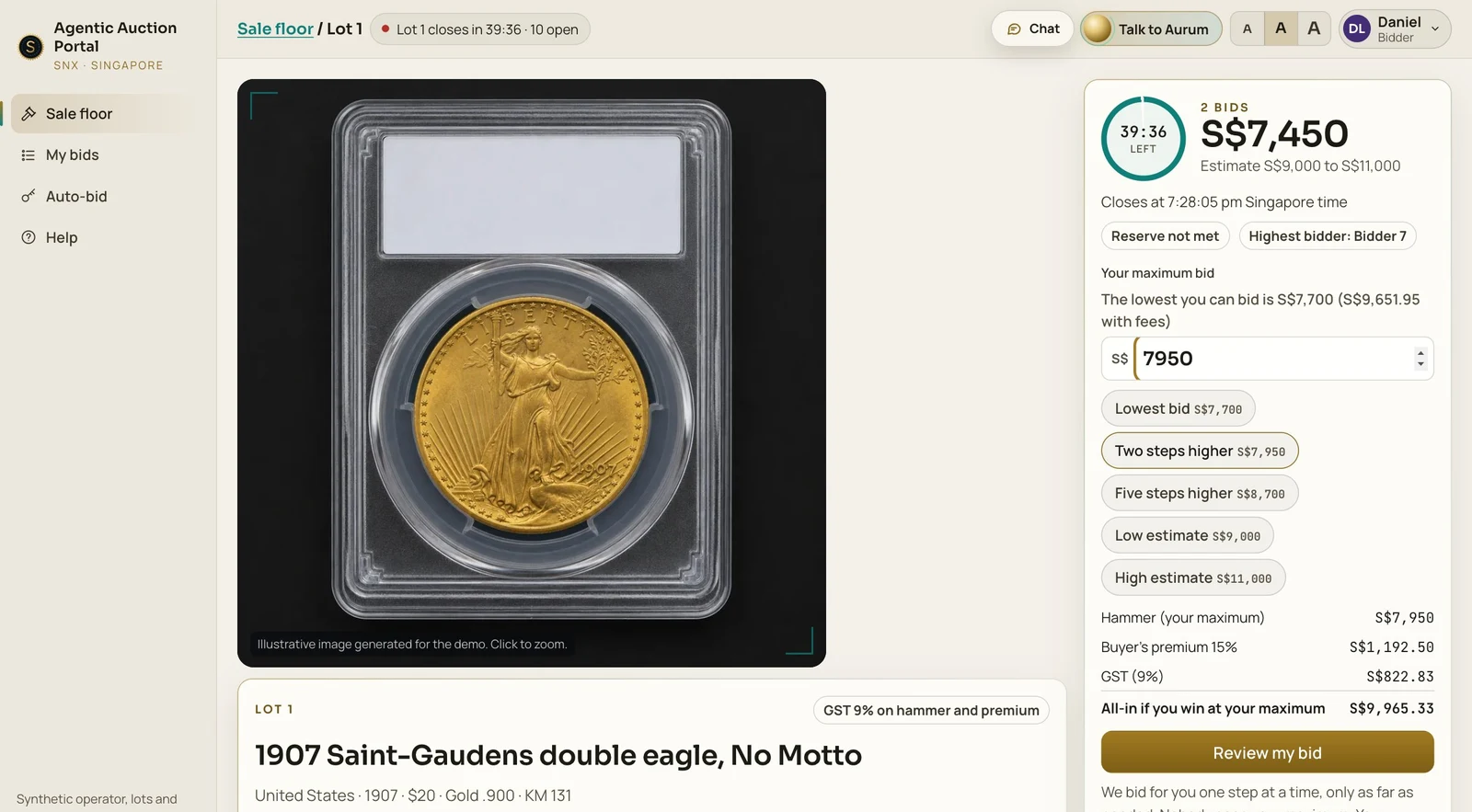
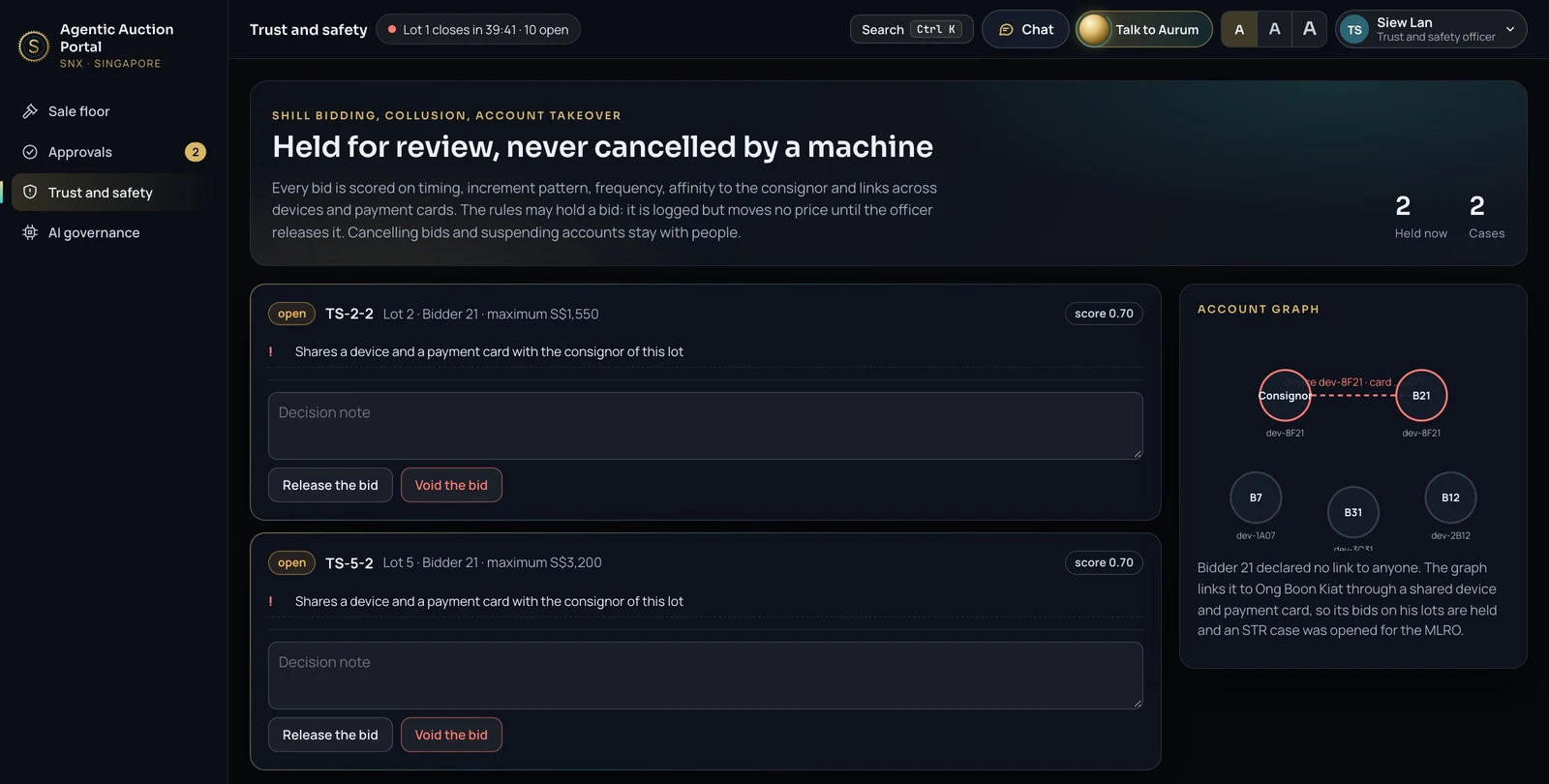
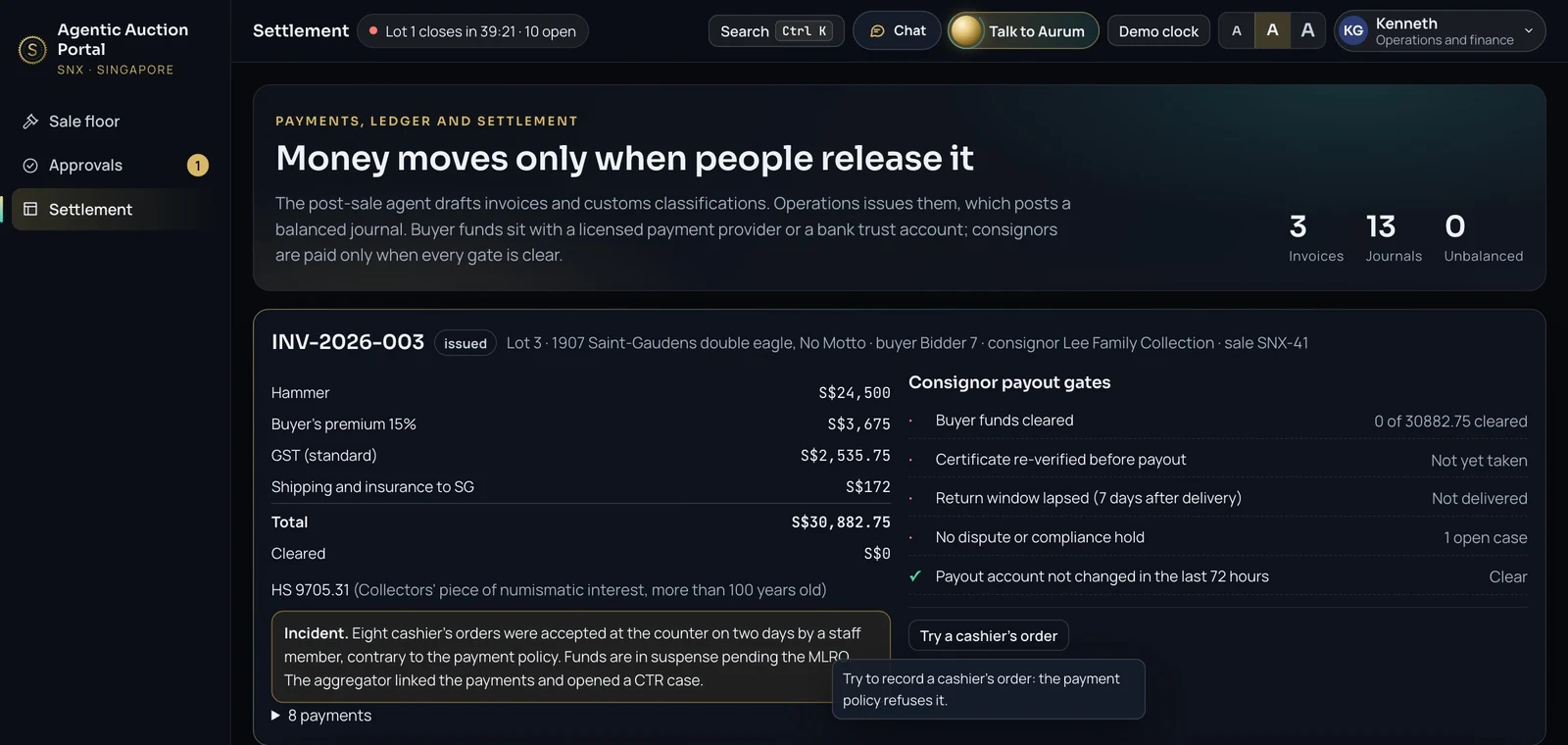
An online auction for certified coins and banknotes in Singapore, with a public website, a bidding app for collectors and staff screens for intake, trust and safety, compliance and settlement. Agents check certificates, draft lot descriptions, price lots, flag suspicious bidding and draft invoices. People approve every listing, decide every held bid and release every payout. The bidding screens were designed for older collectors, with large text by default and plain words.
Certified coin auctions carry three risks at once: counterfeit or misdescribed items, shill bidding, and anti-money-laundering duties on high-value cash and card payments. A small auction house has to manage all three while keeping the experience simple for collectors, many of whom are older.
The system covers the full journey from consignment to settlement. Bidding rules, fees, GST and the soft close are written as plain calculations and tested against 10,000 random bid sequences. Agents treat consignor text as untrusted data. Trust rules can hold a bid but never cancel one, and consignors are paid only when every payout gate is clear.
The system runs a live timed sale with a simulated room, a public website in front of it, and an end-to-end script of 40 checks. Its seeded test cases cover a prompt injection in a consignor note, a counterfeit holder, a certificate changed before close, a bidder linked to a consignor and cash payments split to avoid reporting. Each is caught and routed to a person.
- Status
- Working system
- Client
- Confidential
Built to the Governed Cognitive Layer: the model reads and drafts, deterministic checks decide what it may do, and a named person approves anything that commits the business.
Let automated checks hold a suspicious bid or payment, and leave the decision to cancel with a person. A machine that can only pause cannot wrongly take a win from a genuine collector. Write bid increments, fees and payout conditions as tested code, so the agent can explain them but cannot bend them.
Concept paper, C-suite deck and live demo
The concept paper, the C-suite deck, the public website and the working bidding app sit behind a password. I walk owners through it live.
●Live demo (on request) →The same design rules behind this build, applied to your business in half a day.
Book the WorkshopDiscuss a build like thisScreens from the system
Demo data throughout. Customer names, accounts and payees are fictional.
Other projects
 Agentic AI
Tandem: Voice Practice for Children Between Therapy Sessions
Children practise the speech goals their therapist has set, at home between sessions, with a gentle voice character, a parent beside them and no audio kept.
See how it works → Agentic AI
Oneness: A Private AI Companion with Safety Built Around It
Adults talk privately about work, relationships and decisions, by text or voice, with every message checked for risk before any reply and a human listener one consent away.
See how it works → Agentic AI
Agentic Tour Operations Platform for a Destination Management Company
Offshore staff and bounded agents prepare costed tour proposals from a WhatsApp enquiry, and the founder decides at three gates: release, final price and job confirmation.
See how it works →
My first version was built for staff and for me. Then I was reminded that this is a consumer portal and many bidders are senior. That changed the design more than any agent did. Text is now large by default, the public screens use plain words, there is a My bids page that says outbid or winning in one line, and a Help page that offers a call back. Governance is wasted if the customer cannot read the screen.
