AI Cargo Load Planning for Transport Aircraft
Planners import a manifest and get ranked loading plans already checked against weight, balance and dangerous-goods rules, with an AI agent that explains but never places cargo.

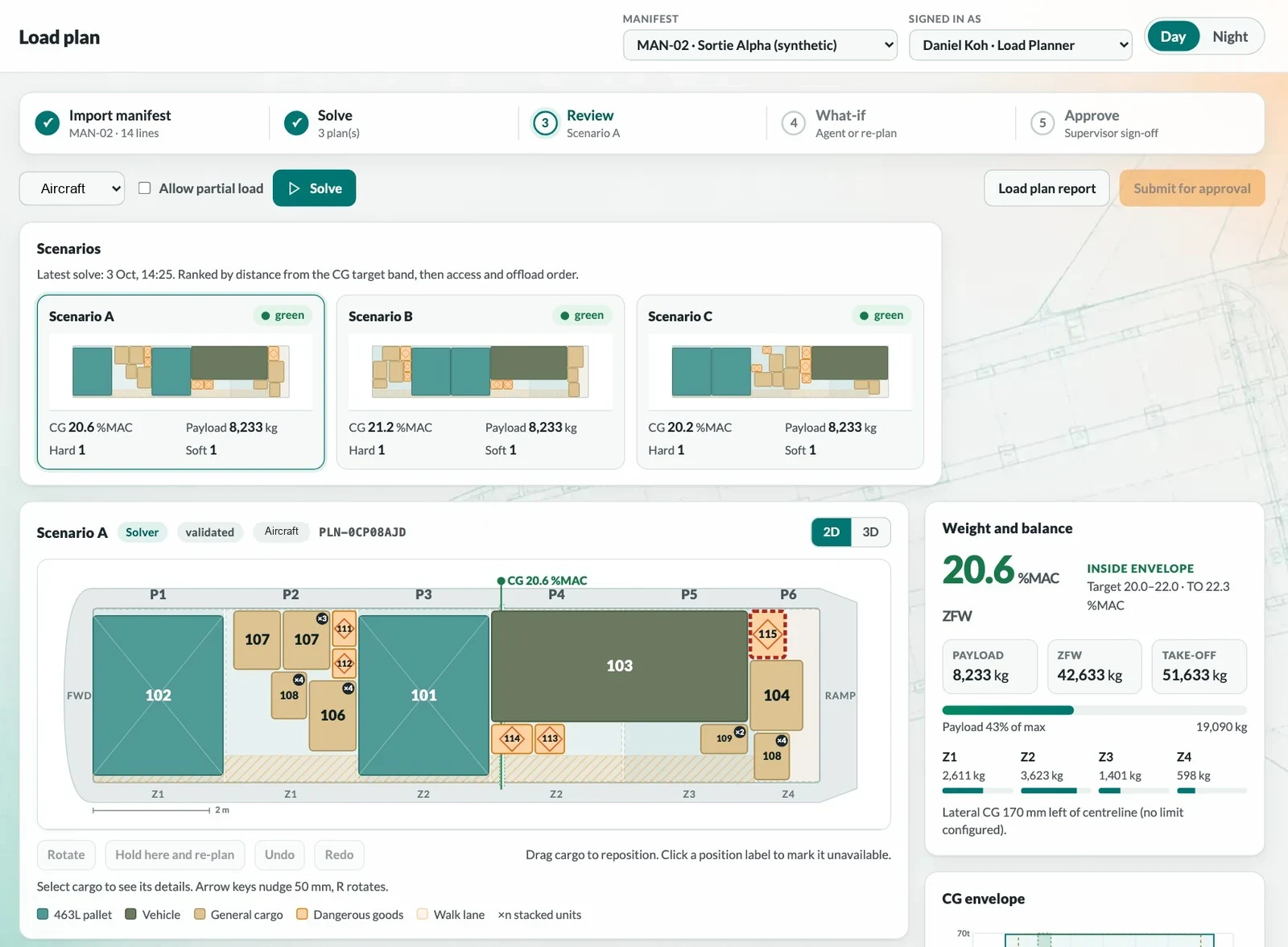
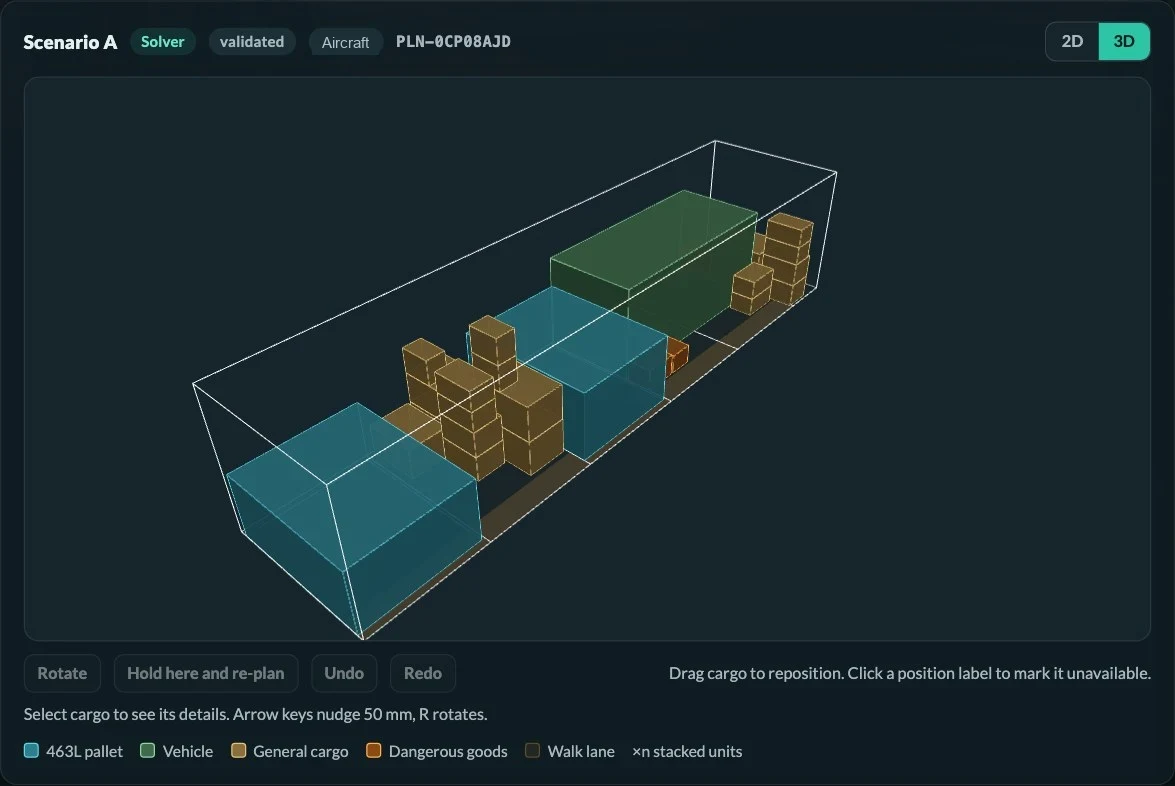
Load planning for transport aircraft. Planners import a cargo manifest, the engine produces ranked loading plans within weight, balance and dangerous-goods rules, and planners can ask the agent by text or voice for a what-if. The agent has no tool that places cargo or approves a plan. A supervisor who did not create or submit the plan signs it off on screen, and every step goes into an audit log that shows any later edit.
Load planning for transport aircraft is done by experienced people working against weight limits, centre-of-gravity limits and dangerous-goods separation rules. The brief asked for an AI planning system that would speed this up without ever letting a language model decide where cargo goes or approve a manifest.
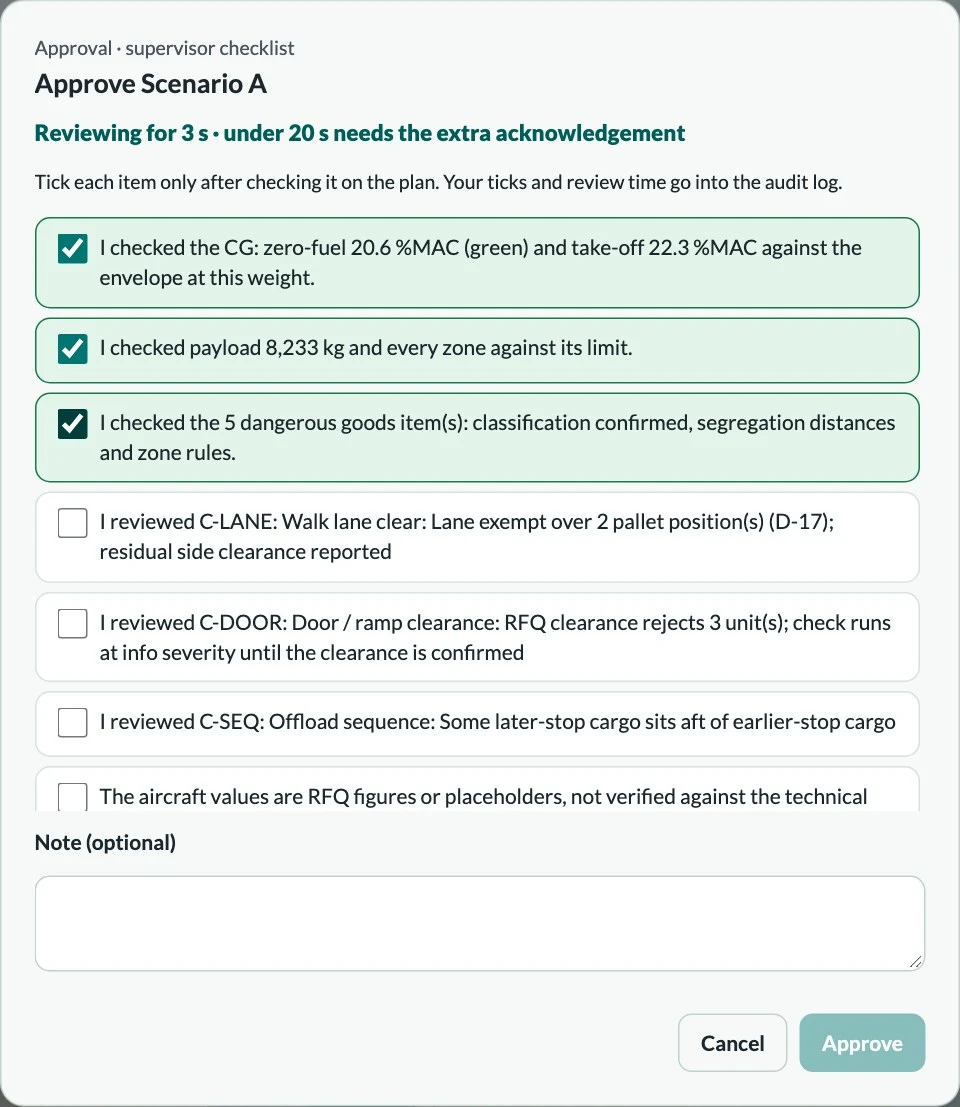
Manifests come in from Excel, CSV or PDF. A solver produces ranked plans, and an independent validator that shares no code with the solver checks each one. The agent orchestrates the solver and explains results, and any number in its reply must trace back to a tool result or the reply is blocked. Approval needs a checklist specific to that plan, an extra acknowledgement when the review was very quick, and a supervisor who is neither the creator nor the submitter. An administrator kill switch turns the agent off while everything else keeps working.
Across 216 generated plans the validator found no limit violations. All 18 deliberately impossible manifests were reported with the binding constraint named, with no silent partial loads. Seventeen data questions were resolved and logged during the build.
- Status
- Working system
- Client
- Confidential
Built to the Governed Cognitive Layer: the model reads and drafts, deterministic checks decide what it may do, and a named person approves anything that commits the business.
Check the calculation a second way. Here the validator shares no code with the solver, so a bug in one cannot hide in the other. Then make sure the person who approves is not the person who prepared the plan. Any business where a wrong number costs money or safety can use both rules.
Concept paper, C-suite deck and live demo
The concept paper, the deck and the working planner are available on request. I demonstrate a full plan live, from manifest to supervisor sign-off.
●Live demo (on request) →The same design rules behind this build, applied to your business in half a day.
Book the WorkshopDiscuss a build like thisScreens from the system
Demo data throughout. Customer names, accounts and payees are fictional.
Other projects
 Agentic AI
Agentic Partner Desk for Industrial Connectivity
Enquiries in five languages become correct quotes and checked purchase orders, with code setting every price and a manager approving every commitment.
See how it works → Agentic AI
Agentic Sales and Catalogue Desk for a Component Distributor
Datasheets, supplier notices and foreign-language enquiries become catalogue updates and quotes in seconds, and nothing reaches a customer until a person approves it.
See how it works → Agentic AI
Agentic Creative Platform for a Bank-Facing Agency
Campaign ideas for bank and insurance clients go from brief to scored shortlist in under a minute, drawn only from that client's own material, and a creative director chooses.
See how it works →
Realistic test loads came out outside the balance limits, and the door clearance in the input data would have rejected every standard pallet. Neither was a solver bug. Both were data questions, and I logged seventeen of them before the planner was finished, each with how the planner handles it. One rule never moved: the solver decides where cargo goes, a separate validator checks it, and the agent is never given a tool that can move a pallet.
