
Listen to this article
Executive Summary
AI growth stalls when it’s run as an innovation experiment rather than a capital programme. Sustainable impact requires the same stage-gate discipline, portfolio structure, and hard metrics as any long-term infrastructure investment.
Core conclusions
- AI initiatives need stage-gated governance, defined investment cases, and explicit acceptance criteria, not enthusiasm-driven progression.
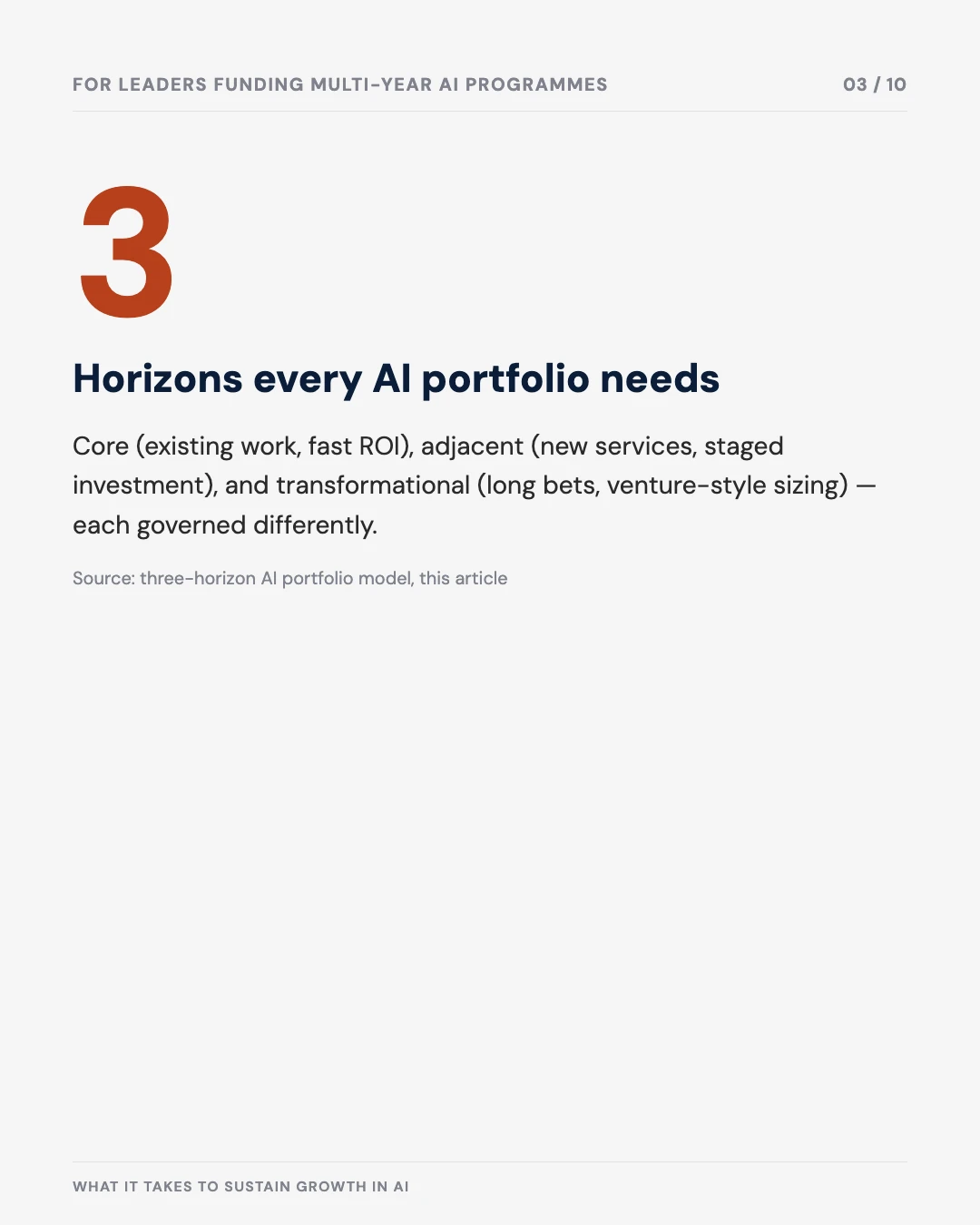
- Structure AI as a three-horizon portfolio (core, adjacent, transformational), each governed and measured differently.
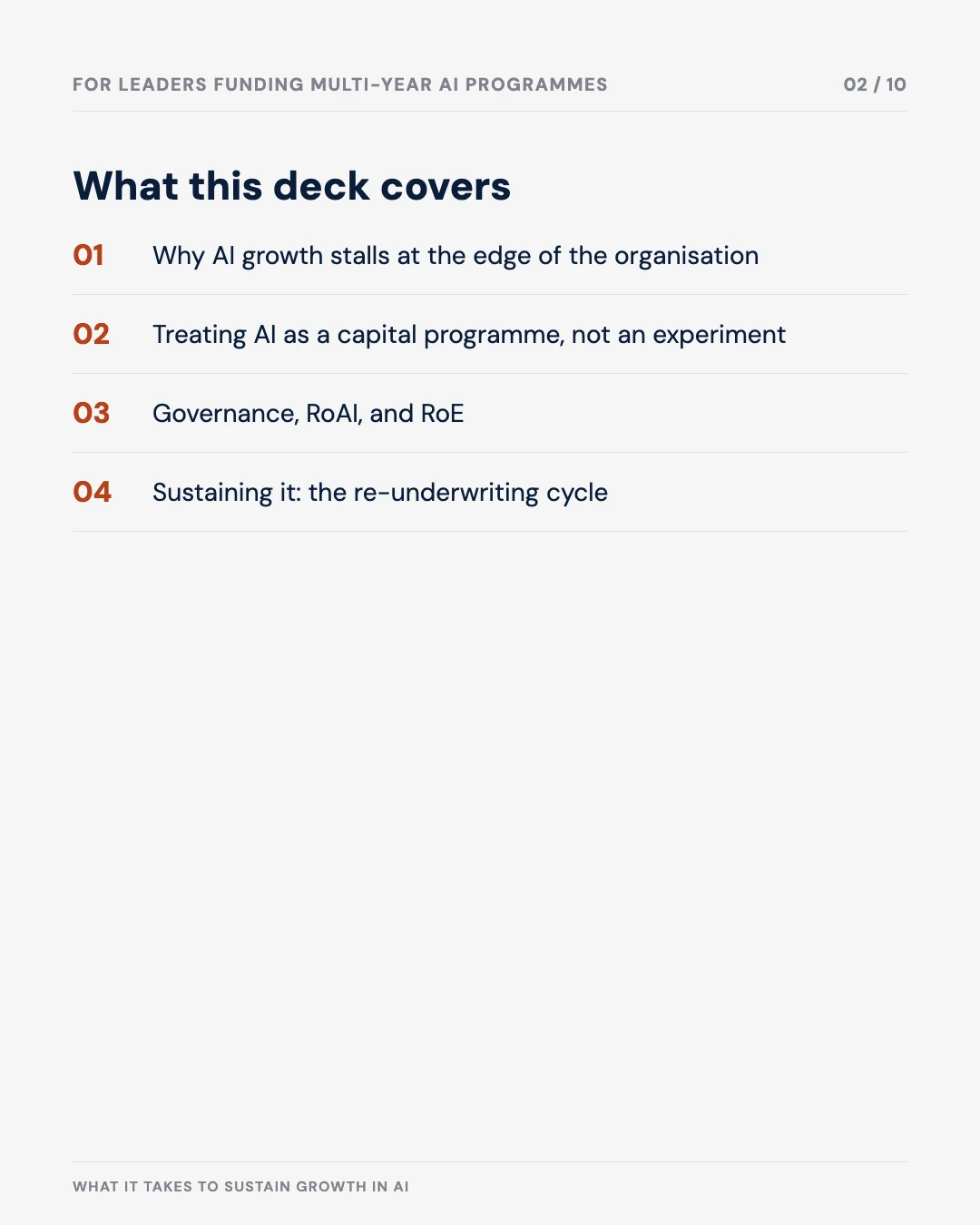
- Traditional ROI is too narrow. Track Return on AI Investment (RoAI) and Return on Employee (RoE) together, and re-underwrite the portfolio on a recurring cycle rather than freezing the strategy.
The argument, in ten slides
Save it, share it, or send it to whoever’s about to fund next year’s AI roadmap.
The question of what it takes to achieve and sustain growth is not theoretical. It is a daily operating concern across multi‑billion‑dollar infrastructure portfolios, where AI deployment and investment must translate into measurable improvements in resilience, efficiency, and citizen experience rather than isolated proofs of concept.
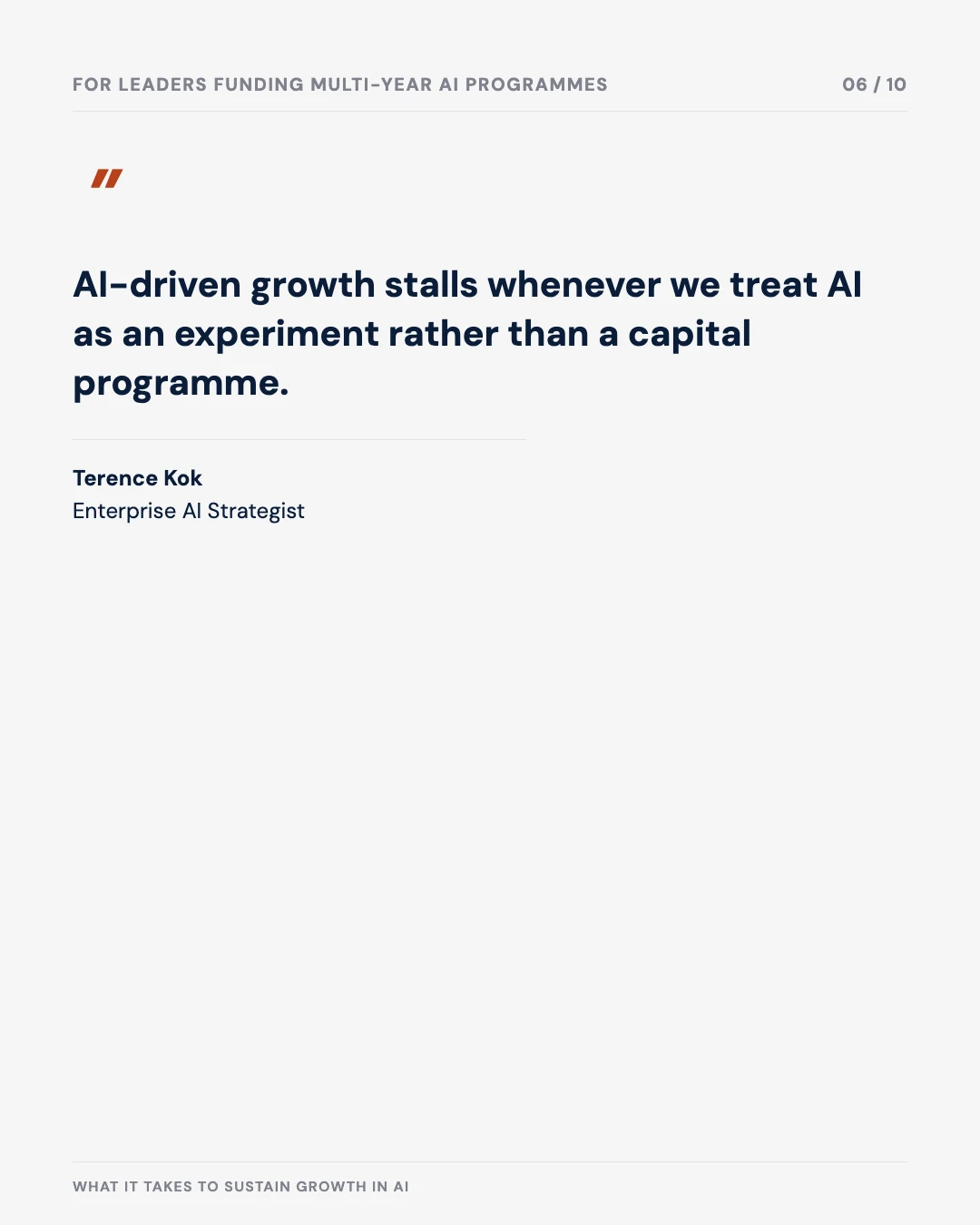
AI‑driven growth stalls whenever we treat AI as an experiment rather than a capital programme. Cost and capex initiatives are governed with hard gates, weekly tracking, and executive accountability. AI initiatives are too often launched with a press release and left to drift. Our own experience building and scaling platforms such as KELIX, digital twins, and integrated operation centres shows that sustainable impact comes only when an AI strategy is subjected to the same discipline as long‑term infrastructure investment.
AI‑driven growth stalls whenever we treat AI as an experiment rather than a capital programme.
Why AI Growth Stalls
In the built environment, city authorities and asset owners commission pilots for computer vision, generative design, or conversational agents. These pilots demonstrate potential, then stall at the edge of the organisation. The issue is rarely model performance. The issue is that the AI strategy is not backed by an operating architecture capable of carrying it from proof‑of‑concept to portfolio‑wide deployment.
The issue is rarely model performance. The issue is that the AI strategy is not backed by an operating architecture.
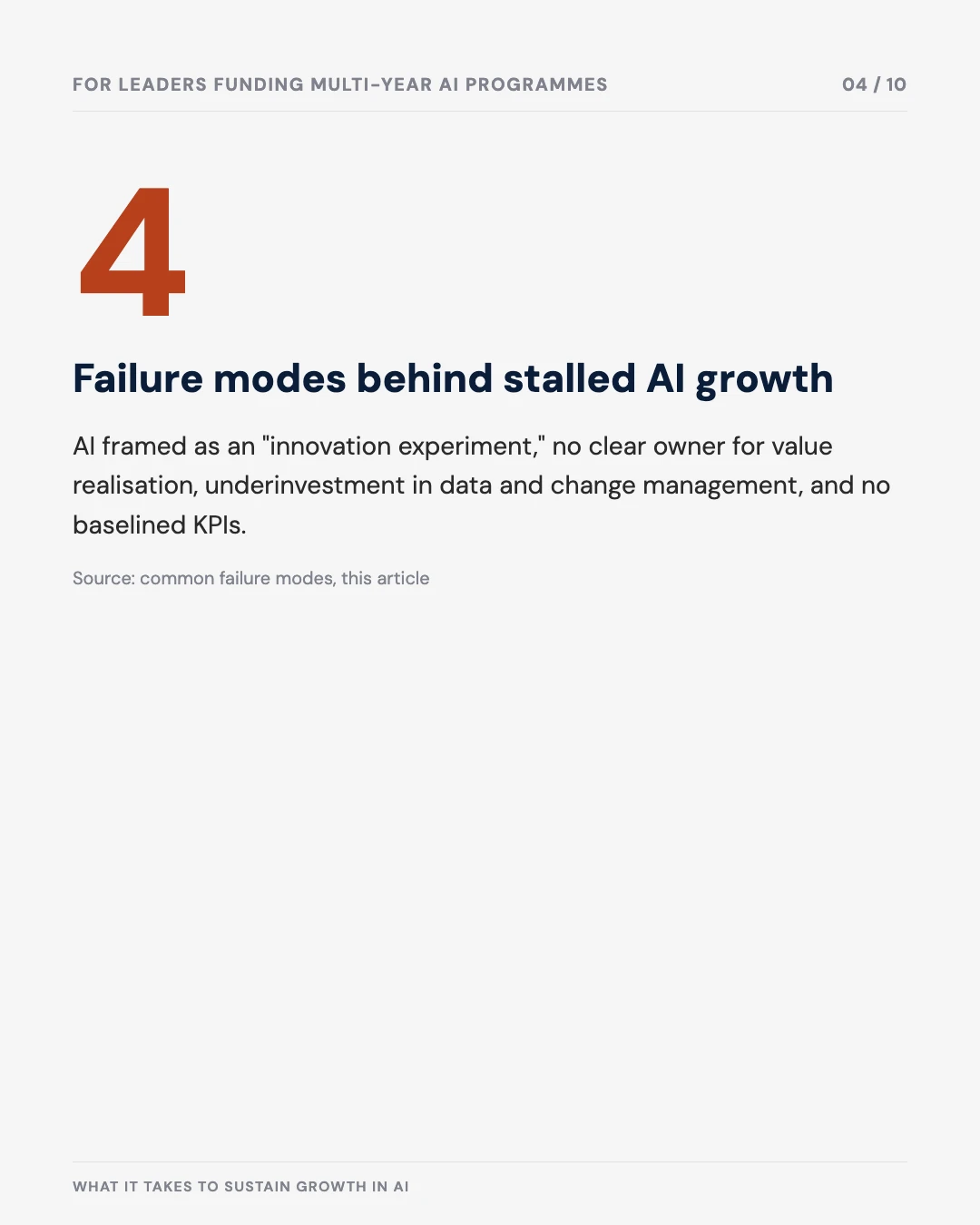
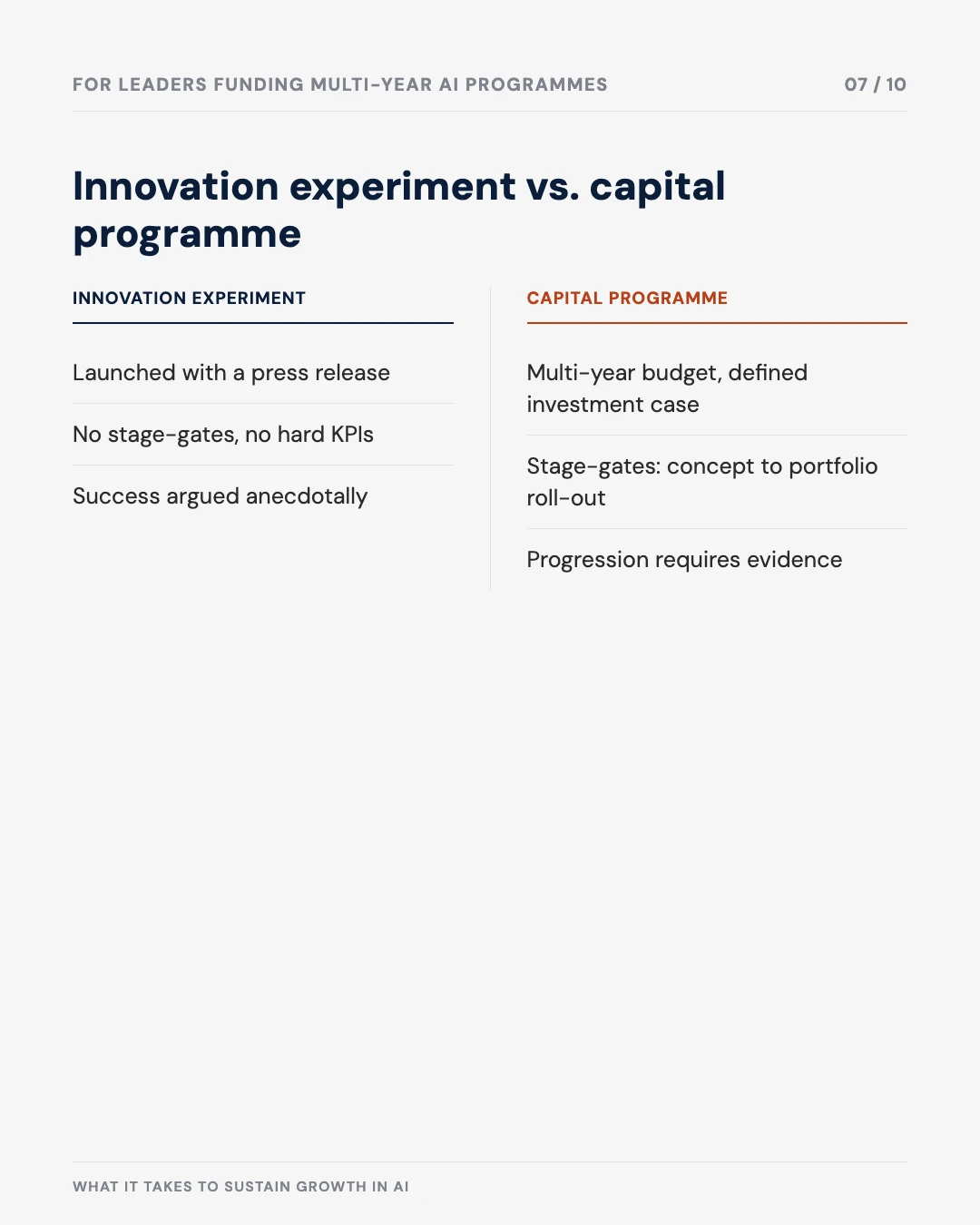
Common failure modes include: AI programmes framed as “innovation experiments” rather than as part of the core capital plan; no clear owner for AI value realisation at a portfolio or enterprise level; underinvestment in data infrastructure, security, and change management compared with the investment in models and vendors; and no baselined KPIs, so success is argued anecdotally rather than evidenced. In engineering and urban operations, this is particularly acute because most of the value sits in cross‑cutting optimisation, across assets, disciplines, and time horizons, not in single‑use tools.
Treating AI as a Capital Programme
Our approach begins with treating AI programmes in the same way as a major infrastructure or systems upgrade. AI roadmaps are integrated into the long‑term capital plan, with multi‑year budgets rather than annual discretionary spend. Each AI initiative has a defined investment case, a forecast benefit profile, and explicit acceptance criteria. Governance follows a stage‑gate pattern: concept, prototype, controlled deployment, and portfolio roll‑out. Progression between gates is contingent on evidence, not enthusiasm. This reframing from “innovation” to “capital programme” forces rigour in design, resourcing, and sequencing.
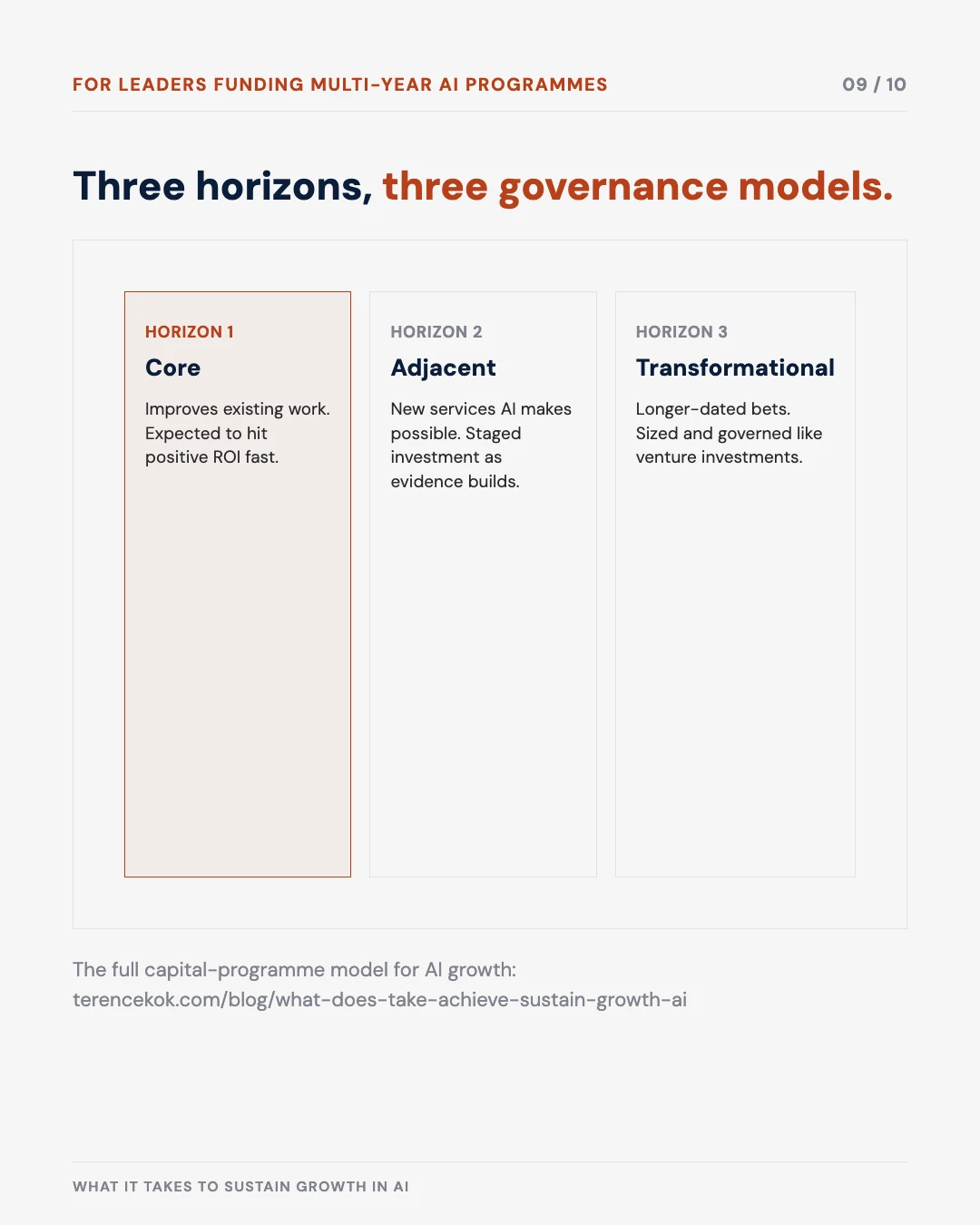
AI deployment is also structured as a portfolio rather than a collection of isolated tools, intentionally spanning three horizons. The core horizon covers use cases that improve existing work: generative review checklists, RAG‑based access to standards, computer vision for construction progress tracking. The adjacent horizon covers new services made possible by AI, such as digital twin‑enabled advisory and predictive maintenance for client portfolios. The transformational horizon covers longer‑dated bets such as adaptive urban platforms and autonomous optimisation across multiple infrastructure systems. Each horizon is governed differently: core use cases are expected to achieve positive ROI rapidly, while adjacent and transformational use cases are sized more like venture investments with staged increases as evidence accumulates.
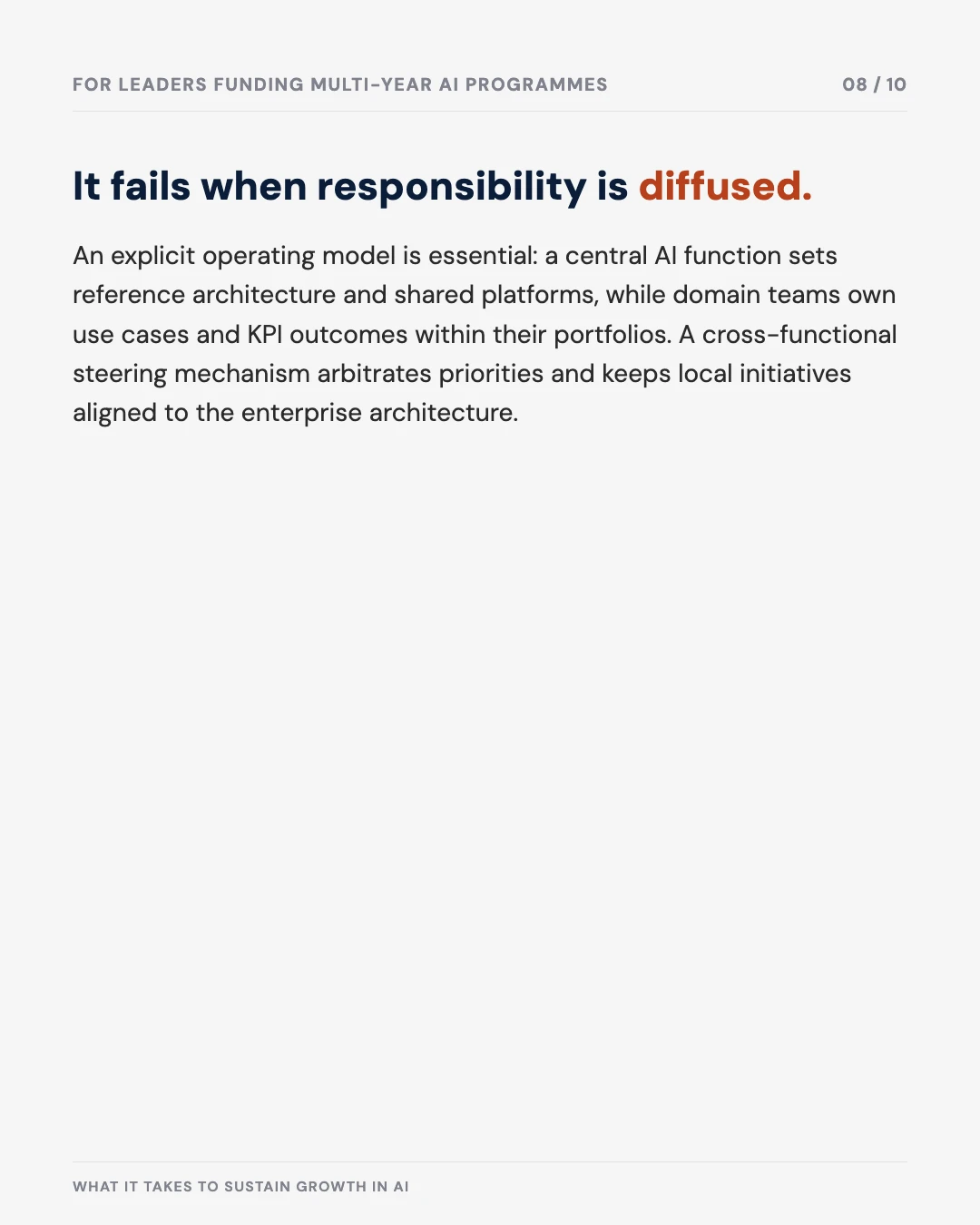
AI growth also fails when responsibility is diffused. An explicit AI operating model is essential: a central AI and innovation function defines reference architectures and common platforms, while domain teams own specific AI use cases and KPI outcomes within their portfolios but operate on shared standards and infrastructure. A cross‑functional steering mechanism arbitrates priorities, allocates scarce talent, and ensures local initiatives do not diverge from the enterprise architecture. This model avoids two extremes: fully centralised AI, which cannot understand domain nuance, and fully fragmented AI, which produces conflicting tools and duplicated effort. I argue this same middle path in more depth in Scaling AI Requires Capability, Not Centralisation.
Governance, Measurement and Capability
Infrastructure and city‑scale projects operate under stringent regulatory, safety, and contractual obligations. AI must match that standard. Governance is embedded into the architecture: access control and role‑based permissions around models and data, data lineage and provenance for RAG and Graph RAG systems where decisions may be audited later, this is exactly the architecture I set out in How to Build Governed RAG 2.0 Systems, model lifecycle management including versioning and rollback mechanisms, and risk classification of use cases with clear boundaries between advisory, decision‑support, and autonomous actions. Governance is not only about compliance. It is about ensuring that AI‑driven growth is survivable under scrutiny. Without it, any short‑term growth in AI usage is brittle; one adverse incident can stall adoption across an entire sector.
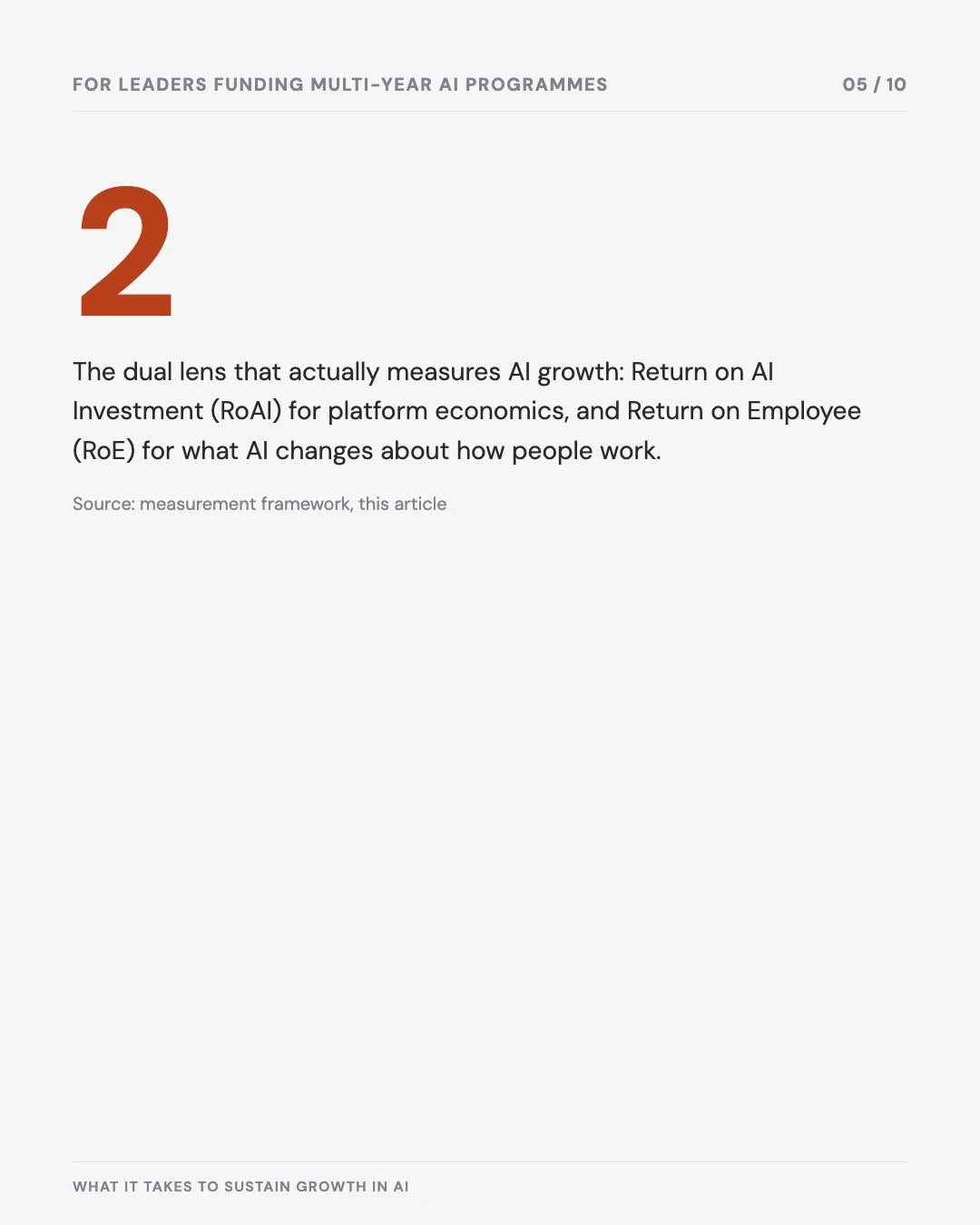
One of the fastest ways to stall AI growth is to measure it poorly. Traditional ROI calculations focusing only on direct cost savings are too narrow. A dual lens is more effective: Return on AI Investment (RoAI) compares the total cost of AI platforms against quantifiable outcomes such as design turnaround time reductions, fewer RFIs, lower unplanned downtime, and reduced lifecycle cost. Return on Employee (RoE) measures how AI changes the productivity and effectiveness of engineers, planners, and operators, including time released from repetitive tasks, quality of design outputs, and the ability to manage larger portfolios without proportionate headcount growth. Baselining these metrics before deployment and tracking them through the life of the programme ensures AI growth is tied to tangible performance rather than anecdotal success stories.
AI investment also fails when it is seen as a technology procurement exercise rather than a capability‑building agenda. High‑potential engineers, planners, and operations staff should be seconded into AI initiatives to embed domain knowledge into solutions and build AI literacy back into their home teams. Communities of practice should be created around key domains to diffuse methods and reusable components. Career pathways should recognise AI‑augmented roles rather than treating AI work as a side activity. This approach ensures that people who will operate and extend these systems are involved from the outset, and the organisation is not dependent on a small, isolated “AI team”.
Sustaining the Strategy
AI technologies, regulations, and client expectations shift rapidly, so the AI strategy should never be frozen. Instead, it follows a cycle similar to how long‑term asset strategies are refreshed. Over a 3–5 year horizon, a defined set of AI themes and platform investments are committed to. At defined intervals, the full AI portfolio is reviewed and “re‑underwritten”: assumptions are tested against current technology capabilities, regulatory frameworks, client demand, and internal adoption levels. Underperforming initiatives are either reshaped or retired, and capital and talent are reallocated to higher‑yield opportunities. This periodic renewal prevents sunk cost bias and “project inertia”.
Achieving and sustaining growth through AI is not about finding the right model or vendor. It is about treating AI as seriously as concrete and steel: as a long‑lived asset class that demands disciplined investment, engineering‑grade governance, and continuous optimisation. When AI programmes are governed like capital projects, organised as portfolios, owned through a clear operating model, grounded in hard metrics such as RoAI and RoE, and refreshed through structured re‑underwriting, growth becomes repeatable rather than sporadic.
Achieving and sustaining growth through AI is not about finding the right model or vendor. It is about treating AI as seriously as concrete and steel.
Free tool
Enterprise AI Value & Adoption Dashboard
Track TCO, AI-influenced revenue, and adoption by business unit, the RoAI/RoE-style hard metrics this piece argues should replace anecdotal AI reporting.
Was this useful?