
Listen to this article
Executive Summary
Most organisations have experimented with RAG, but very few have a version that can survive regulatory scrutiny or a real incident. Governed RAG 2.0 treats permissions, auditability, and policy as the primary design problem, not the model or vector store.
Core conclusions
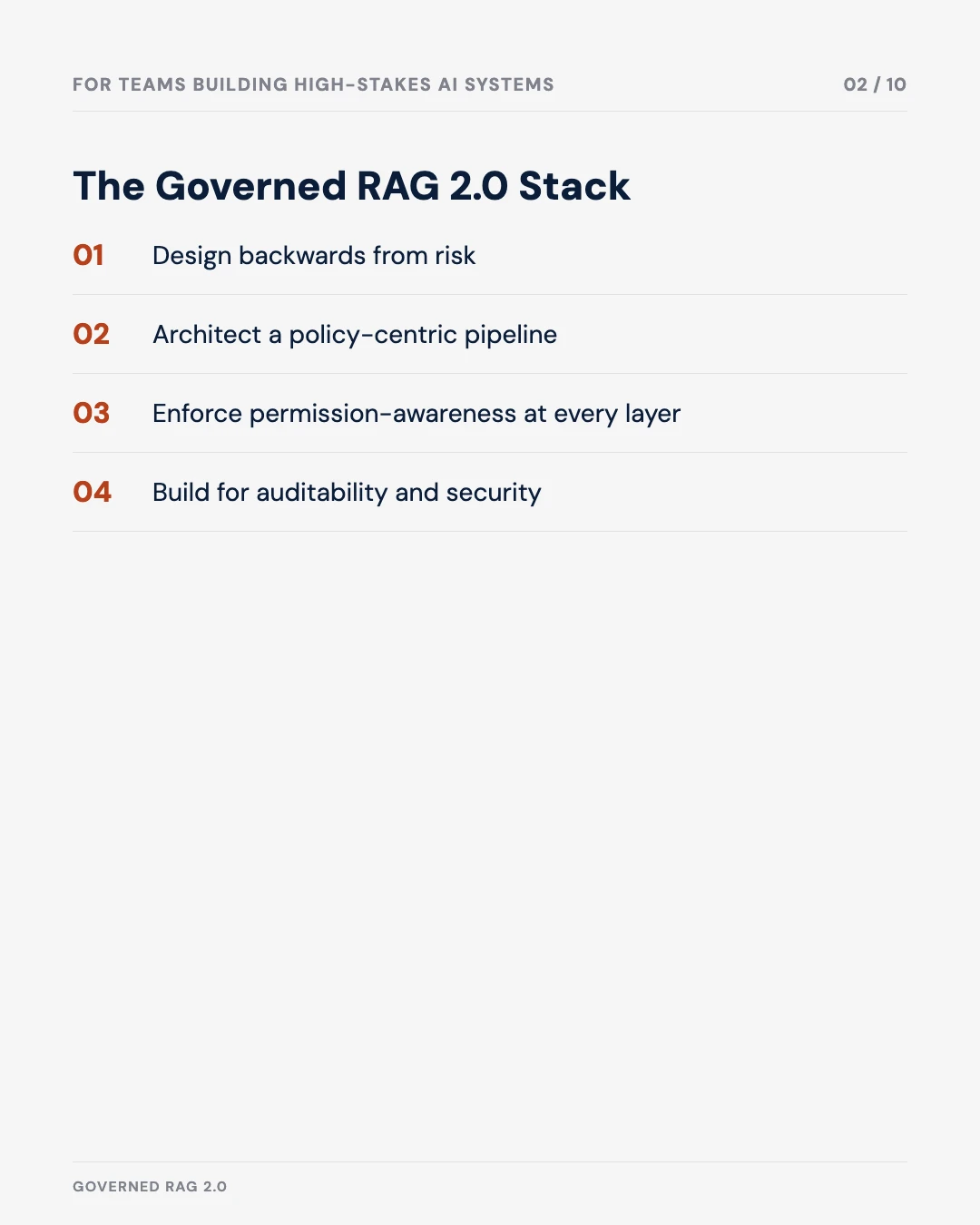
- Design backwards from risk: scope, risk classification, regulatory obligations, and accountability owners come before any model or tooling choice.
- The knowledge system must overlay existing identity, authorisation, and data-classification controls. It must never bypass them because it sits in a separate “innovation” environment.
- Every retrieval is a fresh authorisation decision, every interaction must be reconstructable end-to-end, and the model itself should be treated as an untrusted component requiring active guarding against prompt injection and retrieval poisoning.
The architecture, in ten slides
Save it, share it, or hand it to whoever owns your RAG build.
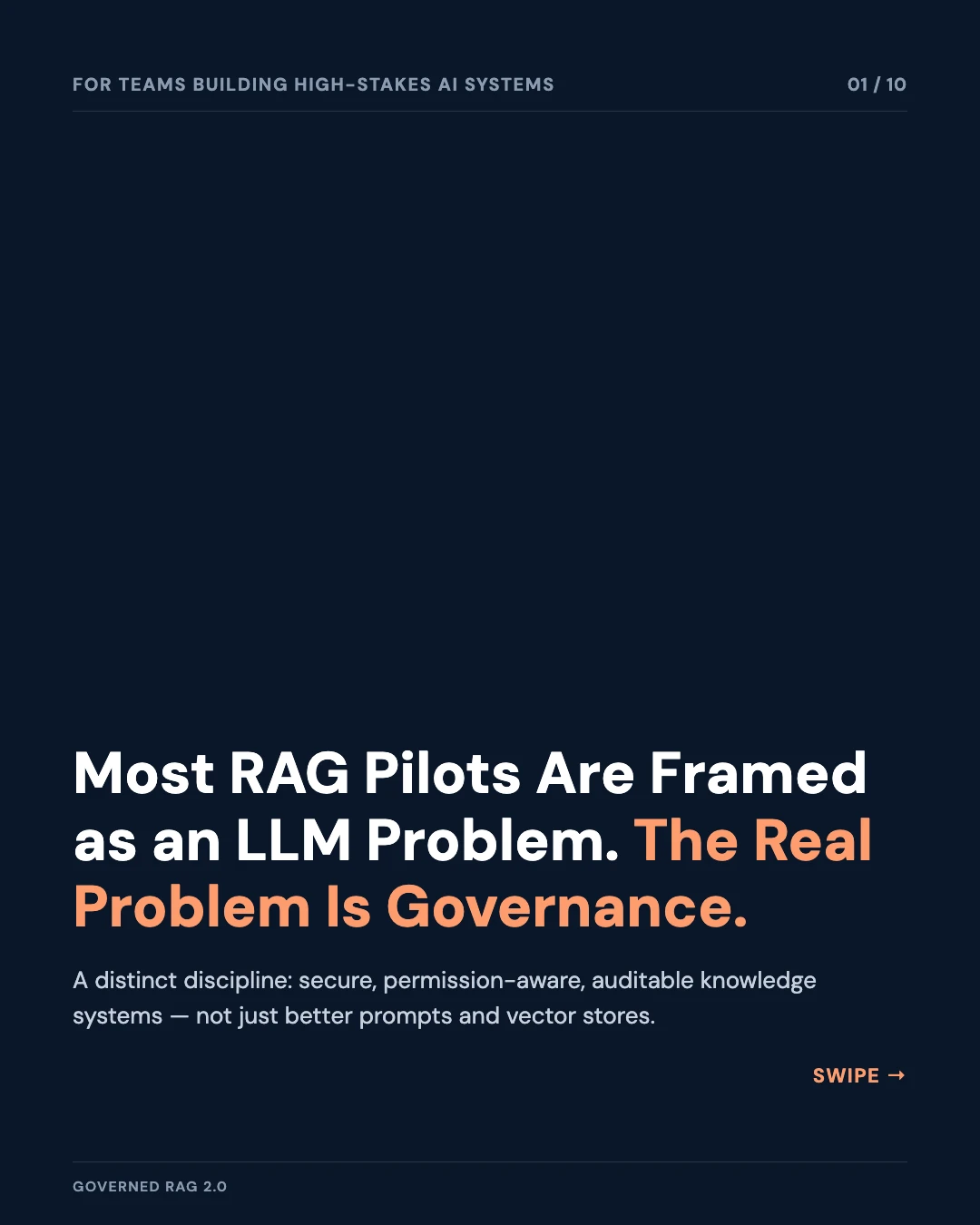
Most organisations have experimented with retrieval‑augmented generation (RAG), but very few have a production‑grade RAG that can withstand regulatory scrutiny, security review, or a serious incident. In high‑stakes environments such as public policy, critical infrastructure, healthcare, and financial supervision, “good enough” answers are not acceptable. RAG 2.0 is emerging as a distinct discipline: not just better prompts and vector stores, but governed knowledge systems that are secure, permission‑aware, and auditable end‑to‑end.
In high‑stakes environments, “good enough” answers are not acceptable.
Governance First: Design Backwards from Risk
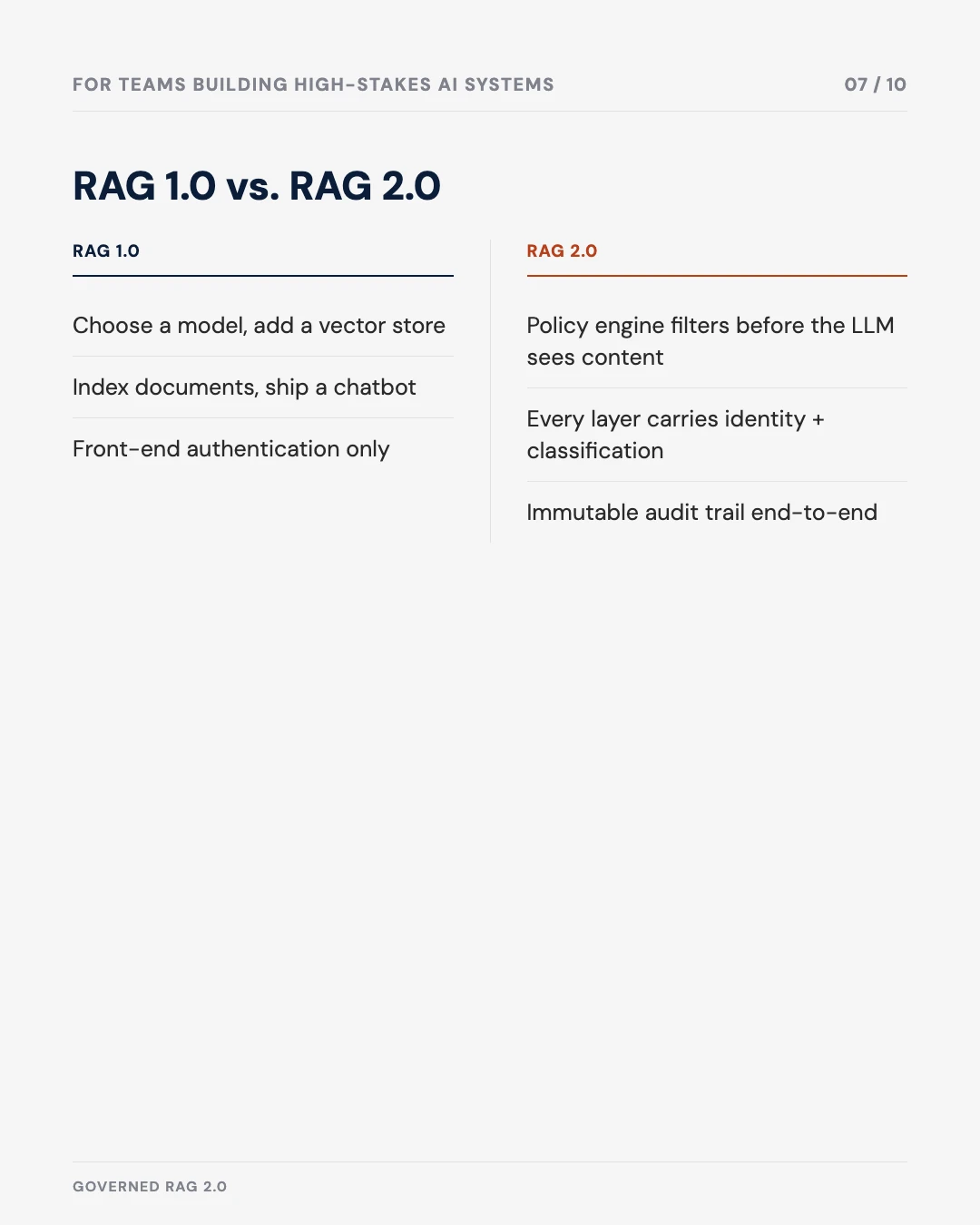
Most RAG pilots are framed as an LLM problem: choose a model, add a vector database, index some documents, ship a chatbot. For high‑stakes use cases, the primary problem is governance: who is allowed to see which data, under which policy? Who is accountable when an answer is wrong or harmful? How is evidence for a given answer recorded, inspected, and challenged? How does the system behave under legal discovery, audit, or incident review?
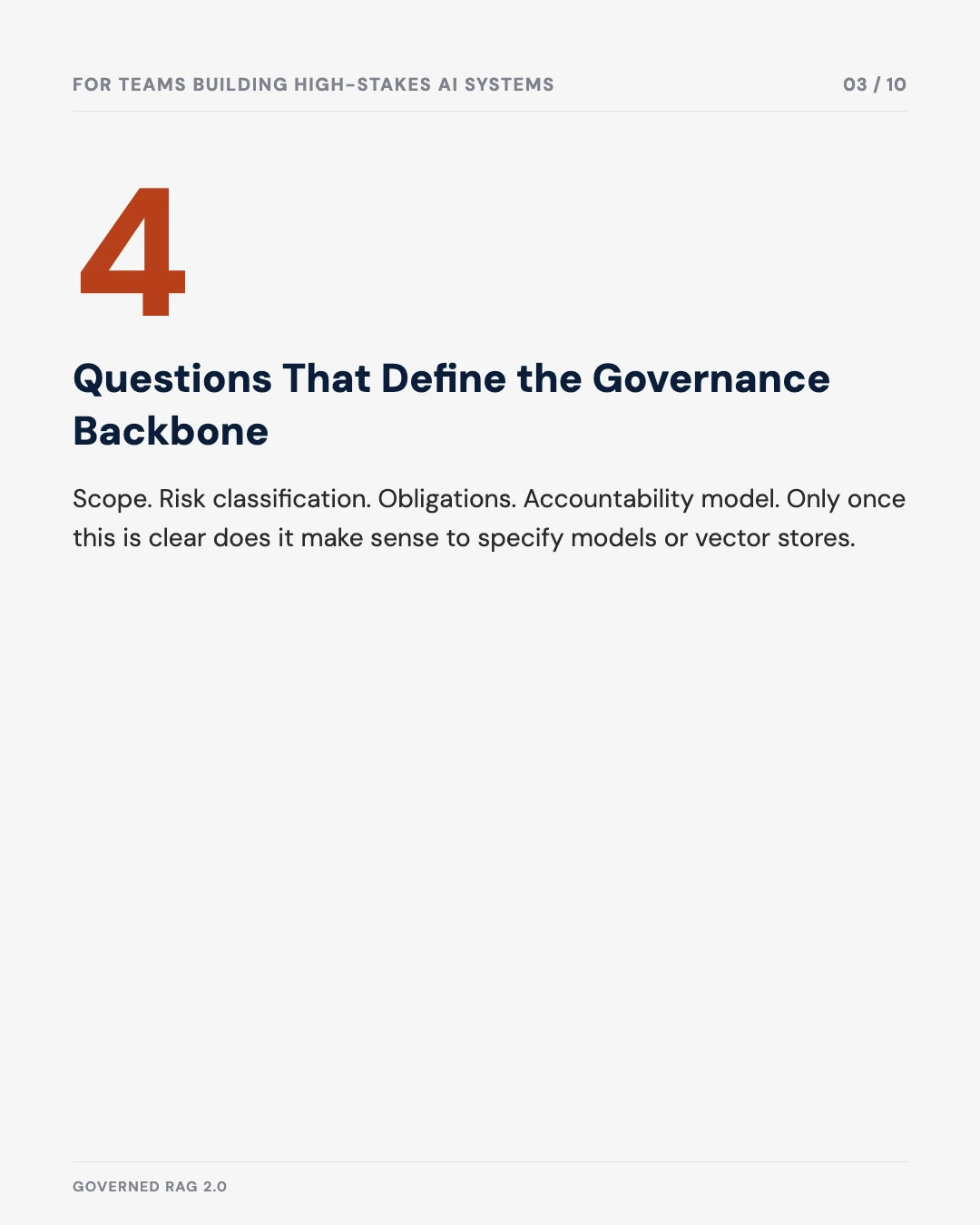
A governed RAG 2.0 architecture should be designed backwards from these constraints. Before tool selection, define scope (which decisions, processes, and user groups are in scope), risk classification (what constitutes high, medium, and low‑risk queries and outputs), obligations (regulatory requirements, internal policies, retention requirements), and the accountability model (business owner, model/solution owner, data owner, and risk/compliance owner). Only when this backbone is clear does it make sense to specify models, vector stores, or orchestration.
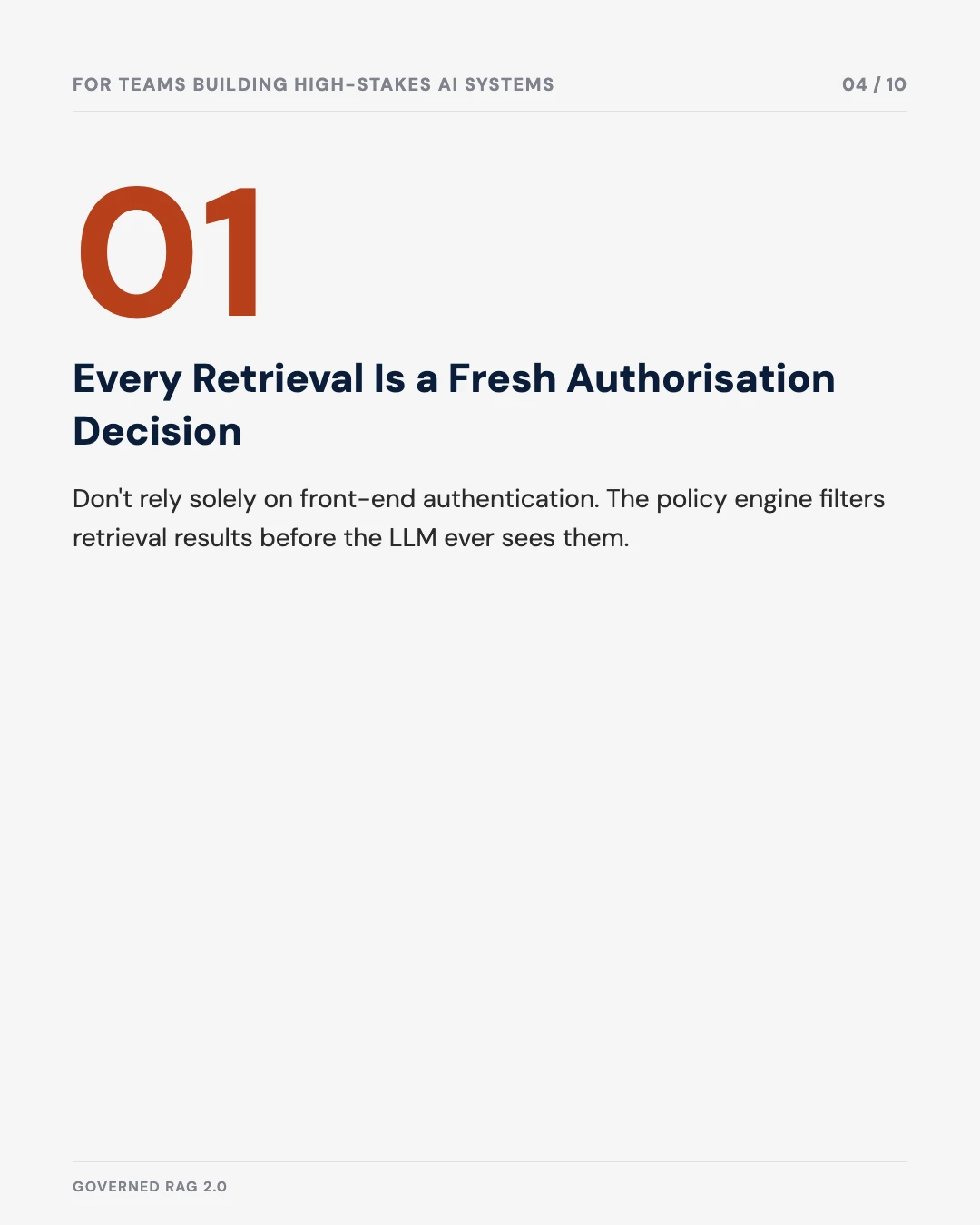
A common anti‑pattern is building a new RAG stack that bypasses enterprise IAM, DLP, and data governance simply because it sits in a separate innovation environment. In high‑stakes domains, the knowledge system must be an overlay on existing data controls, not a side channel. The RAG retrieval layer should call into existing identity and authorisation systems, not re-implement them. Ingest pipelines should read existing classification labels and store them as first‑class attributes alongside text and embeddings. Every retrieval should be treated as a fresh authorisation decision; do not rely solely on front‑end authentication.
In high‑stakes domains, the knowledge system must be an overlay on existing data controls, not a side channel.
Architecting the Policy‑Centric Pipeline
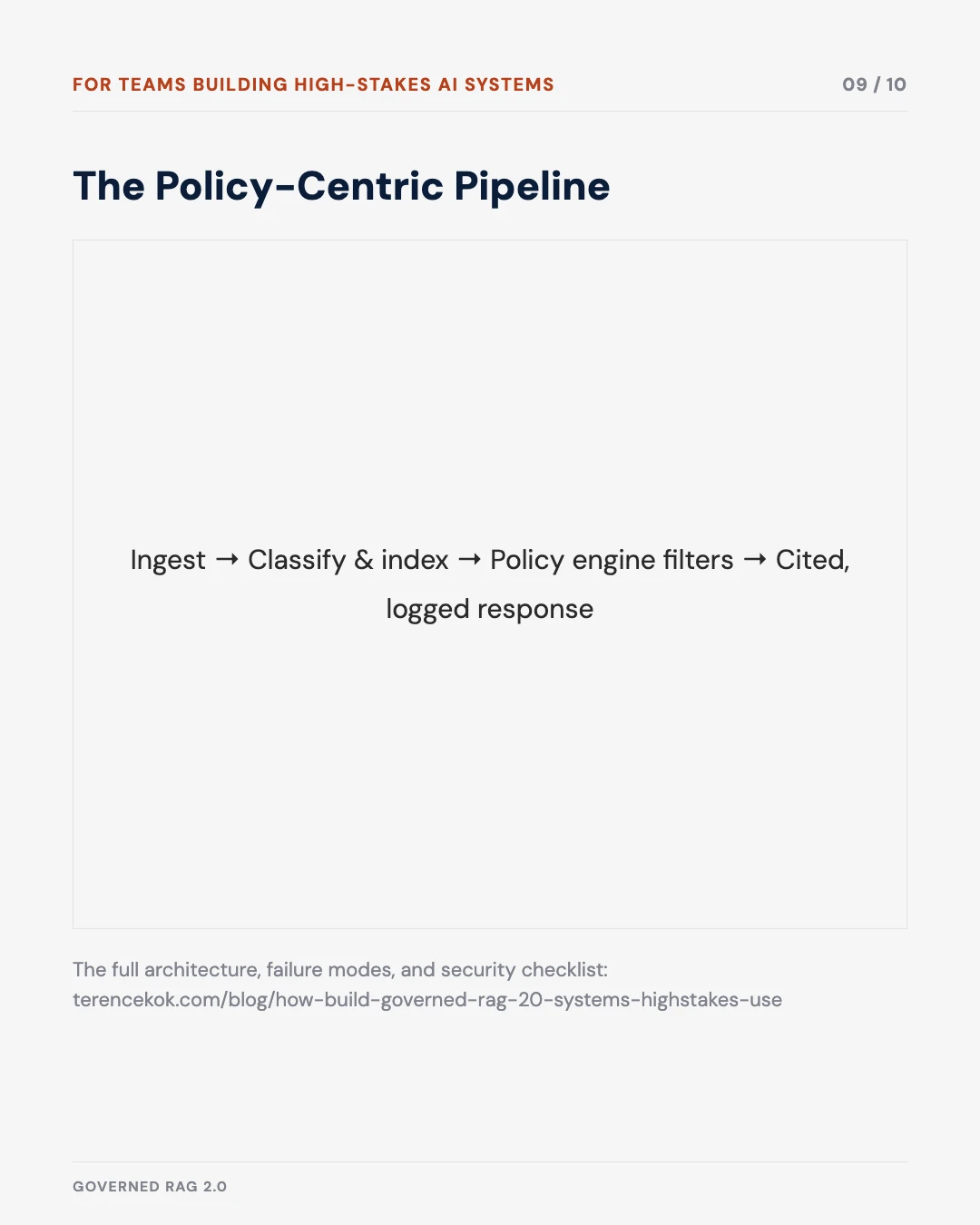
RAG 2.0 must be architected as a policy‑centric pipeline, not a black box. This kind of governed retrieval layer is one of eight recurring agent patterns I have catalogued in production systems. At the ingestion and normalisation stage, connectors ingest documents, records, and logs from source systems; content is normalised, chunked, cleaned, and enriched; and sensitive elements can be masked, tokenised, or redacted based on policy. At the indexing and storage stage, index entries retain links to the original source, access rules, and classification attributes, with encryption enforced as with any critical data store. A policy engine evaluates each query and candidate document against user identity, role, purpose, and context, filtering retrieval results before the LLM sees them: the model never observes content beyond the user’s entitlement. At the response stage, all user‑facing answers are accompanied by citations, links to the underlying sources, and applicable caveats or confidence measures. Every step, query, retrieved documents, policies applied, model prompts, model outputs, is logged in an immutable or tamper‑evident store.
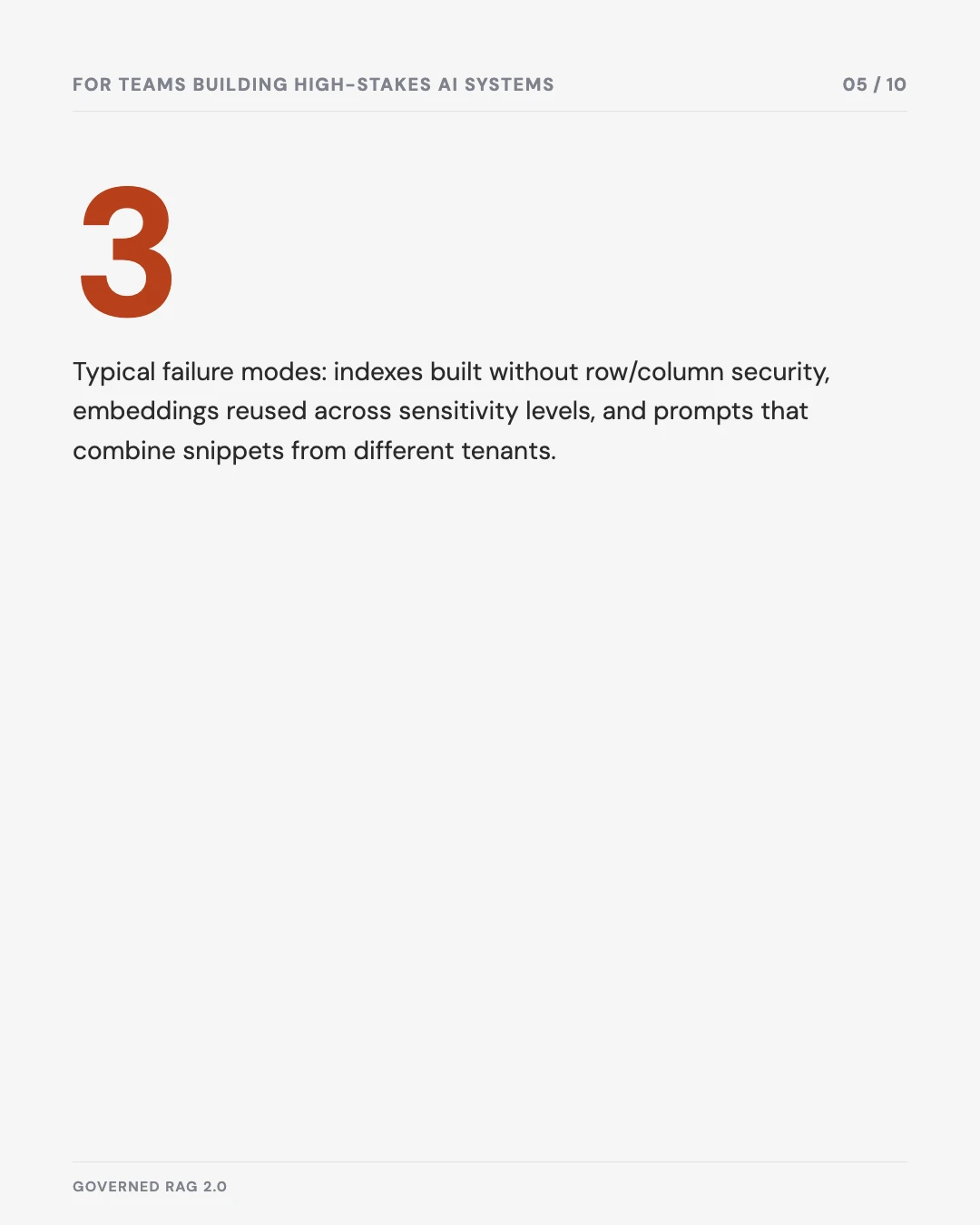
RAG 2.0 must enforce permission‑awareness at every layer, not only at the user interface. Typical failure modes include indexes built from data lakes without applying row‑level or column‑level security, embeddings generated from confidential content and reused in less‑restricted contexts, and LLM prompts that combine snippets from different users or tenants. To avoid this: separate indexes by tenant or sensitivity level, ensure user identity and authorisation context flow through every layer of the system, treat embeddings as sensitive data with the same classification and access rules as the underlying text, and proactively test whether prompts can exfiltrate content across boundaries.
Auditability, Security and Operations
High‑stakes use cases demand that answers are inspectable. For each interaction, record user identity, query, retrieved documents (IDs and metadata), policies evaluated, prompts, model versions, and final responses. Where feasible, maintain the ability to replay a past query with the same model and data snapshot. Design interfaces where the evidence and reasoning path are visible and easy to navigate: users should see the source, not only a narrative. Define formal incident workflows for handling harmful, biased, or incorrect outputs. For flows that feed into formal decisions, log whether and how RAG outputs were actually used by a human. The target state is that an auditor or investigator can reconstruct “why this answer was given to this user at that time” with minimal friction. That standard of reconstructability is exactly what the TRACE framework scores for before an agent or system goes live.
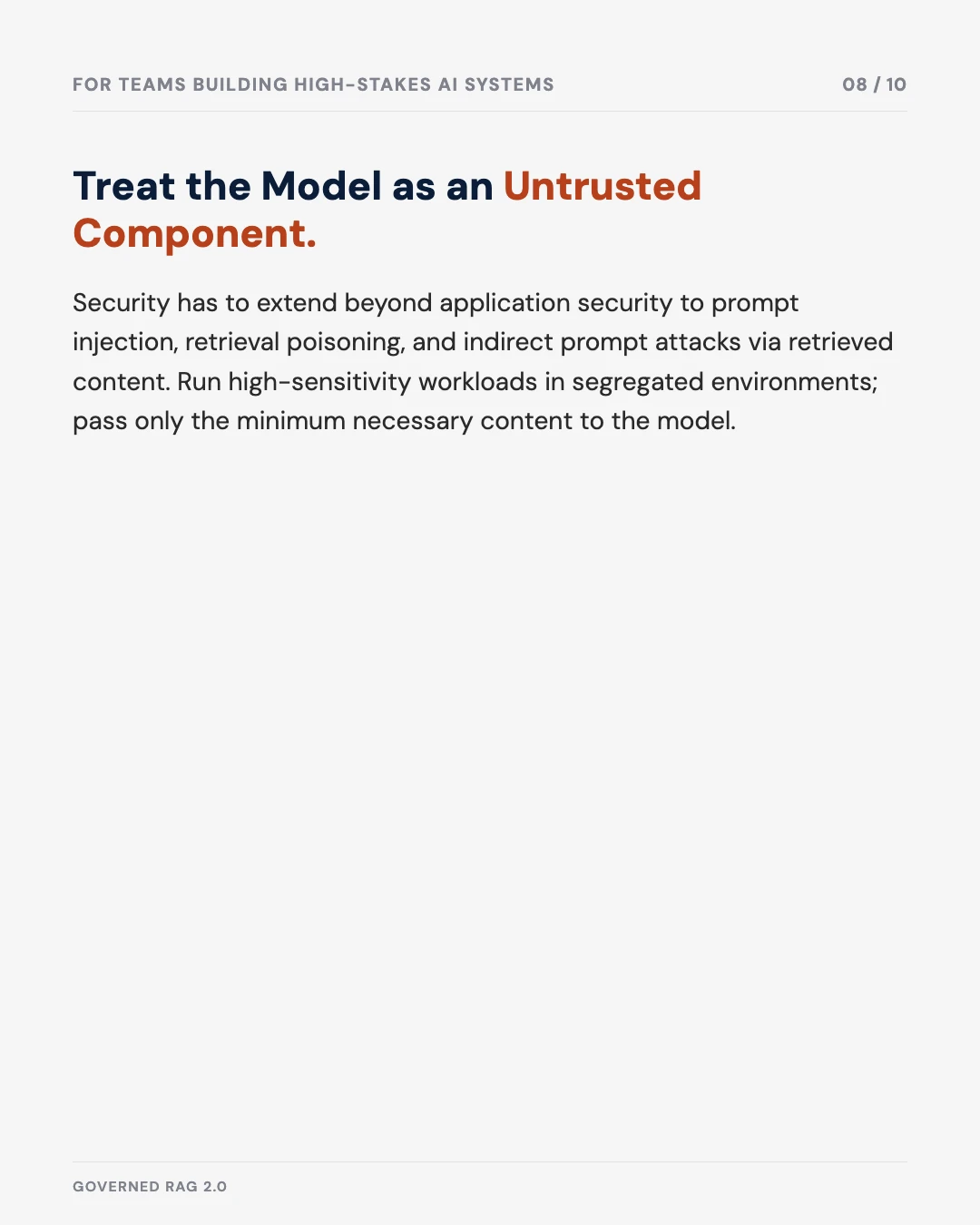
Security for RAG 2.0 extends beyond traditional application security to include prompt injection, retrieval poisoning, training data poisoning, and indirect prompt attacks via retrieved content. Treat the model as an untrusted component that requires guarding. Run high‑sensitivity workloads in segregated environments with explicit inbound/outbound controls. Pass only the minimum necessary content to the model, both for privacy and to reduce the attack surface. For privacy‑sensitive data, combine RAG with privacy‑enhancing techniques such as masking, pseudonymisation, and differential privacy.
RAG 2.0 sits at the intersection of data platforms, MLOps, and software engineering. Models, prompts, retrieval strategies, indexes, and policies should all be versioned and deployed via controlled pipelines, not manual edits. Maintain separate development, test, and production environments with realistic but anonymised data in non‑production environments. A cross‑functional team (data, ML, security, domain experts) should own the RAG service as a product, with SLAs, incident management, and a backlog aligned to business priorities. Capture both explicit feedback (user ratings, flags) and implicit signals (abandoned sessions, re‑queries) to refine retrieval strategy, prompts, and content.
When to Use Governed RAG
Not every use case needs this level of rigour. The cost of RAG 2.0 is justified when the underlying information is sensitive, regulated, or safety‑critical; when outputs are used to support or inform consequential decisions; and when the organisation must be able to demonstrate control, traceability, and fairness. When selecting use cases, favour scenarios where governance itself creates value: regulatory and policy interpretation with clear evidence trails, operational procedures for critical infrastructure where audited updates and traceability matter, and complex case handling that benefits from structured evidence and reproducible reasoning.
In these contexts, governed RAG is not only about avoiding harm; it becomes a strategic capability for how the organisation reasons over its knowledge.
Free tool
AI Trust, Risk & Governance Dashboard
Score your RAG access-control posture and trace data lineage, the exact permission-awareness this architecture is designed backwards from.
Free tool
Fine-Tune vs. Retrieval-Only Data Classifier
Score a dataset across seven risk factors to decide what stays behind permission-gated retrieval versus what’s safe to bake into model weights.
Was this useful?