

Listen to this article
Jump to a section
In this article
Executive Summary
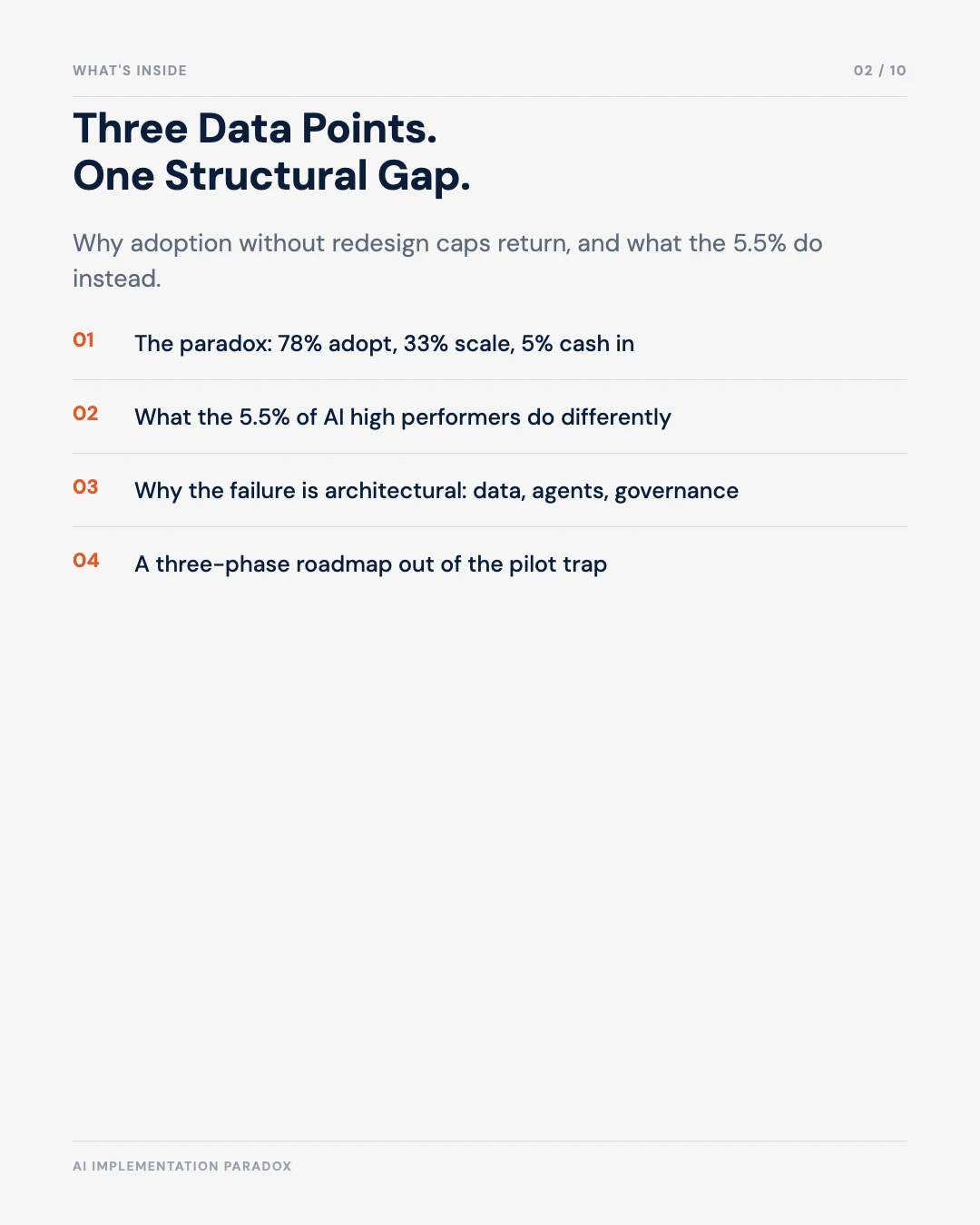
Getting companies to try AI is no longer the hard part. A McKinsey survey from November 2025 found that 78% of companies use AI often, but only 33% have grown their AI use across the whole company. MIT NANDA found that only 5% of company AI test projects lead to real, lasting money gains. That big gap is where companies are losing money. The problem is how AI is built into the company, not how smart the AI is.
33%
of companies have grown an AI program across the whole company, even though 78% already use AI often in at least one part of the business
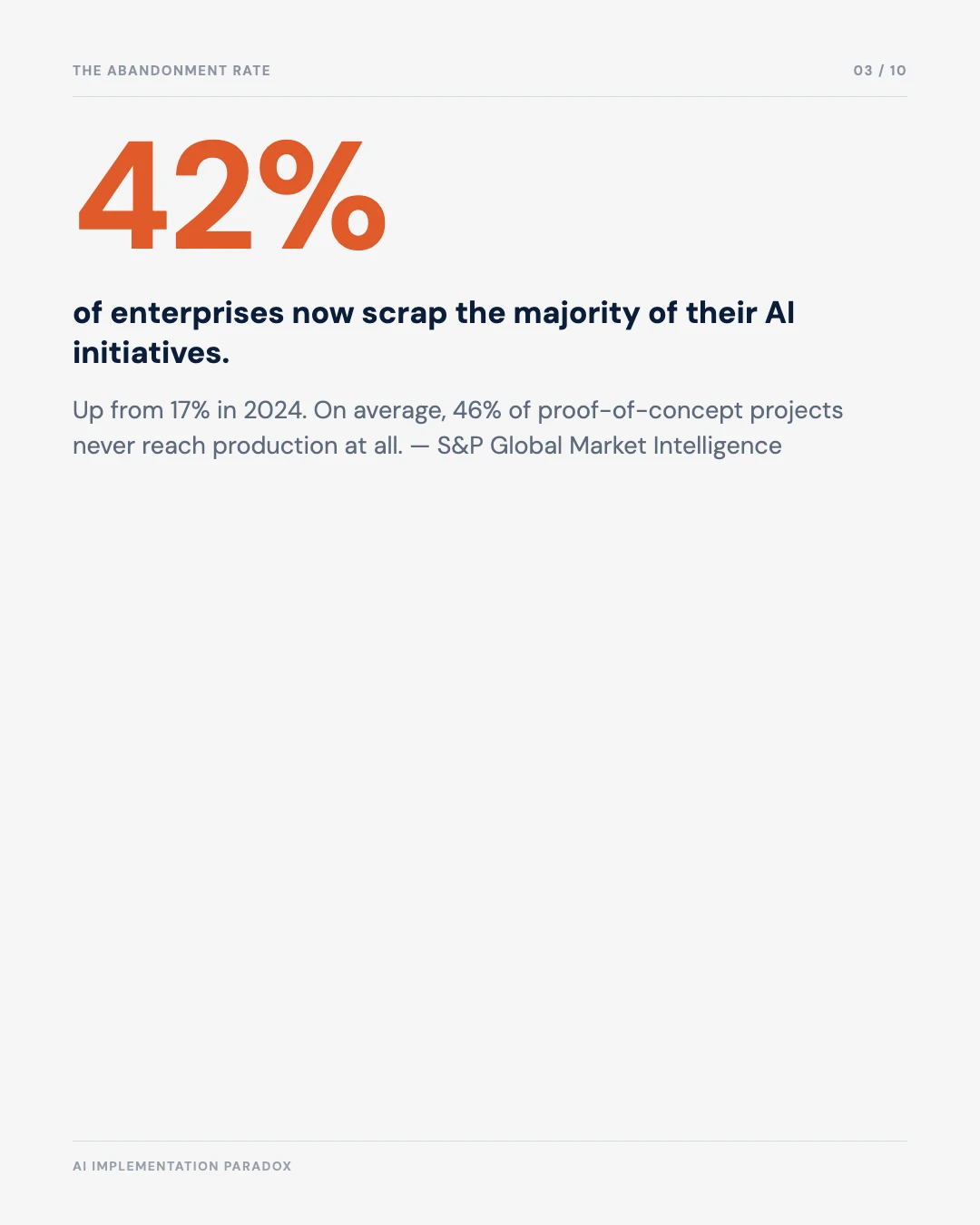
42%
of companies now throw out most of their AI projects, up from 17% in 2024
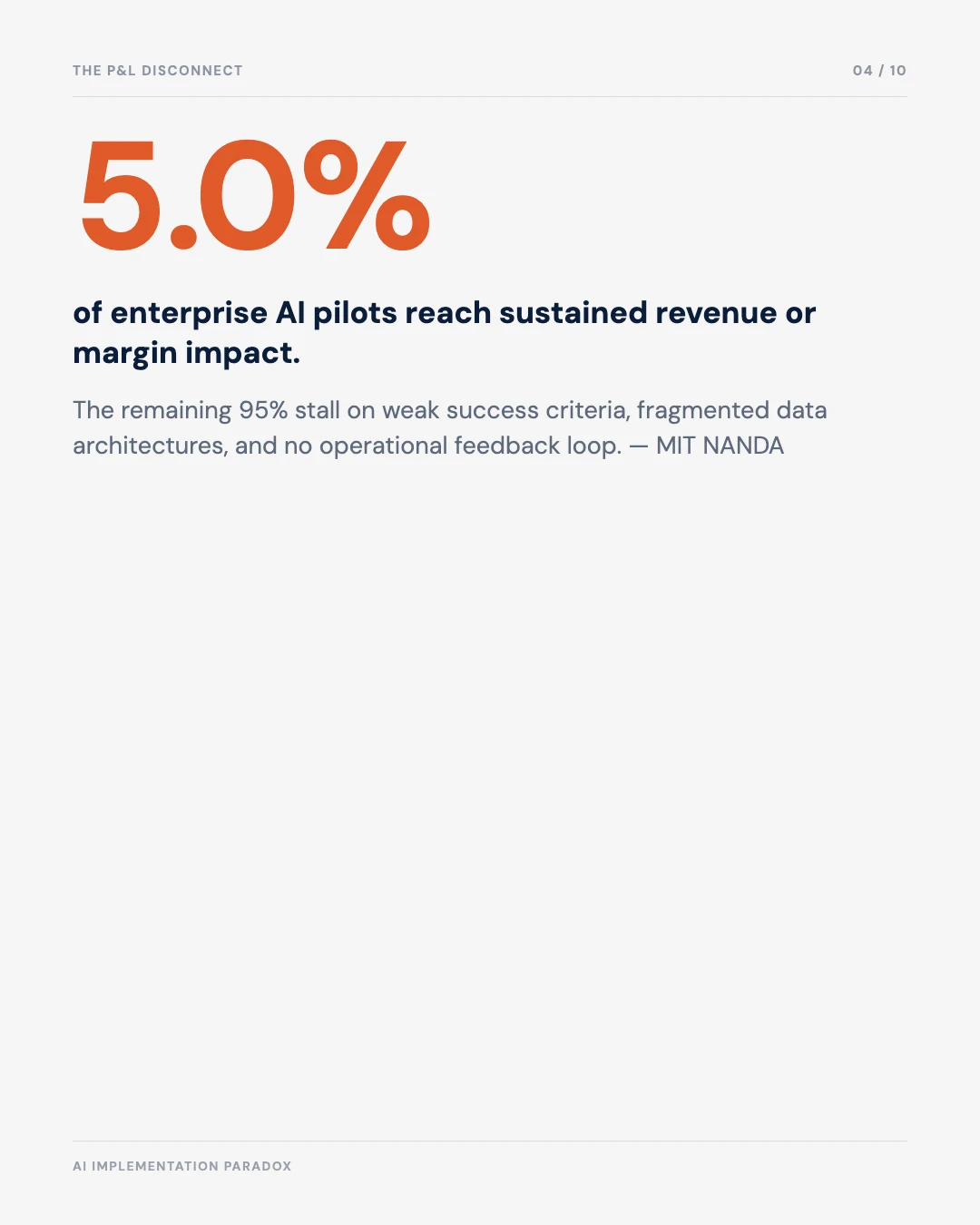
5.0%
of company AI test projects lead to lasting money gains; most others get stuck because of unclear goals and messy data
3.6x
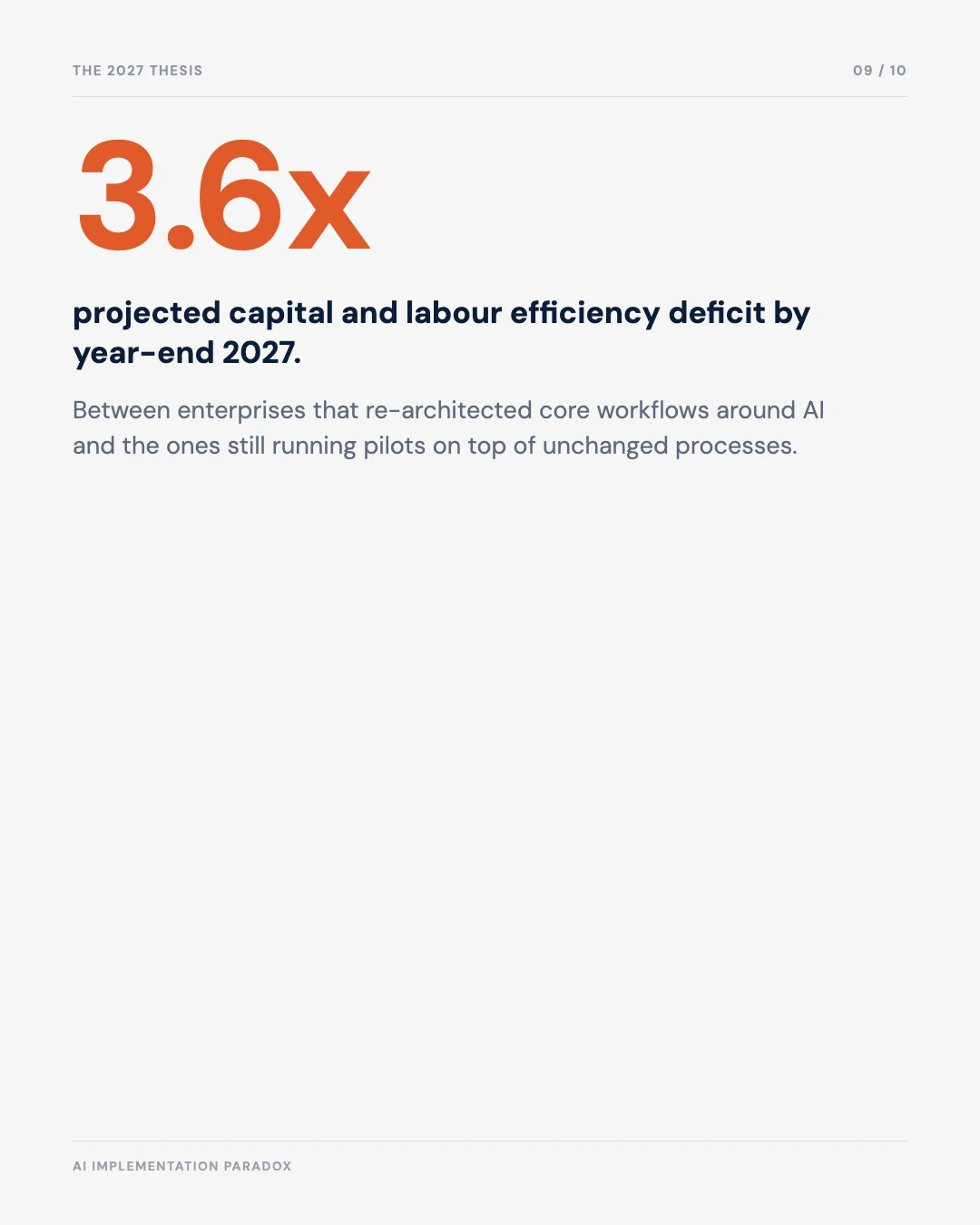
expected gap in money and worker efficiency by the end of 2027, for companies that don’t rebuild their work systems around AI
Core conclusions
- McKinsey calls about 5.5% of companies “AI high performers” because AI adds more than 5% to their profit (EBIT). What makes them different isn’t which AI model they pay for. It’s five things: how they spend money, how they use AI day to day, how they organise data, who is in charge, and how they redesign their work.
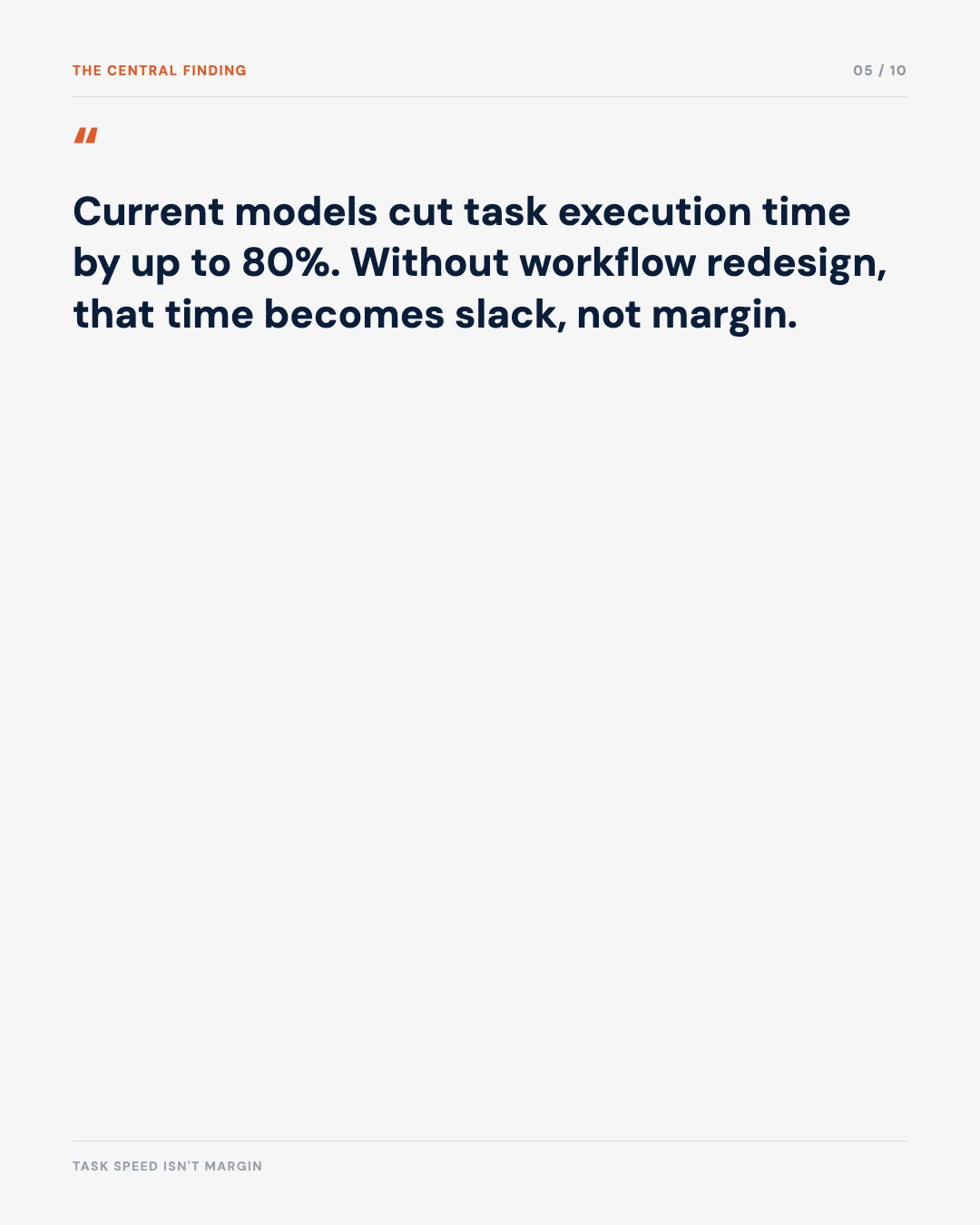
- Making a task faster doesn’t automatically make a company more money. Anthropic’s research shows today’s AI models can cut the time needed for certain tasks by up to 80%. But if a company doesn’t redesign how work flows, that saved time just disappears instead of turning into more output or fewer staff needed.
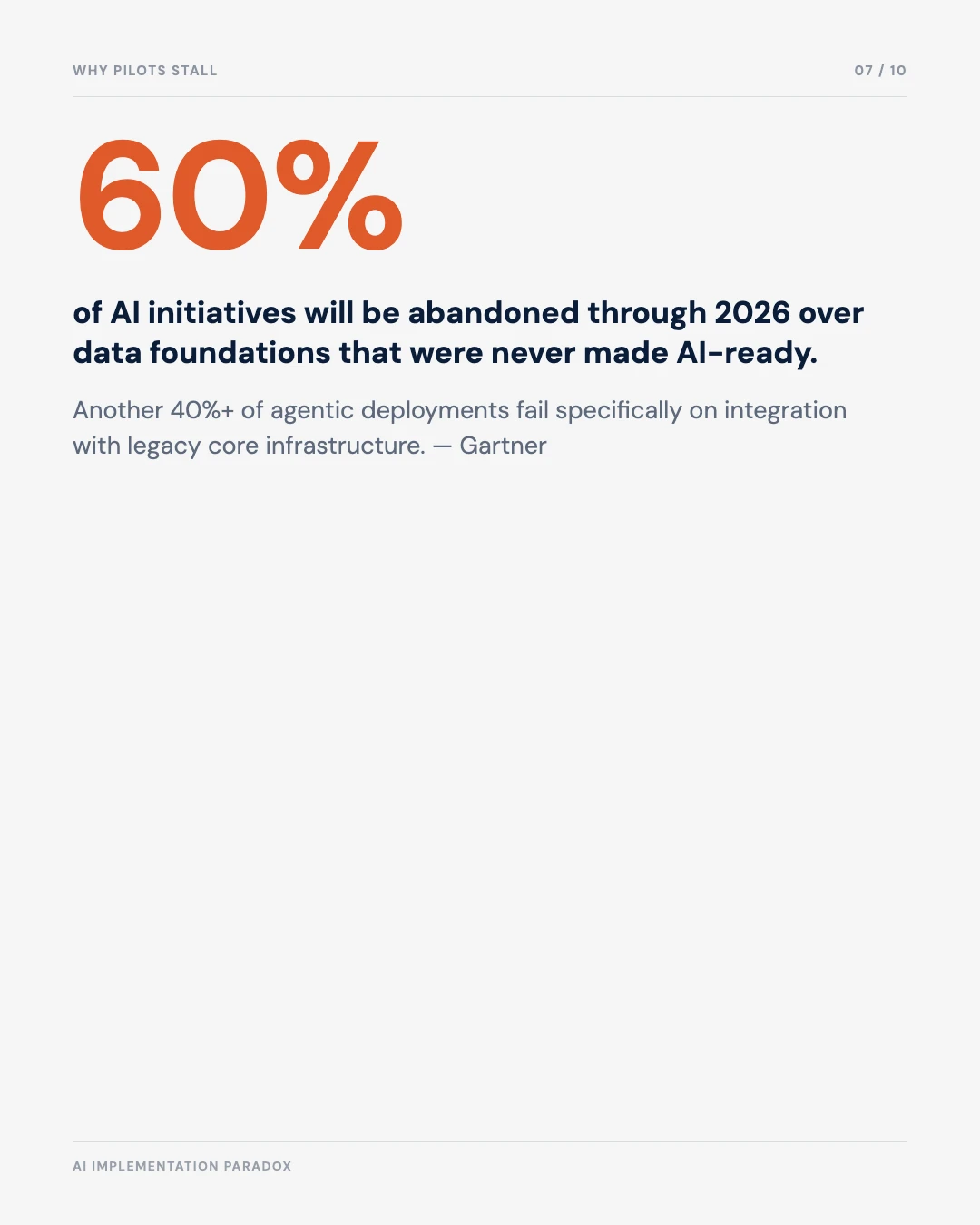
- Gartner says most AI projects dropped in 2026 will fail for two clear, fixable reasons: data that isn’t ready for AI (60% of projects), and trouble connecting AI to old company systems (over 40% of AI agent projects). Both problems can be spotted before a company even buys the AI tool.
The AI gap, in ten slides
Save it, share it, or send it to whoever controls the AI budget.

Everyone uses AI. Few grow it big.
A McKinsey survey from November 2025 found that 78% of companies now use AI often in at least one part of the business, and 71% use generative AI specifically. But only 33% have grown an AI program across the whole company. That’s a 45-point gap between using AI somewhere and using it everywhere it should be used. This gap gives the article its name: it looks like AI is a huge success story, but company profits mostly aren’t moving.
Data on dropped projects explains part of why, as the table below shows: S&P Global Market Intelligence’s project-abandonment figures and MIT NANDA’s own research on which test projects (POCs, short for “proof of concept”) reach lasting revenue or profit gains. The ones that stall get stuck for three common reasons: unclear goals set before the test even started, data too messy to use in real work, and no system to catch problems once the test project goes live.
| Metric | Value | Source |
|---|---|---|
| Companies using AI often in at least one part of the business | 78% | McKinsey Global Survey on AI, Nov 2025 |
| Companies using generative AI | 71% | McKinsey Global Survey on AI, Nov 2025 |
| Companies that have grown AI across the whole company | 33% | McKinsey Global Survey on AI, Nov 2025 |
| Companies throwing out most of their AI projects, 2025 | 42% | S&P Global Market Intelligence |
| Same figure, 2024 | 17% | S&P Global Market Intelligence |
| Average share of test projects (POCs) thrown out before going live | 46% | S&P Global Market Intelligence |
| Company AI test projects reaching lasting revenue or profit gains | 5.0% | MIT NANDA |
The top three rows and the bottom four rows show the same gap, measured three different ways: AI is used widely, but the payoff is small.
Interactive · Hover a bar for its source
Trying AI is nearly universal. Turning it into profit is rare.
None of this means today’s AI models aren’t good enough. Anthropic’s research shows today’s AI models can cut the time needed for certain tasks by up to 80%. But if a company just bolts AI onto its old way of working, it captures almost none of that benefit. The time saved just becomes extra free time for the person doing the task. It doesn’t turn into faster results or lower costs for the company, because nothing else around that task was redesigned to use the extra time well.
What the 5.5% do differently
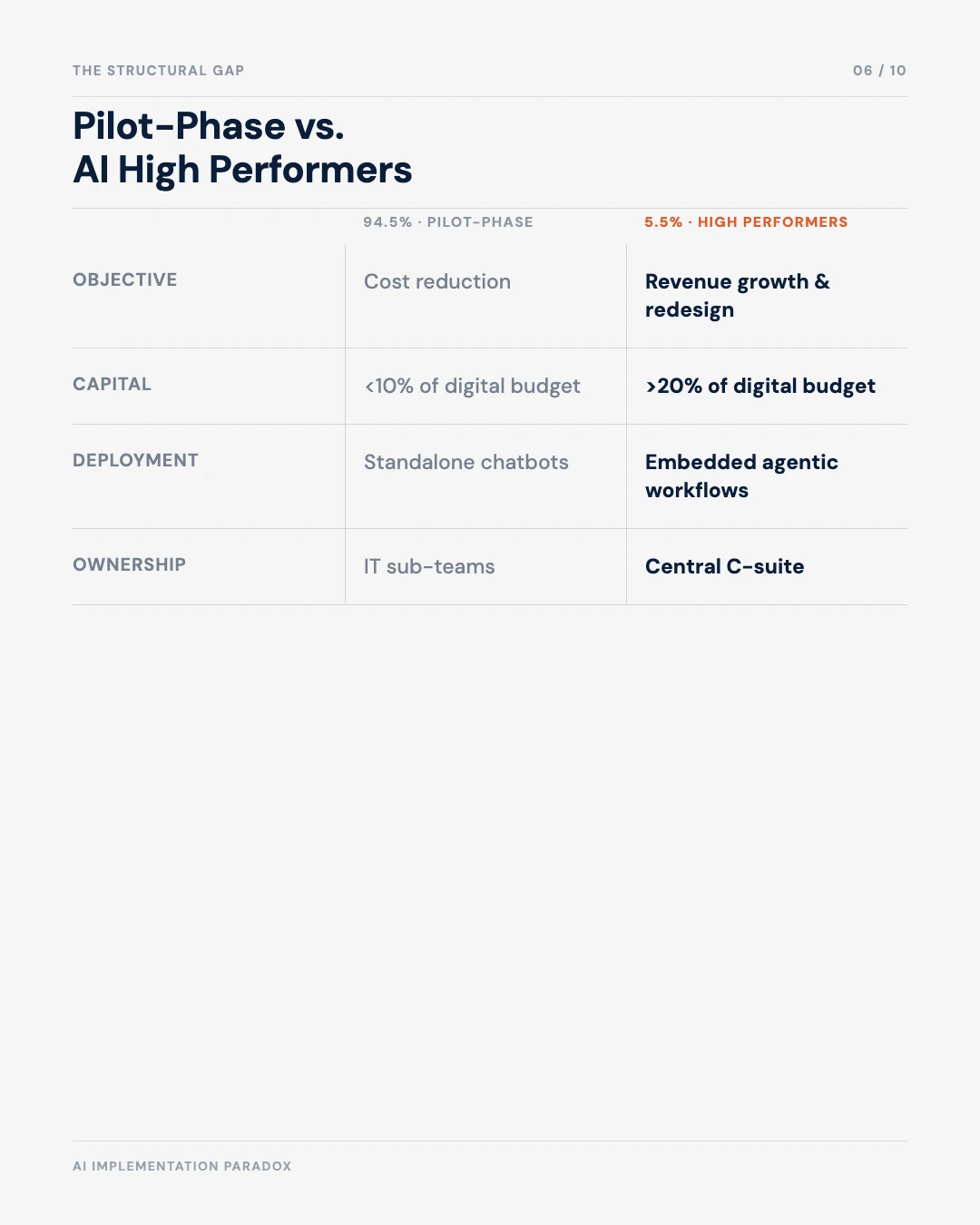
McKinsey’s data points to a small group of companies it calls “AI high performers.” These are companies where AI adds more than 5% to their profit, about 5.5% of the companies studied. What makes them different from the other 94.5% isn’t which AI company they buy from. It’s six clear differences in how they build AI into the way the whole company works.
| Operational dimension | Pilot-Phase Enterprises (94.5%) | AI High Performers (5.5%) |
|---|---|---|
| What they aim for | Small efficiency gains and cost cuts | Redesigning how work is done, new products, more revenue |
| How much money they spend | Less than 10% of their tech budget goes to AI | More than 20% of their tech budget goes to AI |
| How they use AI | Separate tools, like chatbots that stand alone | AI built into daily work, connected to other systems |
| How their data is set up | Data kept in separate, disconnected pieces | Data managed well, connected, and updated in real time |
| Who is in charge | Handed off to small innovation or IT teams | Owned by top leaders and run across the whole business |
| How work processes change | AI added on top of the old way of working | The whole process rebuilt, with people checking AI’s work |
Companies that get more than 5% profit from AI aren’t using a smarter AI model. They’re running their business a different way, with AI built inside how work gets done.
Every row shows the same pattern. The 94.5% add AI on top of how work already happens. The 5.5% use AI as a reason to redesign how work happens from the start. This is a decision for company leaders, not something you fix by just buying a better tool, which is why buying better tools rarely closes the gap on its own.
These projects fail in the setup phase
Gartner’s forecast for 2026 shows exactly where AI test projects fail before they go live: 60% of AI projects will be dropped because the company’s data was never made ready for AI. More than 40% of AI agent projects will fail because they don’t connect well with the company’s old systems. Both problems can be seen before a company even signs a contract; they aren’t surprises that show up partway through. Getting lasting value from AI means fixing three layers.
Getting the data ready. A basic search tool isn’t enough for a real company to run on. Working AI systems need several kinds of search working together, built on top of data that has been cleaned up. Bad or missing data alone causes 38% of company AI projects to stall, which makes cleaning up data the least exciting but most useful fix on the list. I’ve written before about what that data pipeline needs to include in Stop Tuning Prompts, Start Cleaning Data and about the full production setup in How to Build Governed RAG 2.0 Systems.
Managing AI agents. Asking an AI one question at a time only helps a company so much. Growing AI use needs systems of AI agents that can plan, remember what they’re doing, use tools, and fix errors without a person checking every single step. 62% of companies are testing AI agents right now; only 23% have gotten agents fully working in real, everyday use. That gap between testing and real use comes almost entirely from a lack of good management and tracking, which is the point I make in Agentic AI in Singapore Commerce: Building Traceability and Beginning Your Journey: Identifying Tasks for Quality, Traceable, Auditable AI Agents.
Following the rules. The EU AI Act can fine companies up to €35 million, or 7% of their yearly global earnings, for risky AI systems that don’t follow the rules. That means clear tracking of where data comes from, regular testing, strict safety limits, and constant monitoring aren’t nice extras; they’re required. I explain what that oversight needs to include in Beyond the Pilot: A Risk Governance Framework for Scalable AI Deployment.
A step-by-step way out of the test-project trap
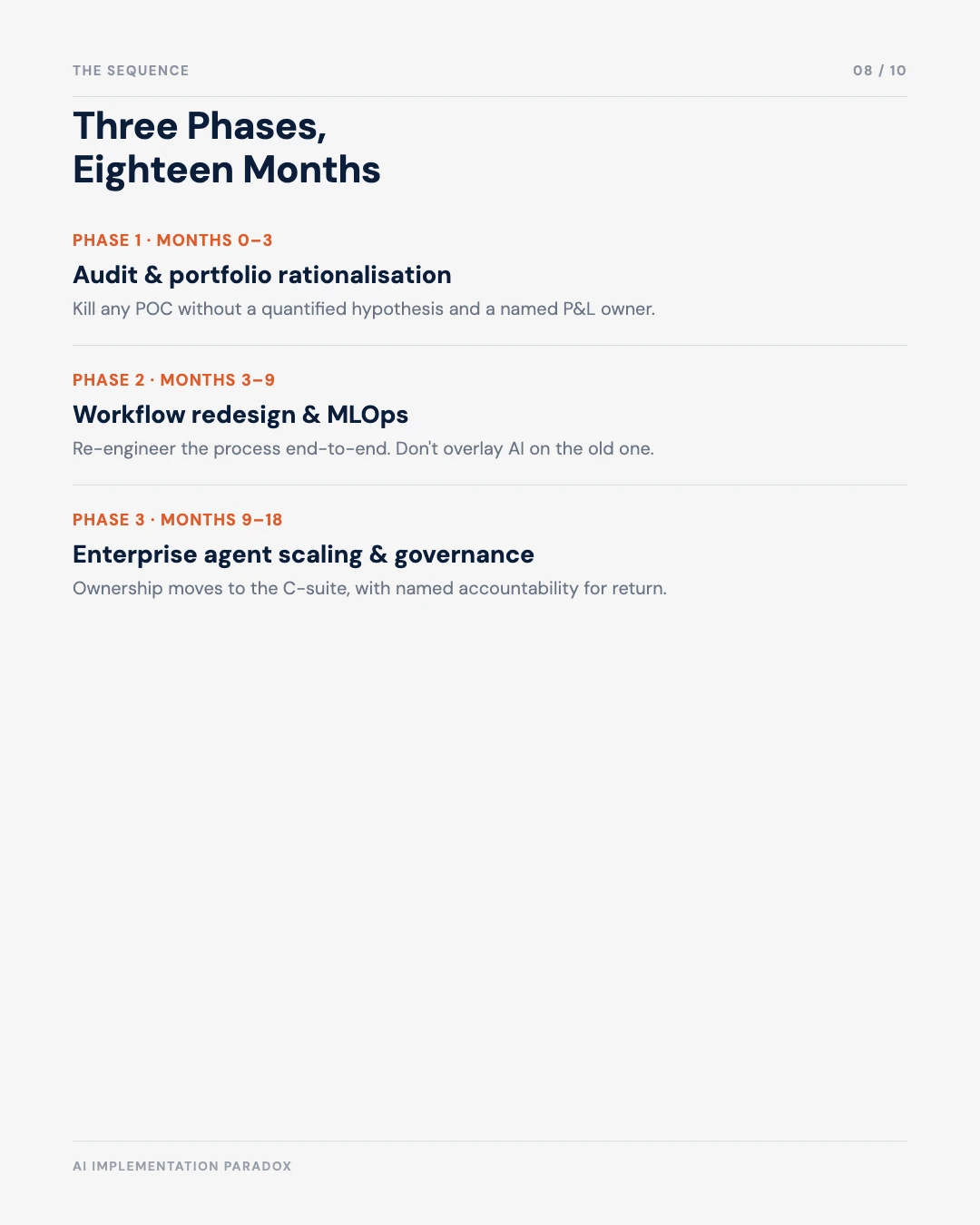
Closing this gap is about doing things in the right order, not doing the same thing faster. The order below matters: each phase sets up what the next one can safely assume.
- Phase 1: Review and cut weak projects (Months 0–3). Stop any test project that doesn’t have a clear goal, a way to measure success, and someone in charge of the money results. Pick two or three high-value tasks to focus on, things like automated IT support, document review, or supply chain planning are common choices, where mistakes can be caught by a person checking the AI’s work.
- Phase 2: Redesign the work, connect the systems (Months 3–9). Don’t just add AI on top of the old manual steps. Change how the work flows so AI agents handle the main data work, gather what they need, and write first drafts, sending only unusual or tricky cases to a person. Pair this with automatic checks that test accuracy and speed before every release.
- Phase 3: Grow AI agents company-wide, with oversight (Months 9–18). Bring all the company’s knowledge together in one central place that AI agent systems can access easily. Move who’s in charge from a small IT team to top company leaders, with named business leaders responsible for how well AI is used and what it earns.
The AI Use Case Prioritisation Matrix is the tool for Phase 1. It scores how well a project fits the strategy, whether the data is ready, and what return to expect, so a keep-or-cut decision is based on facts, not gut feeling.
Waiting costs more the longer you wait
None of the three phases above work alone, and skipping the order doesn’t make things faster, it just moves the failure to later. Good rules without clean data still give confident, wrong answers that look official. Clean data without regular monitoring gets worse once it’s live. Even a well-chosen first project fails if nobody redesigns the process around it. Each phase sets up the next one, which is why the top 5.5% of companies built their structure first, before growing their tools.
The real risk in 2026 isn’t falling behind on AI technology. It’s building up shortcuts and problems while competitors already in the top 5.5% steadily rebuild how their whole company works, with well-managed data and AI agents. By the end of 2027, the expected gap is 3.6 times better money and worker efficiency for companies that made this investment, compared to companies still running small tests on top of an unchanged way of working. This gap will stay no matter how much better AI models get, because the AI model was never the real problem. Every few months spent adding another test project instead of redesigning the work underneath it adds to a bigger bill that a company will eventually have to pay.
Evidence & Methodology
Three of these numbers come from named surveys linked below. One, the S&P Global figure, has no direct link I could find, so weight it as reported rather than independently verified. The 2027 gap is a projection, not something that has happened yet.
| Claim | Source | Grade |
|---|---|---|
| 78% of companies use AI often, but only 33% have scaled it company-wide | McKinsey Global Survey on AI, Nov 2025, cited below | Measured |
| Only 5.0% of AI test projects reach lasting revenue or profit gains | Project NANDA, MIT Media Lab, cited below | Measured |
| 42% of companies now scrap most of their AI projects, up from 17% in 2024 | S&P Global Market Intelligence, 2025, no direct link available | Reported |
| By the end of 2027, AI high performers will hold a 3.6x efficiency edge over pilot-phase companies | A forward projection built on the same data above, not something that has happened yet | Forecast |
Sources
- McKinsey & Company. (2025, November). Global survey on AI.
- S&P Global Market Intelligence. (2025).
- Project NANDA, MIT Media Lab. (2025). “The GenAI Divide: State of AI in Business 2025,“
- Anthropic. Model capability research.
- Gartner. (2026). 2026 forecast.
- European Union. (2024). Regulation (EU) 2024/1689 (EU AI Act).
Free tool
AI Use Case Prioritisation Matrix
Score up to five initiatives across six dimensions to get the ranked, keep-or-cut sequence Phase 1 above calls for.
Free tool
The Discipline Gap
A 32-page briefing on why AI projects stall before they can grow, and what habits separate lasting programmes from expensive one-off tests.
The AI Governance & ROI Executive Programme applies this same three-layer approach to your own company, with a scored starting point and a step-by-step plan as the result. Details are on the workshops page.
Was this useful?