

Listen to this article
Jump to a section
In this article
Executive Summary
AI use by Singapore small businesses tripled between 2023 and 2024. But the gap with bigger companies got wider. The problem is not that small businesses don’t want AI. IMDA’s own data shows 95.1% of small businesses already use at least one digital tool. The problem is picking AI projects that work for a business with no IT team, and knowing which ones don’t.
14.5%
of small businesses used AI in 2024, three times more than the 4.2% in 2023 (IMDA)
48pp
the gap between small business AI use and big business AI use, now at 62.5% for big business
95.1%
of small businesses already use at least one digital tool. Wanting AI is not the problem
52%
average money saved by small businesses in government-funded (PSG) AI projects in 2024
Core conclusions
- Most small businesses that succeed with AI are simply turning on AI features already inside software they use, like Xero, QuickBooks, Shopify, and Microsoft 365. They are not building anything new.
- Five areas have the strongest proof that AI works: bookkeeping, marketing content, customer support, writing emails and documents, and catching payment fraud.
- Be careful with AI hiring tools. Their best-known numbers come from the US, are credited to different sources, and have never been tested in Singapore.
The adoption gap, in ten slides
Save it, share it, or send it to whoever plans AI for your small business.
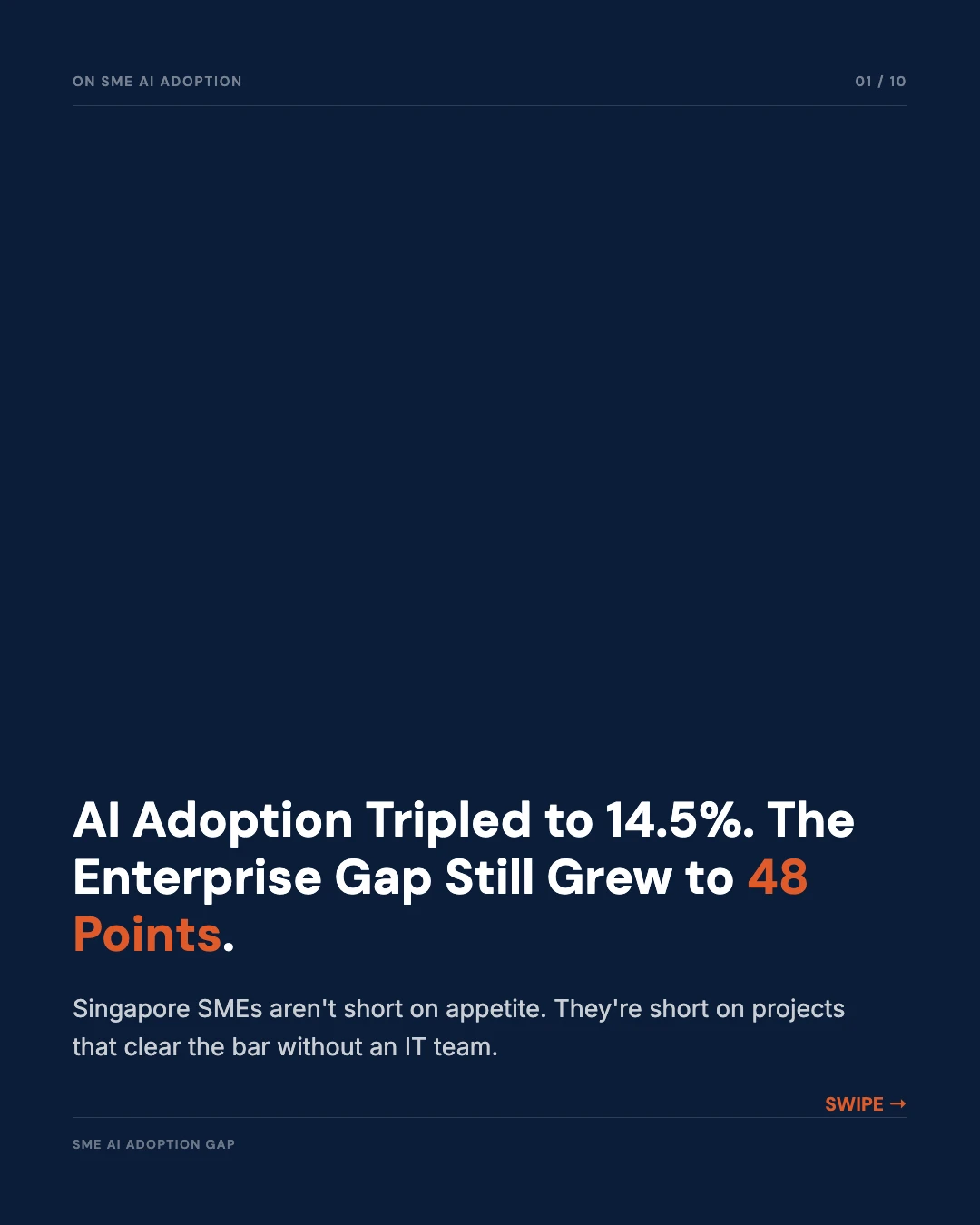
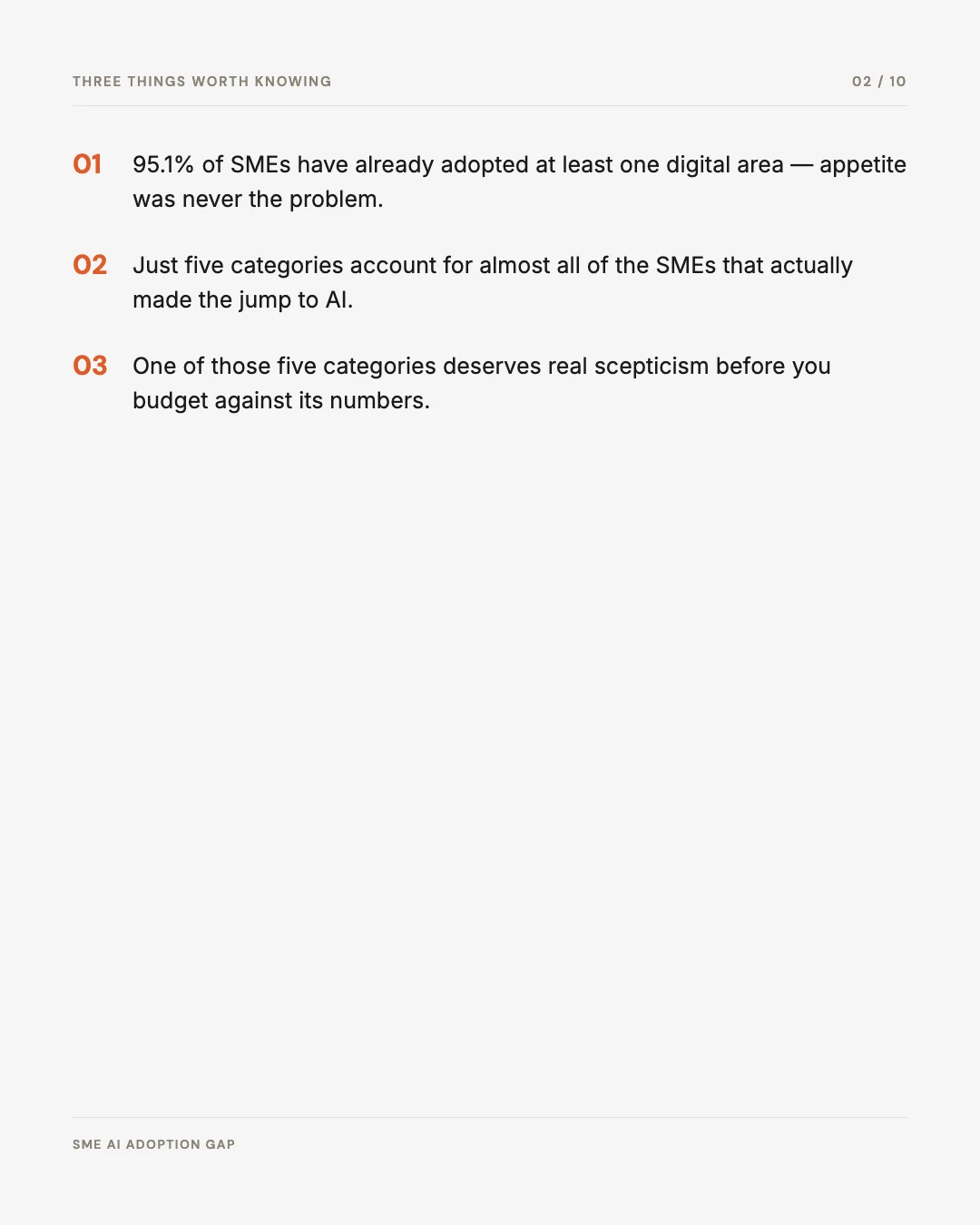
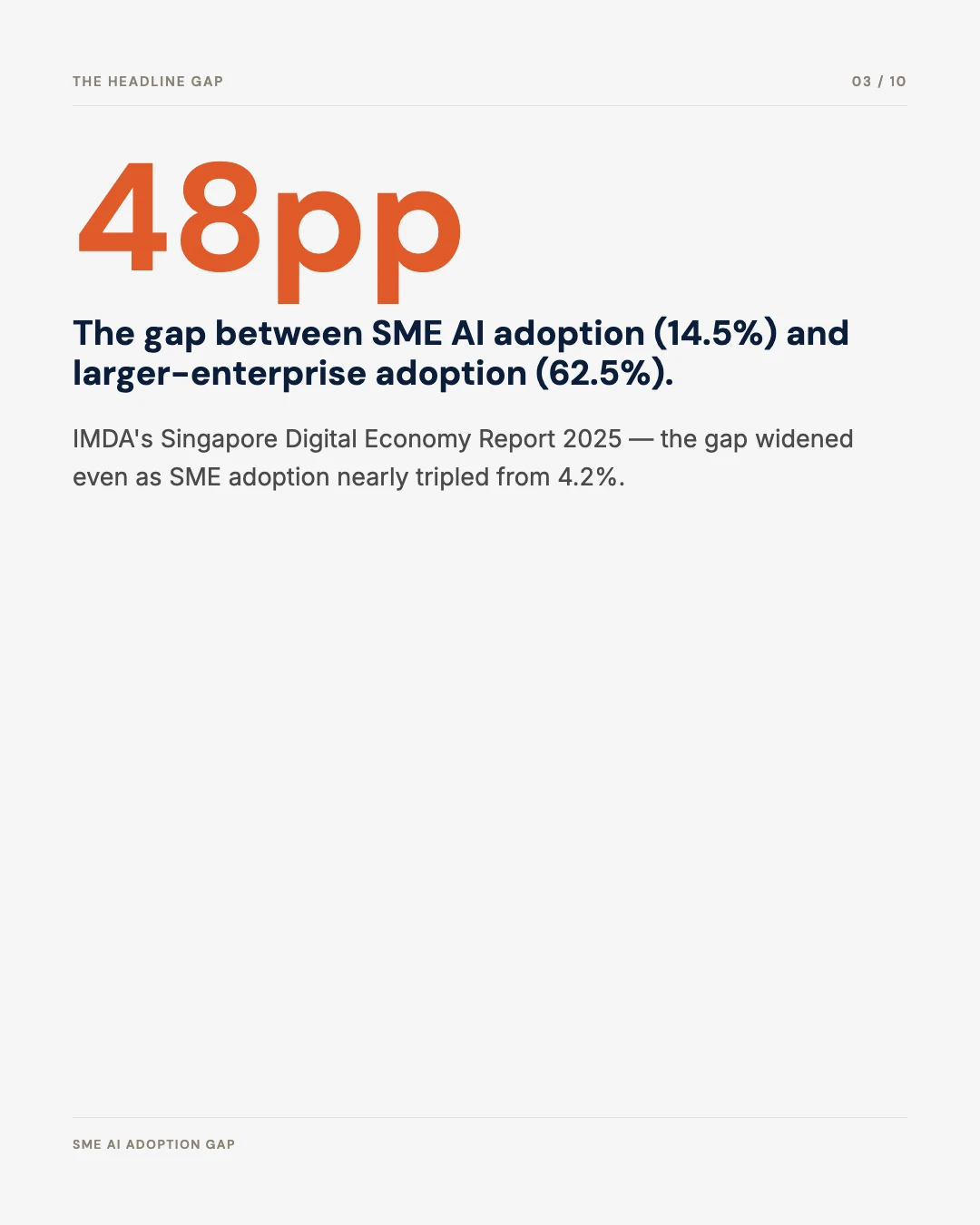
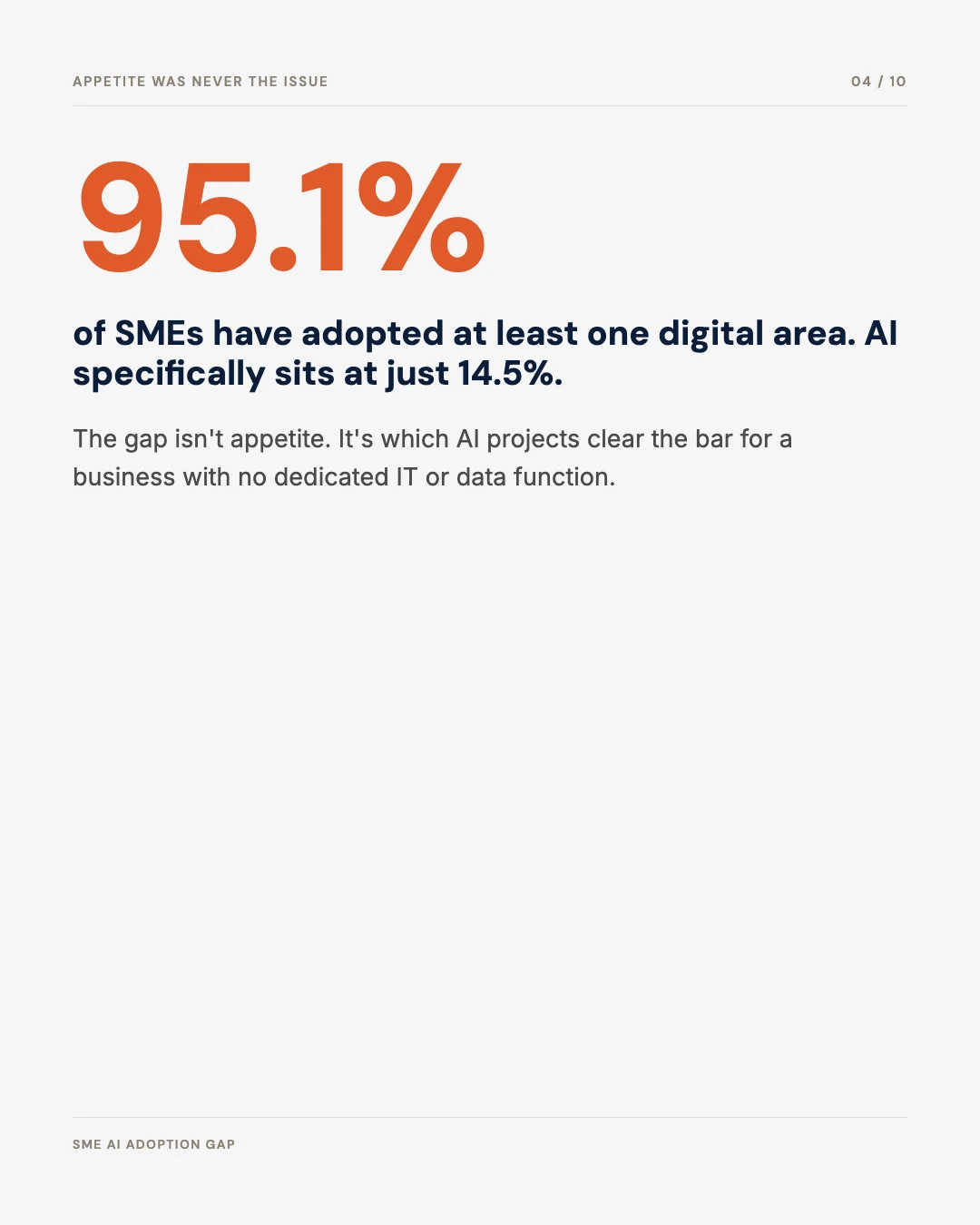
IMDA’s Singapore Digital Economy Report 2025 found that AI use among small businesses tripled from 4.2% in 2023 to 14.5% in 2024. That also means 85.5% of Singapore small businesses still use no AI at all. During the same time, use among bigger businesses rose from 44% to 62.5%. Tripling is real progress. But the 48-point gap between small and big businesses did not shrink. It grew. This is not because small businesses don’t want AI. The same IMDA data shows 95.1% of them already use at least one digital tool. The real difference is which AI projects work for a business with no IT team, and which ones don’t. That is what this article is about.
IMDA Singapore Digital Economy Report 2025
Small business AI use tripled, but the gap with big business still grew
Source: IMDA, Singapore Digital Economy Report 2025.
IMDA Singapore Digital Economy Report 2025
Small businesses aren’t avoiding digital tools. They’re just behind on AI
Share of small businesses using at least one digital tool, compared to the share using any AI. Source: IMDA, Singapore Digital Economy Report 2025.
What successful small businesses have in common
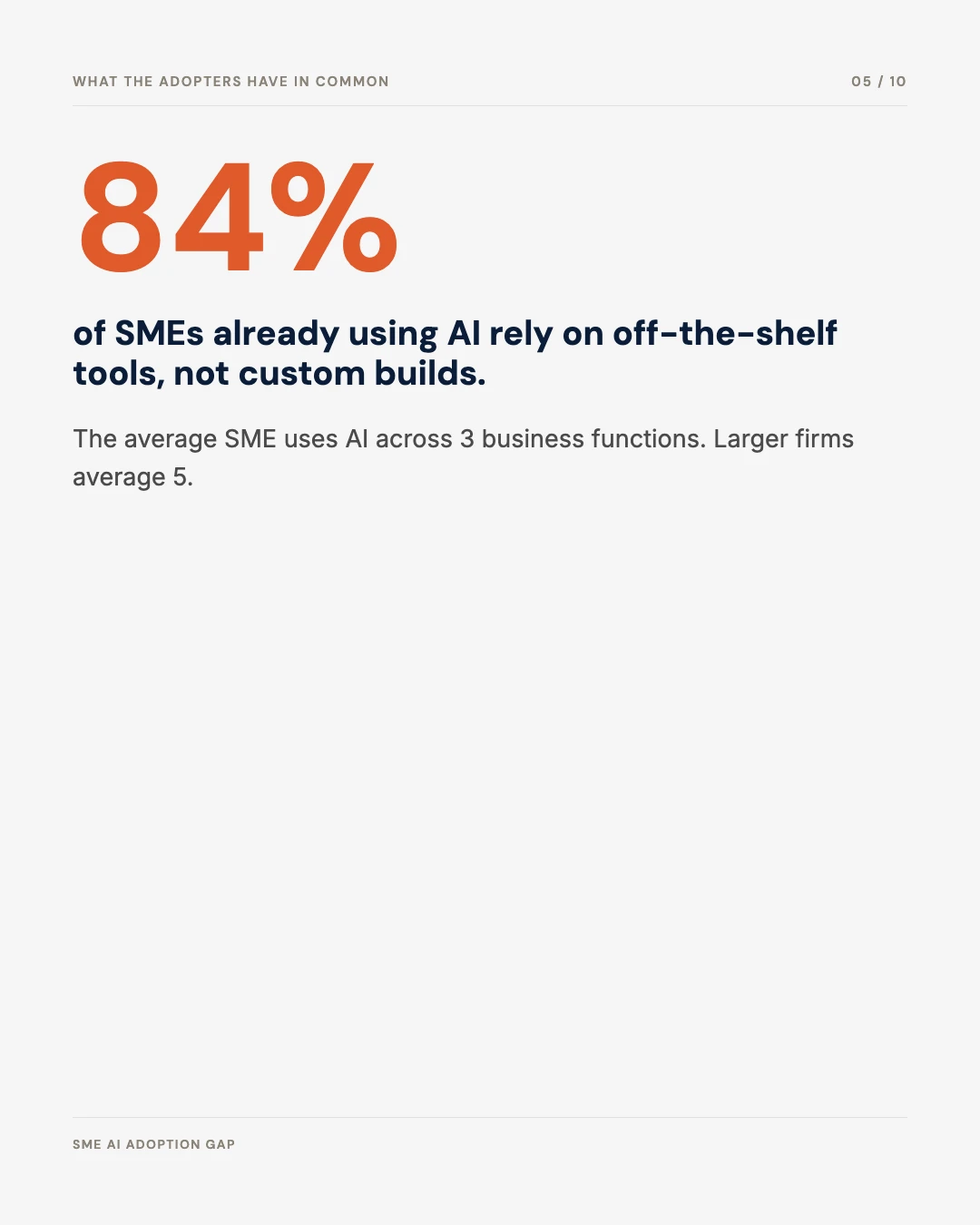
Among Singapore small businesses already using AI, 84% use ready-made AI tools instead of building their own systems. IT, customer service, and finance are the top areas for both small and big businesses.
3
average number of business areas using AI, small businesses
vs
5
average number of business areas using AI, big companies
Small businesses using AI tools funded by the Productivity Solutions Grant (PSG) saved 52% on costs on average in 2024, according to IMDA. This shows a clear pattern: an easy AI project for a Singapore small business has four things going for it. It is built into software the business already uses, or it’s on Enterprise Singapore’s approved PSG list. It needs no new tech hire. It starts working in days or weeks. And you pay as you use it, instead of paying a big amount upfront.
The PSG list itself shows which categories work: approved cloud accounting tools like Xero and QuickBooks, approved CRM and inventory systems, and online stores built on Shopify and WooCommerce. Microsoft Copilot for Microsoft 365 now has its own PSG funding track too: the government pays up to 50% of the licence cost, up to 50 licences per small business, for AI built right into the software the business already uses. When a Singapore small business picks from these categories, it isn’t just choosing the easiest option. In many cases, it’s choosing the option the government is already ready to help pay for. My use-case prioritisation framework uses the same idea: rank projects by how easy they are to set up and how fast they pay off, before ranking them by how ambitious they are.
Five areas with proof behind them
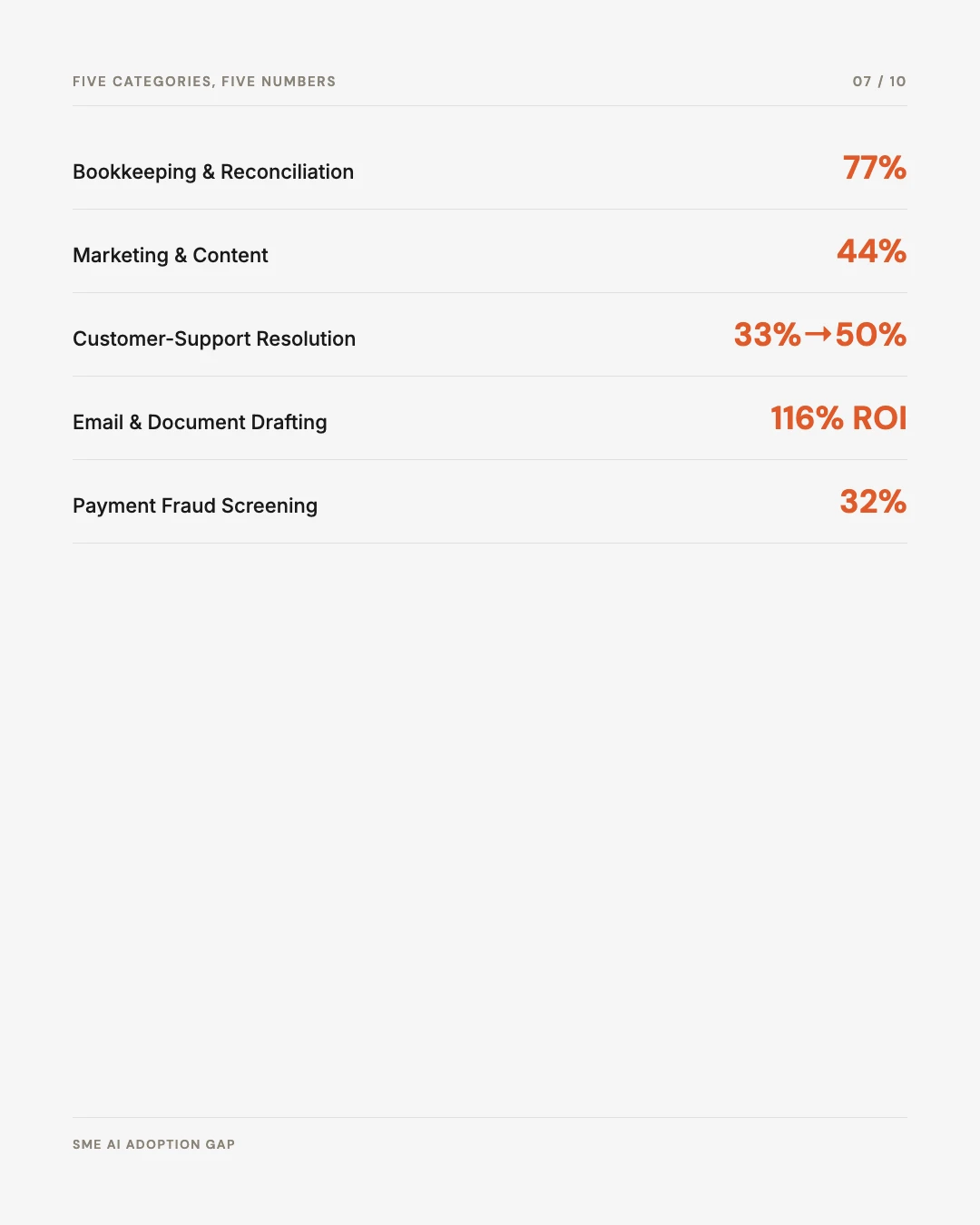
Bookkeeping & Reconciliation
77%
of small businesses said they use AI regularly by January 2026, up from 48% eighteen months before (Intuit, worldwide).
Marketing & Content
44%
of small businesses now use AI to write marketing content (Constant Contact, 2026).
Customer-Support Resolution
33%→50%
how much Intercom Fin’s own success rate jumped on the exact same conversations, after the company changed how it measures success in June 2026, before it later claimed 76%.
Email & Document Drafting
116%
three-year return on investment reported for Microsoft 365 Copilot (Forrester, paid for by Microsoft).
Payment Fraud Screening
32%
average drop in payment fraud reported by businesses using Stripe Radar.
One warning applies to all five numbers above: they come from companies and industry surveys, mostly measured outside Singapore, not Singapore-only data, which doesn’t exist yet at this level of detail. What is Singapore-specific is the categories themselves: each one is either approved by PSG or built into software already on the PSG list. That is a stronger kind of proof than any single company’s claim about how well its product works. This is what should matter most in a Singapore small business’s decision, not the exact percentage. The same strict standard is used below for one category that has no government approval to fall back on.
Bookkeeping, reconciliation, and collecting invoices. Xero and QuickBooks are both PSG-approved. They now run AI on top of the bank and invoice data a small business already has.
Marketing and product content. Shopify Magic, which works with PSG-approved online stores, writes product descriptions and edits product photos using a shop’s existing catalogue. Retail is one of the fastest-growing areas for AI use in Singapore. Enterprise Singapore and IMDA’s updated Retail Industry Digital Plan aims to bring this kind of AI use to more than 2,000 small retail businesses.
Customer-support resolution. Tools like Intercom’s Fin read a business’s existing help pages and support history. No new data needed. Fin is also a good example of why you should question a company’s big headline number. On 24 June 2026, Intercom changed how it calculates its own success rate. It stopped counting conversations where Fin never got a chance to answer. Using that new method on the exact same conversations, the reported rate jumped from 33% to 50%. Intercom’s own blog then said the June 2026 average was 76%, without mentioning the change in how it was measured. This doesn’t mean Fin got worse. It means the number changed even though the real performance didn’t. That is exactly the risk of trusting any company’s headline success number, no matter where the business is.
Email and document drafting. Microsoft Copilot for Microsoft 365 now has its own PSG funding track. That makes it one of the few categories here where the Singapore government has already arranged both the tool and the funding. But one small-business technology adviser found that only 60–70% of people with a Copilot licence were still actively using it after 90 days, a drop-off worth planning for.
Vendor claims vs. independently reported numbers
Where the marketing number and the real number don’t match
Bars scaled 0–100%. Sources: independent 500-ticket test (pre-2026); Intercom Help Center, Fin performance-metric update (24 June 2026, rolled out 1–8 July 2026); Intercom, “From resolutions to outcomes” (June 2026); small-business technology adviser survey on Copilot 90-day retention.
Payment fraud screening. If a Singapore small business already takes card payments through Stripe, its Radar tool checks transactions using data the business already has, at no extra setup cost. Businesses with few monthly transactions should be careful with the 32% average number, since one wrong result can throw off a small sample a lot.
What Singapore Business Federation members are telling PwC
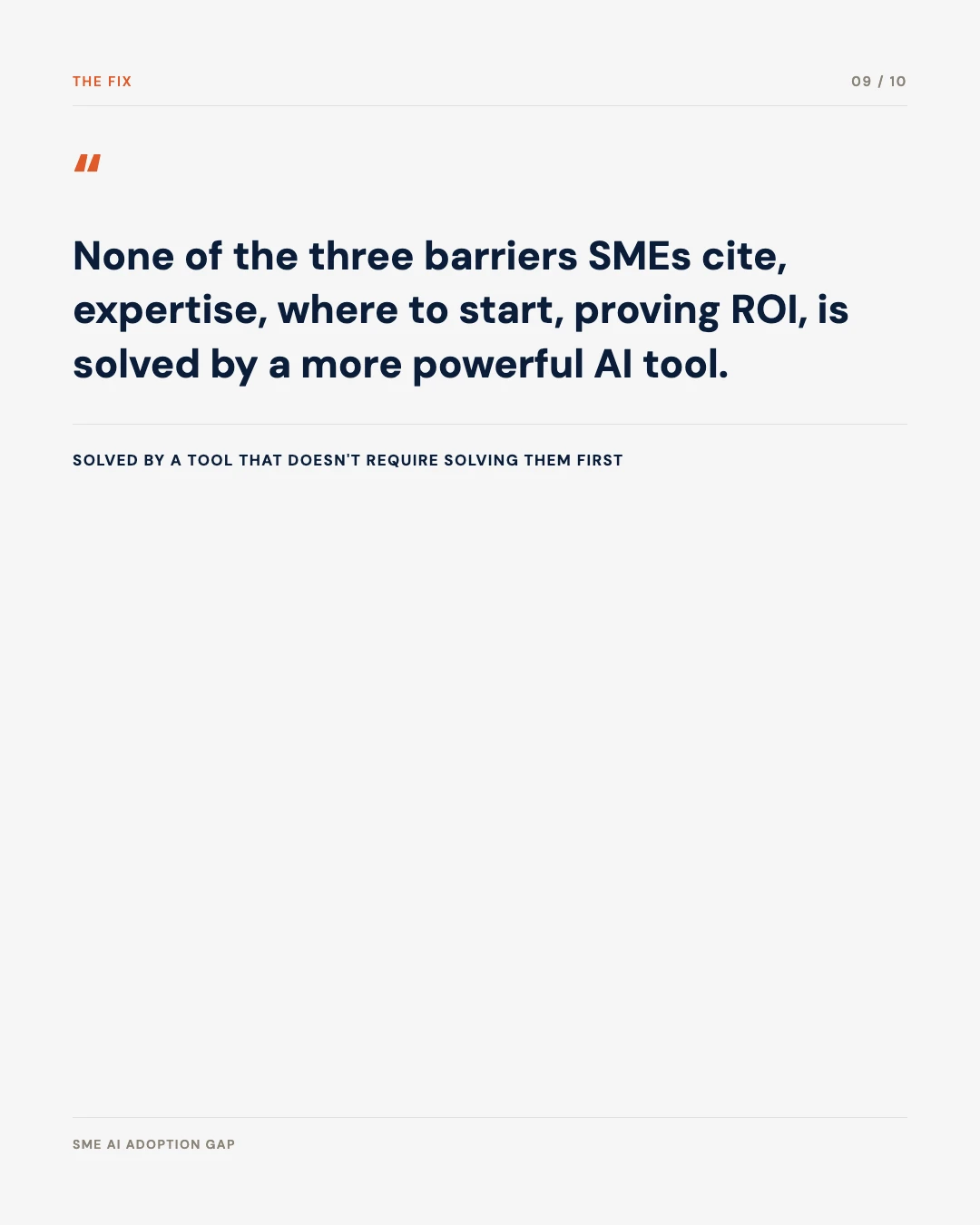
Not every small business that tries one of these tools keeps using it. PwC Singapore’s work with the Singapore Business Federation found a repeating pattern: one person inside the company, sometimes the owner, tries out the tool while still doing their normal job. Once that person gets pulled back into daily work, the tool gets dropped. The SBF’s National Business Survey 2025 names the same three problems again and again: not enough in-house skill, not knowing where to start, and trouble proving the tool is worth the money. A more powerful AI tool doesn’t fix any of these three problems. The fix is choosing a tool simple enough that it doesn’t run into these problems in the first place. That is the whole reason this article only recommends the categories above.
The one category to be careful with
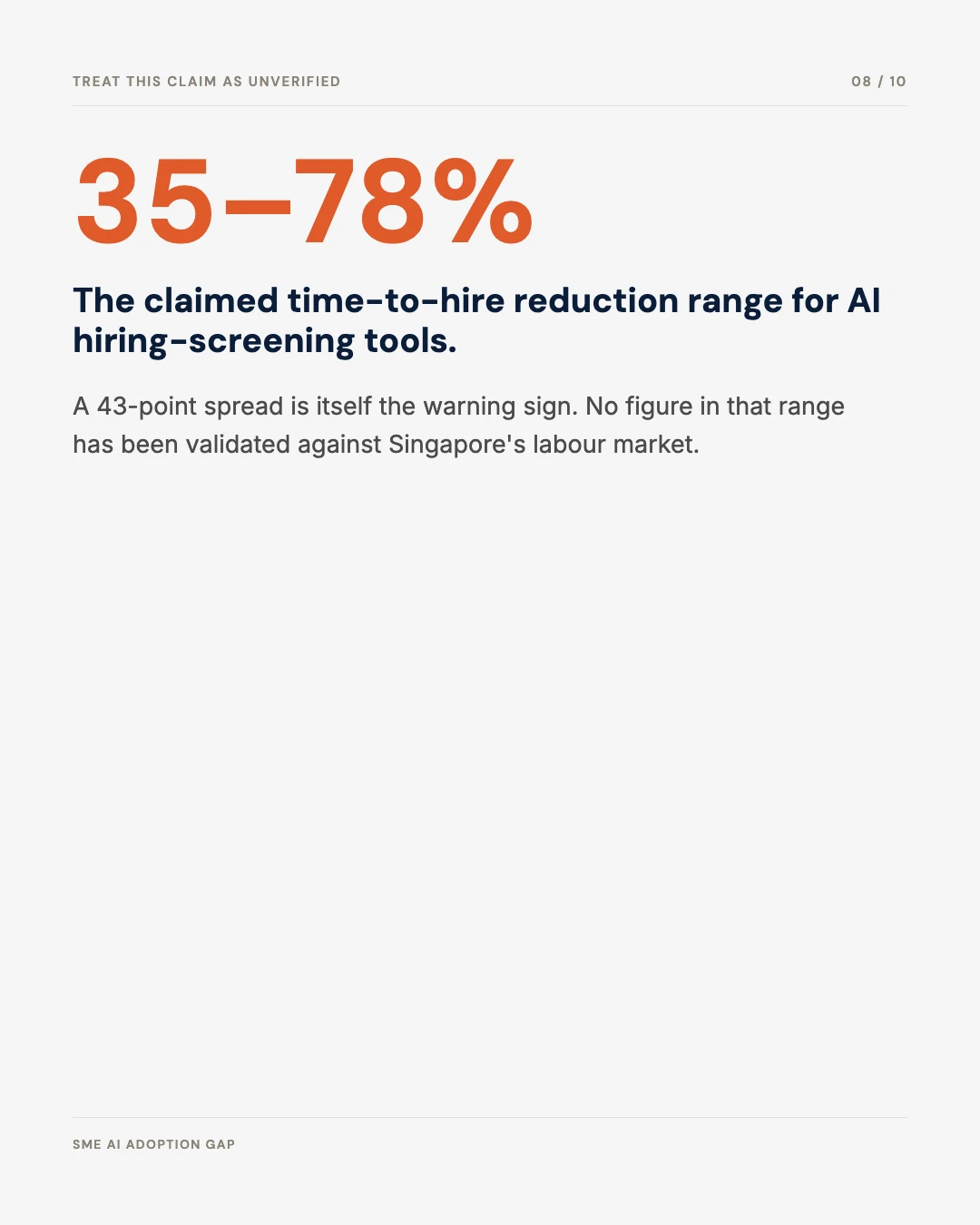
AI hiring-screening tools are heavily marketed to small businesses everywhere, including Singapore. Sellers claim they cut hiring time by 35% to 78%, depending on who you ask.
Treat this claim as unverified
AI hiring screening: claimed drop in hiring time
Bars scaled 0–100%. Figures attributed inconsistently to bodies including SHRM and Greenhouse, rarely traceable to a published study.
Almost all of these numbers come from US companies. They are credited to different groups such as SHRM and Greenhouse, and rarely link to a real published study. None of them has been checked against Singapore’s job market. A Singapore small business looking at this category should ask for the actual study, ask for a similar-sized customer reference in Singapore, and measure its own hiring speed during a trial, instead of trusting a number imported from another country. My vendor evaluation scorecard lists the exact questions to ask any vendor who quotes an improvement number without a source, for hiring or anything else.
The rule you still have to follow
Turning on an AI feature inside software you already own does not remove your duties under the Personal Data Protection Act 2012. The PDPC has said clearly that a business is still responsible for personal data, even when a vendor’s AI makes the decisions. On 2 June 2026, the PDPC proposed guidelines on using personal data in generative AI, and closed public feedback on 1 July 2026. Since 20 July 2026, a new rule requires businesses to clearly tell people when their personal data is used to train or improve a generative AI model. A general notice about product development is no longer enough. The PDPC has not said exactly how this notice must be given: an in-app message or a webpage both work. So a small business turning on any of the tools above should still check whether customer or staff data is used to train models shared with other customers. PSG approval does not cover this question.
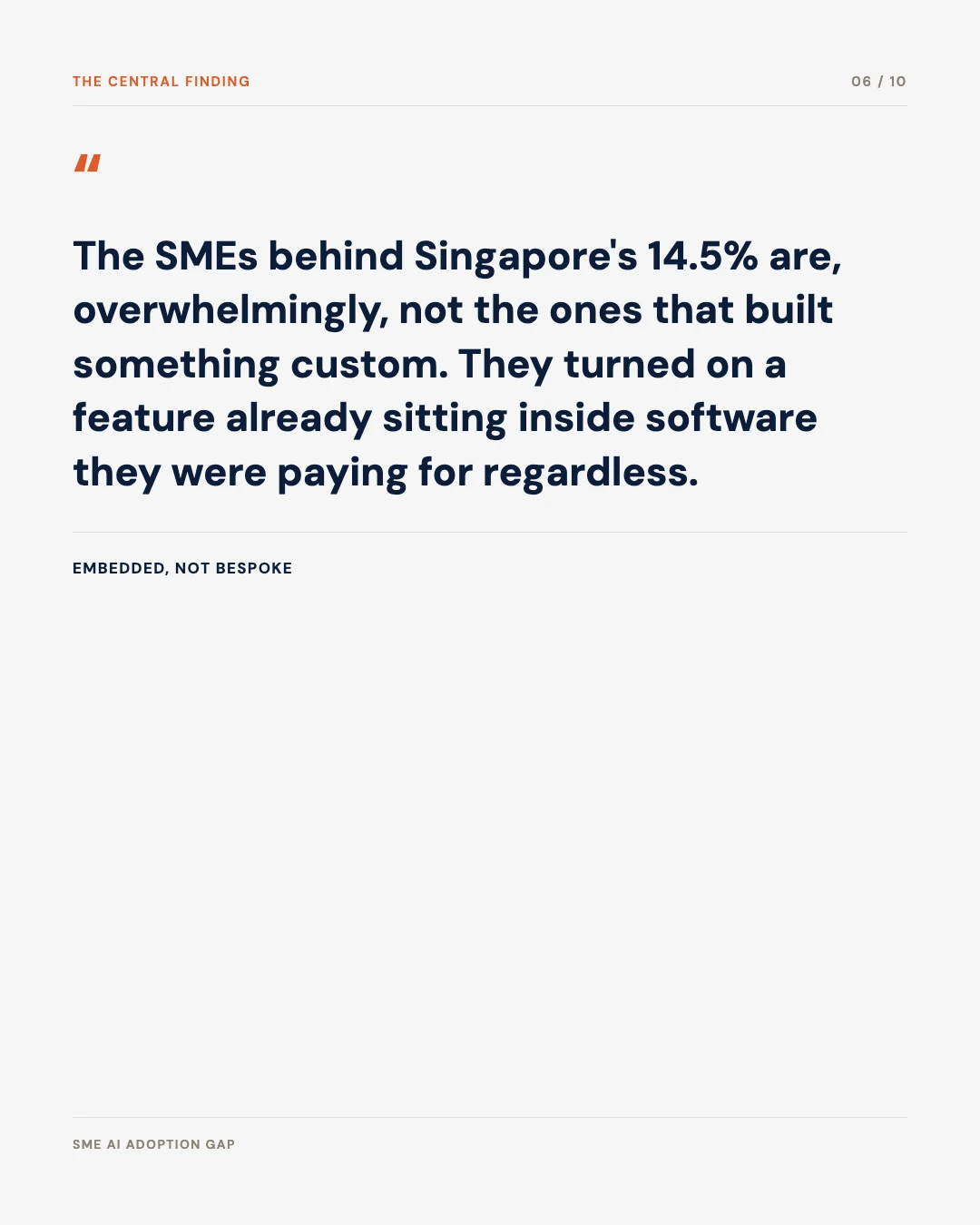
The small businesses behind Singapore’s 14.5% figure are, mostly, not the ones that built something new. They are the ones that turned on a feature already sitting inside software they were paying for anyway. That one choice, more than any strategy document, is what will help the next group of Singapore small businesses close the 48-point gap with bigger companies. For small businesses still deciding where to start, my structured approach to AI adoption explains the order to follow in more detail.
Evidence & Methodology
This piece already grades its own numbers as it goes, the Intercom section is basically a case study in a vendor number changing without the method changing. Here is the same grading, in one place.
| Claim | Source | Grade |
|---|---|---|
| Singapore SME AI use tripled to 14.5%, and the gap with big business grew to 48 points | IMDA’s Singapore Digital Economy Report 2025, cited below | Measured |
| The five proof-backed categories (bookkeeping, marketing, support, drafting, fraud screening) work for a business with no IT team | Vendor and industry numbers, mostly measured outside Singapore, not independently audited here | Vendor-reported |
| Intercom’s resolution rate jumped from 33% to 50% on the same conversations after a June 2026 metric redefinition | Intercom’s own performance-metric update, cited below | Documented |
| AI hiring-screening tools cut hiring time by 35% to 78% | Attributed inconsistently across sources, rarely traceable to a published study, never tested in Singapore | Unverified |
Sources
- IMDA. (2025). Singapore Digital Economy Report 2025.
- Enterprise Singapore. Productivity Solutions Grant (PSG).
- Enterprise Singapore. (2026, May). Retail Industry Digital Plan.
- Microsoft. (2026). Copilot for Microsoft 365 SME Programme (PSG funding terms).
- Intuit QuickBooks. (2026, January). 2026 AI impact report (with the University of Chicago).
- Constant Contact. (2026). Small Business Now report.
- Intercom. Published Fin case studies; an independent 500-ticket resolution test.
- Intercom Help Center. (2026, June 24). Update to Fin performance metrics.
- Intercom. (2026, June). From resolutions to outcomes.
- Forrester. Total Economic Impact study, commissioned by Microsoft, on Microsoft 365 Copilot.
- Stripe. Radar fraud-prevention data.
- PwC Singapore. Engagement summary with the Singapore Business Federation.
- Singapore Business Federation. National Business Survey 2025.
- Personal Data Protection Commission. Personal Data Protection Act 2012.
- Personal Data Protection Commission. (2026, June 2 proposed; effective 2026, July 20). Advisory guidelines on the use of personal data in generative AI.
Free tool
AI Use Case Prioritisation Matrix
Rank your AI projects by how easy they are to set up and how fast they pay off, the same PSG-first logic behind the five categories above.
Free tool
AI Vendor Evaluation Scorecard
The exact questions to ask any vendor who quotes an improvement number without a source, like the unverified 35-78% hiring-screening claims above.
Was this useful?