
Listen to this article
Executive Summary
The AI adoption-to-value gap is overwhelmingly a people and team-design problem, not a technology one. McKinsey, EY, and Fortune 500 research converge on the same lever: leadership ownership and structured upskilling, not model quality, determine whether AI scales or stalls.
88%
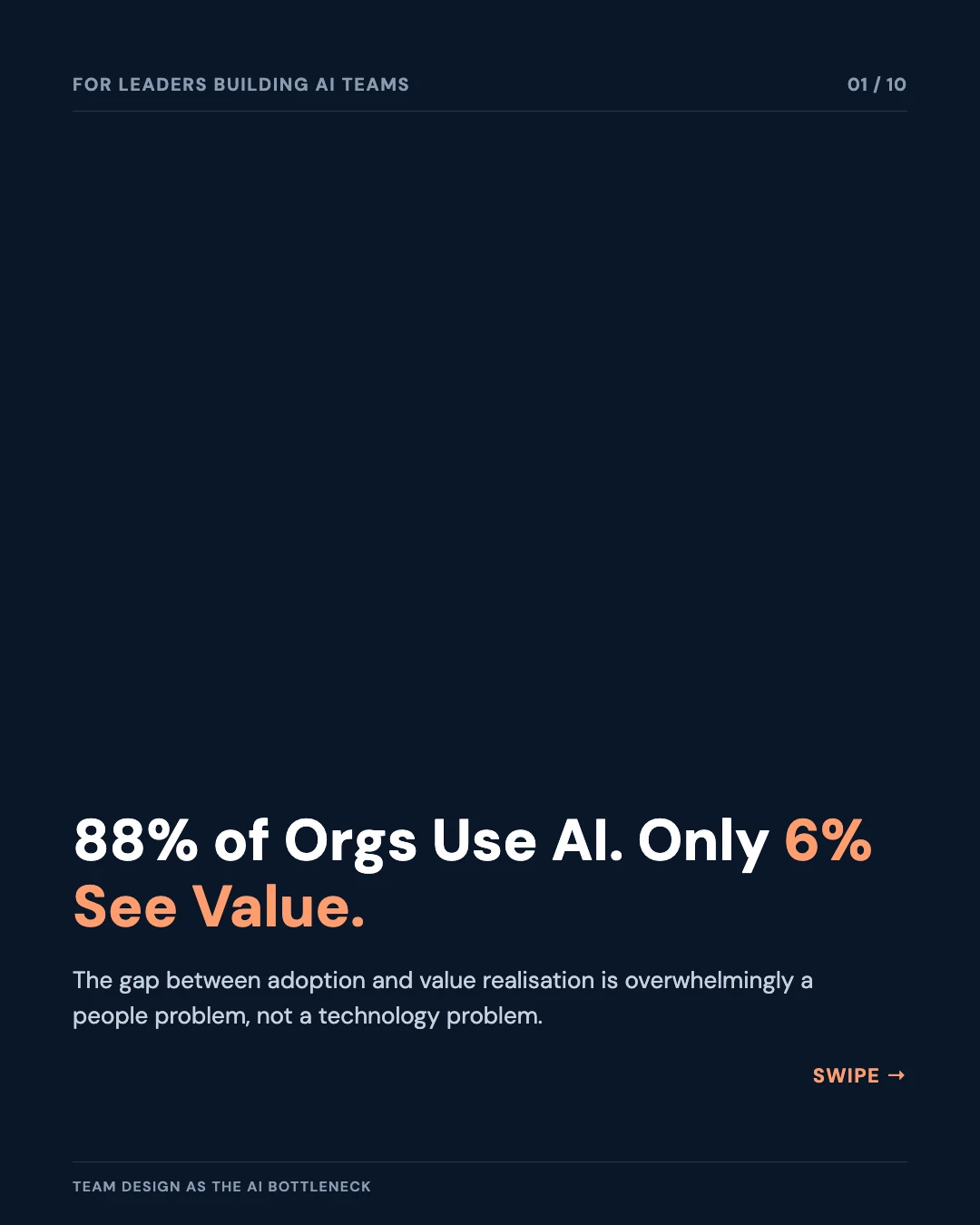
of organisations use AI in at least one function, yet only ~6% capture meaningful enterprise-level financial impact
85%
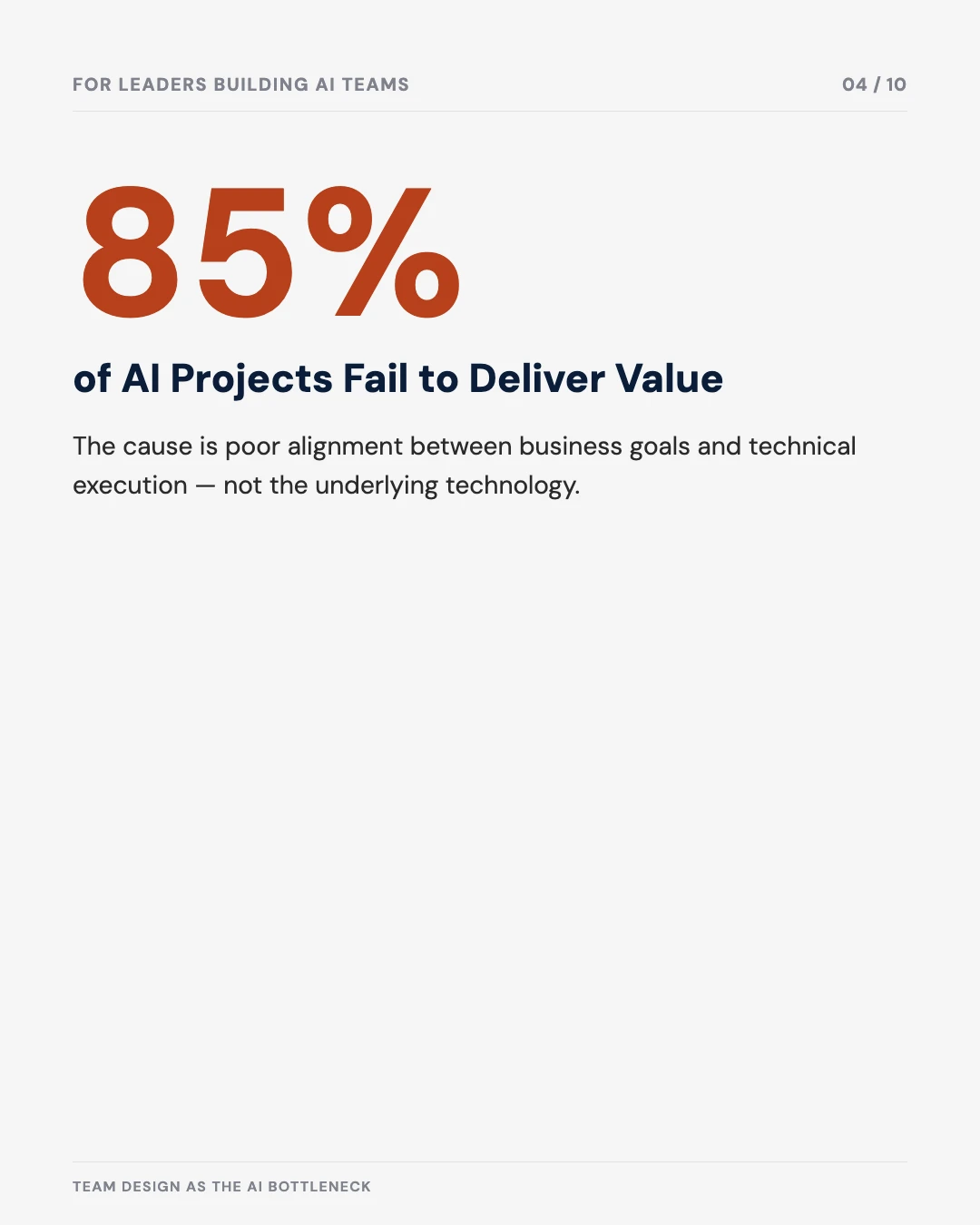
of AI projects fail to deliver business value due to poor alignment between goals and execution
3x
more likely: AI high performers have senior leaders who actively own AI initiatives, per McKinsey
15 hrs
weekly productivity gain reported by employees with 81+ hours of annual AI training, vs. a 6-hour median
Core conclusions
- Only around 6% of organisations that have adopted AI are capturing meaningful enterprise-level financial impact. The gap is structural: 85% of AI projects fail on goal-and-execution alignment, not on model quality.
- McKinsey’s AI high performers separate themselves through team design and leadership behaviour, not technology choices: senior leaders who demonstrate active ownership are three times more common, and high performers invest more than 20% of their digital budgets in AI.
- Upskilling pays off disproportionately when it is substantial. EY’s Singapore research found employees with over 81 hours of annual AI training report more than double the productivity gain of the median.
The roles, in ten slides
Save it, share it, or send it to whoever is sequencing your next AI hires.
The data, in three tables
The adoption-to-impact gap
| Metric | Value | Source |
|---|---|---|
| Organisations using AI in ≥1 business function | 88% | McKinsey, State of AI 2025 |
| Organisations achieving meaningful enterprise-level financial impact | ~6% | McKinsey, State of AI 2025 |
| AI projects that fail to deliver business value (poor goal/execution alignment) | 85% | Cited in article |
| Global enterprises projected to face critical AI skills shortages by 2026 | >90% | Cited in article |
| Estimated global market performance at risk from sustained skills gaps | USD 5.5 trillion | Cited in article |
The 85% and skills-shortage figures are cited in the original piece without a named publisher; the adoption and high-performer figures track McKinsey’s State of AI 2025 findings.
What McKinsey’s high performers do differently
| Practice | Finding | Source |
|---|---|---|
| Senior leadership ownership of AI initiatives | High performers are 3x more likely to have it | McKinsey, State of AI 2025 |
| Digital budget allocated to AI technologies | High performers invest >20% | McKinsey, State of AI 2025 |
McKinsey’s high performers also set growth and innovation, not just efficiency, as AI objectives, and redesign workflows rather than overlay AI onto existing processes.
The governance and upskilling gap
| Metric | Value | Source |
|---|---|---|
| Companies with dedicated AI compliance specialists | 13% | Cited in article |
| Companies with a dedicated AI ethics expert | 6% | Cited in article |
| Productivity gain for employees with 81+ hours/year of AI training | 15 hrs/week (vs. 6-hour median) | EY, Singapore workforce research |
A Fortune 500 survey cited separately in the article found AI is exposing a critical-thinking gap across organisations, distinct from the technical-skills gap.
Eighty-eight percent of organisations now use AI in at least one business function, yet only approximately 6% are achieving meaningful enterprise-level financial impact. The gap between adoption and value realisation is overwhelmingly a people problem, not a technology problem. This article outlines the roles, talent archetypes, and structural principles needed to build an AI team that moves from pilots to production at pace.
The gap between adoption and value realisation is overwhelmingly a people problem, not a technology problem.
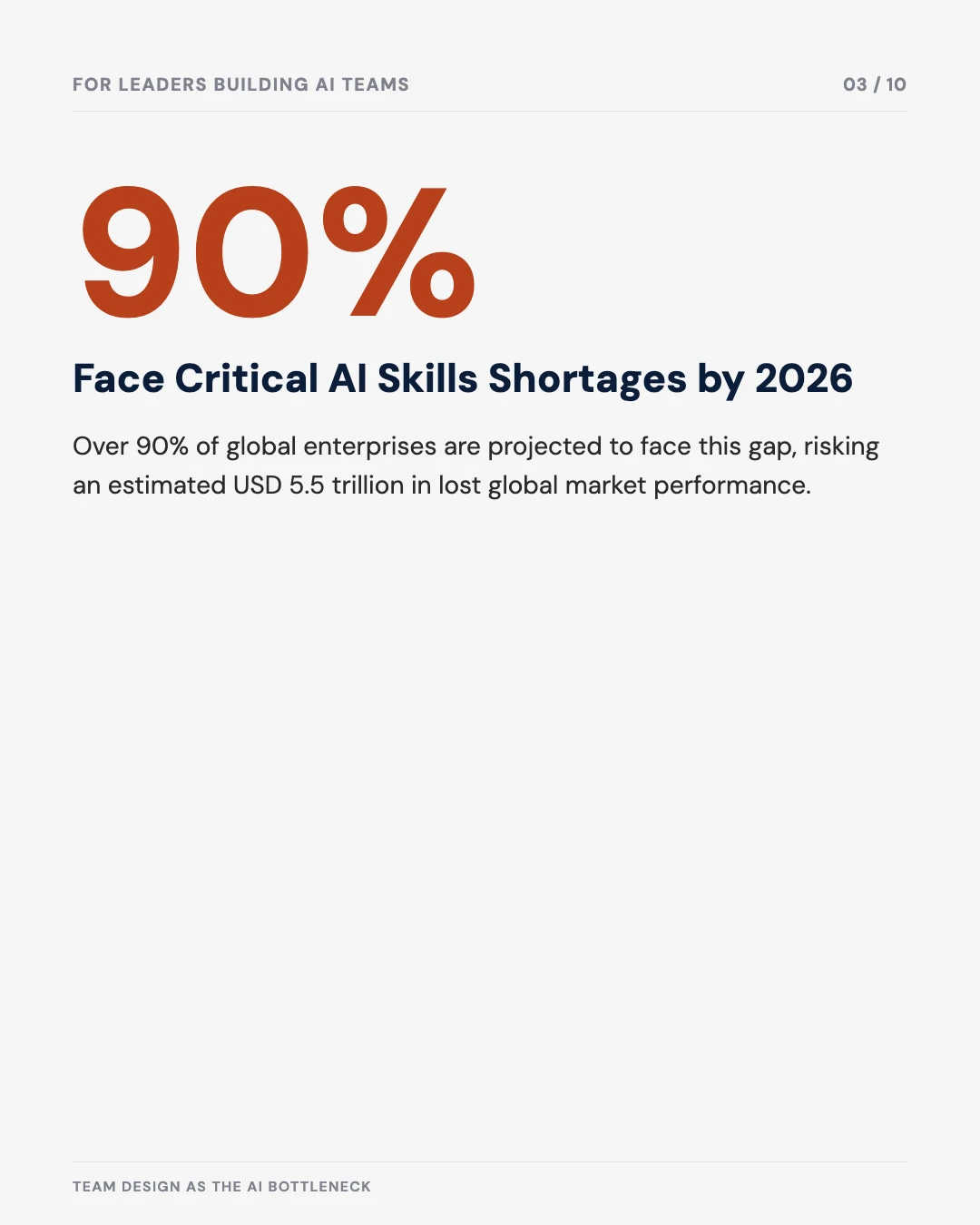
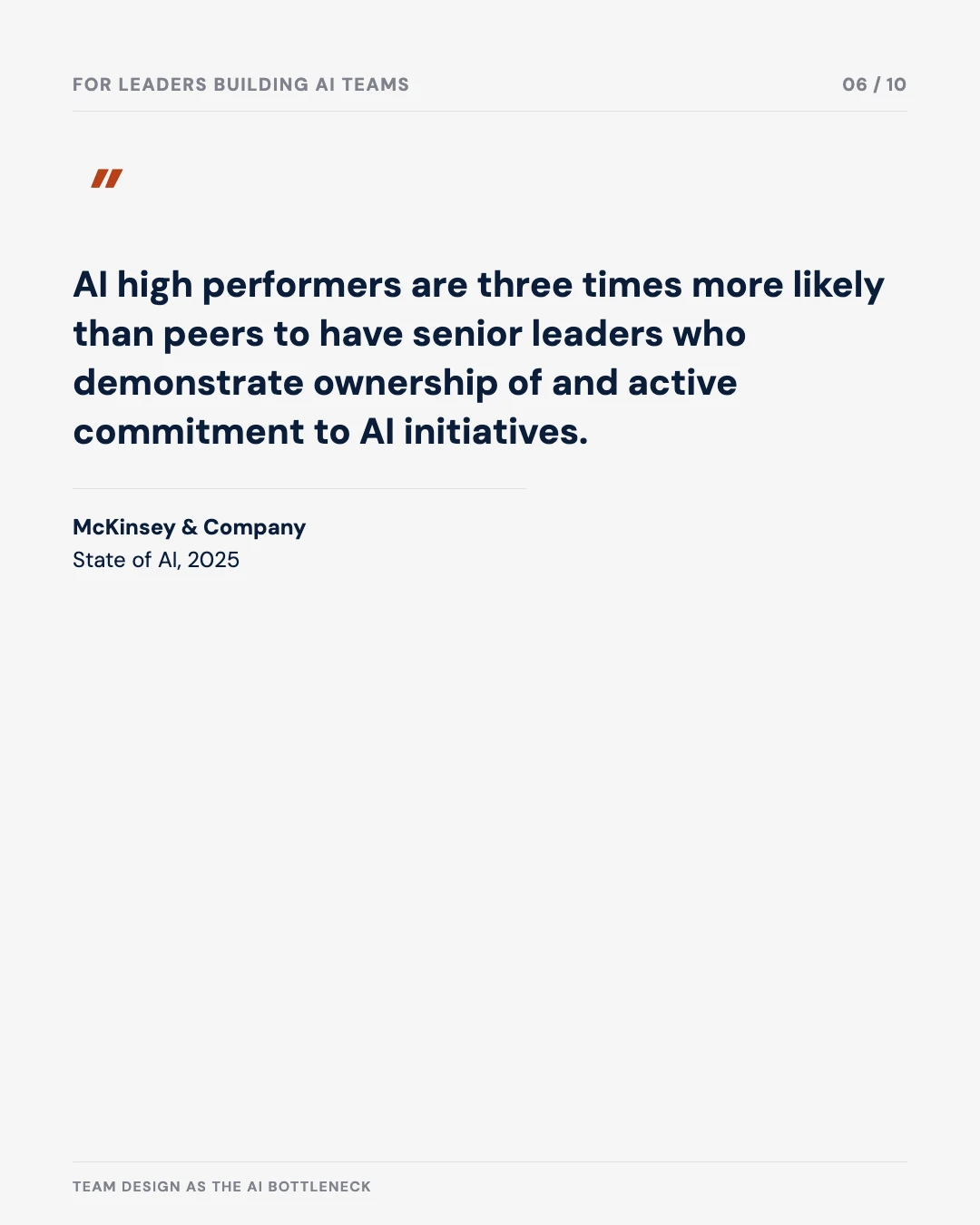
Over 90% of global enterprises are projected to face critical AI skills shortages by 2026, with sustained gaps risking an estimated USD 5.5 trillion in lost global market performance. Meanwhile, 85% of AI projects fail to deliver business value due to poor alignment between business goals and technical execution. McKinsey’s 2025 State of AI survey found that AI high performers are three times more likely than peers to have senior leaders who demonstrate ownership of and active commitment to AI initiatives.
Team composition and leadership sponsorship are the primary determinants of whether AI scales or stalls.
The Roles You Must Have
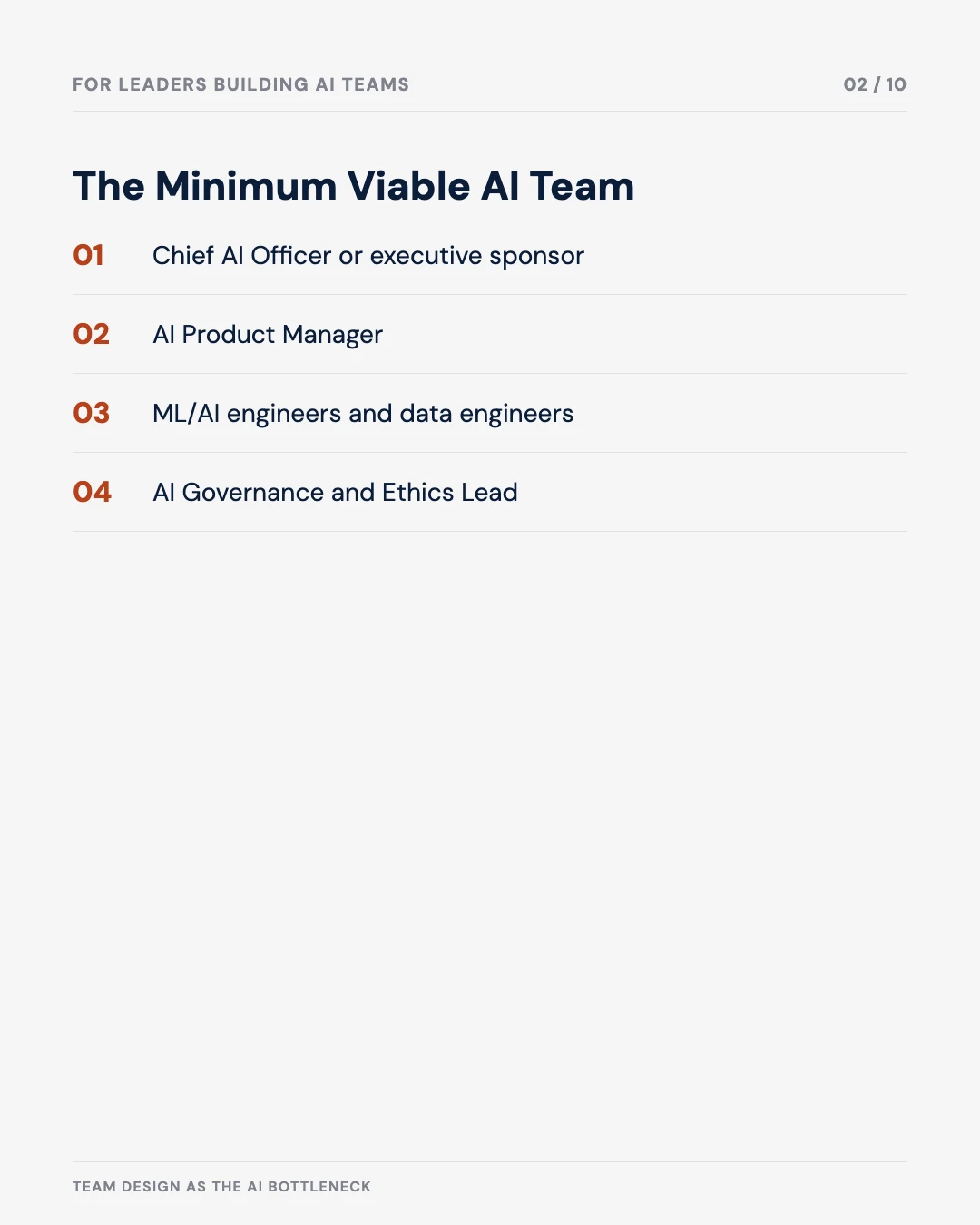
An effective AI team is not a monolithic engineering squad. It is a multidisciplinary unit spanning strategy, engineering, data, operations, and governance. The following roles constitute the minimum viable team for any organisation seeking to move beyond experimentation.
Chief AI Officer or Executive Sponsor. The CAIO owns the AI strategy, governance framework, and cross-functional alignment across the enterprise. This role defines the portfolio of AI initiatives, prioritises resources, and ensures AI investments map to measurable business outcomes rather than isolated technical experiments. For organisations without a dedicated CAIO, a C-suite sponsor with direct accountability for AI outcomes serves the same structural function. Without this executive-level ownership, AI programmes lack the authority to drive workflow redesign, secure sustained funding, and enforce governance standards.
AI Product Manager. The AI Product Manager translates business objectives into prioritised AI use cases and owns the product lifecycle from ideation through deployment and iteration. This role coordinates between engineering, data, and business stakeholders to ensure that what is built is what the organisation actually needs. Critically, this should be the first hire alongside an AI engineer, as it anchors the team around value delivery rather than technical exploration.
ML/AI Engineers. ML Engineers design, train, optimise, and deploy models into production environments. In 2026, the market is shifting demand toward applied ML engineers who can work closely with product and engineering teams, deploy and maintain models in production, and balance technical trade-offs with business impact. Pure research profiles are declining in demand; the premium is on engineers who can ship, iterate, and operate.
Data Engineers. Data engineers build and maintain the pipelines, storage, and integration layers that feed AI models with high-quality, governed data. Without reliable data infrastructure, every downstream model is compromised. Data engineering is foundational. It should be established before scaling model development.
Data Scientists. Data scientists perform exploratory analysis, feature engineering, and statistical modelling to identify patterns and validate hypotheses. Their value is highest when paired with domain experts who can ground analytical findings in operational reality.
MLOps / LLMOps Engineers. MLOps has shifted from a “nice to have” to a core differentiator. These engineers build repeatable CI/CD pipelines, monitoring, model versioning, incident response, and retraining infrastructure to ensure models behave predictably in production. As organisations scale from one model to dozens, MLOps capacity directly determines operational reliability.
AI Solutions Architect. The AI Architect designs the end-to-end system architecture, integrating models, APIs, data platforms, cloud infrastructure, and enterprise IT, into a coherent, scalable, and secure technical estate. For complex deployments involving digital twins, IoT, or multi-system integration, this role is non-negotiable.
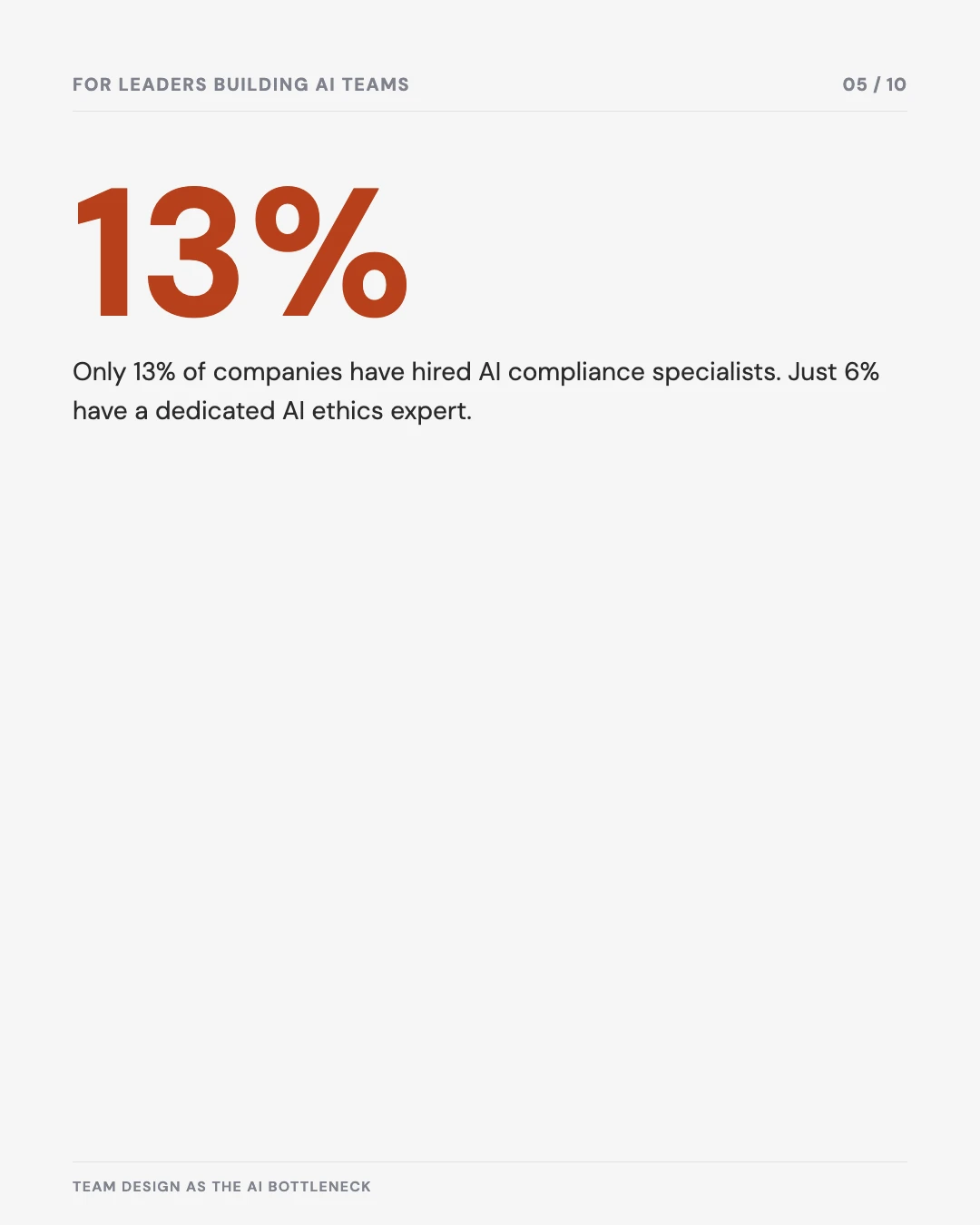
AI Governance and Ethics Lead. Only 13% of companies have hired AI compliance specialists, and just 6% have dedicated AI ethics experts. Yet regulatory pressure, from the EU AI Act to NIST frameworks, is intensifying. This role establishes ethical AI principles, conducts bias assessments, manages risk, and ensures compliance with evolving regulation. Once that role exists, these are the four dashboards it should actually be running. Critically, this role must report to the executive level with actual authority to pause deployments, not merely advise.
The Talent That Accelerates Everything
Beyond the core roles, certain talent archetypes disproportionately accelerate time-to-value. These are the force multipliers.
The AI Translator. McKinsey identified the “analytics translator” as a critical role years ago, and its importance has only grown. The AI Translator sits at the intersection of business domain expertise, technical platform knowledge, and organisational change management. Their function is to convert business pain points into technical requirements and translate technical constraints into business decisions. Organisations that lack this translation layer remain trapped in what practitioners call “pilot purgatory”.
Domain Experts with AI Literacy. Technical teams that operate without embedded domain expertise consistently build solutions optimised for the wrong metrics. Domain experts, whether in urban operations, energy systems, healthcare, or finance, who possess working AI literacy can validate use cases, interpret model outputs, and drive adoption at the operational level.
Prompt Engineers and LLM Specialists. As foundation models become central to enterprise workflows, prompt engineers who can design, test, and refine model behaviour for specific operational contexts are increasingly critical. The discipline underneath that title is worth understanding even if you never hire for it: why prompt engineering still matters. This role is especially relevant for organisations deploying generative AI in customer-facing or decision-support applications.
Strategic Thinkers and Critical Reasoners. A Fortune 500 survey found that AI is exposing not merely a lack of technical skills but a critical thinking gap across organisations. The most valuable team members in 2026 are those who can exercise judgement under ambiguity, make decisions with incomplete information, and communicate trade-offs to non-technical stakeholders.
The Build, Borrow, Upskill Framework
No organisation can hire its way out of the AI talent gap. The most effective strategy combines three approaches:
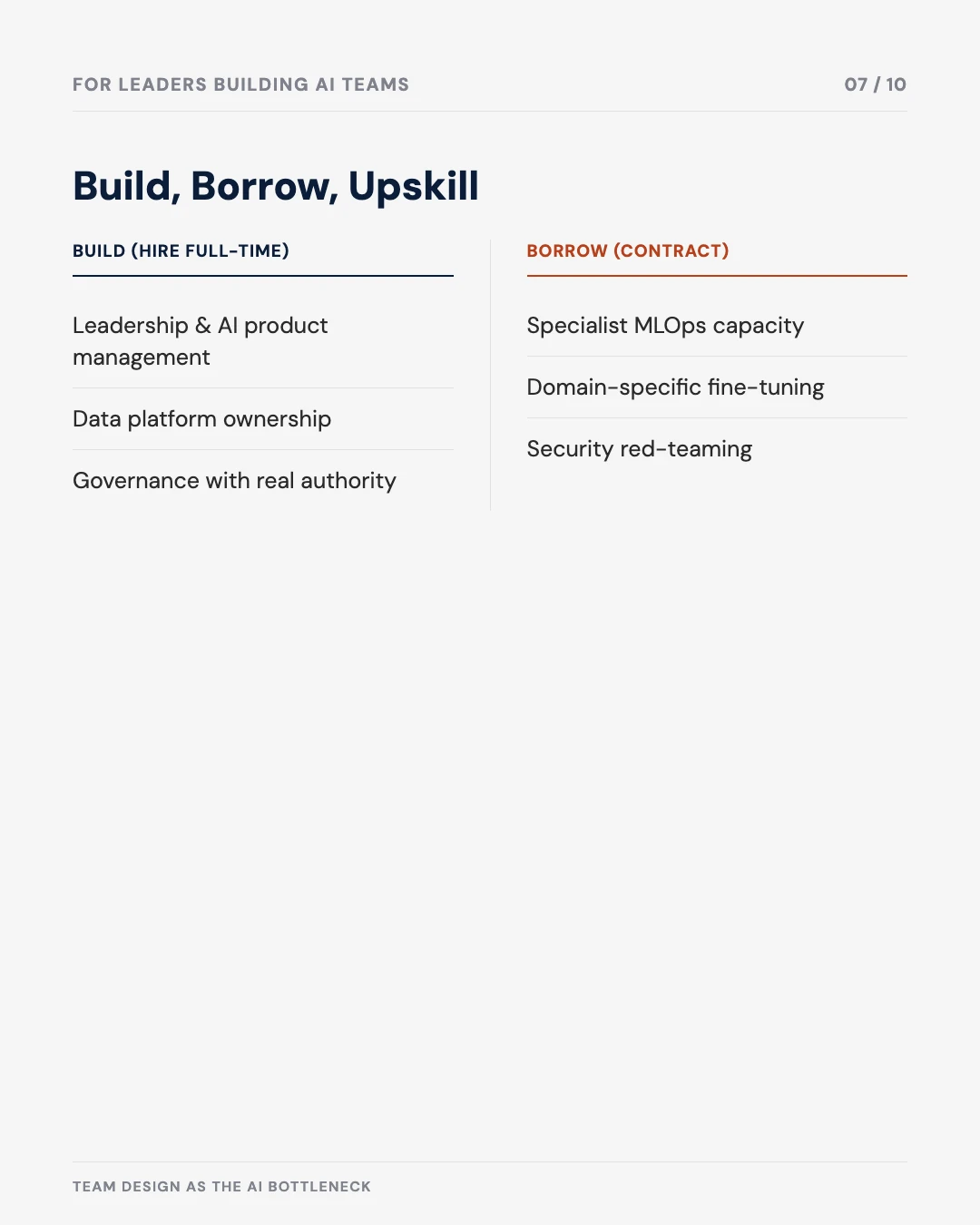
- Build (hire full-time): Leadership roles, AI product management, data platform ownership, and governance: roles requiring long-term institutional knowledge and strategic continuity.
- Borrow (contract or augment): Niche specialisations tied to speed, variable workloads, or specific project phases: specialist MLOps, domain-specific fine-tuning, or security red-teaming.
- Upskill (train existing staff): Internal AI academies that convert data analysts into RAG engineers, business analysts into AI workflow designers, and operations teams into model operators. EY research in Singapore found that employees receiving over 81 hours of annual AI training reported a productivity gain of 15 hours per week, well above the median of six hours.
McKinsey recommends a tiered upskilling model: leaders, builders, domain experts, and the broader workforce, each with differentiated skill paths and expectations.
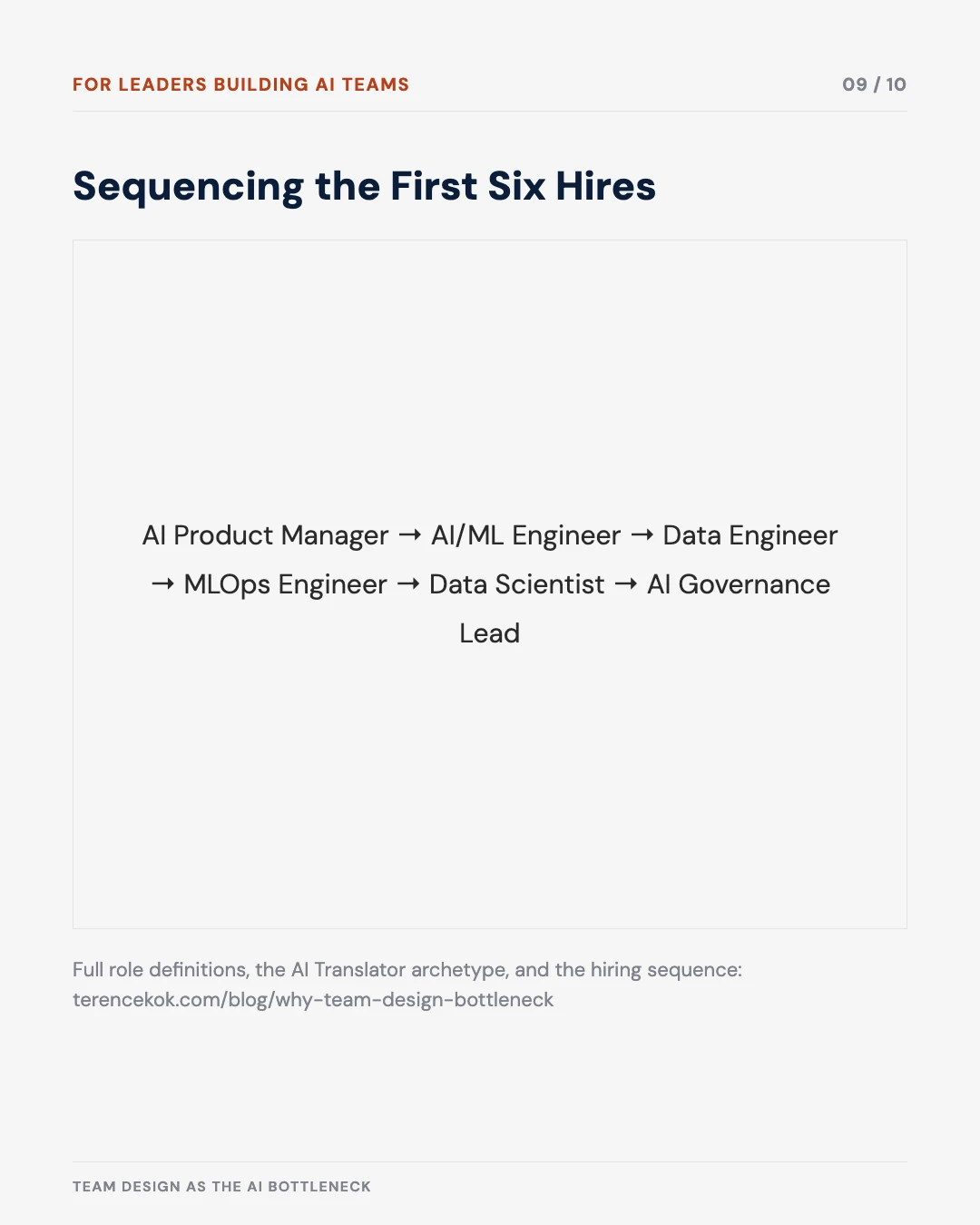
Sequencing the First Hires
For organisations beginning their AI journey, the evidence suggests a clear sequencing:
- AI Product Manager: anchors the team around business value and use-case prioritisation.
- AI/ML Engineer: builds and deploys the first models.
- Data Engineer: ensures data infrastructure is production-grade.
- MLOps Engineer: operationalises models with monitoring and retraining pipelines.
- Data Scientist: deepens analytical capability once the data foundation is stable.
- AI Governance Lead: formalises risk management and compliance as deployments scale.
The AI Translator and domain experts should be embedded from the outset, whether as dedicated hires or as allocated capacity from existing business units.
What Separates the Top 6%
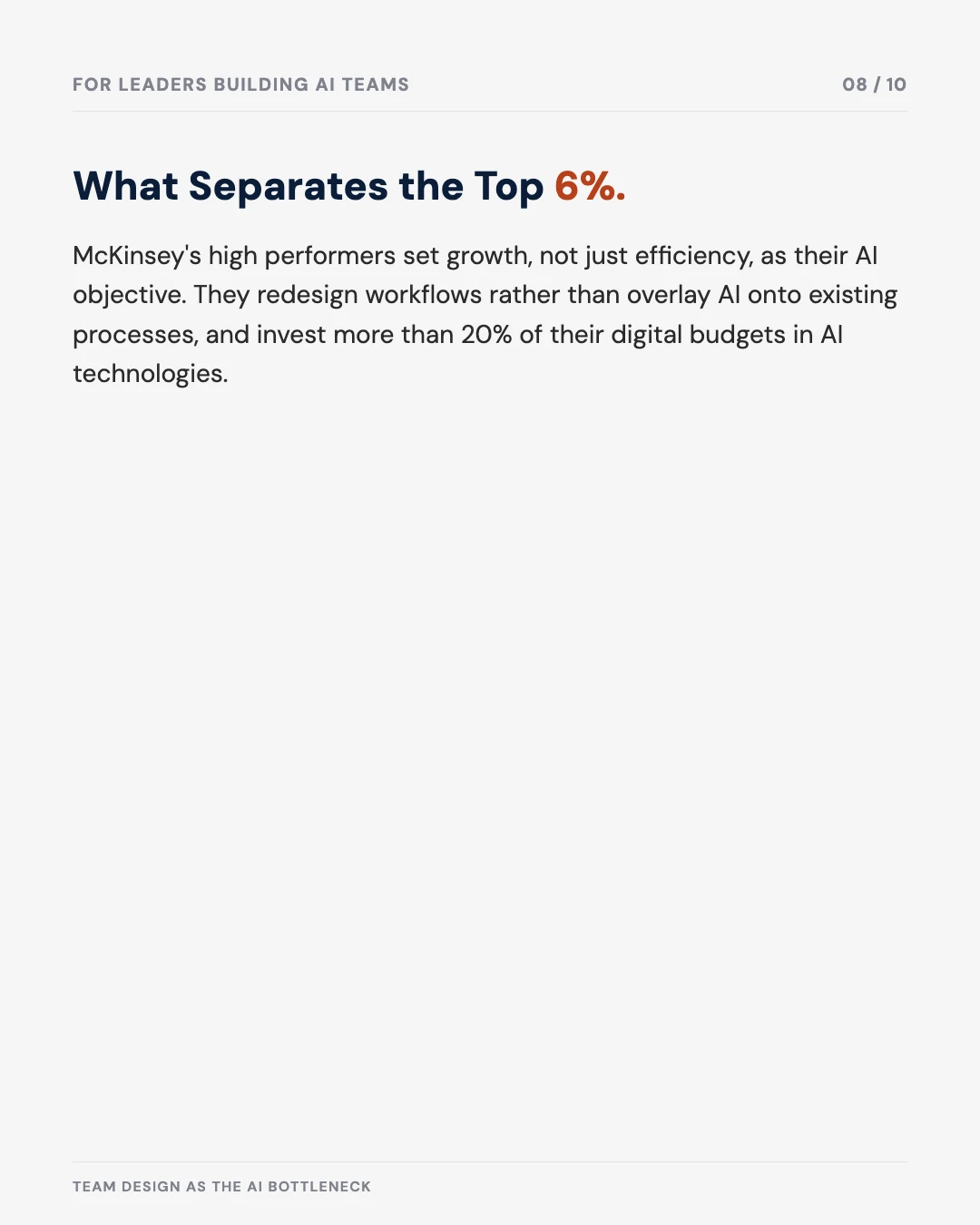
McKinsey’s high performers share a consistent pattern: they set growth and innovation (not just efficiency) as AI objectives, fundamentally redesign workflows rather than overlay AI onto existing processes, and invest more than 20% of their digital budgets in AI technologies.
These are team-design decisions as much as strategic ones. The organisations pulling ahead are those that treat AI team architecture as a first-order operating model decision, not a hiring exercise.
The organisations pulling ahead treat AI team architecture as a first-order operating model decision, not a hiring exercise.
Sources: McKinsey & Company, “The State of AI in 2025”; EY, Singapore workforce AI-training research; Fortune 500 survey, cited in article.
Was this useful?