
Listen to this article
Executive Summary
AI projects fail on organisational alignment far more often than on technology. User adoption, not algorithmic sophistication, is the strongest predictor of whether an AI deployment survives past the pilot stage.
Core conclusions
- The pattern is consistent across cases: AI succeeds when subject-matter experts and frontline operators define the problem it should solve, and fails when technology teams design solutions in isolation from the people who’ll use them.
- Reversing the sequence, starting from a genuine operational problem rather than “which AI tool should we use,” is what separates organisations that scale from those stuck in pilot programmes.
- Technology teams’ role shifts from deciding what the organisation needs to enabling domain experts: accessible infrastructure, embedded governance, unified data foundations, and translation between business outcomes and technical capability.
The argument, in ten slides
Save it, share it, or send it to whoever owns your next AI rollout.
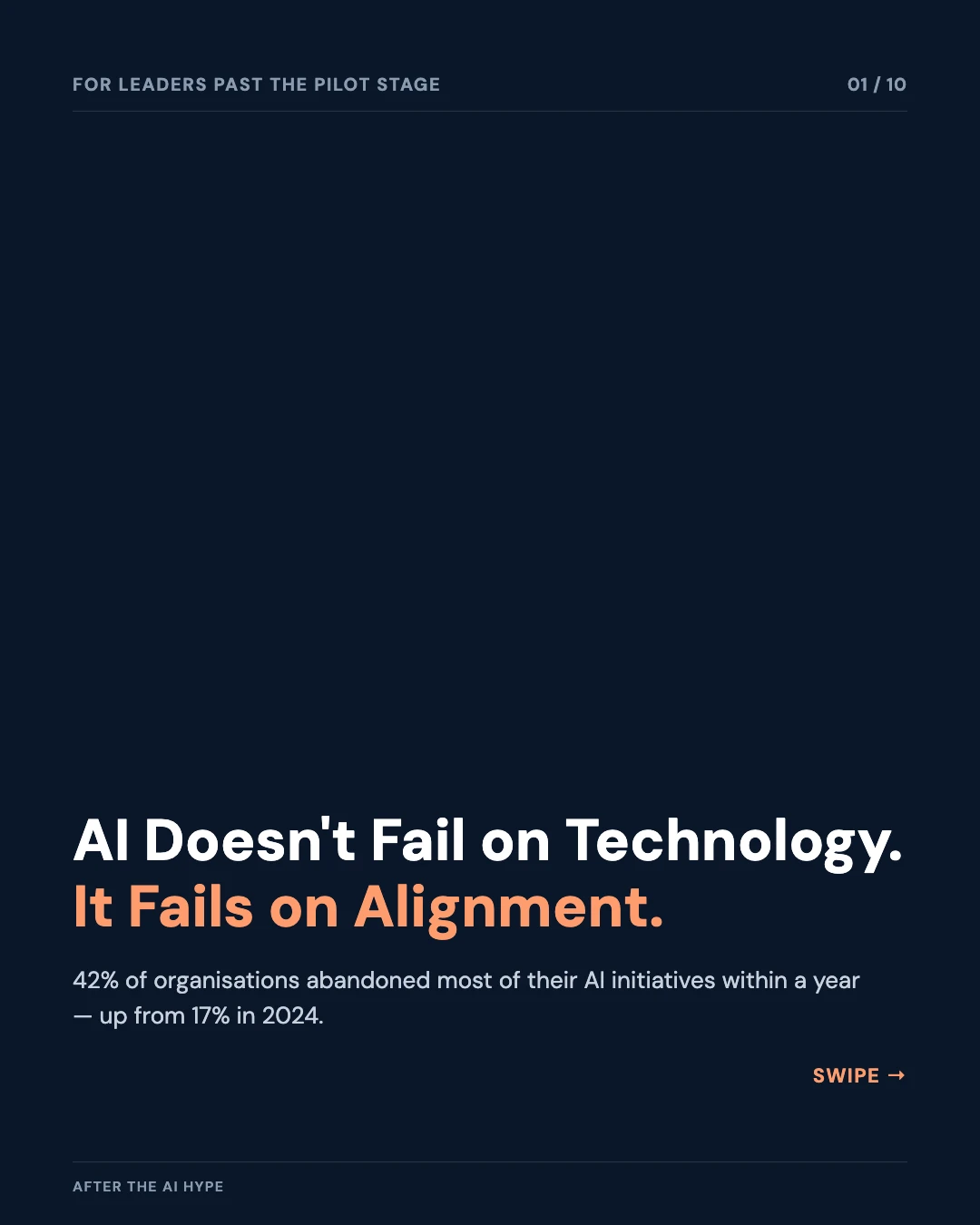
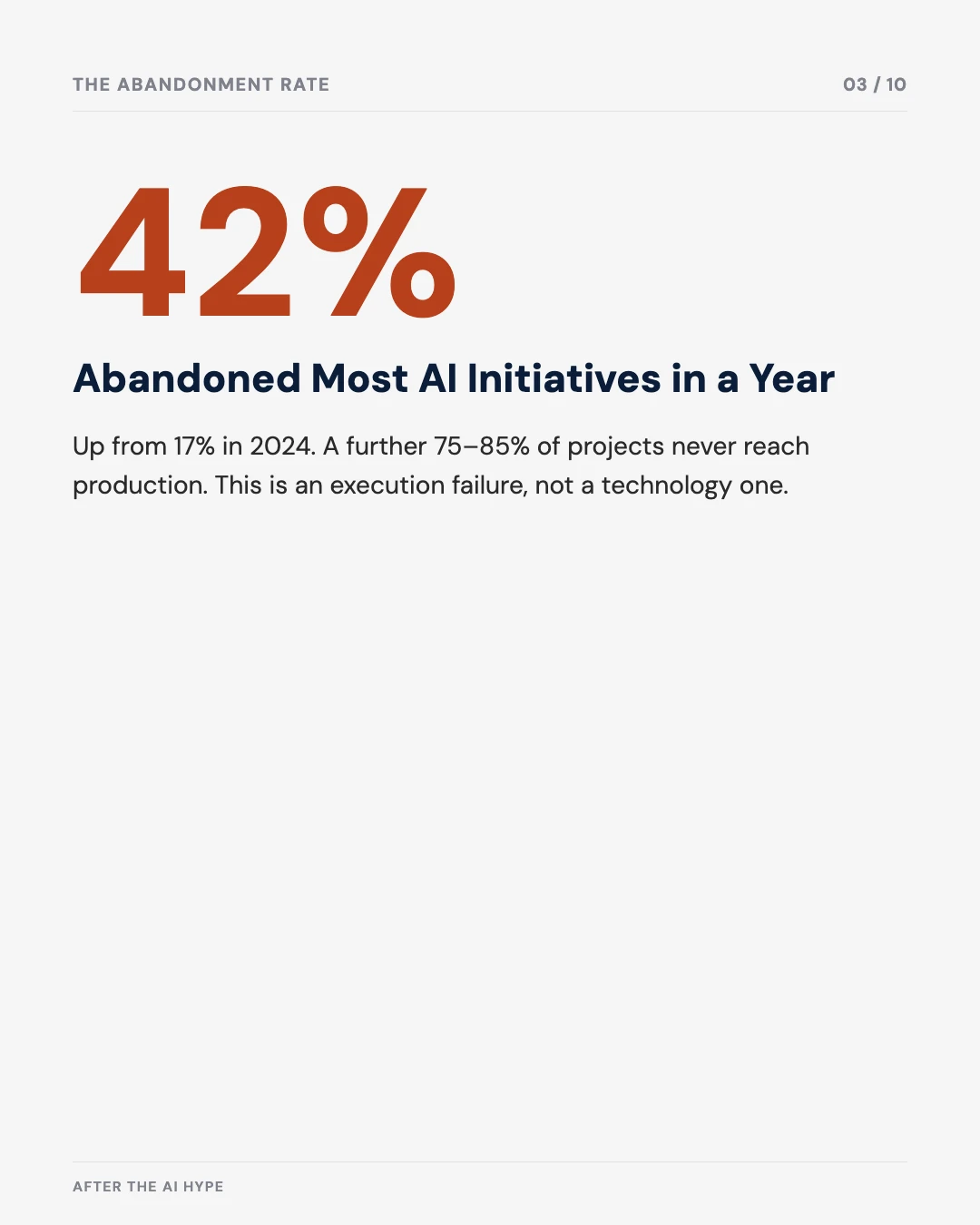
For eighteen months, we watched enterprise AI initiatives proliferate. Millions flowed into vendor products, consultancy engagements, proof-of-concepts, and pilot programmes. The promises were extraordinary: automation at scale, predictive intelligence embedded across operations, competitive differentiation. Yet data from 2025 reveals the sobering reality: 42% of organisations abandoned most of their AI initiatives within a single year, up from 17% in 2024. A further 75 to 85% of projects never reach production. MIT research confirms this is not a technological failure; it is an execution failure rooted in organisational misalignment — I go through the specific failure patterns behind that number elsewhere.
The pattern has become unmistakable. AI succeeds when it solves genuine operational problems for the people who must use it daily. AI fails when technology teams design solutions in isolation, when business leadership and technology are disconnected, and when the organisation treats implementation as a technical exercise rather than a sociotechnical transformation.
The operational insight that separates successful organisations from those stranded in pilot programmes is straightforward: put subject-matter experts and frontline operators in charge of identifying which problems AI should solve, and position technology teams to build the infrastructure that enables those decisions.
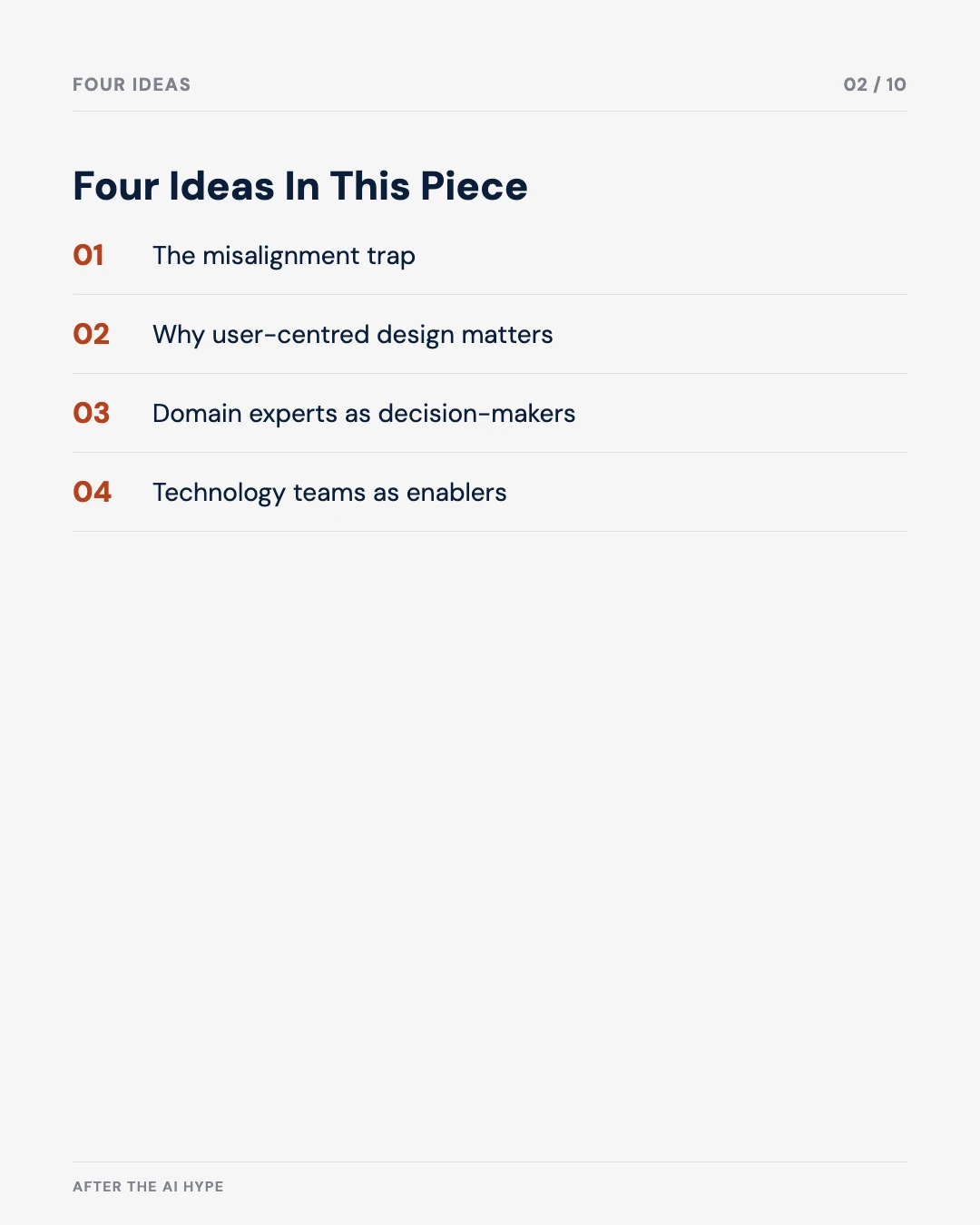
The Misalignment Trap
Most organisations treat AI as a technology problem rather than an alignment problem. When deployment begins, three stakeholder groups (CEO, HR, and Finance) each hold different, often unspoken definitions of success. Without a pre-negotiated agreement on these definitions, every unexpected AI behaviour becomes a political conflict, and the project collapses even when the technology works.
This dynamic repeats across the enterprise. Data scientists celebrate a model achieving 94% accuracy in the demo environment. Finance cannot answer whether the system produces measurable ROI because baseline metrics were never established. Operations cannot explain why staff are quietly sabotaging the system, because no one aligned incentives before deployment. 54% of executives cite cultural resistance as the primary barrier to AI adoption. What they are describing is the absence of alignment, not the absence of capability.
What they are describing is the absence of alignment, not the absence of capability.
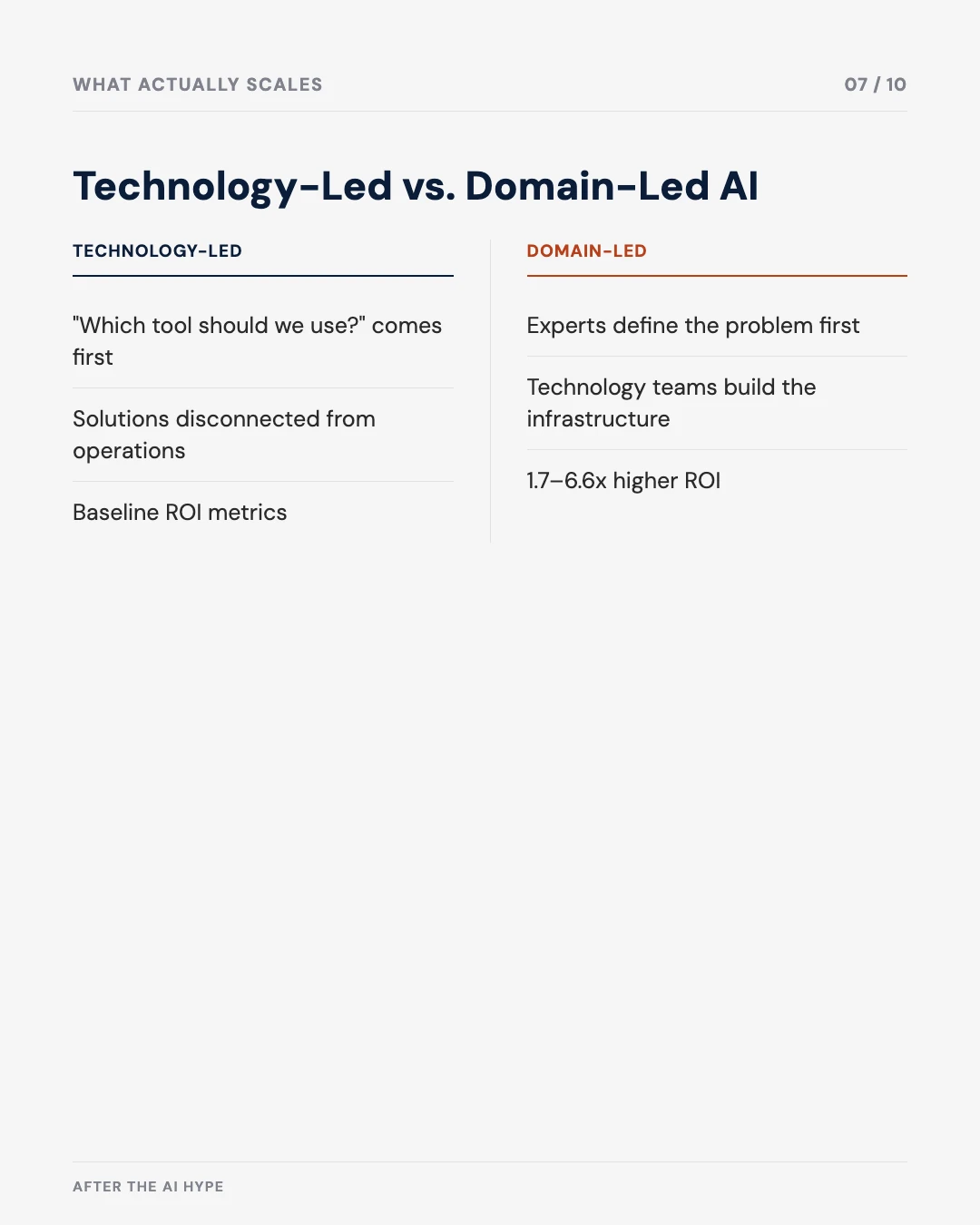
The deeper problem emerges when technology teams lead the discovery process. The question “Which AI tool should we use?” precedes any understanding of the business problem. This technology-first approach is the single largest driver of AI project failures. It results in misaligned investments, wasted resources, and solutions disconnected from core operational requirements.
Why User-Centred Design Matters
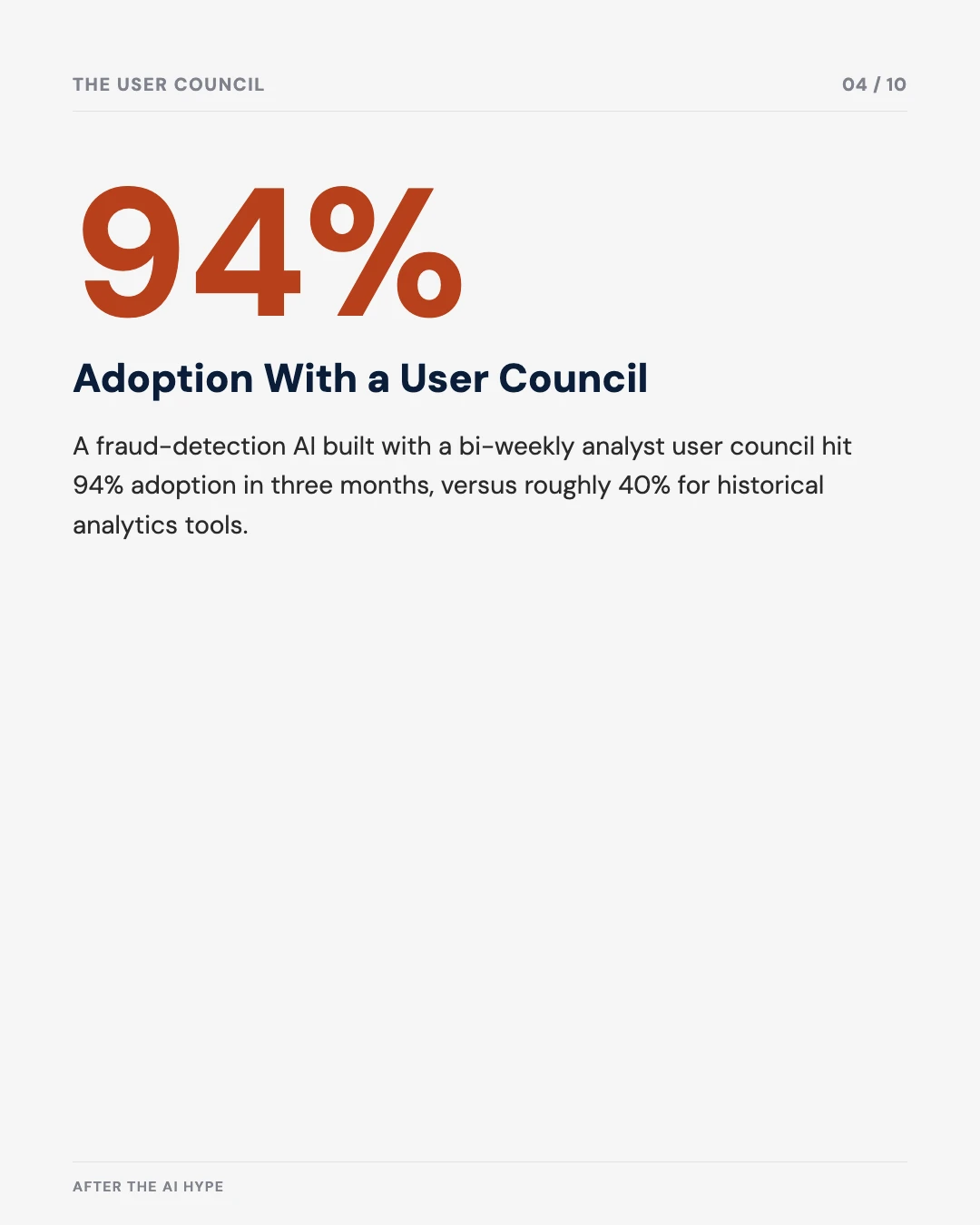
When organisations reverse this sequence, beginning with genuine operational problems and working backwards to technology, adoption rates transform. A financial services organisation developing fraud detection AI established a “user council” comprising fraud analysts from operations. This council met bi-weekly throughout development, providing immediate feedback on interface design, alert structures, and workflow integration. Adoption within three months reached 94% compared to historical analytics tools that typically struggled to reach 40%.
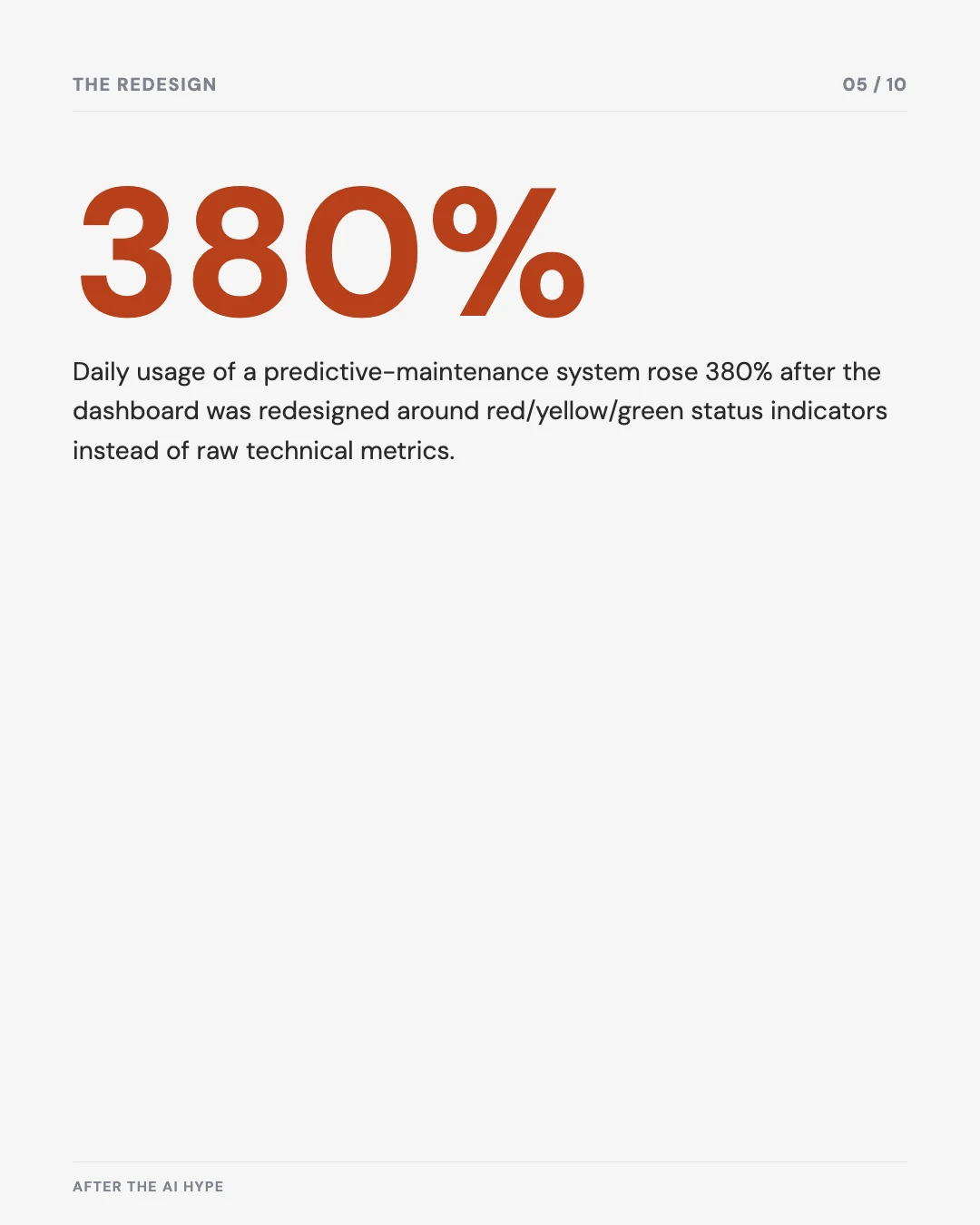
A manufacturing company implementing predictive maintenance AI initially deployed a dashboard filled with technical metrics and probability scores. When adoption stalled, they redesigned the interface to present red/yellow/green status indicators backed by deeper analytics that maintenance teams could access when needed. Daily system usage increased 380%, and maintenance outcomes improved measurably.
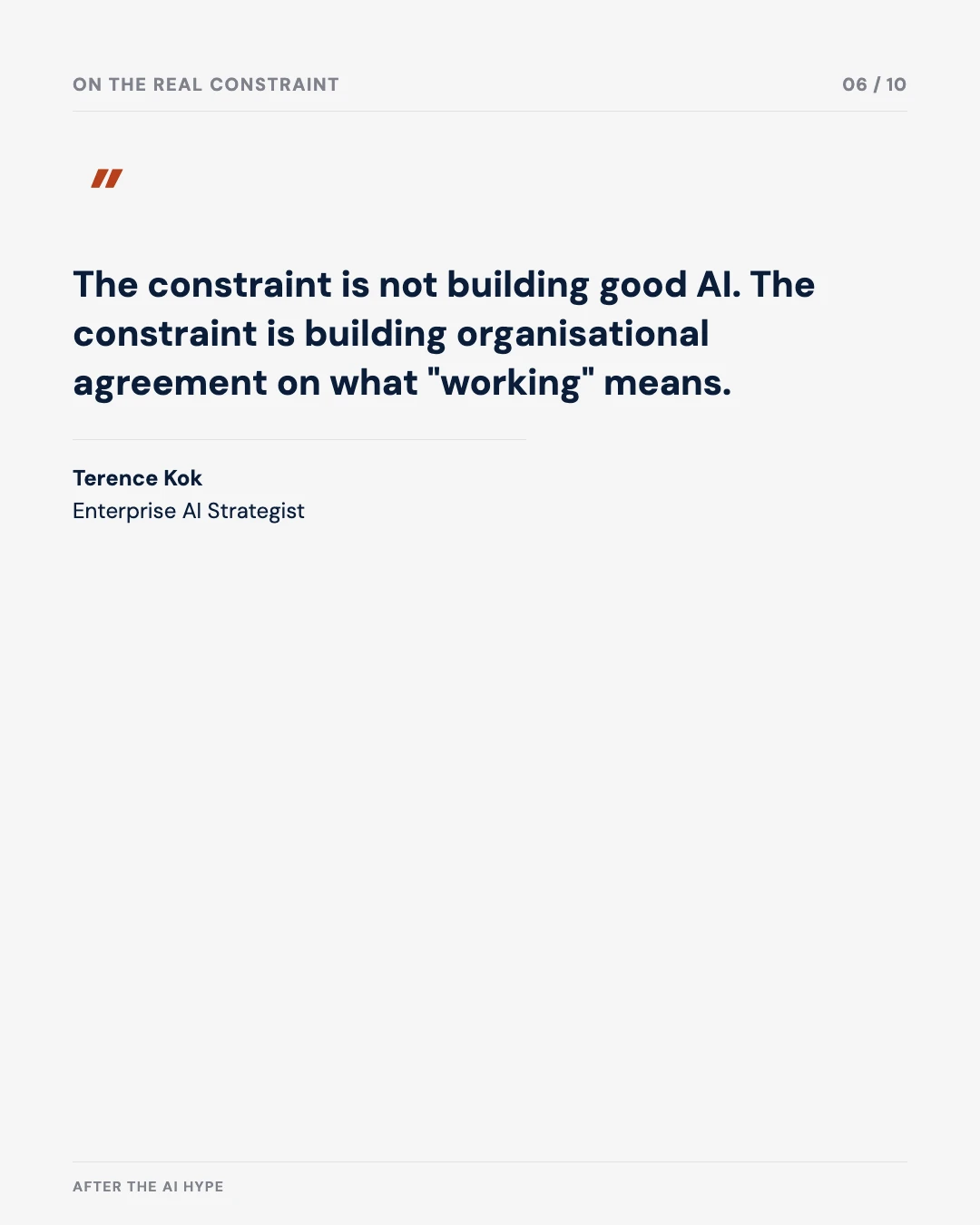
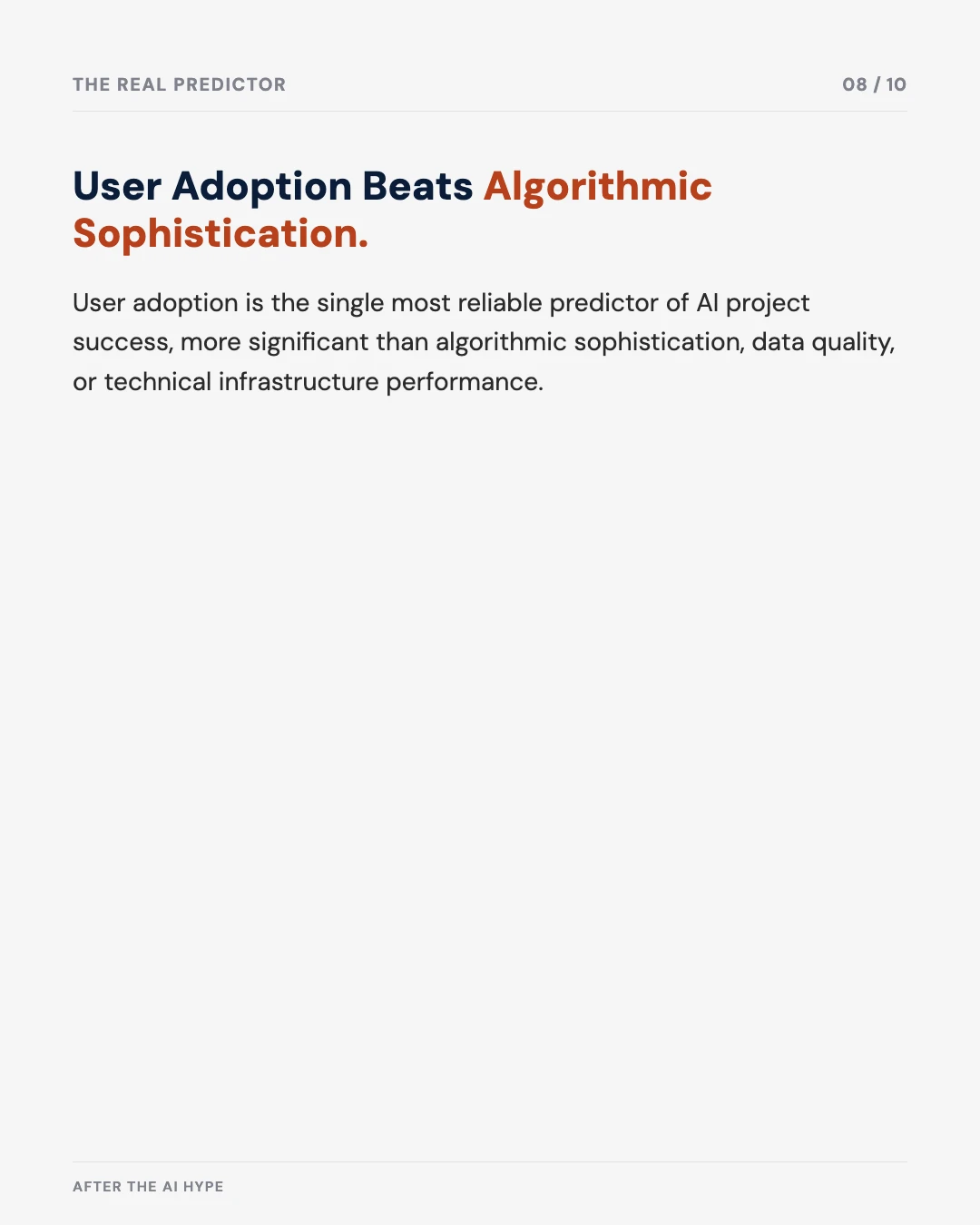
These cases illustrate a critical finding: user adoption is the single most reliable predictor of AI project success, more significant than algorithmic sophistication, data quality, or technical infrastructure performance. The constraint is not building good AI. The constraint is building organisational agreement on what “working” means and proving that the system consistently delivers that outcome.
The constraint is not building good AI. The constraint is building organisational agreement on what “working” means.
Domain Experts as Decision-Makers
Subject matter experts possess irreplaceable insight into the nuances, constraints, and operational realities of their domains. A healthcare organisation developing clinical decision support began not with algorithmic innovation but by shadowing physicians and identifying their most pressing daily pain point: documentation burden consuming 38% of clinical time. This insight redirected the AI focus from exotic diagnostic capabilities to mundane but operationally valuable workflow automation, a solution physicians voluntarily adopted because it addressed their genuine constraint.
Domain experts ensure AI solutions remain accurate, relevant, and grounded in field realities. They identify edge cases, ambiguous scenarios, and exceptions that raw data alone cannot capture. They understand safety regulations, resource constraints, real-time processing requirements, and business rules. In machine learning terms, they are your most reliable source of signal in the training data, and your most credible validators of model outputs.
When organisations embed domain experts directly in AI development, innovation accelerates. Organisations with decentralised governance models, where domain experts make core decisions and technology teams provide infrastructure support, report ROI multipliers ranging from 1.7 to 6.6 times those of technology-led models. Allegis Group restructured around a centralised Data Science Hub, using a hub-and-spoke model that positioned business-unit experts as decision-makers, supported by data scientists and engineers. This approach enabled rapid scaling across the organisation without replicating specialised technical teams in every function.
Technology Teams as Enablers
This repositioning requires a fundamental shift in how technology teams view their role. Rather than defining what the organisation needs, technology teams become infrastructure providers and enablers of expert decision-making.
Successful technology teams in this model accomplish four specific objectives:
First, they establish accessible infrastructure. Platform engineering approaches treat developers and domain experts as customers. Rather than requiring operators to master cloud architecture, containerisation, or data-pipeline orchestration, platforms abstract away complexity through self-service interfaces. Intelligent internal developer platforms (IDPs) embed AI-assisted guidance, policy enforcement, and automated provisioning, removing barriers between an expert’s insight and operational deployment.
Second, they embed governance into systems. Governance in mature organisations is no longer bolted on after deployment; it is woven into products through built-in policy enforcement, model versioning, explainability by default, and audit-ready logging. Technology teams design these constraints in collaboration with compliance and risk functions, so domain experts operate within guardrails rather than against bureaucratic obstacles.
Third, they maintain unified data foundations. The most frequent cause of AI project failure in Asia-Pacific is fragmented data across on-premises infrastructure, multiple cloud platforms, and edge networks. Technology teams that bridge these silos enable domain experts to develop AI solutions without first addressing foundational data engineering challenges. Clean, connected, accessible data infrastructure is non-negotiable; it is the foundation on which all else depends.
Fourth, they translate between business outcome and technical capability. This role requires technical leaders with three competencies: AI fluency to understand what is technically feasible, strategic thinking to connect capabilities to business objectives, and cross-functional coordination to maintain alignment across business, operations, and technology. These individuals act as the bridge between problem definition and technical delivery, ensuring that solutions remain focused on measurable outcomes rather than technical elegance.
Operational Structure for Scale
Organisations that have successfully scaled AI typically adopt one of two governance patterns:
The decentralised model assigns domain ownership to business units, each with embedded AI capability. A central platform team provides data infrastructure, governance guardrails, and shared ML operations (MLOps) tooling. This approach maximises the number of domain experts involved in investment decisions and directs innovation toward high-impact operational problems. Scale increases because more teams can innovate in parallel, each informed by domain-specific constraints.
The hub-and-spoke model (also described as a Competency Centre of Excellence) maintains a centralised data science and engineering function that works in partnership with domain experts across business units. These partnerships are structured as sustained collaboration rather than project-based consultation. Quarterly evolution workshops allow domain experts to share experiences, collaboratively prioritise enhancements, and own the direction of capability improvement. This approach concentrates specialised talent where it is most scarce whilst distributing decision-making to those who understand operational impact.
Both models require explicit governance. Governance is often misunderstood as a constraint on innovation. In reality, organisations with mature governance frameworks are accelerating AI adoption because governance creates the conditions for confident scaling. Executive ownership of AI governance roles reflects this shift: these individuals are not slowing down decisions but making it possible to scale them across the enterprise with confidence.
The AI hype cycle is receding, giving way to a maturation cycle. Organisations are learning that AI succeeds when subject matter experts drive strategy, define problems, validate solutions, and own outcomes. Technology teams play an essential but supporting role: building the infrastructure, maintaining governance guardrails, bridging data silos, and enabling rapid experimentation without requiring domain experts to become infrastructure specialists.
Free tool
Human-AI Interaction & Decision Quality
Diagnose where the handoff between AI speed and human judgement is breaking down in your own teams.
Was this useful?