

Listen to this article
Jump to a section
In this article
Executive Summary
Singapore SMEs already have well-funded tools and seven government grant instruments; the constraint is the absence of structured alignment between leadership intent, process definition, and execution discipline.
Core conclusions
- Three recurring failure patterns explain most SME AI stalls: leadership misalignment on outcome metrics, the false assumption that data availability rather than process definition is the binding constraint, and tool deployment without role-based training.
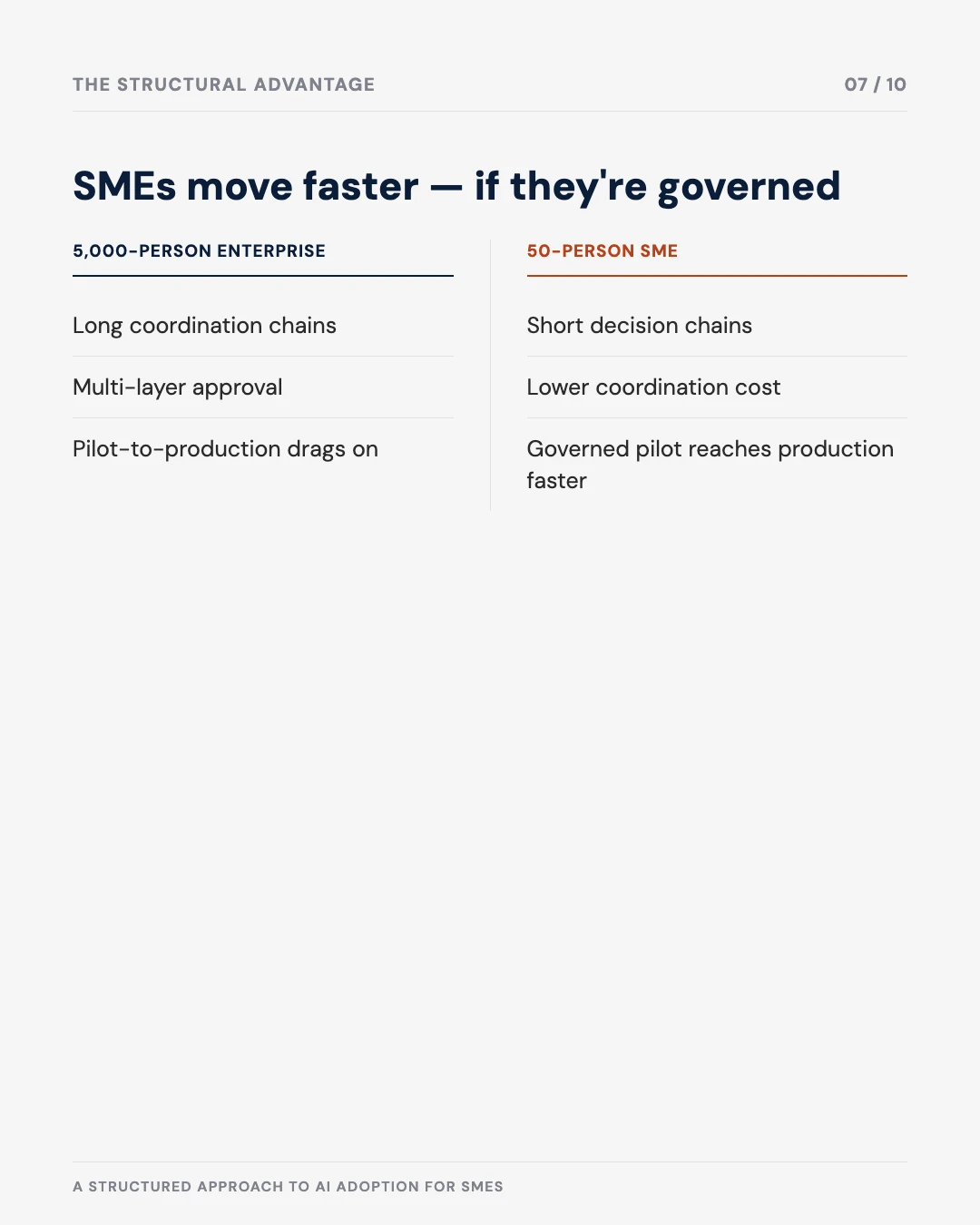
- SMEs have a structural advantage that’s consistently underestimated: shorter decision chains and lower coordination costs mean a well-governed initiative can reach production faster in a 50-person organisation than a 5,000-person enterprise.
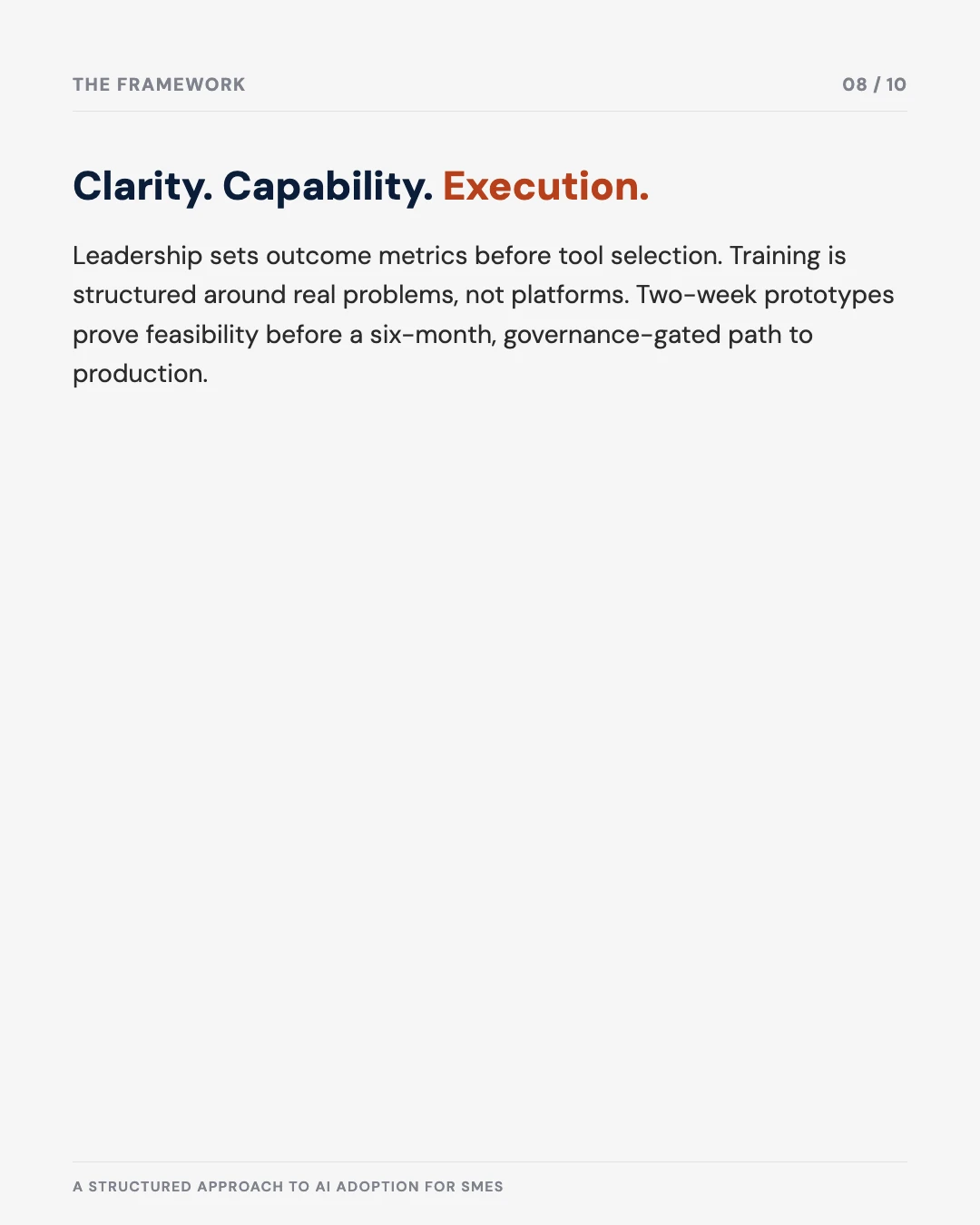
- A three-phase framework converts pilots into production rather than permanent proofs of concept: Clarity (outcome metrics before tool selection), Capability (problem-based training), Execution (two-week prototypes with governed six-month production gates).
The framework, in ten slides
Save it, share it, or send it to whoever owns the grant application.
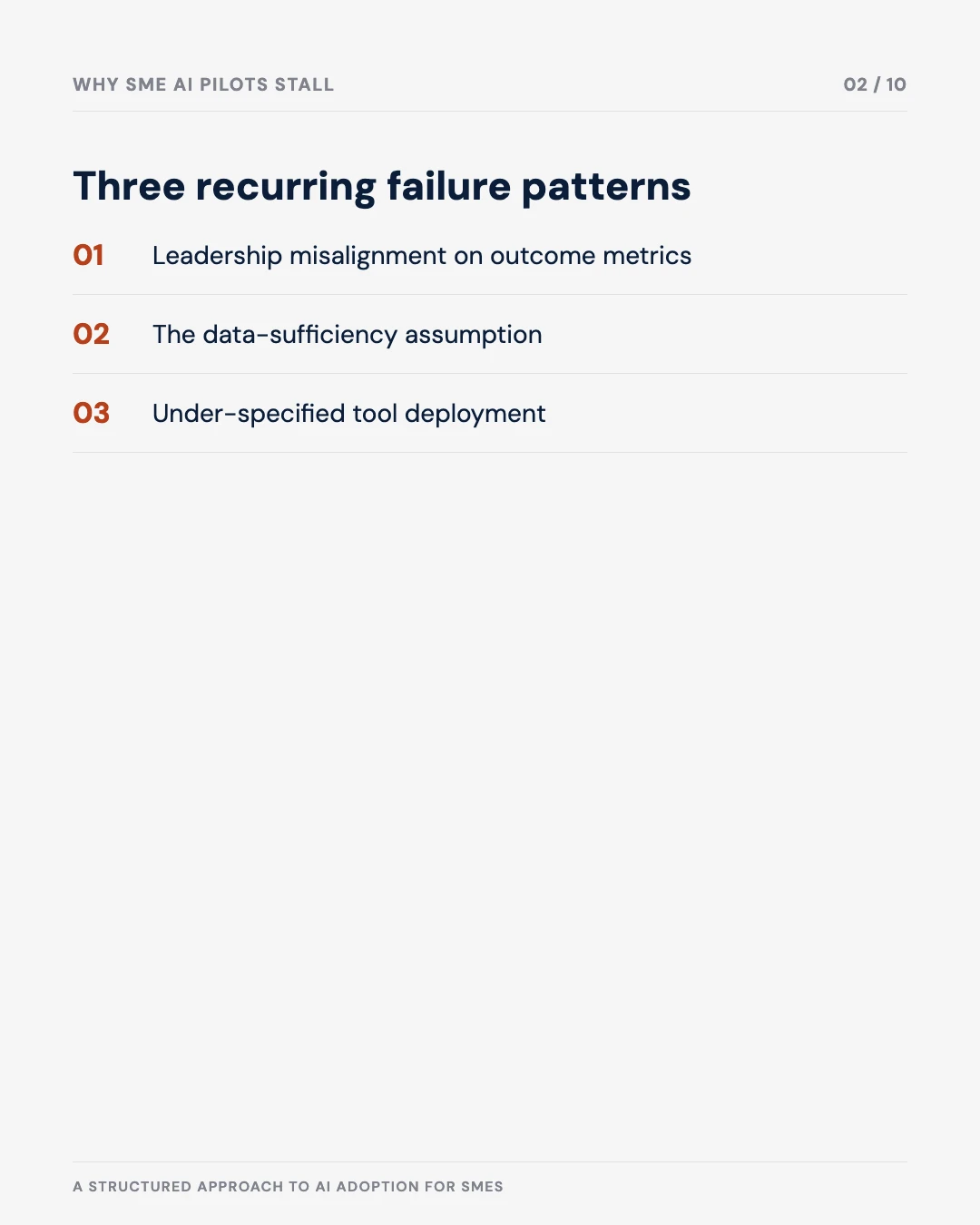
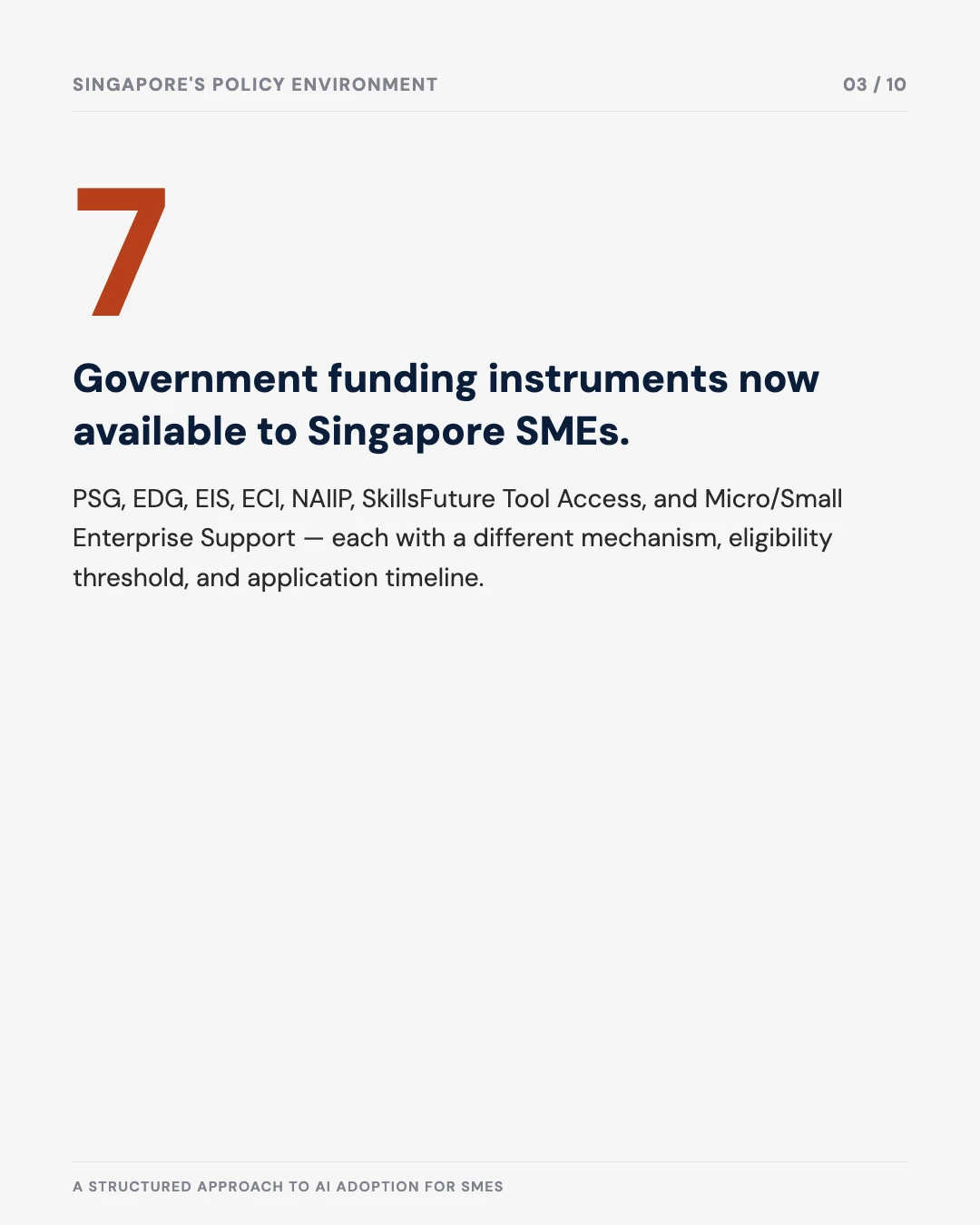
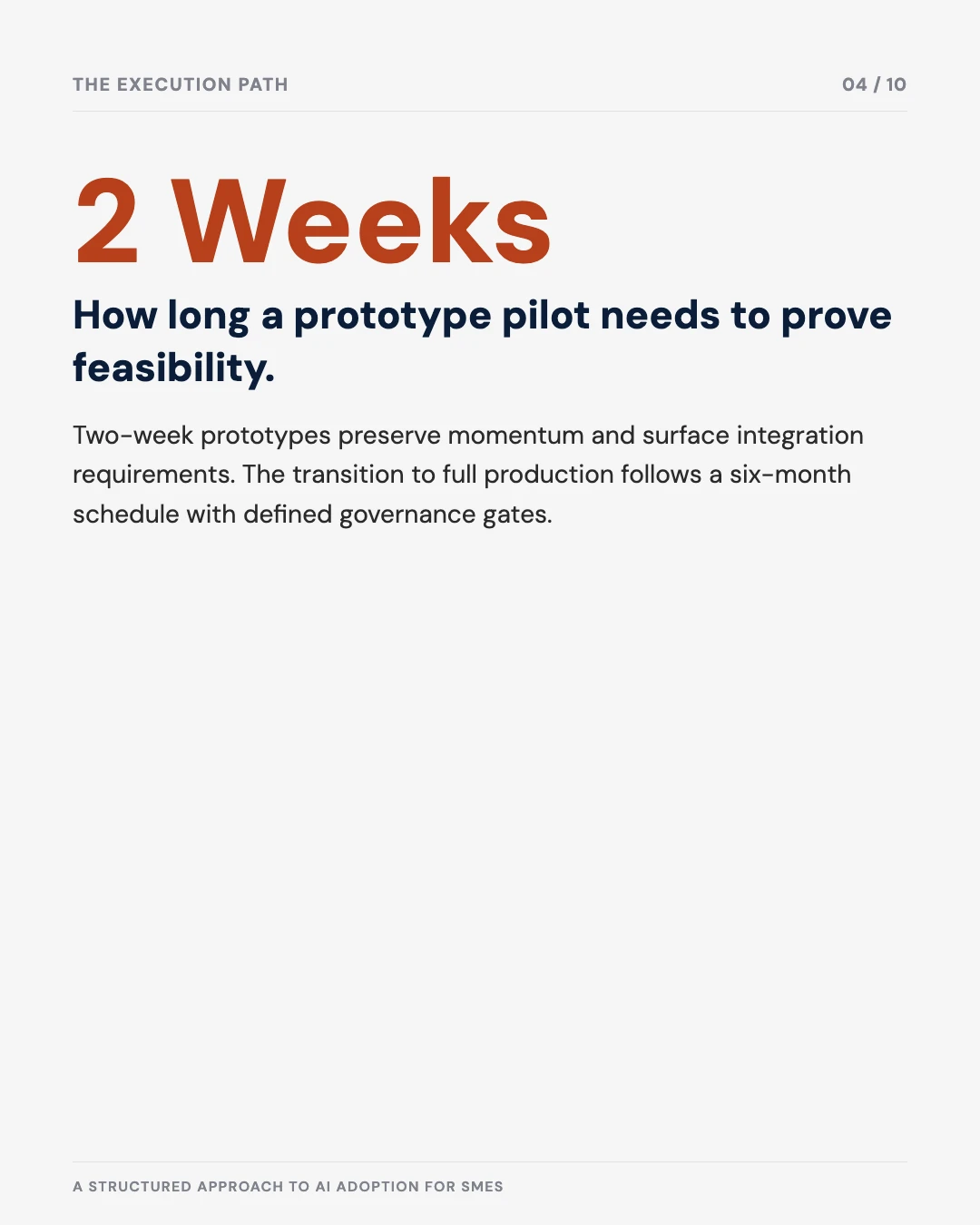
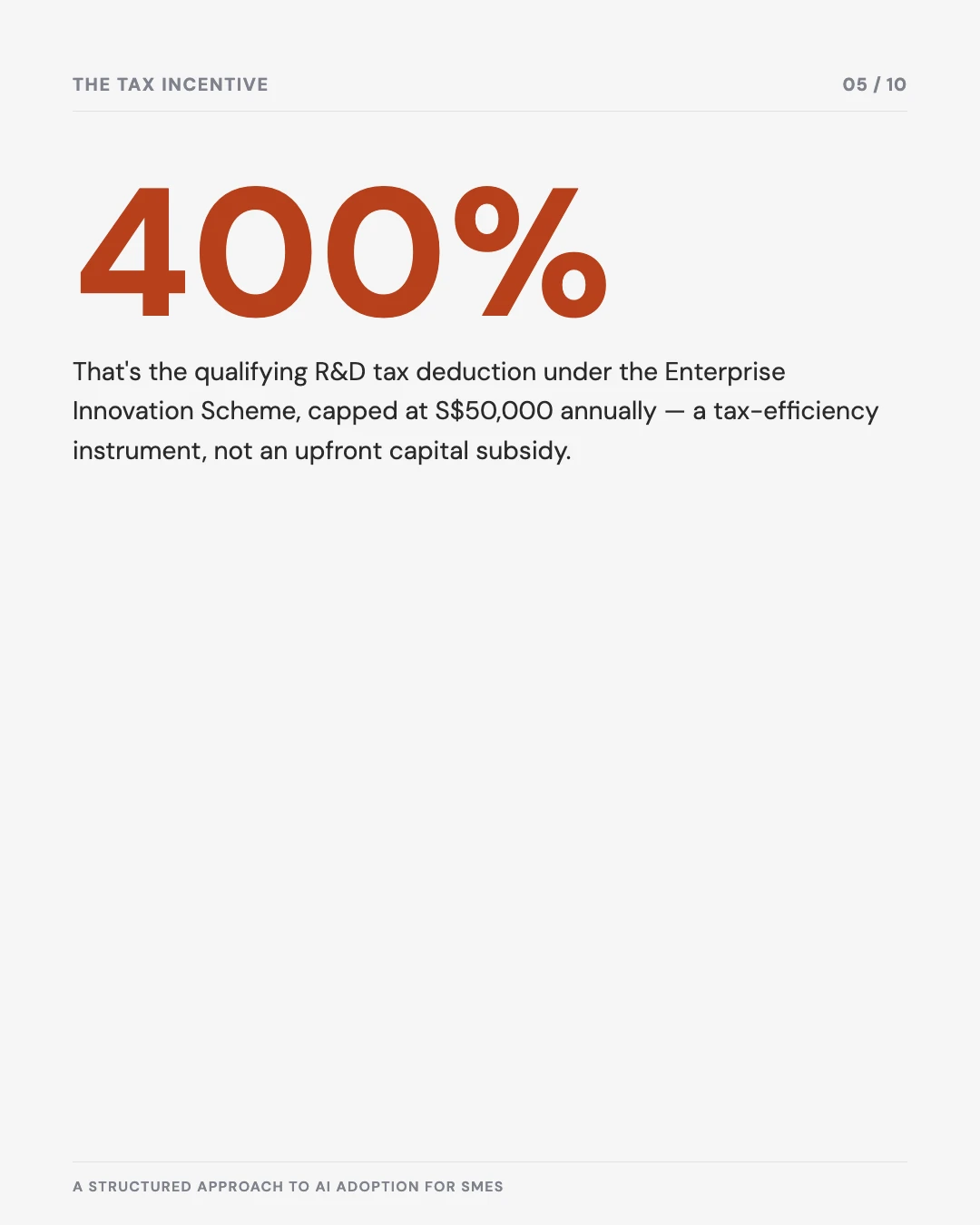
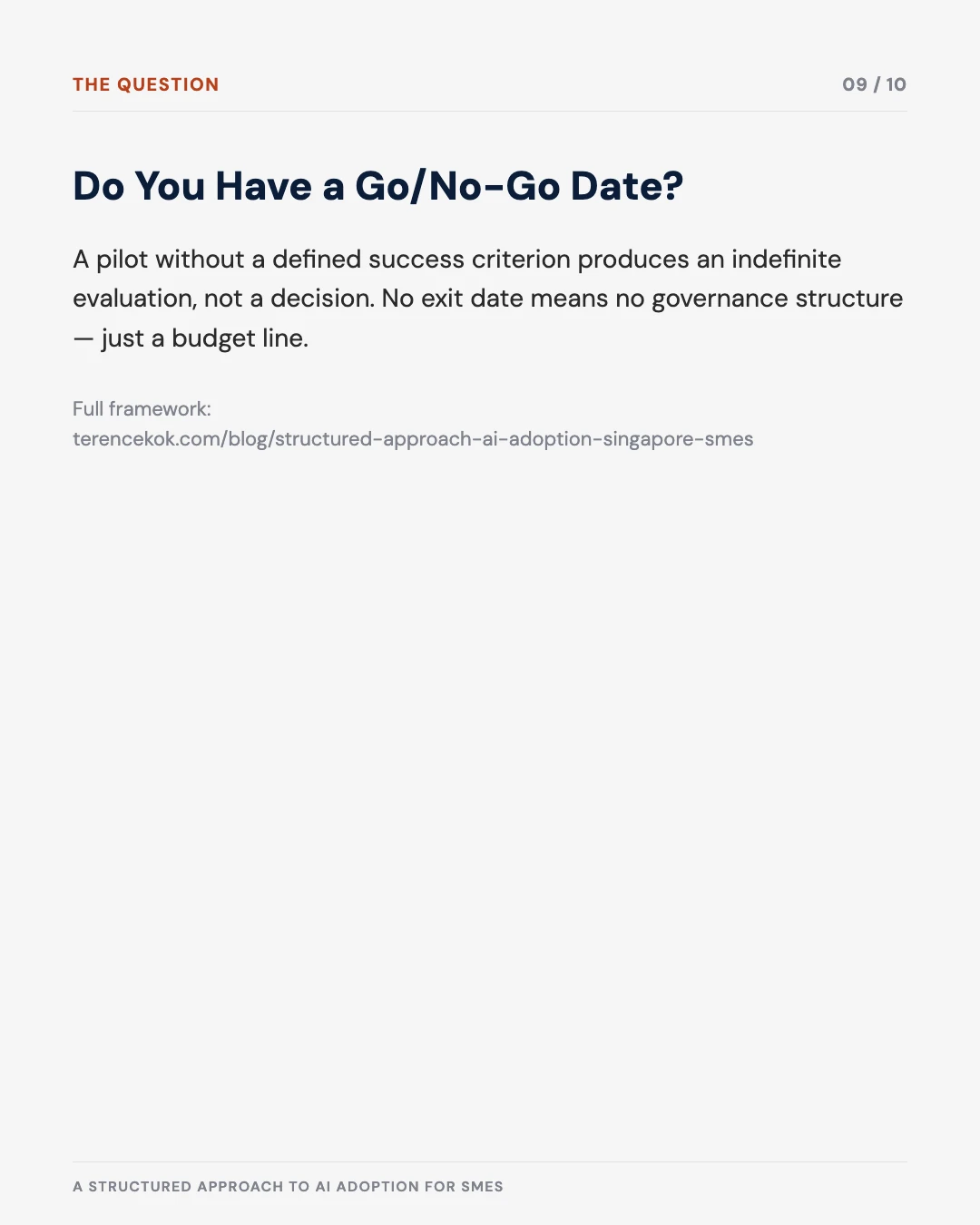
The constraint is not the availability of tools. Singapore SMEs now operate in a policy environment specifically designed to reduce the cost of AI adoption: seven distinct funding instruments, sector-specific training programmes, and compute subsidies that materially lower the barrier to entry. The genuine constraint is the absence of structured alignment among leadership intent, process design, and execution discipline.
SMEs possess a structural advantage that is consistently underestimated. Shorter decision chains and lower coordination costs mean that a well-governed AI initiative can move from pilot to production faster in a 50-person organisation than in a 5,000-person enterprise. The limitation is rarely capability. It is the absence of a framework to convert executive intent into operational outcomes.
The limitation is rarely capability. It is the absence of a framework to convert executive intent into operational outcomes.
Why AI Adoption Fails in SMEs
Three recurring patterns explain the majority of AI adoption failures among SMEs, patterns that are operational.
-
Leadership misalignment. Executives, finance, and operations teams pursue divergent objectives without coordinated outcome metrics. When AI initiatives begin without agreement on what success looks like across functions, they generate activity without accountability. Pilots continue indefinitely. Costs accumulate. Declared outcomes are not defined precisely enough to be verified.
-
The data-sufficiency assumption. Organisations consistently overestimate the importance of data availability and underestimate the impact of unstandardised process definitions and inconsistent data structures. Data volume is rarely the binding constraint. The more common failure is that processes have not been defined with sufficient precision to be automated, and AI deployment exposes that underlying ambiguity.
-
Under-specified tool deployment. Premium AI licences purchased at scale, deployed without role-based training or process integration, produce low-value applications. A sales team using a general AI assistant to draft emails has not adopted AI in any operationally meaningful sense. Process-level optimisation (replacing a decision step, eliminating a coordination bottleneck, automating a reporting cycle) is where commercial return is generated. Tool procurement without use-case specificity does not reach that level.
I go deeper on this execution gap in the video below:
Singapore’s Policy Instruments
Singapore’s policy environment in 2026 provides SMEs with access to a layered set of funding and capability mechanisms. Understanding which instrument applies to which type of initiative is a prerequisite for efficient grant allocation.
- Productivity Solutions Grant (PSG): Up to 50% co-funding for pre-approved, standardised AI solutions. The right instrument when the use case is well-defined and the solution is a certified vendor product.
- Enterprise Development Grant (EDG): 50–70% support for custom AI development tied to defined business problems. Appropriate when the use case requires bespoke configuration or integration work.
- Enterprise Innovation Scheme (EIS): 400% tax deduction on qualifying R&D, capped at S$50,000 annually. A tax efficiency instrument rather than an upfront capital subsidy.
- Enterprise Compute Initiative (ECI): Cloud credits of approximately S$250,000 for compute-intensive workloads. Targeted at model training, inference at scale, or large-volume data processing.
- National AI Impact Programme (NAIIP): Leadership training, sector-specific courses, and adoption grants across 10,000 enterprises. The primary mechanism for building AI literacy at the leadership level.
- SkillsFuture Tool Access: Six months of free premium AI tool access following approved training (H2 2026). Reduces the evaluation cost of enterprise tools for teams completing formal AI capability development.
- Micro and Small Enterprise Support: S$10 million initiative with bank financing partnerships, providing AI adoption capital for organisations below standard grant thresholds.
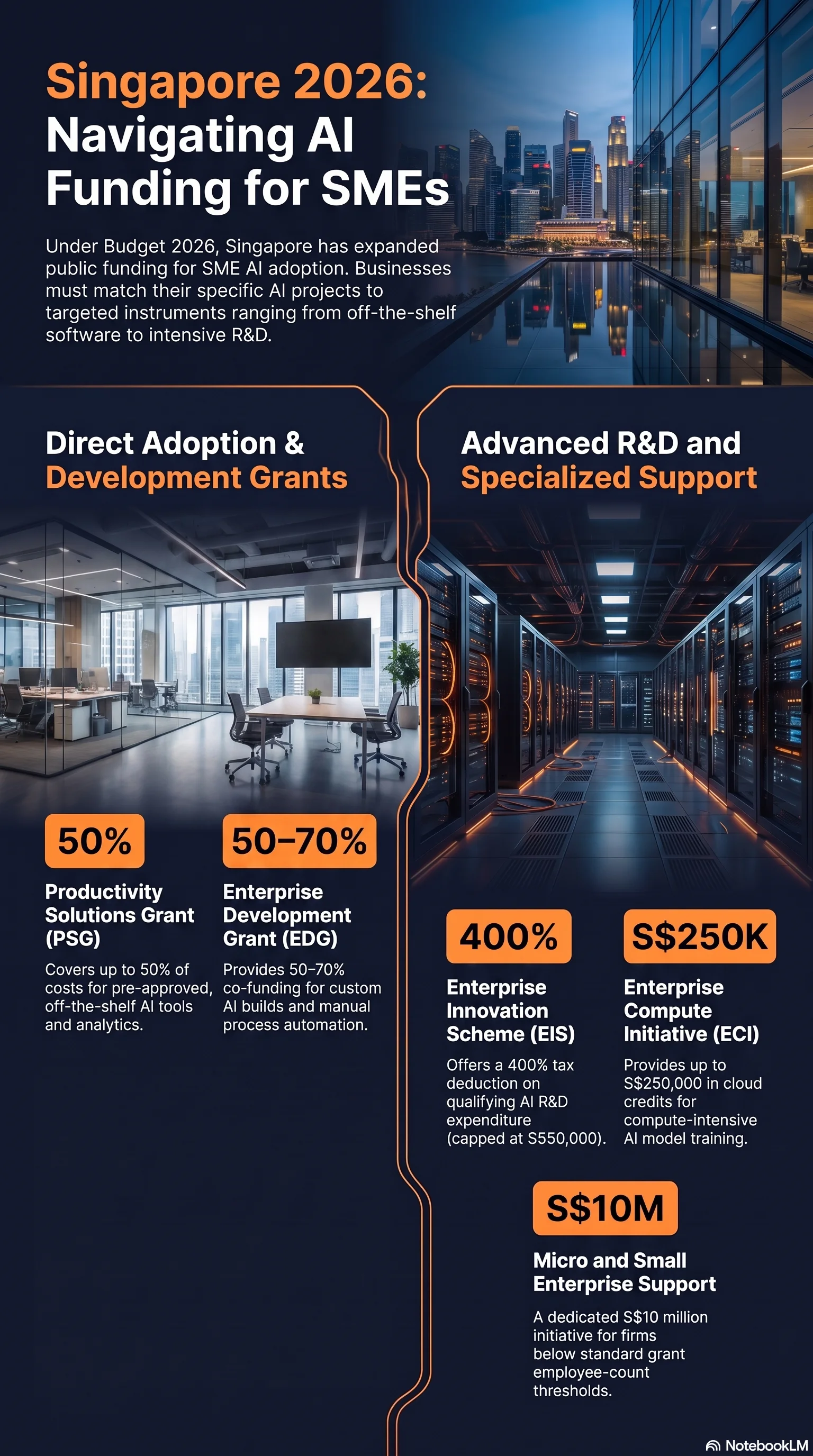
Each instrument has a different mechanism, eligibility threshold, and application timeline. Mapping a planned AI initiative to the correct grant instrument before procurement avoids disqualification and reduces the time between commitment and co-funding disbursement.
A Three-Phase Implementation Framework
AI adoption produces traceable commercial returns when it is structured as a sequenced programme. Three phases define the operational sequence.
-
Phase 1: Clarity. Leadership establishes outcome metrics before tool selection. An outcome metric defines what the initiative is supposed to change: a cycle time, an error rate, a cost per transaction, a conversion rate. Use cases are assessed on an impact-versus-effort basis. Pilot selection criteria are defined before pilots begin.
-
Phase 2: Capability. Training is structured around problems, not platforms. Problem-based training (where teams learn AI tools in the context of the specific workflow they are improving) produces adoption transfer rates materially higher than generic AI literacy courses. The measure of capability is demonstrated ability to identify and execute use cases, not module completion.
-
Phase 3: Execution. Two-week prototype pilots preserve momentum. A prototype establishes feasibility, surfaces integration requirements, and generates the confidence needed to commit to full deployment. The transition to production follows a six-month schedule with defined governance gates: checkpoints at which deployment may proceed, be modified, or be discontinued based on measured performance against established baselines.
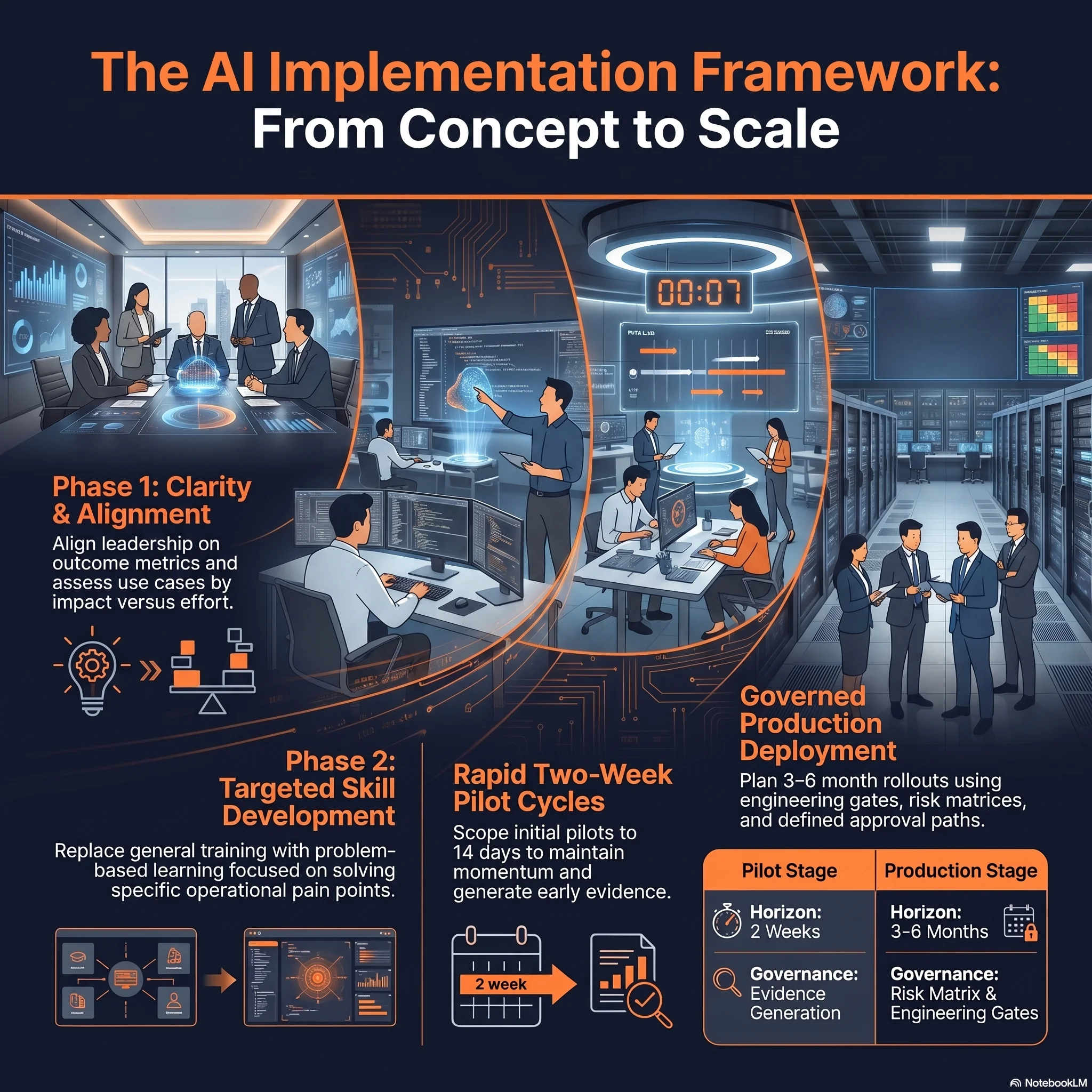
The governance gates are not optional. They are the mechanism that converts a pilot into a production system.
Recommended Actions
Six actions define the operational path from intent to deployment.
-
Conduct an AI readiness assessment before committing capital. Readiness across five dimensions (data, process definition, governance structure, team capability, and measurement baseline) determines whether an organisation is positioned to extract value from a deployment. Capital committed before readiness gaps are addressed produces pilots that do not convert to production.
-
Convene cross-functional leadership workshops before tool selection. Outcome metric alignment across finance, operations, and executive leadership cannot be deferred to the deployment phase. The workshops are the governance mechanism that prevents the leadership misalignment failure mode.
-
Define pilot parameters before beginning. A two-week prototype with a defined success criterion produces an actionable result. A pilot without defined success criteria produces an indefinite evaluation. The organisation never exits with a clear go/no-go decision.
-
Establish governance criteria before production commitment. Human oversight requirements, audit logging, output validation, and rollback protocols must be designed before a system goes live. Retrofitting governance is substantially more costly and creates regulatory exposure during the retrofit period.
-
Scope AI applications across full workflows. The highest-value deployments eliminate process steps or restructure coordination patterns. Scoping begins with workflow mapping, not task identification.
-
Map projects to grant instruments at the planning stage. Grant application timelines and eligibility criteria vary by instrument. Identifying the applicable instrument early allows procurement and application to be sequenced so that co-funding disbursement aligns with deployment costs.
The Determining Factor
Singapore’s policy environment materially reduces the cost and risk of AI adoption for SMEs. The instruments are available, the training infrastructure is funded, and the compute subsidies reduce the economics of experimentation to a level accessible to most organisations operating above minimal scale.
AI adoption outcomes for SMEs are determined less by tool selection than by the discipline applied to leadership alignment, process definition, and phased execution. The organisations that realise commercial returns from AI in 2026 and 2027 will not be those with the most capable tools. They will be those that linked AI initiatives to defined business outcomes, governed the transition from prototype to production with measurable gates, and mapped their projects to available funding mechanisms before committing deployment capital.
The policy environment reduces the cost of starting. Execution discipline determines whether the start produces a return.
Evidence & Methodology
Only one of the seven grant instruments below has a citation attached. The other six are public programme details I did not re-verify line by line for this piece. The failure patterns and the three-phase framework are mine, built from advisory work, not a study.
| Claim | Source | Grade |
|---|---|---|
| The National AI Impact Programme funds leadership training and adoption grants across 10,000 enterprises | IMDA’s own factsheet, cited below | Documented |
| The other six grant instruments (PSG, EDG, EIS, ECI, SkillsFuture, Micro and Small Enterprise Support) | Public Singapore government programme information, not individually cited here | Reported |
| SMEs move from pilot to production faster than large enterprises because of shorter decision chains | My own pattern from advising both SMEs and large enterprises | My pattern |
| The Clarity, Capability, Execution three-phase framework converts pilots to production | My own synthesis, not tested against a formal sample of programmes | My framework |
Sources
- IMDA. (2026). National AI Impact Programme factsheet.
Free tool
AI Readiness Self-Assessment
Evaluates whether the five operational foundations, data, process, governance, team capability, and measurement, are in place before deployment capital is committed.
Free tool
Business Automation Map
Identifies which of your workflows are candidates for AI deployment and benchmarks your coverage against sector peers.
If you’d like structured support navigating Singapore’s grant instruments and putting this framework into practice, that’s exactly what my consulting work covers.
Was this useful?