
Listen to this article
Executive Summary
A destructive AI strategy applies Schumpeter’s creative destruction and Thiel’s zero-to-one logic deliberately: cannibalise your own margin-protected market before a competitor does, and compete only where incumbent structure is a liability.
Core conclusions
- Self-directed disruption beats defensive incrementalism. Incumbents protecting existing revenue are structurally incapable of building models that cannibalise it.
- Win on decision speed, risk tolerance, focus depth, and proprietary data leverage: the dimensions where incumbent scale becomes a weakness, not an advantage.
- Target zero-to-one monopoly, not competition: find the “secret” intersection of high complexity, undigitised data, and an ignored bottleneck, and occupy it before it’s priced by the market.
The six-part framework, in ten slides
Save it, share it, or send it to whoever is scoping your next AI venture.
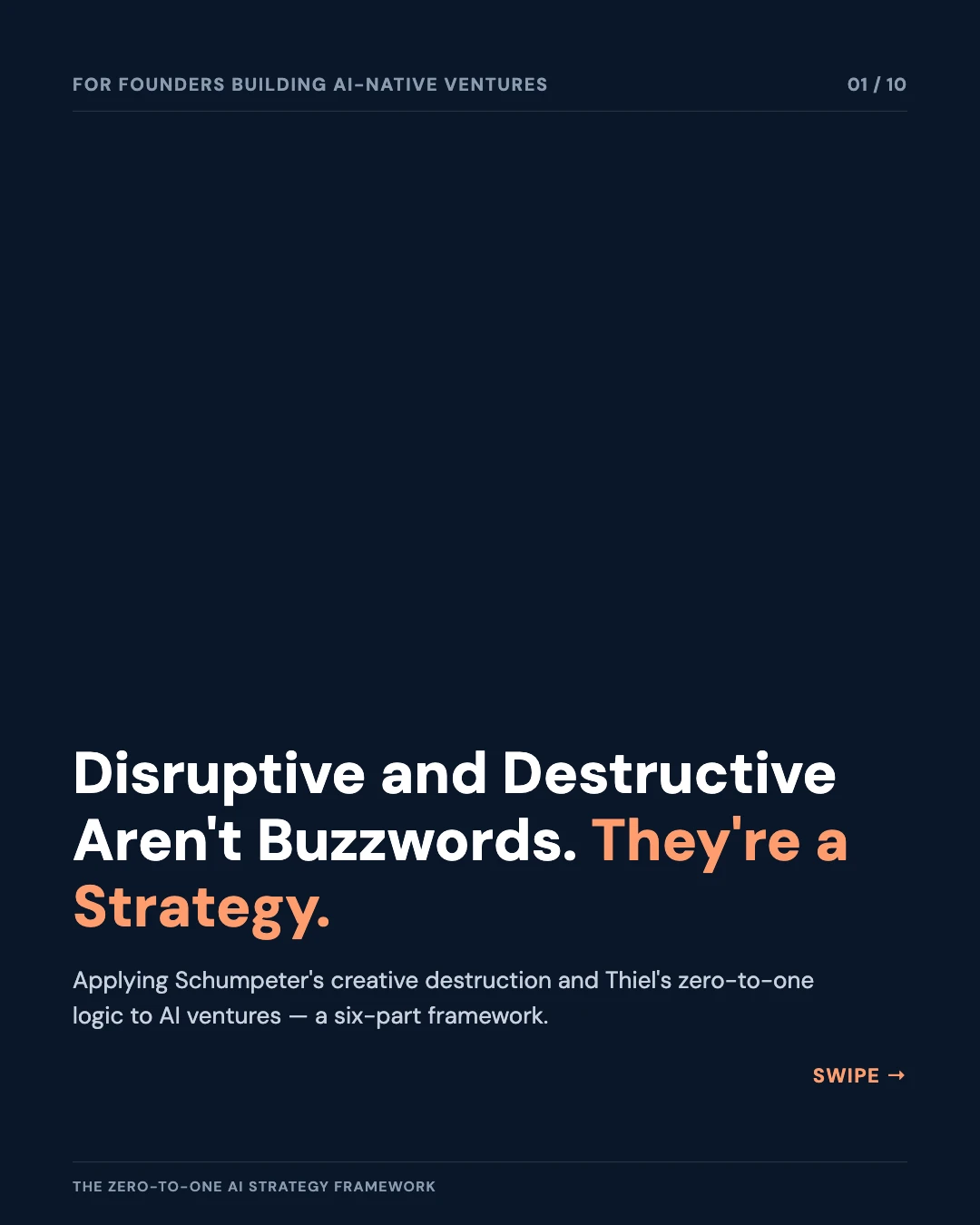
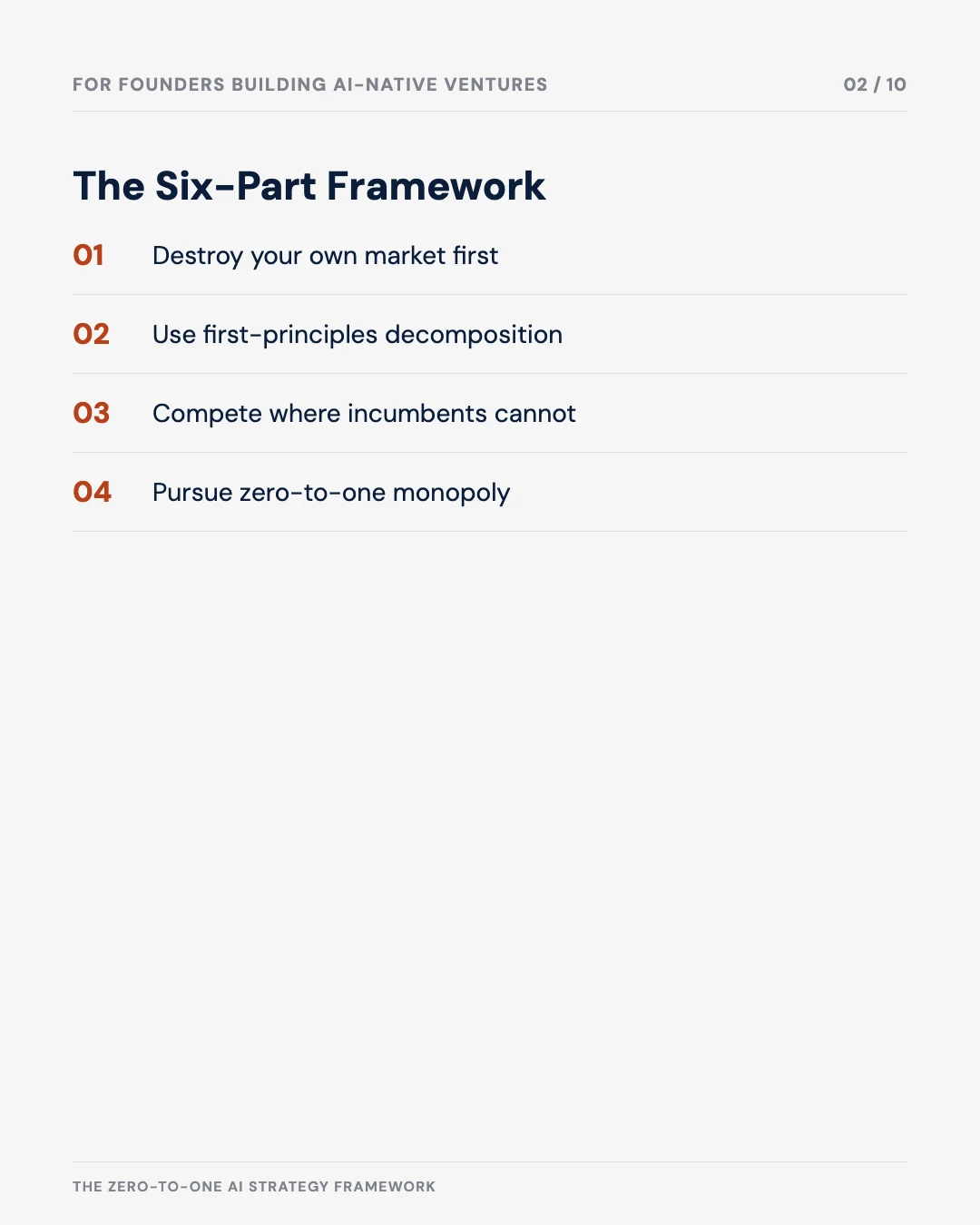

In AI strategy, “disruptive” and “destructive” are not buzzwords.
They describe a deliberate, structurally aggressive approach: applying Schumpeter’s creative destruction and Thiel’s zero-to-one monopoly logic to AI ventures.
The goal is not incremental improvement. It is the displacement of incumbent market structures.
Here is a framework for building that strategy from first principles.
1. Start by Destroying Your Own Market
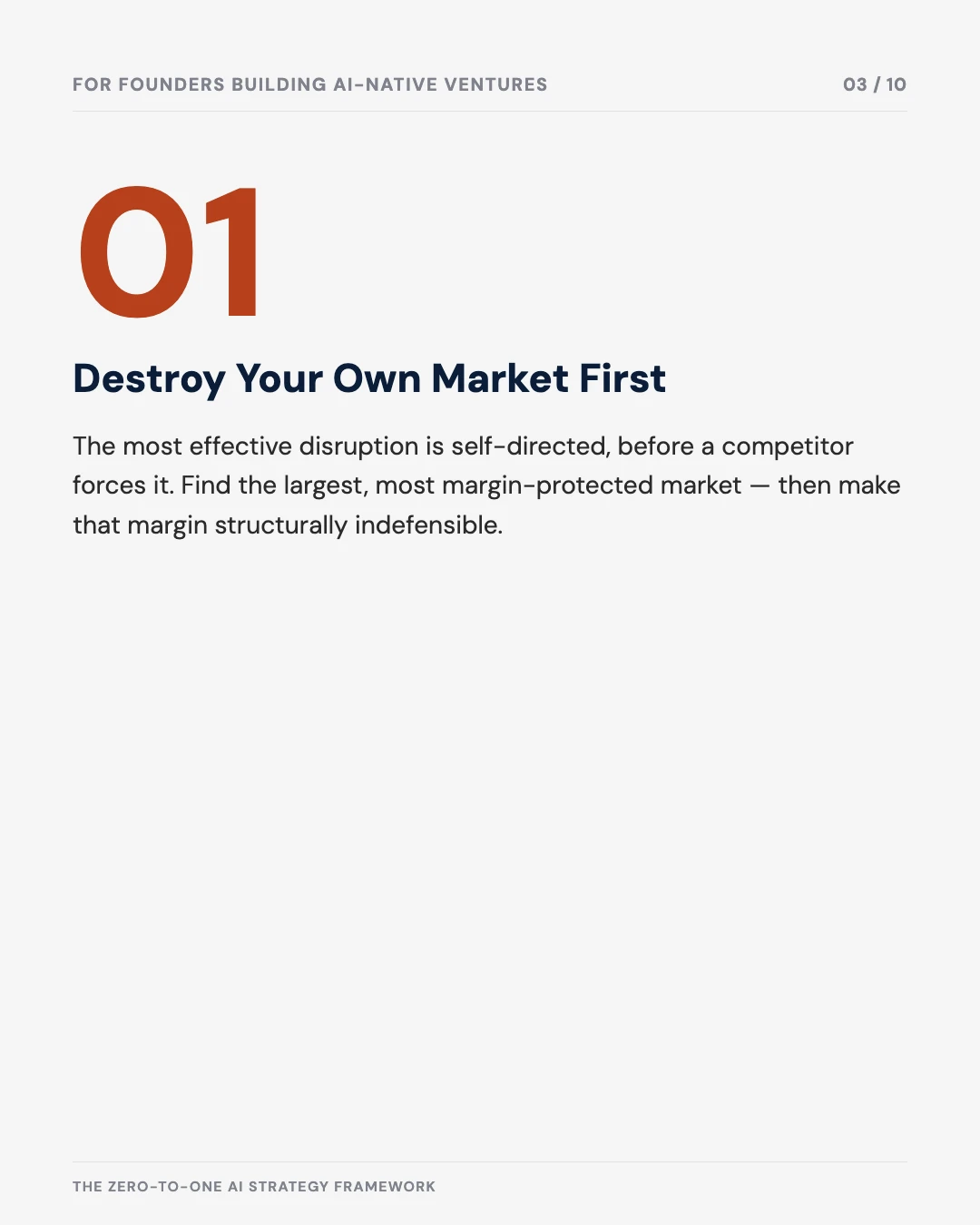
The most effective disruption is self-directed, before a competitor forces it.
PwC’s analysis identifies “creative self-destruction” as a primary offensive move: disrupting your own model before competitors can. Incumbent organisations that protect existing revenue streams are structurally incapable of pursuing models that cannibalise those streams. A new AI venture carries no such constraint.
The first strategic act is to identify the largest, most stable, most margin-protected market in your target domain, then build a model that makes that margin structurally indefensible.
The question is not “How do we enter this market?”
It is “How do we make this market’s current pricing, delivery, and operational logic obsolete?“
2. Use First-Principles Decomposition
Before any product architecture or go-to-market design, strategy must begin with first-principles thinking: breaking every industry assumption down to its constituent elements and testing which are structurally necessary versus historically inherited.
Elon Musk frames it simply: reasoning by analogy copies what others do with slight variations. First principles are rebuilt from provable facts.
For an AI business, this means asking three questions:
- Where does the industry charge for friction rather than value? Businesses profiting from friction that AI systematically eliminates are structurally exposed.
- What is the true value function, and what is just the delivery mechanism? In legal services, insurance, or infrastructure, the real value is the decision outcome, not the human hours wrapped around it. This is the same commoditisation dynamic I trace in When Everyone Knows Everything. AI can own the outcome layer directly.
- Which constraints are technical, which are regulatory, and which are merely conventional? Conventional constraints define the attack surface.
3. Compete Where Incumbents Cannot
Incumbents rarely fail in paradigm shifts due to incompetence. They fail because their established strengths convert into liabilities.
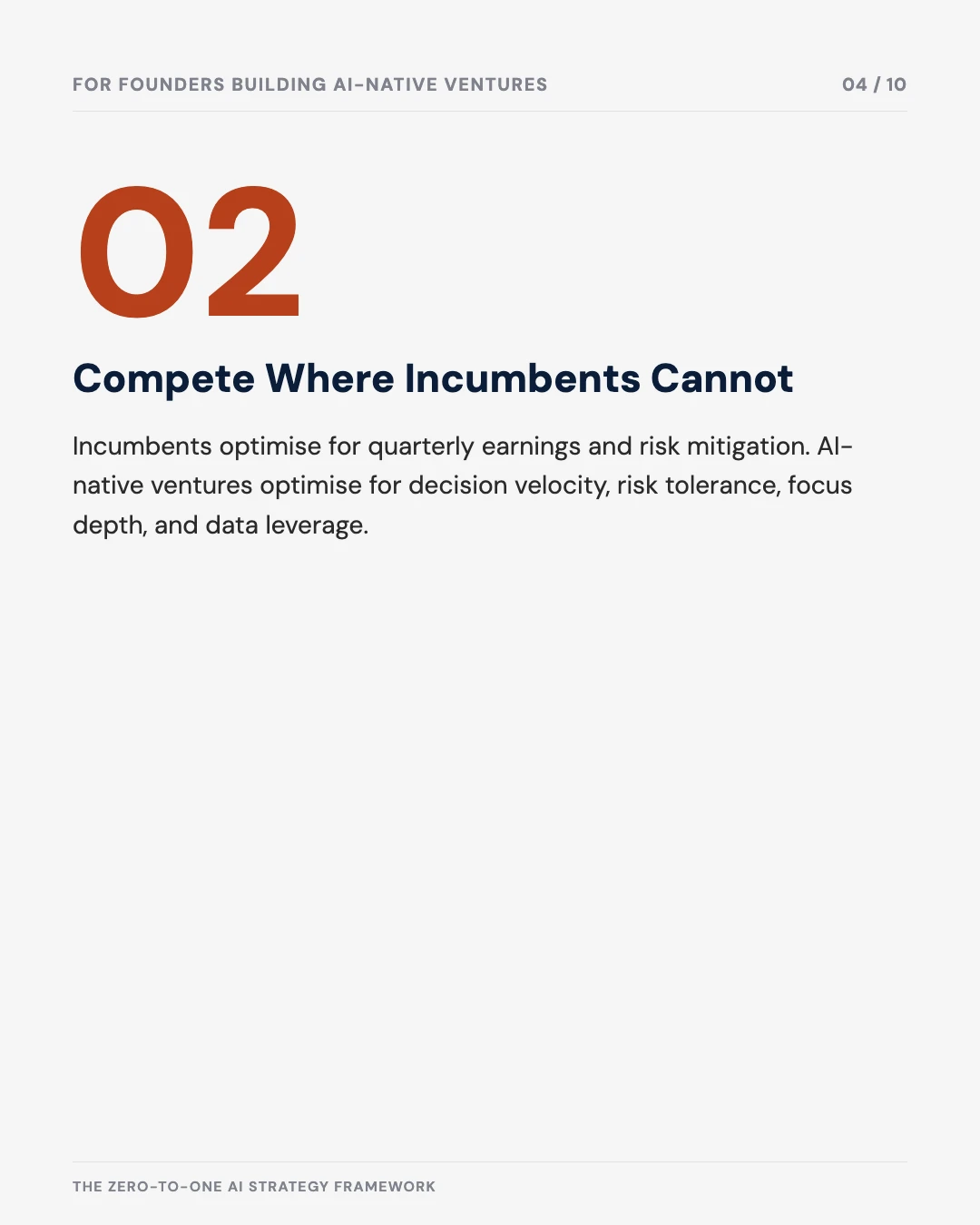
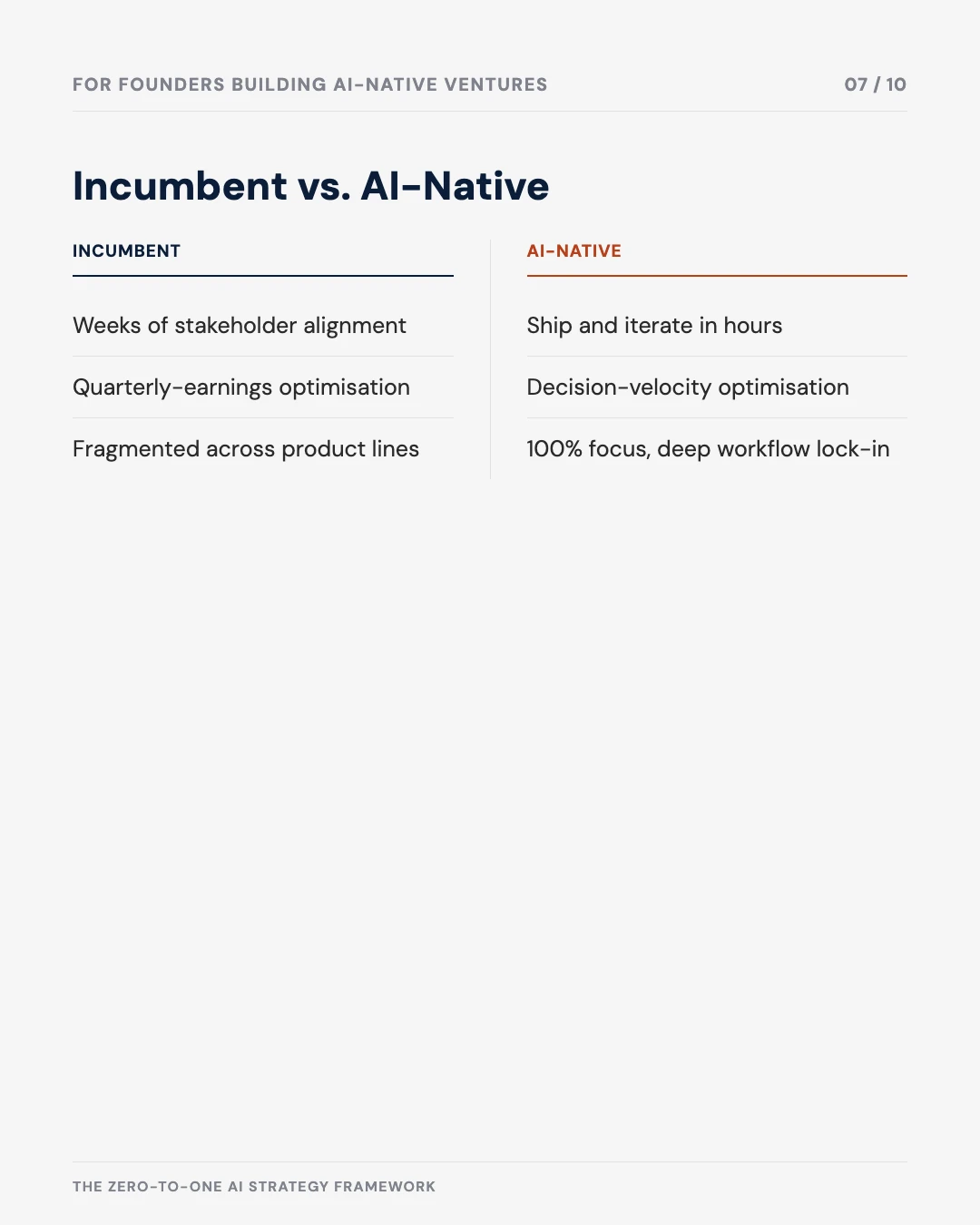
Large organisations optimise for quarterly earnings, risk mitigation, and process compliance. AI-native ventures optimise for decision velocity, learning speed, and product depth.
Compete only along dimensions where incumbent design creates structural weakness:
- Decision speed: AI-native firms can ship, test, and iterate in hours. Incumbents need weeks of stakeholder alignment for the same change. Speed compounds into product advantage over time.
- Risk tolerance: The most disruptive AI opportunities look too small, risky, or unconventional to survive incumbent approval cycles. These “no-go” zones are ideal entry points.
- Focus depth: While incumbents are fragmented across product lines, an AI venture focused 100% on one high-value problem can achieve deep workflow ownership and lock-in.
- Data leverage: Future AI monopolies will be defined by proprietary data-algorithm-workflow combinations competitors cannot replicate. Data acquisition must be designed as a structural moat from day one, not treated as a technical afterthought.
4. Design a Destructive Business Model
Most traditional models rely on information scarcity, process complexity, or access control. AI erodes all three simultaneously.
A destructive AI business model targets the highest-margin, lowest-differentiation layer of the incumbent value chain, reprices it close to zero, and monetises volume and downstream data.
Examples:
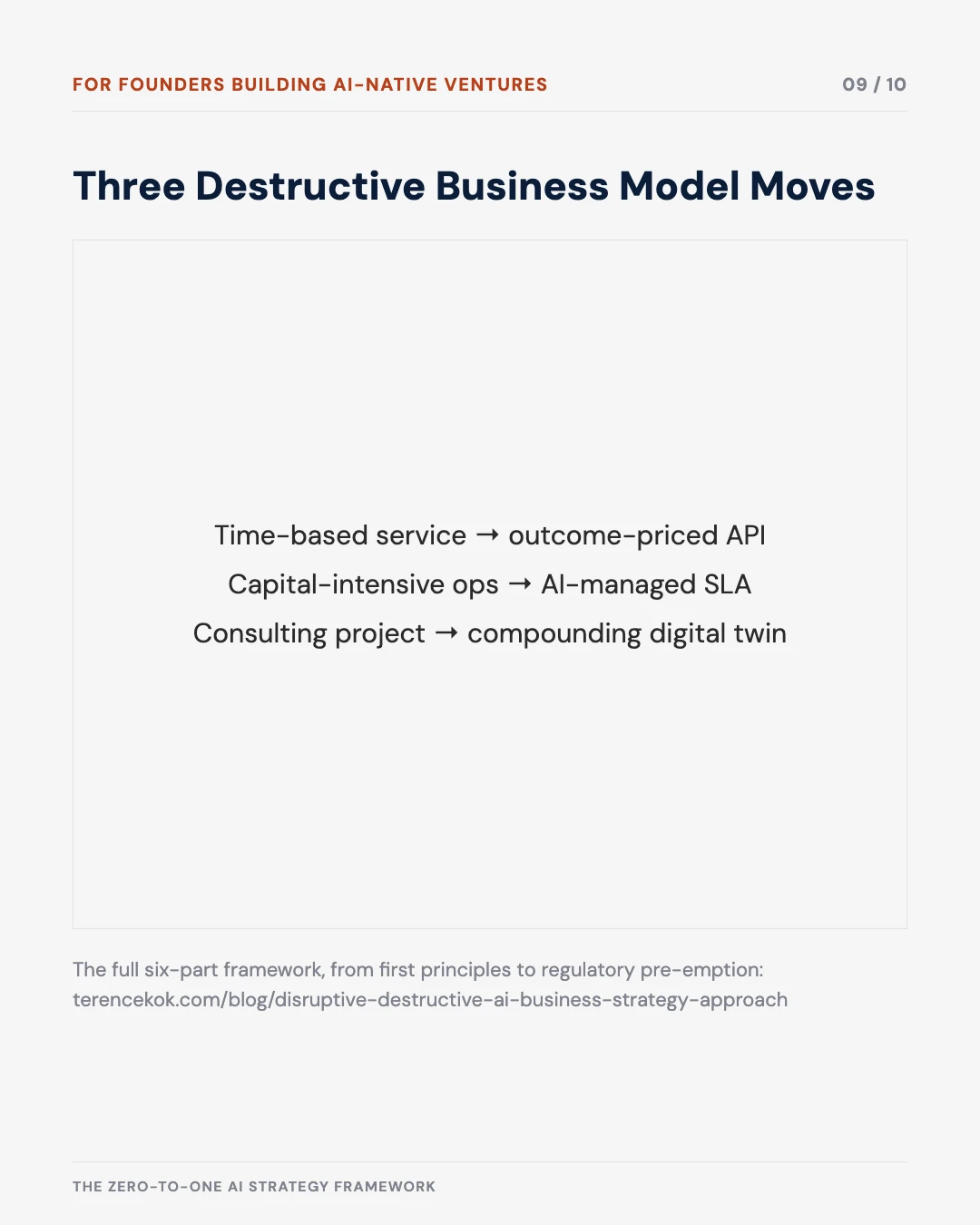
- Reduce a time-based professional service to an outcome-based API priced per result. I make the full case for this specific shift in The End of Billing for Time.
- Convert capital-intensive operations into an AI-managed service with outcome-guaranteed SLAs.
- Replace discrete consulting projects with continuously learning digital twins that compound in accuracy over time.
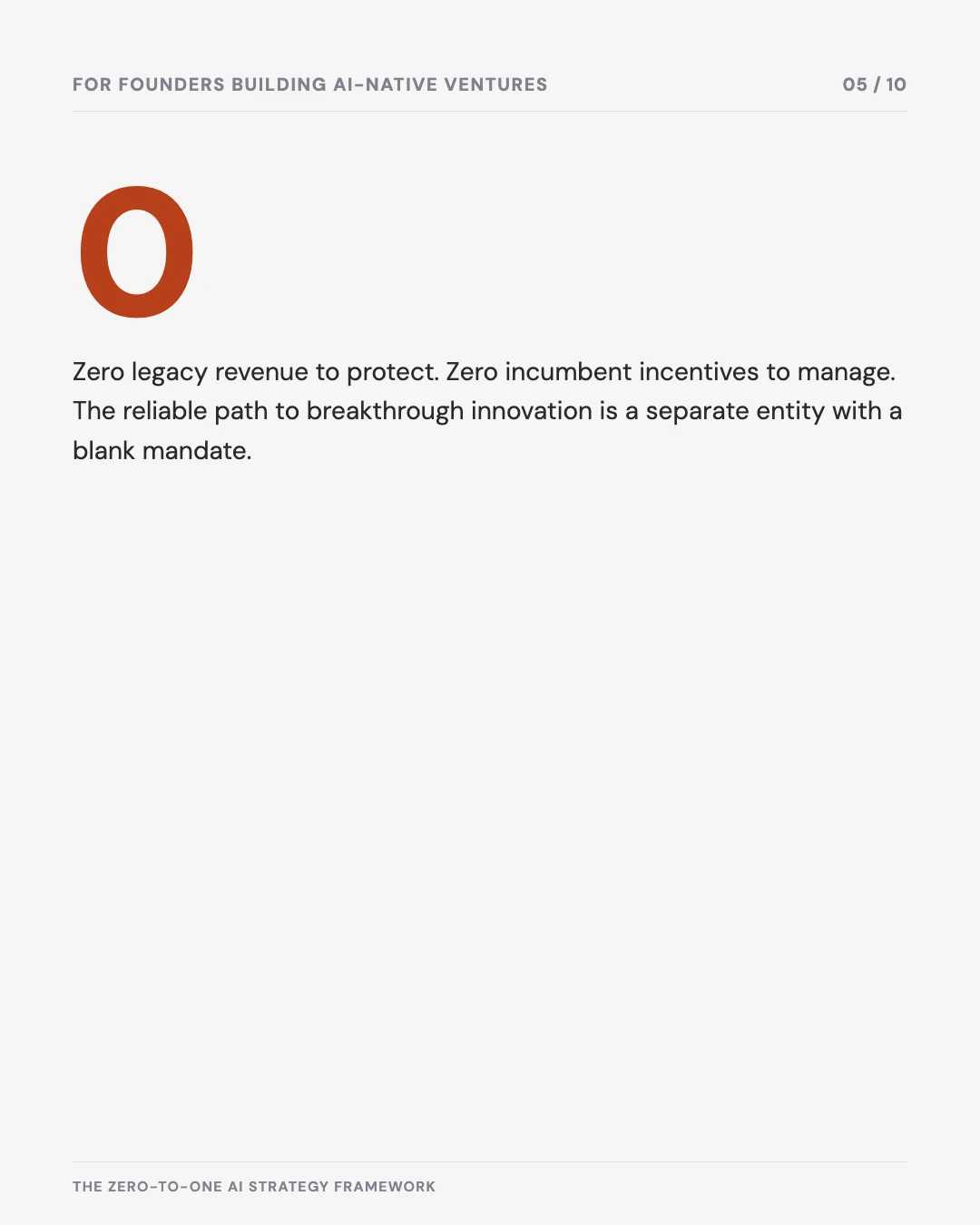
Progressively optimising a legacy operational model rarely produces breakthrough innovation. The more reliable path is to build a separate entity with a blank mandate: no legacy revenue to protect, no incumbent incentives to manage.
5. Pursue Zero-to-One Monopoly, Not Competition
Thiel’s principle: competition is a problem to eliminate, not a contest to win.
Entering crowded markets and relying on marginal superiority leads to rapid commoditisation. The strategic objective is to define and own a category before the market labels it.
This requires identifying what Thiel calls “secrets”: facts that are true but not yet priced by the market. In AI, these secrets typically sit at the intersection of:
- A domain with high decision complexity and low AI penetration.
- A proprietary data source that incumbents neither control nor have meaningfully digitised.
- A workflow bottleneck that is operationally critical but structurally ignored.
The new entrant’s goal is to fully occupy that intersection before incumbents recognise it as a competitive threat.
6. Build an Execution Architecture that Compounds
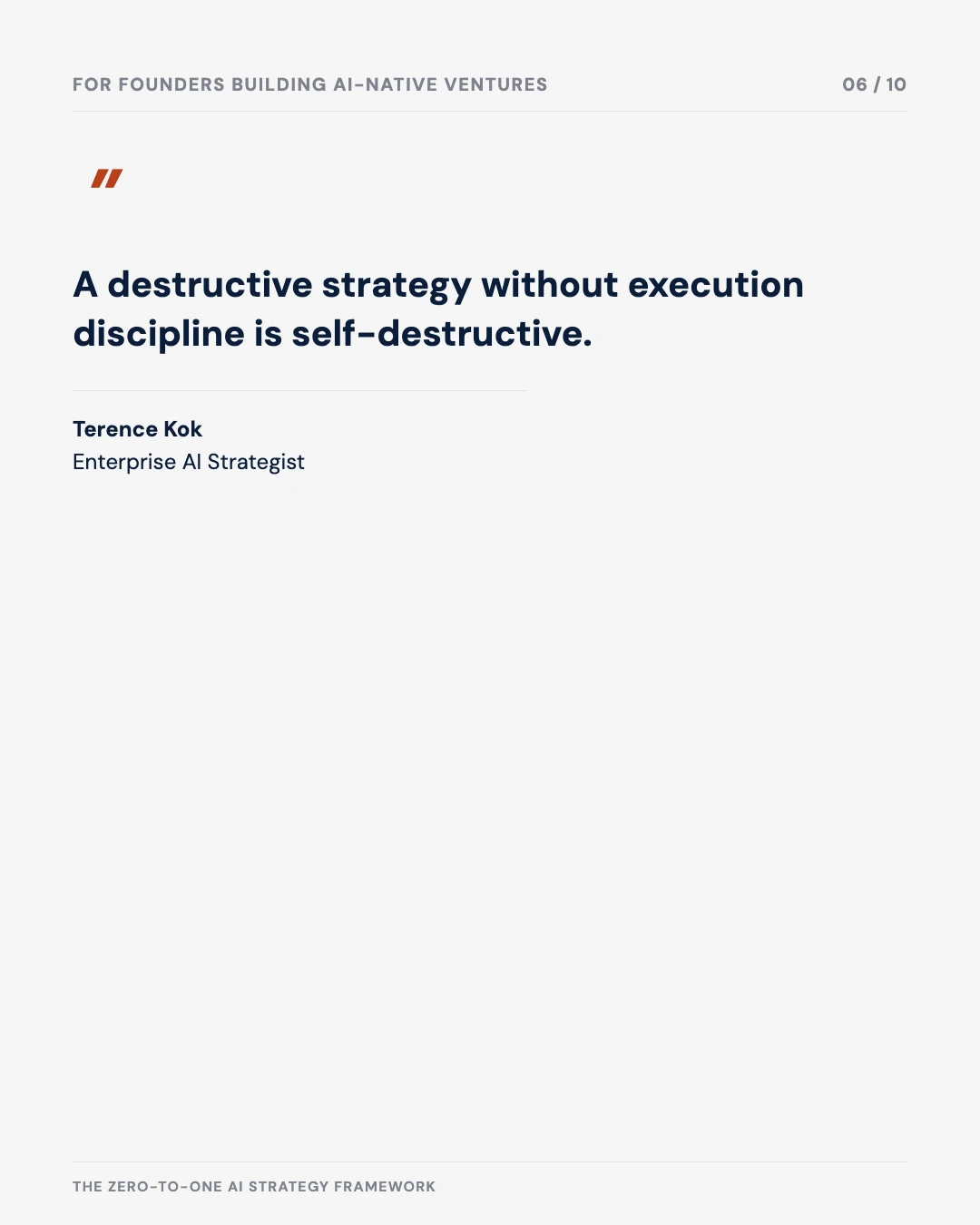
A destructive strategy without execution discipline is self-destructive.
The operating model must embed three commitments:
- Radical velocity with governance checkpoints. Ship quickly, but instrument every deployment with performance baselines from day one. Quantified outcomes are the only defence against being dismissed as another pilot.
- AI-native architecture. Use cloud-edge collaboration, self-healing systems, and closed feedback loops so models continuously learn from operational data. The business should gain value with each transaction.
- Regulatory pre-emption. In regulated sectors (infrastructure, health, finance, government), entrants that proactively align their models to regulatory requirements before being asked remove compliance as a viable barrier for competitors.
Each step-change in AI capability creates a temporary window of monopoly advantage for the innovator. The destructive AI strategy is a race to own that window, and to have built the next defensive moat before the current one closes.
The question is not whether AI will restructure your industry. It is whether you are building the model that does the restructuring, or the one being restructured.
Was this useful?