
Listen to this article
Executive Summary
AI has made codified knowledge nearly free to produce, collapsing the pricing model built on expertise and billable hours. What remains scarce, and valuable, is judgment, relationship, and the ability to turn machine-generated analysis into decisions that hold up in the real world.
$2
per million tokens today via OpenAI’s API, down from $36
30–40%
productivity lift for experienced consultants on routine tasks using AI, per BCG
-23%
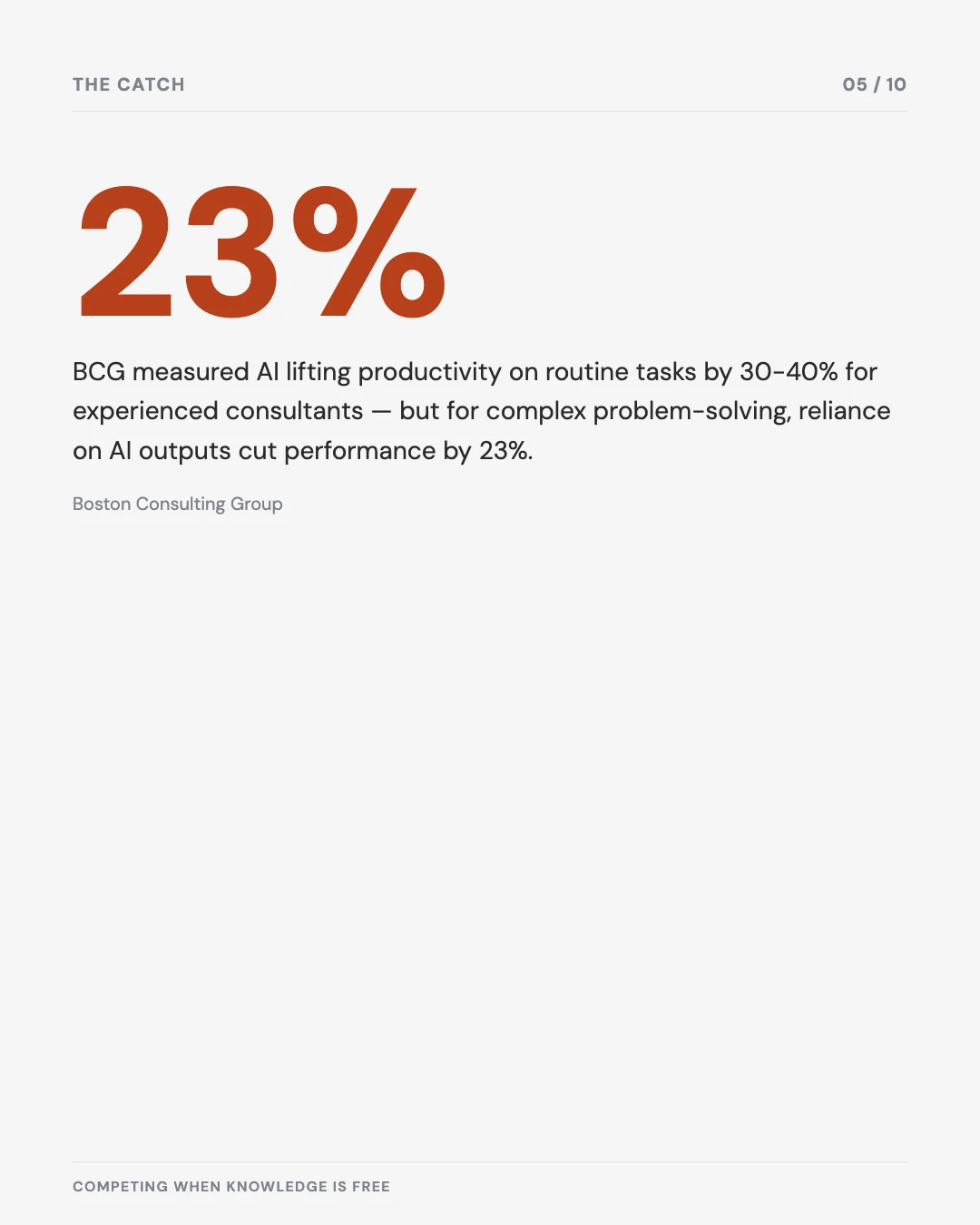
performance change on complex problem-solving when consultants relied on AI outputs, per BCG
81%
of legal, tax, accounting & audit professionals who already see generative AI use cases, per Thomson Reuters
Core conclusions
- AI is commoditising codified knowledge, not judgment, relationship-building, or multi-stakeholder synthesis. Those stay human and now command the premium.
- BCG’s own data cuts both ways: AI lifts performance on routine, structured work, but overreliance on AI outputs measurably hurts performance on complex problem-solving.
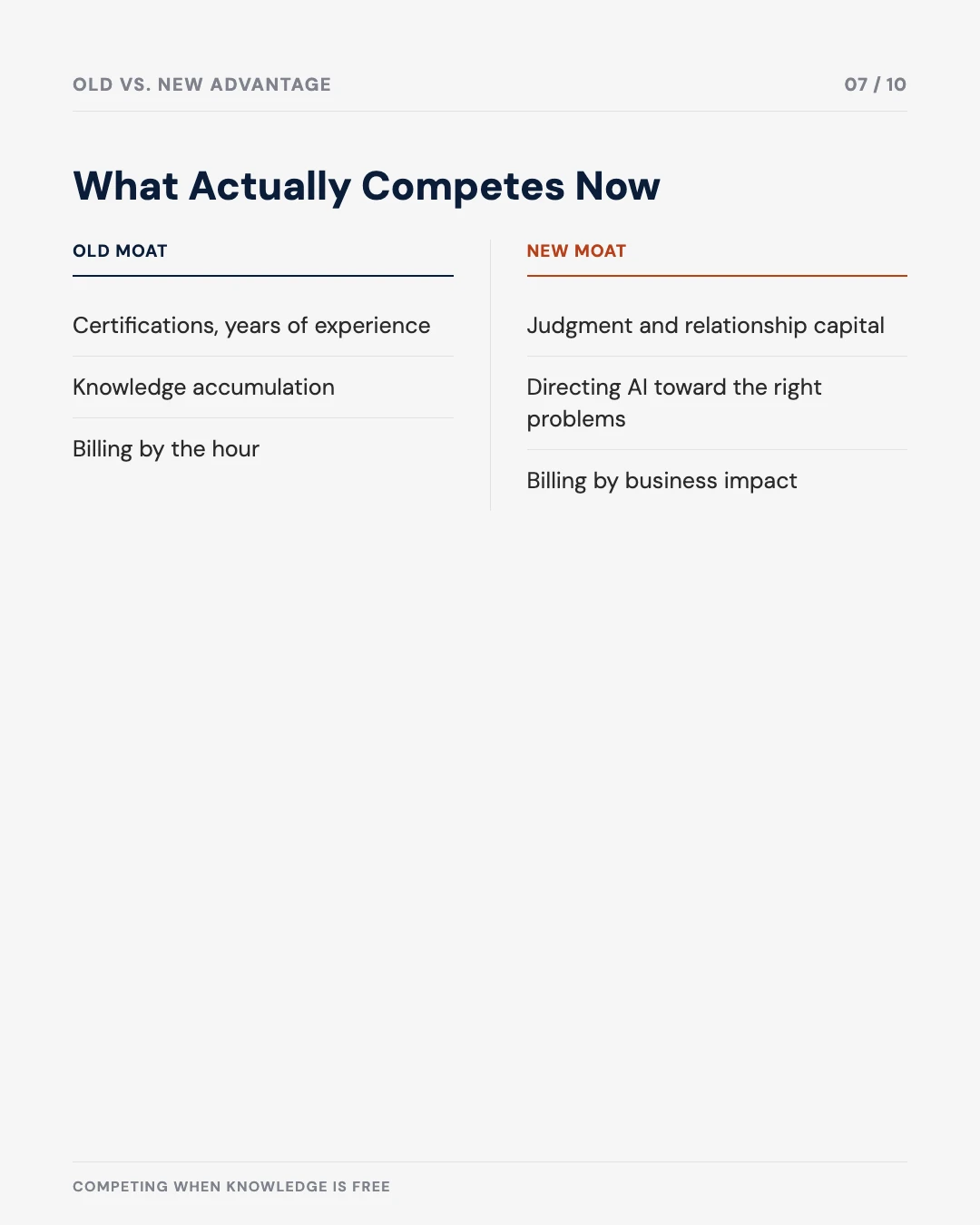
- The response is structural: shift from hourly billing to outcome-based pricing, and from capacity planning (“how many people”) to capability planning (“what can’t be automated”).
Where value still lives, in ten slides
Save it, share it, or send it to whoever prices your services.
The Data Behind the Shift
| Metric | Value | Source |
|---|---|---|
| OpenAI API price per million tokens | $36 → $2 | OpenAI pricing |
| Productivity lift on routine tasks for experienced consultants using AI | 30–40% | BCG |
| Performance change on complex problem-solving when relying on AI outputs | -23% | BCG |
| Legal, tax, accounting & audit professionals who already see generative AI use cases | 81% | Thomson Reuters |
BCG’s figures compare experienced-consultant performance on routine versus complex tasks; the Thomson Reuters figure is professional-services-wide, not specific to any one firm type.
Knowledge used to be power. But here’s the thing: AI just changed the game entirely. As AI gets better at generating expertise instantly and practically for free, all those traditional advantages we relied on (certifications, years of experience, proprietary insights) are starting to lose their edge. This isn’t some future scenario. It’s happening right now and reshaping how we work, how services are priced, and how companies compete.
When Knowledge Becomes a Commodity
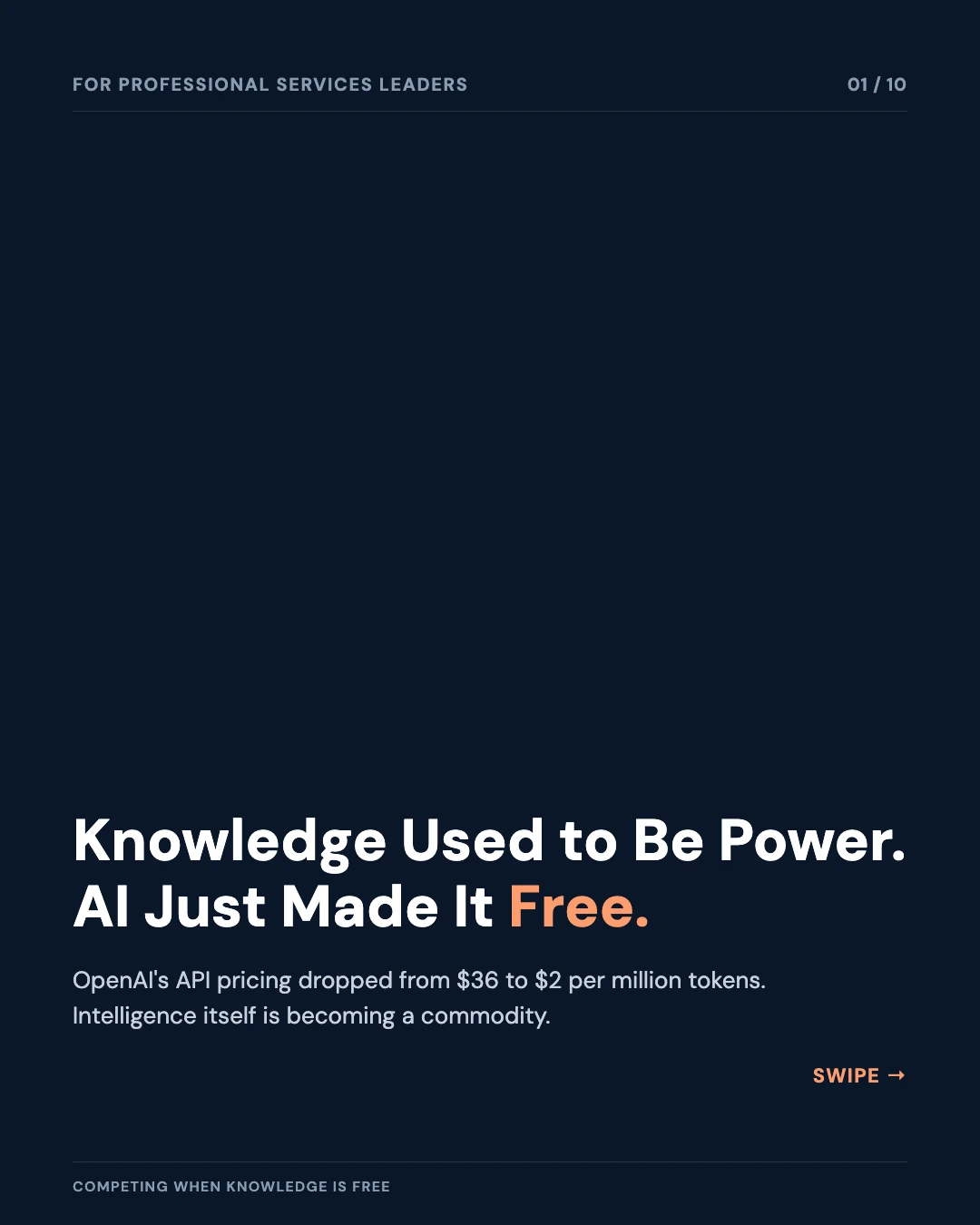
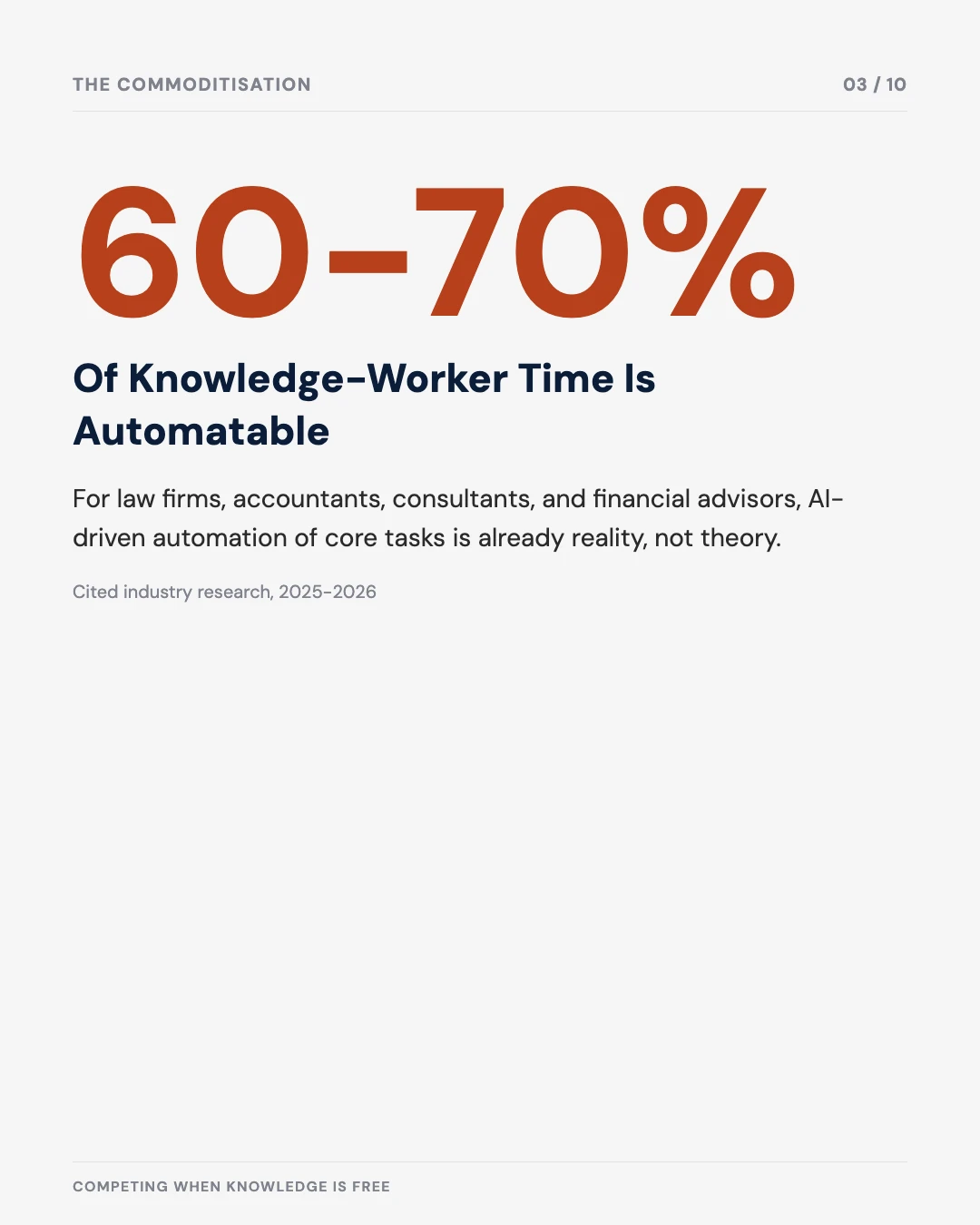
OpenAI’s API pricing dropped from $36 to $2 per million tokens. That’s not just a price cut. It’s a signal that intelligence itself is becoming a commodity. Expertise that used to take years to develop can now be generated by AI in seconds for almost nothing. AI is projected to automate 60–70% of the time knowledge workers spend on core tasks. For law firms, accountants, consultants, and financial advisors, this isn’t theory. It’s reality.
That’s not just a price cut. It’s a signal that intelligence itself is becoming a commodity.
Professional services have always charged by the hour or based on expertise. But when AI commoditises the underlying work, that model falls apart. Companies are shifting to outcome-based pricing, where you pay for results, not effort. Thomson Reuters found that 81% of legal, tax, accounting and audit professionals already see uses for generative AI in their work. Executives estimate 56% of entry-level knowledge worker positions will be eliminated or fundamentally restructured within five years.
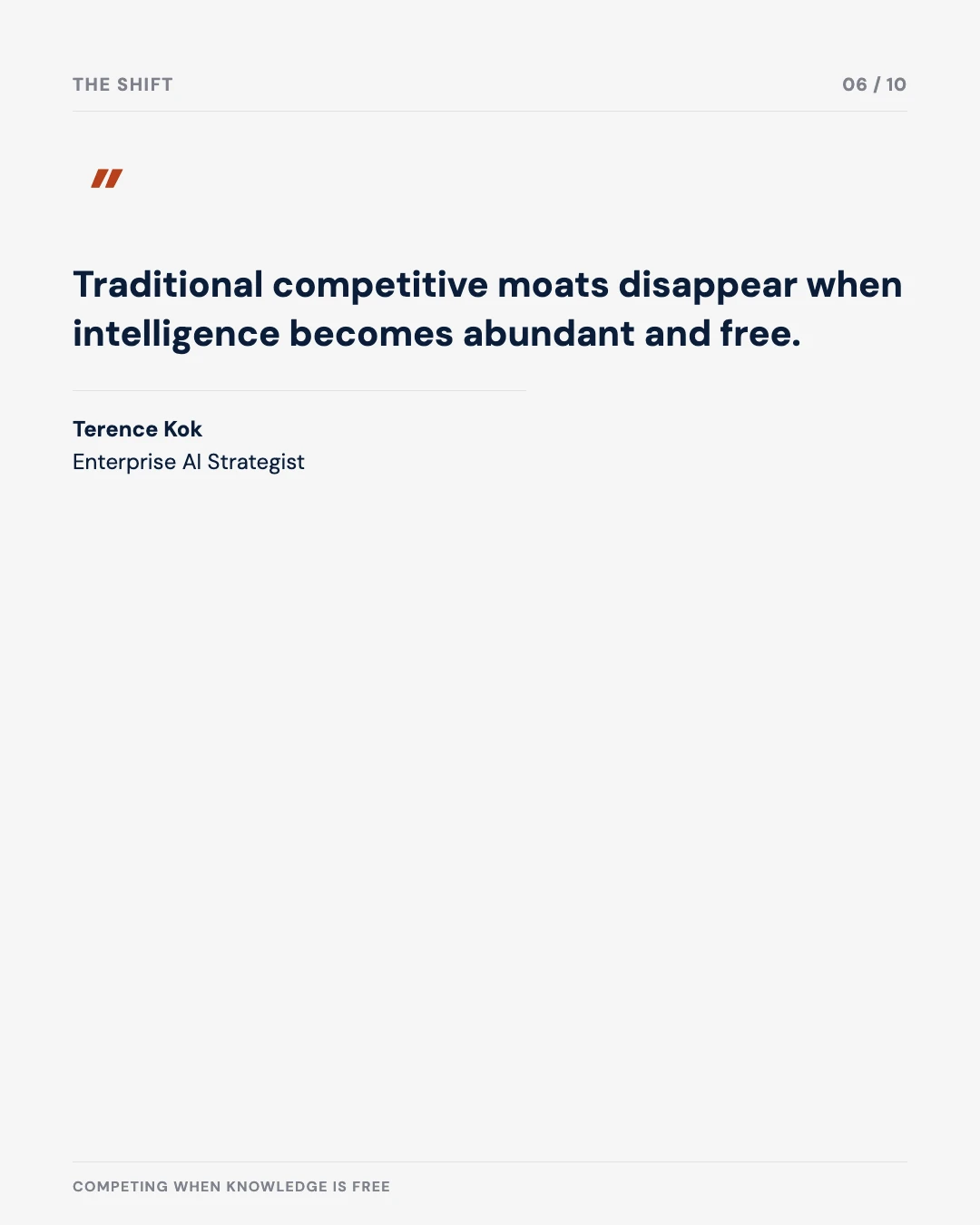
When execution costs approach zero, cost leadership becomes meaningless. If two consulting firms can produce identical strategic analysis at zero marginal cost using AI, neither can compete on price. Traditional competitive moats (cost efficiency, economies of scale, proprietary knowledge) disappear when intelligence becomes abundant and free. This creates two opposing forces: first, democratisation, where barriers to entry collapse and a solo entrepreneur with access to AI can compete with established firms on analytical depth; and second, hypercompetition, where everyone has access to the same AI tools and training data, making services commoditised and competitive advantage fleeting.
Traditional competitive moats disappear when intelligence becomes abundant and free.
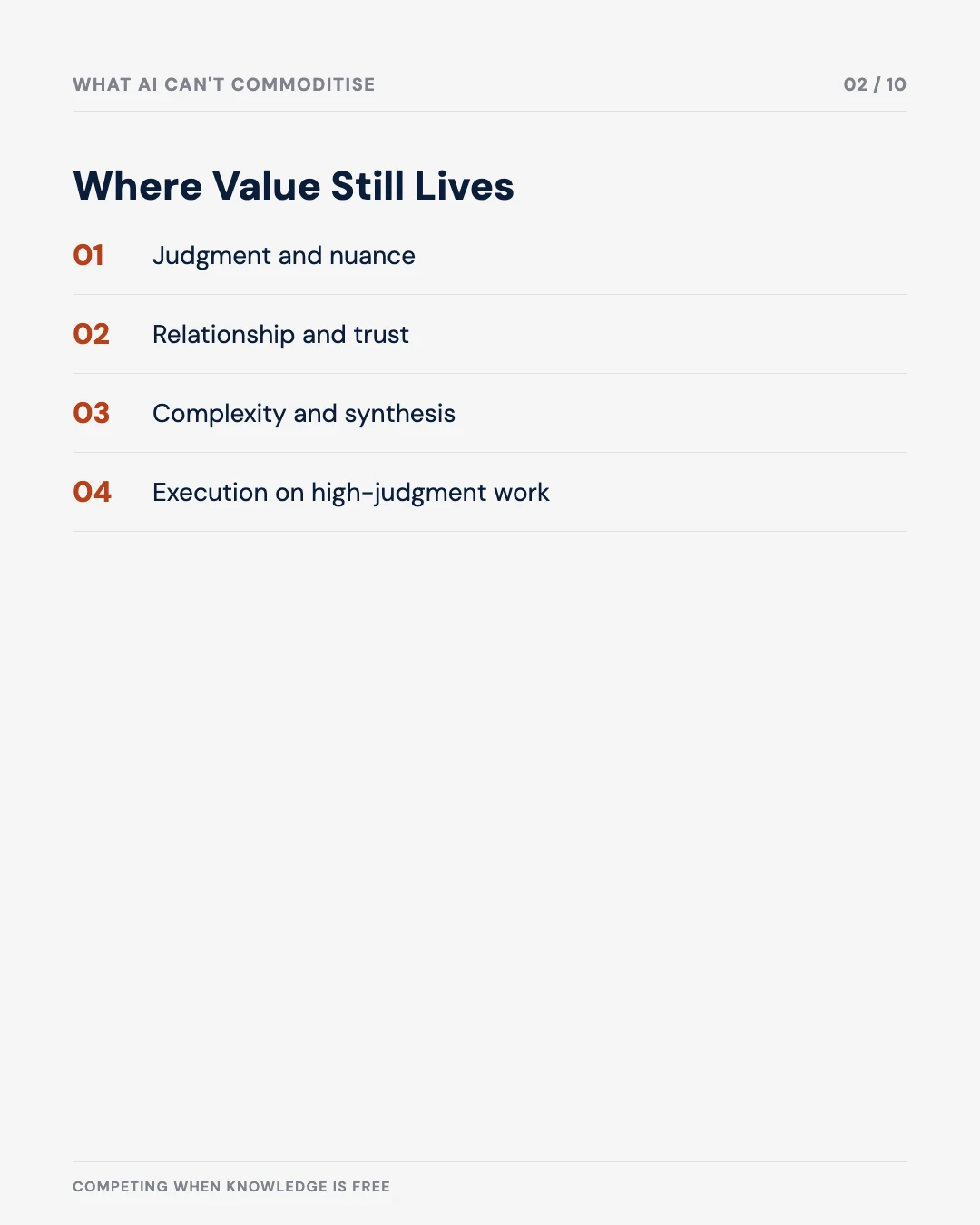
Where Value Still Lives
But here’s where it gets interesting. Writing off knowledge workers as obsolete misses the point entirely. The World Economic Forum and leading research emphasise a critical distinction: while knowledge is becoming commoditised, judgment, creativity, empathy, and relationship-building cannot be replicated at scale by algorithms.
Judgment and nuance. AI generates many possible solutions quickly; humans decide what actually matters in context. The most valuable professionals will be those who can figure out which problems are worth solving and critique AI outputs for real-world viability, not just technical correctness.
Relationship and trust. In saturated, commoditised markets, differentiation moves to relationship quality, personal judgment, and client trust. Look at the airline industry: competition on efficiency has commoditised routes, so value goes to customer-facing staff who deliver warmth and understanding.
Complexity and synthesis. While AI excels at pattern-matching in structured domains, it struggles with multi-stakeholder synthesis, organisational politics, and decisions requiring conflicting values to be integrated. Strategic leadership, organisational change, and regulatory navigation remain stubbornly human.
What Organisations Must Change
The competitive advantage question shifts from “who knows more” to “who deploys their people most effectively on high-judgment work.” This requires fundamental changes in how organisations operate and price their services.
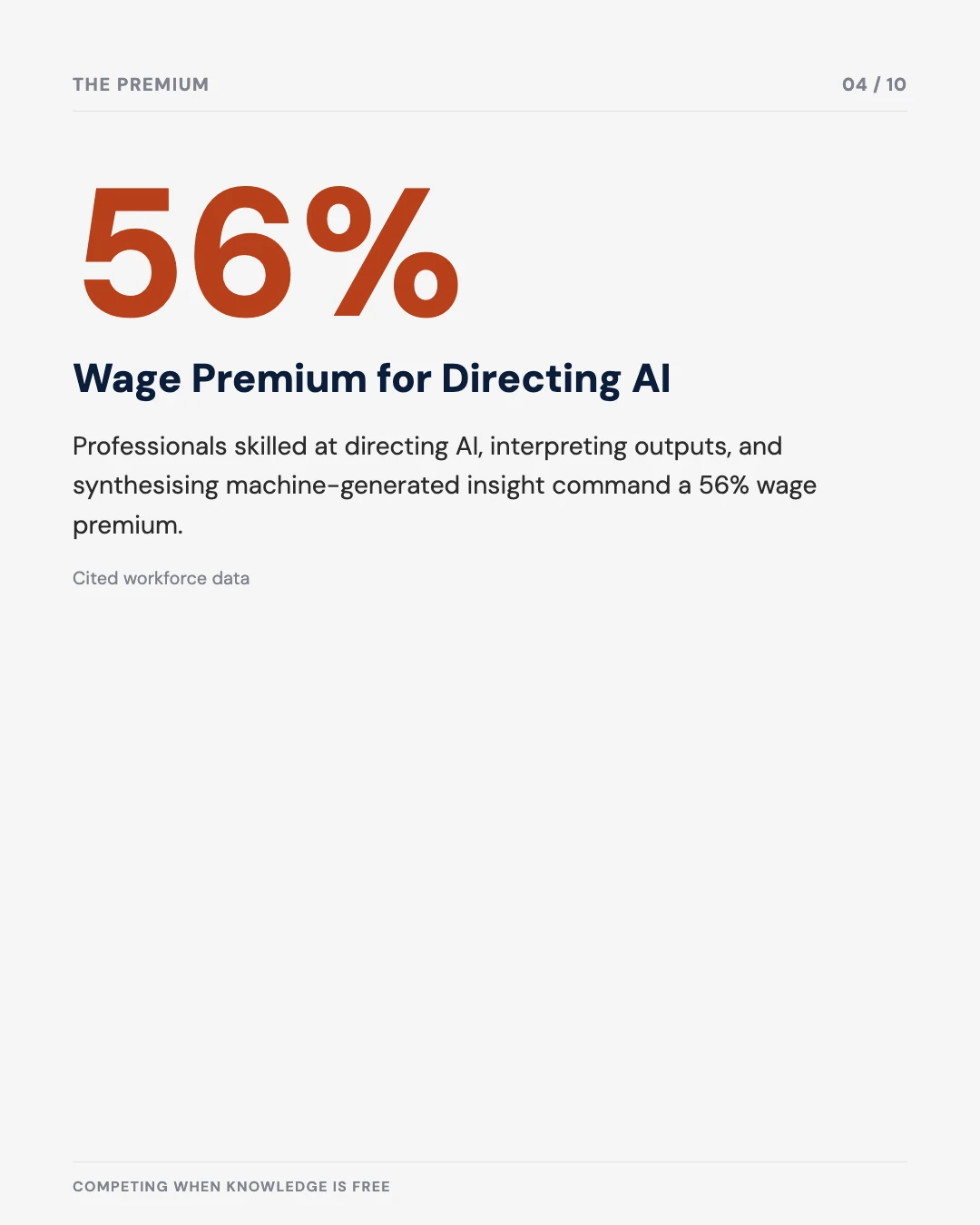
Reframe from capacity to capability: traditional workforce planning asked “how many people do we need?” The AI-era question is “what cognitive and relational work delivers value that machines can’t?” Invest in co-intelligence: BCG measured that AI improved productivity on routine tasks by 30–40% for experienced consultants, but for complex problem-solving, reliance on AI outputs actually decreased performance by 23%. Professionals skilled in directing AI, interpreting outputs, and synthesising machine-generated insights are commanding 56% wage premiums. This is the same human-advantage argument I make in The Human Advantage in the Age of AI. Organisations must actively invest in upskilling workforces toward AI collaboration.
On pricing: when knowledge delivery is commoditised, you can’t anchor pricing to effort. Value must be tied to business impact: revenue generated, risks mitigated, operational improvements achieved. This model aligns incentives: vendors delivering genuine business value can charge premium fees; those selling commoditised intelligence cannot. The transition to outcome billing is not cosmetic. It forces firms to develop genuine strategic differentiation or face margin compression. I have written a full case for this shift in The End of Billing for Time.
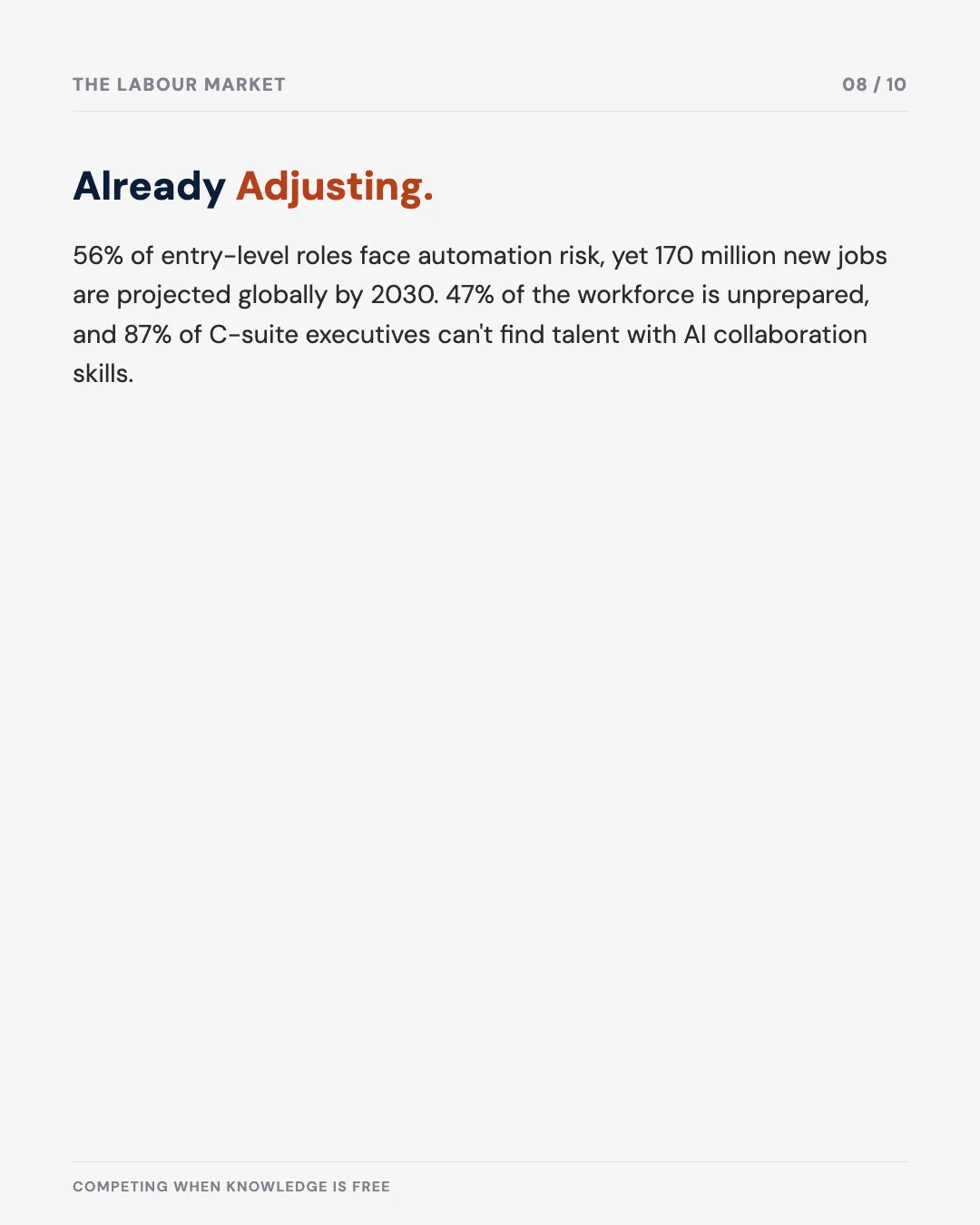
The labour market is already adjusting. While 56% of entry-level roles face automation risk, new categories are emerging: AI prompt engineering, AI output quality assurance, AI-human workflow design, and AI implementation leadership. An estimated 170 million new jobs are projected globally by 2030. But 47% of the current workforce is unprepared for this shift, and 87% of C-suite executives report difficulty finding talent with relevant AI collaboration skills.
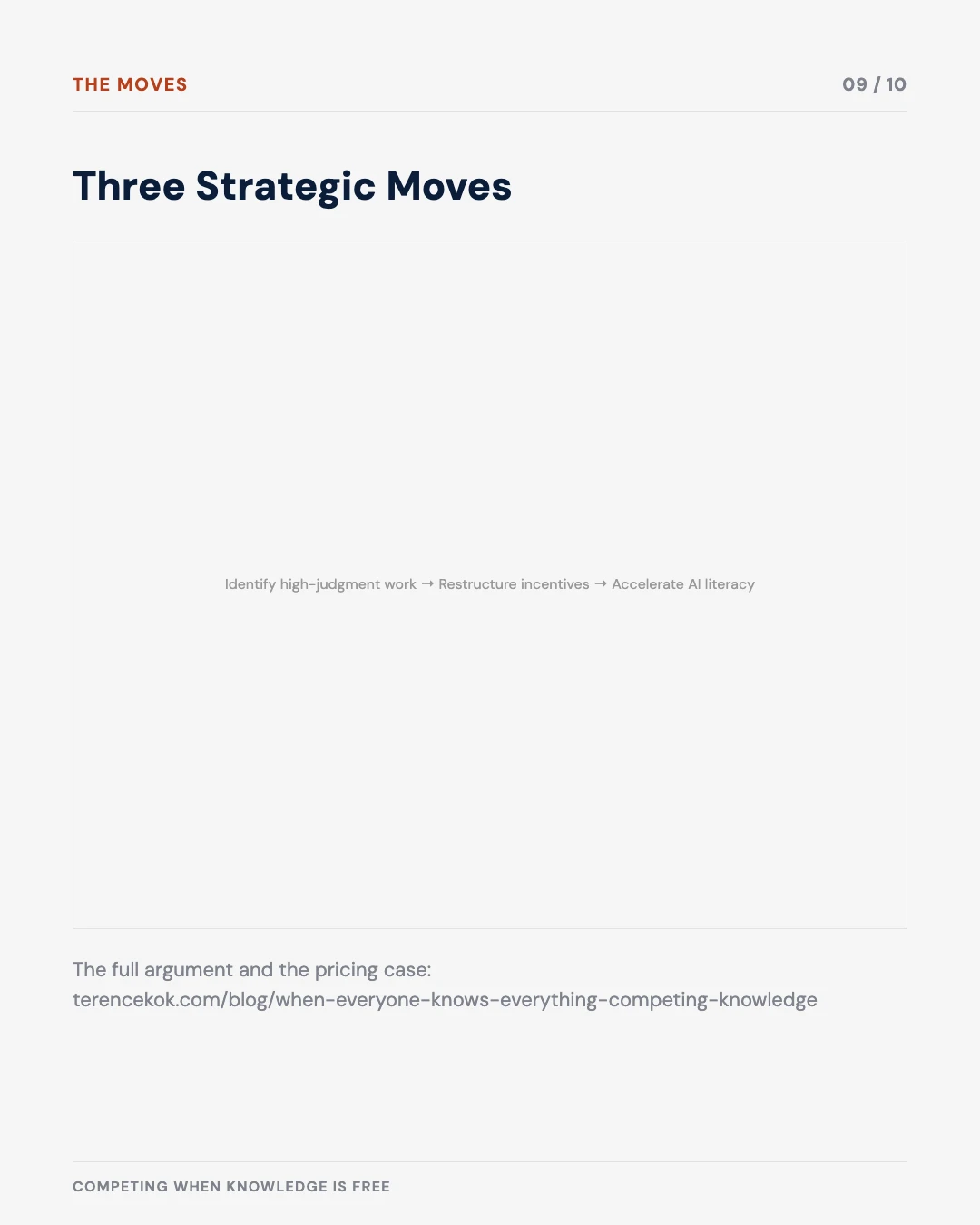
Three Strategic Moves to Make
First, identify high-judgment work. Audit your service offerings and internal workflows. Where does genuine human judgment matter most? Where does relationship capital drive client retention? Protect and invest in these areas; automate everything else.
Second, restructure incentives and compensation. Moving from hourly billing and knowledge-accumulation rewards to outcome-based pricing and judgment-based compensation requires fundamental HR and commercial restructuring. But it’s necessary. Organisations that don’t make this transition will lose talent to those that do.
Third, accelerate AI literacy across the workforce. Not everyone needs to be an AI engineer, but every knowledge worker needs to understand how to work with AI tools, interpret outputs, and direct AI toward high-value problems. This is now a core competency for professional advancement.
The question isn’t whether knowledge will be commoditised. It already is. The real question is what organisations value in a world where knowledge delivery is abundant and free. The answer is execution excellence on work where human judgment remains irreplaceable: asking better questions, building trust, integrating complexity, and translating machine-generated analysis into real-world decisions. Organisations and professionals who make deliberate moves toward judgment-intensive, relationship-centred, synthesis-focused work will sustain competitive advantage. Those clinging to knowledge accumulation as a defensive strategy will find that strategy is quicksand.
Those clinging to knowledge accumulation as a defensive strategy will find that strategy is quicksand.
Sources: Boston Consulting Group, consultant productivity research on routine versus complex tasks; Thomson Reuters, professional-services generative AI usage research; OpenAI, API pricing.
Was this useful?