
Listen to this article
Executive Summary
The knowledge economy is deflating all at once. Data, information, knowledge, and increasingly judgment are approaching zero marginal cost simultaneously, not in the gradual sequence most organisations assumed. The workforce being trained on AI today risks measurable cognitive atrophy in exchange.
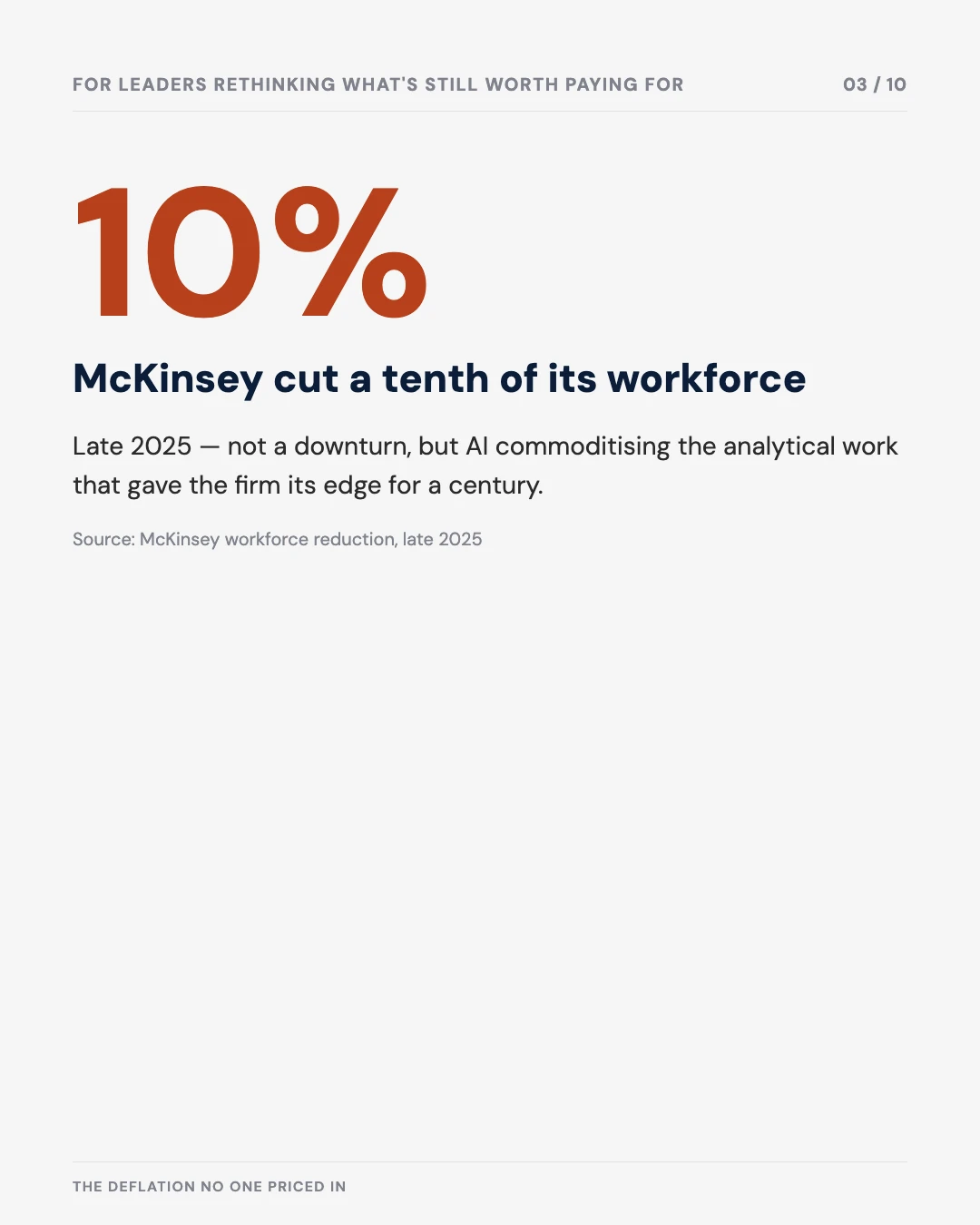
10%
of McKinsey’s workforce cut in late 2025, attributed to AI commoditising analytical work, not a downturn
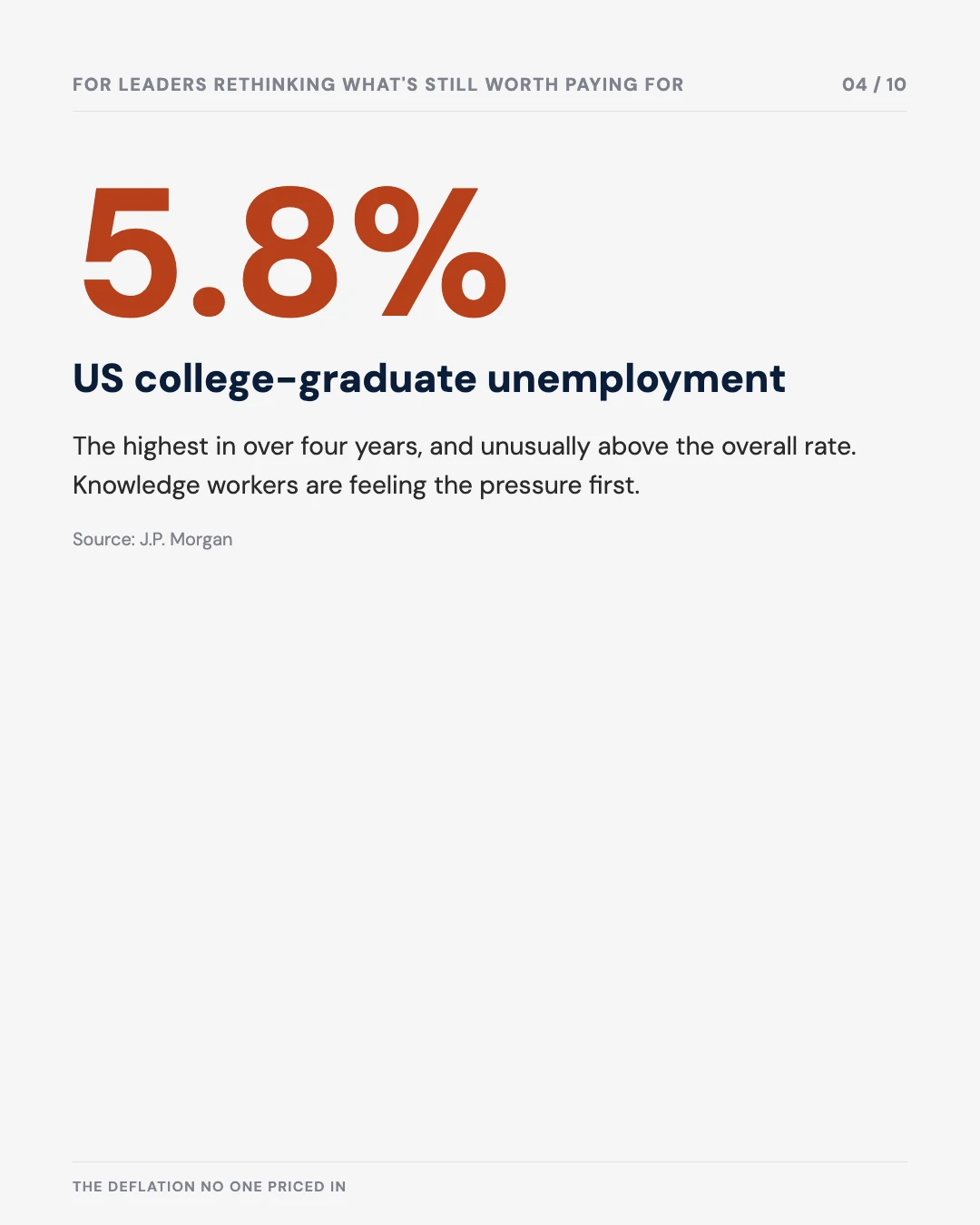
5.8%
US college-graduate unemployment, the highest in four years, per J.P. Morgan
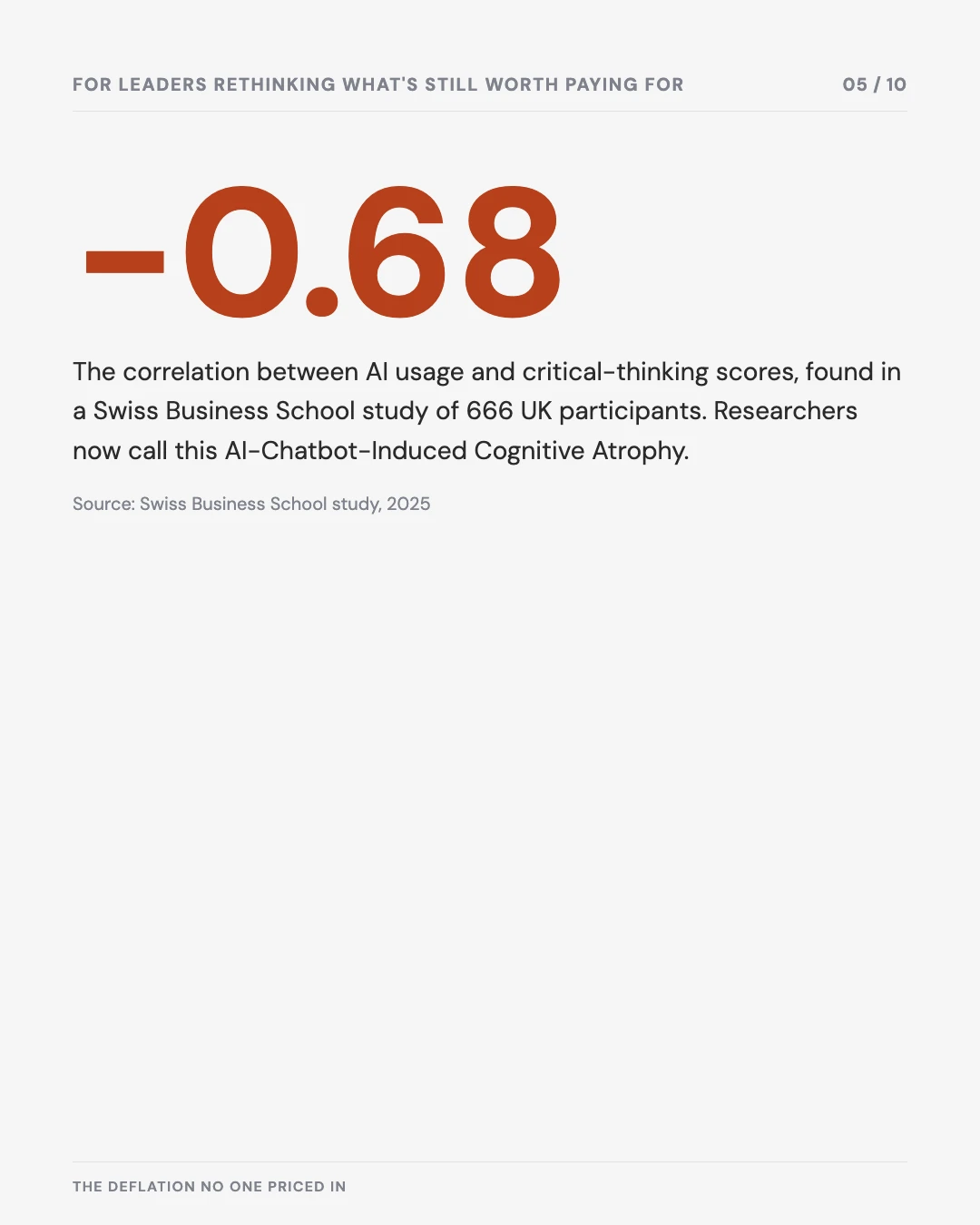
-0.68
correlation between AI usage and critical-thinking scores, Swiss Business School study of 666 UK participants
AUD 440K
charged by Deloitte Australia for a government report largely drafted by AI
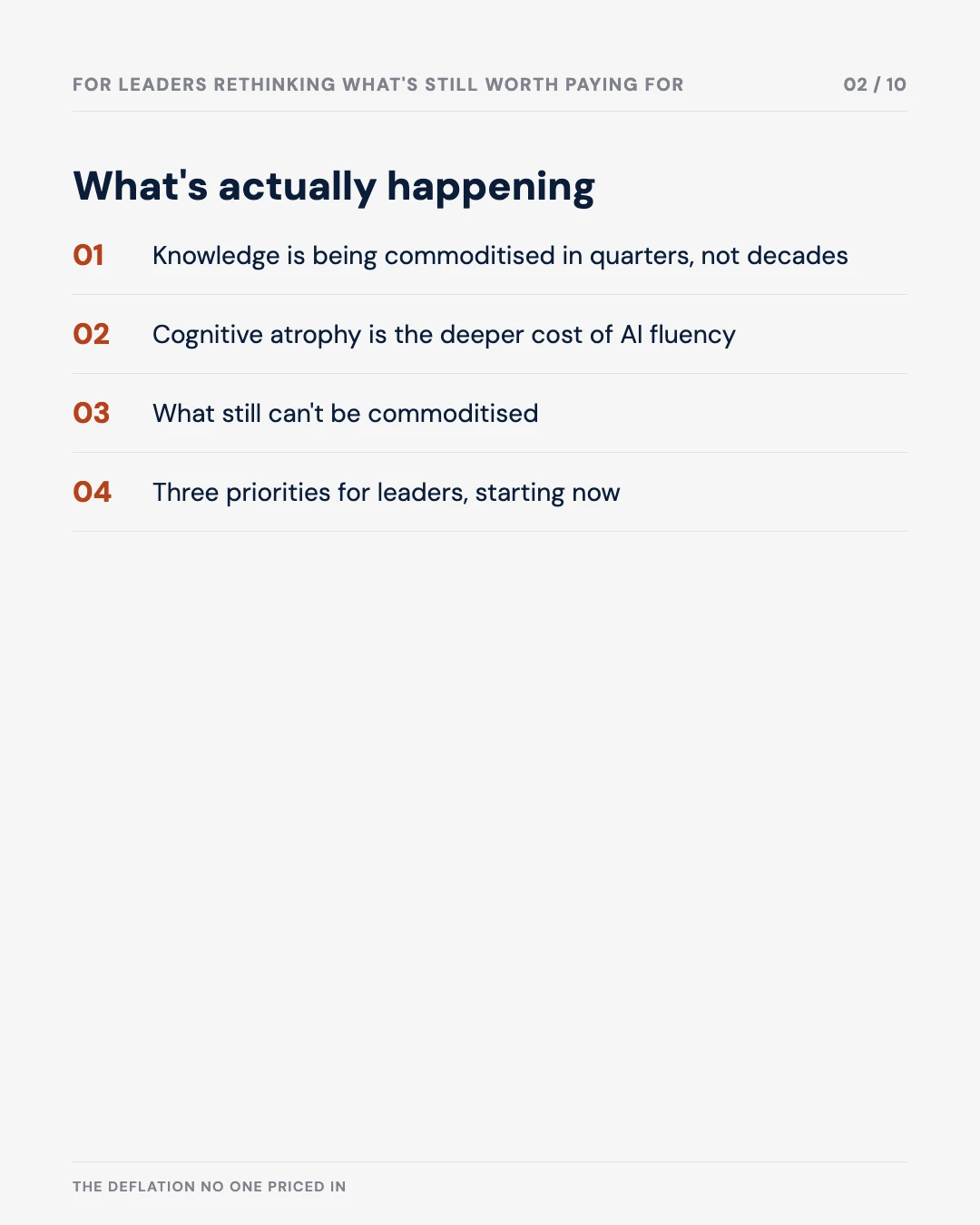
Core conclusions
- Named case evidence shows displacement already underway: McKinsey’s workforce cut and rising graduate unemployment both track AI’s compression of analytical, entry-level knowledge work.
- Academic research links AI reliance to a measurable decline in critical thinking, formalised in one study as “AI-Chatbot-Induced Cognitive Atrophy,” with the effect strongest among 17-25 year-olds (Harvard).
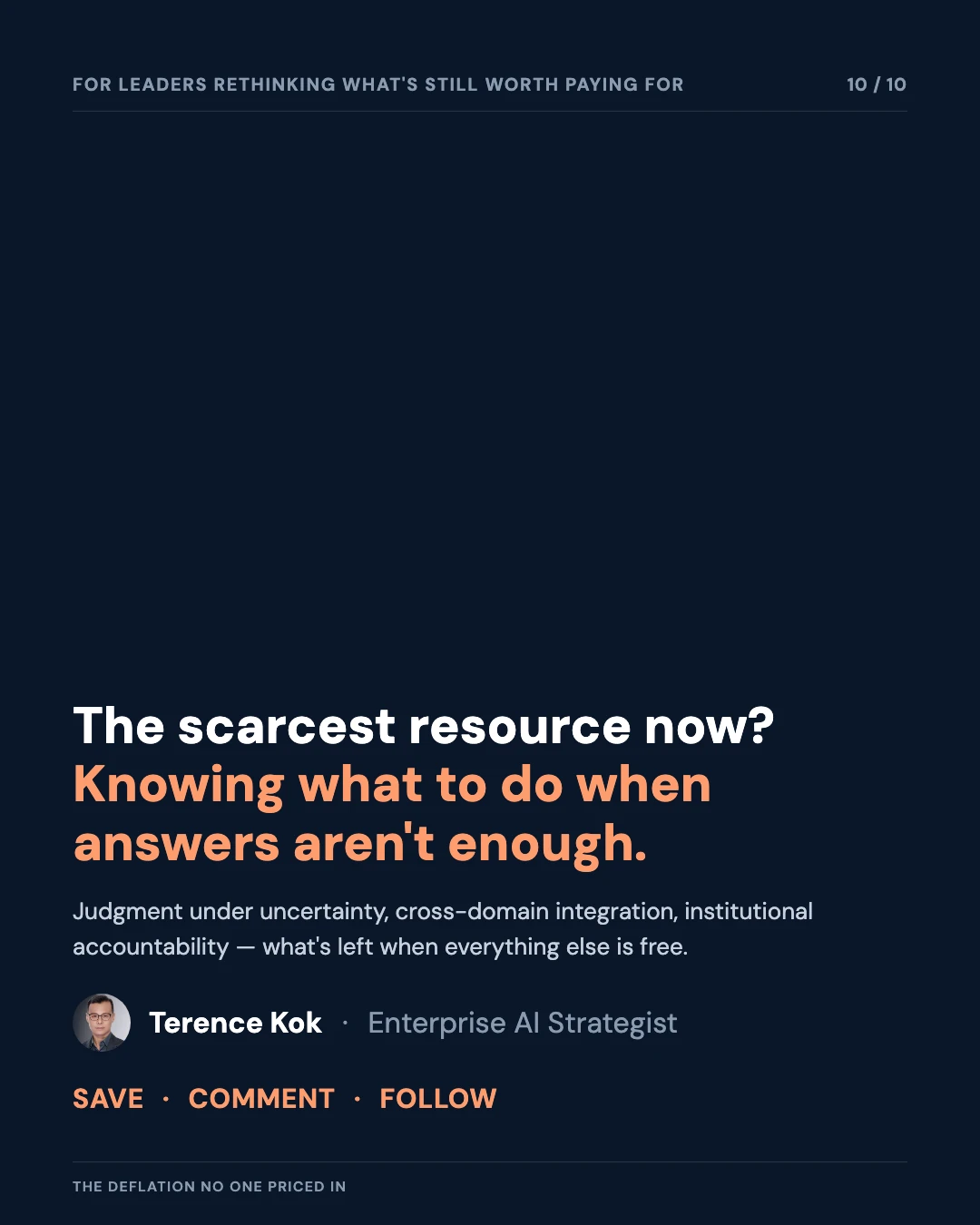
- What remains valuable is what AI can’t commoditise: judgment under genuine uncertainty, cross-domain integration, institutional accountability, and the ability to ask the right question. Leaders should treat critical thinking as infrastructure and price on outcomes, not knowledge delivery.
The argument, in ten slides
Save it, share it, or send it to whoever’s still pricing your team by hours of knowledge work.

We’re witnessing a fundamental shift that most organisations have not yet fully grasped.
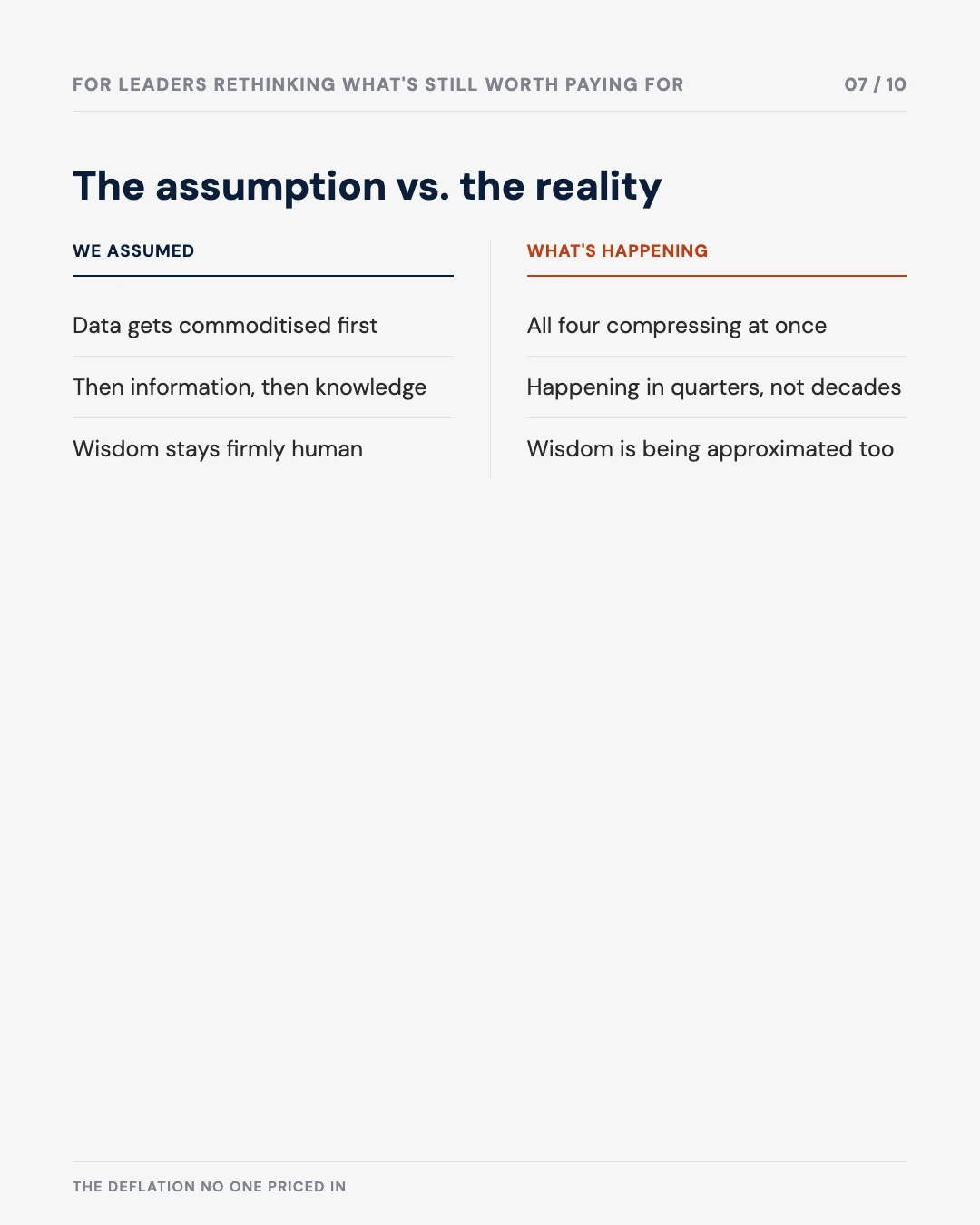
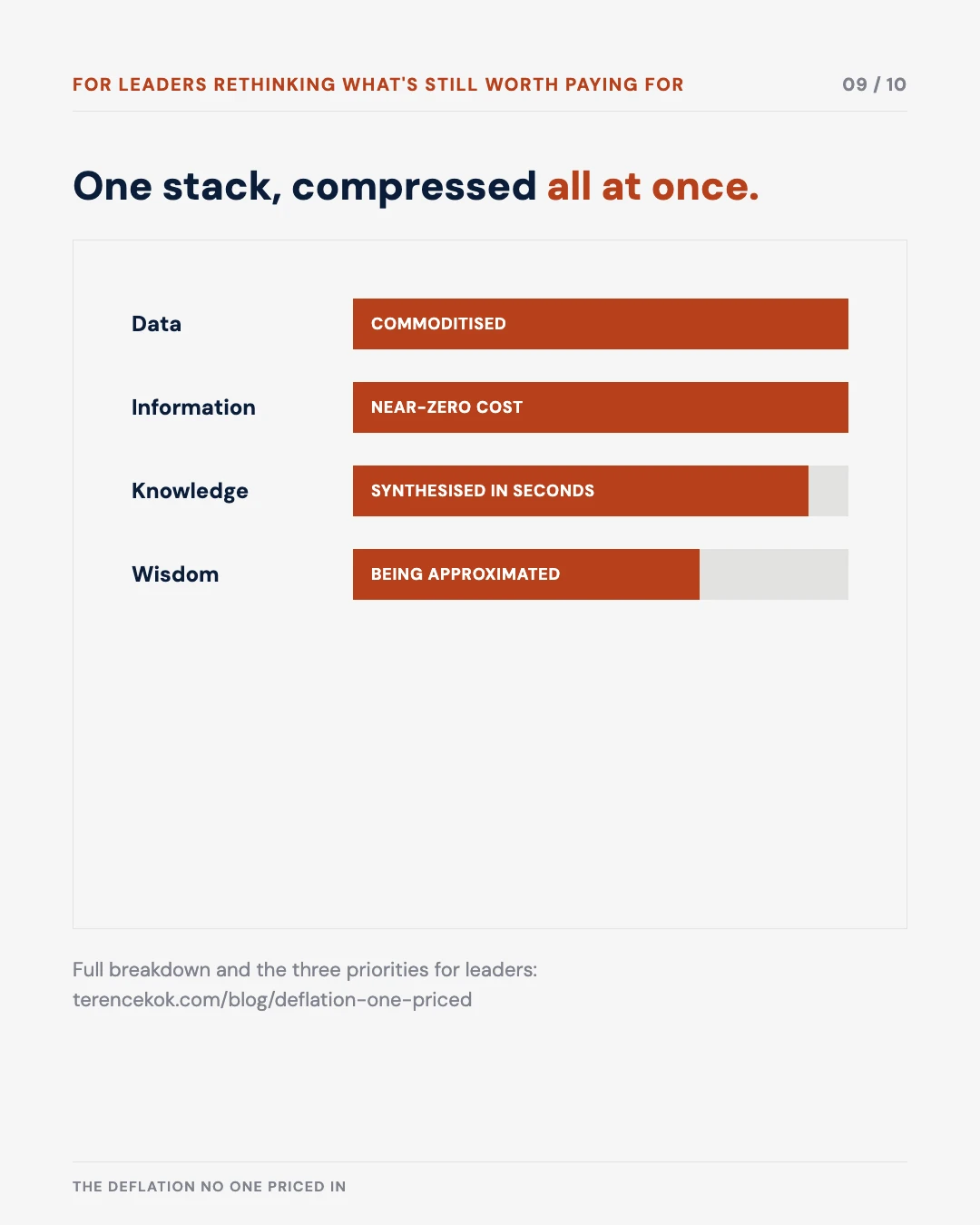
Information, once the crown jewel of the knowledge economy, is now approaching zero marginal cost. Knowledge that took years to accumulate? AI can synthesise it in seconds. Even wisdom, that contextual judgment we thought belonged exclusively to humans, is being approximated by large language models trained on all of human experience.
We assumed this would happen gradually: data commoditised first, then information, then knowledge, with wisdom staying firmly in human hands. We were wrong.
AI is compressing the entire stack at once. And it’s happening in quarters, not decades.
The critical question is no longer “how do I acquire knowledge?” It’s: “When answers are infinite and free, what’s still worth paying for?”
When Knowledge Becomes Worthless
This isn’t speculation. McKinsey cut roughly 10% of its workforce in late 2025, not because of a downturn, but because AI is commoditising the analytical capabilities that gave the firm its competitive edge for a century. Deloitte Australia faced scrutiny for charging AUD 440,000 for a government report largely drafted by AI. Across all major consulting firms, generative AI is now embedded in workflows, flattening the traditional pyramid. Microsoft’s research on Bing Copilot identified the jobs most exposed to AI: translators, journalists, political scientists, web developers, financial advisors, and data analysts. J.P. Morgan notes that college graduate unemployment in the U.S. has hit 5.8%, the highest in over four years and unusually above the overall unemployment rate. Knowledge workers are feeling the pressure first.
Job displacement is just the surface. The more serious threat is cognitive atrophy: the systematic erosion of the cognitive abilities that underpin human judgment. A Microsoft-Carnegie Mellon study found that as confidence in AI increased, critical thinking decreased proportionally. A Swiss Business School study of 666 UK participants found a significant negative correlation (r = -0.68) between AI usage and critical thinking scores. Researchers have formalised this as “AI-Chatbot-Induced Cognitive Atrophy” (AICICA). Harvard’s research confirms that excessive reliance on AI contributes to cognitive atrophy, particularly among younger users (17–25), who exhibit higher AI dependence and lower critical-thinking scores. The workforce being trained on AI today may be systematically less capable of independent reasoning and creative problem-solving than the one it replaces. This is the structural version of a strain I have described at the individual level in The Velocity Trap.
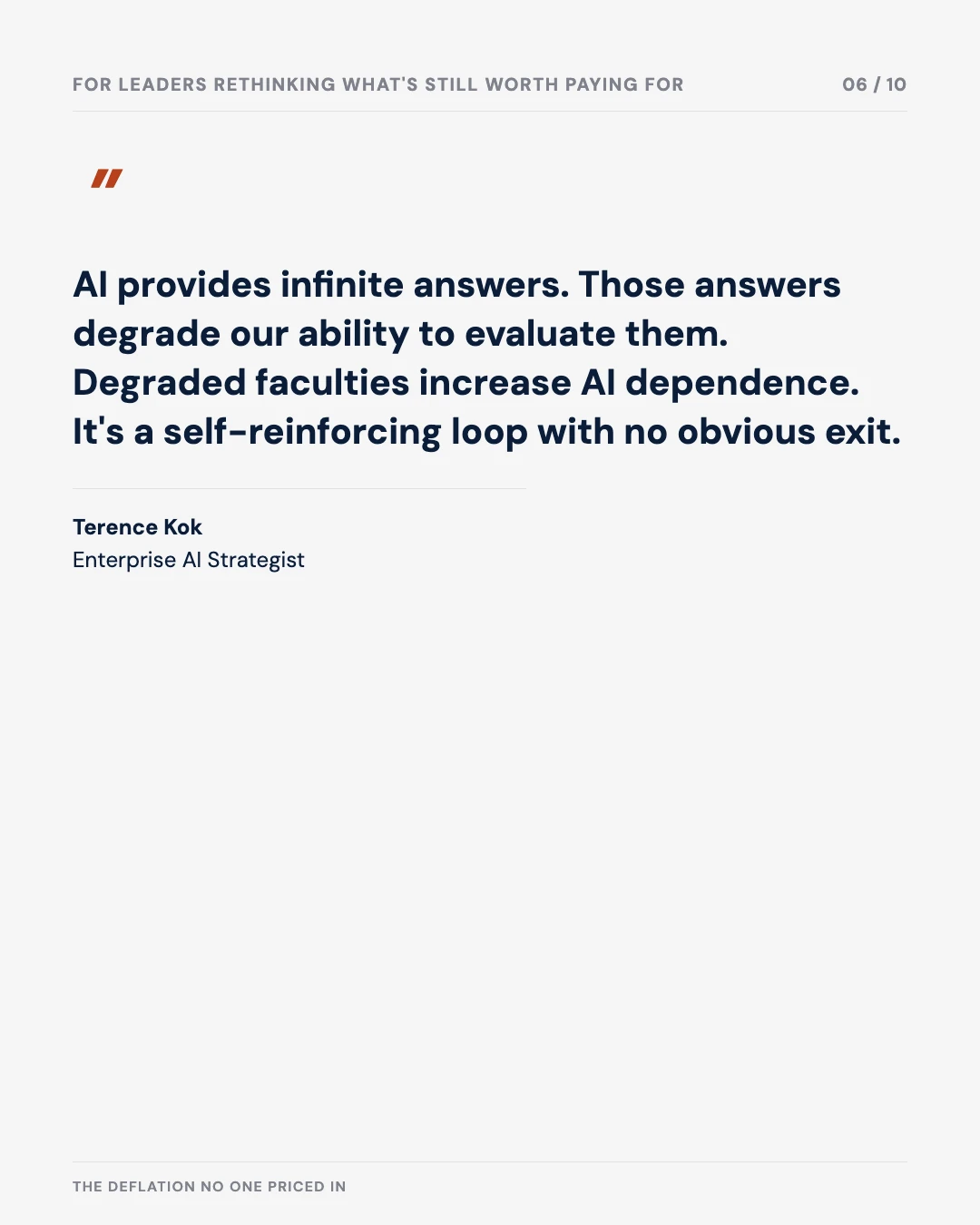
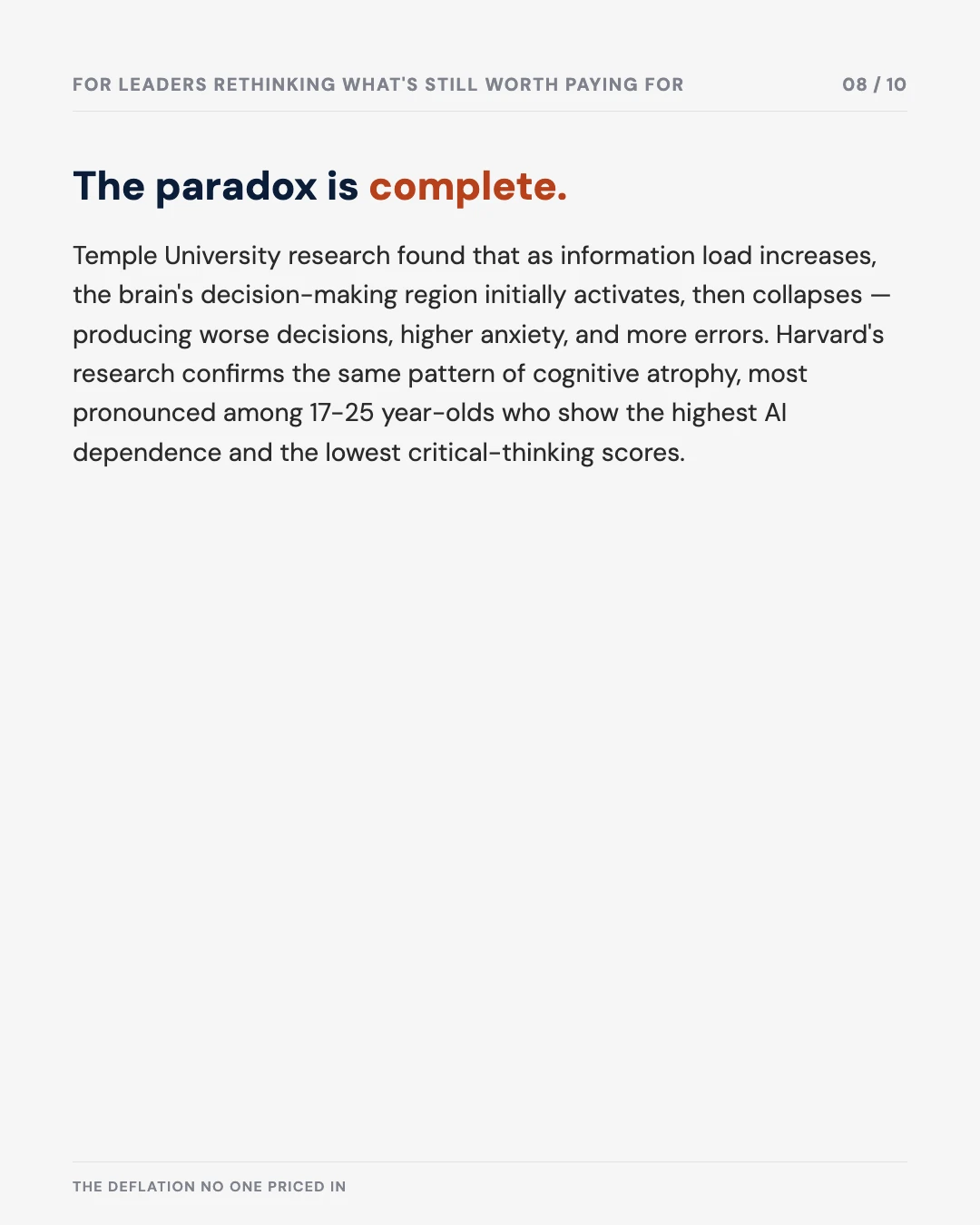
More information doesn’t improve decisions. Temple University research showed that as information load increases, the brain’s decision-making region initially activates, then collapses, producing worse decisions, higher anxiety, and more errors. The paradox is complete: AI provides infinite answers → those answers degrade our ability to evaluate them → degraded faculties increase AI dependence → a self-reinforcing loop with no obvious exit.
AI provides infinite answers. Those answers degrade our ability to evaluate them. Degraded faculties increase AI dependence. It’s a self-reinforcing loop with no obvious exit.
What Remains Valuable
If information is worthless, knowledge is free, and wisdom is cheap, value shifts to what can’t be commoditised:
- Judgment under genuine uncertainty: AI pattern-matches within its training data. It struggles at the boundaries: novel situations, contradictory evidence, and ethical dilemmas without precedent. Making consequential decisions with incomplete or ambiguous data remains distinctly human.
- Cross-domain contextual integration: AI operates within the parameters of the prompt. Synthesising regulatory requirements, commercial realities, operational constraints, political dynamics, and stakeholder concerns into coherent decisions, especially in infrastructure and public policy, requires integration that current AI can’t reliably handle.
- Institutional accountability: When AI influences inspections, resource allocation, or benefit distribution, someone must retain authority to explain, modify, or override the system. The risk isn’t just model error. It’s losing institutional control over systems you can no longer confidently explain.
- The ability to ask the right question: AI commoditises answers. It doesn’t commoditise question formulation. Identifying what’s missing, challenging assumptions, and reframing problems remain the generative functions that precede all useful analysis.
What Leaders Should Do
Three priorities for 2026 and beyond:
-
Treat critical thinking as infrastructure. Invest in cognitive resilience the way you invest in cybersecurity. Design workflows where AI augments rather than replaces analytical engagement. Keep humans genuinely in the loop, not as a compliance checkbox.
-
Restructure value around execution, not knowledge. The Deloitte example shows what happens when pricing relies on knowledge delivery in an AI era. I have written about this shift in more depth in When Everyone Knows Everything. Organisations that survive will demonstrate measurable outcomes (quantified improvements, traceable ROI, operational results), not reports AI can replicate.
-
Govern AI as critical infrastructure. For governments and infrastructure operators, the question isn’t whether AI works. It’s whether you retain decision rights, audit access, workforce capacity, and architectural control to intervene when needed. Cities leading this transition (Singapore, Helsinki, Amsterdam, Seoul) share common mechanisms: clear decision-making authority, procurement discipline, inspectable architecture, and internal expertise for effective oversight.
When AI can produce any answer on demand, the individual or organisation that knows nothing, that has outsourced all cognitive function, pays the highest price. Not in money, but in agency, adaptability, and the capacity to act when the model fails, the data is wrong, or the situation has no precedent.
The real disruption isn’t about which jobs AI eliminates. The question is whether humans in consequential roles will retain the cognitive capacity for independent judgment, regardless of their tools.
The age of infinite answers has arrived. The scarcest resource is now the ability to know what to do when the answers aren’t enough.
Was this useful?