
Listen to this article
Executive Summary
Buying an AI tool before checking whether the business can actually use it well doesn’t just waste money. It creates operational debt. This introduces the five readiness dimensions (data, process, governance, team capability, measurement) that determine whether a first deployment succeeds.
Core conclusions
- Data readiness comes first because every other dimension depends on it: a well-governed, well-staffed business still fails if the underlying data doesn’t exist or isn’t reliable.
- Governance is not compliance overhead reserved for large organisations. Even a one-person business needs a conscious answer to who reviews AI output before it goes out.
- Measurement should be designed before deployment, not after, or any post-deployment improvement becomes impossible to attribute to the AI system.
The five questions, in ten slides
Save it before you buy anything, or send it to the owner about to sign a contract.
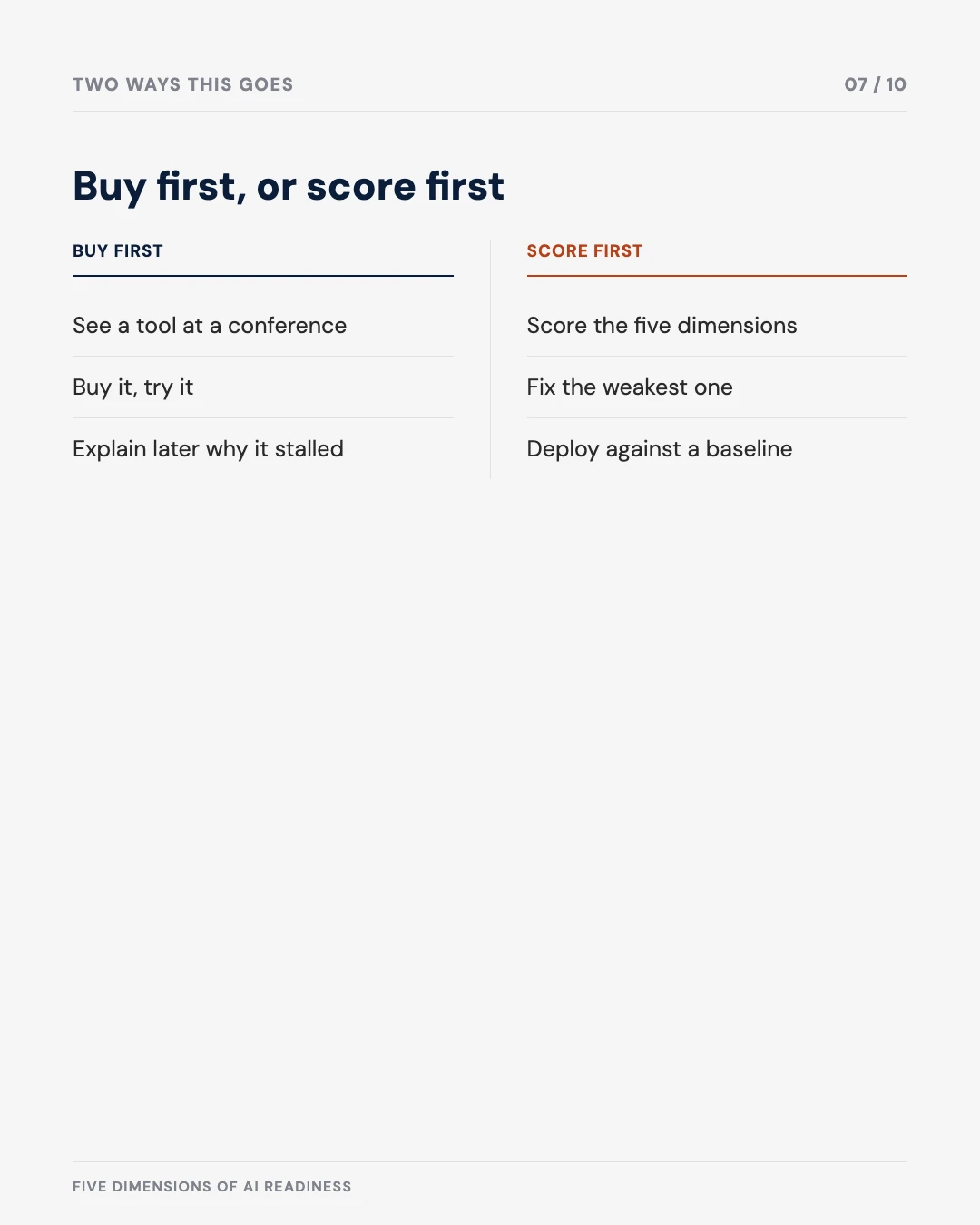

Most business owners encounter AI the same way: someone at a conference mentions a tool, or an article runs about competitors automating their customer service. The instinct is to act. Buy something. Try it.
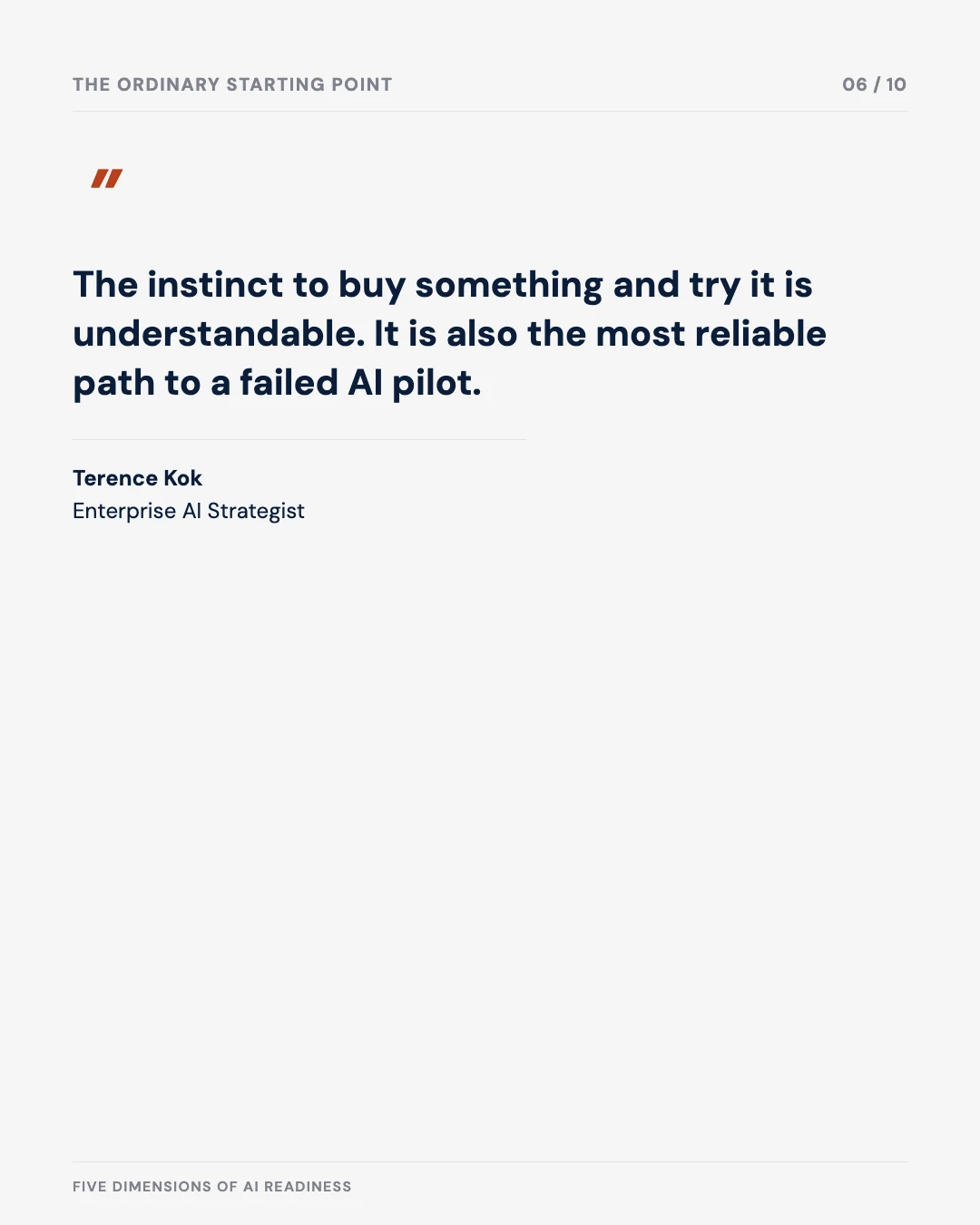
The instinct is understandable. It is also the most reliable path to a failed AI pilot.
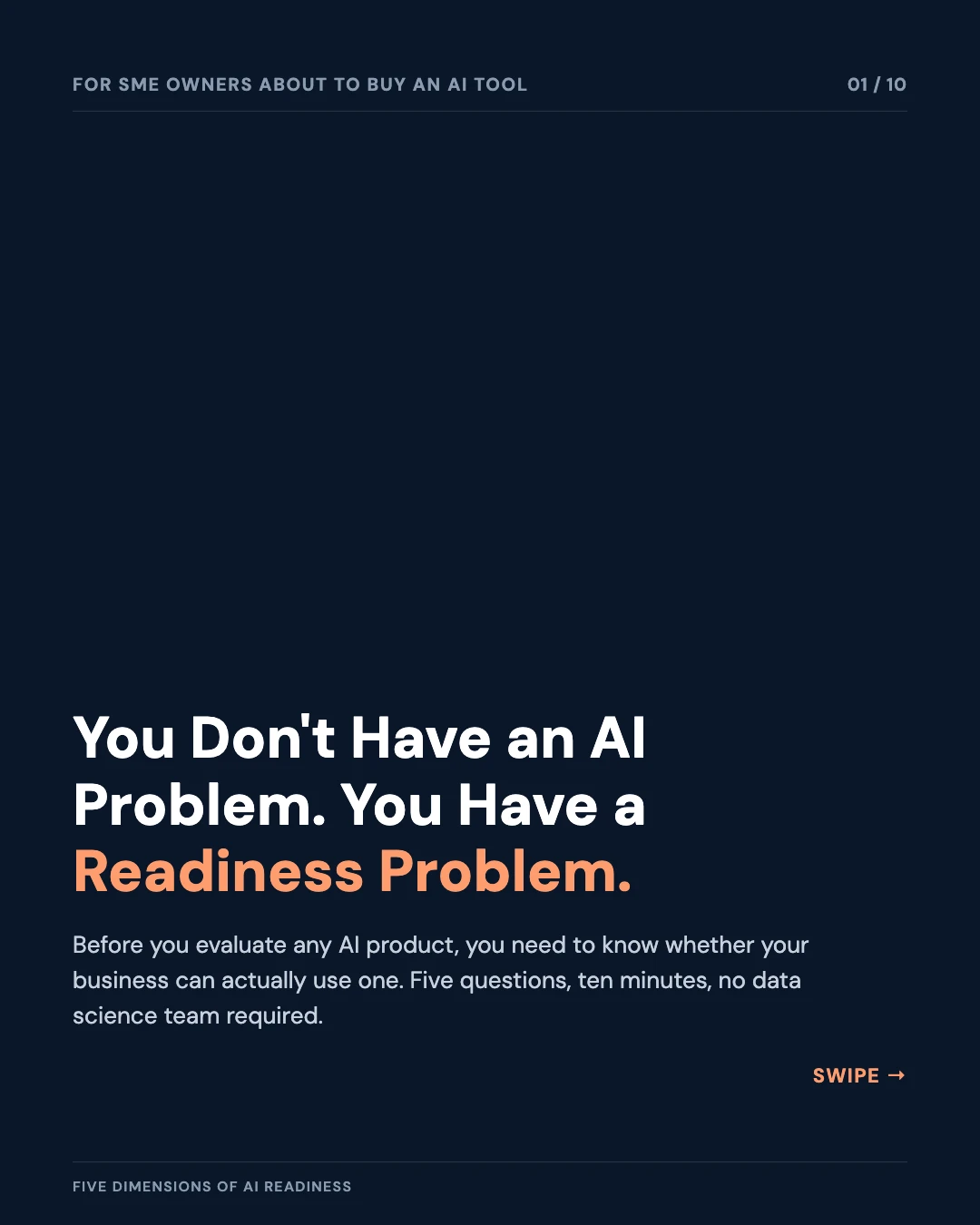
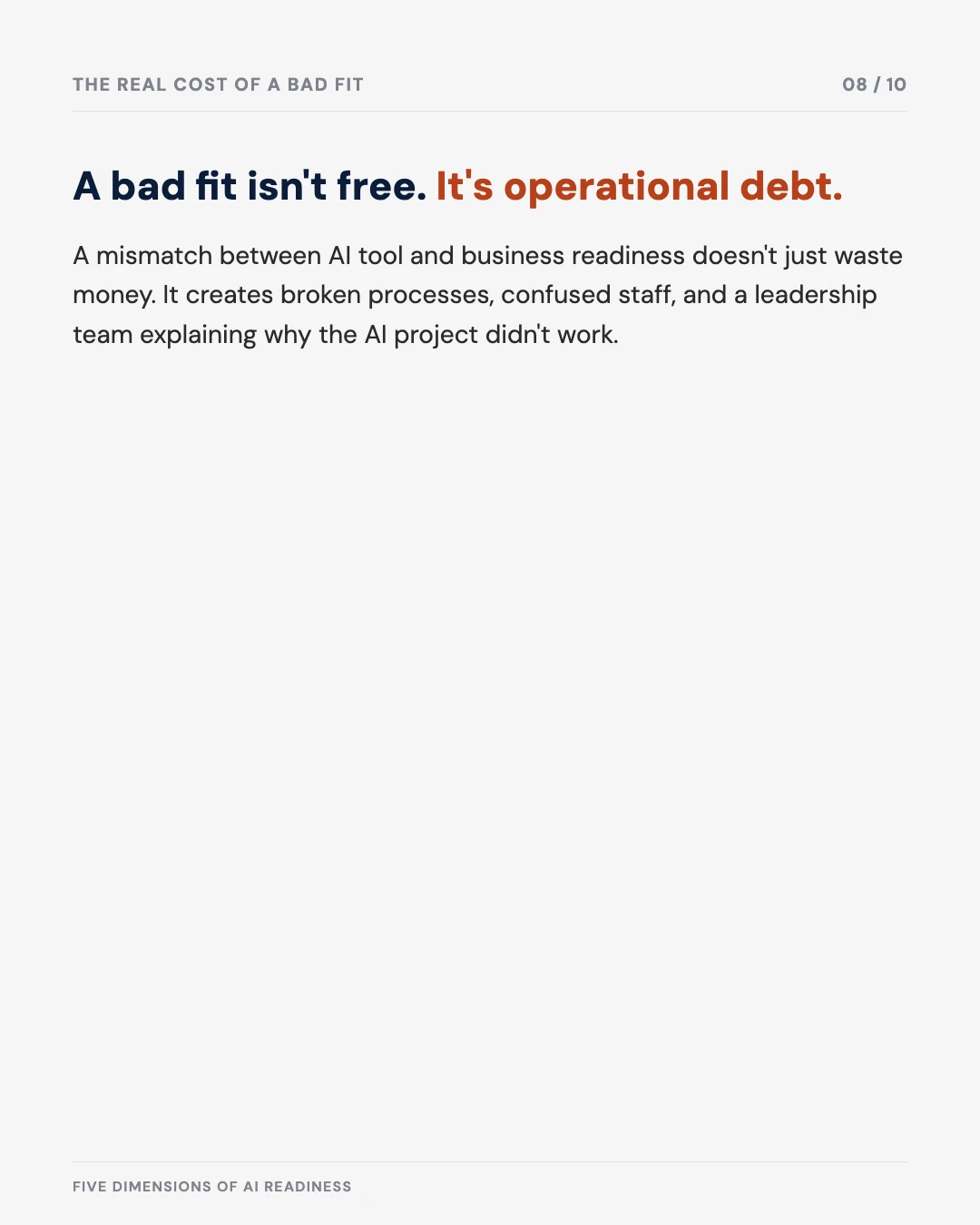
Before you evaluate any specific product, you need to know whether your business is in a position to use it well. A bad fit between AI tool and business readiness does not just waste money. It creates operational debt: broken processes, confused staff, and a leadership team that now has to explain why the AI project did not work.
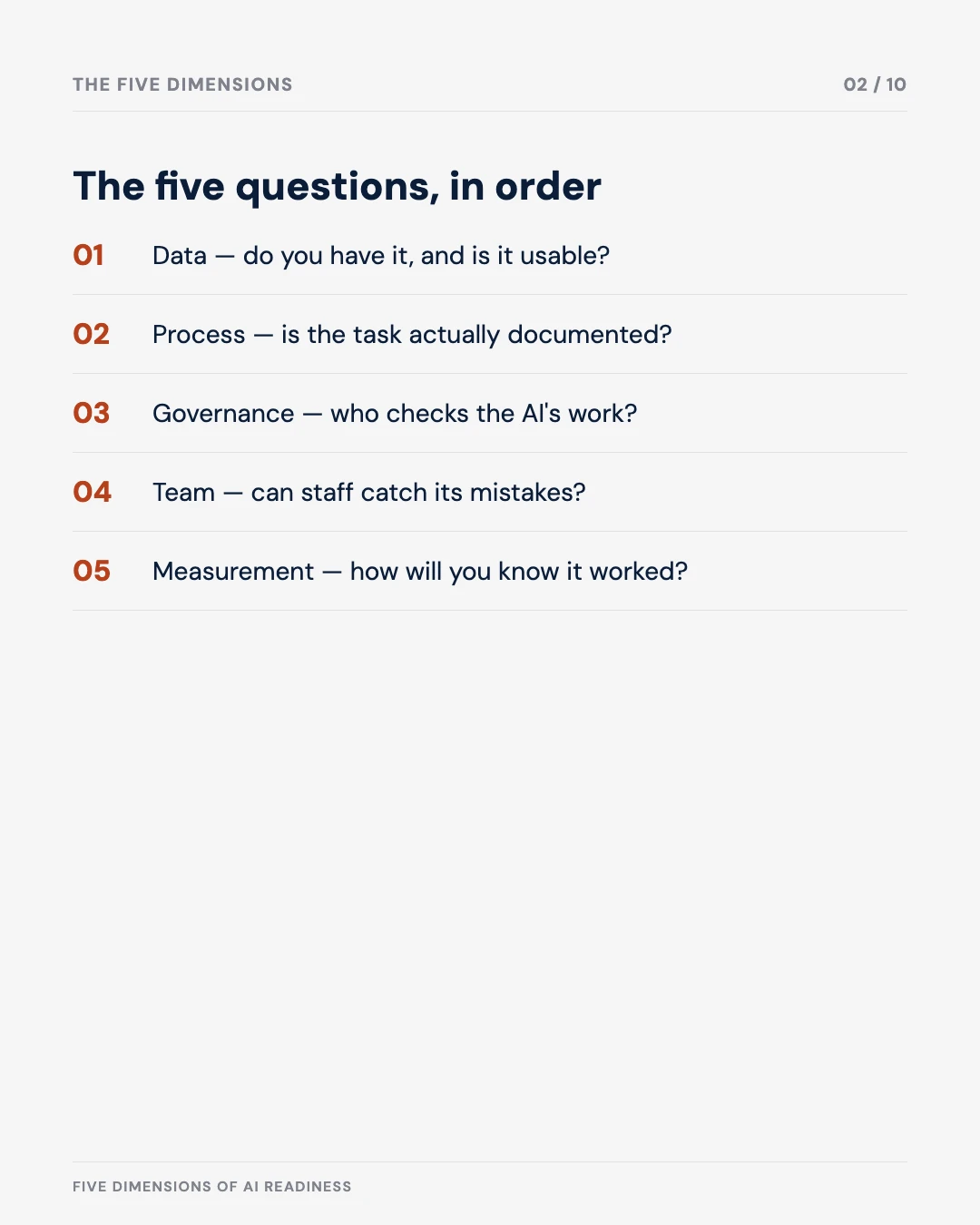
This article introduces the five dimensions of AI readiness that every SME should assess before committing to any AI investment. Each dimension gets its own article in this series, with a self-check at the end of each. The five together form the basis of the scorecard used in the AI Governance & ROI Executive Programme.
Where this framework comes from
The five dimensions are adapted from the Eight-Dimension AI Readiness Assessment in Appendix A of AI at Scale: From Pilot to Production, which was developed for enterprise and government deployments across Asia and the Middle East. For SME marketing operations, eight dimensions are more than necessary. Five cover the decisions that actually determine whether a first deployment succeeds or fails.
They are not abstract. Each one maps to a question you can answer without a data science team.
The five dimensions
1. Data Readiness
Do you have the data your AI system will need, and is it in a usable state?
AI systems learn from data, retrieve from data, and act on data. Before any AI deployment makes sense, the data that system will depend on needs to exist, be accessible, and be sufficiently clean to produce reliable outputs.
For a marketing-focused SME, this typically means: customer records, purchase history, campaign performance data, and product or service catalogue information. The questions are whether that data is actually documented, whether it is in one place or scattered across tools, and whether it is current.
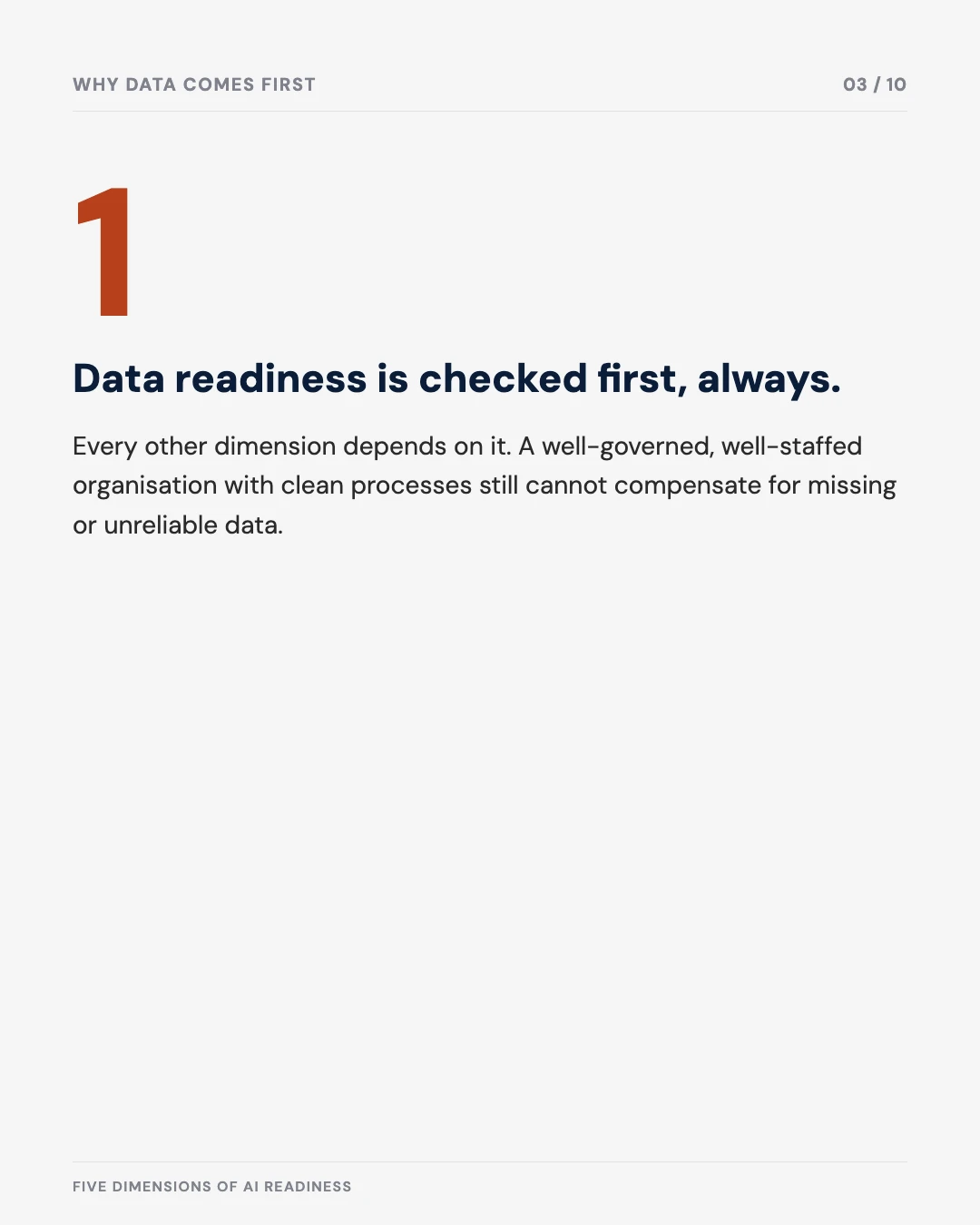
Why this matters first: Every other readiness dimension depends on this one. A well-governed, well-staffed organisation with good processes cannot compensate for missing or unreliable data. The AI system will be unreliable at best, actively misleading at worst.
2. Process Definition
Are the tasks you want to automate clearly documented, bounded, and consistent?
AI systems work best on tasks with clear inputs, defined steps, and predictable outputs. They work worst on tasks that depend on context a human understands implicitly, on judgment calls that vary by situation, or on processes that are not actually documented anywhere.
Before deploying AI to automate a task, you need to be able to describe that task in enough detail that a new employee could follow it on day one. If you cannot do that, the AI system will surface the ambiguity as unpredictable behaviour.
Why this is the second check: Data readiness tells you whether you have the raw material. Process definition tells you whether you know what you are trying to do with it.
3. Governance Structure
Who approves AI-assisted decisions, and what happens when the AI is wrong?
This is the dimension most business owners skip because it feels like compliance overhead for large organisations. It is not. Even a one-person business using an AI tool to draft customer communications needs a governance answer: who reviews the output before it goes out? What is the process when it produces something wrong or harmful?
Governance does not require a committee. For a small business, it might be as simple as: AI drafts, owner reviews before sending. But it needs to be a conscious decision, not an absent one.
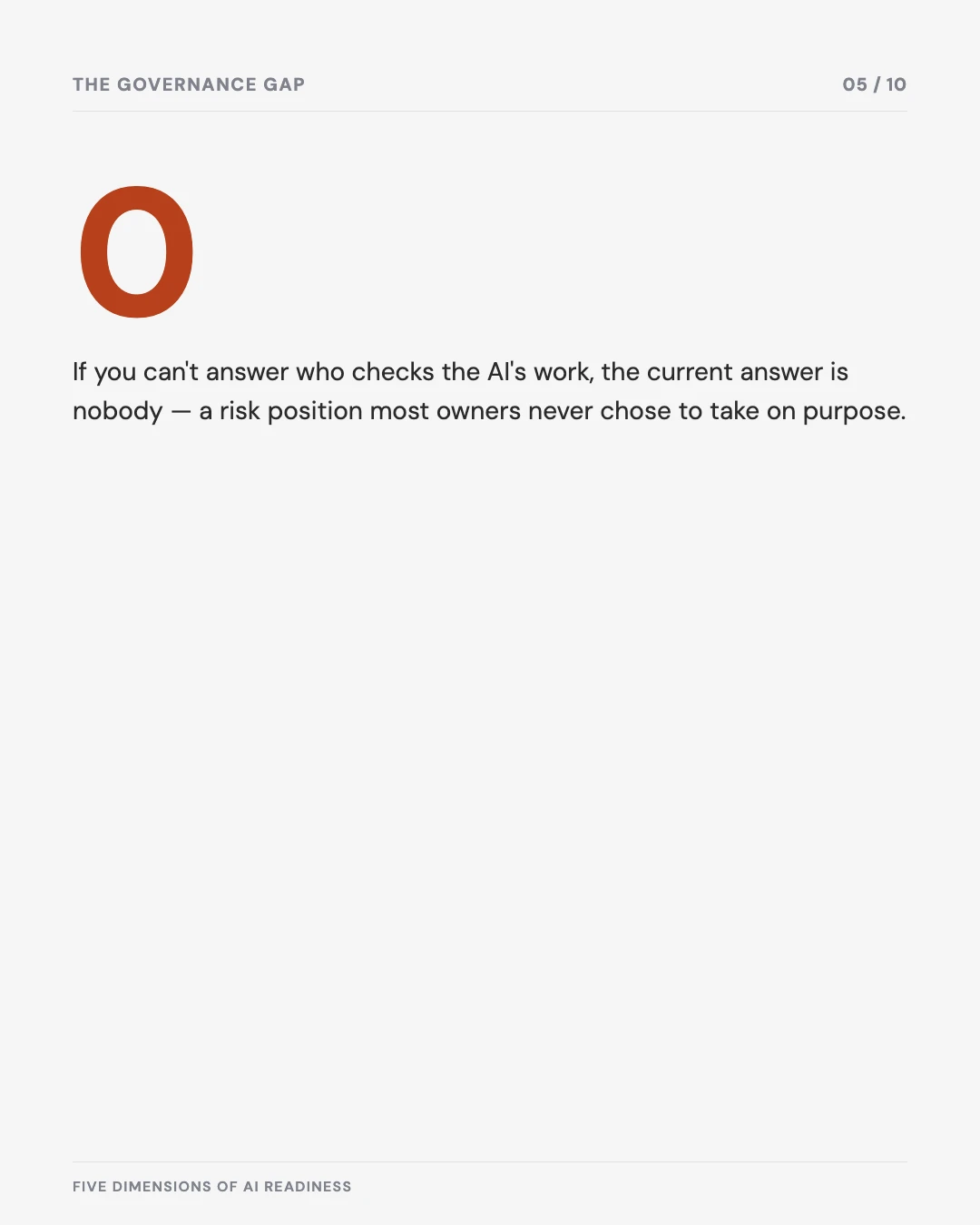
Why this comes before team capability: Governance structure determines how much risk you are taking on. If you cannot answer who checks the AI’s work, the answer is currently “nobody,” which is a risk position you may not have intended to take.
If you cannot answer who checks the AI’s work, the answer is currently “nobody.”
4. Team Capability
Can your team operate, review, and correct AI outputs without specialist support?
The question is not whether your team is technically sophisticated. It is whether they can use the specific tool you are deploying confidently enough to catch errors, escalate problems, and maintain accountability for outputs.
An AI tool that nobody on the team understands creates a black box. Work goes in. Something comes out. Nobody is sure whether it is right. Over time, people either stop using it or stop checking it. Both outcomes are worse than not deploying at all.
Why this matters: Team capability is the operational layer. Even with perfect data, clear processes, and good governance, if the people who need to use the tool daily cannot do so with confidence, the deployment will quietly fail.
5. Measurement Framework
Do you know what business outcome you are trying to move, and how you will measure whether it moved?
This is the dimension that separates deployments that produce documented ROI from deployments that “feel like they are working.” The measurement framework needs to be defined before deployment, not after. Otherwise you will have no baseline to compare against, and any post-deployment improvement becomes impossible to attribute.
For an SME marketing operation, the measurement is typically: how much time is this saving, is the output quality acceptable (and how do you define acceptable), and is the downstream business metric it was supposed to affect actually moving?
Why this comes last in the assessment but first in the planning: You need to understand the other four dimensions before you can set a realistic measurement target. But once you do, measurement should be the first thing you design.
What comes next
Each of the five articles in this series covers one dimension in depth. Each ends with a partial self-check you can complete in under ten minutes. All five self-checks together form the five-dimension readiness scorecard.
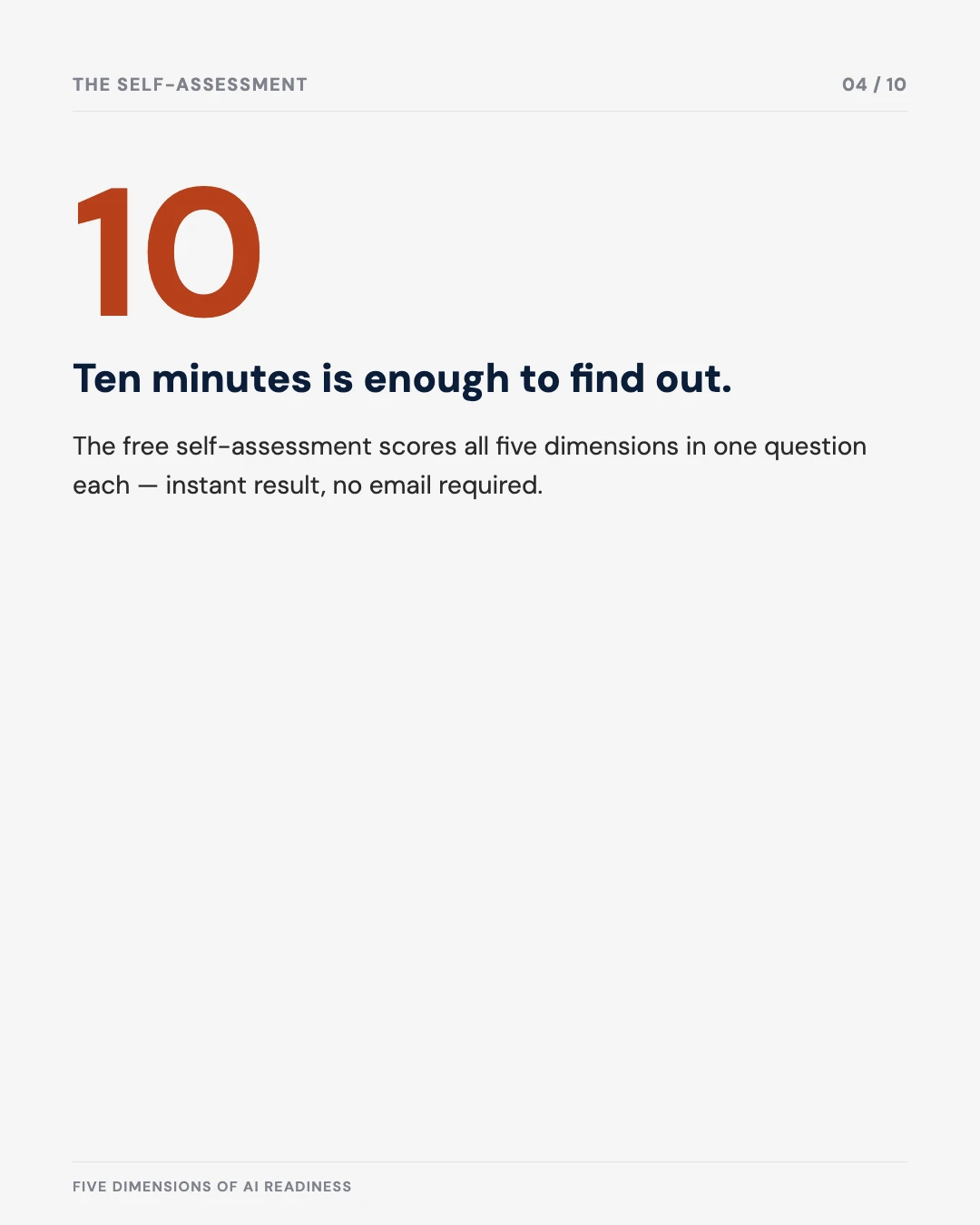
If you want to score all five dimensions now rather than working through the series, the AI Readiness Self-Assessment does it in ten minutes: one question per dimension, instant result, no email required. For a more detailed diagnostic across 17 questions with per-dimension breakdown bars, the Organisational AI Readiness Quiz takes around fifteen minutes.
If you want to go deeper with a facilitated session, the AI Governance & ROI Executive Programme covers this in a half-day structured session, with a scored baseline and a twelve-week improvement roadmap as the output.
This framework is adapted from the Eight-Dimension AI Readiness Assessment in Appendix A of AI at Scale: From Pilot to Production. The original assessment was developed for enterprise and government deployments. The five-dimension SME version covers the dimensions with the highest failure rate in first deployments.
Free tool
AI Readiness Self-Assessment
Score your business across these same five dimensions in about ten minutes, one question per dimension, instant result, no email required.
Free tool
Organisational AI Readiness Quiz
Want the longer version? 17 questions across the same five dimensions, with per-dimension breakdown bars and a tiered roadmap.
Was this useful?