Listen to this article
Executive Summary
Formal curricula move on approval cycles measured in years while frontier AI moves weekly, so relying on a qualification alone now means arriving on the job with skills that are already out of date. Closing that gap is a self-directed responsibility, for graduates and practising engineers alike.
Core conclusions
- The core constraint is the absence of industry context inside the standard curriculum, not a lack of technical grounding, and that has to be built alongside the degree, not after it.
- For practising engineers, self-directed micro-learning isn’t optional development; it’s what stands between them and being displaced by whoever adapts faster.
- A repeatable three-step loop turns upskilling into a habit rather than a one-off effort: deconstruct the architecture, build a minimal prototype, then deploy and benchmark it.
The framework, in ten slides
Save it, share it, or send it to a graduate or engineer building their own loop.
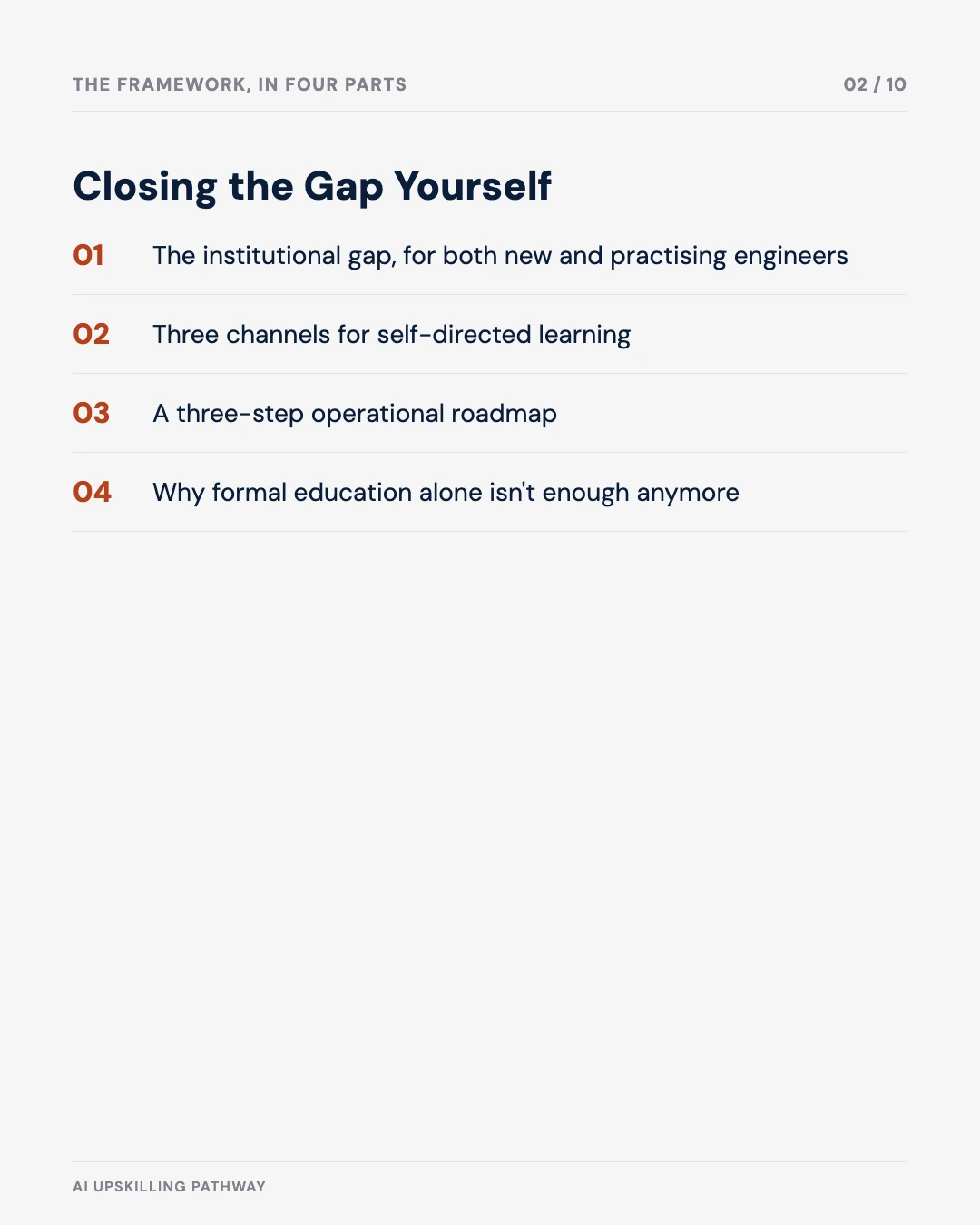
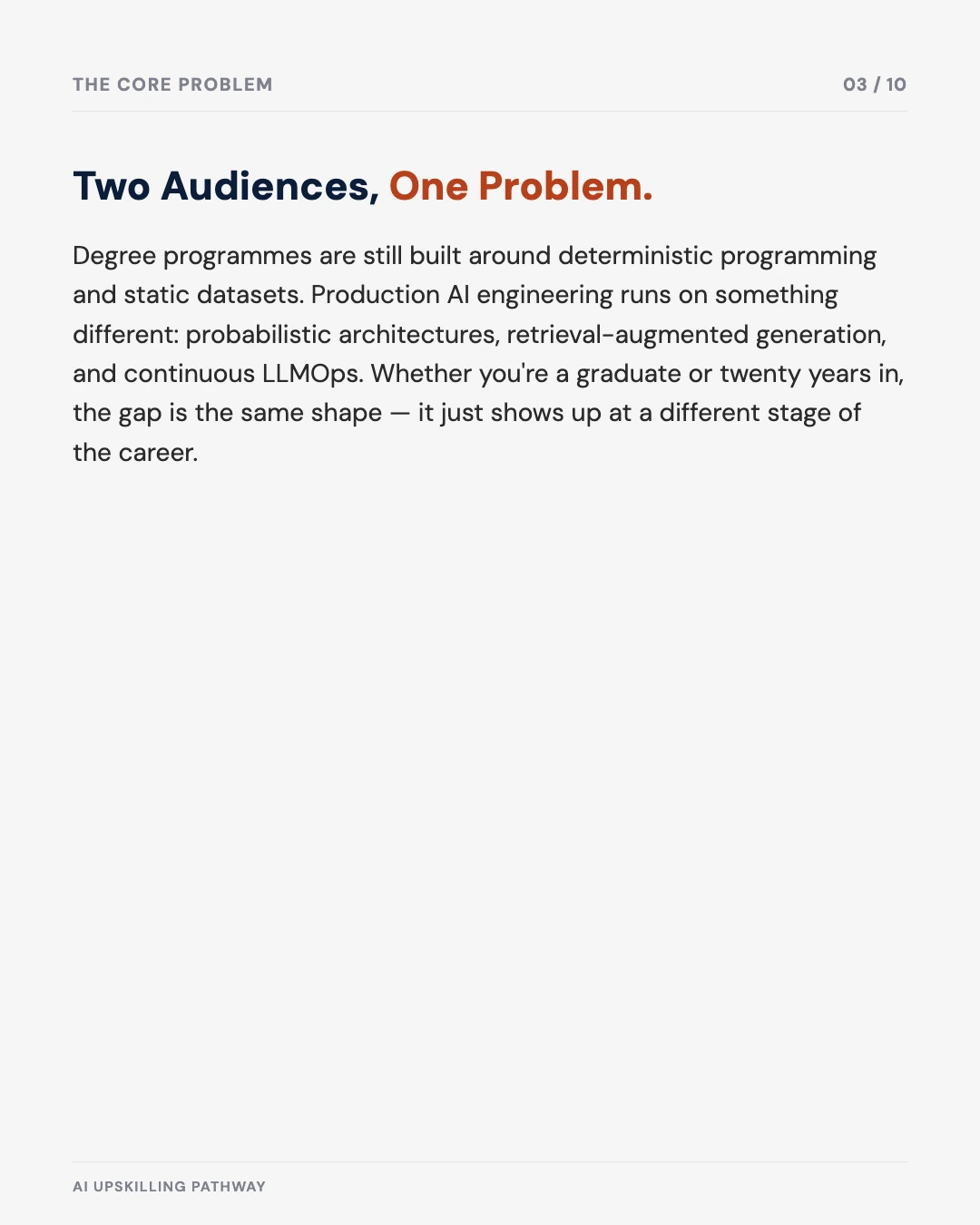
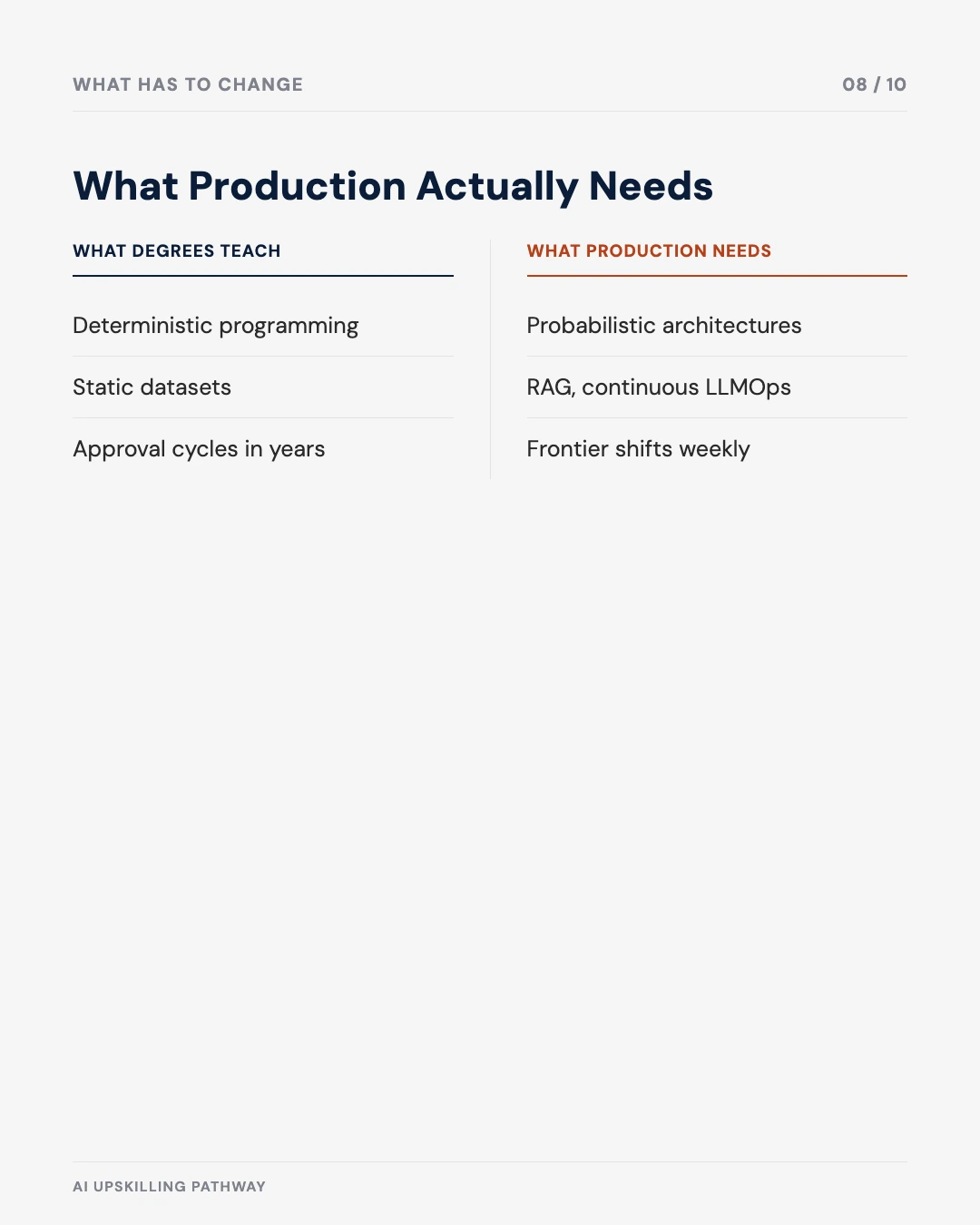
The velocity of AI development has created a structural gap between what institutions teach and what production systems require. Academic curricula offer solid foundations in mathematics and computer science, but the approval cycles behind a formal syllabus can’t track weekly shifts in frontier models, deployment frameworks, and operational practice. Relying on a qualification alone now carries a real risk: arriving on the job with skills that are already out of date.
I go deeper on this framework in the video below:
The Institutional Gap for Emerging Talent
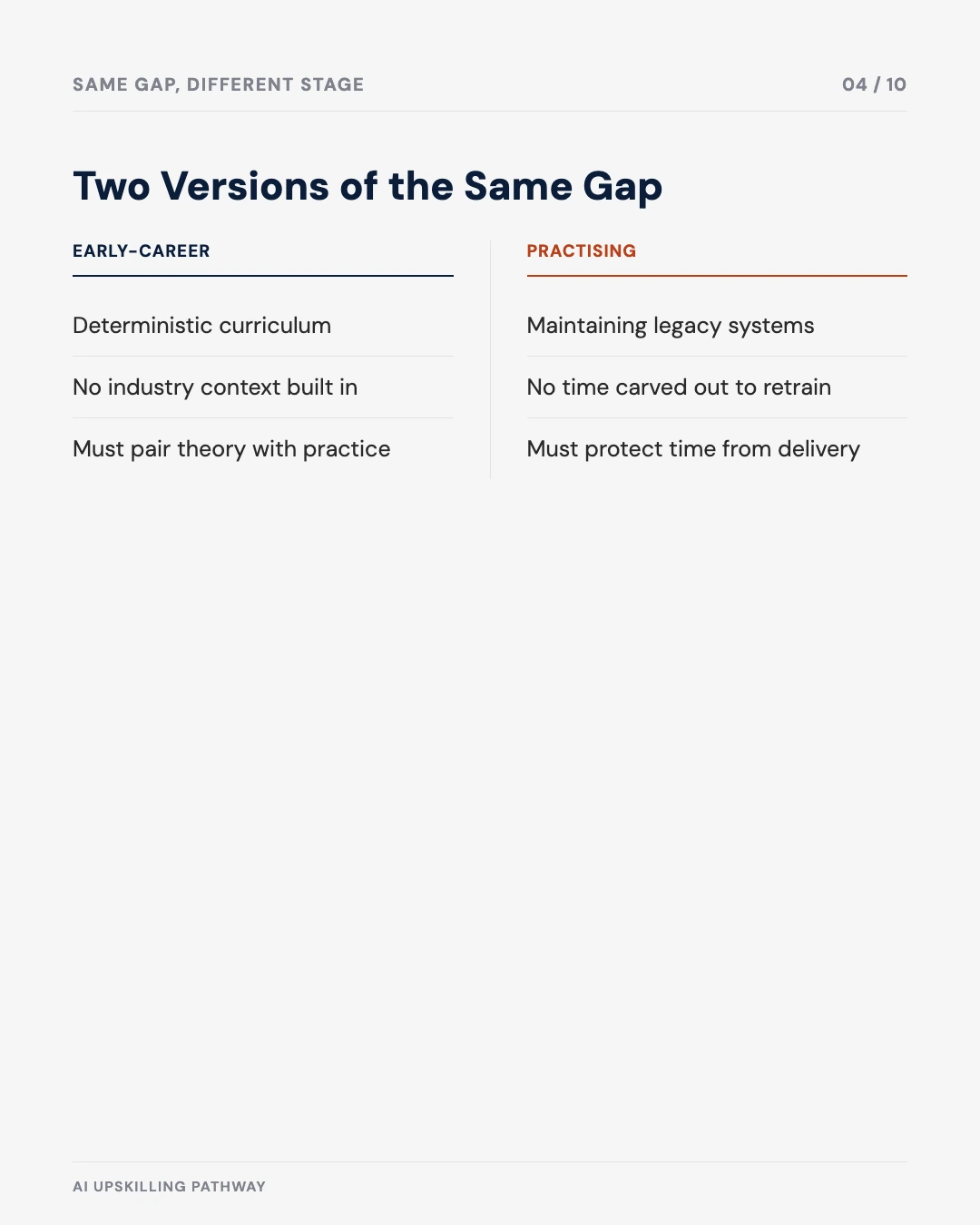
For school leavers and early-career engineers, the jump from academic environments to production systems exposes a real capability gap. Degree programmes are still built around deterministic programming and static datasets. Production AI engineering runs on something different: probabilistic architectures, retrieval-augmented generation, and continuous LLMOps.
The core constraint isn’t a lack of technical grounding, it’s the absence of industry context inside the standard curriculum. Closing that gap falls to the individual: theoretical foundations need to be paired with agile, self-directed practical work, built alongside the degree rather than after it. I have written a companion piece aimed squarely at graduates navigating that exact transition.
The Adaptation Imperative for Practising Engineers
Mid-career and senior engineers face a different version of the same problem: maintaining legacy enterprise systems while integrating AI capabilities into them. For this group, self-directed learning isn’t optional professional development, it’s what stands between them and being displaced by whoever picks it up faster.
Formal retraining programmes rarely fit around a full-time delivery schedule, so the practical alternative is micro-learning: regularly assessing how new AI design patterns intersect with the security protocols, data pipelines, and infrastructure already in production. The trade-off is real. It means protecting time for non-deterministic system architecture against the pull of immediate delivery pressure, and treating that time as non-negotiable.
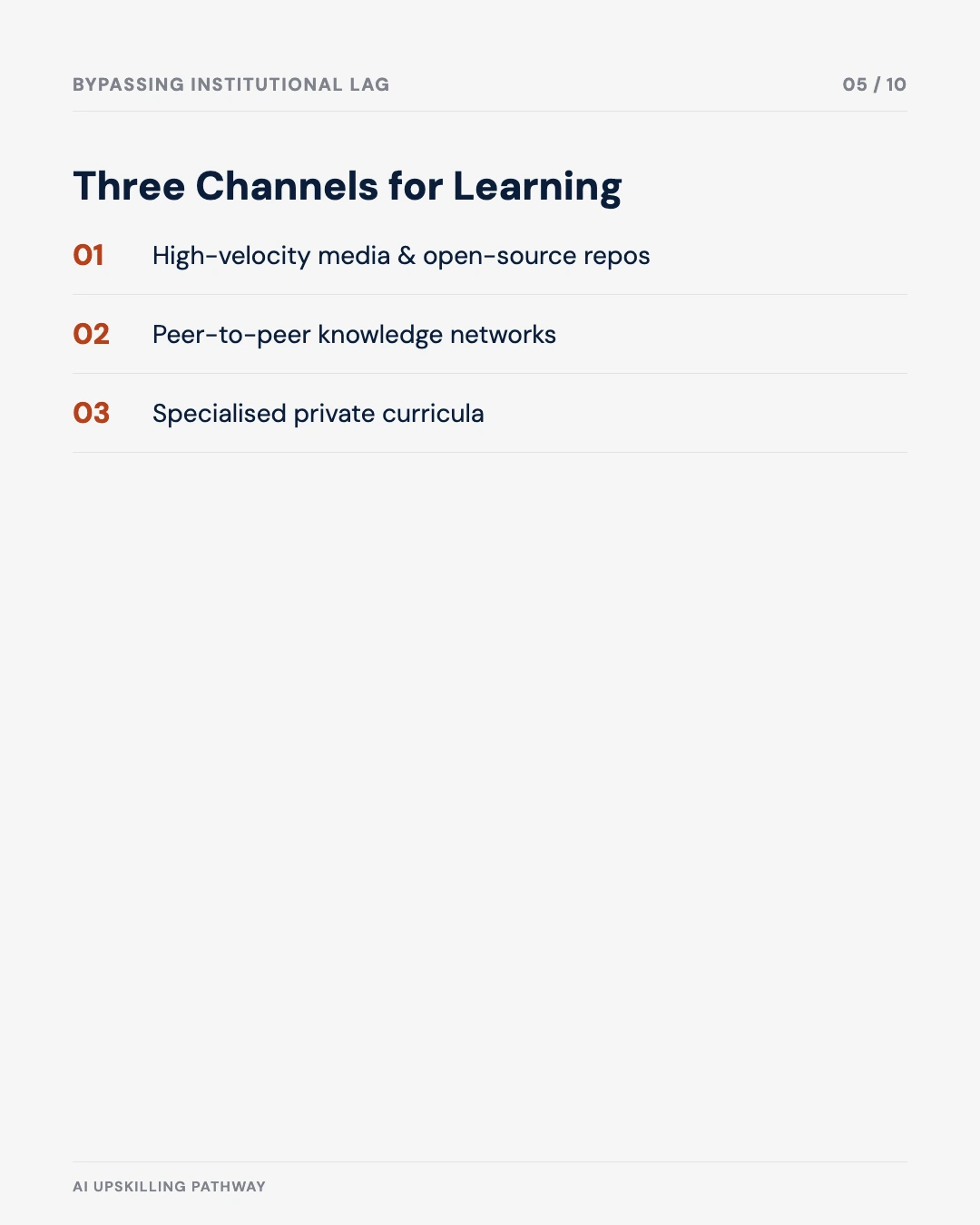
Three Channels for Self-Directed Learning
Bypassing institutional lag means building a personal, high-velocity education from sources outside the standard curriculum.
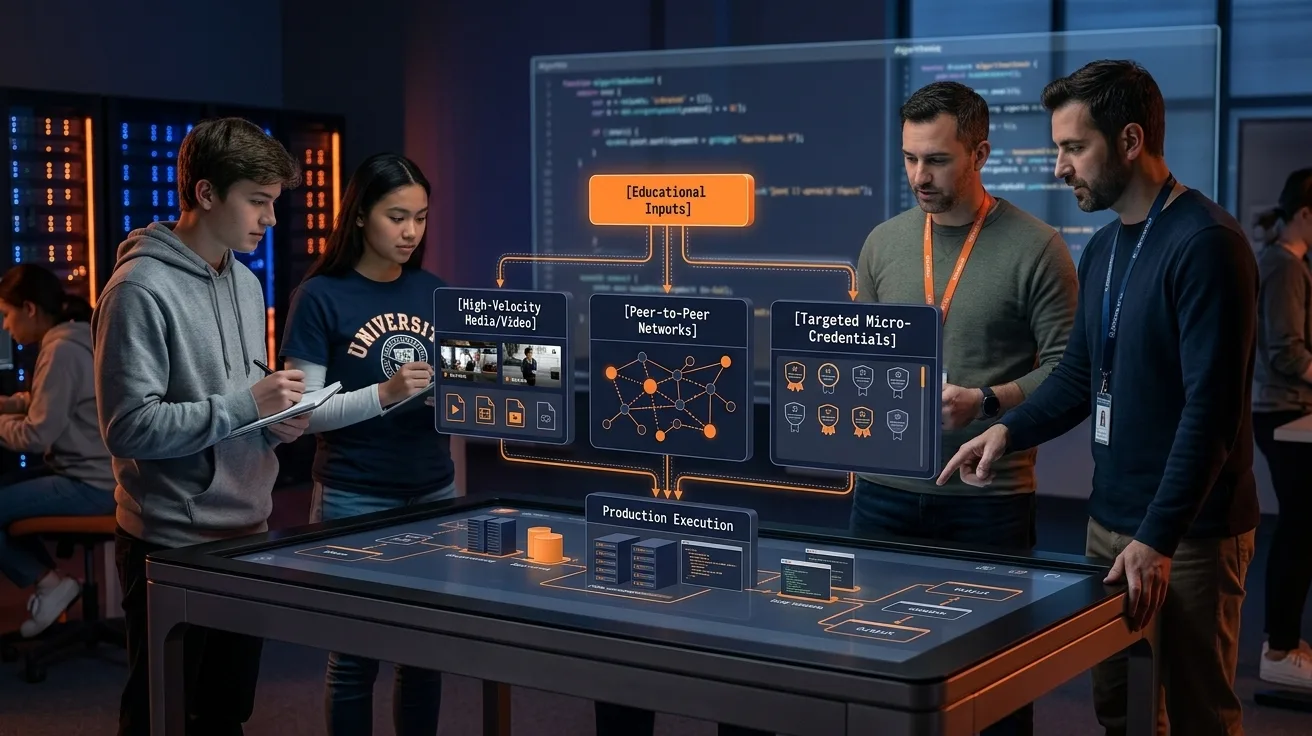
- High-velocity media and technical repositories. Textbooks and formal documentation lag behind library releases. Engineering-focused video channels and open-source repositories are where API changes, framework integrations (LangChain, LlamaIndex, and the like), and debugging workflows show up first, often before they’re written down anywhere official.
- Peer-to-peer knowledge networks. Developer communities, technical forums, and open-source contributions function as live R&D. Watching how peers solve edge cases and architectural bottlenecks in the open surfaces friction points that a simulated academic exercise never will.
- Specialised private curricula. Where deep, domain-specific upskilling is needed fast, short-form courses and bootcamps move faster than institutional programmes. The good ones are taught by active practitioners and updated continuously against current SDKs and cloud provider capabilities.
An Operational Roadmap
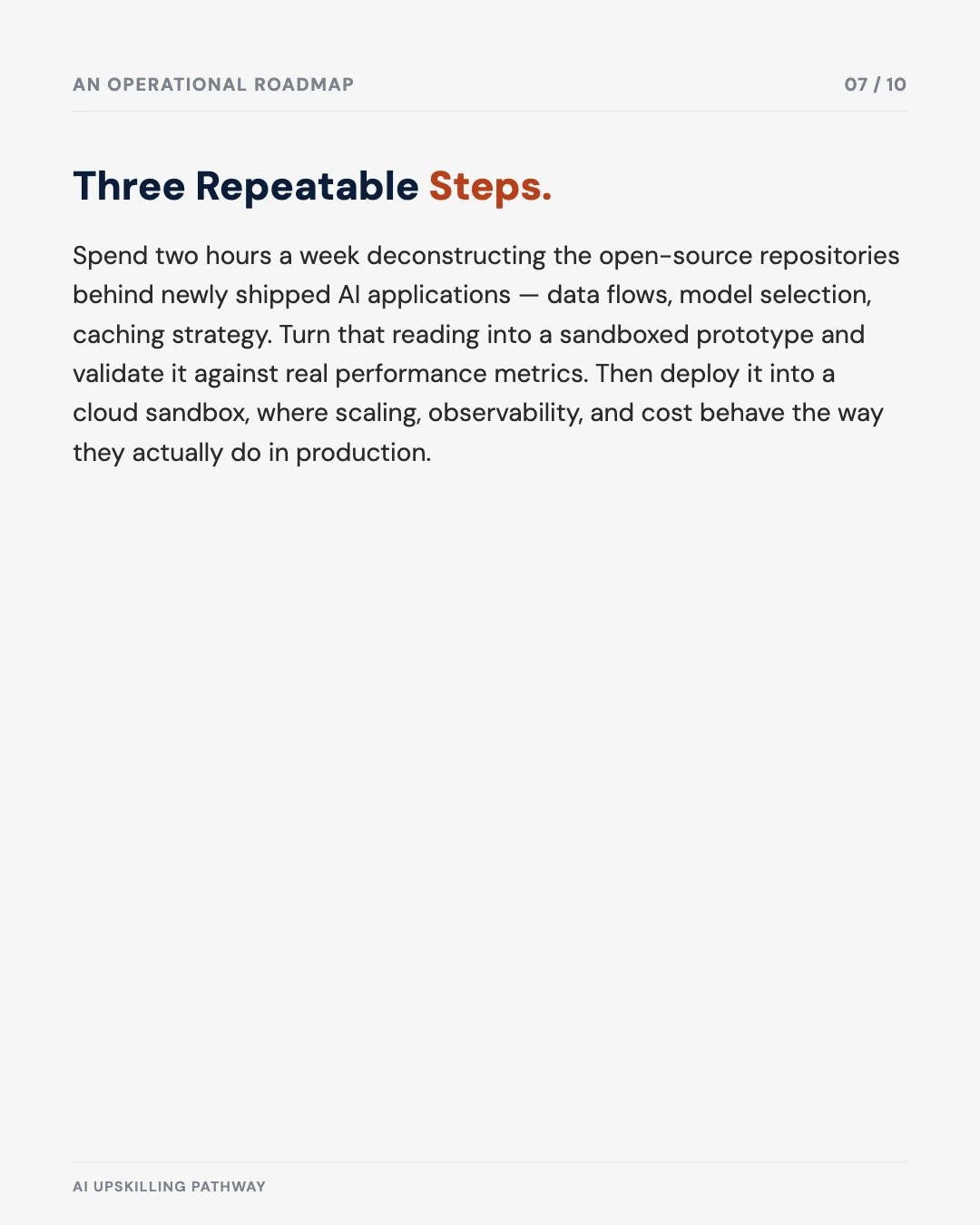
Turning this into a habit, without it turning into cognitive overload, comes down to three repeatable steps:
- Deconstruct the architecture. Spend two hours a week reading the open-source repositories behind newly shipped AI applications. Focus on data flows, model selection, and caching strategy.
- Build minimal viable prototypes. Turn the reading into a sandboxed build. Validate it against real performance metrics: latency, token consumption, accuracy. If AI is writing a meaningful share of that prototype for you, treat that adoption pragmatically rather than ideologically.
- Deploy and benchmark. Move the prototype out of the local environment and into a cloud sandbox, where scaling, observability, and cost actually behave the way they do in production.
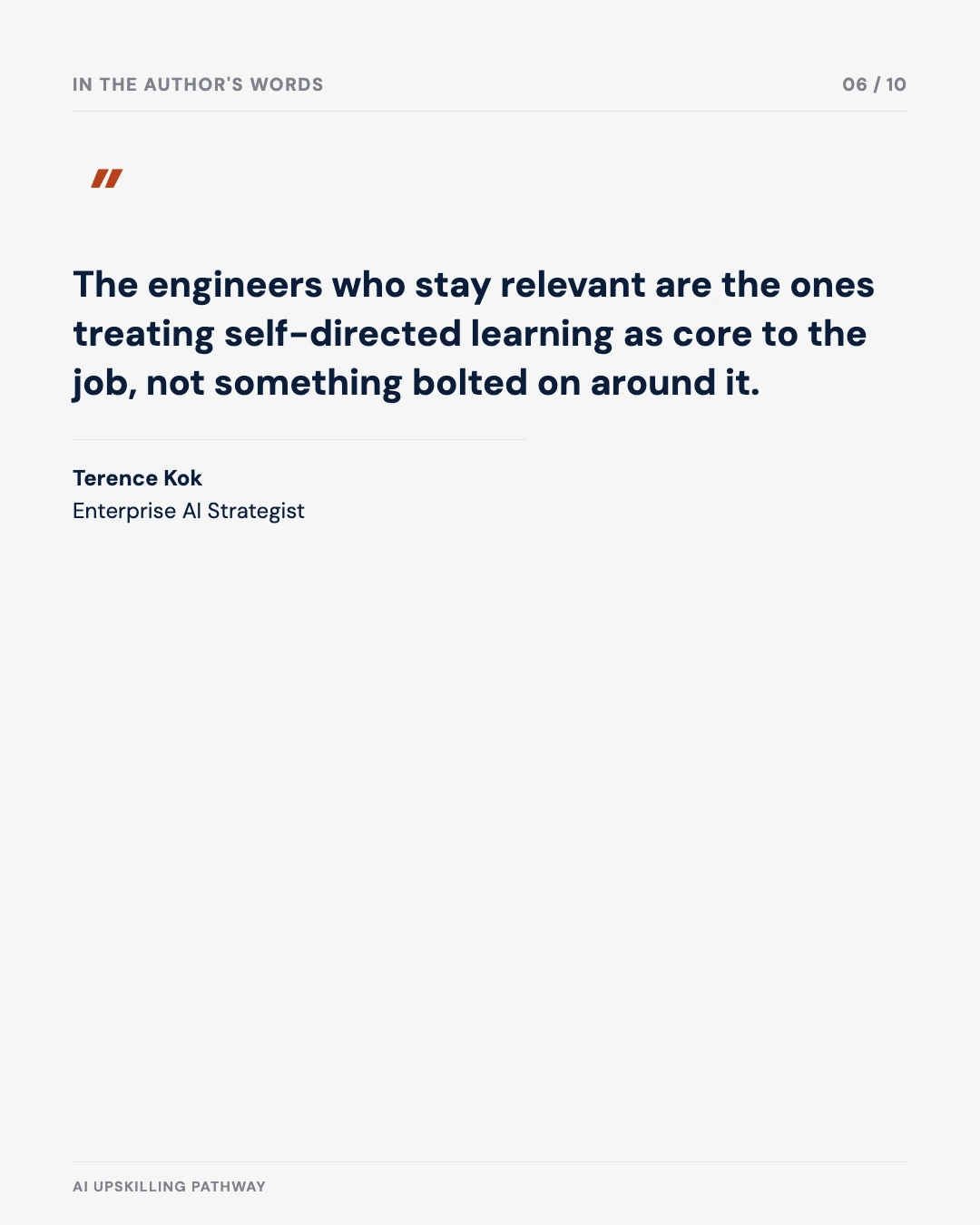
Formal education still matters. It just isn’t sufficient on its own anymore, not at the pace this field moves. The engineers who stay relevant, whether they’re a week into their career or twenty years in, are the ones treating self-directed learning as core to the job rather than something bolted on around it.
What does your own upskilling loop look like, and how often are you actually running it?
Was this useful?